Every comp firm runs a screen on commute injuries, and in most firms it is one question long. Were you on the clock? Or its cousin, were you still at work when it happened? A no sends the enquiry to the decline pile, and the intake coordinator moves on, because this is the rule everybody learns in their first week and almost nobody revisits.
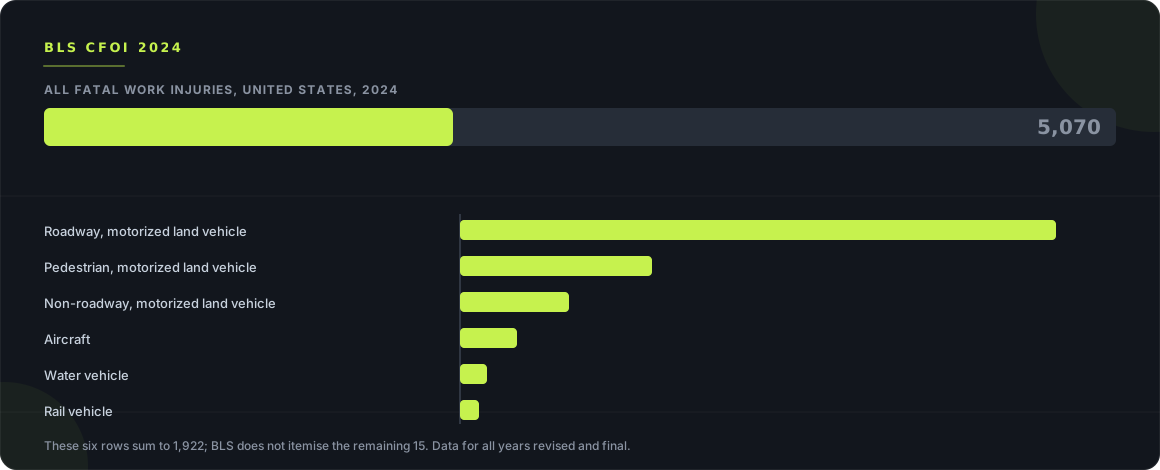
It is worth asking how much traffic that screen handles. In 2024 the Bureau of Labor Statistics recorded 5,070 fatal work injuries in the United States, of which 1,937 — 38.2 per cent — were transportation incidents. BLS puts it plainly: transportation incidents “continue to be the most frequent type of fatal event.” On the non-fatal side, its 2023–24 survey counted 91,690 private-industry cases involving days away from work from transportation incidents, with a median of 16 days away.
Not all of those are commutes, obviously; a great many are people whose job is driving, and nobody is confused about those. But the screen does not distinguish. It fires on the word driving, and a meaningful share of the largest injury category in the country goes into the decline pile on a one-line rule that has a second half.
We have written before about the decline desk — the observation that the largest single output of a firm’s marketing is the enquiries it turns away, and that it is the only part of the funnel with nothing built around it. The commute injury is the clearest case of that in the whole practice area, because the decline is made in seconds, on a rule, by the person least equipped to apply it.
The rule, and the clause the screen drops
Two sentences of law. The first is the one everybody quotes; the second is where every contested case actually sits.
California’s starting point is statutory: an injured worker must prove an injury “arising out of and in the course of the employment.” The going-and-coming rule is, as the Court of Appeal described it in Zenith, one of “the judicially created doctrines that define that statutory requirement.” The rationale, from Santa Rosa Junior College v. W.C.A.B., is that the employment relationship is suspended from the moment the employee leaves work until he resumes it.
Here is the rule as the court states it, quoting Price: an injury suffered “during a local commute enroute to a fixed place of business at fixed hours” is not within the course of employment — “in the absence of special or extraordinary circumstances.”
The Hinojosa passage the court quotes sharpens it further. The ordinary local commute is contrasted with what the Supreme Court called “extraordinary transits” — which arise where the employer requires “a special, different transit, means of transit, or use of a car,” or where the employer’s “imposition of an unusual condition” removes the transit “from the employee’s choice or convenience.”
Read those two formulations next to the question your intake script asks. The script asks whether the worker was commuting. The law asks whose journey it was — who decided how the worker would get there, and whether that decision was really his. Those are different questions, and only one of them can be answered from the facts a standard intake note contains.
Zenith v. W.C.A.B.: what was in the record
The facts are worth reading slowly, because every one of them is a question somebody could have asked on day one.
Javier Hernandez was a farm labourer employed by Ceja Reyes, Inc., a farm labour contractor based in Woodland that supplies agricultural workers to businesses that need them. He lived in Yuba City. He was assigned to a single site in Winters, about sixty miles away, roughly an hour each way.
He had no driver’s licence, owned no car and did not drive. He testified there was no reasonable public transportation between his home and the jobsite. He got there in a vanpool — and the details of that vanpool are the whole case.
It was arranged by another Ceja Reyes employee, the court records, “as a personal side business independent of their employer.” That man held himself out as a supervisor for Ceja Reyes, which he was not, in order to encourage workers to use the van. Hernandez paid $10 a day to ride; the opinion does not say who received the money. The van was driven by the organiser’s son, who had no California driver’s licence, and the vehicle was not certified as a farm labour vehicle. There were ten or eleven other people in it. On the site, of forty or more farm workers, up to about half used this vanpool.
On the employer’s side, the written contract with Hernandez said Ceja Reyes “did not make transportation arrangements, did not recommend any type of transportation,” and that he was “solely responsible for his transportation.” But his actual supervisor told the workers that the van owner was in charge of them “when they were ‘using the van,’” watched the workers be delivered to the site, and assigned each man his duties once they arrived.
In May 2022, on the ride home, the van crashed in Yolo County. Hernandez alleged catastrophic injuries including the amputation of his right leg.
Zenith, the employer’s comp carrier, denied the claim under the going-and-coming rule. A workers’ compensation judge tried the issue in March 2024 and found that two exceptions applied: the special risk exception and the dual purpose exception. Zenith petitioned for reconsideration; the Board adopted the judge’s report and denied it. Zenith sought writ review, and the Court of Appeal took the case.
Why both exceptions failed
One failed on geography, the other on a threshold requirement. Neither failed because the facts were bad.
The special risk exception comes from Parks v. W.C.A.B., which the court describes as having “devised a two prong test”: the exception applies if, first, “but for” the employment the employee would not have been at the location where the injury occurred, and second, if “the risk is distinctive in nature or quantitatively greater than risks common to the public.”
The court held it did not reach this injury at all, for a reason that has nothing to do with vanpools. Citing Price, it said the exception “provides for compensation where a risk associated with the employment causes injury just outside the employer’s premises,” and neither the Board nor Hernandez had cited any authority “for rendering the zone of employment exception as large as an entire commute.” The facts, it said, “do not comport with that requirement” — and, notably, “we have no doubts,” a pointed remark given the rule that doubts are resolved in favour of coverage.
It went further on the second prong anyway. The Board had reasoned that Ceja Reyes created special risks by hiring a worker who could not drive and had no car. The court answered that those risks were “based on the nature of the employee, as a person who is not licensed to drive,” rather than on circumstances of the employment the employer knew about or controlled — and that “there is no support in the record for the suggestion that Ceja Reyes was aware Hernandez could not drive.” Nor was there any indication the employer knew the van’s drivers were unlicensed, and no evidence had apparently been introduced that vanpools are risky as such. The Board’s logic, the court said, “stretches the special risk exception far beyond prior case law” and “could apparently apply any time an employer hires a person without a driver’s license or a car.”
The dual purpose exception failed earlier than that. Quoting Bramall v. W.C.A.B., the court noted that the exception applies “to a local commute to and from the place of employment when the employee performs work at home,” and that the question is whether the trip involves “an incidental benefit to the employer, not common to commute trips by ordinary members of the work force” — a benefit conferred in furtherance of an express or implied term of the employment contract. Hernandez performed no work at home. The court held the facts “do not meet threshold requirements,” and that they “do not go beyond the ‘normal need of the presence of the person for the performance of the work.’”
His argument that he performed work in the van got nowhere because the Board had made no such finding: the supervisor assigned duties after the workers arrived, and the statement that the van owner was “in charge of them” was, the court said, “ambiguous.”
The two theories nobody decided
The case is remanded. The arguments that fit these facts best have still never been ruled on.
Hernandez’s lawyers had argued, before the workers’ compensation judge, that the employer-controlled transportation exception and the benefit-to-the-employer exception applied. The Court of Appeal did not decide either. It says why, in a sentence worth quoting in full for anyone who thinks appellate review is a second bite at the whole apple: those theories “were the focus of Hernandez’s briefing before the workers’ compensation judge but not in this original proceeding because they were not the basis for the Board’s ruling.”
So the matter is annulled and remanded, and the live questions are the ones the record was built for. Whether the employer controlled this transportation. Whether it took a benefit from it.
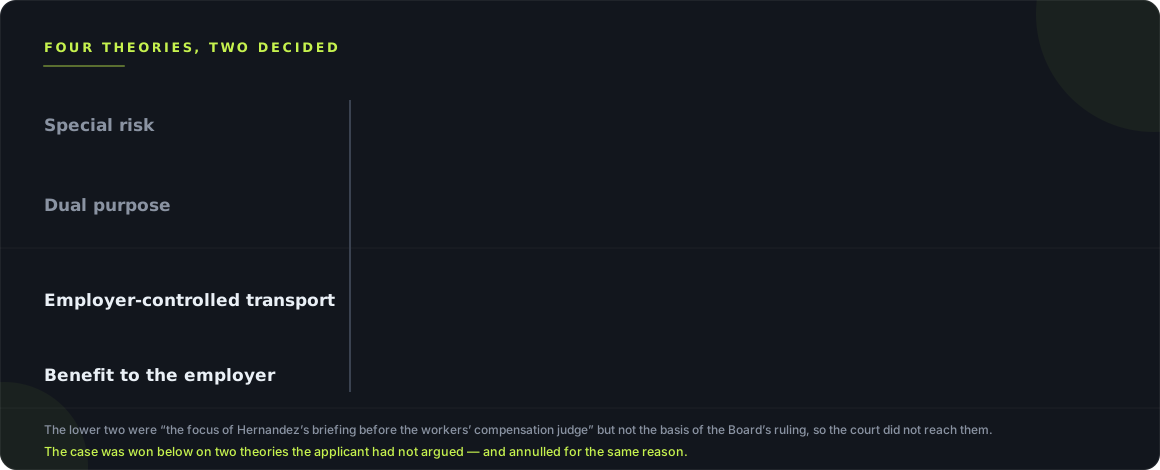
Look back at the record with those two questions in mind and the facts rearrange themselves. A man who held himself out as a supervisor recruited riders. A real supervisor told the crew that man was in charge of them while they were in the van. Half the workforce at the site arrived in it. The employer’s business model is supplying labour reliably to sites, which is difficult if the labour cannot get there. None of that was enough for the two exceptions the Board picked. Whether it is enough for the two it did not is an open question, and it is open because somebody wrote those facts down.
| Theory | Below | On review |
|---|---|---|
| Special risk | Found to apply | Annulled — reaches only “just outside the employer’s premises” |
| Dual purpose | Found to apply | Annulled — requires work performed at home |
| Employer-controlled transportation | Argued | Not reached |
| Benefit to the employer | Argued | Not reached |
One more point of law from the opinion matters for how a firm should think about these files. Where the relevant facts are not in real dispute, the court says, whether the going-and-coming rule applies is “a question of law,” and a purported finding on it “is not binding on this court.” That cuts both ways, but the practical consequence is clear enough: on a commute case, the facts are the whole contest. Get them recorded and the legal argument is available to you; miss them and no amount of advocacy later will put them back.
Why the record is the whole contest
On a commute case the advocacy does less work than anybody expects, and the intake note does more.
There is a passage in Zenith about the court’s own role that deserves more attention from firms than it will get. Its review, the court says, “though limited, includes determining whether the Board’s decision is supported by substantial evidence and whether the findings of fact support the decision,” and “where the award rests on an erroneous interpretation of law it will be annulled.”
Then the part that matters operationally. Where, as in that case, “the relevant facts are not in real dispute,” whether the going-and-coming rule applies is “a question of law,” and a purported finding on it “is not binding on this court.”
Read that as a firm rather than as a lawyer and it says something uncomfortable: on a commute case you do not win on how well the issue is argued at trial. The trial-level finding does not travel. What travels is the record — the set of facts nobody disputes — and the record is assembled from what the client told somebody, early, about a journey they had no reason to think was important.
The same opinion carries a smaller sting worth noting, because it affects the economics of taking one of these on. In a footnote the court disposes of the applicant’s request for fees: “Accordingly, we reject Hernandez’s argument he is entitled to fees and costs under Labor Code section 5801.” An annulment on review is not a neutral event that simply resets the case. The work is done, the award is gone, and the fee application that might have offset some of it goes with it.
One more signal, from the counsel list rather than the reasoning. Zenith was represented on the writ by appellate specialists, and the California Workers’ Compensation Institute — the carrier-side research body — appeared as amicus curiae in support of the carrier. Institutions like that do not file amicus briefs in cases they regard as one-offs. Whatever else Zenith is, it is a boundary question the defence side is organised around, and the claimant side of this market is, on the evidence of a library search, not writing about it at all.
Put those three together — the record is what travels, the gaps in it are read against the applicant, and the other side treats this boundary as worth institutional attention — and the case for a one-minute capture list at intake stops being a nicety. It is the only point in the process where the decisive material is cheap to obtain, and it is currently the point at which the file is most likely to be closed.
It is worth being concrete about the scale of that, because “the decline pile’ is an abstraction until somebody counts it. Across roughly $16.5M of managed workers’ comp Meta spend we have produced around 219,000 injured-worker leads and around 21,000 signed cases — which means the overwhelming majority of what a firm’s marketing produces is enquiries that do not become files. Those are our aggregate figures and not an industry benchmark, and we cannot tell you what share of them were commute injuries, because that is not a field anybody captures. That absence is the point. The largest category of fatal work injury in the country is being sorted, at volume, on a rule with a second half, by a process that keeps no record of what it decided or why.
What a commute-injury intake should capture
Eight questions. None of them requires legal judgement, and all of them can be asked by whoever answers the phone.
The gap this article is about is not a gap in anybody’s legal knowledge. It is that the person who decides whether a commute enquiry becomes a file is doing it on a note that records the injury and the employer and nothing about the journey — which is a property of the first ninety seconds of the call rather than of anybody’s legal training. The fix is a short, fixed list of questions, asked before the decline, and recorded whether or not the file is taken.
| Ask | What it could establish | Where the answer lives |
|---|---|---|
| Who arranged the transport? | Own choice, or an arrangement | The worker |
| Did the employer require, suggest or approve it? | Employer control | The worker, then the contract |
| Who paid, and to whom? | Whether the employer funded it | The worker, then pay records |
| Who was driving? Were they licensed? | The nature of the risk | The worker |
| Whose vehicle, and was it certified? | Regulatory status of the transport | The worker, then the vehicle record |
| How many co-workers used it? | Whether it was a system or a lift | The worker |
| What did anyone from the employer say about it? | Supervisory statements and apparent authority | The worker, then co-workers |
| Was any work done during the journey? | The dual purpose threshold | The worker |
Every row in that table is a fact that appears somewhere in the Zenith record. None of them requires the person asking to know what a dual purpose exception is. And the list is short enough to live on one screen of a CRM, which matters more than its contents, because an intake addition that takes four minutes does not survive contact with a busy Tuesday.
There is a measurement point here too, and it is the reason this belongs in a marketing conversation at all. A firm that records these answers on every commute enquiry — including the ones it declines — has, within a quarter, a dataset nobody else has: how many of its commute declines involved employer-arranged transport, how many involved a vehicle the employer required, how many involved work done en route. That is the number that tells you whether the one-line screen is costing you anything. Right now almost nobody can answer it, which is precisely why the screen has gone unexamined for so long.
Monday
Three things, and the first one is just a branch in a script.
Add the branch. When an enquiry involves a vehicle and a journey to or from work, the script opens the eight questions above. Record the answers whether or not the file is taken. The cost is a minute on a call you are already having.
Move the decline one step later. Today the commute decline happens inside intake, on a rule. Make it a decline that an attorney signs off on, at least until the firm has enough recorded answers to know what it is turning away. This is the whole change, and it is a workflow change rather than a legal one.
Read the declines at the end of the quarter. Count how many commute enquiries involved employer-arranged transport, a required vehicle, or work performed during the journey. If the answer is none, the screen is fine and you have proved it — which is worth something on its own. If it is not none, you have found a leak that no amount of additional ad spend would have shown you.
Key takeaways
Transportation is the largest category of fatal work injury in America. 1,937 of 5,070 deaths in 2024, which BLS calls the most frequent type of fatal event.
The going-and-coming rule has a second half. It applies “in the absence of special or extraordinary circumstances” — and that clause is where the contested cases live.
The question is whose journey it was. Not whether he was commuting, but who arranged, required, paid for and controlled the transport.
Special risk reaches only just outside the premises. Zenith held it cannot be stretched across a sixty-mile commute, and dual purpose needs work performed at home.
The case was decided on theories the applicant had not argued. The two he did argue were never reached, and the matter was remanded.
Eight questions close the gap. All factual, all answerable on the first call, and worth recording even on the enquiries you decline.
WorkersComp Marketing is a marketing agency, not a law firm. This article describes one published California Court of Appeal decision — Zenith Insurance Co. v. Workers’ Compensation Appeals Board (3d Dist., 1 May 2025, C101549) — together with the California authorities quoted in it and California Labor Code §§ 3600, 5801, 5950 and 5952, and it describes them in order to explain what a firm should capture at intake. Nothing here is legal advice, nothing here is advice about whether any particular commute injury is compensable, and nothing here is a view on how the remand in that case should come out. Whether a given enquiry supports any exception to the going-and-coming rule is a question for the lawyer handling it.
Frequently asked questions
Are you saying firms should start signing commute cases?
No. The going-and-coming rule disposes of the great majority of these enquiries and a firm that started taking them on principle would lose money quickly. The argument is about when and on what the decline is made. At the moment it happens inside intake, in seconds, on a one-line rule, using a note that contains nothing about the transport arrangement. Recording eight factual answers before declining costs about a minute and makes the decision reviewable. That is the entire proposal.
Does Zenith make it harder to win these cases?
On the two exceptions it decided, yes — it is a published decision holding that the special risk exception reaches only just outside the employer’s premises and cannot be stretched across a commute, and that dual purpose needs work performed at home. But it decided nothing about employer-controlled transportation or benefit to the employer, which were the theories actually argued below, and it annulled and remanded rather than ending the case. Read as guidance for intake, it is less about which exceptions are available and more about which facts have to be in the record for any of them to be argued.
Is this a California-only question?
The rule and the authorities in this article are Californian, and we have not surveyed any other state for this piece. Most jurisdictions have some version of a going-and-coming or coming-and-going rule with exceptions, but the exceptions and their thresholds differ, and nothing here should be carried across a state line without checking. What does travel is the operational point: whatever your state’s exceptions are, they turn on facts about the journey that a standard intake note does not contain.
Should we advertise for commute injuries?
No, and the reason is the same one that applies to most of these operational findings. There is no searchable audience of people who know their commute injury might be compensable — a worker injured driving home describes it as a car accident, and will more often call a personal injury firm than a comp firm. The value here is entirely on the conversion and lead-quality side: it changes what happens to enquiries a firm is already paying to receive, which is a far cheaper place to find cases than the auction.
How confident are you that Zenith is still good law?
The opinion carries “CERTIFIED FOR PUBLICATION” on its face and was filed on 1 May 2025. We could not confirm from an official court source whether the Supreme Court granted or denied review, whether it has been depublished, or what its official Cal.App.5th citation is — the appellate docket search was unreachable. Anyone relying on it should check the Supreme Court docket for C101549 and the official reporter first. We have flagged the same limitation in the sources below rather than present the case as settled.
Sources
- 01Zenith Ins. Co. v. W.C.A.B. (3d Dist., 1 May 2025) C101549
Source of every fact, quotation and holding about the case. Read in full on two copies that match word for word, CourtListener and FindLaw; only the first carries the “Filed 5/1/25 CERTIFIED FOR PUBLICATION” header. Both are secondary publishers, not the official reporter. Review status, depublication and the official citation could not be confirmed: the appellate docket search was unreachable.
- 02The California authorities quoted
Price (1984) 37 Cal.3d 559, Hinojosa (1972) 8 Cal.3d 150, Parks (1983) 33 Cal.3d 585, Santa Rosa Junior College (1985) 40 Cal.3d 345 and Bramall (1978) 78 Cal.App.3d 151. Every quotation from these is taken from the Zenith opinion as it quotes them; we did not read any of them in the original, and attempts to reach Hinojosa independently failed.
- 03The exceptions named in this article
Special risk and dual purpose are set out with their tests because the court decided them. Employer-controlled transportation and benefit to the employer are named only as the theories argued below and not reached. We do not state their elements, because the opinion does not, and we could not corroborate them elsewhere. This is not a survey of California going-and-coming law.
- 04BLS, Census of Fatal Occupational Injuries, 2024
Released 19 February 2026. 5,070 fatal work injuries in 2024; 1,937 transportation incidents, which BLS calls “the most frequent type of fatal event,” at 38.2 per cent. Sub-category counts from Table 2. Those six rows sum to 1,922; BLS does not itemise the remaining 15. Data for all years revised and final.
- 05BLS, Survey of Occupational Injuries and Illnesses, 2023–24
Released 22 January 2026. Transportation incidents: 91,690 private-industry cases with days away from work, rate 4.3 per 10,000 FTE, median 16 days. A two-year biennial estimate, private industry only, not a 2024 annual figure — BLS does not publish the 2024 transportation count separately in this release.
- 06Our own figures
~$16.5M of managed workers’ comp Meta spend, ~219,000 leads at ~$75, ~21,000 signed cases at ~$775. Aggregate across client firms, ours and not an industry benchmark. No estimate of how many commute enquiries a firm declines appears in this article, because we have not measured it and neither, as far as we can tell, has anyone else.
- 07Prior coverage of this case
This decision has already been written up publicly — by Horvitz & Levy, who were Zenith’s appellate counsel, for a defence and carrier readership. We did not read their note before writing this, and nothing here is drawn from it; we flag it so readers know the case is not unreported and can see how the winning side frames it.
The case was read in full on two matching copies; every other authority in it is quoted at second hand, as flagged. The BLS figures were read on bls.gov. This is a marketing article about what a firm should capture at intake; it is not legal advice and it is not a view on any particular claim.