You cannot serve a market you only speak to in your second language — and for millions of injured workers, English is theirs, not yours.
Most workers’ comp firms treat Spanish as an afterthought: a translated line on the website, an intake person who “gets by,” a Google-translated ad. Then they compete for the same English-speaking leads as everyone else and watch cost per signed case rise. Meanwhile, the single largest pool of injured workers in the highest-risk industries goes underserved.
This piece lays out the size of that opportunity, why “translated English” quietly fails, and the bilingual marketing-and-intake system that turns Spanish-speaking searchers into signed cases — and into the most referral-rich book of business a firm can build.
The size of the opportunity
The highest-injury industries in America are also the most Spanish-speaking.
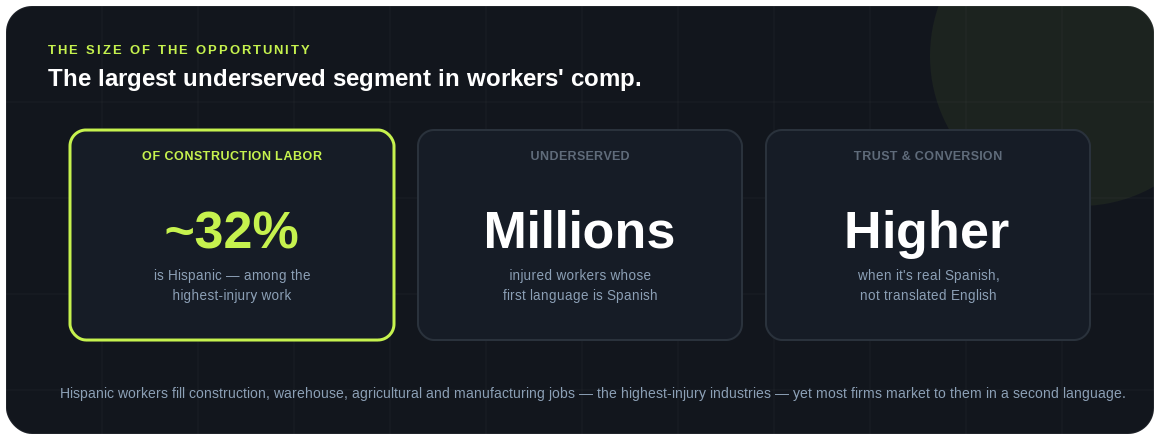
Start with the labor data. Hispanic workers now make up close to a third of the U.S. construction workforce — up from under a quarter a decade ago, according to analyses of Census and Bureau of Labor Statistics data (Eye On Housing / NAHB). Across all industries Hispanic workers are roughly one in five; in construction it is closer to one in three.
Now overlay injury risk. Construction, warehousing, agriculture, and manufacturing carry some of the highest occupational-injury rates in the country — and they employ a disproportionately Spanish-speaking workforce. The result is simple math: a large share of the people who need a workers’ comp attorney most are Spanish-speaking, and many prefer to handle something this important in their first language.
Where the injuries and the language actually overlap
Everyone in legal marketing quotes the national figure. We joined the Census language table to the BLS injury model county by county instead, because a firm does not market to a country. Of the 3,142 U.S. counties, 1,295 publish both a Spanish-at-home share and enough unsuppressed industry detail to model injuries. Those 1,295 carry 508,855 modelled recordable injuries a year between them, and this is how they fall.
The counties themselves are the argument. These are the eighteen largest of the 73 counties where a quarter or more of the population speaks Spanish at home, ranked by how many people get hurt at work there each year — alongside how many legal-services jobs sit in the county to represent them.
| County | State | Injuries / yr | Spanish at home | Legal-services jobs |
|---|---|---|---|---|
| Los Angeles County | CA | 13,981 | 37.7% | 56,346 |
| Harris County | TX | 10,136 | 35.1% | 27,189 |
| Dallas County | TX | 8,156 | 33.7% | 20,772 |
| San Bernardino County | CA | 6,393 | 35.3% | 2,374 |
| Riverside County | CA | 5,551 | 34.5% | 2,834 |
| Miami-Dade County | FL | 3,109 | 66.4% | 24,421 |
| Bexar County | TX | 2,934 | 32.9% | 6,992 |
| Orange County | FL | 2,721 | 26.0% | 11,627 |
| San Joaquin County | CA | 2,489 | 26.8% | 679 |
| Broward County | FL | 2,273 | 27.9% | 13,596 |
| Fresno County | CA | 1,587 | 33.6% | 2,568 |
| Kern County | CA | 1,316 | 39.7% | 827 |
| Kane County | IL | 1,269 | 26.2% | 745 |
| Ventura County | CA | 1,241 | 30.2% | 1,921 |
| El Paso County | TX | 1,226 | 66.3% | 1,330 |
| Stanislaus County | CA | 1,153 | 34.3% | 749 |
| Union County | NJ | 945 | 29.6% | 1,936 |
| Hall County | GA | 814 | 25.3% | 386 |
Read the last two columns together. Los Angeles County has 56,346 legal-services jobs for 13,981 injuries a year. San Bernardino County, next door and 35.3% Spanish-speaking, has 2,374 for 6,393. Kern County has 827 for 1,316. El Paso County, where two in three households speak Spanish at home, has 1,330 for 1,226. The places where the language gap is widest are, with a consistency that is hard to look away from, also the places where there are fewest lawyers per injured worker.
Method. Language is American Community Survey 5-year (2023), table C16001, share of the population aged 5+ speaking Spanish at home. That is not Hispanic ethnicity and it is not limited English proficiency — many of these households are entirely bilingual. The point is not that these workers cannot read English; it is that people choose a lawyer in the language they live in. Injuries are modelled from BLS Quarterly Census of Employment and Wages (2023 Q1) employment by industry against published injury rates. Counties where BLS suppressed an industry for disclosure are excluded from the join rather than estimated, which is why the base is 1,295 counties and not 3,142.
Why translated English fails
Translation is not fluency, and fluency is not trust.
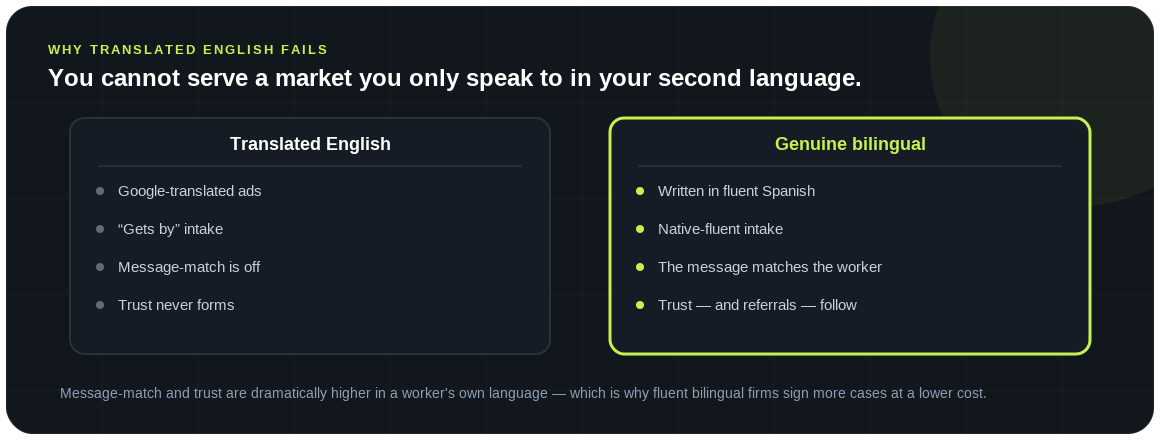
The instinct is to take what works in English and translate it. It rarely works — for three reasons.
1. Translation reads as translation
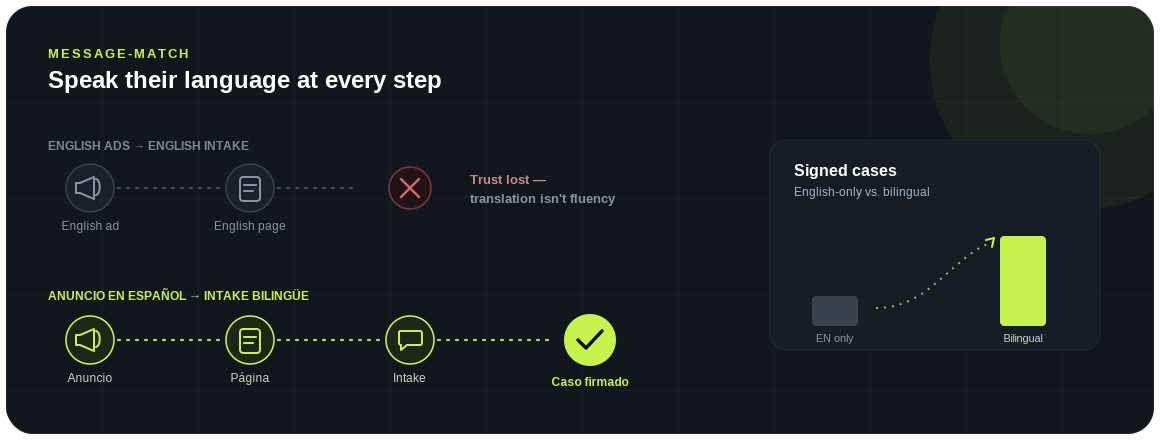
A Google-translated ad or a hesitant, dictionary-driven intake call signals that the firm doesn’t really serve this community — it’s dabbling. Native and fully fluent communication signals the opposite: we are for you.
2. The fears are different
Many Spanish-speaking workers carry specific, heightened fears — of employer retaliation and, for some, of immigration consequences. Messaging that acknowledges those fears respectfully and accurately converts; generic “injured? call us” copy does not.
3. Trust is cultural, not just linguistic
Warmth, respect, and appropriate formality matter. A rushed, transactional call — even in correct Spanish — misses. This community refers heavily to firms it trusts and avoids ones that feel like a mill.
The difference isn’t subtle. When the ad, the landing page, and the intake all speak the worker’s language, the chain holds and the case gets signed; the moment one link reverts to English, trust breaks and the lead is lost — which is exactly what the diagram below traces.
The bilingual marketing system
Meet the worker in their language at every step, not just the first one.
A real Spanish acquisition system is coherent end to end:
Dedicated Spanish creative
Ads written in Spanish by a fluent copywriter — not translated — that lead with the community’s specific concerns. On Meta and Google, this is often the single biggest lever on cost per lead in these markets.
Spanish landing pages
The ad’s promise must continue on the page. A Spanish ad that lands on a Spanish page (with Spanish reviews and a Spanish click-to-call) converts far better than one that dumps the visitor into English.
Spanish reviews and proof
Nothing converts a Spanish-speaking prospect like testimonials from people who sound like them. Feature Spanish-language reviews prominently.
For the full channel picture this plugs into, see the WC marketing playbook and our breakdown of Meta ad creative for WC firms.
The bilingual intake system
Marketing gets them to call. Intake decides whether they sign.
The fastest way to waste great Spanish marketing is to route the call to someone who isn’t fluent. Elite Spanish intake means:
| Element | What “good” looks like |
|---|---|
| Specialists | Native or fully fluent — never “conversational” |
| Scripts | Written in Spanish and attorney-approved, not translated on the fly |
| Follow-up | Texts, emails, and the retainer all in Spanish |
| Fears | Retaliation addressed factually; immigration routed to an attorney |
| Speed | The same five-minute response standard as every other lead |
Our free Intake Playbook includes a full Spanish intake script and message library you can adapt today.
The referral flywheel
Serve this market well and it becomes your best marketing channel.
Here is the compounding advantage most firms miss: Spanish-speaking communities refer strongly when they’re treated with respect. A worker you helped tells their crew, their family, their church. Over time, a firm that genuinely serves this market builds a referral engine competitors can’t buy — the highest-ROAS, highest-close channel there is.
A narrower position often produces a larger business. Owning the Spanish-speaking market in your city beats competing generically for everyone.
Spencer Moeller, WorkersComp Marketing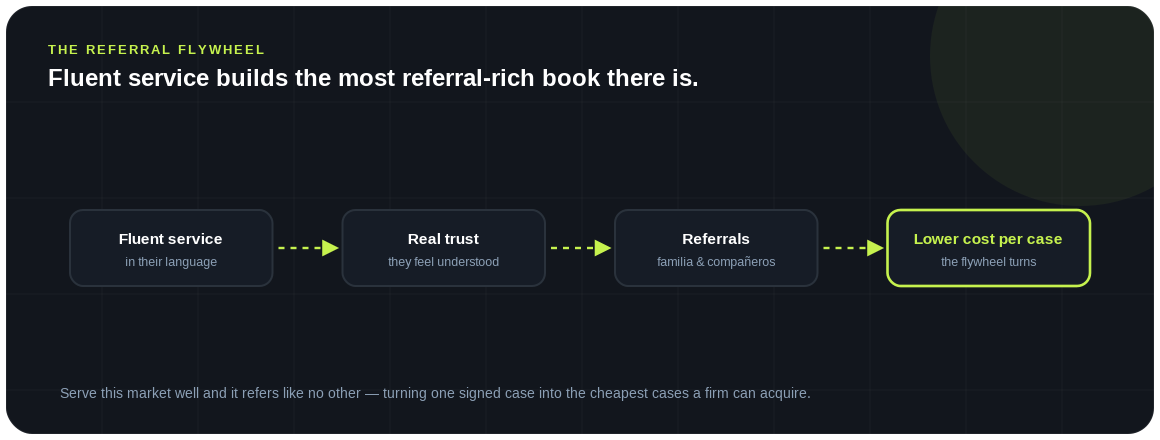
Key takeaways
-
The Spanish-speaking market is large and underserved. The biggest pool of injured workers in the highest-risk industries is the one most firms market to in their second language.
-
Injury and language overlap in specific industries. Construction, agriculture, and manufacturing concentrate both the risk and the Spanish-dominant workforce.
-
Translated English fails. A machine-translated ad and a get-by intake person lose the trust the market runs on.
-
Bilingual has to run end to end. Spanish ads need Spanish landing pages, Spanish reviews, and genuinely fluent intake; message-match protects conversion.
-
The referral flywheel is stronger here. In tight-knit communities one well-served client brings several; trust compounds faster.
Frequently asked questions
How big is the Spanish-speaking workers’ comp market?
Very large. Hispanic workers make up roughly a third of the U.S. construction workforce and about one in five workers overall, concentrated in the highest-injury industries like construction, warehousing, and agriculture. A substantial share of injured workers who need an attorney are Spanish-speaking, and many prefer to handle their claim in Spanish.
Can’t I just translate my English ads and pages?
You can, but it underperforms. Translated copy reads as translated, misses the community’s specific concerns, and often mismatches the language of the next step. Ads written natively in Spanish, pointing to Spanish landing pages and fluent intake, convert far better and lower your cost per signed case.
What about immigration status — is that a problem for the claim?
Workers’ compensation protections often apply regardless of immigration status, and reassuring a worker of their right to seek help is appropriate. But specific immigration-law questions must be answered by a qualified attorney, not a marketer or intake specialist. Acknowledge the fear, affirm their rights generally, and route specifics to counsel.
Do I need a separate website for Spanish?
Not necessarily a separate site, but you do need genuine Spanish landing pages, reviews, and forms that match your Spanish ads — plus fluent intake. Message-match between the ad and the page is what protects your conversion rate.
Sources & further reading
-
01
The size of the opportunity
Hispanic workers make up nearly a third of the construction labor force, concentrated in the highest-injury trades.
- 02
External sources were accurate at publication and change over time; confirm current figures at the source. General marketing information, not legal advice.