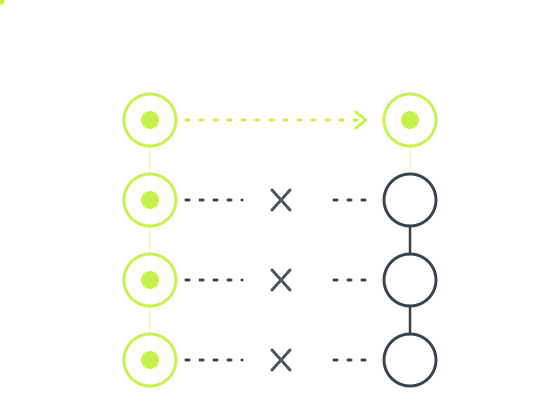
The second office is usually signed before anyone has asked the only question that matters: of all the things that make the first market profitable, which ones can actually move?
The conversation starts from the wrong end. A firm has a market working — the phone rings, the cost per signed case is where it should be — and the natural next thought is let’s do that again somewhere else. A metro is chosen, usually because a partner knows it or because it is the next-biggest city on the map. A lease gets signed, a sign goes up, the ad account is cloned, and everyone waits for the second market to look like the first.
It does not, and the reason is rarely the one the firm reaches for. The ads are not broken and the agency is not underperforming. What happened is that the firm moved the one component that travels instantly, left behind the three doing most of the quiet work, and then judged month three of a new market against year five of a mature one.
The order almost everyone uses is backwards
Firms buy the address first and the evidence last. It should be the other way around.
The standard expansion runs like this: pick the city, sign the lease, announce the office, launch the ads, wait for the map pack, hope the referrals follow. Every step in that sequence is a commitment made before the thing that would justify it is known. The lease is a multi-year obligation signed on an assumption about demand. The office is staffed before there is case volume to staff it against. The ads — the only reversible decision in the list — come fourth.
Reverse it and the risk profile changes completely. Paid media is the cheapest, fastest, most reversible instrument you own for answering “will injured workers in this metro respond to us, and at what cost?” It is the only part of the expansion you can switch on in a week and switch off in an afternoon. Using it last, after the irreversible commitments, turns your only cheap experiment into a very expensive confirmation.
Firms do it in the wrong order for an understandable reason: the lease feels like the serious step. It makes the expansion real, gives the partners something to point at, and satisfies the reasonable instinct that a firm claiming to serve a city should be in it. That instinct is right about the destination and wrong about the timing. You will need the bona fide office — just not in month one, and buying it in month one is how firms spend the entire expansion budget on rent and staff before learning anything about the market.
What transfers, and what doesn’t
Four assets make your home market cheap. One of them has wheels.
A mature workers’ comp market rests on four things, and they behave very differently when you try to move them. The diagram below sets the two markets side by side: the same firm, the same skill, the same creative — and only one of the four load-bearing assets present in the new metro on opening day.
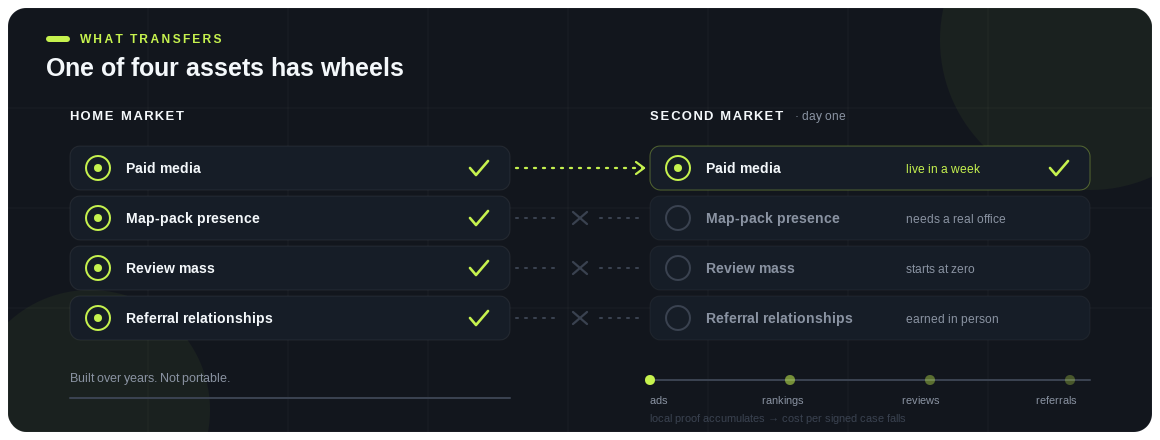
Paid media transfers immediately. Creative, offers, landing pages, negative-keyword lists, audience learnings, intake scripts — all portable. Change the geotargeting and you are live. That is real and valuable, and it is also why expansion feels easier than it is: the part you can see working is the part that moved, so the parts that did not are invisible until the numbers come in.
Map-pack presence does not transfer at all. Google is explicit that local results are ranked on relevance, distance, and prominence. Distance is measured from the searcher to your location — and in a new metro you do not have one. Prominence is accumulated reputation. Your home profile’s authority does not radiate outward; the new metro is a cold start. Same terrain as winning the Google map pack, with none of the runway already built.
Review mass does not transfer, and it is slower than it looks. Reviews attach to a profile, which attaches to a location, and a new profile starts at zero. Worse, comp has an unusually cruel review clock: cases signed in the new market will not resolve for a long time, so a firm that only asks at case close leaves its new market’s review engine idle for years — the 901-day problem. Expansion is where that habit stops being a minor inefficiency and becomes the thing holding a whole market back.
Referral relationships do not transfer, and they are slowest of all. The occupational-medicine clinic that sends you cases, the union rep who has your number, the plaintiff firm that refers its comp work out — none of them know you in the new city, and none will on the strength of an ad. These are the cheapest cases you sign anywhere and the only ones you cannot buy. Rebuilding them, as we laid out in the referral engine, is measured in quarters of consistent, in-person effort.
| Asset | Transfers? | Time to rebuild locally | Cost per signed case it produces |
|---|---|---|---|
| Paid media | Immediately — change the geotargeting | None | Highest |
| Map-pack presence | No — distance and prominence are local | Months, and only with a qualifying location | Low |
| Review mass | No — reviews attach to a profile | Months to years, depending on when you ask | Indirect, but compounding |
| Referral relationships | No — they are personal and local | Quarters of consistent effort | Lowest |
Read that table in order and the shape of the problem is obvious: the asset that transfers instantly is the one with the highest cost per signed case, and the three that produce your cheapest cases are precisely the three that stay behind. A second market on day one is your home market with its three cheapest case sources removed and the expensive one left running. That is not a failure of execution — it is arithmetic, and it is survivable if you plan for it instead of discovering it in month four.
You are not starting from zero on everything, and that matters too. Domain authority, existing content, brand, creative library, intake skill, and operational discipline all come with you; a firm entering its second market is far better equipped than a startup firm entering its first. But the specifically local proof — what decides map-pack position, reassures an injured worker comparing three firms, and makes a clinic manager comfortable handing over a patient — has to be earned again, in place.
The shortcut that doesn’t exist
A mailbox with your name on it is not a location, and both Google and your bar have written that down.
Every firm reaching this point has the same idea, and it is a good idea until you read the rules: rent a virtual office or co-working desk in the new metro, put the address on the website, open a Google Business Profile, and start accumulating local presence now while the real office gets figured out later. It does not work — and the failure mode is not “it underperforms,” it is “the profile is ineligible and the advertising may be misleading.”
Google’s guidelines close it directly. The Business Profile rules state that “if your business rents a physical mailing address but doesn’t operate out of that location, also known as a virtual office, that location isn’t eligible for a Business Profile,” and that “businesses can’t list an office at a co-working space unless that office maintains clear signage, receives customers at the location during business hours, and is staffed during business hours by your business staff.” The same page adds that businesses showing an address should “maintain permanent fixed signage of their business name at the address” (Google Business Profile guidelines). Those three sentences describe a real office with your name on the door and your people inside it during published hours — the exact thing the shortcut was designed to avoid.
Bar advertising rules close it again, independently. In states with a bona fide office requirement, advertising an office you do not really keep is a professional-conduct problem, not a platform-policy one. The Florida Bar’s published guidance is the clearest example: it states that “an advertisement is misleading if it lists law firm offices in several cities when, in fact, there are no bona fide firm offices in those cities,” and defines a bona fide office as “a physical location maintained by the lawyer or law firm where the lawyer or law firm reasonably expects to furnish legal services in a substantial way on a regular and continuing basis.” It then sets out five questions used to decide whether an advertised location qualifies — exterior signage, whether firm employees answer client calls there, whether full-time staff are present, whether legal services beyond client interviews are performed there, and whether at least one firm lawyer is present on a regular and continuing basis (The Florida Bar, revised August 2023).
Two things follow. The service-area route is not an escape hatch either — Google caps those boundaries at “about 2 hours of driving time from where your business is based,” so a genuinely separate metro cannot be annexed to your existing profile. But there is an honest interim position: the Florida guidance expressly permits advertising that a lawyer is “available for consultation” or “available by appointment” at a specified location, including shared or virtual space, and permits identifying satellite offices as such where the space is controlled exclusively by the firm. You simply cannot call it an office, and it buys you no map-pack eligibility.
The practical consequence is clean: local proof cannot be bought forward. There is no compliant way to have the presence before you have the place, and no cheap way to have the place. So the only real question is what you do during the months when you have demand but not yet proof.
The one asset that moves on day one is the one with the highest cost per signed case. Expansion doesn’t make marketing harder — it removes your three cheapest case sources and leaves the expensive one running.
Spencer Moeller, WorkersComp Marketing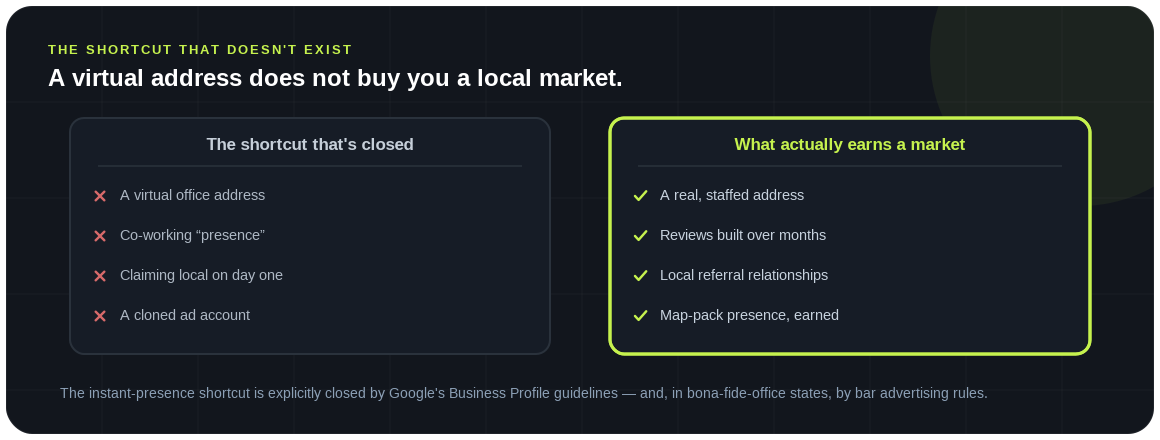
The window: why it costs more, and for how long
A second market that costs more per case isn’t failing. One that costs more indefinitely is.
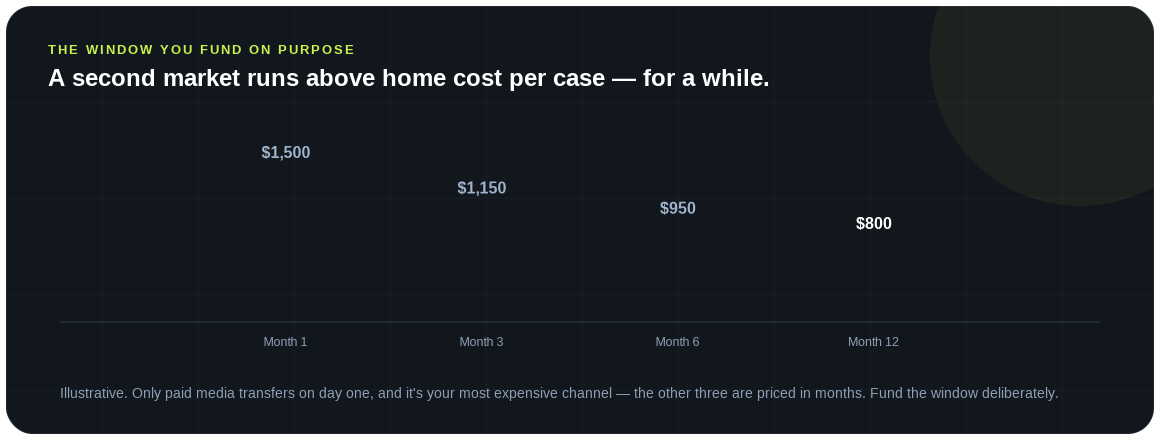
Put the last two sections together and the shape is predictable. In month one, effectively all new-market volume comes from paid media, because paid media is all you have. Over the following quarters — as content ranks, a qualifying location comes online, reviews accumulate, and the first referral relationships form — the cheaper sources come up underneath the paid line and the blended cost per signed case falls toward home-market levels.
How long that takes is the question every managing partner asks, and it is the one we are least able to answer with a number. Here is the honest position. Across ~$16.5M in managed workers’ comp Meta ad spend, ~219,000 injured-worker leads at roughly $75 CPL, and ~21,000 signed cases at roughly $775 each, we have a firm view of what mature-market economics look like. What we have not published — and will not invent — is a measured multi-market cohort that would let us say the second market costs precisely X% more for precisely Y months. Treat the shape as directional and the timing as market-specific. What we can say with confidence is the ordering: the curve starts high, and it falls as the three assets that did not transfer are rebuilt.
That framing changes the decision that actually kills expansions. The failure is almost never “the market never worked.” It is that the firm budgeted for a second market that would behave like the first, hit month four well above home cost per signed case, concluded the expansion was a mistake, and pulled the funding — usually right as the content started ranking and the first reviews landed. The money was spent; the window was abandoned a quarter before the payoff. Nothing about the market was wrong. The budget was built on a curve that does not exist.
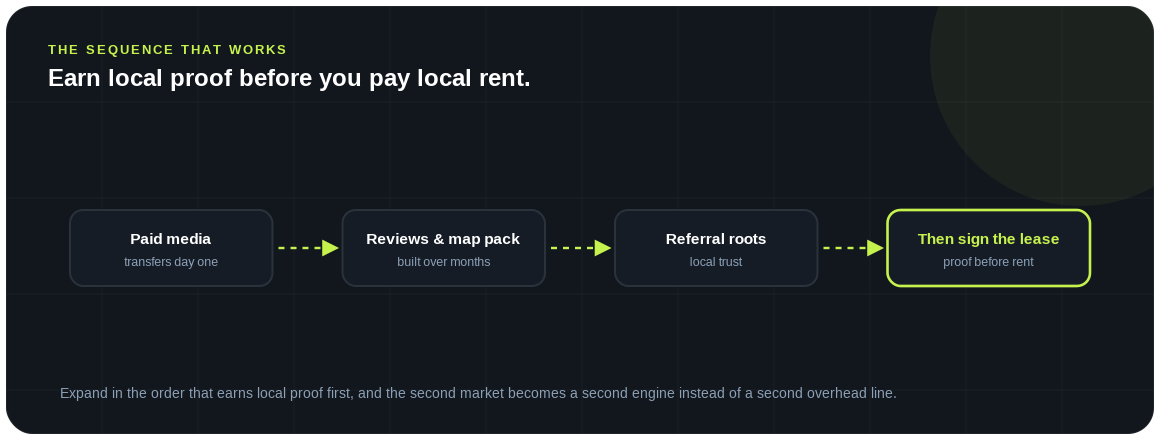
The sequence that works
Prove demand, earn proof, then pay rent — in that order.
The alternative to the lease-first launch is four phases in which each is funded by evidence from the one before, and no irreversible commitment is made until a reversible experiment has justified it.
Phase one: prove demand, with no address at all. Run paid media into the target metro, routed to your existing intake team, with landing pages built for that market, advertising honestly that you serve the area rather than claiming an office there. What you are buying is not cases — it is an answer: do injured workers here respond, at what cost per lead, at what sign rate, with what case quality? Ninety days, a defined budget. If the answer is bad, you learned it for the price of media instead of a lease.
Phase two: earn the local proof. With demand confirmed, start the slow assets in parallel — because they are slow, they must start early. Metro-specific content aimed at what injured workers there actually search. A review process that asks at relief milestones rather than case close, so cases you are already signing produce reviews this quarter instead of in three years. And the first referral conversations: occupational clinics, union locals, firms that refer comp out. None of this requires an office. All of it requires starting sooner than feels necessary.
Phase three: commit physically — properly. Now the office earns its cost, because now there is volume to justify it and a compliance requirement only it satisfies. It has to be real in the specific sense both Google and the bar rules describe: permanent signage, staff present during published hours, clients received there, legal work performed there, a lawyer present on a regular and continuing basis. A room you visit on Thursdays satisfies neither. Done properly, this is what unlocks the map pack and makes the advertising defensible.
Phase four: compound. With a qualifying location, a review engine running, and content ranking, the cheap channels finally carry load. The referral engine matures; brand and out-of-home become sensible amplifiers rather than expensive noise; blended cost per signed case converges toward home. This is where the second market stops being an expansion and becomes a market.
| Phase | What you spend on | What you are actually buying | The test that moves you on |
|---|---|---|---|
| 1. Prove demand | Paid media only, into existing intake | Evidence the metro responds — CPL, sign rate, case quality | Cost per signed case inside a range you set in advance, at real volume |
| 2. Earn local proof | Metro content, review process, referral outreach | Relevance and prominence — the ranking factors you can move without an address | Local content ranking, a live review flow, first referral sources sending |
| 3. Commit physically | A bona fide office: signage, staff, a lawyer present | Eligibility — map-pack entry and defensible advertising | Profile verified and ranking; advertising compliant in that state |
| 4. Compound | Referral engine, brand, amplification | The cheap case sources you left behind at home | Blended cost per signed case converging toward home |
Choosing the second market
Demand is only half the question. The half firms skip is how contested it already is.
Most second markets are chosen for reasons that have nothing to do with the market: a partner lives there, the firm won a case there, it is the next-largest city, a competitor just opened there. Those are not selection criteria, they are anecdotes with a map attached.
A defensible choice weighs two things. The first is demand — how much injured-worker volume the market generates, which depends less on workforce size than on workforce composition. A metro built on construction, warehousing, logistics, manufacturing, and healthcare support generates comp claims at a very different rate than one built on office employment with the same headcount. Population is a poor proxy; industry mix is a good one.
The second is supply — how many firms already compete for that volume and how entrenched they are. Heavy demand with twenty established comp firms carrying a decade of reviews each is a harder, costlier entry than moderate demand with no dedicated comp specialist. What matters is not how big the market is, but how much unclaimed demand there is per competing firm.
This is the comparison our Workers’ Compensation Intelligence Center was built to support — real BLS and Census data across 51 states and 3,192 counties, so selection starts from injury-generating industry composition rather than from which city sounds big. Because we work with one firm per market, this is a conversation we have constantly, and the metros that look best on a population map are frequently not the ones that look best on an injury map.
One line there is discovered late more often than any other. If the second market is in a different state, you are not opening a second office — you are entering a second body of law. Workers’ compensation is state-statutory: different deadlines, forms, administrative bodies, fee schedules, and rules about what an advertisement may even say. A second market in your own state is an expansion. A second market across a state line is closer to a second practice, and should be resourced and timed as one.
The numbers that tell you which is happening
Two very different problems produce the same complaint. Four numbers separate them.
Four or five months in, the complaint is always the same sentence: the new market isn’t working. That sentence covers two opposite situations. Either the market is fine and you are early — the expected curve, on schedule — or you picked wrong, and patience fixes nothing. Four numbers tell them apart.
Source mix, not blended cost. Blended cost per signed case in a new market is nearly meaningless because it is nearly all paid. Track the share of new-market signed cases from paid versus organic, map pack, review-driven, and referral. In a healthy expansion that mix shifts every quarter even while the blended number is still high. In a bad market it stays 100% paid indefinitely — local proof is not accumulating.
Cost per lead versus sign rate. These fail differently. CPL in line with home but a sign rate well below it is usually not a market problem — it is intake capacity, response time, or a mismatch between what you advertised and what the market needs. CPL far above home points to genuine competitive density or a thin audience, which is a selection problem, not an execution one.
Local ranking movement. Metro-specific content ranking, and eventually map-pack position, are the leading indicators that phase two is working. They move before case volume does. If they are moving, the curve is bending even if this month’s cost per case does not show it.
Review velocity. Not total reviews — velocity. New reviews per month from new-market clients is the cleanest early signal that local proof is compounding. Zero at six months means the review process is still asking at case close, and the market will stay expensive for years for that reason alone.
Together those four tell you which story you are in. Mix shifting, rankings moving, reviews arriving, sign rate healthy, blended cost still high — that is a market working on schedule, and cutting it is the expensive mistake. Mix static, no ranking movement, no reviews, CPL far above home after real spend — that is a selection error, and the disciplined move is to stop, take the lesson, and choose the next market on industry composition and competitive density instead of on which city the firm happened to like.
Expansion is not a marketing problem and it is not a courage problem. It is a sequencing problem wearing the costume of both. The firms that make it work are rarely the ones that spent the most or moved the fastest — they are the ones that ran the reversible experiment before the irreversible commitment, funded the window they knew was coming, and understood from the start that the ad account was the only thing in the truck.
Key takeaways
-
Expansion is a sequencing problem, not a marketing one. Everything that makes your home market cheap — map-pack position, years of reviews, referral relationships — is bolted to a place and paid for in time.
-
Only the ad account moves on Monday. Paid media is the one asset that transfers to a second market on day one; organic presence has to be earned there from scratch.
-
The obvious shortcut is closed by Google’s rules and your bar’s. A listing at an address you don’t genuinely staff violates Google Business Profile guidelines and attorney-advertising ethics both.
-
Budget for a window where the second market costs more. For a stretch you pay to buy the attention your home market earns for free — plan the duration rather than be surprised by it.
-
Pick the second market on demand and eligibility, not ambition. The numbers tell you which markets can actually be won before you commit spend to them.
Frequently asked questions
Can a workers’ comp firm use a virtual office to open a new market?
Not for what most firms want it for. Google’s Business Profile guidelines say a rented mailing address you don’t operate out of isn’t eligible for a profile, and a co-working office doesn’t qualify unless it has clear signage, receives customers during business hours, and is staffed by your own people. Separately, in states with a bona fide office requirement, advertising an office you don’t genuinely maintain can make the advertisement misleading. There is an honest middle path — some rules expressly allow advertising that a lawyer is “available for consultation” or “by appointment” at a location — but it buys no map-pack presence, and the rules vary by state.
How long before a second market matches the first on cost per signed case?
It depends on the market, and we won’t pretend to a number we haven’t measured. The shape is predictable: month one is almost entirely paid media, your most expensive source, so cost per signed case starts high and falls as the three non-transferable assets rebuild locally. Judge progress by whether the source mix is shifting away from pure paid, not by whether the blended number has reached home-market levels.
Should we open the office first or run ads first?
Ads first, almost always. Paid media is the only part of an expansion that is fast, cheap, and reversible, which makes it the right instrument for testing whether a market responds to you. A lease is slow, expensive, and irreversible. Run the reversible experiment first and a bad market costs a media budget instead of a multi-year obligation — and if the market is good, you sign the lease already knowing its cost per lead, sign rate, and case mix.
Does our existing SEO help us rank in a new city?
Partly. Domain authority, existing content, and brand travel with you and put you ahead of a brand-new firm. But local results are ranked on relevance, distance, and prominence, and distance is measured from a physical location you don’t yet have there. Content targeted at that market can start ranking before you have an office; the map pack effectively cannot, because a Business Profile there requires a real, staffed location.
Is expanding to another state different from expanding within our state?
Substantially. Workers’ compensation is state-statutory, so a new state means different deadlines, forms, administrative bodies, and fee structures, plus separate attorney licensing and a different set of bar advertising rules — including whether that state has a bona fide office requirement at all. A second market in your own state expands an existing practice. Across a state line, it is closer to standing up a second one.
How do we know whether to keep funding a new market or cut it?
Look at four things rather than blended cost per signed case, which will be high early regardless. Is the source mix shifting away from 100% paid? Are metro-specific pages gaining rankings? Are new reviews arriving from new-market clients each month? Is the sign rate in line with home, which separates a market problem from an intake problem? If those are moving, the market is on schedule and cutting it wastes what you already spent. If all four are flat after meaningful spend, that is a selection error worth accepting quickly.
Sources & further reading
-
01
How Google ranks local results
The factors a new-market listing is judged on, from the source.
-
02
The advertising-ethics line
Why a convenience address is a bar problem, not just a Google one.
-
03
What a new market has to earn
The place-bolted assets that don’t transfer.
-
04
Size the opportunity first
Judge candidate markets on real demand.
Rules and figures change over time — confirm current details at each source before acting. This article is general marketing information, not legal advice.