
There is a case that signs itself. It arrives asking for your firm by name, already trusting you, already screened by someone who knows what a comp case looks like. You did not pay a platform for the click.
Every workers’ comp firm gets a few of these. Almost no workers’ comp firm has ever sat down and asked the obvious question: where exactly do they come from, and what would it take to get more of them on purpose?
That is what this article is about. Not networking platitudes — an actual system: who refers injured workers, why they refer, what the ethics rules allow, and the five working parts that turn goodwill into a channel you can count. It is the companion piece to everything we write about paid acquisition, because referrals are the one channel where the marginal case costs nearly nothing — and the one channel money genuinely cannot buy.
Why referred cases behave nothing like cold leads
Trust transfers. That single fact changes everything downstream of the first call.
A cold lead — a form fill from an ad, a click from a search result — arrives skeptical. They are probably talking to several firms. They do not know you, they are comparing you against strangers, and the burden is on your intake team to build trust from zero in a few minutes on the phone.
A referred injured worker arrives having already borrowed someone else’s trust. Their doctor said “call this firm.” Their union steward said “these are the people who handled Miguel’s shoulder case.” Their old coworker said “they took care of me.” The vouching happened before you ever picked up the phone.
That transfer of trust changes the shape of the entire funnel, and it changes it in your favor at every stage:
- They call you first — often you only. A referred prospect is not filling out five forms and waiting to see who answers. They were sent to a specific firm, and unless you fumble the handoff, they are not shopping.
- They show up pre-screened. The people who refer comp cases — lawyers, treating providers, stewards — have a working sense of what a real claim looks like. A meaningful share of the filtering that your intake team does on cold leads has already happened.
- They sign with less friction. The conversation starts at “how do we proceed,” not “why should I trust you.” Objections that eat cold-lead consults — is this firm legit, do they handle cases like mine — were answered by the referrer.
- They cost almost nothing at the margin. There is no media spend behind a referred case. The costs are relationship costs — lunches, printed material, the time to send a status update — and they are spread across every case the relationship ever produces.
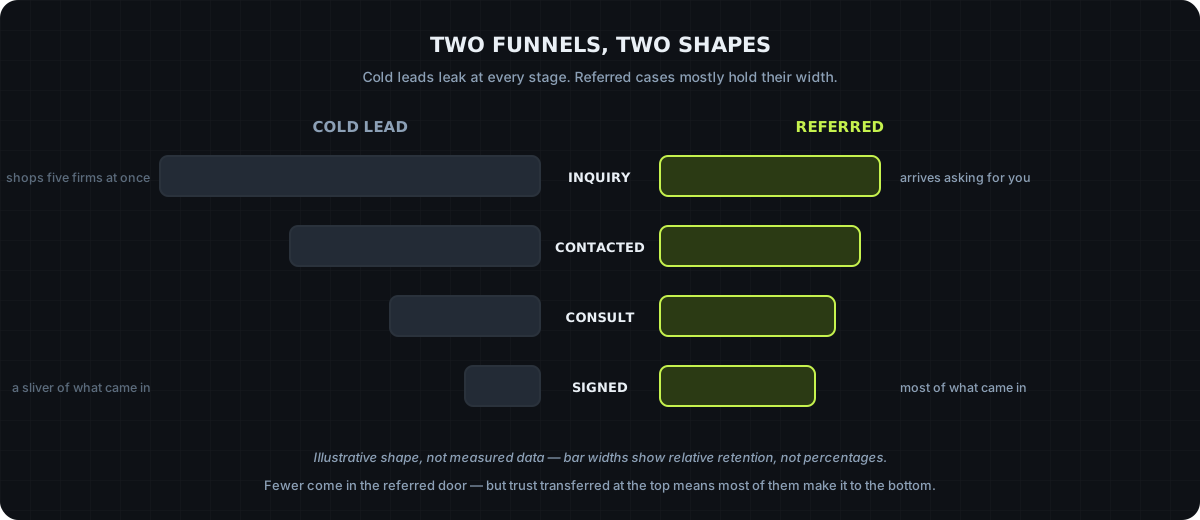
We spend most of our working life on the paid side of this equation — the ads, the landing pages, the five-minute response windows that decide whether a $75 lead becomes a case or a voicemail. So take it as an admission against interest when we say: nothing we can buy for a firm converts like a warm introduction from someone the injured worker already trusts.
Paid channels rent attention. A referral transfers trust. You can scale the first. You can only earn the second — which is exactly why so few firms bother, and exactly why it’s worth doing.
Spencer Moeller, WorkersComp MarketingAnd yet walk into a typical WC firm and ask three questions. Who are your top ten referral sources? When did each of them last hear from you? What happened to the last case each one sent? Most firms cannot answer any of the three. The channel with the best-behaving cases in the building is running on autopilot, unmeasured and unmanaged, while the channels with the hardest-behaving cases get the budget, the meetings, and the dashboards.
The rest of this article is the fix.
The four referral populations
Every referral a WC firm will ever receive comes from one of four groups. Name them, and you can work them.
“Referrals” feels like weather — it happens to you. It stops feeling that way the moment you break the channel into its actual components. For a workers’ comp practice, essentially every referred case comes from one of four populations:
- Attorneys who don’t practice comp. PI firms, immigration lawyers, family lawyers, employment lawyers — people who regularly meet injured workers and cannot help them with the comp claim.
- Treating medical providers. Occupational clinics, chiropractors, orthopedists, physical therapists — the people who see injured workers before any lawyer does.
- Unions, worker centers, and community organizations. The institutions injured workers already trust, especially in immigrant and blue-collar communities.
- Past clients. The people you already proved yourself to — who happen to be surrounded by coworkers doing the same jobs with the same risks.
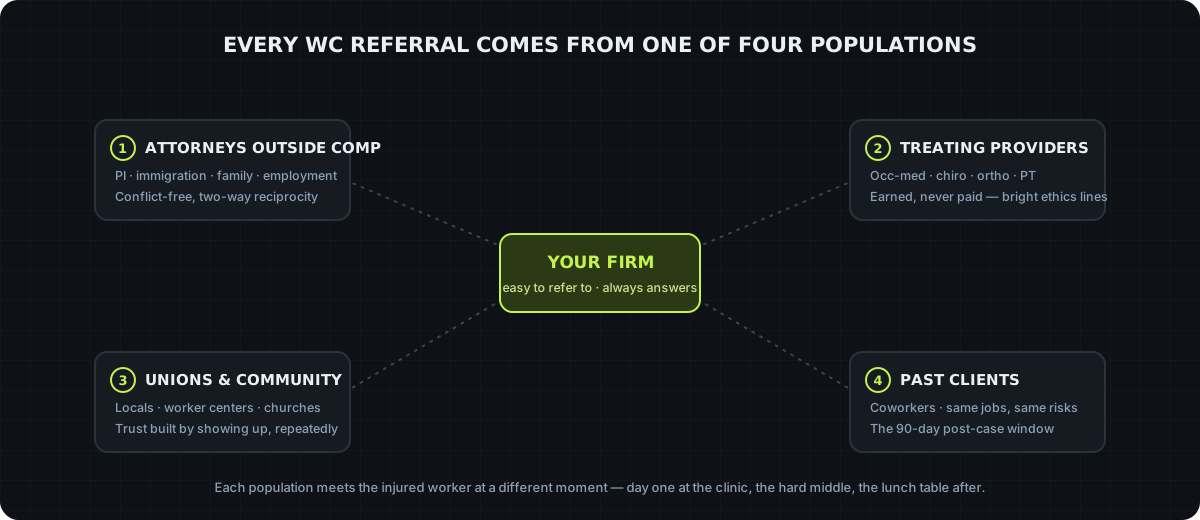
Each population meets the injured worker at a different moment — the provider on day one, the non-comp lawyer when a legal question surfaces, the union steward when the claim gets hard, the past client at the lunch table when a coworker gets hurt. Each responds to a different kind of relationship-building, and two of the four sit under real ethics constraints you need to respect. So let’s take them one at a time.
Population one: attorneys who don’t practice comp
The cleanest referral relationship in law: they can’t take the case, you can’t take theirs.
Start with the population most WC firms under-work despite it being the most natural fit: other lawyers.
Think about who is already talking to injured workers in your county. Personal injury firms field calls every week from people hurt on the job — and a pure workplace injury with no third party is usually a case they cannot run. Immigration lawyers sit across the desk from clients in physically demanding jobs, and workplace injuries come up constantly; those clients often don’t know that immigration status generally does not bar a comp claim in most states. Family lawyers hear about a spouse’s work injury in the middle of a support dispute. Employment lawyers handling a wrongful termination discover there’s an unreported injury underneath it.
None of these lawyers practice comp. All of them face the same uncomfortable moment: a person who needs help they cannot provide. If you are the WC firm they trust, you are the answer to that moment — every time it happens, for years.
What makes this population special is that the relationship is structurally conflict-free. A PI firm is not your competitor; you are each other’s overflow valve. The reciprocity is real, too: your intake takes calls every week that turn out to be third-party injury claims, employment disputes, or SSDI questions. A firm that reliably sends those callers somewhere good — instead of saying “we can’t help” and hanging up — becomes a hub other firms want to be connected to.
How do you build this population? Not with a mass email. With a short list. Identify the fifteen or twenty firms in your market that most plausibly meet injured workers — the busiest PI shops, the immigration practices serving the industries where your clients work, the employment lawyers. Then make yourself unmistakably useful to them: answer their comp questions when they call, take their referred clients instantly and treat them visibly well, and close the loop so the referring lawyer hears how their former client made out. A lawyer who refers once and hears nothing refers somewhere else next time. A lawyer who gets a thank-you call the same day and a status note when the case resolves refers for a decade.
Population two: treating medical providers
They see injured workers before anyone else — and the rules here are bright lines, not suggestions.
The second population sees the injured worker first, sometimes within hours of the injury: occupational medicine clinics, chiropractors, orthopedists, physical therapists, urgent-care providers who handle work injuries.
Providers watch the comp system fail their patients up close. They see claims denied, treatment authorizations stalled, patients pressured back to work before they’re ready, bills left hanging when a claim gets disputed. When a provider believes a patient is being run over by the process, “you should talk to a lawyer” is a natural, patient-protective thing to say. The only question is whether your firm’s name comes attached to the sentence.
Before we go one step further, the ground rules — because this is the population where firms get themselves in real trouble:
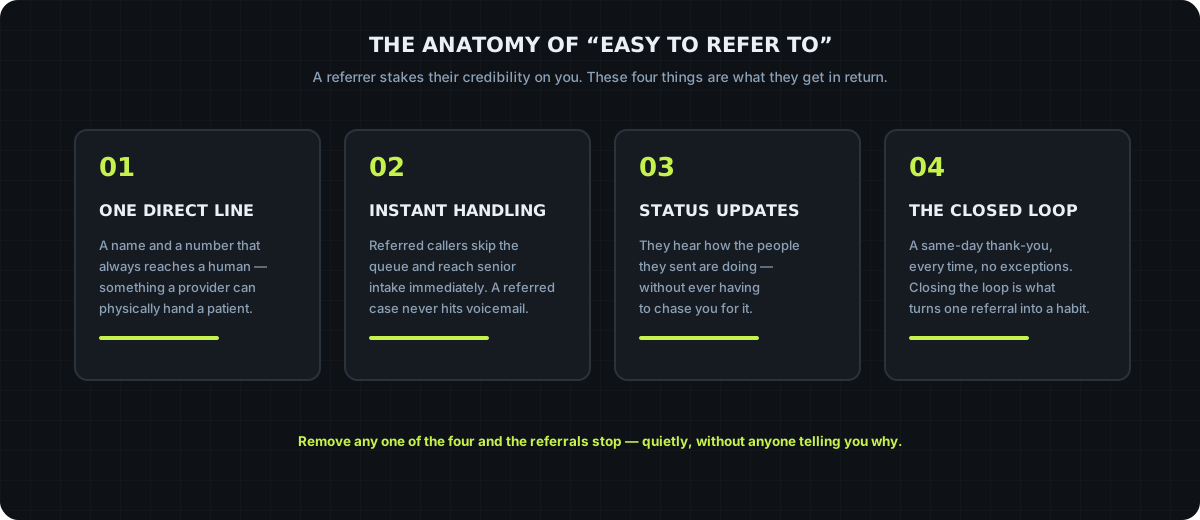
So if you can’t pay, what’s left? The honest answer: being the firm that is easy to refer to. Providers refer to whoever makes the sentence “you should talk to a lawyer” effortless to finish. In practice that means:
- One name, one number, a human answer. A provider will not hand a patient a website. They will hand a patient a card with a name on it — if calling that number reliably reaches a person who helps immediately.
- Their patients come back cared for. The provider hears about the experience from the patient at the next appointment. If the patient says “they called me back in five minutes and explained everything,” the provider refers again. If the patient says “I left two voicemails,” they never do.
- You make their life easier, not harder. A represented claimant with a properly managed claim is, for the provider, a claim that is likelier to stay on the rails — authorizations pursued, disputes handled by someone whose job it is. You are not selling the provider marketing; you are removing a headache from their week.
- You give them something to hand out. A plain-language, well-designed know-your-rights one-pager — what to do after a work injury, in English and Spanish — is genuinely useful in an occ-med waiting room. Co-brand it, keep it educational rather than promotional, and let it sit on the counter doing quiet work all year.
Build the provider list the same way you built the attorney list: fifteen or twenty clinics and practices that see the highest volume of work injuries in your area. Visit them. Not with a pitch — with lunch for the front desk, the one-pager, and a simple message: when your patients have claim problems, this is who we are and this is exactly what happens when they call. Then let the experience of the first referred patient do the selling.
Population three: unions, worker centers, and community organizations
The institutions injured workers already trust — reached by showing up, not by advertising.
The third population is the least transactional and the slowest to build, which is precisely why nearly nobody in your market is building it.
Injured workers — especially in construction, warehousing, food processing, healthcare, and hospitality — are embedded in institutions that long predate their injury: union locals, worker centers, immigrant community organizations, churches, trade associations. When something goes wrong at work, many people ask these institutions before they ask Google. A union steward or a worker-center organizer fields “I got hurt, what do I do” conversations all the time. The name they give out is the name that has shown up for them.
Showing up looks like this:
- Know-your-rights trainings, free, no pitch. A thirty-minute session for stewards or members: what to do in the first 48 hours after a work injury, reporting deadlines, the right to a doctor, what retaliation looks like. Educational, bilingual where the audience needs it, and repeated — once is a favor, quarterly is a relationship.
- Materials the organization can make its own. The same know-your-rights content, co-branded with the local or the worker center, in the languages their members actually speak. You supply the accuracy; they supply the trust.
- Answering the organizer’s own questions. Stewards and organizers accumulate half-answered legal questions. Being the lawyer who returns their calls — about members’ problems, not prospective fees — makes you part of their infrastructure.
- Presence at their events, on their terms. Sponsor the safety training, attend the membership meeting, staff the table at the health fair. Quietly, repeatedly, without turning every appearance into an ad.
Two cautions. First, this population is trust-dense: one badly handled referral — one member who hits voicemail and tells the steward — can undo two years of showing up, because the institution talks to itself. Second, the same ethics lines apply as with providers: you are not paying organizations for cases, you are earning a place in their answer to a member’s question. Some organizations have formal legal-services referral arrangements with their own rules; where those exist, work within them.
What you get in return is a channel with roots. Paid traffic stops the day you stop paying. A union local that has handed out your number for five years is close to unbuyable for a competitor at any budget.
Population four: past clients and the 90-day window
Your former clients eat lunch every day with the exact people you want to meet next.
The fourth population is the one your firm has already fully earned: the clients whose cases you closed.
Past WC clients are a uniquely targeted referral base, for a reason that is obvious once said out loud: they are surrounded by the population you serve. Their coworkers do the same jobs, for the same employers, with the same hazards. When someone on their crew gets hurt — and on the crews your clients come from, someone will — your former client is standing right there, with firsthand experience of exactly this problem and exactly your firm. No ad platform on earth can target that precisely.
The variable you control is timing. There is a window — roughly the first ninety days after a case resolves — when the outcome is concrete, the gratitude is fresh, and the client’s story is still being told at the lunch table. That window is when two asks belong:
- The review ask. The public version of the referral — the vouching that works on strangers. We’ve written a full piece on why WC review programs fail and how to time them across a long claim; see our guide to reviews for WC firms.
- The referral ask. The private version. Plain words work: “If a coworker or friend ever gets hurt on the job, we’d be glad to take care of them the way we took care of you — here’s how to reach me directly.” Said at the closing meeting, repeated once in a follow-up note, and then left alone.
Beyond the window, past clients respond to the same principle as every other population: occasional, genuinely useful contact. A once-or-twice-a-year touch — a plain-English update when the state changes a benefit rule, a holiday note, a “how’s the shoulder” message — keeps the firm’s name findable in a phone that otherwise deletes it. This is also where a light ongoing presence pays off: past clients who see your firm’s faces and answers in their feed remember you exist when the moment comes. That is a big part of why we build content engines for WC firms — not to chase strangers, but to stay quietly present with the people who already trust them. The same logic drives long-cycle nurture for unsigned leads, which we cover in the slow yes.
The referral engine: five working parts
Relationships are the fuel. This is the machine that burns it on purpose.
Everything above describes who refers and why. None of it produces a single additional case until somebody at the firm owns it as a system. Here is the system — five parts, none of them complicated, all of them skipped by almost every firm we meet.
Part 1 — The referral map
Before cadence, inventory. Sit down once and write out, by population, every person and institution that could plausibly send you a case: the PI and immigration firms, the occ-med clinics and orthos, the locals and worker centers, the past clients who already sent someone or said they would. For each: who owns the relationship at your firm, when they last heard from you, and what they’ve sent you historically. The first time a firm does this, two things happen — they discover the list is longer than expected, and they discover that most of it has heard nothing from the firm in over a year. Both discoveries are the point.
Part 2 — The monthly cadence: give, give, ask
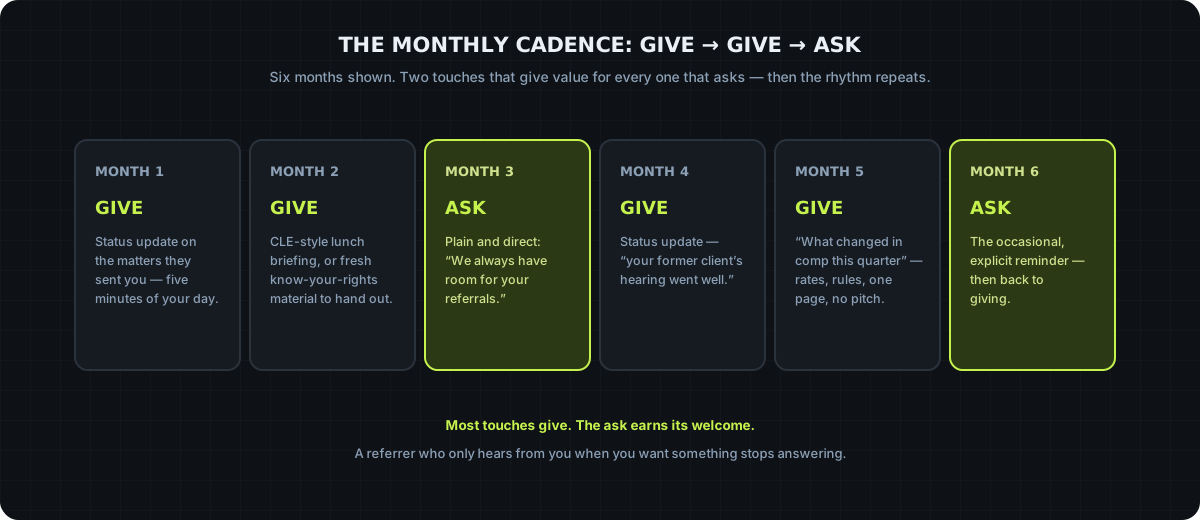
Referral relationships die of silence, and they also die of being treated like vending machines. The fix is the same rhythm sales teams have used forever: give value twice before asking once.
- Give — status updates. The single highest-value touch for professional referrers costs you five minutes: a short, ethics-compliant note on the matters they sent you. “Wanted you to know your former client’s hearing went well and she’s back at modified duty.” Referring lawyers and providers almost never get this from anyone. Be the one who does it, and you become the default.
- Give — briefings and material. A quarterly CLE-style lunch for referring attorneys on what’s changing in comp — new case law, new benefit rates, what to spot in their own client meetings. Fresh co-branded know-your-rights material for clinics and locals. A short “what changed in comp this year” letter for everyone else.
- Ask — occasionally, directly. Every third or fourth touch, say the quiet part: “We always have room for your work-injury referrals, and they come straight to me.” Referrers are busy; an explicit, occasional reminder is not pushy, it is useful.
Part 3 — Instant handling for referred cases
This is the part firms get wrong at the worst possible cost. When a referred injured worker calls and hits voicemail, you have not lost one lead — you have damaged the relationship that produced it. The referrer staked their credibility on you. The patient goes back and tells the steward, the receptionist, the lawyer: “I couldn’t get through.” That story travels, and the channel quietly closes.
So referred cases don’t wait in the general queue. They jump it:
- A dedicated number or named contact that referrers give out — one that reaches a human, always.
- Referred callers flagged at the first hello (“Dr. Alvarez’s office sent me”) and routed to senior intake immediately.
- A same-day thank-you to the referrer, every time, without exception — closing the loop is what turns one referral into a habit.
Everything we’ve written about the five-minute response window applies double here, because the downside isn’t one wasted lead — it’s a poisoned well. If your intake can’t guarantee that today, fix intake before you spend a single lunch building relationships; this is exactly the problem our intake and CRM system exists to solve.
Part 4 — Track sources in the CRM
If “referral” is one undifferentiated source label in your CRM, you are flying blind on your best channel. Every referred matter should carry the specific source — the person, the clinic, the local, the past client — the same way every paid lead carries its campaign. Do that for a year and the reports start answering real questions: which relationships actually produce cases rather than coffee meetings, which populations are growing, what a referred case’s sign rate and value look like next to your paid channels. Those answers tell you where the next hundred hours of relationship-building belong — and they are also what makes the thank-you specific: “that’s the third person you’ve sent us” lands very differently than a form letter.
Part 5 — The reactivation touch
Run the source report and you will find them: the clinic that sent three cases two years ago and nothing since, the PI firm that went quiet after their contact changed jobs. Dormant referrers are the warmest cold list you own. The reactivation touch is honest and simple — “You used to send folks our way and we haven’t spoken in too long; I’d love to catch up and hear what you’re seeing” — plus something useful in hand, like the current benefit-rate card. Often the relationship didn’t end for a reason; it just stopped being tended. A standing quarterly review of the dormant list, with one revival attempt each, keeps the map from silently shrinking.
| Part | Job to be done | Rhythm |
|---|---|---|
| 1. Referral map | Know every relationship, its owner, and its history | Built once, reviewed quarterly |
| 2. Give-give-ask cadence | Stay useful and present without becoming noise | Monthly touches |
| 3. Instant referred-case handling | Protect the referrer’s credibility, every call | Every referred lead, always |
| 4. CRM source tracking | Know which relationships actually produce | Every matter, reported monthly |
| 5. Reactivation touch | Revive the relationships that went quiet | Quarterly dormant-list review |
Why referrals can’t be your only channel
The honest section. The best channel in the practice is also the least controllable one.
Everything above is true, and so is this: a firm that tries to live on referrals alone has signed up for three structural problems that no amount of relationship-building fixes.
Referrals are slow. The engine compounds beautifully, but it compounds on relationship time — months to warm a clinic, quarters to become a union’s default answer, years for a past-client base to reach critical mass. A firm that needs more cases this quarter cannot get them from a channel whose flywheel spins up over years. Paid channels are the opposite: turn them on and qualified injured workers see your firm this week.
Referrals are lumpy. The channel produces on its schedule, not yours. Three cases arrive in one week because a clinic had a bad month of denials; then six quiet weeks. You cannot staff a growing firm — intake, paralegals, attorneys — against a case flow that arrives in unpredictable clusters. Payroll is monthly; referrals are not.
Referrals are capped. The ceiling is the size and productivity of your network. When you have won your county’s occ-med clinics and the PI firms know your name, the channel is mature — and mature means roughly flat. There is no budget dial. If your growth plan calls for doubling signed cases, the doubling will not come from the same twenty relationships; it comes from channels that scale with spend.
And there is a quieter risk worth naming: concentration. A referral book built on a handful of relationships is exposed to a single retirement, a clinic acquisition, or one contact changing jobs. Channels you own — your ads, your rankings, your list — don’t resign.
So the honest frame is not referrals versus paid. It is a portfolio: paid buys volume and control; referrals raise the blended quality. Paid acquisition gives you the predictable case flow that lets you plan staffing and growth. The referral engine layers on a stream of high-trust, near-zero-marginal-cost cases that sign easier and speak well of you in public. Each covers the other’s weakness — the paid channel’s colder economics, the referral channel’s slowness and lumpiness. The firms that get this right run both deliberately and measure them in one place, which is precisely why Part 4 — source tracking — matters so much: it is what lets you see, in one report, what each channel actually contributes per signed case.
Key takeaways
-
Referred cases behave nothing like cold leads. They arrive pre-trusted, convert higher, and cost almost nothing to acquire.
-
There are four referral populations. Non-comp attorneys, treating medical providers, unions and community organizations, and past clients.
-
Non-comp attorneys are the biggest untapped source. Lawyers who do not handle comp meet injured workers constantly and have nowhere to send them.
-
Past clients have a 90-day window. Relief is freshest right after a case closes; that is when referrals and reviews come easiest.
-
Referrals cannot be your only channel. They compound slowly and unpredictably; they amplify a system, they do not replace one.
Frequently asked questions
What is a referral engine for a workers’ comp firm?
A referral engine is referrals run as a managed system instead of a happy accident: a written inventory of every person who could plausibly send you a case, a monthly touch cadence that gives those people something useful before asking for anything, priority intake handling for referred callers, source tracking in the CRM, and a reactivation touch for referrers who have gone quiet. The relationships already exist around most firms — the engine is simply the discipline of working them on purpose.
Can we pay doctors or clinics for referring injured workers to our firm?
No. Lawyer ethics rules prohibit giving anything of value in exchange for a recommendation of your services — the model rule is 7.2(b), and every state has its own version. Many states layer criminal statutes on top; paying non-lawyers for cases is what capping and runner laws exist to punish. The compliant play is to earn provider referrals by being genuinely easy to refer to: treat their patients well, communicate, and make the handoff effortless. Check your own state bar’s rules before building any provider program.
How do attorney-to-attorney referral fees work in workers’ comp?
Fee divisions between lawyers in different firms are regulated state by state, generally under each state’s version of Rule 1.5(e) — most require client consent in writing, and some require the fee split to be proportional to work performed or that both lawyers assume responsibility for the matter. Workers’ comp adds a wrinkle: in many states the comp statute itself controls or caps attorney fees, and some require commission or board approval. Confirm your own state’s rule before promising a referring lawyer anything.
How often should we contact our referral sources?
Roughly monthly, and most touches should give rather than ask. A workable rhythm is two giving touches for every ask: a case-status update on matters they sent you, a short briefing or lunch-and-learn, co-branded know-your-rights material they can hand out — then, occasionally, a direct reminder that you welcome their referrals. A referrer who only hears from you when you want something stops answering; one who gets something useful every month thinks of you first.
When is the right time to ask a past client for a referral?
The window that matters most is roughly the first ninety days after the case resolves, while gratitude is fresh and the outcome is concrete. That is when to ask for the review and to say, plainly, that if a coworker or friend gets hurt on the job you would be glad to help them too. Past WC clients are surrounded by the exact population you serve — same employers, same work, same injuries — which makes this the most targeted audience any firm will ever reach.
Why can’t referrals replace paid advertising?
Because referrals are slow, lumpy, and capped. Relationships take months to warm up, they produce cases on their own schedule rather than yours, and the ceiling is the size of your network — you cannot turn a dial and get more this month. Paid channels buy volume and control; referrals raise the blended quality and economics of everything else. The strongest firms run both: paid for predictability, referrals for the cases money can’t buy.
Sources & further reading
- 01
- 02
- 03
Benchmarks here draw on WorkersComp Marketing’s own managed-spend data across live firms; your numbers will differ. General marketing information, not legal advice.