
A review is not a verdict on the outcome. It is a verdict on the experience — and in workers’ compensation, the experience peaks long before the case ends.
Almost every firm I talk to has the same reputation process, and it is almost always inherited from a personal-injury playbook: when the case resolves and the check clears, someone in the office sends a thank-you note with a Google link. It is polite, it is well-intentioned, and it is quietly costing the firm money every single month.
The reason is arithmetic, not attitude. In workers’ comp, “when the case resolves” is not next month. It is the better part of a presidential term. And by the time it arrives, the client’s most vivid memory of your firm — the day someone finally picked up the phone and made the pain stop — is three years cold.
This piece makes a specific argument: reviews in a workers’ comp firm are not a marketing task, they are a case-management task, and the only way to generate them at the velocity your ad spend requires is to build the ask into the case calendar at the points where relief actually happens. I’ll show the timing math, the survivorship problem hiding inside it, the reason a stale review profile raises your cost per lead rather than merely bruising your ego, and the exact milestone map we use.
The 901-day lag: why close-only fails
The standard advice assumes a short job. Workers’ comp is the longest job in consumer law.
Start with the numbers that define the category. According to NCCI research on temporary disability duration, the average lost-time claim runs 94 days, with a median of 54 — and that is the unrepresented baseline. The moment a lawyer is involved, the clock changes character entirely.
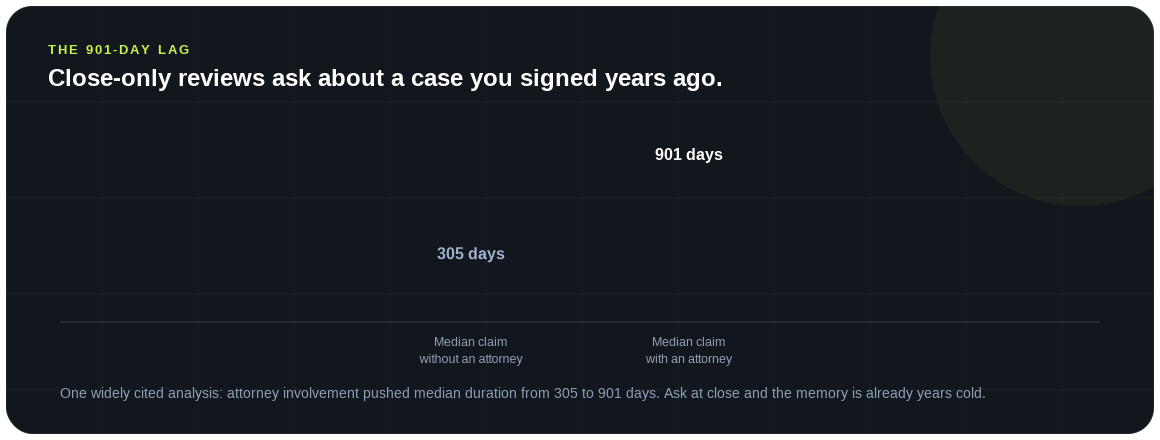
A 2018 Clara Analytics study, summarised in Healthesystems’ RxInformer review of litigation in workers’ comp, found that attorney involvement increased median claim duration from 305 days to 901 days. A more recent 2024 WCRI study of nearly a million claims across 31 states found attorney involvement increased lost-time days by 284%.
Those figures exist to describe cost to insurers. Read them as a marketer and they say something else: the median case you sign this month will not close until roughly the back half of 2028.
Now run the consequence. Suppose you sign 30 cases a month and you ask for a review only at close. Your review flow this month is not a function of the 30 clients you are serving right now. It is a function of the 30 clients you signed in early 2024 — a smaller, differently-sourced, differently-served cohort, filtered further by who is still answering your emails after three years.
This produces three failures at once, and they compound.
Failure one: the flow never matches the firm
If you are growing, your review count is permanently pegged to the size you were two and a half years ago. The firm that just tripled its intake looks, on Google, exactly like the firm it used to be. Every prospect comparing you against the incumbent down the street is reading a profile that describes a smaller, quieter version of your practice.
Failure two: the flow is lumpy, and lumpy reads as dead
Case closes cluster. Settlement calendars, hearing dates, and lien resolutions arrive in clumps, so a close-only process produces four reviews in one week and none for the next two months. Reputation platforms and search engines both reward a steady drip, not a burst. A profile with 60 reviews all dated within a single quarter of 2024 looks less alive than a profile with 25 reviews arriving one a week.
Failure three: memory decays faster than the case
Ask a client to describe your firm on the day their settlement funds land and you will get a review about money. Ask them on the day you got their denied surgery authorised — when they had been in pain for five months, had been told no twice, and someone in your office finally made it a yes — and you get a review about rescue. The second one signs the next case. The first one does not, because the next prospect is not shopping for money yet. They are shopping for someone to make it stop.
The survivorship problem nobody names
A close-only process does not just sample late. It samples the winners.
Here is the part firms find uncomfortable, so most simply never think about it.
When you ask for reviews only at case close, you are asking only the clients whose cases got to a close you feel good about. The denials you could not overturn, the claims that settled for far less than the client hoped, the clients who moved states, changed numbers, or went back to work and stopped answering — none of them get asked. Not out of cynicism. It just never feels like the right moment, and eventually the file closes and the moment never comes.
The result is a review profile assembled entirely from your best-case outcomes. That sounds like an advantage. It is not, for two reasons.
First, it shrinks the pool dramatically. A firm signing 30 cases a month is not asking 30 people 901 days later — it is asking the subset that both resolved well and stayed reachable. In practice that is a fraction of the cohort, which is why so many firms with real volume have review counts that would embarrass a coffee shop.
Second, it makes your reviews sound alike. Every one of them says a version of “they got me a great settlement.” That is the single least differentiating sentence in legal marketing, and it does nothing for the prospect whose actual fear is not “will I win” but “will anyone believe me.”
That fear is not a marketing invention. WCRI’s research on why injured workers hire attorneys at all found the three biggest drivers were fear of being fired, the sense that a supervisor doubted the injury was real, and the belief that the claim had been denied. Forty-eight percent of workers who hired attorneys somewhat or strongly agreed that they feared losing their job; 42% felt their supervisor suspected them of faking. Those are the anxieties your prospects arrive with — and no settlement testimonial answers any of them.
Your prospect’s question is not “will this firm win.” It is “will this firm believe me.” Only a client asked mid-case can answer that.
Spencer Moeller, WorkersComp MarketingWhy stale reviews raise your cost per lead
This is a media-efficiency line item wearing a reputation costume.
Firms park reviews under “brand,” which is a polite way of saying “nobody’s number.” That is a mistake you can measure. Review count, rating, and recency are inputs to three systems that decide what you pay for a case.
1. The local pack
Review signals sit near the top of every serious ranking-factor study. In Whitespark’s Local Search Ranking Factors survey, review signals rank among the three biggest drivers of local pack placement, behind only Google Business Profile signals and on-page factors. Map pack position is not a vanity metric for a WC firm — it is the difference between free cases and bought ones, which is exactly why we wrote the local SEO playbook for winning the map pack.
2. Local Services Ads
This is the one most firms miss. Google’s own documentation on how Local Services Ads are ranked states plainly that ad rank depends on “profile quality” — and lists your rating, number of reviews, and average response time among the factors. Google adds that higher-quality profiles “may rank higher and may also pay lower costs per lead.”
Read that last clause again. Google is telling you, in writing, that your review profile is a bid multiplier. A firm with a thin, stale profile is not merely showing up less often in Local Services Ads — it is paying more for the leads it does get. Reviews are the cheapest CPL lever on the board, and they are sitting inside your case files.
3. The consumer, and now the machine
BrightLocal’s 2026 Local Consumer Review Survey reports that 41% of consumers now always read reviews when browsing for a local business — up from 29% the year before — and that 31% say they will only use a business rated 4.5 stars or higher, nearly double the 17% who said so in 2025. Eighty-five percent say positive reviews make them more likely to use a business.
The same survey found consumers now consult an average of six review sites, that Google’s share of review-reading has slipped from 83% to 71%, and that use of AI tools for local business recommendations jumped from 6% to 45%. That last number is the one to sit with: the assistant summarising your firm to an injured worker is reading your reviews. It has no other way to know what it is like to be your client.
| Channel | What reviews affect | Direction of the cost impact |
|---|---|---|
| Google local pack / Maps | Ranking (review signals are a top-three factor per Whitespark) | Fewer free cases when weak — pushes volume onto paid |
| Local Services Ads | Profile quality → ad rank and, per Google, cost per lead | Directly raises CPL when weak |
| Paid search & Meta landing pages | Conversion rate of traffic you already paid for | Raises cost per signed case when weak |
| AI assistants & answer engines | What the model can say about you at all | Invisible when weak — and you cannot bid your way in |
Ranking-factor weights are survey-based and directional; Google’s LSA documentation is explicit that profile quality influences both rank and cost.
Put the pieces together and reviews stop looking like a reputation chore. Every channel we run for a firm — Meta, search, LSAs, organic — is priced partly by the strength of the review profile it lands on. Which means the firm that fixes its review engine gets a discount on everything else it buys.
The relief-milestone map
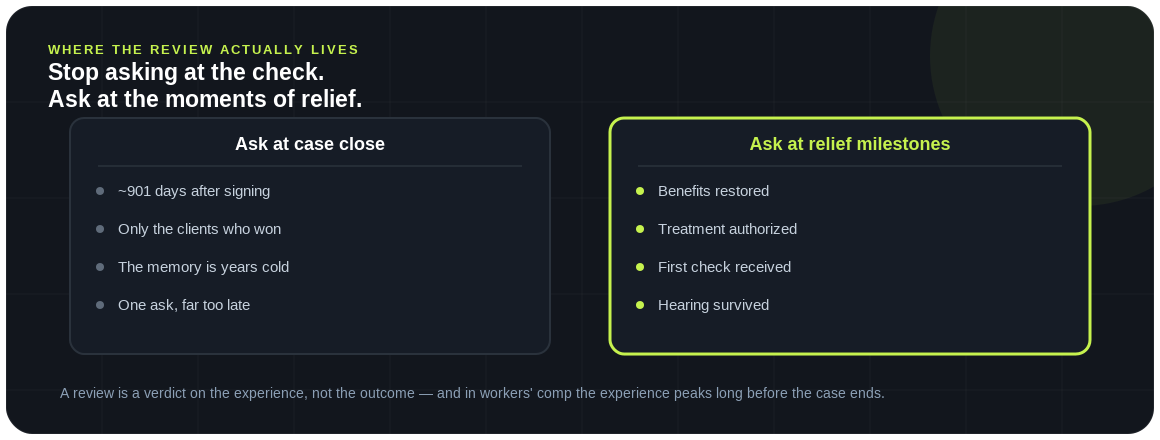
There are four or five moments in a workers’ comp case when a client would genuinely thank you. Ask then.
Once you accept that the review must come from inside the case, the design problem gets concrete: which moment?
The answer is not “whenever we remember.” It is the set of points where the client’s experience of the case flips from fear to relief. Those points are predictable, they are already events in your case-management system, and every one of them can fire a trigger. The diagram below maps them against the close-only approach most firms use today.
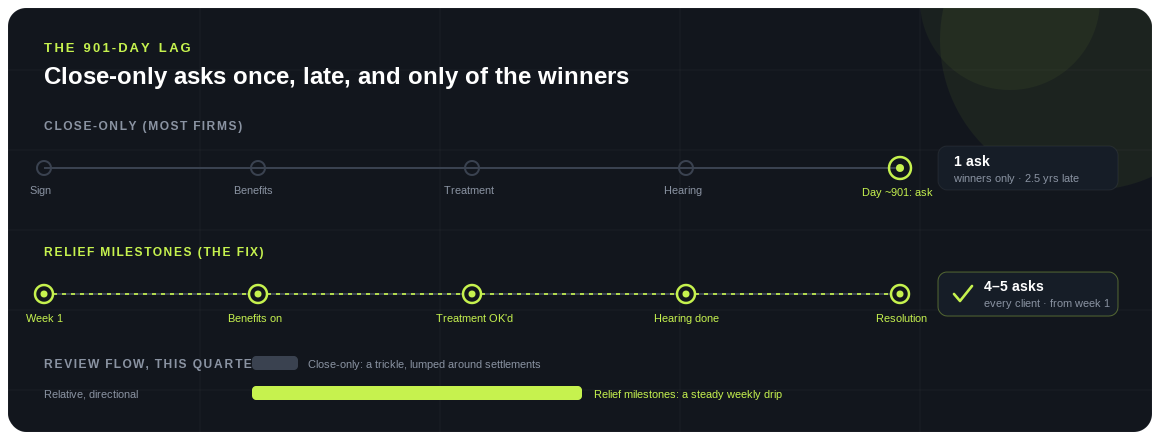
Each milestone has a different emotional register, and the ask has to match it. The script that works the week benefits are restored is not the script that works after a hearing.
| Milestone | Typical timing | What the client feels | What the review will be about |
|---|---|---|---|
| 1. First real contact — someone picked up, took the case seriously, explained the process | Days 1–7 | Relief that they are not alone; that someone believed them | Responsiveness, being believed, plain-English explanation |
| 2. Benefits started or restored — indemnity flowing, or a wrongly stopped check turned back on | Weeks 2–8 | Financial panic lifting | “They got my checks started when nobody would call me back” |
| 3. Treatment authorised — the denied MRI, surgery, or specialist referral gets approved | Months 1–8 | Physical relief; the pain has a plan | Fighting the denial; persistence; medical advocacy |
| 4. A hearing or deposition survived — the thing they dreaded most is behind them | Varies | Fear discharged; pride | Preparation, being defended, not being humiliated |
| 5. Resolution — settlement, award, or case close | ~901 days (median, represented) | Closure; often ambivalence | The outcome — useful, but the weakest of the five |
Notice what the table reveals. The most persuasive reviews — the ones that answer the fear a prospect actually arrives with — come from milestones 1 through 4. The only one most firms ever use is milestone 5, which is the last, the slowest, the most survivorship-biased, and the least differentiating.
That is the whole argument in one row.
The wording matters more than the channel
Two rules. First, name the specific thing that just happened — “now that Dr. Alvarez’s referral has been approved” — because a request tied to an event gets answered and a generic request gets ignored. Second, tell them what would help, without telling them what to say: “if you have two minutes, it would help other injured workers to know what the process was actually like.” That is a legitimate ask. “Could you mention how happy you are with our results?” is not.
Building the ask into the case calendar
If reviews belong to marketing, they will not happen. They belong to whoever touches the file.
Every firm that has tried and failed at reviews failed the same way: the request lived in a marketing person’s head, and the marketing person does not know the day the surgery was approved. The case manager does. So the system has to sit where the events are.
Step 1 — Define the triggers in the case-management system, not in a spreadsheet
Whatever you run — Filevine, Litify, Smart Advocate, CasePeer, a homegrown CRM — you already log the events. Benefits restored. Treatment authorised. Hearing completed. Turn each into a status change that fires a task. If your system cannot fire a task on a status change, that is the first thing to fix, and it is the same fix that makes your intake and CRM stack work properly for everything else.
Step 2 — Give the ask an owner and a deadline
The person who delivered the good news makes the ask, within 48 hours, while the client still feels it. Not the marketing director. Not a generic firm email. The case manager or paralegal the client already trusts — by text, because Healthesystems’ research on injured workers found 94% say mobile is their most-used device and 70% always prefer to text.
Step 3 — Remove every step you can
One link, straight to the review form, no login gymnastics, no landing page in between. Send it in the language the client speaks — if a meaningful share of your caseload is Spanish-speaking, and in most WC markets it is, you need a Spanish ask, which is a point we made at length in marketing to the Spanish-speaking injured worker.
Step 4 — Respond to every review, publicly, within 48 hours
Google names average response time as a profile-quality factor for LSAs, and prospects read replies as a live demonstration of how you handle people. Reply to the good ones briefly and specifically. Reply to the bad ones without ever confirming the person was a client, without discussing the matter, and with an invitation to talk offline. Your confidentiality obligations do not pause because someone was rude on the internet.
Step 5 — Distribute across platforms deliberately
Consumers now consult an average of six review sites. Google is the priority — it feeds the map pack and LSAs — but a profile that exists only on Google is a single point of failure, and Google’s share of review-reading is falling. Rotate the ask: Google for most clients, then a second platform for a share of them.
The lines you cannot cross
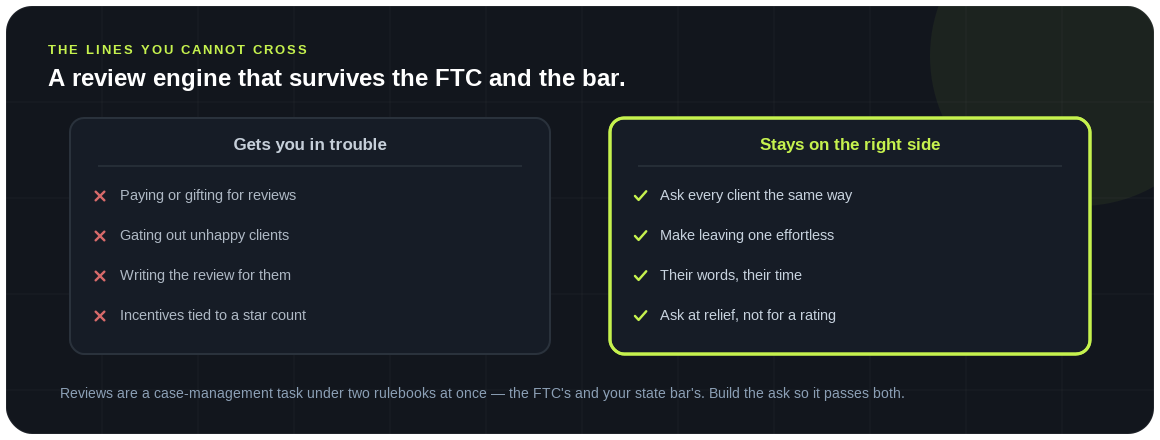
Everything above is legitimate. A short list of adjacent tactics is not, and two of them are now federally illegal.
Asking more clients, earlier, is a volume strategy inside the rules. What follows is outside them, and the fact that competitors do it is not a defence.
No incentives, ever
The FTC’s final rule on consumer reviews and testimonials, effective October 2024, prohibits creating, buying, or disseminating fake reviews and bars incentivizing a review when the incentive is conditioned — expressly or implicitly — on the review expressing a particular sentiment. Civil penalties run to tens of thousands of dollars per violation. Separately, state bar advertising rules generally prohibit giving anything of value for a recommendation of your services; the ABA’s Model Rule 7.2 is the template most states adapt. Your jurisdiction’s rule governs — check it, and have your ethics counsel look at your ask script before it goes out.
No gating
Review gating — surveying clients first and only sending the happy ones to Google — violates platform policy and is precisely the “review suppression” the FTC rule targets. It is also, on the merits, a bad trade: a profile of unbroken five stars is less credible than one with a handful of mixed reviews answered gracefully.
No drafting, no bulk sends, no AI-written testimonials
Do not write the review for the client. Do not send the same text to 300 clients at once. Do not let a tool generate “suggested” review text on their behalf. Beyond the legal exposure, it destroys the only thing that made the review worth having — the fact that a real person wrote it about a real experience.
How to measure a review engine
Four numbers, reported weekly, next to your cost per lead — because that is what they move.
If reviews are a CPL lever, they belong in the same report as CPL. We track four, and they should sit alongside the three numbers from our piece on the marketing metrics every WC firm should track.
| Metric | Definition | Why it matters | What good looks like |
|---|---|---|---|
| Review velocity | New reviews published per week | The one signal that is both a ranking input and a credibility cue | A steady weekly number, not a quarterly spike |
| Ask rate | % of clients hitting a relief milestone who were actually asked | The only metric you fully control — and where every engine dies | Near-total coverage; anything under half means the trigger isn’t firing |
| Conversion on the ask | Reviews published ÷ asks sent | Tells you whether your timing and wording are right | Rising over time as milestones and scripts get tuned |
| Response SLA | % of reviews replied to within 48 hours | Named by Google as a profile-quality factor for LSA rank | Every review, every time |
We deliberately do not set target numbers here. Benchmarks vary too much by market, caseload mix, and firm size for a published figure to be honest — measure your own baseline for 60 days, then beat it.
One warning about attribution: reviews will never show up cleanly in your ad platform. The lift arrives as a slightly better conversion rate on traffic you were already buying, a slightly better LSA position, a slightly higher share of map-pack calls. It is real, it is compounding, and it is nearly invisible in a channel report — which is exactly why it gets neglected, and exactly why the firms that do it well quietly buy cases cheaper than the firms that do not.
If you want the full measurement stack, the Growth Library has our KPI dashboard and intake playbook as free downloads — the review metrics above drop straight into the same weekly sheet.
Key takeaways
-
Asking only at close fails. Comp cases run hundreds of days, so a close-only review ask leaves most clients un-asked for years.
-
There is a survivorship problem nobody names. The clients happiest to review are often the ones whose cases went smoothly and fastest.
-
Stale reviews quietly raise your cost per lead. Recency and velocity move the map pack and the caller; a frozen profile costs you placement.
-
Ask at relief milestones, not just the end. Map the moments a client feels helped and build the ask into the case calendar.
-
There are lines you cannot cross. The bar rules govern incentives and content; a clean ask still produces plenty of reviews.
Frequently asked questions
When should a workers’ comp firm ask a client for a review?
At the first moment of relief inside the case — the day benefits are restored, treatment is authorised, the first check lands, or a hearing goes well — not at case close. Because the median attorney-represented claim runs roughly 901 days, a close-only ask puts your review engine two and a half years behind your marketing.
Is it legal to ask a workers’ comp client for a Google review?
Asking is generally permitted. Paying for it is not. The FTC’s rule on consumer reviews and testimonials prohibits incentivizing reviews conditioned on a particular sentiment, and state bar advertising rules restrict giving anything of value for a recommendation. Ask, make it easy, never buy it, and never screen clients so that only the happy ones reach Google. Confirm the specifics with your jurisdiction’s rules and your ethics counsel.
Do online reviews actually affect a law firm’s cost per lead?
Indirectly, yes. Google’s Local Services Ads documentation states that profile quality — including rating, number of reviews, and average response time — affects ad rank, and that higher-quality profiles may pay lower costs per lead. Reviews also feed local pack rankings and lift conversion on traffic you already paid for, so the same budget buys more signed cases.
How many reviews does a workers’ comp firm need?
There is no magic number, and total count matters less than most firms think. What matters is a steady flow — reviews arriving every week rather than in a burst two years ago — and a rating that clears the bar consumers now set. In BrightLocal’s 2026 survey, 31% of consumers said they would only use a business rated 4.5 stars or higher.
What do we do about clients whose claims are denied?
You still ask — just not about the outcome. Injured workers who lose can still say, truthfully, that they were answered quickly, explained the process clearly, and never treated like a fraud. Those reviews often outperform the wins, because the next prospect’s real fear is not losing; it is not being believed.
Should we use a review platform or just send a link?
Start with the link. The bottleneck in a workers’ comp firm is almost never the software — it is that nobody owns the ask and no trigger exists in the case calendar. Fix the trigger and the owner first. If volume later justifies automation, buy it then, and make sure whatever you buy cannot gate, draft, or bulk-send.
Sources & further reading
-
01
How long comp cases run
Research on temporary-disability duration and litigation timelines shows why close-only asks miss most clients.
-
02
How reviews move local ranking
Local-ranking research and Google’s own LSA documentation on how reviews feed placement.
- 03
External sources were accurate at publication and change over time; confirm current figures at the source. General marketing information, not legal advice.