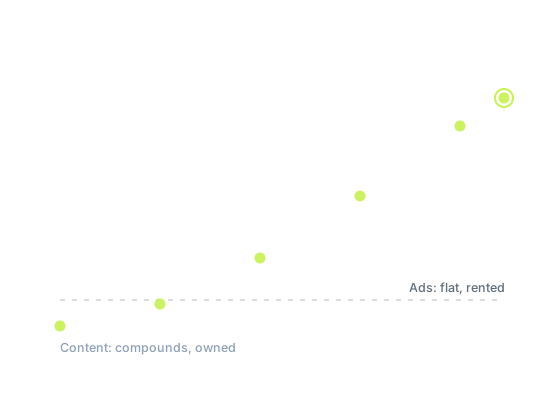
Paid ads have one quiet, permanent flaw: the day you stop paying, you disappear. A content engine is the opposite. It is the one marketing asset a workers’ comp firm can build that keeps working after the invoice is paid.
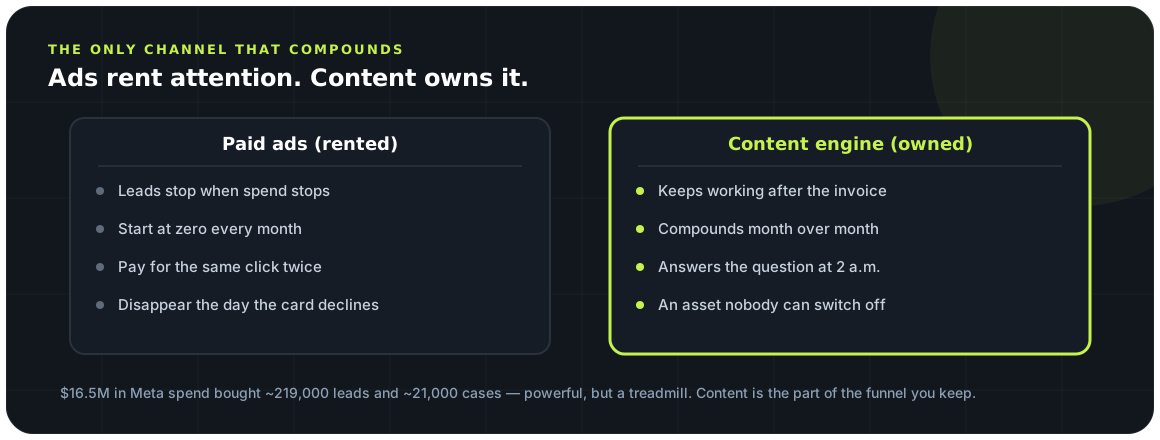
Across the firms I have run marketing for, paid social did real work — roughly $16.5M in Meta ad spend, about 219,000 injured-worker leads at around $75 each, and near 21,000 signed cases. That machine is powerful, and it is also a treadmill. Turn it off and the leads stop the same afternoon. Every month you start again at zero and buy the same attention over. It is rented, not owned, and the rent never stops.
Content is the part of the funnel that compounds. An article that ranks for “how long does a workers’ comp claim take” does not stop working when the month ends. It answers that question at 2 a.m. for a frightened worker in your city, and it does it again tomorrow, and next quarter, with no additional spend. Write thirty of those and you have not run thirty campaigns — you have built an asset that quietly sends cases to your door while you sleep. This article is about how to build that asset on purpose, so it produces signed cases instead of sitting on a “News” page nobody visits.
Why content is the only channel that compounds
Think of your marketing in two buckets. The first is rented attention: Google Ads, Meta, Local Services Ads, purchased leads. You pay, you appear; you stop, you vanish. The economics are honest and immediate, and for a firm that needs cases this quarter, indispensable — we cover the paid side in depth in the marketing budget guide. But the meter never stops, and the price of attention only ever goes up.
The second bucket is owned attention: a website and a body of content that ranks on its own merits. It is slow to start and nearly free to keep. An article you publish this month can still be the top organic result for its question two years from now, sending you leads at an effective cost that falls every month it keeps ranking. That is the definition of a compounding asset, and it is the single most under-built thing in workers’ comp marketing.
None of this makes ads wrong. The firms that win run both: paid for the cases they need now, content for the cost curve they want later. The mistake is running only the treadmill for years and wondering why the cost per signed case never improves. It never improves because you never built the thing that makes it improve.
Start where the injured worker starts
Here is the trap most firm blogs fall into: they write about the firm. “We are proud to announce,” “our attorney spoke at,” “five reasons to choose us.” No injured worker has ever typed any of that into Google. They type their situation, in their own frightened words, usually at night, usually before they have decided they need a lawyer at all.
They type “can I be fired for filing workers comp,” “workers comp denied what do I do,” “how long does a workers comp settlement take,” “do I have to see the company doctor,” “how much is my back injury worth.” Behind every one of those searches is a person who is scared, in pain, and worried about money — and who has not yet chosen a firm. Content marketing is simply being the clearest, calmest, most trustworthy answer at that exact moment. Do that well and you are not competing on ad price; you are the source they found on their own, which is a far warmer place to start a relationship.
| What they type | What they are really afraid of | The page that answers it |
|---|---|---|
| “workers comp denied, what now” | It’s over and I’m out of options | A calm guide to appeals and next steps |
| “can I be fired for filing” | Standing up for myself will cost my job | A plain-English rights explainer |
| “how long does a claim take” | I can’t pay rent while this drags on | An honest timeline, stage by stage |
| “do I need a lawyer for workers comp” | Am I being taken advantage of | An even-handed when-to-call-one piece |
Notice what these have in common: not one is about you. Yet each is the top of a path that ends at a signed case, because the worker who trusts your answer is the worker who calls your number. The content earns the search; your intake call earns the case. And every one of these pages is a place to hand off gracefully to the rest of your library — the denied-claim reader is one honest link away from “here is when an appeal needs a lawyer.”
Pillars and clusters, not scattered posts
A pile of unrelated articles is not an engine; it is a junk drawer. What turns individual posts into ranking power is structure — the pillar-and-cluster model that search engines reward and readers actually navigate.
A pillar is the big, comprehensive page on a broad topic: “The injured worker’s guide to workers’ compensation.” Around it sit clusters — focused articles that each answer one narrower question in depth: denied claims, settlement timelines, choosing a doctor, filing deadlines, returning to work, permanent disability. Every cluster links up to the pillar, the pillar links down to every cluster, and the whole set tells Google, unmistakably, that this site is an authority on this subject. It also keeps a reader moving from the answer they came for to the three adjacent answers they will need next.
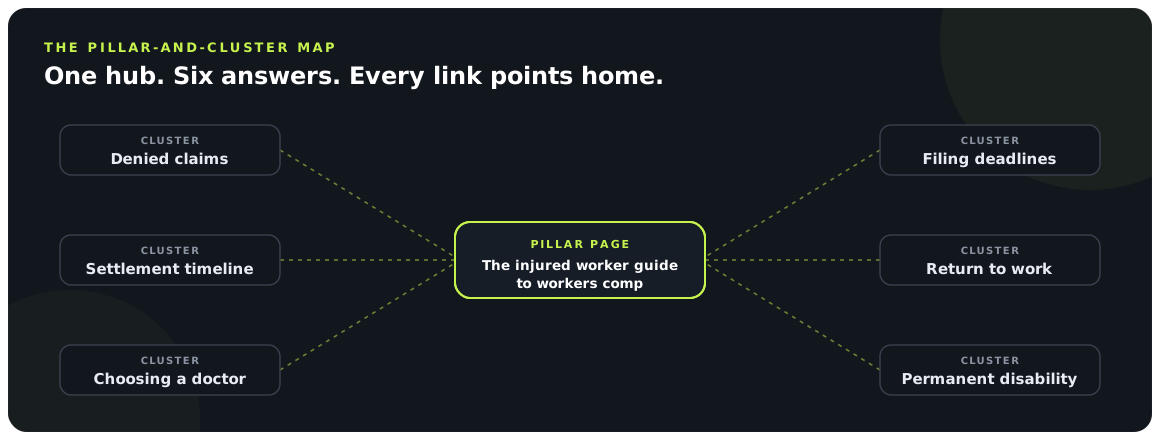
This structure is also how you avoid quietly competing with yourself. Publish four thin, overlapping posts all targeting “workers comp settlement” and Google cannot tell which one to rank, so it tends to rank none of them well — a problem called keyword cannibalization. One strong cluster article per question, linked cleanly into its pillar, is worth more than a dozen near-duplicates. Depth beats volume, and organization beats depth.
Experience on the page: the bar for a law firm
Legal content sits in the category Google treats most strictly — “Your Money or Your Life” topics, where bad information can cause real harm. For these subjects the bar for what ranks is demonstrated experience, expertise, authority, and trust. A generic, anonymous article scraped together from other websites will not clear it, and increasingly it should not.
For a workers’ comp firm this is a gift, not a burden, because experience is the one thing you have that a content mill never will. You have handled the denied claim, sat across from the adjuster, argued the hearing. Put that on the page. Name the attorney who stands behind the article. Reference how the process actually works in your state, because workers’ comp is governed state by state and the specifics matter enormously to the reader. Be accurate, be current, and be honest about what you cannot promise. That firsthand authority is exactly what both Google and a scared human are looking for, and it is unfakeable.
The content mills can out-publish you. They cannot out-experience you. On a legal topic, that is the whole game — and it is the one advantage a real firm can’t lose.
Spencer Moeller, WorkersComp Marketing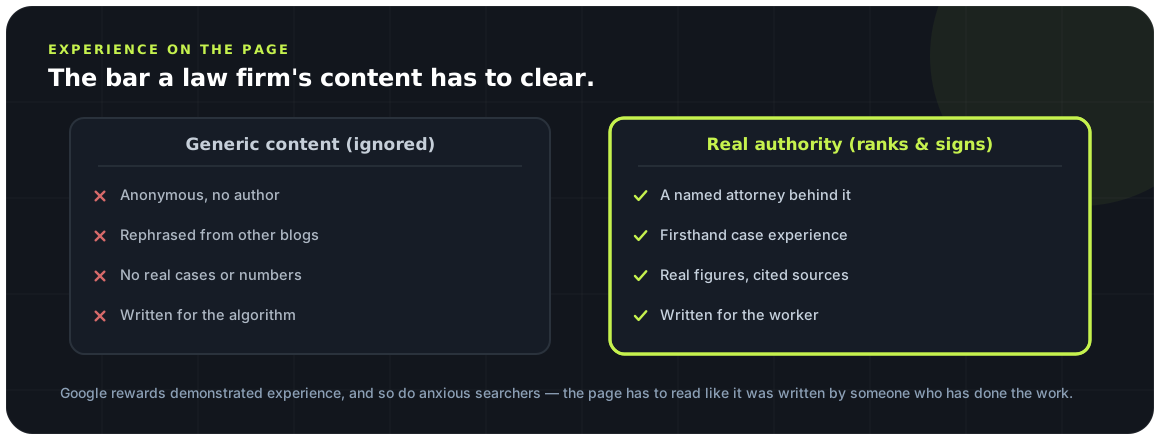
The one-post-a-quarter trap
The most common way a firm’s content engine dies is not a bad strategy — it is starvation. Someone gets excited, publishes three posts in a month, then the quarter gets busy and the blog goes silent for a year. A compounding asset cannot compound if you stop adding to it. Search engines reward sites that are alive and consistently useful, and readers can smell a page that was last updated in a different presidential term.
The fix is not heroics; it is a sustainable, boring cadence you can actually hold. One genuinely useful, in-depth article every week or two, forever, will bury a competitor who sprints for a month and then quits — every single time. Consistency is the whole secret, and it is unglamorous on purpose.
If a weekly cadence sounds impossible with everything else a firm carries, that is the honest argument for help — a marketing partner or a disciplined internal owner whose only job is to keep the engine fed. What cannot work is treating content as the thing you do when there is nothing else to do. There is always something else to do. The engine has to be someone’s actual job, or it quietly becomes no one’s.
Measuring content without lying to yourself
Content marketing dies in two ways: starvation, and being measured by the wrong number. Pageviews are the wrong number. Ten thousand views from people who will never have a workers’ comp claim are worth nothing; two hundred views from injured workers in your state who then call you are worth a quarter of revenue. Vanity metrics feel like progress and fund nothing.
Measure the things that map to cases. Which queries do you now rank for, and are they queries an injured worker would type? How many organic leads — calls and form fills that started with a search, not an ad — arrive each month? And, hardest and most important, how many signed cases had a content page somewhere in their path? That last one requires honest attribution, because content is usually an assist: the worker reads your denied-claims article in March, sits with it, and calls in May after the second denial. The dashboard that only credits the last click will tell you content did nothing. It is lying to you, in exactly the way we take apart in the attribution guide.
A first-90-days build order
You do not need a hundred articles to start. You need the right first ten, in the right order, wired together on purpose.
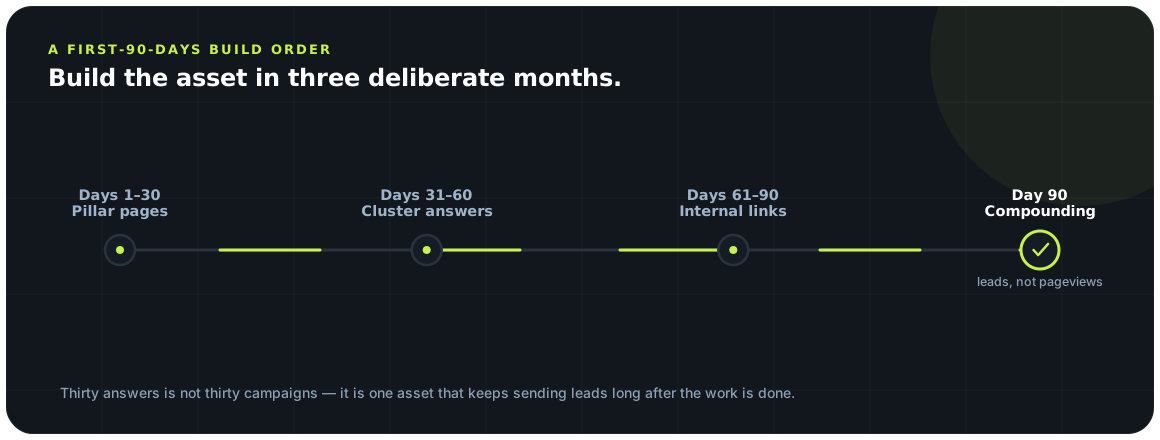
- Weeks 1–2 — harvest the real questions. Pull the actual questions your intake team hears every week and the phrases people search. That list, not a marketing brainstorm, is your content plan.
- Week 2 — draw the map. Pick one pillar (“the injured worker’s guide to workers’ comp”) and six clusters from the questions above. Put them on one page with the links drawn in.
- Weeks 3–10 — publish the pillar, then one cluster a week. Each piece is the best answer on the internet to its question, attributed to a named attorney, accurate for your state.
- Ongoing — link every piece home. Every cluster links up to the pillar and out to two siblings; the pillar links down to all of them. Nothing published is an orphan.
- Week 6 onward — measure cases, not clicks. Track ranked queries, organic leads, and assisted signed cases. Feed what works; retire what only earns pageviews.
- Day 90 — decide the cadence you can hold. One deep piece a week or every two weeks, owned by a specific person, indefinitely. The engine only compounds if it never stops.
Do this and in a year you will own a body of answer-content that competitors cannot buy back overnight, sending you injured-worker leads at a cost that keeps falling. It is the slowest channel to start and the only one that gets cheaper the longer you run it. Every other stage of the machine — from the map pack to the website to the intake that catches the call — works better when content is feeding it.
Key takeaways
-
Content is the only channel that compounds. Ads stop the day you stop paying; content keeps ranking and earning for years.
-
Start where the injured worker starts. Answer the questions they actually type, not the ones you wish they would ask.
-
Pillars and clusters, not scattered posts. A deliberate topic structure out-ranks a pile of one-off articles.
-
Experience on the page is the bar for a law firm. Search rewards first-hand expertise; generic restated advice does not rank.
-
The one-post-a-quarter trap kills it. Content compounds only with consistency; sporadic publishing never reaches escape velocity.
Frequently asked questions
How is a content engine different from just having a blog?
A blog is a place you occasionally post firm news. A content engine is a deliberately structured library built around the questions injured workers actually search, organized into pillars and clusters, internally linked, and measured in leads and signed cases. The difference is intent and structure: one is a diary, the other is a lead channel you construct one article at a time.
How long before content produces leads and cases?
Longer than ads and shorter than most firms fear. New articles on a young site often take a few months to climb, and the compounding really shows up somewhere around six to twelve months in, as pages mature and rank. It is the slowest channel to start, which is exactly why so few firms have built it — and why it is such a durable advantage once you have.
Can we just use AI to write the articles?
AI can help you draft and outline, but it cannot supply the one thing that makes legal content rank and convert: real, firsthand experience with how these claims actually go, reviewed by a named attorney and accurate for your state. Thin, unreviewed, spun content is worse than none on a legal topic — it trains Google to distrust your domain and hands a scared reader shaky information. Use AI as an assistant, never as the author of record.
How many articles does a firm actually need?
Fewer, deeper, and better-organized beats a big pile of thin posts. A single strong pillar with six to ten focused cluster articles, each the best answer to its question and linked cleanly together, will out-rank a site with fifty overlapping near-duplicates. Start with the right ten, then add on a cadence you can hold, rather than chasing a word count.
Should our content target our city or the whole state?
Both, on purpose. Broad answer-content (“how long does a claim take”) can serve your whole state and pairs with your local pages, while workers’ comp law itself is state-specific, so getting your state’s rules right is non-negotiable. Pair the content engine with local SEO so the map pack and your articles reinforce each other rather than compete.
Where should a firm start?
With the questions your intake team already hears every week, not a marketing brainstorm. Turn those into one pillar and a handful of clusters, publish the best answer on the internet to each, link them together, and measure signed cases rather than pageviews. Then hold a cadence you can actually sustain — the engine only compounds if it never stops.
Sources & further reading
-
01
Where content meets search
The surfaces content has to win.
- 02
-
03
Run it like a budget line
Fund it, measure it, keep it compliant.
Benchmarks here draw on WorkersComp Marketing’s own managed-spend data across live firms; your numbers will differ. General marketing information, not legal advice.