Injury does not keep office hours. Intake, at most firms, does.
The warehouse shift ends at eleven. The ER discharges at 1 a.m. The denial letter gets re-read at the kitchen table on Sunday, after the kids are in bed, and that is the moment the phone finally comes out. None of these moments checks your office schedule first — and every one of them is a case deciding, right then, which firm to trust.
This article maps where those cases go when the office is dark, and then builds the coverage system rung by rung: the honest self-audit, the coverage ladder, the instant-response bridge, the night script, weekends and holidays, Spanish-language coverage, and the measurement that tells you what your own after-hours share actually is.
Injury doesn’t keep office hours
The week is 168 hours. A standard office covers about 45 of them.
Start with the arithmetic that nobody runs. A Monday-to-Friday, nine-to-five office is staffed for roughly 45 hours a week. The week has 168. Everything outside that band — every evening, every night, every weekend — belongs to voicemail.
Now think about who your clients are. Workers’ comp is the practice area of second shifts, third shifts, overnight warehouse crews, hospital staff, drivers, and cleaners. A meaningful share of your future clients are at work during your business hours — that is precisely why they are your future clients. The hour they are free to sit down, think about their injury, and talk about it honestly is the hour your office is closed.
Layer the injury timeline on top. The incident happens mid-shift; the ER visit runs into the night; the pain that “will probably be fine” declares itself at 2 a.m.; the claim denial arrives in Tuesday’s mail but gets truly read — slowly, angrily, twice — after dinner. Each of those beats produces a search, a form-fill, or a call. Almost none of them lands between nine and five.
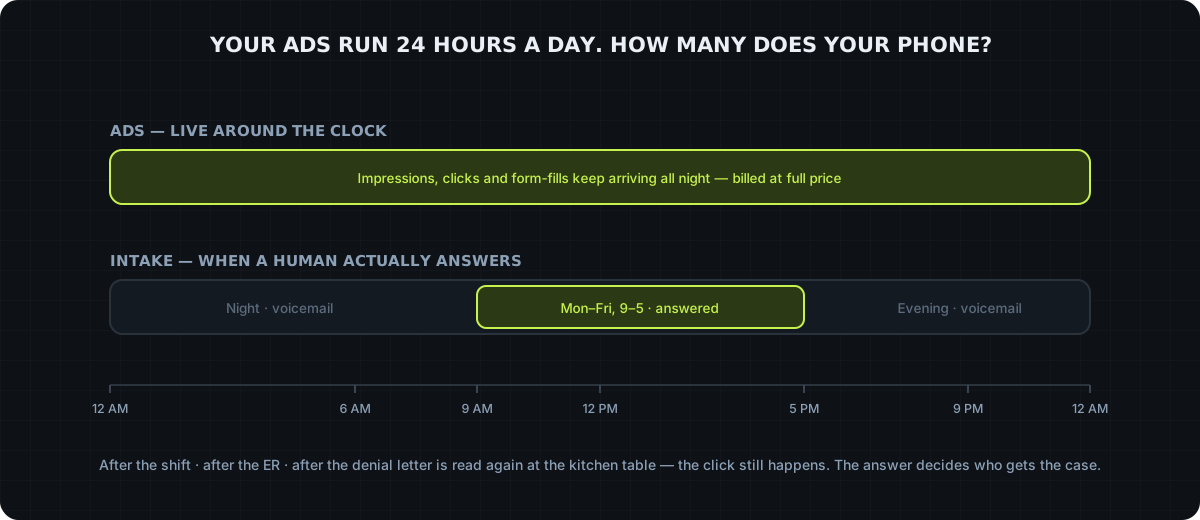
Meanwhile, your marketing never clocks out. Meta and Google will happily serve your ads at 11 p.m., charge you for the click, and deliver the form-fill to an inbox nobody reads until morning. The mismatch is structural: a 24-hour demand engine bolted to a 45-hour response engine.
The honest audit: call your own firm at 8:30 p.m.
Before buying anything, find out what actually happens when you’re closed. Most owners have never checked.
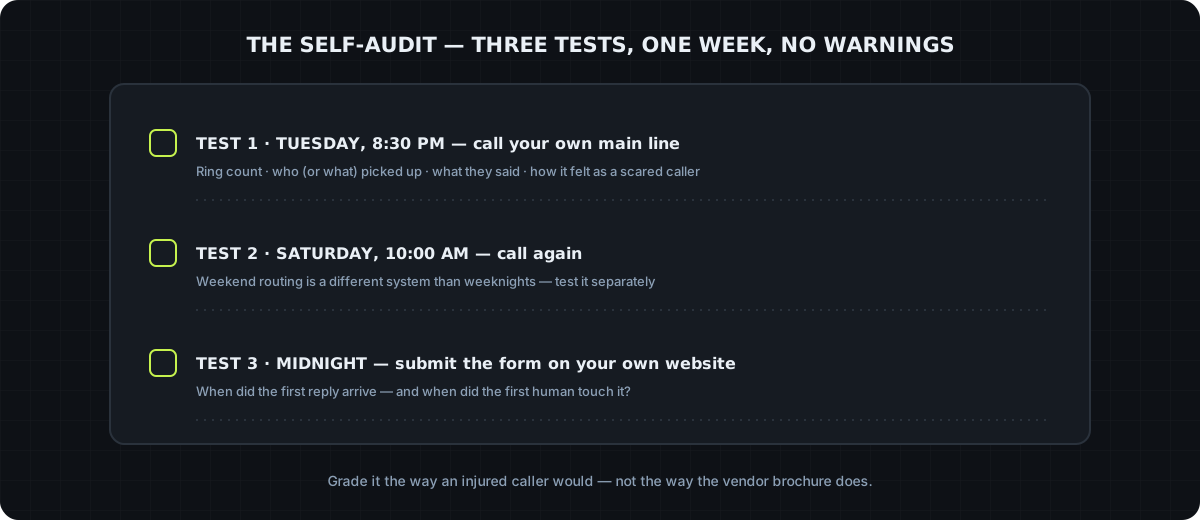
Every fix in this article is cheaper and better-targeted if you first know your real starting point. So run the audit — this week, unannounced, without warning your team or your answering service. Three tests:
Test one: Tuesday, 8:30 p.m. Call your own main line. Use a phone your caller ID won’t give away. Count the rings. Note who — or what — picks up. If it is a voicemail greeting, listen to it the way a frightened caller would: does it offer any path forward tonight, or does it just recite your hours? If it is an answering service, play the part: “I got hurt at work last week and I don’t know what to do.” Write down exactly what they say next.
Test two: Saturday, 10:00 a.m. Call again. Weekend routing is usually a different configuration than weeknights — different forwarding rules, different service tier, sometimes a setting someone changed two years ago and forgot. Saturday mid-morning is prime research time for someone who was hurt during the week and finally has quiet to deal with it. Test it separately.
Test three: midnight. Submit the form on your own website. Then watch two clocks: when does the first automated reply arrive (if ever), and when does the first human touch happen the next day? If your form submission at midnight produces silence until someone opens the shared inbox at 9:40 the next morning, you now know your true speed-to-lead for a night lead is measured in hours, whatever your daytime numbers say.
Score each test on one question only: would an anxious injured worker, holding a phone in a dark kitchen, feel caught — or dropped? Not “did the system technically function.” Caught or dropped. Most firms that run this audit honestly find at least one dropped, and it is usually the one they were most confident about.
The coverage ladder
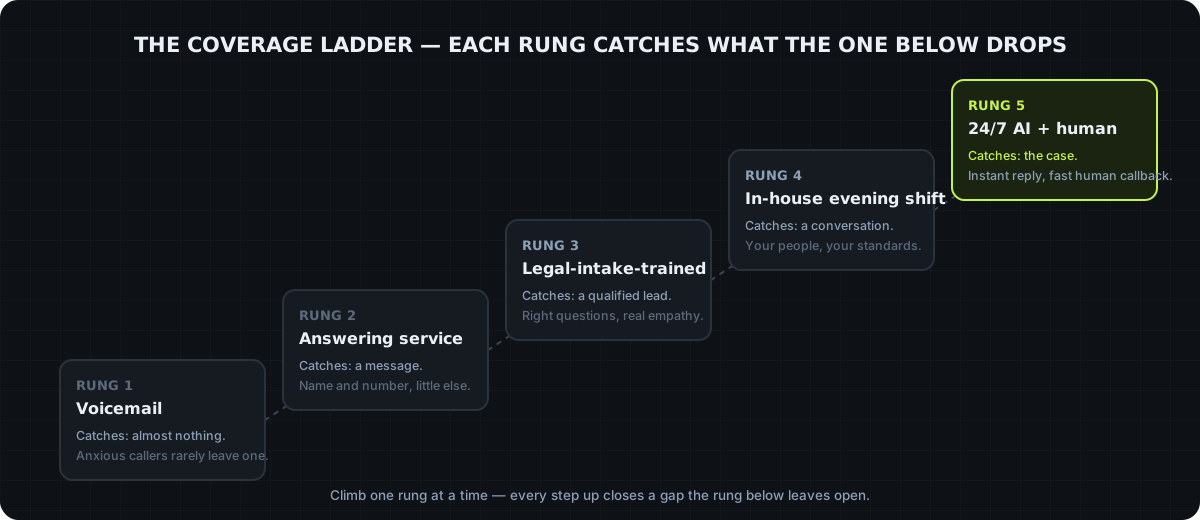
Five rungs, from voicemail to genuine 24/7. Each rung catches what the one below drops.
After-hours coverage is not a yes/no question. It is a ladder, and every firm is standing on one of five rungs whether they chose it or not.
Rung 1 — Voicemail
The default, and functionally a closed sign. An anxious caller who reaches a recording rarely leaves a message; they hang up and dial the next result. Voicemail does not capture after-hours demand — it documents that you missed it.
Rung 2 — A generic answering service
A human answers, which is genuinely better than nothing: the caller is acknowledged, and a message exists in the morning. But a generic operator reads from a card that fits any business. They cannot empathize specifically, cannot tell a workplace injury from a slip-and-fall at the grocery store, and cannot say anything reassuring about what happens next. You get a name and a number — the conversation, and often the caller’s confidence, is gone.
Rung 3 — A legal-intake-trained answering service
The same coverage hours, but the people answering know what a workers’ comp call is. Armed with your script, they can lead with empathy, ask your qualifying questions, capture the facts that matter — hurt at work, medical treatment, employer notified — and make a concrete promise about the callback. For many small and mid-sized firms this is the sensible resting rung: real coverage, real qualification, without new payroll.
Rung 4 — An in-house evening shift
Your own intake person, on your own standards, working the hours when your callers are actually free — say, into mid-evening on weekdays. Nobody sells your firm like someone who works for your firm: they can speak to your process, your attorneys, your track record, and they can move a caller from “message taken” to “appointment set” in one conversation. The trade is management: scheduling, training, and covering the sick days yourself.
Rung 5 — 24/7: AI-assisted first response plus guaranteed human callback
The top rung is not “a human awake at 3 a.m. forever” — for most firms that is neither realistic nor necessary. It is a system: every call and form at any hour gets an instant, competent first response (automated text and email, an AI assistant that can acknowledge, empathize, and collect basics, or a trained overnight service), and every one of those contacts is guaranteed a fast human callback at a stated time. Instant acknowledgment, human follow-through, no exceptions — that combination is what “always open” actually means in practice.
| Rung | What it catches | Where it fails |
|---|---|---|
| 1. Voicemail | Almost nothing | Anxious callers don’t leave messages |
| 2. Generic answering service | A message | No empathy specific to injury, no qualification |
| 3. Legal-intake-trained service | A qualified lead | Still an outside voice; hours may not be truly 24/7 |
| 4. In-house evening shift | A real conversation | Coverage ends when the shift does; you manage it |
| 5. 24/7 AI + human callback | The case | Only fails if the human callback promise is broken |
Climb one rung at a time. The jump from voicemail to a trained service changes more than the jump from a trained service to 24/7 — fix the biggest hole first.
What each rung costs — and what it protects
Think in cases, not line items. One signed case pays for a long stretch of coverage.
We deliberately won’t put dollar figures on the rungs — pricing varies by market, vendor, and volume, and any number printed here would be wrong for your firm by the time you read it. But the shape of the math is the same everywhere, and it is worth stating plainly.
A signed workers’ comp case is one of the most valuable single outcomes your firm produces. A month of answering-service coverage, or the automation that acknowledges every form instantly, costs a small fraction of what one signed case is worth. So the question is never “can we afford coverage?” It is: over a whole year of nights and weekends, do we believe better coverage captures at least one case we would otherwise have lost? If the honest answer is yes — and after the audit, it almost always is — the coverage funds itself, and everything past that first case is margin.
The real cost of each rung is mostly effort, not money. Voicemail costs nothing and protects nothing. A generic service costs a modest subscription and a routing change; it protects the message but not the momentum. A trained legal-intake service costs the same money plus real setup work — writing the script, defining the qualifying questions, holding the vendor to your standard with test calls. An evening shift costs hiring and management attention. The 24/7 system costs integration work up front — connecting forms, texts, the CRM, and the callback workflow so nothing depends on someone remembering.
One more cost worth naming: the burnout cost of pretending. Firms that “handle” after-hours by forwarding the main line to a partner’s cell phone are choosing the most expensive coverage there is — attorney attention — and applying it at the hours attorneys are least able to give it well. It works until the week it doesn’t, and it usually collapses without anyone deciding to stop. Build a system instead of borrowing a person.
The instant-response bridge
The moment a form lands, something must answer — and then a human must actually call.
Whatever rung you occupy on the phone side, one piece of the system is available to every firm this week: the instant-response bridge for forms and messages.
The mechanics are simple. The moment a lead submits your website form — 2 p.m. or 2 a.m. — an automated text and email go out immediately: “We got your message about your work injury. You’ve reached the right place. A member of our team will call you at [time] — from this number, so you know it’s us.” The submission simultaneously lands in the CRM and pings whoever owns the next callback window, so the promise has an owner before the caller has put their phone down.
This matters because of what the night hours otherwise do to your response time. We have written at length about the speed-to-lead discipline — MIT’s lead-response research found that responding within five minutes rather than thirty made firms up to 21× more likely to qualify the lead. During office hours, a disciplined team can win that race live. At midnight, no one can — unless something automatic answers first. Response within minutes dramatically outperforms response within hours, and the bridge is how a closed office still responds within minutes.
Be clear about what the bridge is and is not. It is not the response — it is the receipt that keeps the lead from walking while the real response is scheduled. An autoresponder that promises a callback that never comes at the stated time is worse than silence, because it converts a missed connection into a broken promise. The automation and the human callback are one system; installing the first without operating the second is how firms end up distrusted by the exact leads they paid the most to reach.
This is the layer where done-for-you tooling earns its keep: our AI automation service exists to wire exactly this bridge — instant acknowledgment, CRM routing, callback ownership — so speed stops depending on who happens to be awake.
Scripting the night call differently
The 9:40 p.m. caller is not a daytime caller who dialed late. Write them their own script.
Whoever answers your night line — trained service, evening staffer, or the on-call rotation — needs a script written for who is actually calling. The daytime caller may be organized, on a break, working through a list. The night caller is anxious, possibly in pain, possibly sitting in an ER parking lot, possibly three hours into re-reading a denial letter. They did not call at 9:40 p.m. because it was convenient. They called because it could not wait.
So the night script inverts the usual order: empathy first, qualification second.
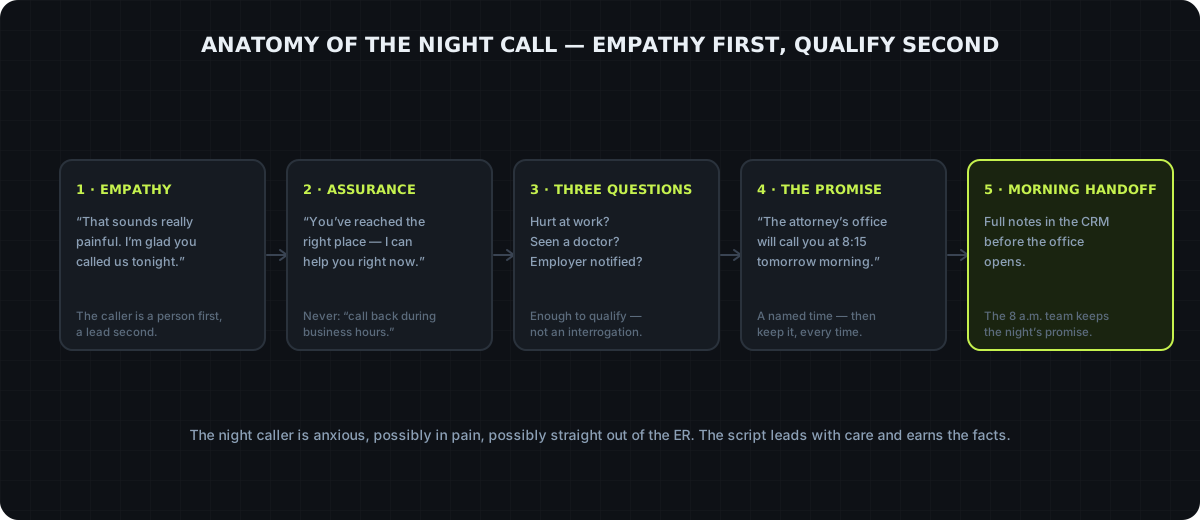
Open with empathy. “That sounds really painful — I’m glad you called us tonight.” Ten words, and the caller knows they reached a person, not a process. Then assurance: “You’ve reached the right place, and I can help you right now.” The night caller’s background fear is that nothing can happen until morning; the assurance dissolves it. Then three questions, gently: were you hurt at work? Have you seen a doctor? Does your employer know? That is enough to qualify a workers’ comp lead — anything more at this hour is an interrogation of a person who needs a blanket, not a deposition.
Then the promise: a named time. “The attorney’s office will call you at 8:15 tomorrow morning.” Not “first thing,” not “as soon as possible” — a time. And finally the morning handoff: the night conversation, in full, sits in the CRM before the office opens, so the 8:15 caller opens with “you spoke with Maria last night about your shoulder” instead of “can you spell your name for me?” The handoff is what makes the night call feel, to the client, like one continuous act of care instead of two disconnected shifts.
There is one sentence a night caller must never hear, in any wording, from any rung of your ladder: “call back during business hours.” The caller who hears it does — someone else’s.
Spencer Moeller, WorkersComp MarketingIf you have already built your daytime script around the first ninety seconds of the intake call, the night version is not a new document — it is the same skeleton with the empathy dialed up, the question count dialed down, and the close changed from “let’s schedule you” to “here is exactly when we call you.”
Weekends and holidays
The weekend is not overflow. For working people, it’s the main research window.
It is tempting to treat weekends as a smaller version of the weeknight problem. They are not. For a person who works full-time, the weekend is often the only unhurried stretch in the week — the time to sit with a spouse, look at the pay stub and the medical bill, search “workers comp lawyer near me,” and make three calls. Saturday and Sunday are not the leftovers of the week’s demand; for your audience, they are prime time that happens to fall on days your office was never staffed.
Plan them deliberately. Decide who owns Saturday and Sunday — service, rotation, or shift — and put it in writing, because “the weekend is covered” without a name attached means it is not. If you run an on-call rotation, keep the load humane: a rotation that quietly burns out your best intake person costs you more than it catches. And test weekend routing on an actual weekend, because forwarding rules have a way of differing from the weekday configuration in ways nobody remembers choosing.
Holidays deserve their own line in the plan, and not only because the office is closed. Holidays are when family gathers — and family is where injured workers finally get told, out loud, “you need to call a lawyer about that.” Long weekends produce decisions. Put the year’s holidays on the intake calendar in January, assign coverage the same way you assign it for Saturdays, and treat the Tuesday after a long weekend the way retailers treat the day after a sale: heavier inbound, worked oldest-first.
Spanish-language coverage after dark
Bilingual at 10 p.m. is a differentiator almost nobody in your market has.
In most markets, a large share of the workforce in the highest-injury industries — construction, warehousing, food processing, agriculture, hospitality — speaks Spanish at home. Plenty of firms have acknowledged this during business hours: a bilingual intake person, a translated website page. Far fewer have thought about what happens when a Spanish-speaking worker calls at 10 p.m.
Run your audit again, in Spanish, and you will usually find the coverage gap doubled. The English caller who reaches a voicemail at least understands the recording. The Spanish-speaking caller may reach an English-only greeting, an English-only answering service, or an autoresponder text in a language they read with difficulty — at the exact moment they are most frightened and least willing to struggle through a second language about a legal problem. They hang up faster, and they are even less likely to leave a message.
Which is exactly why this is a differentiator rather than a checkbox. Every rung of the ladder has a Spanish version: a bilingual voicemail greeting is the floor; answering services can be contracted with Spanish-capable operators — ask specifically about nights, not just daytime staffing; your instant-response bridge can send the acknowledgment text in the language of the form the lead filled out; and your night script deserves a real Spanish translation, by a fluent speaker, not a machine pass — empathy is the part of the script that translation software mangles first.
One honesty rule: never advertise “Se habla español” beyond the hours it is actually true. A Spanish-speaking caller who saw the promise and reaches an English-only night line has been failed twice — once by the gap and once by the claim. Match the promise to the coverage, then grow the coverage — because in most markets, the firm that genuinely answers in Spanish at night has no competition for those hours at all.
Measure it — and the ad-spend connection
Your after-hours share is a report, not a guess. Then make your ads and your hours tell the same story.
Everything above rests on one number this article has deliberately refused to invent for you: how much of your demand arrives after hours. Industry averages are quoted loosely and vary by market, channel mix, and audience. You do not need them. Your CRM already logs a timestamp on every call, form, and chat. Group them by hour of day and day of week, look at ninety days, and you have your own answer — not an average of other people’s.
Read the report with three questions. First, what share of total contacts arrives outside staffed hours? That is the size of the exposed surface. Second, what happens to those contacts — compare contact rate and signed rate for after-hours leads against business-hours leads, and the gap between those two numbers is, roughly, what your current rung is costing you in outcomes. Third, where do the after-hours contacts cluster? If your volume peaks in the two hours after dinner, an evening shift until 9 p.m. may capture most of the value of “24/7” at a fraction of the effort. Let your own histogram, not a vendor pitch, choose your rung.
If your current setup cannot produce this report — if calls, forms, and chats live in different tools with no shared timeline — that is a finding in itself, and fixing it is the first job. This hour-by-hour view is a standard report in the intake and CRM systems we build precisely because coverage decisions made without it are guesses with invoices attached.
And then the connection that makes this a marketing article and not just an operations one. Your ad account does not close at five. If you run paid campaigns around the clock while intake sleeps, you are paying full price for a class of leads your firm structurally cannot win — the platforms bill the same for the 11 p.m. click as the 11 a.m. one, but only one of them reaches a firm that answers. Slow after-hours response quietly inflates your cost per signed case, and firms routinely misread that inflation as “the ads getting worse” when the traffic never changed — the coverage did.
You have two honest ways to close that gap. The better one is the whole point of this article: extend coverage until your intake matches the hours you advertise, and the after-hours leads you already pay for start converting like daytime ones. The fallback is dayparting — restricting ad delivery toward the hours you can genuinely answer. It is the weaker play, because it shrinks the firm to fit the phone schedule and concedes the night to whoever stays open. But it is at least coherent. The one indefensible configuration is the one most firms are running right now: buying the night at full price and staffing it with a recording.
Key takeaways
-
Injury does not keep office hours; intake does. Most firms pay for clicks all evening and let the calls they generate ring out after five.
-
Audit it the honest way: call your own firm at 8:30 p.m. What a prospect hears after dark is the real state of your intake.
-
Coverage is a ladder, not a switch. Overflow, answering service, trained after-hours, 24/7: each rung costs more and protects more. Pick the rung your spend justifies.
-
The night call needs a different script. After dark the job is to reassure and secure the next step, not to run a full daytime intake.
-
After-hours coverage is an ad-spend decision. Every evening lead that goes unanswered is media budget you already spent and lost.
Frequently asked questions
Do injured workers really contact law firms at night?
Yes — and it follows directly from how work injuries happen. Second- and third-shift workers get hurt outside business hours by definition, ER visits run late, and the quiet moments when someone finally decides to call a lawyer — after dinner, after the kids are down, after re-reading a denial letter — mostly fall outside 9 to 5. Pull your own CRM data by hour of day and you will see your firm’s actual after-hours share rather than an industry average.
What counts as after-hours for a workers’ comp firm?
Every hour a qualified caller cannot reach a human who can help them: evenings, nights, weekends, and holidays — plus the quieter gaps like lunch coverage and the first and last thirty minutes of the day. A standard office week covers roughly 45 of the week’s 168 hours, so for most firms the majority of the week is after-hours.
Is a standard answering service good enough for workers’ comp intake?
It is better than voicemail, but a generic service takes messages — it does not do intake. An operator with no legal training cannot empathize specifically, cannot ask the three qualifying questions, and cannot make a credible promise about next steps. If you use a service, use one trained on legal intake and give it your script, your qualifying questions, and a hard rule against telling anyone to call back during business hours.
Should we use AI to answer after-hours leads?
Use AI as the first response, not the whole response. An automated text or AI assistant can acknowledge the contact instantly, express empathy, collect basic facts, and promise a specific human callback — that beats silence in every way. What it should not do is pretend to be a lawyer or replace the human call. The pairing that works is instant AI-assisted acknowledgment plus a fast, guaranteed human follow-up.
What should a night intake script never say?
Never say some version of “call back during business hours.” The night caller is anxious, possibly in pain, possibly just home from the ER — being told to call back tells them they called the wrong firm, and the next number they dial answers. The script should lead with empathy, assure them they have reached the right place, ask a few gentle qualifying questions, and end with a specific, kept promise about when a human calls them back.
Should we just pause our ads at night instead?
Dayparting is the honest fallback if you truly will not build coverage — at least you stop paying for leads you structurally cannot win. But it is the weaker play: you are shrinking your firm to fit your phone schedule instead of growing your phone schedule to fit demand, and you disappear during the hours when injured workers do much of their deciding. Fix intake first; cut hours only as a last resort.
Sources & further reading
-
01
The intake system
Everything the after-hours layer plugs into.
-
02
Automate the off-hours
Cover evenings and weekends without adding headcount.
Benchmarks here draw on WorkersComp Marketing’s own managed-spend data across live firms; your numbers will differ. General marketing information, not legal advice.