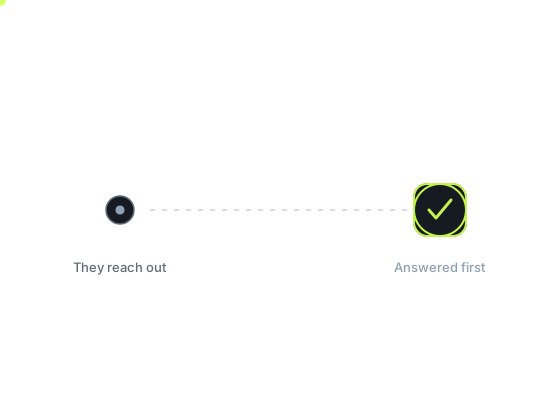
You do not have an attention problem at the top of your funnel. You have a response problem at the bottom of it, and it is where signed cases go to die.
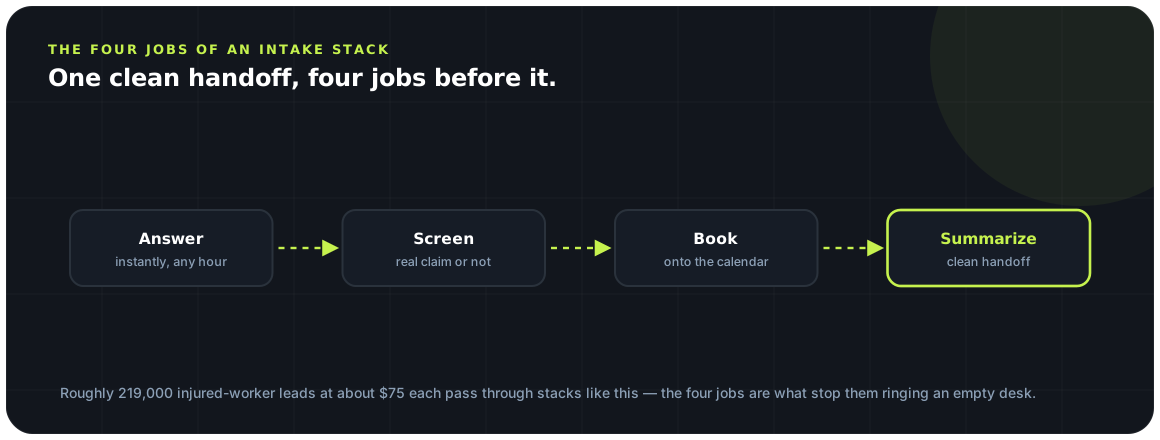
Spend any time inside a workers’ comp firm’s phone logs and a pattern appears that no amount of ad budget fixes. The leads arrive. Someone even paid a fair price for them — across the firms I have run marketing for, roughly 219,000 injured-worker leads at about $75 each. And then a meaningful share of them ring an empty desk, hit a voicemail box, or land in a web form that nobody touches until tomorrow. By tomorrow the worker has already talked to two other firms and signed with one of them.
This is not a criticism of your staff. It is arithmetic about human coverage. A person cannot answer a midnight call, work a hearing, and greet a walk-in at the same time, and injured workers do not file their pain during business hours. The gap between “a lead arrived” and “a human responded” is where automation earns its place — and where, done wrong, it can also do real damage. This article is about doing it right: what to automate, what to never automate, and the order to build it in.
Speed-to-lead is the whole game
The injured worker is not comparison shopping. They are calling down a list until someone answers.
An injured worker rarely researches firms for a week. They are frightened, often in pain, sometimes worried they are about to be fired for filing at all. So they do what anyone does in a crisis: they call the first number, and if no one answers, the second. The firm that responds while the worry is still hot is usually the firm that signs the case. We wrote a whole piece on why the first five minutes decide the case; AI intake is simply how you win those five minutes on every lead, not just the ones that happen to arrive when a person is free.
The reason this matters more in workers’ comp than almost anywhere else is the emotional state of the caller. This is not a plumbing quote they can get tomorrow. Research from the Workers Compensation Research Institute on why injured workers hire attorneys found the biggest drivers were fear of being fired, the sense that a supervisor doubted the injury was real, and the belief the claim had been denied. A caller carrying that fear will not leave a second voicemail. They will call the next firm. Every minute of delay is not a neutral wait — it is an open door for a competitor and a widening crack in the caller’s nerve.
What AI should do — and never do
The moment automation tries to be the lawyer, it stops helping and starts hurting.
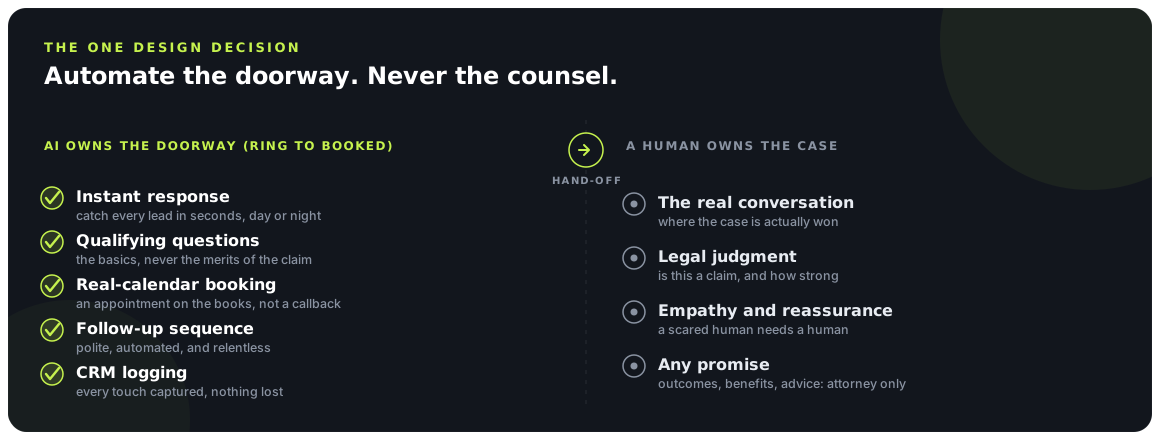
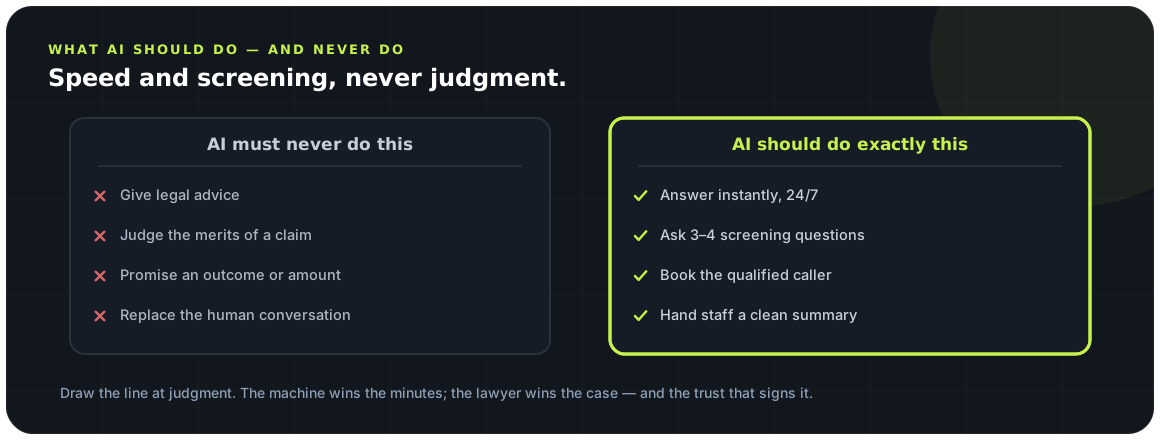
The firms that get burned by AI intake are the ones that pointed it at the wrong job. They tried to make a bot replace the intake conversation, and injured workers — who are already afraid no one is taking them seriously — felt handled by a machine and hung up. The firms that win pointed AI at the jobs a machine is genuinely better at than a tired human at 11 p.m., and kept the human exactly where empathy and judgment live.
The dividing line is simple. AI is excellent at the parts of intake that are fast, repetitive, and available — instant acknowledgment, a few qualifying questions, scheduling, and follow-up. It is dangerous at the parts that require reading a frightened person, exercising legal judgment, or making a promise. Keep it on its side of that line and it is the best receptionist you will ever hire. Push it across and it becomes a liability with your name on it.
The four jobs of an intake stack
Not one tool. Four functions that hand off cleanly to each other and to your people.
“AI intake” is not a single product you buy; it is four jobs wired together. You can run all four through one platform or stitch them from parts, but the functions are what matter. Get them in order and each one feeds the next.
1. Instant response, on every channel
The first job is to make sure no lead ever hits silence. A missed call triggers an immediate text back. A web form fires an instant reply and a real-time alert to whoever is on. A website chat answers in seconds instead of collecting an email for later. The goal is that within moments of reaching out, the worker hears some version of “we’ve got you, and a person is coming” — because that sentence, delivered fast, is what stops them dialing the next firm. This is the same logic behind reactivating older leads, applied to the live ones you are paying for right now.
2. Qualification without an interrogation
The second job is to ask the few questions that separate a real workers’ comp matter from a car accident, a non-injury call, or a wrong number — gently, and without making a hurt person fill out a form that feels like a claim denial in advance. Was the injury at work? Roughly when? Have they reported it to the employer? Are they already represented? Four questions, conversational, is plenty to route the lead. The point is not to build a case file; it is to make sure the human minutes go to the callers who deserve them.
3. Scheduling that closes the loop
The third job is to turn an interested caller into a booked conversation before they cool off. AI that can offer real calendar times and confirm one on the spot converts far better than “someone will call you back,” because it removes the second wait — the one after the first contact — that quietly kills so many leads. A booked, reminded appointment is a dramatically stronger asset than a name on a callback list.
4. Follow-up for the slow yes
The fourth job is patience. Most injured-worker leads are not ready to sign on the first touch, and a firm that treats “not today” as “no” is discarding cases it already paid for. A polite, automated sequence — a text a day later, a check-in that week, a resource that helps — keeps you present without harassing anyone. This is the slow yes, run by a system that never forgets and never gets discouraged.
| Job | Owner | What breaks without it |
|---|---|---|
| Instant response | AI, every channel, 24/7 | Leads sign with whoever answered first |
| Qualification | AI, then human review | Staff time is spent on wrong-numbers |
| Scheduling | AI booking into a real calendar | Interested callers cool off before the call-back |
| Follow-up | AI sequence, human can take over anytime | The “not yet” majority is written off as lost |
The human handoff, and why it is the point
The automation exists to deliver a warm, pre-qualified human conversation — sooner, and to more people.
Here is the reframe that makes injured workers comfortable with an AI-assisted intake instead of alienated by it: the machine is not there to keep them away from a person. It is there to get them to the right person faster, with the frantic first minutes already handled. When done well, the caller never feels processed. They feel caught — answered instantly, asked a couple of easy questions, and handed to a human who already knows the basics and can get straight to reassurance.
Good AI intake does not replace the human conversation. It protects it — by making sure it happens at all, and happens warm.
Spencer Moeller, WorkersComp MarketingThat handoff is also where your real intake skill still decides everything. Automation gets a qualified, calm caller onto your team’s calendar; from there, the outcome rests on the conversation itself — the empathy, the coverage questions, the ability to make a scared person believe they are finally being taken seriously. Everything we cover in the anatomy of the intake call still applies. AI just makes sure your best intake people are spending their minutes on the callers most likely to sign, instead of burning them on voicemails and wrong numbers.
The lines you cannot cross
Automation touches advertising, solicitation, and consent rules at the same time. Treat it as a compliance surface, not just a tech project.
The moment a machine is talking to prospects on your behalf, it is doing regulated things: making representations, contacting people, and collecting data. None of that is a reason to avoid AI intake — it is a reason to build it with your ethics counsel in the room. This is practical guidance, not legal advice, and the specifics vary by state, so treat the list below as the questions to bring to your own bar rules, not as a ruling.
Three lines come up in every build. First, texting consent: automated SMS is governed by consent rules, so your forms and scripts need clear, documented opt-in and an easy opt-out, and your follow-up cadence has to respect it. Second, no promises: the bot must never characterize the strength of a claim or guarantee an outcome — that is both a legal-judgment problem and an attorney-advertising problem, and we walk through where those lines sit in the marketing-compliance guide. Third, honest identity: do not let an AV pretend to be a specific human. It is fine for a caller to reach an automated assistant; it is not fine to deceive them about it. Reassure, gather, disclose, hand off — and keep a human able to step in at any moment.
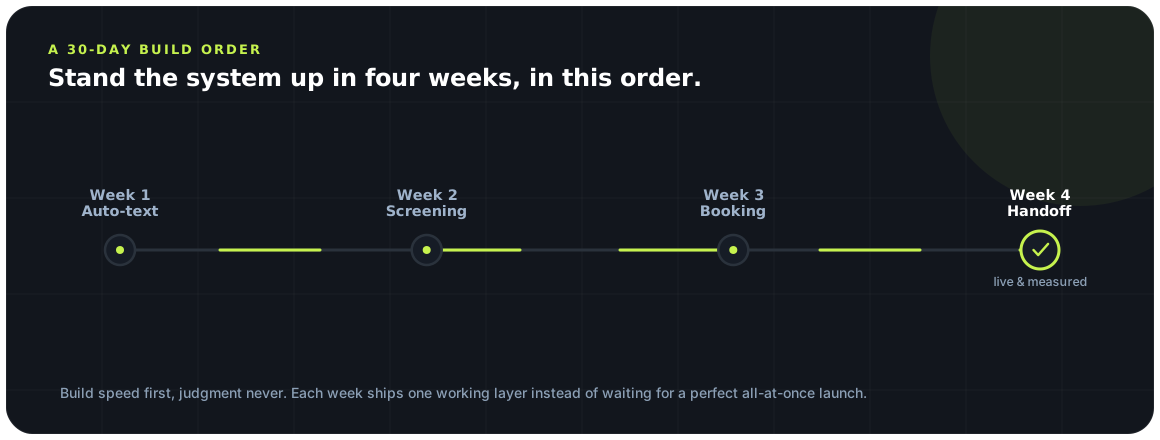
A 30-day build order
Do not buy the biggest platform first. Seal the biggest leak first.
The mistake is treating this as one large software purchase. Build it in the order of what is bleeding, and each step pays for the next.
Week 1 — measure and cover the silence. Pull one honest week of inbound by hour and day and find the holes. Turn on the single cheapest fix that exists: an automated missed-call text-back and an instant web-form auto-reply, so no lead hits pure silence while you build the rest.
Week 2 — qualify and route. Add the four-question conversational qualifier on your highest-volume channel (usually the website and inbound calls). Keep it short and warm. Wire every lead it touches into your CRM so nothing lives only in the bot.
Week 3 — book, don’t promise a callback. Connect scheduling to a real calendar so qualified callers leave with a confirmed time and a reminder, not a place on a list. This is usually the single biggest jump in signed-case rate.
Week 4 — automate the slow yes and review. Turn on the polite follow-up sequence for the “not yet” leads, and put a standing weekly human review of transcripts on the calendar. Then, and only then, evaluate whether a bigger platform (voice AI, deeper CRM sync) earns its cost — against signed cases, the way we insist on measuring everything in the attribution guide.
None of this asks you to trust a machine with your clients. It asks you to stop trusting an empty desk with your leads. The firms pulling ahead are not the ones with the fanciest bot; they are the ones who decided that “we’ll call you back” was costing them cases and built a system that answers first, every time, and hands a warm caller to a real person. That is the whole play. If you want a second set of eyes on where your own intake is leaking, that is exactly what our AI automation work starts with.
Key takeaways
-
Your funnel problem is at the bottom, not the top. It is a response problem, not an attention problem, and that is where signed cases leak.
-
AI should do speed and triage, not advice. It should respond, qualify, and route instantly; it must never give legal advice or pretend to be a lawyer.
-
The human handoff is the point, not a fallback. AI buys the minutes; a person signs the case. Design for the handoff, not around it.
-
There are lines you cannot cross. Disclosure, confidentiality, and no unauthorized practice are the guardrails that keep AI intake clean.
-
Build it in 30 days, in order. Instant response first, then qualification, then routing and measurement.
Frequently asked questions
Will AI intake make injured workers feel handled by a robot?
Only if you point it at the wrong job. Used for instant response, a few qualifying questions, and booking — then handing off to a person — it makes callers feel caught, not processed, because someone (or something) finally answered at the moment they were scared no one would. The damage happens when firms try to make a bot replace the human conversation instead of protecting it.
What should an AI never do in a workers’ comp intake?
It should never assess the strength of a claim, promise benefits or an outcome, give anything resembling legal advice, or deceive the caller about being automated. Those are legal-judgment and attorney-advertising problems at once. Script it to reassure and gather information, and to hand every real matter to a human quickly.
Is automated texting to leads allowed?
Automated SMS is governed by consent rules, so you need clear, documented opt-in and an easy opt-out, and your follow-up cadence must respect both. This is practical guidance, not legal advice; confirm the specifics with your ethics counsel and your state’s rules before turning on any automated messaging.
Do we still need human intake staff?
Yes — more than ever, just pointed at higher-value minutes. AI covers the silence and screens out wrong numbers so your people spend their time on calm, pre-qualified callers most likely to sign. The outcome of a workers’ comp case still turns on the human conversation; automation just makes sure that conversation happens, and happens warm.
How fast does a firm actually need to respond?
As close to instant as possible. Injured workers rarely leave a second voicemail; they call down a list until someone answers. A reply within minutes — even an automated “we’ve got you, a person is coming” — is what keeps a lead from signing with a competitor. Every minute of delay is an open door.
Where should a firm start?
With the cheapest fix for the biggest leak: automated missed-call text-back and instant web-form replies, so no lead hits silence. Then add qualification, then real-calendar booking, then a polite follow-up sequence — and only then evaluate a larger platform, measured against signed cases rather than features.
Sources & further reading
-
01
The intake stack AI plugs into
The human system AI is layered onto.
-
02
Work the slower leads
Where automation earns its keep beyond the first call.
-
03
Keep it measured and compliant
Prove it works, and keep it within the rules.
Benchmarks here draw on WorkersComp Marketing’s own managed-spend data across live firms; your numbers will differ. General marketing information, not legal advice.