
Marketing compliance has a reputation as the department of no — the place good campaign ideas go to die. That reputation is mostly wrong. The rules that govern legal advertising are, at their core, a single instruction: do not mislead the person you are trying to help.
For a workers’ comp firm, that instruction lines up almost perfectly with what actually converts. An injured worker is anxious, wary of being taken advantage of, and specifically scanning for reasons not to trust. The honest claim is usually also the persuasive one. So compliance is less a constraint on good marketing than a description of it — with a few genuine tripwires worth knowing by name.
This guide walks the four areas that catch firms, in plain English, plus a pre-launch checklist you can run before anything ships. One caveat runs through all of it, and it is not a formality: the rules vary by state, they change, and nothing here is legal advice. Treat this as the map that tells you where to slow down and ask your own bar counsel — not as the counsel itself.
The one rule under all the rules
Almost every advertising rule for lawyers is a specific case of one general principle: do not make a false or misleading communication.
The professional-conduct rules most states adapt from the ABA Model Rules open with a simple prohibition — a lawyer shall not make a false or misleading communication about the lawyer or the lawyer’s services. Nearly everything else that follows — the limits on guarantees, superlatives, testimonials, and comparisons — is that one idea applied to a specific temptation. Learn to feel the general rule and you can reason your way through claims no checklist happens to mention.
The practical test is not “is this technically true.” A statement can be literally true and still misleading if it creates an unjustified expectation — the “we recovered millions” line that quietly implies this claimant will too. The law cares about the impression a reasonable, non-lawyer reader would take away, not the defensibility of each individual word. That is a higher bar than honesty in the narrow sense, and it is the bar the rest of this guide keeps returning to.

So when you are unsure whether a claim is over the line, run it through that reader’s eyes. Ask what a hurt, non-lawyer person would reasonably expect after reading it. If the expectation is one you cannot honor — a result, a timeline, a certainty — the claim is a problem, however true its individual words. Almost every specific rule below is just this test applied to a place firms keep tripping.
A concrete example makes the standard less abstract. Suppose a firm advertises a large past verdict, every dollar of it real. The number is true. But placed next to “injured at work? call us,” with no context and no disclaimer, it quietly tells a frightened reader “this could be you” — an expectation the firm cannot honor and did not technically state. That is the whole trap in miniature: nothing false was said, and the communication is still misleading, because meaning lives in the impression, not the sentence. Add context and a disclaimer and the same true number becomes a fair, and still persuasive, claim.
Claims: guarantees and superlatives
Two families of claim get firms in trouble more than any others: promises of outcome and superlatives you cannot prove.
Guarantees of result are the brightest line. “We’ll win your case,” “guaranteed settlement,” “you will get paid” — no lawyer can promise these, so stating them is misleading by definition in essentially every state. You can describe your experience, your process, and even past results with proper context, but a promise about this client’s future outcome is off-limits. The instinct to make one is understandable — certainty sells to a frightened person — which is exactly why the rule exists: it protects the frightened person from the promise.
Superlatives and specialist claims are the subtler trap. “Best workers’ comp firm in the state” invites the question: says who, measured how? Many states treat unprovable superlatives as misleading, and many restrict “specialist” or “expert” unless you hold a recognized certification. The safe and often stronger move is to state genuine focus rather than rank: “we handle only workers’ comp” is both defensible and, to an injured worker, more meaningful than a boast. A specific true claim almost always out-persuades a grand unprovable one, because the reader can feel the difference.
Comparisons deserve their own note. Claiming you are better than a named competitor, or ranking firms against each other, invites both a substantiation problem and a fight you do not need. If a comparison cannot be objectively proven, it reads as the same unprovable superlative in a different costume. The stronger move is almost always to make an affirmative case for your own firm — what you focus on, how you work, what you have actually done — and let the reader draw the comparison themselves. It persuades better, and it never needs defending.

Solicitation: the cold-contact line
The riskiest thing a firm can do is reach out, in real time, to an injured stranger who never asked to hear from it.
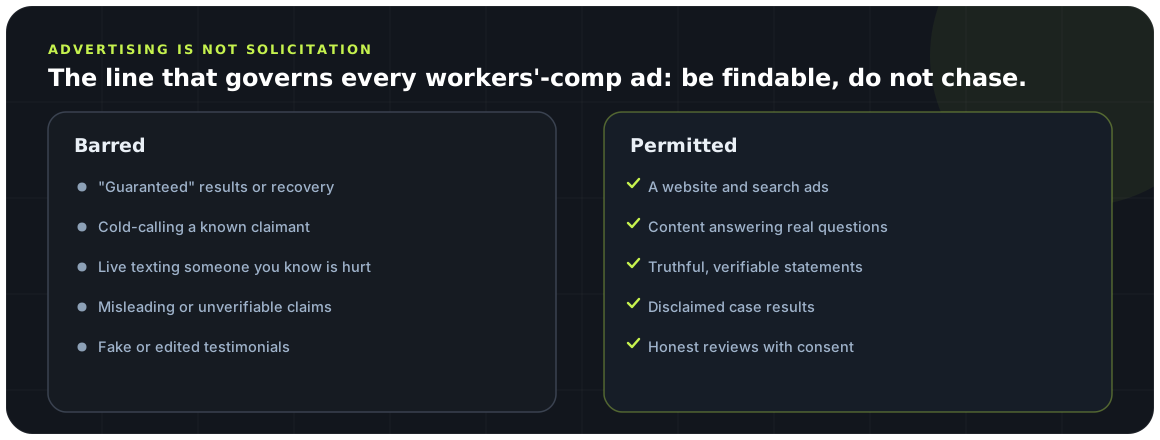
Advertising to the public at large is broadly protected. Solicitation — targeted, real-time contact with a specific person known to need legal services — is where the rules tighten sharply. The Model Rules restrict live person-to-person solicitation (in person, by phone, or by real-time electronic contact) for the lawyer’s own gain, with limited exceptions such as other lawyers or people with a prior professional relationship. The concern is the pressure of a live, one-to-one approach on someone who is hurt and unprepared to say no.
This is why the direction of first contact matters so much. An injured worker who fills out your form or calls your office has invited a response; following up is generally fine. Buying a list of recent injury reports and cold-texting the people on it is a different act entirely, and one that runs straight at both bar solicitation rules and the consent rules in the next section.
It also helps to separate the medium from the act. A written communication a person can set down and read later — a letter, an email, a public ad — is treated very differently from live, real-time contact that puts someone on the spot. Many jurisdictions that flatly restrict live phone or in-person solicitation permit truthful written outreach, sometimes with specific labeling requirements. But the rules on written contact to accident and injury victims vary widely, and several states impose waiting periods after an injury, so this is precisely the kind of thing to confirm with counsel for your state before you build a sequence around it.

The practical guidance is simple to state and important to follow: if cold outreach to injured workers is on the table, it is something to design with a lawyer, deliberately and in writing, not something to improvise around one. The downside of getting it wrong is not a bad campaign; it is a bar complaint and, potentially, statutory liability. When in doubt, let the worker come to you and make it very easy for them to do so.
Testimonials, results, and disclaimers
Client stories and past results are powerful and generally allowed — with truthfulness and, often, a disclaimer.
Most states permit testimonials and case results as long as they are truthful and not misleading. The recurring requirement is context: a specific past recovery, shown without a disclaimer, can imply a typical or guaranteed outcome. Many states require language to the effect that past results do not guarantee a similar outcome, and some have specific rules about how prominent that disclaimer must be and where it has to appear.
Two honest practices keep you clear. First, never edit a testimonial into a claim the client did not make or the facts do not support — a trimmed quote that changes the meaning is a misleading statement wearing a client’s face. Second, when you show a number — a settlement, a recovery — pair it with the disclaimer your state expects and enough context that a reader understands it was that case, not a promise about theirs. Everything on our own site follows one rule that captures this: a firm that markets honestly never invents a figure, a review, or a result. The moment you would have to make something up to make the ad work, the ad is the problem.
The same logic governs the reviews that increasingly serve as testimonials. A genuine review a client wrote on their own is theirs to write; a firm that edits, incentivizes, or fabricates reviews has walked straight into the false-or-misleading rule — and, separately, into consumer-protection law about fake endorsements. Ask for reviews, make them easy to leave, and take the honest ones you get. Never write them, never trade for them, and never trim a real one into a promise. The reviews an anxious worker actually trusts are exactly the ones you did not touch.
Texting and calling: consent
Beyond bar rules, a separate body of law governs texts and automated calls — and it has teeth.
Telephone-consumer law restricts sending marketing texts and making automated or pre-recorded calls without the right consent. The analysis turns heavily on relationship and consent: a person who gave you their number and asked you to contact them about their injury is in a very different position from a stranger whose number you obtained elsewhere. The distinction is the same one that runs through the solicitation rules — who invited the contact — which is why the two areas have to be reasoned about together, not in separate silos.
Even with an existing lead, honoring opt-outs immediately and permanently is non-negotiable — a “STOP” that keeps getting messages is both a rule violation and a reputation problem, and the person on the other end is exactly the kind of unhappy former prospect who files complaints. Because this area carries real statutory penalties and shifts with regulation and case law, it is the clearest place to defer to counsel on specifics: how you collect consent, what your opt-out mechanics are, and how you document both. Build those guardrails before the first message goes out, not after a complaint arrives.
Documentation is the unglamorous part that saves firms. If a dispute ever arises about whether someone agreed to be texted, the firm that can show when and how consent was captured is in a completely different position from the firm relying on memory. Log the consent, log the opt-out, and keep the records — not because it is enjoyable, but because in this area the burden of proving you did it right tends to land on you.
Why compliant marketing converts better
In a trade where the product is trustworthiness, the honest version of a claim is usually the stronger one.
It is worth saying plainly, because it reframes the whole subject: for a workers’ comp firm, compliant marketing and effective marketing are not in tension. The injured worker you are trying to reach has often already been let down — by an employer, an insurer, a system — and is reading your ad specifically for signs that you are one more person about to overpromise. A guarantee does not reassure that reader; it confirms their fear. A specific, honest, slightly under-stated claim does the opposite.
So the firms that treat compliance as a floor to scrape over tend to convert worse, not better, than the firms that treat honesty as the pitch. “We handle only workers’ comp, we answer the phone, here is what we actually did for people like you” is both airtight under the rules and more persuasive than any superlative. The constraint and the conversion advantage point the same direction, which is a rare and useful thing.
A pre-launch checklist
Run every campaign past a short, boring list before it ships. Most compliance problems die here for free.

| Check | The question to ask |
|---|---|
| No guarantees | Does anything promise or imply a result? |
| No unprovable superlatives | Could we substantiate “best” or “specialist” if asked? |
| Fee claims complete | If we say “no fee unless we win,” do we address costs? |
| Testimonials in context | True, unedited, and disclaimed as your state requires? |
| Contact direction | Are we responding to inquiries, not cold-soliciting strangers? |
| Consent & opt-out | Do we have consent to text, and does STOP truly stop? |
| Counsel review | Has a lawyer signed off on anything novel or borderline? |
None of this dulls good marketing. It removes the claims that were never going to build trust anyway and keeps the ones that do. In a trade where the product you are selling is, at bottom, trustworthiness, compliant marketing and effective marketing turn out to be the same thing — which means the checklist is not a tax on growth. It is part of how you earn it.
Key takeaways
-
One rule sits under all the rules: do not mislead. Rule 7.1 is the spine; most compliance questions resolve to it.
-
Guarantees and superlatives are the common trap. “Best,” “guaranteed,” and implied results are where firms cross the line.
-
Solicitation is about the channel, not the message. Live, cold, person-to-person contact is barred; advertising is not.
-
Testimonials and results need disclaimers. Real reviews are fine; results claims require context and care.
-
Compliant marketing converts better. The honest version reassures the anxious worker you are trying to win, and keeps you out of a grievance.
WorkersComp Marketing is a marketing agency, not a law firm, and this article is not a compliance opinion. Attorney-advertising rules — the false-or-misleading standard, the limits on solicitation and direct contact, testimonial and disclaimer requirements, and record-keeping or filing obligations — are set by each state’s bar and are amended regularly. The authorities cited here are cited to show that such rules exist and that they differ, not to tell any firm what its own jurisdiction permits, and nothing here approves any particular advertisement. Have a lawyer at your firm, or your state bar’s ethics counsel, review your advertising before it runs.
Frequently asked questions
Can a workers’ comp firm guarantee a result in its ads?
No. Guaranteeing an outcome — “we’ll win your case,” “guaranteed settlement” — is the classic false-or-misleading claim that advertising rules exist to stop, because no lawyer can promise a result. You can describe what you do, your experience, and past results with proper context and disclaimers, but a promise about this client’s outcome crosses the line in essentially every state. This is general guidance, not legal advice — confirm the specifics with your own bar counsel.
Are client testimonials allowed in law firm marketing?
Usually yes, but with care. Most states allow testimonials that are truthful and not misleading, and many require a disclaimer noting that past results do not guarantee a similar outcome. What is not allowed is a testimonial that implies a guaranteed result or misrepresents the nature of the work. Rules and required disclaimers vary by state, so run your exact wording past counsel before it goes live.
Can we text or cold-call injured workers we found in public records?
This is the highest-risk area, and the honest answer is: get counsel before you do it. Bar solicitation rules restrict real-time contact with people you have no prior relationship with, and telephone-consumer rules restrict texts and automated calls without proper consent. Responding to someone who contacted your firm first is a very different act from reaching out cold to a stranger. Treat cold outreach to injured workers as something to design with a lawyer, not around one.
Can a firm call itself a “specialist” or the “best” workers’ comp firm?
Carefully, and it depends on your state. Superlatives like “best” can be treated as misleading if they cannot be substantiated, and claims of being a “specialist” or “expert” are restricted in many states unless you hold a recognized certification. Describing genuine focus — “we handle only workers’ comp” — is generally safer than a superlative you would have to prove.
Does marketing compliance really matter, or is it just red tape?
It matters commercially, not just ethically. A bar complaint or a consumer-protection action can cost a firm far more than any campaign earns, and misleading claims erode the trust an anxious injured worker is specifically looking for before they call. Clean, honest marketing is both the compliant choice and, in this trade, the higher-converting one — because trust is the product.
What is the difference between advertising and solicitation?
Advertising is communicating to the public at large — billboards, search ads, a website — and is broadly protected. Solicitation is targeted, real-time contact with a specific person you know needs legal help, initiated for your own gain, and it is tightly restricted. The line is not the medium so much as the targeting and the timing: a public ad a worker chooses to respond to is very different from a live, one-to-one approach to a stranger who never asked.
Sources & further reading
-
01
The advertising & solicitation rules
The ABA Model Rules that govern lawyer communications and in-person solicitation; states adopt their own versions.
-
02
Further reading
Compliance in the claims you actually make.
Rules vary by state and change over time — confirm your state’s version with bar counsel. General marketing information, not legal advice.