
Every firm eventually faces this decision: pay a lead vendor for a predictable flow of contacts, or invest in the marketing that produces contacts only you get. Both can work. What separates them is who owns the asset and what the leads actually cost once you count the cases that never sign.
The two ways to get workers’-comp leads
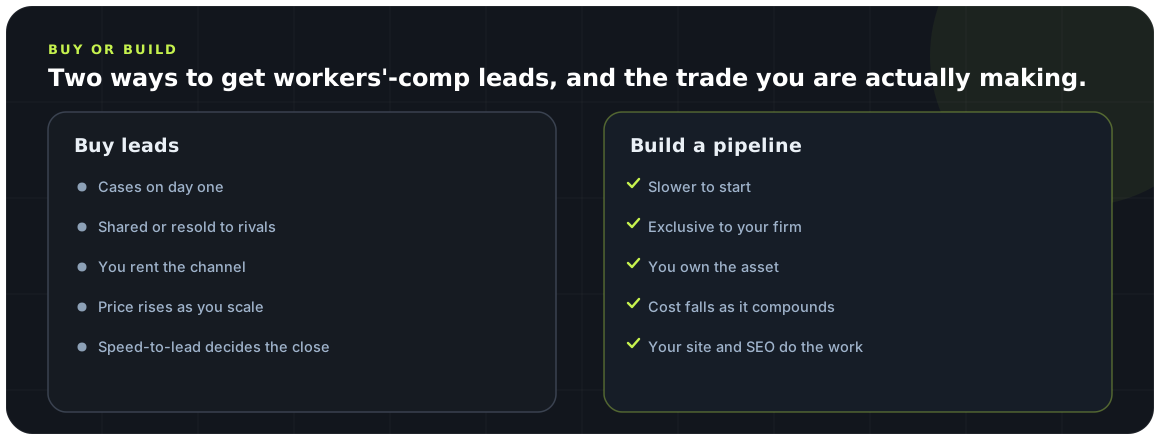
Buying means paying an aggregator or lead-gen company per contact. It’s instant flow with no ramp-up, but you’re one of several buyers, and the moment you stop paying, the flow stops. Building means running your own Google Ads, Local Services Ads, SEO, and landing pages so the leads come to you directly. It takes longer and costs more to start, but the pipeline is an asset you own — and nobody can sell the same lead to four competitors.
What bought leads cost
A shared lead is sold to several firms at once; an exclusive lead is yours alone. That one difference drives everything — here’s the sign-rate gap it opens up.
| Lead type | Typical price | Sold to | Typical sign rate |
|---|---|---|---|
| Shared / aggregator (WC) | ~$5–$30 each | 3–5 firms at once | ~2–6% |
| Exclusive web form (WC) | ~$75–$200 | One firm — you | ~8–15% |
| Exclusive live transfer | Higher still | One firm — you | ~15–25% |
Sources: Rankings.io, Superpractice, and InjuryLeadGen vendor-pricing analyses (2026). Ranges differ between vendors — treat them as directional, not precise. The consistent pattern across all sources: shared leads are cheap and convert poorly; exclusive leads cost more and convert far better.
The math that flips the decision
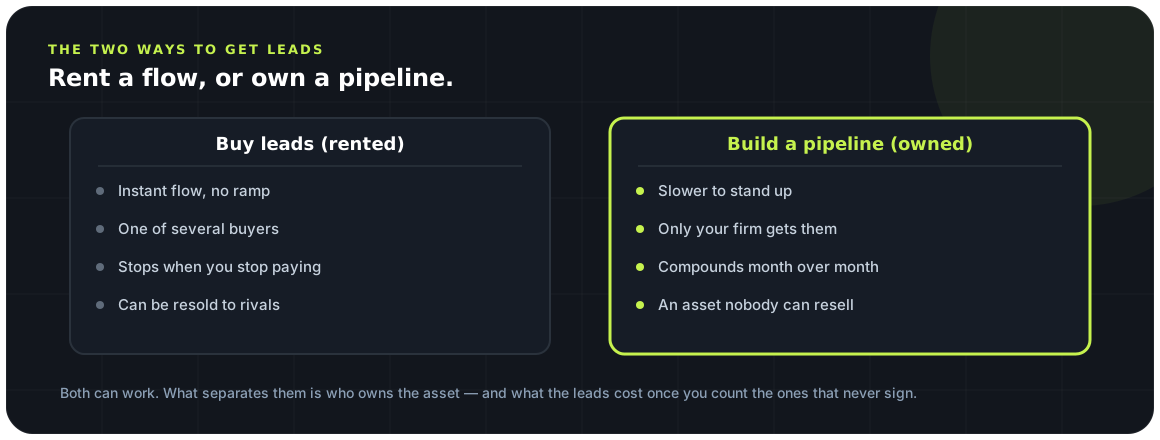
Sticker price is a trap. What matters is cost per signed case — price divided by sign rate:
A $20 shared lead that signs at 3% costs about $670 per signed case — before you count the staff time chasing four other firms’ rejects. A $150 exclusive lead that signs at 15% costs about $1,000 per case but reaches you first and reaches you alone. Change the assumptions and the ranking flips, which is exactly the point: compare cost per case, not cost per lead. We run the full model in Exclusive vs. Shared Workers’ Comp Leads.
Why speed-to-lead decides it
Whether you buy or build, the same rule governs conversion: how fast you respond. The classic Lead Response Management study (Dr. James Oldroyd, MIT Sloan) found that contacting a web lead within five minutes rather than thirty made a firm about 100× more likely to reach the lead and 21× more likely to qualify it (Oldroyd, 2007). Peer-reviewed follow-up work in Harvard Business Review found firms responding within an hour were 7× likelier to qualify a lead than those waiting just over an hour, and 60× likelier than those waiting a day (HBR, 2011).
When buying leads makes sense
Buying isn’t wrong — it’s a tool. It makes sense when you need to fill open intake capacity fast, test a new market before committing to build there, or supplement a pipeline that isn’t producing enough yet. Just go in clear-eyed: prefer exclusive over shared, track your real cost per signed case by source, and remember you’re renting flow, not building an asset. If a vendor won’t tell you how many firms a lead is sold to, assume the worst.
Building your own pipeline
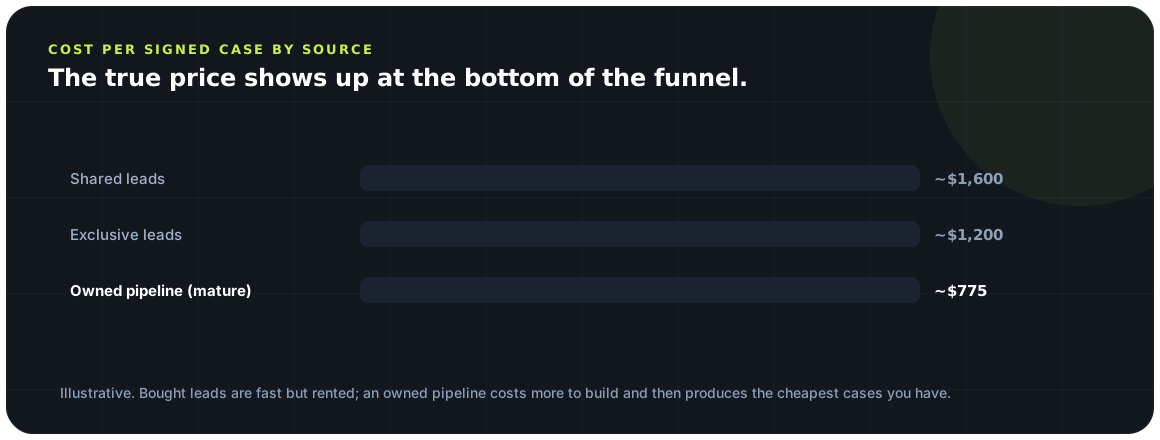
The alternative is to make the leads yourself: Google Ads & LSA for people searching right now, SEO and content for compounding organic visibility, landing pages built to convert, and intake tight enough to answer before the competition does. It costs more up front and takes longer to ramp, but every lead is exclusive by definition, the cost per case falls as the SEO compounds, and the pipeline is yours — not a subscription that ends the day you stop paying.
Related reading: the full exclusive-vs-shared math, speed-to-lead, what workers’-comp marketing costs, and the pillar Workers’ Comp Marketing Guide. To build a pipeline you own, book a call.
Key takeaways
-
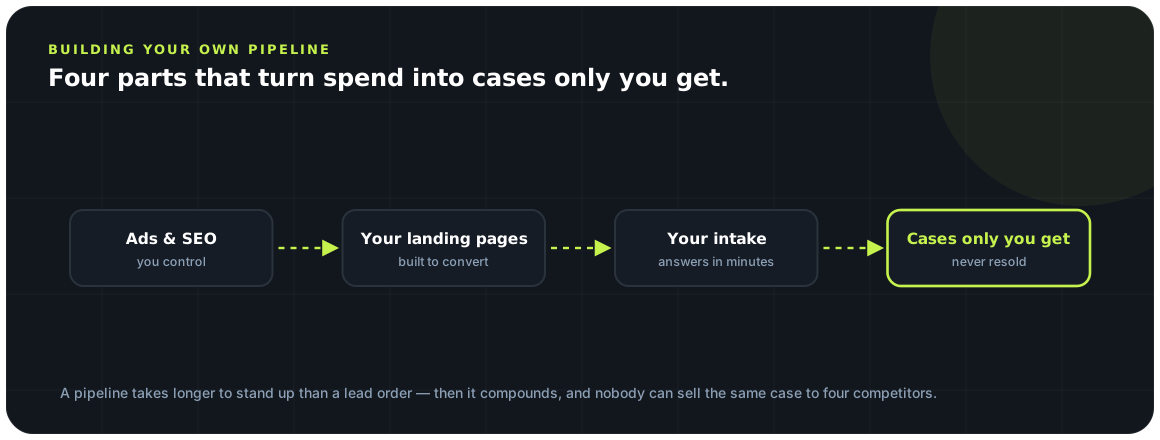
There are two ways to get comp leads: buy them or build them. Each has a different cost curve and a different ceiling.
-
Bought leads cost more than their price. Shared sourcing and low intent push the real cost per case well above the quote.
-
The math flips on signed cases. Once you divide by cases, an owned pipeline usually beats bought leads.
-
Speed-to-lead decides bought leads. If you cannot call in minutes, you are paying for cases a faster firm signs.
-
Buying makes sense in narrow windows. To fill capacity fast or test a market, not as the whole plan.
Frequently asked questions
Is it better to buy workers’ comp leads or generate your own?
Both can work. Buying is renting: you get instant flow, but shared leads go to several firms at once and the flow stops the moment you stop paying. Building your own pipeline is slower to start but compounds, and the contacts are exclusively yours. Many firms blend the two and shift weight toward the owned pipeline over time.
Why do shared leads convert so much worse than exclusive ones?
A shared lead is sold to several firms simultaneously, so signing it is a speed race against three to five competitors. Whoever reaches and reassures the injured worker first usually wins, which is why shared leads only pay off for firms with genuinely fast intake.
How do I compare the true cost of a cheap lead and an expensive one?
Compare cost per signed case, not sticker price: divide the lead price by its sign rate. A cheap shared lead with a low sign rate frequently costs more per signed case than a pricier exclusive lead that signs at a much higher rate, before you even count the staff time chasing shared-lead rejects.
Does responding faster actually change whether a lead signs?
Speed is the single biggest controllable factor in whether you ever reach and qualify a lead. The well-known Lead Response Management research found the odds of making contact fall sharply as response time grows. Speed governs contact and qualification rather than guaranteeing a signature, but with shared leads it is often the whole game.
When does buying workers’ comp leads make sense?
Buying is a tool, not a mistake. It makes sense when you need to fill open intake capacity quickly, test a new market before committing to build there, or supplement an owned pipeline that is not yet producing enough volume, provided your intake is fast enough to win a shared-lead race.
How do I build my own workers’ comp lead pipeline?
You generate the leads yourself: Google Ads and Local Services Ads for people searching right now, SEO and content for compounding organic visibility you own, and referral relationships. It is slower to start than buying, but the flow is exclusive and it keeps working after the spending stops.
Sources & further reading
-
01
Buy or build
The decision the whole piece turns on.
-
02
Build your own pipeline
The channels that make leads yours.
- 03
Benchmarks here draw on WorkersComp Marketing’s own managed-spend data across live firms; your numbers will differ. General marketing information, not legal advice.