
If you’ve asked three agencies what workers’-comp marketing costs and gotten three different answers, that’s because the honest answer is “it depends” — on your channels, your market, and your goal. Below are the real ranges, sourced from independent benchmarks, plus the one calculation that tells you whether any of it is worth it.
What actually drives the cost
Three things move the number more than anything an agency puts on a rate card:
- Your channel mix. Google Search, Local Services Ads, Meta, and SEO have very different price tags and payback curves. Paid search bills you per click today; SEO is a monthly retainer that compounds over months.
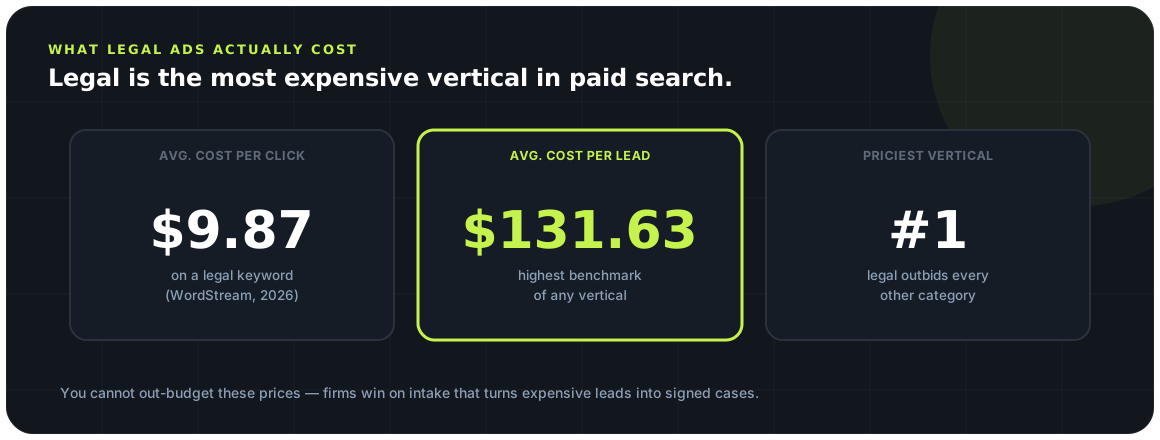
- Your market’s competition. Legal is the priciest vertical in digital advertising, full stop — and personal-injury and workers’-comp keywords sit at the top of it. A click that costs a plumber $4 can cost an injury firm nine or ten dollars (LocaliQ, 2023).
- Your goal. Chasing maximum case volume in a competitive metro costs far more per month than defending a niche (say, Spanish-speaking claimants or a specific injury type) where you can win on relevance instead of budget.
Cost by channel
Independent benchmarks for the legal vertical (the closest verified proxy for workers’ comp — the public benchmarks break out “Legal” and “Personal Injury,” not WC specifically):
| Channel | Typical cost | What you’re buying | Payback |
|---|---|---|---|
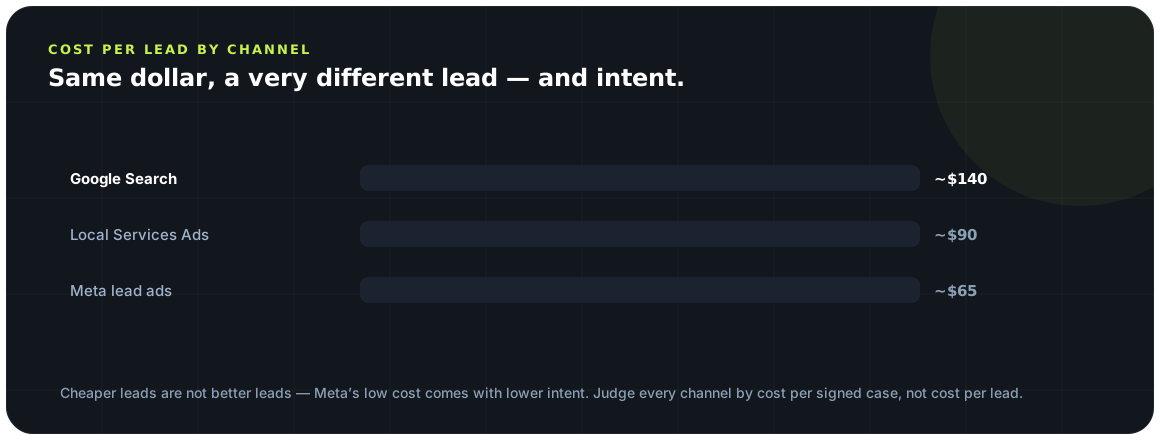
| Google Search Ads | ~$9 per click; ~$111–$159 per lead | High-intent clicks from people searching right now | Immediate, but pay every month |
| Google Local Services Ads | ~$150–$240 per lead (legal) | Pay-per-lead, “Google Screened” badge, top of page | Immediate; you pay per lead, not click |
| Meta (Facebook/Instagram) | Lower cost per lead, colder intent | Interruption reach + retargeting | Needs strong intake to convert |
| SEO & content | ~$1,500–$25,000+/month retainer | Compounding organic visibility you own | Slow to start, cheapest per case over time |
Sources: LocaliQ Legal Search Advertising Benchmarks (2022–2023) and WordStream 2024 Google Ads Benchmarks for CPC/CPL; OptimizeMyFirm (2022) for legal LSA per-lead ranges; Market My Market (2024) for agency SEO retainer ranges. Figures are vertical benchmarks, not guarantees for any one firm.
The only number that matters: cost per signed case
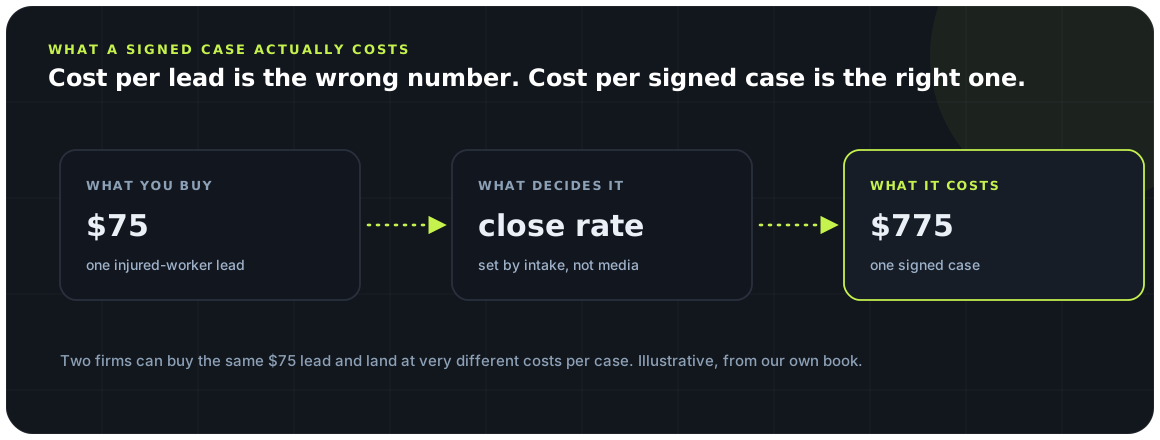
Cost per click and cost per lead are vanity numbers. The metric that decides whether your marketing is a profit center or a leak is cost per signed case, and the formula is simple:
Run the math. A $150 lead that signs at 7% costs about $2,140 per signed case. The same $150 lead that signs at 14% — because your intake answers in two minutes instead of two hours — costs about $1,070. Nothing on the ad side changed; your intake just doubled the value of every dollar. That’s why we treat intake and speed-to-lead as a marketing channel, not an afterthought.
How much should you budget?
The common rules of thumb, both cited by Clio (2024): the U.S. Small Business Administration’s general guidance is 7–8% of gross revenue on marketing, while law-firm management consultants often suggest a leaner 2–5%. So a firm doing $2M a year would land somewhere between roughly $3,300 and $13,000 a month depending on how aggressively it wants to grow.
How agencies price it
Most legal-marketing agencies charge a monthly retainer. Published ranges for SEO run from about $1,500 to $25,000+ a month, with the bottom of that range effectively a floor that rarely moves the needle without real content and account management behind it (Market My Market, 2024). Paid-search management is usually billed as a flat retainer or a percentage of ad spend on top of the media budget itself. Be wary of the cheapest tier and of anyone who quotes a price before asking what a signed case is worth to you.
Buy leads, or build your own pipeline?
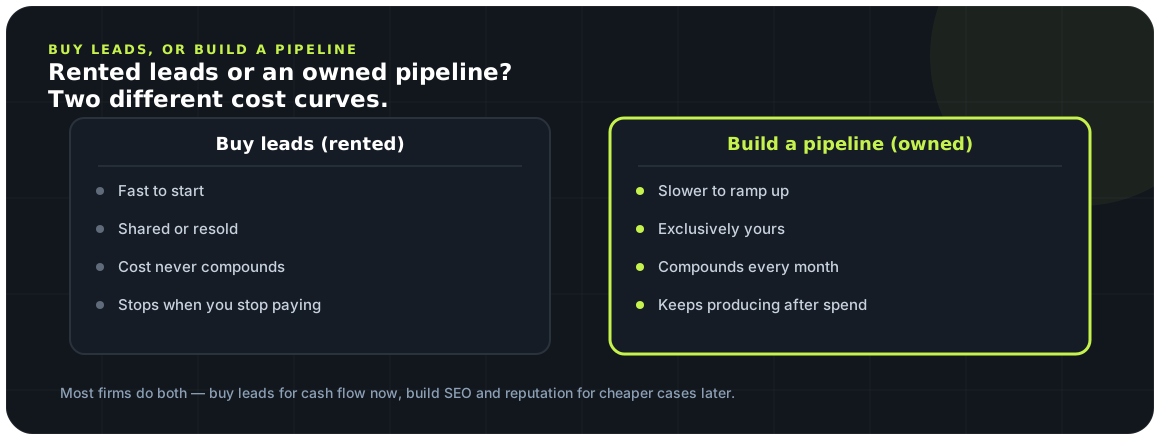
You can also skip the channels entirely and just buy leads from a vendor. It’s faster, but it’s renting: a shared lead is sold to several firms at once, and the cheapest leads usually carry the highest true cost per signed case. We break down the full buy-versus-build math in Workers’ Comp Leads for Law Firms and the shared-versus-exclusive question in Exclusive vs. Shared Leads.
Go deeper in the pillar Workers’ Comp Marketing Guide, size a specific budget with the Budget Calculator and Cost-Per-Case Calculator, or plan a scale-up in Scaling Your Ad Budget. When you’re ready to price a plan for your firm, book a call.
Key takeaways
-
Cost is driven by competition and conversion, not the channel label. The same channel costs two firms very different amounts.
-
Every channel has a different cost shape. Search, social, LSA, and SEO trade upfront cost for compounding differently.
-
Cost per signed case is still the only number that matters. Channel CPLs are noise until you convert them to cost per case.
-
How much to budget comes from your economics, not a rule of thumb. Case value and conversion set the number.
-
Buying leads and building a pipeline are different bets. One is rented demand; the other is an owned asset that lowers cost over time.
Frequently asked questions
How much does workers’ comp marketing cost per month?
There is no flat price. A lean, single-channel start runs around $2,000 a month, while aggressive multi-channel growth commonly runs $15,000 to $30,000 or more a month. What matters more than the monthly figure is your cost per signed case.
What is the average cost per lead for a law firm?
Legal is the most expensive vertical in digital advertising. Independent benchmarks (LocaliQ / WordStream, 2022-2024) put the average legal keyword click around $9 and the average legal lead around $111 to $159. Workers’ comp is not broken out separately in the public data, so the legal vertical is the closest verified proxy.
What is cost per signed case and how do I calculate it?
It is the only number that decides whether your marketing profits or leaks: cost per signed case equals cost per lead divided by your lead-to-case sign rate. Because it depends on intake, doubling your sign rate halves your cost per case without spending another dollar on ads.
How much of revenue should a law firm spend on marketing?
Common rules of thumb, both cited by Clio, run from the leaner 2 to 5 percent that law-firm consultants often suggest up to the U.S. Small Business Administration’s general 7 to 8 percent of gross revenue. A $2M firm typically lands somewhere between roughly $3,300 and $13,000 a month depending on how aggressively it wants to grow.
Which channel is cheapest for workers’ comp leads?
It depends on intent and time horizon. Meta tends to have a lower cost per lead but colder intent that needs strong intake; Google Search and Local Services Ads cost more per lead but bring high-intent, ready-now searchers; SEO is a monthly retainer that is slow to start but usually the cheapest per signed case over time because you own it.
Should I buy leads or build my own pipeline?
Buying leads is faster but it is renting: shared leads are sold to several firms at once, and the cheapest leads often carry the highest true cost per signed case. Building your own pipeline compounds and produces contacts only you get. Most firms end up blending both while shifting weight toward the owned pipeline over time.
Sources & further reading
-
01
What drives the real cost
Why the sticker price is not the cost.
- 02
-
03
Run the numbers
Size it against your own firm.
Benchmarks here draw on WorkersComp Marketing’s own managed-spend data across live firms; your numbers will differ. General marketing information, not legal advice.