
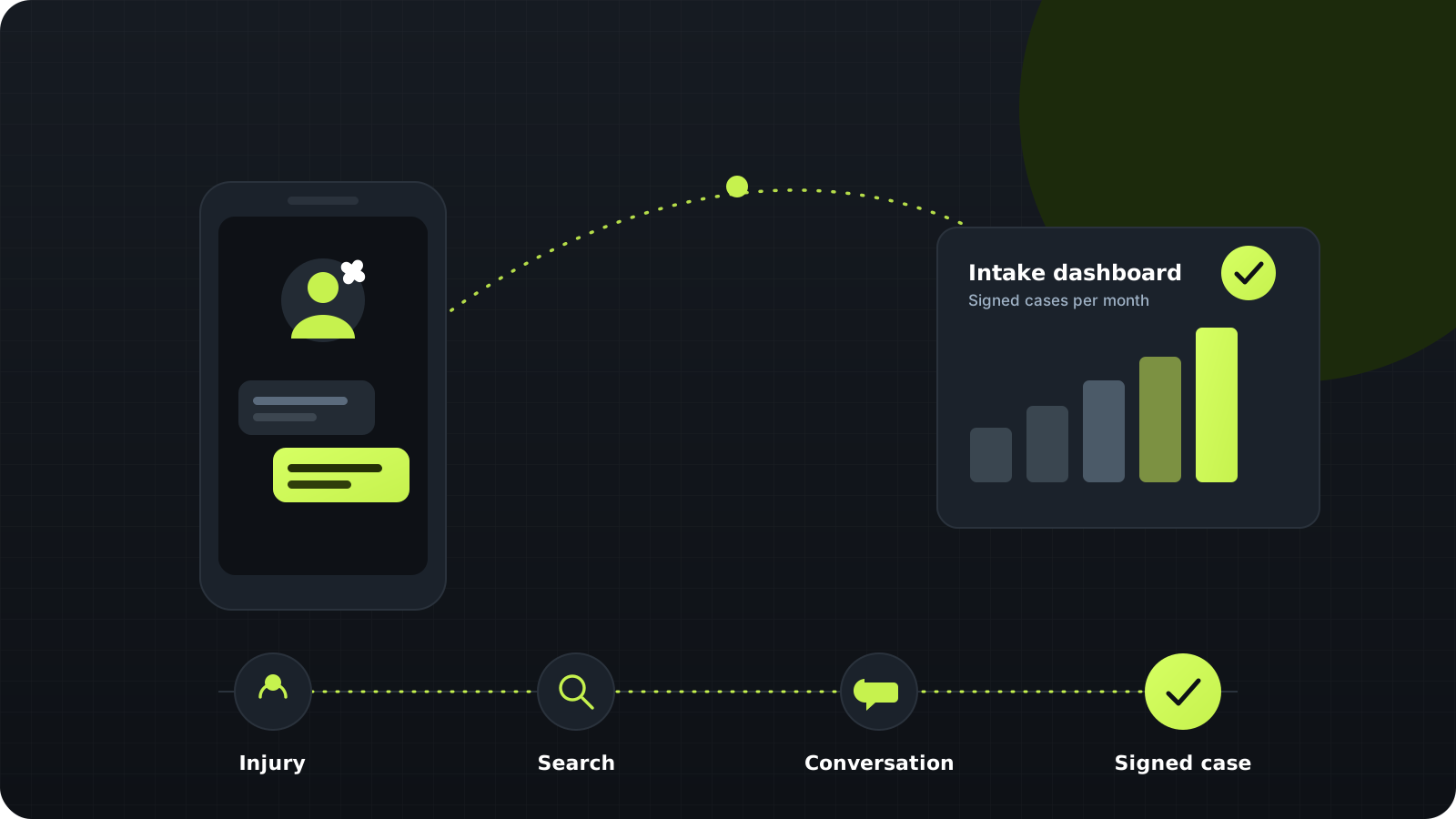
Private employers reported 2.4 million workplace injuries and illnesses in 2025. A share of them will search for a lawyer within days. The firms that win those cases aren’t always the best litigators — they’re the ones the injured worker reaches first, trusts fastest, and hears back from soonest.
That is the uncomfortable truth of legal marketing in 2026. Representation quality gets you referrals. But new-client acquisition is a separate discipline with its own physics — traffic, response time, and conversion — and most workers’ comp firms are losing on all three without realizing it.
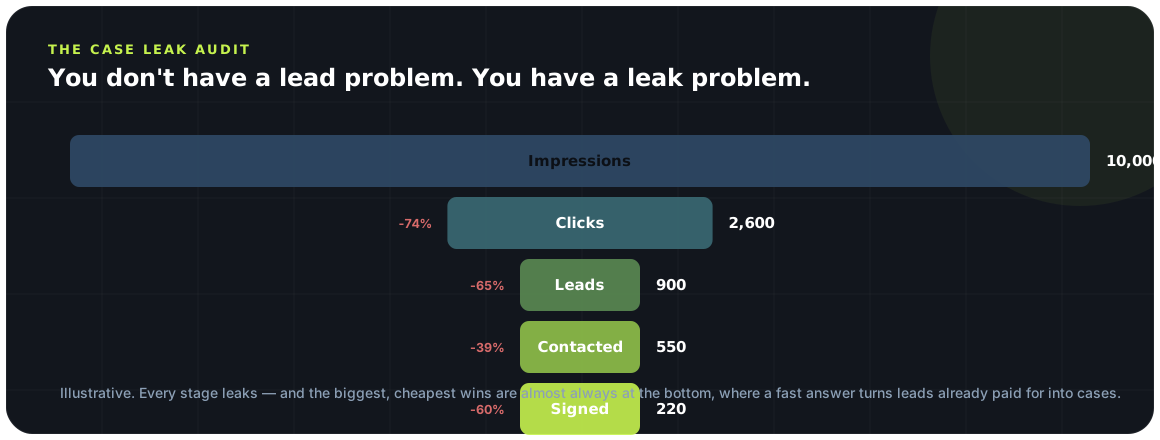
This guide is the playbook we use inside high-volume workers’ comp firms. It’s built on real campaign data, independent research, and the one operating principle that separates firms that scale from firms that plateau: you don’t have a lead problem, you have a leak problem.
Looking for the overview instead — the channels, the budget and the bar rules on advertising? Start with workers’ comp lawyer marketing; this guide is the operating detail behind it.
The state of workers’ comp marketing in 2026
Under-marketed, misunderstood, and more winnable than any other legal niche.
Workers’ compensation is one of the most overlooked niches in legal marketing. Personal-injury firms flood television and Google with car-accident ads. Meanwhile, injured workers — who often assume their employer or insurer will “handle it” — go under-served until a deadline slips past.
That gap is the opportunity. Demand is structural: private employers reported 2.4 million nonfatal workplace injuries and illnesses in 2025, including 842,500 serious enough to involve days away from work, according to the U.S. Bureau of Labor Statistics. Every one of those workers is a potential client who may never learn they needed counsel.
And when they do go looking, they start where everyone starts: a search bar.
Sources: iLawyer Marketing’s consumer surveys — 1,052 respondents in 2025 and 1,110 in 2026.
The Signed-Case Equation
Our core framework — because every marketing decision should trace back to it.
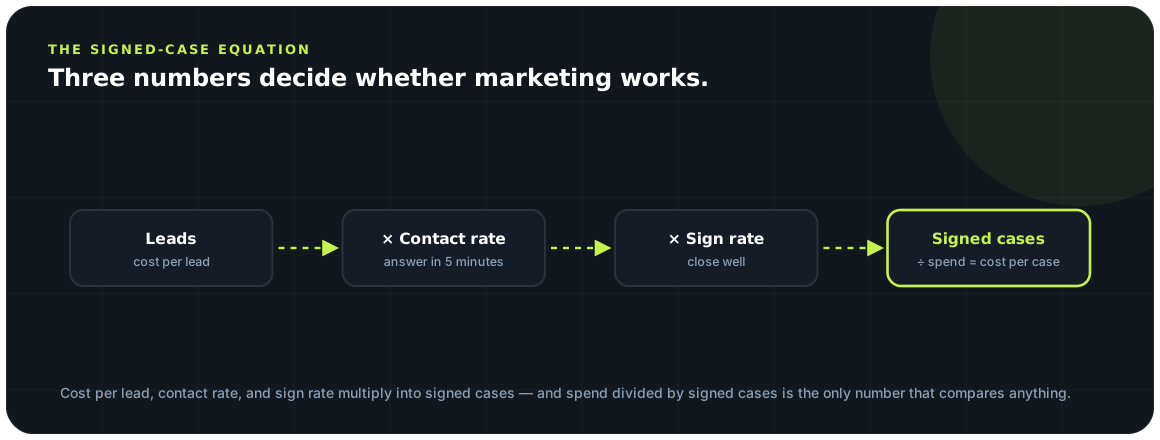
Most firms measure marketing in leads. That’s the mistake. Leads are a vanity metric; signed cases pay the bills. Here’s the equation we run every campaign against:
Signed Cases = Traffic × Lead Rate × Contact Rate × Sign Rate
The Signed-Case Equation — WorkersComp MarketingFour levers. Most agencies obsess over the first one — traffic — because it’s the easiest to sell. But the biggest, cheapest wins almost always hide in the last two: contact rate and sign rate.
Double your contact rate and you’ve effectively doubled your ad budget — without spending another dollar. That’s why the sharpest operators audit the whole equation before touching a single campaign.
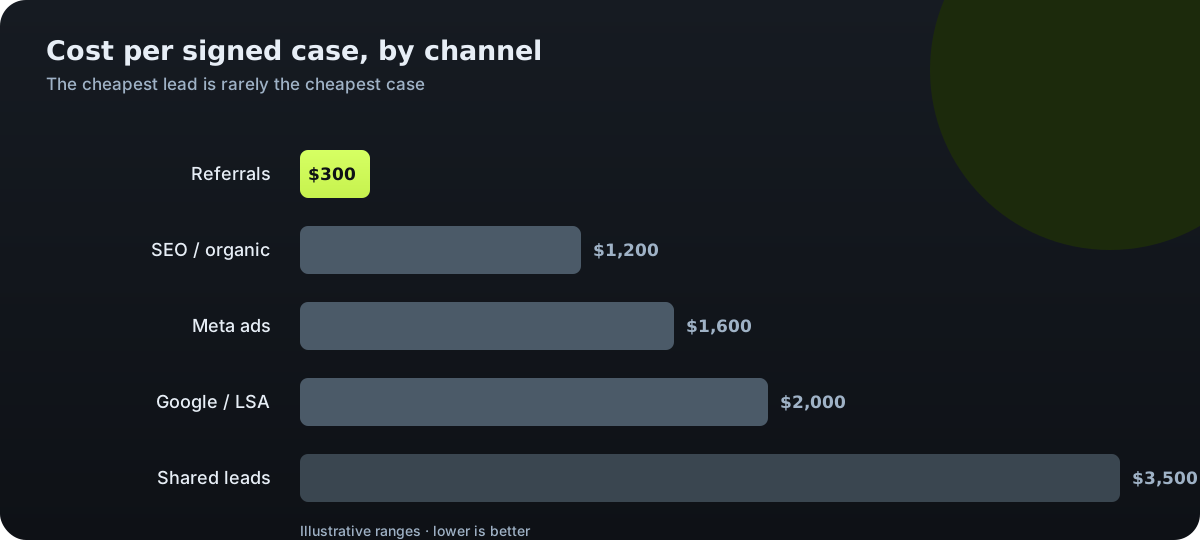
Cost per case: the only metric that matters
Why “cost per lead” lies, and how to read the real numbers.
Legal is the most expensive category in paid search — full stop. According to WordStream’s 2026 benchmarks, Attorneys & Legal Services carry the highest average cost per click of any industry at $9.87 and the highest cost per lead, $131.63 — about twice the cross-industry median of $66.69.
But averages hide the story. On high-intent keywords in competitive metros, a single click can run $100–$300. The number that actually matters isn’t cost per click or even cost per lead. It’s cost per signed case — and that depends entirely on how well you convert.
| Channel | Typical cost / lead | Realistic sign rate | Est. cost / signed case | Speed to results |
|---|---|---|---|---|
| Google Search / LSA | $120–$300 | 8–15% | $1,000–$3,000 | Days |
| Meta (Facebook/Instagram) | $40–$120 | 4–10% | $700–$2,500 | Days–weeks |
| SEO / organic | Low marginal | 10–20% | Falls over time | 6–12 months |
| Shared lead vendors | $40–$90 | 1–4% | $1,500–$5,000+ | Immediate |
| Referrals | Near zero | 30–50% | Lowest | Ongoing |
Ranges reflect industry consensus and our own campaign data; your numbers depend on market, offer, and intake. Treat this as a directional model, not a quote.
The channels, ranked by fit
There is no single best channel. There’s a best sequence for your stage.
Google Search & Local Services Ads
The highest-intent traffic on earth. Someone typing “workers comp lawyer near me” is ready to hire now. It’s also the most expensive, so tight keyword discipline and a fast intake are non-negotiable. Local Services Ads (the “Google Screened” pack) add trust and pay-per-lead pricing that many WC firms underuse.
Meta advertising (Facebook & Instagram)
Where injured workers actually spend their time — and where you can reach them before they start searching. Meta rewards strong creative and fast follow-up. Done right, it delivers a lower cost per lead than search; done lazily, it fills your pipeline with tire-kickers. The difference is qualification built into the creative and the form.
SEO & content
The compounding asset. It’s slow — expect six to twelve months for meaningful movement — but it lowers your blended cost per case every month it works. Target the injury moment, your state’s comp rules, and “near me” local intent.
Reviews & Google Business Profile
The cheapest lever most firms ignore. Reviews are read before the phone is picked up, and the map pack sits above the organic results, so a strong profile and a steady review engine quietly raise the conversion rate of every other channel.
| Channel | Intent | Cost | Speed | Best for |
|---|---|---|---|---|
| Google Search / LSA | Very high | High | Fast | Firms ready to answer the phone instantly |
| Meta ads | Interrupt / mid | Medium | Fast | Volume + brand at a lower CPL |
| SEO / content | High | Low marginal | Slow | Durable, compounding case flow |
| Reviews / GBP | High | Very low | Medium | Lifting conversion everywhere else |
| Retargeting | Warm | Low | Fast | Staying in front of undecided prospects |
The Case Leak Audit framework
Four leaks quietly drain most WC firms. Find yours before you scale.
When a campaign underperforms, agencies blame the ads. Usually the ads are fine — the cases are leaking somewhere downstream. Run this four-point audit before you change a single headline.
| Leak | Symptom | The fix |
|---|---|---|
| 1. Lead quality | Intake wastes hours on unqualified leads | Qualify in the ad and form; drop shared vendors |
| 2. Speed-to-lead | Leads go cold before the first call | Sub-5-minute response, automated first touch |
| 3. Intake conversion | Contacts don’t become signed cases | Scripts, follow-up cadence, warm handoff |
| 4. Attribution | You can’t tell what’s actually working | Call tracking + CRM + signed-case reporting |
Speed-to-lead: the 5-minute rule
The single highest-ROI change most firms can make this week.
This is the leak that costs firms the most — and the one they most underestimate. The landmark Lead Response Management study from Dr. James Oldroyd at MIT analyzed thousands of leads and over 100,000 call attempts. The finding is brutal and clear.
Now the opportunity. When Hennessey Digital sent inquiries to 1,333 U.S. law firms in the first quarter of 2025, 26% never responded at all, and three in four missed the five-minute window.
Read that again. Three out of four firms lose the speed race by default. In a market that expensive, response time is the cheapest competitive edge available.
In workers’ comp, the firm that replies first usually signs the case — long before the best lawyer ever gets a chance to.
Spencer Moeller, WorkersComp Marketing| KPI | Poor | Good | Elite |
|---|---|---|---|
| Speed-to-lead (first touch) | > 1 hour | < 15 min | < 5 min |
| Lead-to-contact rate | < 40% | 60–75% | > 85% |
| Contact-to-signed rate | < 10% | 20–30% | > 35% |
| Follow-up attempts / lead | 1–2 | 4–6 | 6–8+ |
Building the system: a 90-day rollout
Foundations first. Flow second. Scale third.
| Phase | Focus | What you ship |
|---|---|---|
| Days 1–30 — Foundation | Fix the leaks | Call tracking + CRM, sub-5-min intake, review engine, landing page, tracking pixels |
| Days 31–60 — Flow | Turn on demand | Meta + Search campaigns, retargeting, weekly signed-case reporting |
| Days 61–90 — Scale | Compound what works | Scale winners, kill losers, launch SEO/content, systematize follow-up |
7 mistakes that quietly kill WC campaigns
None of these show up as a dramatic failure. They just bleed margin.
- Measuring leads, not signed cases. Activity feels like progress; only cases pay.
- Slow intake. Great ads feeding a two-hour response time is money set on fire.
- Buying shared leads. The same case sold to five firms is a race you usually lose.
- Treating WC like personal injury. Different searcher, different intent, different message.
- No call tracking. If you can’t attribute revenue, you can’t scale it.
- Ignoring reviews. Reputation is a conversion multiplier on every channel.
- Scaling before fixing conversion. More traffic into a leaky funnel just leaks faster.
What’s changing: AI search and beyond
The ground is shifting. Here’s where to skate.
Search behavior is fragmenting fast. In the same consumer survey, ChatGPT went from 9% in 2023 to 41.9% in 2026 as a way to research a lawyer, while Google fell from 91.7% in 2024 to 71.9%. Google still leads, so AI is additive for now, not a replacement. The practical takeaway: structure your content so both Google and AI models can quote it cleanly.
Three shifts to prepare for now:
- AI Overviews & answer engines. Clear, well-structured, genuinely helpful content gets cited. Thin SEO filler gets ignored.
- First-party data. As tracking tightens, owning your leads, call data, and CRM matters more than borrowed audiences.
- Conversation at scale. Instant, human-quality response — via text and AI-assisted intake — is becoming the default expectation, not a differentiator.
Key takeaways
-
Marketing is one equation: the signed-case equation. Spend, leads, conversion, and case value: every tactic is a term in it.
-
Cost per signed case is the only metric that matters. It is the number every channel ultimately answers to.
-
Rank channels by fit, not fashion. The right mix depends on your market, stage, and economics.
-
The case leak audit finds where you lose. Most lost cases leak at predictable, fixable points.
-
Speed-to-lead is the 5-minute rule. Answering fast is the cheapest, biggest lever in the whole system.
Frequently asked questions
How much should a workers’ comp firm spend on marketing?
There’s no universal number — it depends on your market and case value. A more useful frame is cost per signed case: decide what a signed case is worth to your firm, then work backward. Many growth-focused WC firms invest $5,000–$30,000+ per month once their intake can convert the volume.
What’s the best marketing channel for workers’ comp attorneys?
There isn’t one “best” channel — there’s a best sequence. Most firms start with Meta and Google Search for immediate case flow, add reviews and retargeting to lift conversion, and build SEO in parallel as a compounding long-term asset.
Why are my leads not turning into signed cases?
Usually one of four leaks: low lead quality, slow response time, weak intake conversion, or no attribution. Speed-to-lead is the most common culprit — research shows responding within five minutes can raise qualification odds by up to 21× versus 30 minutes.
Are shared workers’ comp leads worth it?
Rarely. Shared leads are sold to multiple firms, so sign rates are low and you’re competing on speed alone. When you calculate cost per signed case rather than cost per lead, exclusive leads are usually cheaper despite a higher upfront price.
How long does SEO take for a law firm?
Expect six to twelve months for meaningful movement in competitive markets. SEO is a compounding asset, not a quick win — which is why most firms run paid ads for immediate flow while SEO matures in the background.
What is a good cost per case for workers’ comp?
It varies widely by market and channel, but many well-run WC campaigns land somewhere in the four-figure range per signed case. The right target is one that keeps acquisition comfortably below the value of a signed case for your firm.
Sources & further reading
-
01
The data behind the equation
BLS injury counts, 2026 paid-search benchmarks, consumer search surveys and the lead-response research behind the 5-minute rule (checked November 2026).
-
02
Further reading
The system the guide lays out.
External sources were accurate at publication and change over time; confirm current figures at the source. General marketing information, not legal advice.