
Most “marketing plans” a firm owner is handed are either a vendor’s pitch deck or a 30-page template nobody reads twice. A real plan does one thing: it connects the number of cases you need to the decisions that will produce them, in an order you can actually execute. Here’s how to build one for a workers’ comp firm — starting from the goal, not the tactics — that fits on a page and survives contact with a real month.
Start from the number, not the tactics
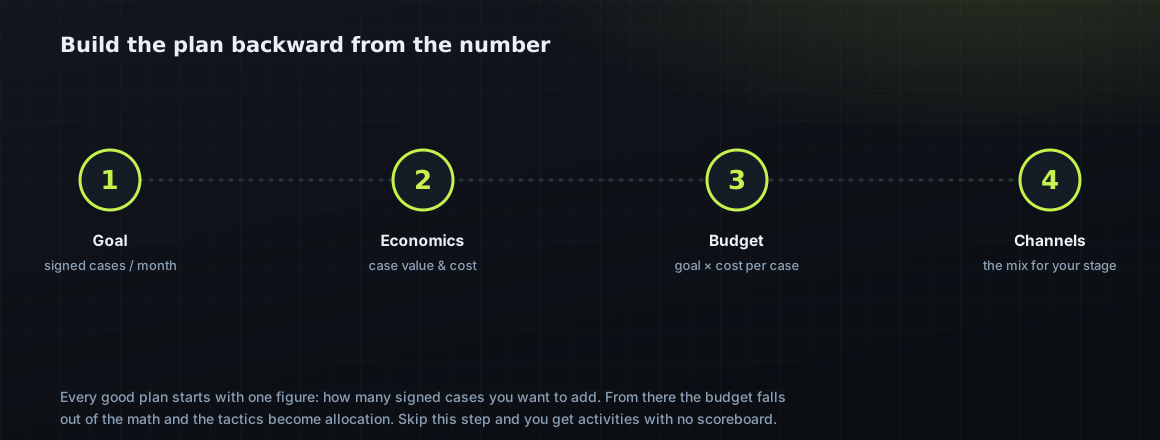
Every good plan begins with one figure: how many additional signed cases you want per month. Not “more leads,” not “more awareness” — cases. From there the plan builds itself backward. If a case is worth a known amount and you can acquire one for a known cost, then your growth goal times your cost per signed case is your media budget, and the tactics are just how you spend it. Skip this step and you get a plan made of activities with no way to tell whether any of them worked.
This is why the plan and the marketing budget are the same conversation from two directions, and why cost per signed case is the hinge the whole document turns on. Get the number first; everything downstream is allocation.
Work a quick example to see how the plan builds itself. Say you want to add ten signed cases a month and your blended cost per signed case runs around $800. That’s an $8,000 monthly media budget — before you’ve named a single tactic. Now the plan has a spine: everything you do either produces those ten cases at or below that cost, or it doesn’t belong in the plan. Channels that can’t be traced to a signed case aren’t strategy; they’re hope with a line item.
Notice what the goal is not. It isn’t “more awareness,” “more traffic,” or even “more leads” — it’s signed cases, because that’s the only output that pays. Setting the goal in cases forces every downstream decision to answer to revenue. A plan built on softer goals can look busy and successful for months while the caseload flatlines, because nobody tied the activity to the outcome. Start with cases and the plan can’t drift.
This is also why the plan belongs on a single page. A plan that runs thirty slides is a document nobody reopens; a plan that fits on one page is a tool you actually steer by. On that page: the case goal, the economics behind it, the channel mix for your stage, the launch sequence, the budget split, and the three numbers you’ll watch. Everything else — the tactics, the ad copy, the landing pages, the reporting detail — is execution that hangs off those decisions. If a stranger couldn’t read your plan in two minutes and know what your firm is trying to do and how you’ll know if it’s working, it isn’t a plan yet.
Pick the channel mix for your stage
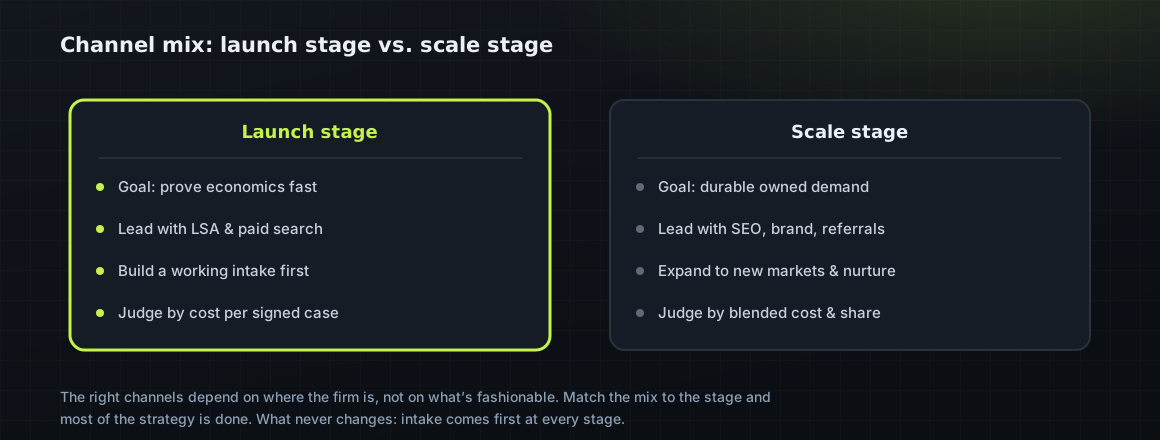
The right channels depend on where the firm is, not on what’s fashionable. A firm launching in a market needs fast, high-intent case flow to prove the economics before it invests in anything slow. A firm at scale can afford to build compounding channels that pay off over quarters. Matching the mix to the stage is most of the strategy.
| Stage | Primary goal | Lead with | Build toward |
|---|---|---|---|
| Launch | Prove the economics fast | Local Services Ads, paid search | A working intake and clean tracking |
| Growth | Lower blended cost per case | Paid search + Meta | SEO, content, reviews |
| Scale | Durable, owned demand | SEO + brand + referrals | New markets, retargeting, nurture |
Notice what doesn’t change across stages: intake comes first everywhere. The channels differ; the requirement that you answer and convert what they produce does not.
Stage also decides how patient you can afford to be. A launching firm needs cases this quarter to fund the next one, so it leans on the channels that produce fast even if they cost more per case; it can’t wait two quarters for SEO to mature. A firm at scale has the cash flow to invest in compounding channels whose payoff arrives later but lasts longer. Reading your own stage honestly — and not copying the channel mix of a firm three sizes larger — is most of what keeps a plan realistic.
The common failure is a small firm trying to run a big firm’s plan: brand campaigns, a content team, six channels at once, before it has proven a single one produces cases at target. That plan burns the runway before anything compounds. The mirror-image failure is a large firm still living hand-to-mouth on paid search alone, having never built the owned demand its cash flow could have funded. Match the mix to the stage you’re actually in.
One rule holds across every stage, and it’s worth repeating because firms violate it constantly: intake comes first, everywhere. It doesn’t matter whether you’re a brand-new office leaning on Local Services Ads or a scaled firm building brand and referrals — if inquiries aren’t answered within minutes, day and night, every channel above them leaks. A plan that pours budget into new channels while the phone goes to voicemail after five o’clock is funding a bucket with a hole in it. Fix the intake before you widen the funnel; it’s the cheapest cost-per-case improvement in the plan and the one most likely to be skipped because it isn’t as exciting as a new campaign.
Sequence it — what to turn on first
The most common planning mistake is launching everything at once. You light up three channels, the phone rings, half the calls go unanswered, and you can’t tell which channel is working because nothing is being tracked. A plan is as much about order as about choice.
Sequencing this way means every addition is judged against a known baseline, and you never scale a channel you haven’t proven. It also protects the intake — the part that quietly decides whether any of the spend becomes cases. The speed-to-lead discipline belongs at the very front of the plan, not the end.
Sequencing also protects your ability to learn. When you turn on one channel at a time, every result is attributable — you know exactly what produced the change, because only one thing changed. Blitz five channels at launch and you get a blur: the phone rings, some cases sign, and you have no idea which channel to credit or cut. The plan that adds one proven channel at a time isn’t just safer; it’s the only one that actually teaches you your own numbers.
A reasonable launch sequence looks like this: get intake answering every inquiry within minutes; turn on one high-intent channel and run it until you know its real cost per signed case; once it’s profitable and measured, add a second; begin the compounding channels — content, reviews, referrals — in parallel, knowing they’ll pay off later. Each step is judged against a known baseline, and nothing scales until it’s proven. It feels slower than launching everything at once. It is dramatically faster to a plan that works.
Allocate the budget

Two splits decide whether a budget holds up. First, keep media and management separate — the money that goes to Google and Meta should never be blended with the fee that pays the team, or you lose the ability to see your true cost per case. Second, don’t spend the whole media budget on what already works.
Put most of the budget on what’s proven, a meaningful slice on testing what could work, and a small bet on something new. A plan that only funds today’s winners has no way to find tomorrow’s.
The reserve for intake is the allocation firms forget, and it’s the one that quietly caps everything else. If you spend the entire budget widening the top of the funnel and leave nothing for the capacity to answer and sign what it delivers, you’ve built a machine that generates leads you can’t catch. Before scaling media, make sure intake can absorb the volume — staff, hours, and the speed to reach every inquiry fast. A dollar of media into a saturated intake produces nothing; a dollar into intake capacity can unlock every dollar of media behind it. The way that ceiling works is in the capacity ceiling.
Keep media and management strictly separate in the plan, too, because blending them destroys your ability to see any of this. The money that goes to Google and Meta is media; the money that pays the team running it is management. Rolled into one number, you lose the ability to calculate your true cost per signed case, to tell whether a bad month was a media problem or an execution problem, or to compare one channel honestly against another. Two clean line items — media and management — are worth more to a plan than any clever tactic, because they’re what let you manage instead of guess.
Spencer Moeller, WorkersComp MarketingA simple rule of thumb: the majority of media on proven channels, a fifth on active testing, and a small slice on genuinely new bets — adjusted as things prove out. And always reserve capacity for intake: a bigger top of funnel is wasted if you can’t answer and sign what it delivers. The full breakdown of media versus management and how to size each is in the budget framework, with market-level pricing in what workers’ comp marketing costs.
The three numbers you steer by

A plan you can’t measure is a wish. But firm owners get buried in dashboards of forty metrics and steer by none of them. Pick three and watch them relentlessly: cost per signed case (is acquisition below case value?), close rate (are leads becoming cases, or leaking?), and speed-to-lead (are you reaching inquiries fast enough to win them?). Everything else is diagnostic detail you consult when one of those three moves.
The discipline is in the restraint. Firm owners are handed dashboards with forty metrics, and the temptation is to watch all of them, which means steering by none. Impressions, clicks, cost per click, click-through rate — these are diagnostics, useful for figuring out why one of your three core numbers moved, but useless as a steering wheel. Pick the three that tie to revenue, put them on one page, and look at that page on a schedule. A plan measured by three numbers you actually act on beats a plan measured by forty you only admire.
Each of the three numbers points at a specific action when it moves, which is what makes them a steering wheel rather than a scoreboard. A rising cost per signed case says a channel is degrading — audit it or cut it. A falling close rate says the problem is intake or lead quality, not traffic — look at how leads are handled, not how many arrive. A slipping speed-to-lead is money walking out the door in real time — fix the coverage before you touch anything else. Three numbers, three clear diagnoses. A firm owner who checks those three every week and acts on what they say is running a plan; one who admires a forty-metric dashboard and changes nothing is running a screensaver.
These three tell you what to do next: a rising cost per case says cut or fix a channel; a falling close rate points at intake or lead quality; a slipping response time is money walking out the door. The case for these three — and why most of the dashboard is noise — is in the only three metrics a firm owner should track.
Make it a living plan
The plan is a starting hypothesis, not a contract with reality. Put a standing review on the calendar — monthly at first, then quarterly — where you look at the three numbers and make two kinds of decision: what to scale (a channel beating its cost-per-case target gets more budget) and what to kill (a channel that can’t hit target after a fair test gets cut, and its budget moves). A plan with explicit scale-and-kill rules turns marketing from a series of arguments into a routine.
What the first twelve months look like
A plan lives in time, so it helps to see the shape of a year. The first quarter is proving: intake tightened, one high-intent channel running long enough to learn its real cost per signed case, tracking clean enough to trust. You are not scaling yet; you are establishing a baseline. The temptation to judge the whole plan on month one is the classic mistake — paid channels are still learning your market, and the number that matters is the trend, not the first invoice.
The second quarter is scaling what proved out and adding the second channel, again run to a known baseline before you trust it. By now cost per signed case should be stabilizing and predictable, which is the signal that you can safely put more fuel on the fire. The third and fourth quarters are where the compounding channels — the content, the reviews, the referral relationships you started early — begin to pull their weight, lowering your blended cost per case as owned demand takes some of the load off paid.
None of this is rigid, and a real plan flexes as the numbers come in. But the arc is consistent across firms that succeed: prove, then scale, then compound, reviewing the three numbers each step and making explicit scale-or-kill calls. A year in, the firm that ran this arc has a pipeline it understands and can steer; the firm that launched everything at once, judged it by month one, and never established a baseline is usually still guessing. The difference isn’t budget or talent. It’s whether there was a plan, on a page, that someone actually followed.
The living part is the part firms skip, and it’s what separates a plan from a binder. Put a standing review on the calendar — monthly while you’re launching, quarterly once things stabilize — where you look at the three numbers and make two decisions, out loud: what to scale, and what to kill. A channel beating its cost-per-case target earns more budget. A channel that can’t hit target after a fair test loses its budget to one that can. Writing those scale-and-kill rules down before you need them takes the emotion out of the decision, so you’re not defending last quarter’s idea against this quarter’s data. That single recurring habit — review the real number, act on it, repeat — is what turns a plan from a document you wrote once into a system that compounds. The broader system these decisions serve is laid out in how to get more workers’ comp clients.
That’s the whole document: a goal, a mix, a sequence, a budget split, three numbers, and a review cadence. It fits on a page because everything else is execution. The system view that ties these decisions together is in how to get more workers’ comp clients.
The hardest part of a marketing plan isn’t writing it — it’s following it when a shiny new tactic or a nervous month tempts you to abandon it. A plan on a page is only worth something if someone owns it and defends it: reviews the three numbers on schedule, resists adding a sixth channel before the fifth is proven, and makes the scale-and-kill calls the data demands even when they’re uncomfortable. The firms that outgrow their competitors are rarely the ones with the cleverest plan; they’re the ones disciplined enough to keep running an ordinary, sound plan while everyone around them chases the tactic of the month. Write it down, keep it to a page, put the review on the calendar, and let consistency do what improvisation never can.
Key takeaways
-
Start from the number, not the tactics. Begin with the signed cases you need and work backward to the plan.
-
Pick the channel mix for your stage. A new firm and a scaled one need different plans; copy neither blindly.
-
Sequence it, turn things on in order. Foundations first, then demand capture, then demand creation.
-
Steer by three numbers. Cost per signed case, case value, and the ratio between them.
-
Make it a living plan. Review and adjust monthly; a static plan is wrong by month two.
Frequently asked questions
What should a workers’ comp marketing plan include?
Five things, on one page: a case goal (how many signed cases per month you want), the economics (case value and cost per signed case), the channel mix for your stage, the launch sequence, and the three numbers you’ll steer by. Everything longer than that is execution detail, not the plan.
How much should a workers’ comp firm budget for marketing?
Size it from the goal, not a percentage of revenue: multiply the cases you want to add by your cost per signed case to get the media budget, then add a separate management fee. Keep the two line items separate so you can always see your true cost per case.
What marketing channel should a workers’ comp firm start with?
Start with intake, then one high-intent channel — usually Local Services Ads or paid search — run long enough to learn your real cost per signed case. Prove that one is profitable before layering on slower, compounding channels like SEO and content.
How do you measure a workers’ comp marketing plan?
Steer by three numbers: cost per signed case (is acquisition below case value?), close rate (are leads becoming cases?), and speed-to-lead (are you reaching inquiries fast enough?). Review them monthly at first, then quarterly, with explicit rules for what to scale and what to cut.
How often should you update a marketing plan?
Treat it as a living document. Review the three core numbers monthly while you’re launching, then quarterly once things stabilize, and make scale-or-kill decisions each time: give more budget to channels beating their cost-per-case target and cut the ones that can’t after a fair test.
Sources & further reading
-
01
The numbers the plan starts from
What anchors every channel decision.
-
02
Size the budget and capacity
Match spend to what intake can hold.
- 03
Benchmarks here draw on WorkersComp Marketing’s own managed-spend data across live firms; your numbers will differ. General marketing information, not legal advice.