
“How do I get more clients?” is really three questions in a trench coat: where is the demand, how do I reach it, and why aren’t the leads I already pay for turning into signed cases? Answer them in that order and growth stops being a mystery.
Most workers’ comp firms don’t have a demand problem. Injured workers are searching, scrolling, and asking friends for a lawyer every single day. What firms have is a capture-and-convert problem: they show up in the wrong places, or they show up and then let the case slip at the one moment that decides it — the first phone call.
This guide is the whole playbook, in the order an owner should actually work it: where the demand really sits, the five channels that sign cases (ranked by how ready-to-hire each person is), the intake truth that quietly caps every firm’s growth, the one market almost nobody is competing for, and the only number you should judge any of it by.
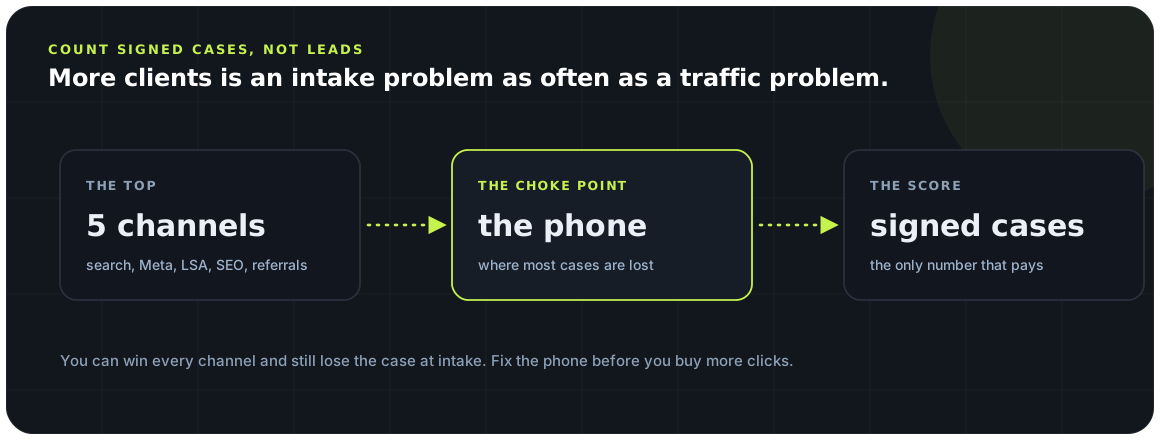
Stop counting leads. Count signed cases.
The metric you optimize is the outcome you get. Optimize the wrong one and you scale a loss.
A “lead” is a promise. A signed case is a client. The two move independently, and the gap between them is where most marketing money quietly dies. A firm can double its leads, keep the same intake, and sign no additional cases — it has simply paid more to talk to more people it never signs.
So the governing metric for everything below is cost per signed case, and the governing goal is more signed cases at a cost that stays well under what a case is worth. Every channel, every tactic, every “growth hack” is judged against that one line. If a tactic lifts leads but not signed cases, it’s not working — it’s just expensive.
Where the demand actually is
Injury demand and legal capacity are not in the same place — and the gap is your opening.
Before you spend a dollar, know where the underserved demand sits. We keep a county-level dataset that ranks all 50 states and 3,142 counties on the gap between workplace-injury demand and local legal capacity, built on BLS employment data. The pattern is consistent and useful: injury demand concentrates in manufacturing, meatpacking, warehousing and construction counties, while legal capacity clusters in a few big metros.
The most underserved states are in the industrial Midwest — Indiana ranks #1, with an estimated 1.58 recordable injuries a year for every legal-services job, and Iowa and Wisconsin close behind. Inside those states the gap is sharpest in fast-growing suburban and industrial counties: Elkhart County, Indiana has an estimated 1,987 injuries a year against just 164 legal-services jobs. The downtown legal markets are crowded; the collar counties and factory towns are wide open.
The takeaway for a firm: don’t only fight for the saturated core of your metro. The cases with the least competition are often 30–60 minutes out, in the counties where the work is dangerous and the lawyers are few. See the full workers’ comp coverage-gap study and the interactive county map to find the openings in your own state.
The five channels that sign WC clients
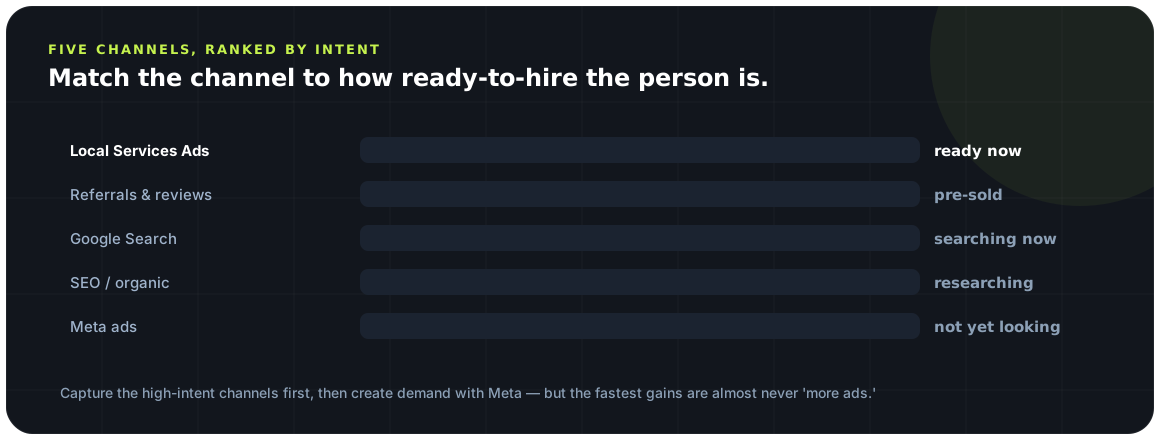
Ranked by intent — how close each person is to hiring a lawyer right now.
There is no single best channel; there is a best sequence, and it runs from highest intent to lowest. The higher the intent, the faster and more expensive the case; the lower the intent, the cheaper and slower. A healthy firm runs several at once, but if you’re starting, start at the top.
1. Google Search & Local Services Ads — the ready-to-hire buyer
Someone typing “workers comp lawyer near me” has the highest intent there is: they’ve decided they need a lawyer and they’re choosing one now. Google Local Services Ads (the pay-per-lead badges at the very top) and Search Ads put you in front of that person at that exact moment. It’s the fastest channel to first case and usually the highest cost per lead — but the intent is so high that the cost per signed case is often the best you’ll find. This is where most firms should spend first. More on running it well: workers’ comp Google Ads & LSA.
2. SEO & content — the compounding asset you own
Ads stop the day you stop paying. Rankings don’t. Ranking for “workers comp lawyer [your city],” for the questions injured workers ask (“how long does workers comp last,” “what if my claim is denied”), and in the Google map pack builds a stream of high-intent visitors you don’t pay per click for. It’s the slowest channel to start — three to six months before it moves — and the one with the best long-run economics, because it’s an asset that appreciates. Start it now precisely because it’s slow. More: workers’ comp SEO & content.
3. Meta & Facebook ads — reach the injured worker before they search
Not everyone who’s hurt at work searches Google first. Many scroll Facebook and Instagram, unsure they even have a case. Meta ads reach that person before the “lawyer near me” search ever happens — which means lower intent, lower cost per lead, and a longer nurture, but access to demand your competitors bidding only on Search never touch. It’s also where creative matters most: the right hook to a frightened, injured person outperforms a polished brand ad every time. More: workers’ comp Facebook & Meta ads.
4. Referrals — the highest close rate you’ll ever get
A referred injured worker arrives pre-trusted and rarely shops around. The four populations that reliably send comp cases — past clients, treating physicians and chiropractors, other attorneys who don’t handle comp, and community/union contacts — will keep sending them if you build a simple system to ask and to thank. Most firms treat referrals as weather; the ones that grow treat them as a channel with a cadence.
5. Reviews & reputation — the tiebreaker that quietly decides it
Every channel above ends at the same moment: a nervous person comparing two or three firms. Your Google review count and rating are the tiebreaker, and they also lift your map-pack ranking, so reputation compounds your paid and organic work at once. A steady process for earning reviews from signed clients is the cheapest growth lever on this list.
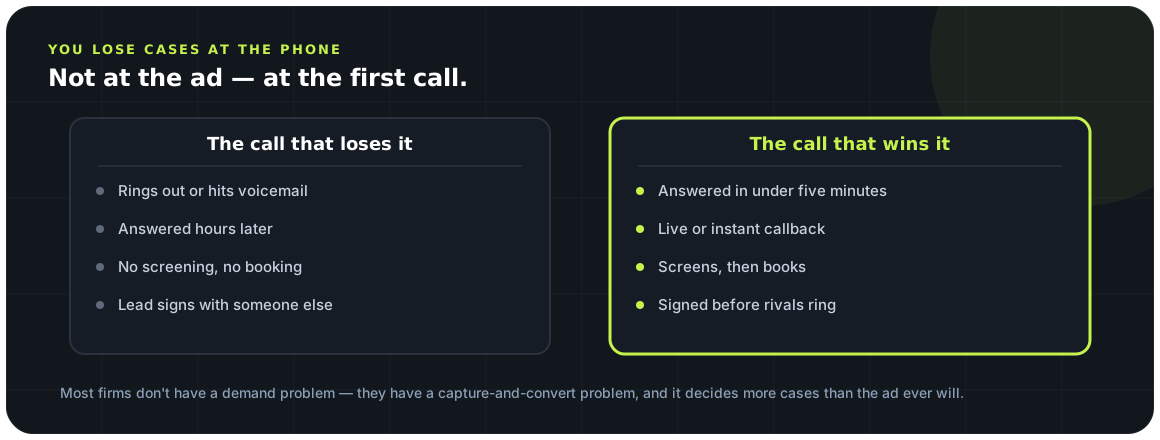
You lose cases at the phone, not the ad
The uncomfortable truth: most firms’ biggest leak is after the click, not before it.
Here’s what a decade of campaign data shows again and again: the difference between a firm that grows and one that plateaus is rarely the ads. It’s the intake. Two firms can run identical campaigns and one signs twice the cases — because one answers every call in under five minutes and the other lets a third of them go to voicemail during a deposition.
Speed is the single biggest lever. Contact rates fall off a cliff after the first five minutes; a lead you call back an hour later is often already signed with someone else. Doubling your contact rate can add as many signed cases as doubling your ad budget — at a fraction of the cost. Before you spend another dollar on traffic, make sure every inquiry is answered fast, by a person who can sign the case on that first call. That’s the highest-ROI move in this entire guide. More: intake & CRM for WC firms and why the first five minutes decide the case.
The market almost nobody is competing for
Roughly one in three U.S. construction workers is Hispanic. Most firms market to them in translated English, or not at all.
The workers most likely to be injured — in construction, meatpacking, warehousing, agriculture — are disproportionately Spanish-speaking, and the demand for a lawyer who communicates in Spanish is large and badly underserved. Winning it takes more than a translated landing page: it takes bilingual ads, bilingual intake, and creative built for the audience rather than run through a translator. Because so few firms do it well, the cost per signed case is often the lowest in the whole market. If you can answer the phone in Spanish, this is the fastest underpriced demand you can reach. More: bilingual & Spanish-speaking WC marketing.
The only math that matters
Cost per signed case versus case value. Get that gap right and everything else is a dial.
Reduce the whole business to two numbers: what it costs you to acquire a signed case, and what a signed case is worth to your firm. Well-run workers’ comp campaigns typically land in the four-figure range per signed case — one blended breakdown produced signed cases near $775 — and a comp case is worth many multiples of that. When the gap between cost and value is wide, you have a machine: every additional dollar of well-spent media returns more than a dollar, so the right move is to grow, not to economize.
This is also why budgets should never be set as “a percentage of revenue.” Set them from the math: decide how many cases you want to add, multiply by your cost per case, and the media budget falls out. Model your own numbers with the cost-per-case calculator, and see the full framework in how much a WC firm should spend on marketing.
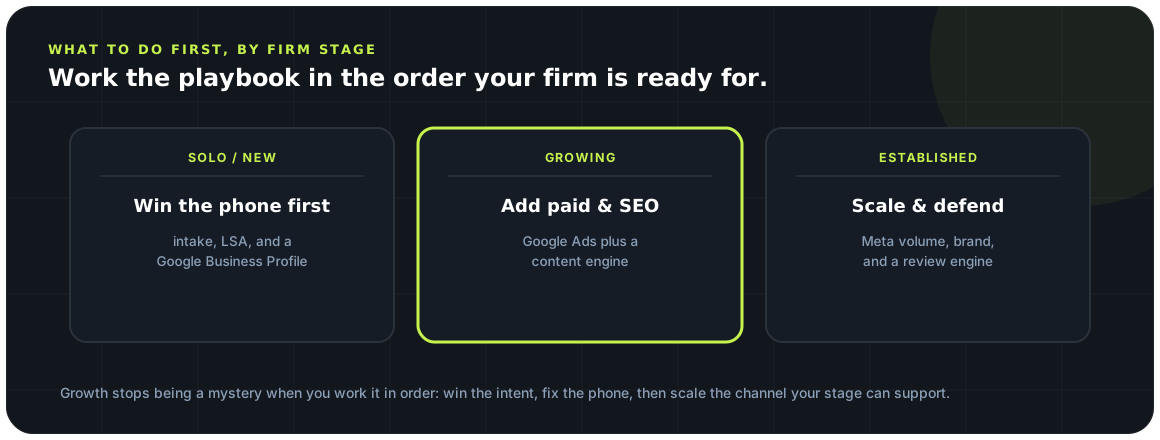
What to do first, by firm stage
Same principles, different starting move depending on where you are.
If you’re getting fewer than ~10 cases a month: fix intake first (speed-to-lead, answer every call), then turn on Google LSA/Search for the fastest high-intent cases. Don’t spread thin — one channel run well beats three run badly.
If you’re steady and want to scale: your intake can already convert, so add demand — layer Meta for lower-funnel reach, start SEO for the compounding asset, and systematize referrals and reviews. Watch cost per signed case as you scale spend; grow it in steps, not leaps.
If you’re plateaued despite spending: the leak is almost certainly conversion, not traffic. Audit the phone, the follow-up on leads that didn’t sign in week one, and whether you’re chasing shared leads that never had a chance. Fix the leak before you add fuel.
What to ignore, and the red flags
Growth is as much about what you stop doing as what you start.
Shared lead lists. A lead sold to four firms at once is a race you usually lose, and the cost per signed case is far higher than it looks per lead. Exclusive leads you generate cost more upfront and convert far better — and they build a pipeline you own instead of renting. See exclusive vs. shared leads.
Vanity metrics. Impressions, clicks, “engagement,” and cost per lead all feel like progress and predict almost nothing about signed cases. If a report doesn’t tie back to cases and their cost, it’s decoration.
Agencies that won’t show you the media spend. If your media budget and management fee are bundled into one number, you can’t calculate your true cost per case — which means you can’t tell whether it’s working. Insist on transparent media, separately.
Doing everything at once with no intake to catch it. More channels only help if the phone is answered. Sequence beats simultaneity.
Do the high-intent channels well, answer the phone fast, own your Spanish-speaking market, and judge all of it by cost per signed case. That’s not a hack — it’s the whole game, and it’s how a workers’ comp firm gets more clients without lighting money on fire.
Key takeaways
-
Count signed cases, not leads. The firms that grow stop chasing lead volume and start engineering signed cases at a cost that works — every channel is judged by that one number.
-
Match each channel to buyer intent, in order. Google Search and Local Services Ads capture people already hiring, SEO compounds over time, Meta reaches injured workers before they search, and referrals and reviews close the loop.
-
You lose more cases at the phone than in the ad. Most firms leak signed cases at the first intake call; a slow or missed response quietly undoes even great marketing, which makes speed-to-lead the highest-ROI fix most owners skip.
-
The Spanish-speaking market is the one almost nobody contests. Bilingual intake and marketing open a high-demand segment most competitors ignore entirely.
-
Judge every dollar by cost per signed case. Not cost per lead, not cost per click — the gap between what a signed case costs and what it is worth is the only math that tells you whether the growth is real.
Frequently asked questions
How do workers’ comp law firms get more clients?
Match channels to buyer intent — Google Search and Local Services Ads for people already looking, SEO and content to compound over time, Meta ads to reach injured workers before they search — and then win the intake call, because most firms lose more cases to a slow phone than to weak marketing.
What’s the fastest way to get more workers’ comp cases?
Google Local Services Ads and Search reach the highest-intent buyers, but the single fastest lever is usually speed-to-lead: answer every inquiry within five minutes. Doubling your contact rate can add as many signed cases as doubling your ad budget, at a fraction of the cost.
How much does it cost to get a workers’ comp client?
Judge it by cost per signed case, not cost per lead. Well-run campaigns typically land in the four-figure range per signed case; one blended breakdown produced signed cases near $775. What matters is the gap between that cost and what a case is worth to your firm.
Should I buy workers’ comp leads or generate my own?
Shared leads sold to several firms are cheap per lead and expensive per signed case, because you’re racing competitors to the same person. Exclusive leads you generate cost more upfront but convert far better and build a pipeline you own. For most firms, owning the pipeline wins on cost per signed case.
Which marketing channel is best for a workers’ comp firm?
There isn’t one best channel — there’s a best sequence, from highest intent to lowest: Google LSA/Search, then SEO, then Meta, with referrals and reviews closing the loop. Start at the top, run one channel well before adding the next, and make sure intake can catch everything you turn on.
Sources & further reading
-
01
Where the demand is
Injured-worker demand, mapped by county and by coverage gap.
-
02
The channels, in depth
Each channel the guide ranks, broken down on its own page.
-
03
Win the phone, own the market
The intake call that decides the case, and the market few firms contest.
-
04
Run the math
Size the budget, then judge every dollar by cost per signed case.
Figures in this guide, including the Central Valley breakdown, draw on WorkersComp Marketing’s own managed-spend data across live workers’ comp firms; your numbers will differ. General marketing information, not legal advice.