
Marketing is not a cost to minimize. It’s an engine to tune — and you only know the right size once you know what a case is worth and what it costs to get one.
Ask ten agencies how much you should spend and you’ll get ten percentages — “8% of revenue,” “10% of goal,” “match your competitors.” None of them start where an owner actually thinks: with a signed case and its profit.
This framework flips it. We’ll build the budget from the bottom up — case value, cost per case, and growth goal — then cover how to split media from management fee, what to expect during ramp-up, and the reserve most firms forget until it’s too late.
Why the percentage rules fail
“Spend X% of revenue” ignores the only variables that matter.
The percentage-of-revenue rule is popular because it’s easy, not because it’s right. It anchors your future spending to your past size — which punishes exactly the firms best positioned to grow and flatters the ones that shouldn’t.
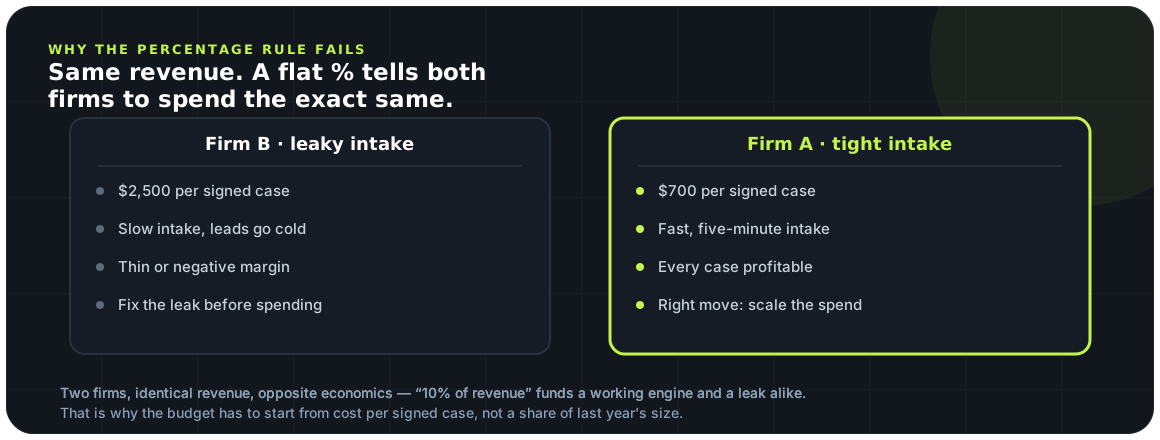
Consider two firms with identical revenue. One signs cases at $700 each with a fast, tight intake; the other at $2,500 with a leaky one. A flat “10% of revenue” tells them to spend the same. That’s absurd — the efficient firm should pour fuel on a working engine, and the inefficient one should fix the leak before spending another dollar.
Build the budget from unit economics
Three numbers turn “how much?” into a calculation instead of a guess.
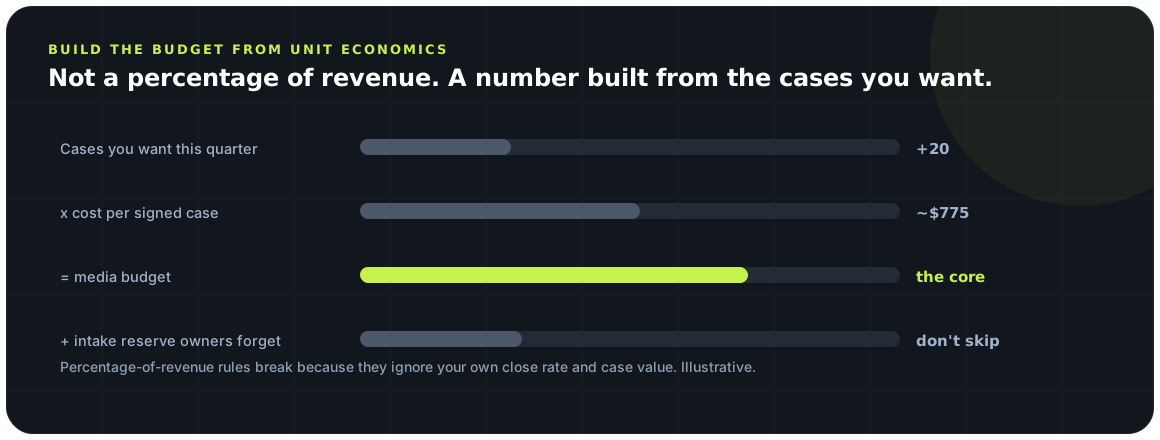
You need only three inputs to size a rational media budget: what a signed case is worth to you, what it costs to acquire one, and how many more you want each month.
1. What a case is worth
A signed workers’ comp case is worth several thousand dollars in eventual fees to most firms. You don’t need a perfect number — you need a defensible average of the fee a typical signed case produces. That figure is the ceiling that makes acquisition spend rational.
2. What a case costs to acquire
This is your cost per signed case — total marketing spend divided by cases actually signed. In the campaign data behind this framework, blended spend produced signed cases at roughly $775 each. Use that as a north star, not a promise; your real number depends on market, offer, and intake.
3. How many more cases you want
This is the goal that turns the other two into a budget. Want ten more signed cases a month at a $775 acquisition cost? That’s about $7,750 in media — before the management fee. Want twenty? Double it, provided your intake can absorb the volume.
Media budget vs. management fee
Two different dollars doing two different jobs — keep them separate.
Every honest marketing arrangement has two line items, and conflating them is where owners get confused about “what it costs.”
The media budget is money that goes straight to Google, Meta, and other platforms to buy attention. It’s not the agency’s revenue — it’s ad spend, and it should be fully transparent, down to the platform dashboards. The management fee is what you pay a team to build creative, run campaigns, manage intake tech, and report. It’s their compensation for making the media work.
| Media budget | Management fee | |
|---|---|---|
| Goes to | Google, Meta, LSA — the platforms | The team running it |
| Buys | Impressions, clicks, leads | Strategy, creative, optimization, reporting |
| Should be | 100% transparent, no markup | Flat and predictable |
| Scales with | Your growth goal | Mostly fixed as you scale |
The ramp: what months 1–6 look like
Paid acquisition compounds — early months teach the algorithm and your funnel.
New campaigns don’t hit their stride on day one. The platforms need conversion data to optimize, your creative needs testing to find winners, and your intake needs reps to tighten. Expecting month-one economics to match month-six economics is the fastest route to quitting a campaign right before it works.
The practical takeaway: fund the ramp, not just the first month. Give a serious paid program a runway of several months before judging it, and hold it to a trend — is cost per case falling? — rather than a single week’s number.
Judging a paid campaign by its first month is like judging an associate by their first week. The system is still learning your market.
Spencer Moeller, WorkersComp Marketing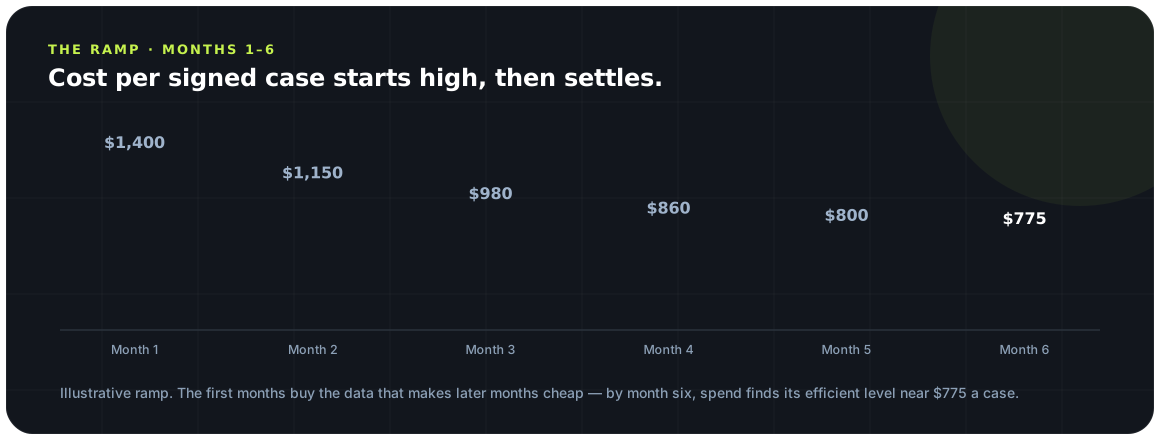
The intake reserve owners forget
The cheapest cases come from spending on the phones, not just the ads.
Here’s the budget line almost no one plans for: the capacity to answer what you buy. A bigger media budget generates more leads — and if your intake can’t reach and sign them, you’ve simply paid more to lose more.
Before scaling media, make sure a slice of budget covers fast intake: enough staff or automation to answer within five minutes, follow-up cadence, and off-hours coverage. Doubling your contact rate has the same effect on signed cases as doubling your ad budget — at a fraction of the cost.
How much capacity you actually need is arithmetic rather than instinct, and the answer is less intuitive than it looks: wait times rise non-linearly as a desk approaches its limit, so a team that is comfortable today can be underwater at twice the volume. The capacity ceiling works the numbers through.
Benchmarks by firm stage
Rough starting ranges — then let your own cost per case take over.
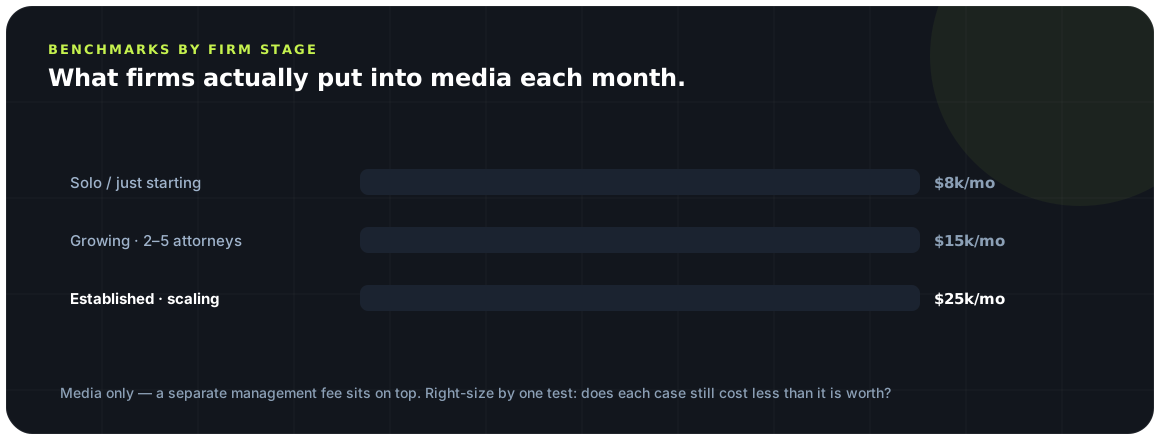
Benchmarks are a place to start, not a place to stay. Once you have real cost-per-case data, that becomes your guide and these ranges become irrelevant. But if you’re sizing a first serious budget, here’s the neighborhood most WC firms operate in.
| Firm stage | Monthly media (typical) | Primary goal |
|---|---|---|
| Testing the water | $5,000–$8,000 | Prove the channel, gather cost-per-case data |
| Committed growth | $8,000–$15,000 | Consistent case flow, tighten intake |
| Scaling | $15,000–$25,000+ | Add cases predictably, expand channels |
| Market leader | $25,000+ | Own the market, multi-channel dominance |
Media budget only, separate from management fee. Ranges reflect common WC firm spend and vary widely by market size and competition.
Key takeaways
-
Percentage-of-revenue budget rules fail. Spend-ten-percent ignores your case value, your conversion, and your market’s prices.
-
Build the budget from unit economics. Start from what a case is worth and what one costs to sign; the budget falls out of that.
-
Media budget and management fee are different line items. Confusing them is how firms underfund the spend that actually buys cases.
-
The first six months are a ramp, not a launch. Budget for the learning curve, not for day-one performance.
-
Reserve for intake, not just ads. The budget owners forget is the capacity to answer the leads the ads produce.
Frequently asked questions
How much should a law firm spend on marketing?
Rather than a percentage of revenue, size it from unit economics: multiply the number of cases you want to add by your cost per signed case. Most workers’ comp firms running paid acquisition seriously spend roughly $8,000–$25,000 a month in media, plus a separate management fee — but the right number is whatever keeps each case’s acquisition cost well below its value.
What’s the difference between media budget and management fee?
The media budget goes directly to the ad platforms — Google, Meta, LSA — to buy attention, and should be fully transparent with no markup. The management fee compensates the team that builds creative, runs campaigns, and manages intake and reporting. Keeping them separate is the only way to calculate your true cost per case.
How long before marketing starts working?
Plan for a ramp of several months. The first month or two is a learning phase while the platforms gather conversion data and you test creative; cost per case typically falls toward target by months three to four and reaches a predictable stride around months five and six. Judge the trend, not a single week.
Is a bigger budget always better?
Only if your intake can absorb it. Extra media generates extra leads, and if you can’t reach and sign them, you’ve paid more to lose more. Often the cheapest additional cases come from improving contact and sign rates first — doubling your contact rate can match doubling your budget, at a fraction of the cost.
What’s a good cost per signed case for a WC firm?
It varies by market, but well-run campaigns typically land in the four-figure range, and the blended data behind this framework produced signed cases at roughly $775 each. What matters more than any benchmark is the gap between that cost and what a case is worth to your firm — a wide gap means you can afford to grow aggressively.
Sources & further reading
-
01
The economics it is built from
The numbers a budget has to start with.
- 02
- 03
Benchmarks here draw on WorkersComp Marketing’s own managed-spend data across live firms; your numbers will differ. General marketing information, not legal advice.