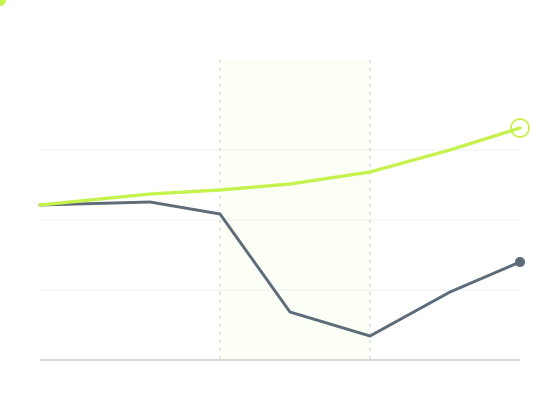
The most expensive marketing decision a workers’ comp firm ever makes is not a bad ad. It is going quiet at the exact moment its competitors do, and handing away search real estate that took years to earn.
Every downturn, the same conversation happens in law-firm conference rooms. Revenue looks shaky, someone opens the P&L, and the marketing line is the biggest number that does not have a person’s name attached to it. It looks discretionary. It looks like the safe cut. So the firm pulls back — pauses the ads, defers the content, lets the reviews go stale — and for a month or two nothing bad visibly happens, which feels like confirmation that the cut was smart.
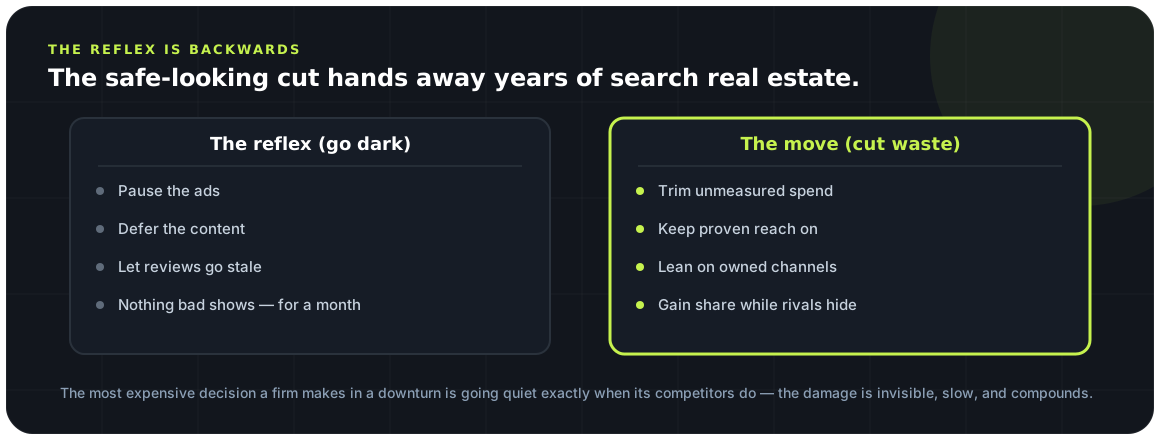
What actually happened is invisible and slow. The firm stopped showing up for injured workers who were still, right then, searching for help. Those cases did not evaporate — they went to whichever firm stayed visible. The map pack position that took two years to earn started to erode. The referral flywheel lost a little momentum. None of it shows up on a dashboard the week you cut. All of it shows up two quarters later as a caseload that is quietly smaller than it should be, and a cost to rebuild that is higher than the money you saved. This piece is about why that trap is so specific to workers’ comp, and what to do instead.
The reflex is backwards: why firms cut first
Marketing looks discretionary on a spreadsheet. For this practice area, it is closer to inventory.
The reflex to cut marketing first is not stupid; it is a category error. On a spreadsheet, marketing sits next to genuinely discretionary lines — the conference sponsorships, the office plants, the software nobody logs into. It reads as overhead. But for a firm whose entire revenue engine is “an injured worker finds us and signs,” demand generation is not overhead. It is closer to inventory: stop replenishing it and you do not save money so much as stop selling.
Three things make the cut feel safe when it is not. The savings are immediate and visible; the cost is delayed and invisible, so the feedback loop lies to you. The pipeline has lag — the cases you sign this month came from spend weeks or months ago, so the tap keeps dripping for a while after you turn it off, which looks like proof the spend was unnecessary. And everyone else is cutting too, so it feels prudent rather than reckless. All three push in the same wrong direction.
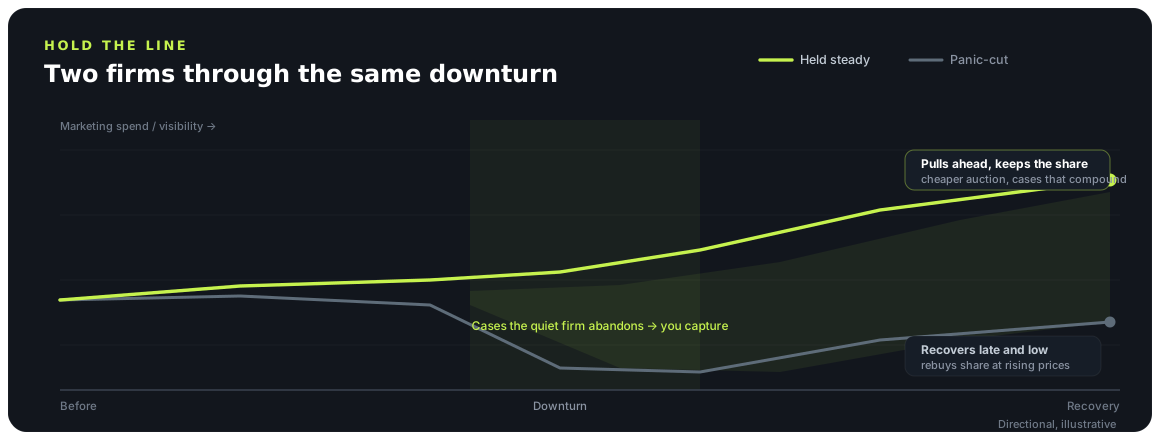
The firms that win downturns understand the asymmetry. Cutting saves a known, small amount now. Staying in captures an unknown, larger amount later — the cases rivals abandoned, at prices rivals stopped competing for. You are not choosing between spending and saving. You are choosing between a small certain saving and a large probable gain, and the panic reflex talks you out of the gain every time.
Why injured-worker demand is non-discretionary
People postpone vacations and kitchens. They do not postpone a comp claim with a clock on it.
The reason this practice area survives downturns better than almost any other in legal is the nature of the need. A workers’ comp case is not a purchase the client chooses to make when they feel financially comfortable. It is a response to an event that already happened — an injury — under a system that imposes deadlines whether the economy is booming or cratering.
Consider what does not change when confidence falls. The injury still happened. The pain is still there. The employer or insurer still disputes, delays, or denies. And the statute of limitations and the various filing and reporting deadlines still run on their own schedule, indifferent to the stock market. An injured worker who needs benefits restored cannot decide to “wait until next year” the way a homeowner defers a remodel, because waiting forfeits the claim. The clock is the client’s problem and, for a marketer, the client’s motivation.
This is also why the contingency model compounds the durability. The injured worker is not paying a retainer they suddenly cannot afford; the firm is paid out of the recovery, so the client’s own cash crunch does not price them out of hiring you. If anything, financial stress raises the stakes of a disputed claim — the lost paycheck matters more — which makes representation feel more urgent, not less. The demand is not merely stable in a downturn; for some workers it intensifies.
A necessary caution on the volume question, because owners always ask it: does the number of claims rise or fall in a recession? The honest answer is that it is genuinely mixed and depends on which force dominates. Layoffs reduce hours worked and therefore exposure, which can lower claim counts; at the same time, job insecurity and financial pressure can change how injuries are reported and pursued. Do not build a plan on a confident prediction in either direction — anyone who sells you one is guessing. Build it on the part that is not a guess: injured workers who need representation will keep searching for it, and your only real question is whether they find you or a competitor.
The quiet gift: when rivals pull back, the auction thins
Ad prices are set by competition. Fear is your competitors removing themselves from the auction.
Here is the mechanism most owners forget under stress. Google and Meta price advertising as an auction. What you pay for a click is set less by some fixed rate card than by how many other firms are bidding on the same injured-worker searches and how hard. When competitors cut their budgets, they are not just going quiet — they are leaving the auction. Fewer bidders on the same demand tends to mean lower click costs and a wider gap between your bid and the next firm’s.
So the firm that holds steady through a downturn frequently gets a double reward: it captures the cases the quiet firms abandoned, and it often buys those cases for less than it paid before the downturn. That is the precise opposite of the story that justifies the cut. The owner cutting spend imagines they are avoiding an expensive market. In reality the market is getting cheaper, and they are choosing that moment to walk out of it.
I want to be careful and directional here rather than promise a number — how much cheaper depends on your market, your competitors’ nerve, and the channel. But the direction is reliable, because it is arithmetic, not optimism: subtract bidders from an auction and the survivors pay less. A firm with the discipline to keep its budget steady while the row panics is, in effect, being paid by its competitors’ fear.
Your competitors’ panic is a discount. Every firm that pulls its budget in a downturn is removing a bidder from the auction you are still standing in — and the auction gets cheaper for you the moment they leave.
Spencer Moeller, WorkersComp Marketing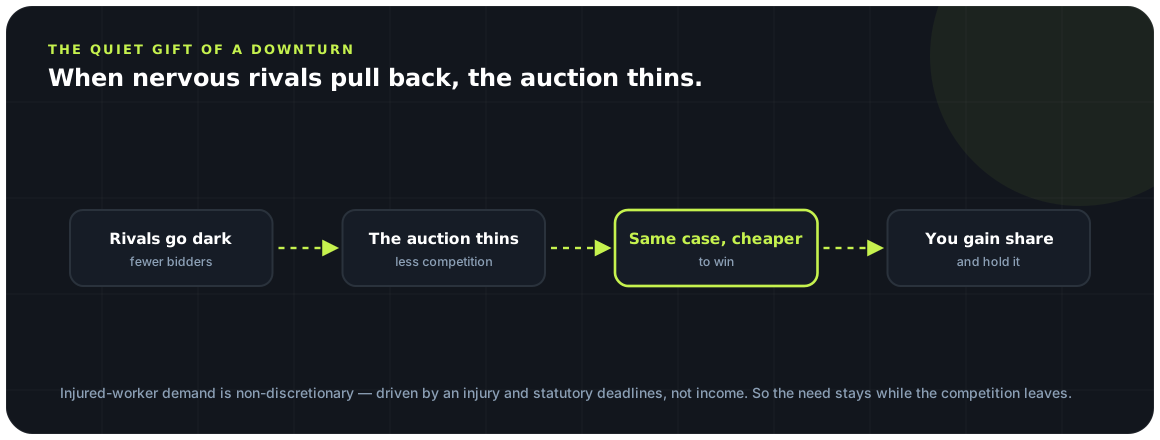
What to defend and what to actually cut
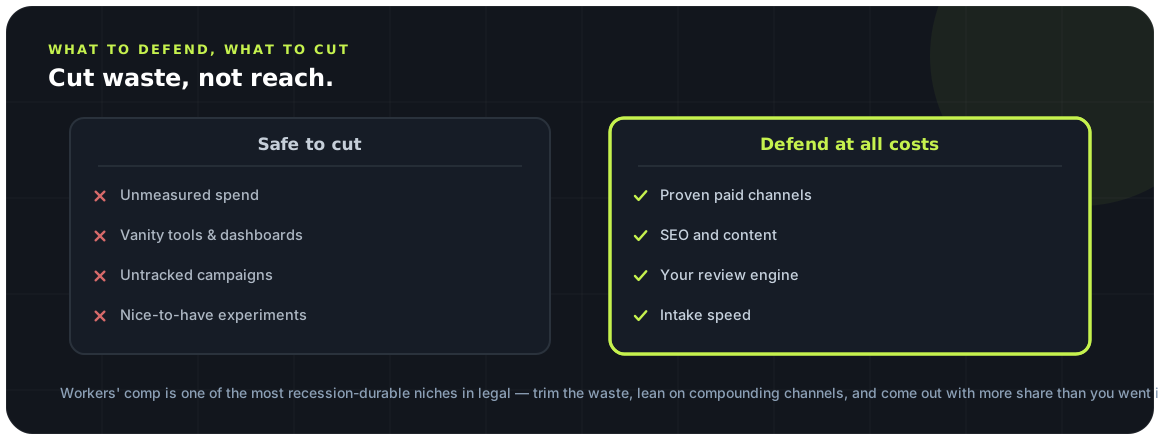
The right move is a scalpel, not a switch. Trim what you cannot measure; protect what signs cases.
None of this is an argument to spend blindly. A downturn is a genuinely good reason to get ruthless — but ruthless about waste, not about reach. The discipline is to sort every dollar into what you can tie to a signed case and what you cannot, and to cut from the second pile without touching the first.
Defend the owned and compounding channels first. Organic search, your Google Business Profile and reviews, referral relationships, and a database you can reactivate keep working whether or not you spend a dollar that week — and they are exactly what is most expensive to rebuild if you let them decay. Content that ranks, a map-pack position, a steady review flow: these are assets, and a downturn is the worst possible time to stop maintaining an asset that took years to build. We made the compounding case for organic in the content-engine piece, and for reviews as a case-flow system in the reviews playbook.
Protect the paid channels tied to signed cases. The search and Local Services spend that reliably produces retained cases at a known cost is not discretionary either — it is the most measurable case flow you have. If anything, a downturn is when you consolidate budget into your best-converting campaigns and starve the experiments, not when you shut the whole account.
Now cut, hard, from what you cannot measure. The billboard nobody can attribute. The sponsorship that generates goodwill and no tracked cases. The brand-awareness display campaign with no path to a signed matter. The agency retainer you cannot connect to pipeline. These are where a downturn budget should bleed — and cutting them can fund holding the line everywhere that matters.
| Channel or line item | Downturn move | Why |
|---|---|---|
| Organic search & content | Protect | Compounds; keeps producing with no incremental spend; brutal to rebuild |
| Google Business Profile & reviews | Protect | Cheapest case flow you own; feeds the map pack and LSA quality |
| Best-converting search & LSA campaigns | Hold or consolidate | Most measurable case flow; auction is getting cheaper, not dearer |
| Referral & database reactivation | Lean in | Lowest cost per signed case; pre-sold; nearly free to run |
| Unattributed brand / display / billboards | Cut | Real spend, no path to a signed case; funds the defense of everything above |
| Untracked retainers & experiments | Cut or pause | Cannot tie to pipeline; a downturn is the time to demand attribution |
Intake efficiency: make every paid lead worth more
In a downturn you cannot always buy more leads. You can always sign more of the ones you buy.
There is a lever most firms ignore entirely in good times and cannot afford to ignore in a downturn: the conversion rate from lead to signed case. If money is tight and you want more cases without more spend, the cheapest cases available to you are the ones you are already paying for and currently losing at the intake stage.
Do the arithmetic in your head. A firm that signs a quarter of its leads and a firm that signs a third of the identical leads have the same ad bill and dramatically different caseloads. Lifting intake conversion is, in effect, a budget increase that costs nothing — every point of improvement means the same paid lead is worth more. In a flush year that is a nice-to-have. In a downturn it is the difference between holding your caseload and watching it shrink while your spend stays flat.
The leaks are almost always the same and almost always fixable without money: speed to the first response, after-hours coverage, and follow-up persistence. An injured worker in distress calls more than one firm and signs with the one that answers first and makes them feel safe fastest; every minute of delay bleeds signed cases to a competitor. We broke the mechanics down in the anatomy of the intake call and the response-time case in after-hours intake — but the headline for a downturn is simple: before you cut a dollar of spend, make sure you are signing the leads that dollar already bought.
How to defend the budget to your partners
Partners cut “marketing.” They rarely cut a machine with a known cost per signed case.
If you are the one arguing to hold the budget while nervous partners reach for the scissors, understand why you keep losing the argument: you are defending the wrong noun. “Marketing” sounds like brand awareness and agency fees — soft, optional, cuttable. Nobody around the table has an emotional attachment to it, so it loses to fear every time.
Stop defending marketing and start defending cost per signed case. Partners will always cut a line labeled “advertising.” They will almost never cut a machine that reliably turns a known dollar amount into a known number of signed cases at a known price — because that is not a cost, it is the firm’s case-acquisition engine, and cutting it is cutting revenue. The entire argument comes down to changing the unit of the conversation from dollars spent to cases acquired.
To do that you need attribution that survives scrutiny: a line that connects ad spend to retained cases, a cost-per-signed-case number you can put on a slide, and a trend that shows what happens to that number when spend moves. This is precisely why measurement is not a nice-to-have — it is what lets you win the budget fight. We laid out how to build that connection, and why most dashboards mislead, in the attribution piece. Walk into the partner meeting with cost per signed case and its trend, and the budget stops being a target and starts being obviously load-bearing.
Notice that the argument is not “spend more in a recession because it feels brave.” It is “spend deliberately, defend the measurable, and prove the machine.” A partner who cuts an unattributed billboard is being sensible. A partner who cuts the campaign with a documented cost per signed case is cutting the firm’s revenue to save a rounding error, and the way you stop them is to show them, in their own language of cost and return, exactly what the line does.
The downturn playbook
Defend the compounding assets, exploit the cheap auction, tighten the funnel, prove the numbers.
Put together, the recession-durable firm is not the one that spends the most or the one that saves the most. It is the one that is deliberate while everyone else is emotional. When the row panics and goes quiet, being the firm that is still visible, still answering, and still measuring is a nearly unfair advantage — and it is available to any firm with the nerve to hold.
And do not miss the compounding part, because it is where the real money is. Market share taken in a downturn does not reset when the economy recovers. The map-pack position you defended, the reviews that kept flowing, the search real estate the quiet firms handed you — you keep all of it as demand returns and competitors try to buy their way back in at now-rising prices. The downturn is not merely something to survive. Handled with discipline, it is the cheapest opportunity you will get to permanently take ground from firms who mistook their marketing for an expense.
The firm that treats its marketing as inventory rather than overhead does not fear a downturn. It waits for one — because it knows the row is about to go quiet, the auction is about to get cheap, and the cases the nervous firms abandon have to go somewhere. Be where they go.
Key takeaways
-
In a downturn, cut waste — not reach. Workers’ comp is one of the most recession-durable niches in legal, so the reflex to reach for the marketing scissors is close to exactly backwards.
-
Injured-worker demand doesn’t follow consumer confidence. People get hurt at work and need a lawyer regardless of the economy, which makes comp demand structurally non-discretionary.
-
The ad auction gets cheaper when rivals lose their nerve. Firms that hold the line buy attention at a discount and take share that keeps paying out long after the downturn lifts.
-
Defend reach; cut the genuinely wasteful. The goal isn’t to spend more — it’s to protect the channels that produce signed cases while trimming the ones that don’t.
-
Make every paid lead worth more at intake. When budgets are under scrutiny, speed-to-lead and after-hours coverage turn the same spend into more signed cases.
Frequently asked questions
Is workers’ comp marketing recession-proof?
No marketing is literally recession-proof, but workers’ comp is unusually durable. An injured worker’s need for representation is non-discretionary — it is driven by an injury and a set of statutory deadlines, not by consumer confidence or discretionary income. People do not postpone a comp claim the way they postpone a vacation. That makes demand far steadier than in most legal niches, which is exactly why the panic-cut reflex is so costly here.
Should a law firm cut its marketing budget in a recession?
Cut waste, not reach. The right move is to trim the channels you cannot measure and defend the ones tied to signed cases, not to zero out demand generation across the board. When you go dark, you do not just lose this month’s leads — you concede the auction and the search real estate to the competitors who stayed in, and winning it back later costs more than holding it now.
What happens to cost per lead when competitors cut their spend?
Ad auctions are priced by competition. When nervous competitors pull back, there are fewer bidders on the same injured-worker searches, which tends to lower click costs and widen the gap between your bid and the next one. A firm that holds steady through a downturn can often buy the same case for less — the opposite of the story most owners assume when they cut.
Which workers’ comp marketing channels hold up best in a downturn?
The owned and compounding ones. Organic search, your Google Business Profile and reviews, referral relationships, and a database you can reactivate keep working whether or not you are spending that week. Paid channels still matter, but in a downturn you lean harder on assets you already own and on intake efficiency, so every lead you do pay for is more likely to sign.
How do I defend a marketing budget to my partners in a downturn?
Stop defending “marketing” and start defending cost per signed case. Partners will always cut a line item labeled brand awareness; they rarely cut a machine that reliably turns a known dollar amount into a known number of signed cases at a known cost. Bring attribution that connects ad spend to retained cases, show the cost per signed case trend, and frame the budget as case acquisition, not advertising.
Does workers’ comp claim volume rise or fall in a recession?
The honest answer is that it is mixed and depends on which forces dominate — layoffs can reduce hours worked and exposure, while cost pressure and job insecurity can change how injuries are reported and claimed. Do not build a plan on a confident prediction in either direction. Build it on the durable fact that injured workers who need help will keep searching for it, and make sure that when they do, your firm is the one still visible and still answering.
Sources & further reading
-
01
Protect the channels that compound
The assets a downturn is the worst time to abandon.
-
02
Make every lead worth more
Efficiency at intake is the cheapest growth in a downturn.
- 03
Benchmarks here draw on WorkersComp Marketing’s own managed-spend data across live workers’ comp firms; your numbers will differ. General marketing information, not legal advice.