There are two kinds of marketing reports in a law firm. The kind that tells you what happened, and the kind that tells you what to do next. Most firms only have the first.
Here is a scene we have walked into more times than we can count. A managing partner pulls up Meta Ads Manager on a Monday. It says 84 leads, $71 cost per lead, spend on target. He nods. Then he opens the intake spreadsheet, which says six signed cases last month. Nobody in the room can tell him which of the 84 became the six.
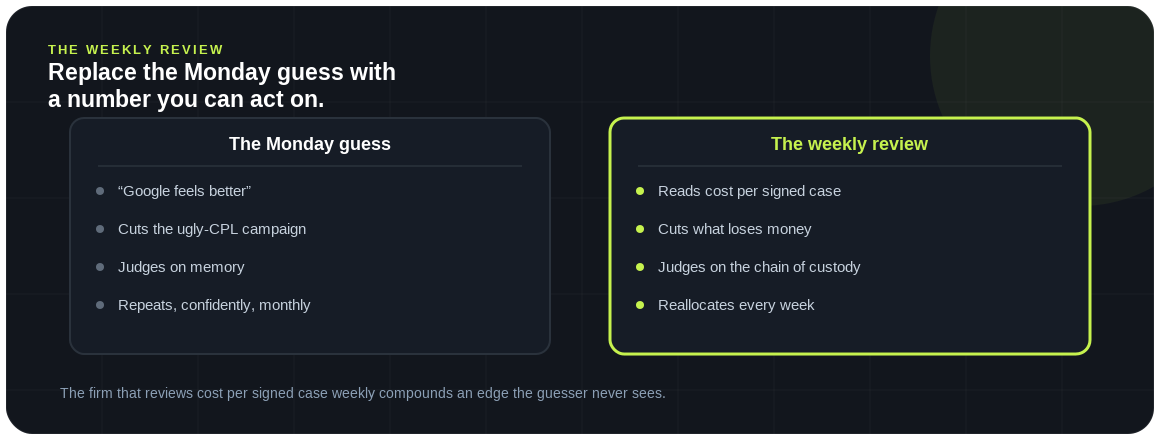
So he does what any reasonable person does with incomplete information: he guesses. He decides Google “feels” better than Meta because the one case he remembers came from a search call. He cuts the campaign with the ugly cost-per-lead — which happens to be the one producing his highest-value cases. And every month he repeats it, confidently, with a dashboard open.
That is not a data problem. It is a plumbing problem. This article is about the plumbing: where attribution breaks in a workers’ comp firm, why the platform numbers you trust are structurally optimistic, and how to build a chain of custody from ad click to signed case that survives contact with a real intake team.
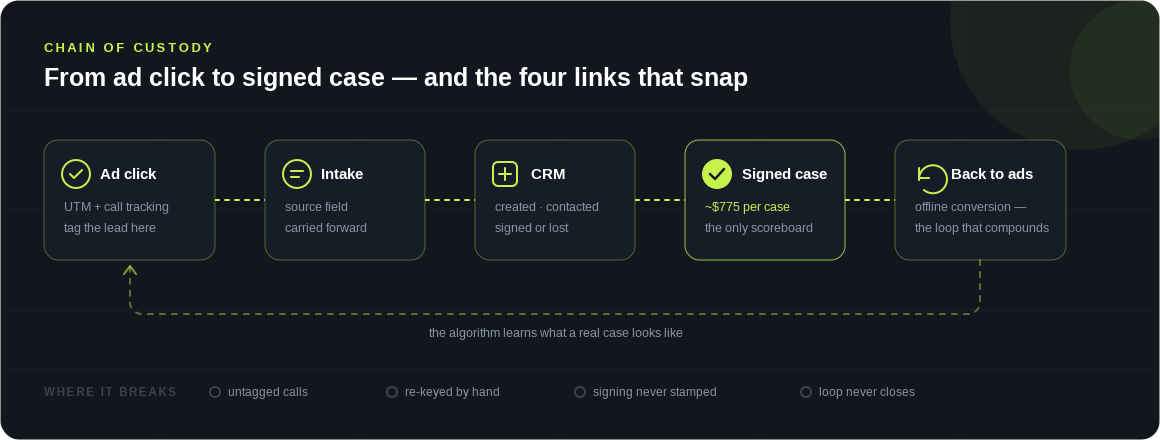
Before we get into the failure modes, it helps to see the whole path a case travels — and every point along it where the thread can be dropped.
Why the dashboard lies (and isn’t sorry about it)
Ad platforms are not lying to deceive you. They are answering a different question than the one you are asking.
When Meta reports a lead, it is reporting an event it observed: someone it can identify submitted a form. That is a true statement. The problem is what the platform cannot see — whether that person answered the phone, whether they had a compensable injury, whether they had already retained another firm, and whether they ever signed. The platform grades its own homework using the only assignment it was given: generate form fills.
So you end up optimizing a machine toward a goal that is one step short of your actual business. The algorithm gets very good at finding people who fill out forms. Some of them are excellent cases. Some of them are people who fill out every form they see.
Three structural distortions make platform-reported numbers optimistic in ways that are easy to miss.
Every platform claims the same case
Attribution windows overlap. An injured worker sees your Facebook video on Tuesday, searches your firm’s name on Thursday, clicks the Google ad, and calls on Friday. Meta claims the case under view-through attribution. Google claims it because it owns the last click. Your SEO consultant claims it because the person landed on a blog post in between.
Add up what each channel reports and you will “sign” more cases than you actually signed. Every marketer who has ever reconciled platform numbers against a CRM has seen this: the parts sum to more than the whole.
The last click gets all the credit it did not earn
Most default reporting is last-click or last-touch: whatever the person did immediately before converting gets the trophy. In workers’ comp — where the buying window can stretch across weeks of pain, denial letters, and pressure from an employer — the last click is usually a branded search. The person Googles your firm’s name because they already decided to call you.
Branded search is a receipt, not a salesman. If you fund it based on last-click ROI, it will look like the best-performing thing you own, right up until you cut the top-of-funnel campaign that was creating the demand and watch the branded search volume quietly collapse.
The tracking itself is leakier than it used to be
Browser tracking prevention, app tracking permissions, ad blockers, and privacy-first defaults have all chipped away at the old pixel-based model. A meaningful slice of conversions now happen invisibly — the case is real, but the trail back to the click is gone. Platforms fill those gaps with modeling, which is to say: educated inference.
None of this makes the platforms useless. It makes them a leading indicator rather than a scoreboard. They are excellent at telling you what is happening at the top of the funnel today. They are structurally incapable of telling you what a case cost you.
The only number that tells the truth: cost per signed case
Every other metric is a proxy. This one is the business.
Cost per signed case is brutally simple: total marketing spend divided by the number of cases signed from that spend, over a period long enough to account for your sign cycle.
It is the only marketing number that a managing partner and a marketing director can both look at without arguing, because it survives every fashion in ad tech. Platforms change. Cost per click changes. The question “what did it cost us to put one signed case on the board” does not.
Sit with that spread for a second, because it contains the whole argument. The distance between a $75 lead and a $775 case is not marketing. It is intake, qualification, and follow-up. A firm that improves its sign rate from 8% to 11% has cut its cost per case by roughly a quarter without touching the ad budget at all.
Which means: if you are only watching cost per lead, you are watching the smaller of the two levers.
Cost per lead measures your marketing. Cost per signed case measures your firm.
Spencer Moeller, WorkersComp MarketingHere is how the same month reads depending on which number you look at. Two channels, identical budgets, opposite conclusions.
| Channel | Spend | Leads | Cost per lead | Sign rate | Signed cases | Cost per signed case |
|---|---|---|---|---|---|---|
| Channel A | $10,000 | 160 | $63 | 4% | 6 | $1,667 |
| Channel B | $10,000 | 90 | $111 | 13% | 12 | $833 |
Channel A wins on every metric the ad platform shows you. Channel B signs twice as many cases for the same money. The firm looking at cost per lead cuts the wrong one.
This is not a hypothetical distortion. It is the single most common way we see good budgets destroyed: a firm defunds its best case source because that source produces fewer, more expensive, dramatically better leads.
The four places attribution breaks in a workers’ comp firm
In our experience, the leak is almost never in the ad account. It is in the handoffs.
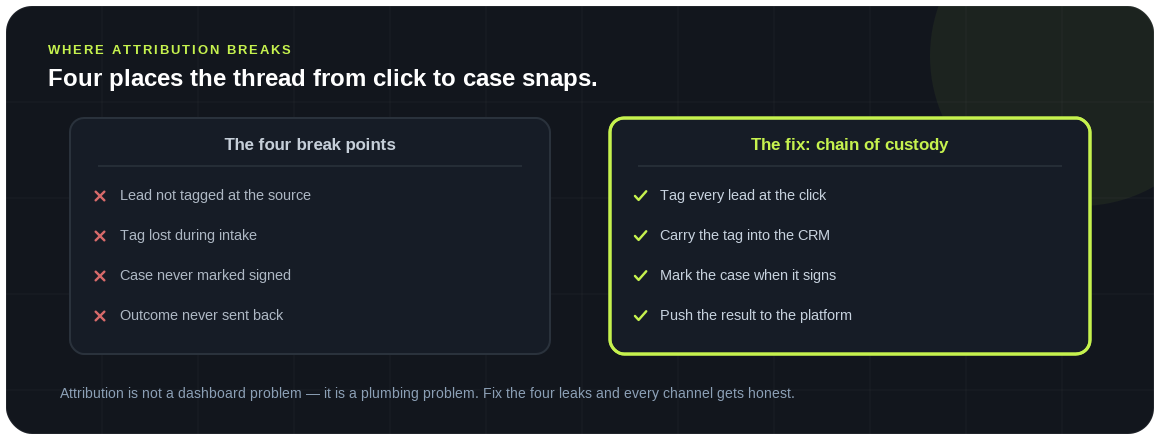
When a firm tells us their attribution is broken, we do not start in Ads Manager. We start by tracing one real signed case backwards and seeing where the trail goes cold. It is almost always one of these four places.
1. The lead arrives without a source tag
Someone calls the main office line. The receptionist writes down a name and an injury. Nothing records that this person came from a Google ad for “workers comp lawyer near me.” The case may be worth six figures and it enters your firm as an anonymous phone call.
In workers’ comp specifically, this is severe, because a large share of your best prospects call rather than fill out a form. They are in pain, they are frustrated, and they want a human. If your phone calls are untracked, you are blind to your highest-intent channel.
2. Intake doesn’t carry the tag forward
The lead arrives tagged. Then an intake specialist re-keys the person into the case management system by hand, and the source field is optional, so it is blank. Or it defaults to whatever the last selection was. Or the entire team has been choosing “Website” for three years because it is the first option in the dropdown.
The data existed for about ninety seconds and then a human being dropped it, not out of carelessness, but because nothing in their workflow made carrying it forward easier than not.
3. Nobody marks the moment of signing
The most expensive gap of all. The case signs. The retainer comes back. And no one updates a field anywhere that says this specific lead, from this specific source, became a case on this date. Intake moves on to the next call. Now the outcome — the only outcome that matters — is unrecorded, and no amount of dashboard sophistication can reconstruct it.
4. The outcome never gets back to the ad platform
Even when a firm records everything internally, the loop usually stops there. The signed case lives in the CRM and never travels back to Meta or Google. So the algorithms — which are genuinely good at finding more people like the ones you tell them about — keep optimizing toward form fills, because form fills are all you ever told them about.
Building a chain of custody, link by link
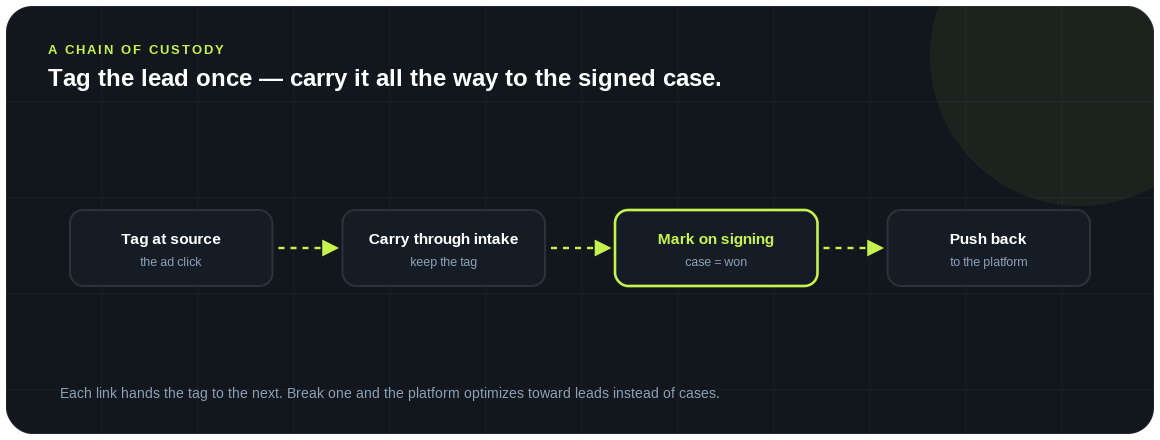
Attribution is not a tool you buy. It is a discipline you enforce at four handoffs.
Think of it the way an evidence locker works. Every transfer is logged, every custodian signs, and the chain either holds or the evidence is worthless. Same principle, less paperwork.
Link 1 — Tag at the source
Every inbound path gets a durable identifier before a human ever touches it.
For forms, that means UTM parameters captured into hidden fields on submission — source, medium, campaign, and ideally the ad or keyword. Not just stored in the browser; written into the lead record itself, so it survives the trip to your CRM.
For calls, it means dynamic number insertion, which we cover in the next section.
For everything else — chat, texts, referral forms, the QR code on a flyer at a union hall — a distinct entry point that identifies itself.
Link 2 — Make the tag mandatory in intake
The technology is the easy half. The hard half is making the source field required, with a short, unambiguous list of options, and no default selection. Ten sensible choices beat forty precise ones that nobody uses correctly.
And a rule we have never regretted: if your intake team can see the source automatically, they will not have to remember it. Push the tag into the CRM record programmatically wherever you can. The most reliable data-entry policy is the one that requires no data entry.
Link 3 — Stamp the outcome
You need three timestamps on every lead, minimum: created, contacted, and signed (or lost, with a reason). That is the whole scoreboard. From those three fields you can calculate speed-to-lead, contact rate, sign rate, and cost per signed case by source — which is to say, everything.
Notice how little this asks of your CRM. This is not an enterprise data-warehouse project. It is three fields, filled in reliably.
Link 4 — Return the outcome to the platform
Finally, that signed-case event goes back to Meta and Google as an offline conversion, so the platforms can optimize toward retained clients rather than form fills. This is the step almost nobody does, and it is the step that compounds.
| Link | What must happen | Common failure | The fix |
|---|---|---|---|
| Source | Every lead carries a tag on arrival | Phone calls arrive anonymous | Dynamic number insertion + UTM capture into hidden fields |
| Intake | The tag survives into the CRM | Manual re-keying drops it | Auto-populate the source; make the field required, never defaulted |
| Outcome | Signed / lost is stamped with a date | Nobody updates the record at signing | Three mandatory timestamps: created, contacted, signed-or-lost |
| Feedback | The signed case returns to the ad platform | The loop simply never closes | Offline conversion upload / CRM integration on a weekly cadence |
Do those four things and you can answer, on any given Monday, the question that used to require a guess: which channel is producing the cases we actually want, and what did each one cost?
Call tracking, done right — without wrecking your local SEO
Phones matter enormously in workers’ comp, and this is where most firms either skip the work or break their own rankings doing it.
Dynamic number insertion (DNI) is the mechanism. A small script swaps the phone number displayed on your site depending on how the visitor arrived. Someone who came from a Google ad sees one number; someone from a Meta campaign sees another; organic visitors see another. All of them ring the same intake team, and every call arrives stamped with its origin.
Done properly, you learn which keyword produced the call, hear the recording, and can connect that call to a case. Done carelessly, you create two problems that are genuinely expensive.
The second failure is subtler. A firm buys a single tracking number, points every campaign at it, and learns exactly one thing: “some calls came from marketing.” That is not attribution, that is a rounding error with a phone bill. You want a number pool deep enough to distinguish channels — at minimum paid search, paid social, organic, and offline/referral, kept separate.
Record the calls, then actually listen to them
Call recording (with the consent your state requires — check this, it varies) turns your intake queue into the richest qualitative dataset your firm owns. Not for surveillance. For the two questions no dashboard can answer.
Why did this lead not convert? The recording will tell you whether the person had a compensable claim, whether they had already retained counsel, or whether your intake specialist simply talked past them.
What language do injured workers actually use? They rarely say “I sustained a workplace injury.” They say “I hurt my back at work and my boss is being weird about it.” That sentence, lifted verbatim from a recording, is better ad copy than anything a marketer will write from imagination.
Closing the loop: teaching the algorithm what a real case looks like
This is the step that separates firms that measure from firms that compound.
Modern ad platforms are optimization engines. You give them a target and they relentlessly find more of it. Point them at “form submissions” and they will bring you an ocean of form submissions — including from people who submit a lot of forms.
Point them at “signed workers’ comp cases,” and something different happens. The algorithm begins to recognize the pattern of the people who actually retain a firm, and it goes looking for more of them. Same budget, better targets.
Mechanically, this means sending your signed-case outcomes back to the platforms as offline conversion events — Meta’s offline/conversions API, Google’s offline conversion imports — matched back to the original click or lead. Many case management systems and CRMs support this directly; the rest can do it with a weekly upload.
| Optimization target | What the algorithm learns to find | Typical result |
|---|---|---|
| Link clicks / traffic | People who click things | Cheap clicks, few leads |
| Form submissions (lead) | People who fill out forms | Cheap leads, unpredictable quality |
| Qualified lead (intake-verified) | People who pass a real screen | Fewer, better conversations |
| Signed case (offline conversion) | People who retain a firm | Higher cost per lead, lower cost per case |
Notice the last row carefully, because it is counterintuitive and it is the reason many firms abandon the strategy right before it works. When you optimize for signed cases, your cost per lead will usually go up. That is not a failure. That is the algorithm declining to spend your money on people who were never going to retain you.
If the person watching the dashboard does not understand this in advance, they will panic at the rising CPL and revert the change in week three — one week before the case data would have vindicated it.
The weekly review that replaces the guess
Attribution only pays off if someone acts on it on a schedule.
The firms that get value out of this do not have better software than the firms that do not. They have a standing meeting. Thirty minutes, same time every week, same four questions — and crucially, the marketing person and the intake person are both in the room, because half the answers live on each side.
The four questions
1. What did we spend, and what did it produce? Spend, leads, and cost per lead by channel. This is the fast signal — it tells you whether creative is fatiguing or a campaign is drifting.
2. How fast did we respond? Median speed-to-lead for the week, by channel. If this number is creeping up, nothing else on the list matters, because you are paying for conversations you are not having. (We wrote about why the first five minutes decide the case.)
3. What signed — and where did it come from? Cases signed this month, by source, with the running cost per signed case. This is the number that moves budget.
4. What did we lose, and why? The single most under-used field in any law firm’s CRM is reason lost. Not compensable. Already represented. Never answered. Outside our state. Each of those points at a completely different fix — targeting, speed, geography, screening — and without the field, all four look identical: “bad leads.”
Give the sign cycle time to close
One last discipline, and it is the one most often violated. Workers’ comp cases do not sign the day they call. There is a lag — sometimes days, often weeks, occasionally months while a claim gets denied and the worker finally decides to fight it.
Which means the cases signing this month came, in part, from spend two or three months ago. If you judge this month’s spend by this month’s signed cases, you will systematically undercount your newest campaigns and overcount your oldest ones. Match the cohort to the spend that created it, and be patient enough to let the window close before you draw conclusions.
Key takeaways
-
Your dashboard lies, and is not sorry about it. Platform-reported conversions overcount, double-count, and miss the phone entirely.
-
Cost per signed case is the only number that tells the truth. Everything upstream is a proxy; the signed case is the fact.
-
Attribution breaks in four predictable places. The click-to-call gap, multi-touch journeys, offline signing, and un-tagged sources.
-
Build a chain of custody, link by link. Tag the source, track the call, record the signing, and reconcile, a custody chain, not a guess.
-
Close the loop to teach the algorithm. Feed real signed cases back so the platform optimizes toward cases, not clicks.
Frequently asked questions
What is marketing attribution for a law firm?
Marketing attribution is the practice of connecting a signed case back to the marketing that produced it — the specific channel, campaign, ad, or keyword. For a workers’ comp firm it means being able to say “this retained client came from a Meta campaign, and cases from that campaign cost us X each,” rather than guessing which channel deserves next month’s budget.
Why don’t my ad platform numbers match my CRM?
Because they are counting different things and both are right. The platform counts conversion events it observed within its attribution window, including view-through credit and modeled conversions. Your CRM counts humans who signed. Overlapping attribution windows also mean two platforms can each claim the same case, so the parts sum to more than the whole. Treat the platform as a leading indicator and the CRM as the scoreboard.
Do I need call tracking if I already track form fills?
Almost certainly yes. In workers’ comp, a large share of the highest-intent prospects call rather than fill out a form — they are in pain and want a human immediately. If your calls arrive untagged, you are blind to your best-converting channel and you will systematically underfund it.
Will call tracking hurt my local SEO?
Only if it is implemented carelessly. Local rankings depend on consistent Name, Address, and Phone (NAP) data across your Google Business Profile and citations. Keep your real number as the primary listing and use tracking numbers as forwarding numbers, or limit dynamic number swapping to paid traffic. Done that way, call tracking is safe; done by replacing your number everywhere, it can undo years of local SEO.
What is an offline conversion, and why does it matter?
An offline conversion is an event that happens outside the ad platform — like a case signing weeks after the click — that you send back to the platform and match to the original lead. It matters because ad algorithms optimize toward whatever you report. Report only form fills and they will find you form-fillers. Report signed cases and they start finding people who actually retain firms.
How long should I wait before judging a campaign?
Long enough for your sign cycle to close. Workers’ comp cases frequently sign weeks after first contact, so the cases signing this month were partly created by spend two or three months ago. Judge weekly numbers (cost per lead, speed-to-lead) weekly, but judge budget decisions on cost per signed case over a window long enough to let the cohort mature — usually 60 to 90 days.
What’s the minimum setup if I have no budget for tools?
A required source field on every intake record, three timestamps (created, contacted, signed-or-lost), a “reason lost” field, and one spreadsheet that divides monthly spend by monthly signed cases per channel. That costs nothing but discipline and it will out-perform an expensive dashboard that nobody maintains.
Sources & further reading
- 01
- 02
Benchmarks here draw on WorkersComp Marketing’s own managed-spend data across live firms; your numbers will differ. General marketing information, not legal advice.