A lead is not a person. It is a person’s attention — and attention has a shelf life measured in minutes, not hours.
When an injured worker fills out a form, they are usually filling out several. They are anxious, in pain, and looking for the first firm that feels responsive and real. Whoever answers while that moment is still warm gets the conversation.
This piece lays out the evidence behind the five-minute rule, what slow response actually costs a firm paying premium legal prices, and the intake system we use to make sub-five-minute response automatic rather than heroic.
Why speed beats everything: the physics of a fresh lead
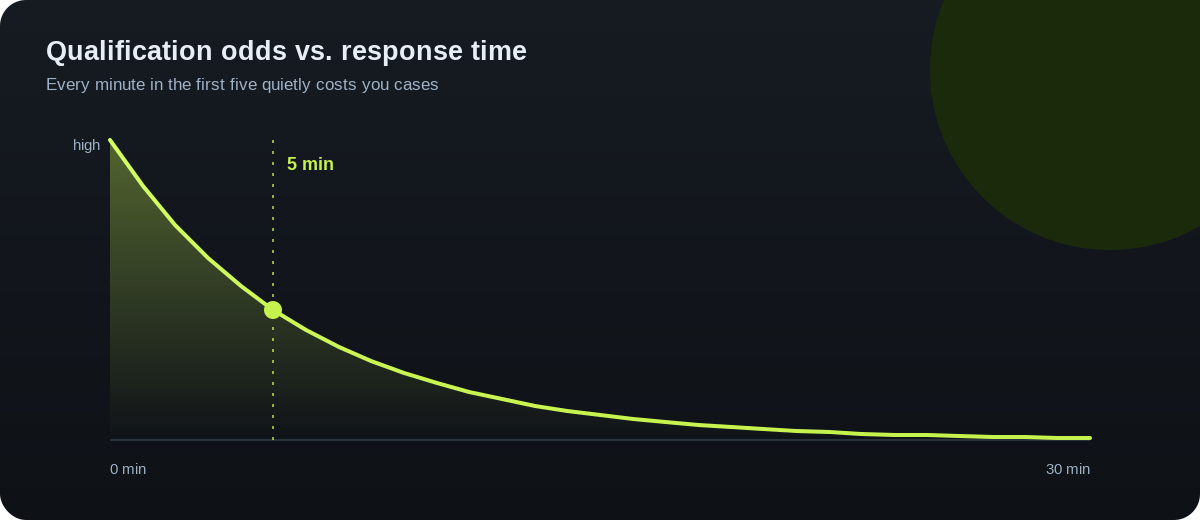
A lead decays like a signal — the longer you wait, the weaker it gets.
Think of an inbound lead as a signal with a half-life. The instant someone hits “submit,” their intent is at full strength. Every minute after that, it decays.
Two forces drive the decay. The first is distraction: the prospect gets a call, returns to work, sets down the phone. The second is competition: they contacted other firms too, and one of them is already calling.
This is why speed compounds every other dollar you spend. A better ad, a sharper landing page, a cheaper cost per lead — none of it matters if the lead goes cold before a human ever makes contact.
There is a second, quieter reason speed wins: it signals competence. A firm that calls back in four minutes feels organized and serious, which is precisely the impression a frightened prospect is scanning for. Slow response reads as indifference — and indifference loses cases.
The data: the 5-minute rule
The most-cited response-time research in the business, and what it really says.
The definitive study here is the Lead Response Management research led by Dr. James Oldroyd, then at MIT, in partnership with InsideSales. It analyzed more than 15,000 leads and over 100,000 call attempts.
The headline findings are stark, and they hold up because the sample is enormous rather than anecdotal.
The decay does not stop at five minutes — it accelerates. The same research found that once an hour passes, the odds of qualifying a lead fall by roughly 90% compared with an immediate response.
Put plainly: the difference between a five-minute reply and a one-hour reply is not incremental. It is the difference between a conversation and a voicemail no one returns.
| Response time | Odds of contact | Odds of qualifying |
|---|---|---|
| Under 5 minutes | Highest | Highest |
| 5–30 minutes | Falling sharply | Falling sharply |
| 30–60 minutes | Much lower | Much lower |
| Over 1 hour | Low | ~90% lower than immediate |
Directional summary of the MIT / InsideSales Lead Response Management study; exact odds depend on channel, offer, and industry.
Now for the opportunity buried in a second dataset. A 2025 study by Hennessey Digital examined 1,300+ law-firm websites, gathering 150,000 data points over five years.
It found that 26% of firms never respond to an inbound lead at all, and only about 25% respond within five minutes. Three out of four firms lose the speed race by default.
In an expensive category, response time is the rarest thing in marketing: a decisive edge your competitors are handing you for free.
Spencer Moeller, WorkersComp Marketing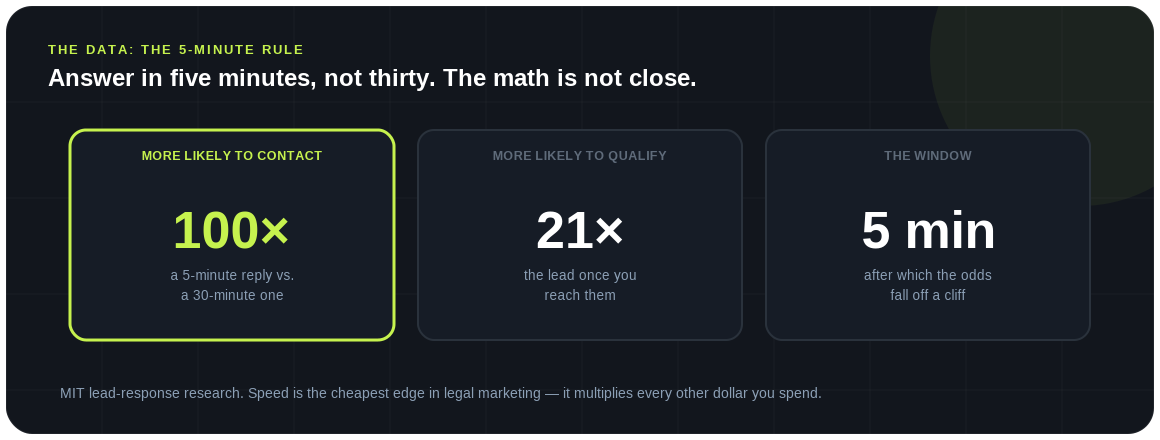
What slow response actually costs
In legal, wasted leads are uniquely expensive — because the leads are the priciest in marketing.
Speed matters everywhere, but it matters most where leads cost the most. And nowhere are leads more expensive than law.
Legal is the single most expensive category in paid search. According to WordStream’s benchmarks, the average cost per lead for legal services runs about $131.63 — far above the cross-industry average.
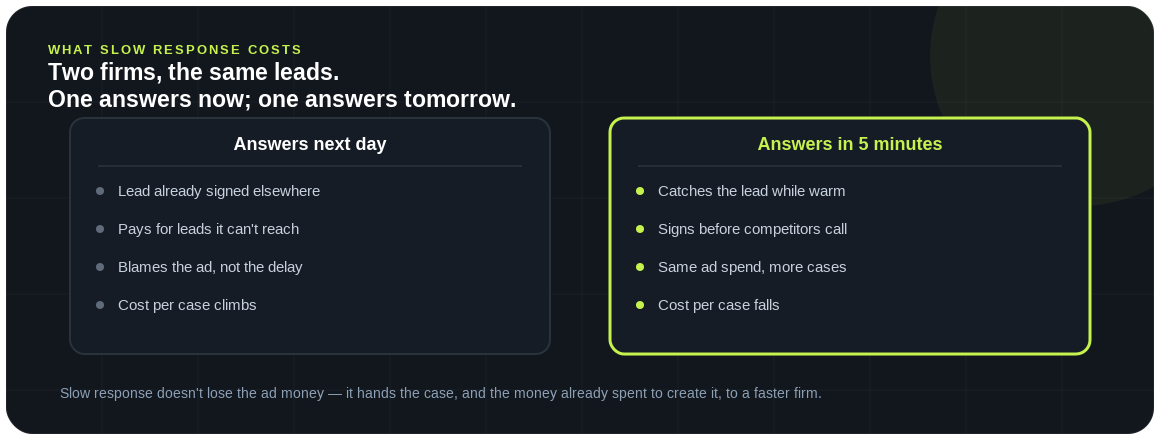
Layer the two facts together. You are paying roughly $130 per lead, and if you respond in an hour you have cut your odds of qualifying that lead by about 90%. You are not saving money by staffing intake thin — you are burning it.
Here is the scale it can reach. Across our own work, we have managed $16.5M in workers’ comp Meta ad spend — 219,000 leads at roughly $75 CPL, producing 21,000 signed cases at about $775 each. At that volume, a few points of response-time improvement is not a rounding error. It is dozens of additional signed cases a month.
For the full picture of how speed fits the broader acquisition model, see the full WC marketing playbook. If most of your volume comes from paid social, our breakdown of Meta ads for WC firms pairs directly with the intake system below.
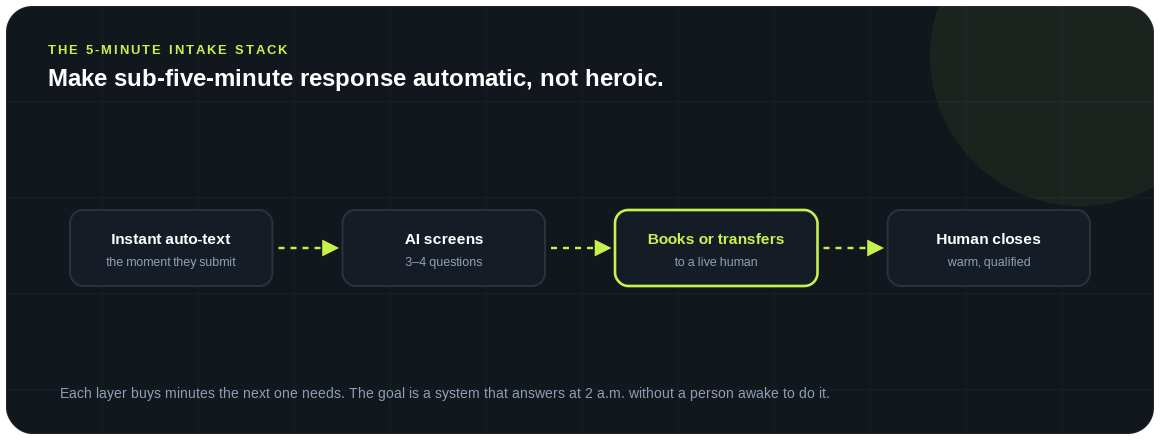
The 5-Minute Intake Stack
Sub-five-minute response is a system, not a personality trait. Here’s how to build it.
Firms that respond fast are not staffed by uniquely diligent people. They have engineered speed into the workflow so it happens whether anyone is watching or not.
We call the framework the 5-Minute Intake Stack — five layers that turn a raw lead into a live conversation before it can go cold.
Layer 1 — Instant automated acknowledgment
The second a lead submits, fire an automatic text and email: “We got your message — an attorney’s office will call you in the next few minutes.” This buys goodwill and stops the prospect from moving to the next firm while a human spins up.
Layer 2 — Immediate routing and alert
Route the lead into your CRM and ping the on-duty intake person by text and screen notification at the same instant. No one should have to remember to check an inbox; the system interrupts them.
Layer 3 — The human call, within five minutes
Automation opens the door; a human closes it. A real person calls within the window, using a short script for the top injury types so no time is lost improvising. Warmth and speed, together, are what convert.
Layer 4 — A defined follow-up cadence
Most leads are not reached on the first try. A structured cadence — multiple calls plus texts across the first days — captures the ones who missed the first ring, instead of one attempt and a shrug.
Layer 5 — Off-hours coverage
Leads arrive at 9 p.m. and on Sundays. An answering service, trained intake partner, or AI-assisted responder keeps the five-minute promise when the office is dark — because so do your competitors’ after-hours forms.
| Layer | Job to be done | Owned by |
|---|---|---|
| 1. Instant acknowledgment | Hold attention the moment they submit | Automation |
| 2. Routing & alert | Get the lead in front of a human instantly | CRM + automation |
| 3. The 5-minute call | Turn a form into a conversation | Intake team |
| 4. Follow-up cadence | Reach the ones you missed first try | Intake team |
| 5. Off-hours coverage | Keep the promise nights and weekends | Service / AI |
Want this built for you rather than assembled from scratch? This is exactly what our lead + intake system installs inside WC firms — automation, routing, cadence, and coverage as one connected stack.
Intake KPIs to track weekly
You cannot improve response time you do not measure. Watch these four every week.
Speed is only real if you can see it. Pull these numbers weekly, by lead source, so a slow week surfaces before it becomes a slow quarter.
| KPI | Poor | Good | Elite |
|---|---|---|---|
| Speed-to-lead (first touch) | > 1 hour | < 15 min | < 5 min |
| Lead-to-contact rate | < 40% | 60–75% | > 85% |
| Contact-to-signed rate | < 10% | 20–30% | > 35% |
| Follow-up attempts / lead | 1–2 | 4–6 | 6–8+ |
Key takeaways
-
A lead is attention with a shelf life. It is not a person — it is a person’s attention, and attention decays in minutes, not hours.
-
The 5-minute rule is real and measured. Contact and qualification rates fall off a cliff after the first few minutes; responding in five beats responding in an hour many times over.
-
Slow response is the most expensive leak you are not measuring. Every lead that goes cold before you call is spend you already paid for and threw away.
-
Speed is a system, not a hustle. The 5-minute intake stack of routing, alerts, templates, and coverage makes fast response the default instead of a heroic act.
-
Track intake KPIs weekly. Speed-to-first-touch, contact rate, and set-rate tell you whether the system is holding.
Frequently asked questions
What is speed-to-lead?
Speed-to-lead is the elapsed time between a prospect submitting an inquiry and your firm’s first genuine attempt to reach them — a call, text, or personal message, not just an automated receipt. It is one of the strongest predictors of whether a lead ever becomes a signed client.
How fast should a law firm respond to a lead?
Under five minutes. MIT research found that responding within five minutes rather than thirty made firms up to 100× more likely to make contact and 21× more likely to qualify the lead. After an hour, the odds of qualifying fall by roughly 90% compared with an immediate response.
Does texting a lead work better than calling?
Not better — together. Many prospects will not answer an unknown number but will read a text within seconds, so a short opening text often earns the callback that turns a cold call into a warm one. The strongest intake stacks fire an instant text and then place the human call.
How many times should we follow up?
Most leads are not reached on the first attempt, so a single try leaves signed cases on the table. A structured cadence of roughly six to eight touches — a mix of calls and texts spread across the first several days — captures the prospects who simply missed your first ring.
Can we automate intake without sounding robotic?
Yes — automation should open the door, not replace the person. Use it for the instant acknowledgment and internal alert, then have a real human make the call within five minutes. Done well, the prospect experiences a firm that is fast and attentive, not a bot handling their injury.
Sources & further reading
-
01
The 5-minute rule research
Lead-response research showing how sharply contact and qualification rates fall as minutes pass.
-
02
Cost & conversion benchmarks
Industry benchmarks for what a lead costs and converts at, the baseline speed protects.
- 03
External sources were accurate at publication and change over time; confirm current figures at the source. General marketing information, not legal advice.