Every firm that has run ads for more than a few months owns two lead sources. One costs money every day. The other is already paid for.
The first is the live pipeline — the ads running right now, generating new inquiries at whatever your market charges this quarter. The second is the database: every injured worker who ever called, filled out a form, or messaged the firm and did not sign. Most firms treat that second source as a graveyard. It is closer to a savings account nobody remembers opening.
This article is the system for going back: why workers’ comp leads go dormant in the first place, how to audit what you are sitting on, when and how to reach back out without being a pest or a compliance problem, and how to make sure the database never rots like this again.
The cheapest case source you own
The acquisition cost is already spent. That changes the economics of everything downstream.
When a new lead comes in from a live campaign, its cost is whatever your channel charges — media spend, landing pages, management, all of it, divided by the leads produced. That cost is real and recurring: to get another lead tomorrow, you pay again.
The dormant lead is different in one structural way. Its acquisition cost is sunk. The money left the account months ago, whether the lead ever became a case or not. Going back to that lead costs the labor of a text, an email, and a phone call — and nothing else. There is no media bill attached to a follow-up.
This is not a clever growth hack. It is basic accounting. The firm has already converted cash into a list of injured workers who, at some point, wanted to talk to a lawyer badly enough to raise their hand. Whatever fraction of that list can still become clients, the firm acquires them at the marginal cost of outreach — which no live channel, in any market, can match, because every live channel has media cost baked in.
And yet almost nobody does it systematically. Intake teams are staffed and measured around new leads. The moment a lead stops answering, it slides out of view — no owner, no next step, no scheduled return. Not because anyone decided those people stopped mattering, but because nobody built the system that goes back. That system is the rest of this article.
Why workers’ comp leads go dormant
The injured worker is on the claim’s timeline. Your follow-up sequence is on yours. They rarely match.
To reactivate a lead respectfully, you first have to understand why they went quiet — because in workers’ comp, silence almost never means “not interested.” It usually means one of four things.
Fear of the employer. Many injured workers half-believe that hiring a lawyer is an act of war against their employer — that it means losing the job, the shift, the reference, or the goodwill of a supervisor they still see every day. So they inquire in a brave moment, then retreat. The fear does not disappear; it waits, and it often loses the argument later when the claim turns hostile.
Hoping the insurer “handles it.” Early in a claim, the adjuster is often polite, the checks arrive, and the clinic visits are approved. The worker concludes the system works and a lawyer would only complicate things. Anyone who has watched a few hundred claims knows how often that honeymoon ends — but the worker does not know it yet. They are not rejecting your firm; they are trusting a process they have never seen fail before.
Waiting on the denial. Some workers explicitly plan to call a lawyer “if something goes wrong.” The claim has to visibly break before they feel entitled to help. Your first conversation happened before the break; the case exists after it.
Treatment comes first. A person in pain triages. Surgery, physical therapy, childcare, making rent on partial checks — paperwork with a law firm falls to the bottom of that list, not because it is unimportant but because everything above it hurts more. “I’ll deal with it after the MRI” is one of the most common silent goodbyes in intake.
Notice what all four have in common: the lead’s decision clock is set by the claim — the denial, the checks, the treatment calendar — while the firm’s follow-up sequence is set by the firm’s calendar, usually a burst of attempts in the first week and then nothing. The two clocks are misaligned by weeks or months. The firm gives up at precisely the point where the worker’s reasons for waiting have not yet collapsed. Reactivation is the correction: it re-enters the lead’s life when the claim, not the campaign, says it is time. We covered the front half of this problem — staying present between inquiry and readiness — in the slow yes; reactivation is what you do when that nurturing never happened and the database went cold.
The audit: export everything, sort into four piles
You cannot reactivate a database you have not looked at. Start with a full export and an honest sort.
Pull every lead from the last 12 to 24 months out of your CRM, intake sheets, call logs, and form notifications — all of it, into one list. Twelve months is the minimum for a meaningful pass; twenty-four is worth it in most states, though filing deadlines vary and a lawyer, not a marketer, should judge which older claims are still viable. If the leads live in three systems and a paralegal’s notebook, that is itself a finding — write it down and fix it in the last section.
Then sort every record into one of four piles. Resist the urge to invent more categories; four is enough to act on.
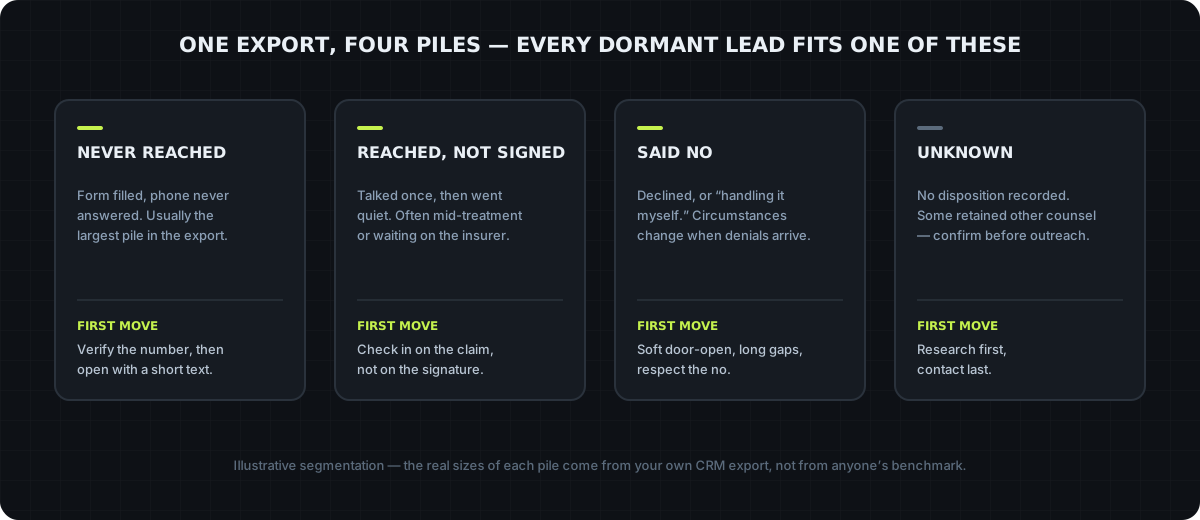
| Segment | What it means | Approach |
|---|---|---|
| Never reached | Inquired; no live conversation ever happened | Full sequence — they are still waiting on a first real contact |
| Reached, not signed | Talked at least once, then went quiet | Warm check-in on the claim; reference the earlier conversation |
| Said no | Explicitly declined or “handling it myself” | Light, infrequent, door-open touches only — respect the no |
| Unknown / possibly signed elsewhere | No disposition recorded | Research before any contact; anyone represented is permanently off-limits |
The “never reached” pile is usually the humbling one. These are people who asked for help and never got a real conversation — often because the inquiry arrived at night, or the one callback went to voicemail, or the lead simply fell between two staff members. They deserve the most complete sequence, because from their side of the phone, the firm still owes them a first answer. If that pile is large, your problem is not only reactivation — it is response speed, and we wrote the fix in the five-minute rule.
The “unknown” pile is the dangerous one. A record with no disposition might be a worker still going it alone — or someone who retained other counsel a year ago. Before any outreach touches this pile, do the homework: check your own case management system for conflicts, check notes and emails, and where your jurisdiction provides it, check whether an attorney has appeared on the claim. When in doubt, leave the record out. Nothing in this playbook is worth a call to a represented person.
What changed since they first called
You are not re-contacting the same person. The claim has moved — and its pain points are your timing.
The biggest mental shift in reactivation: the lead you are writing to is not the person who filled out the form. Months have passed, and in workers’ comp, months change everything.
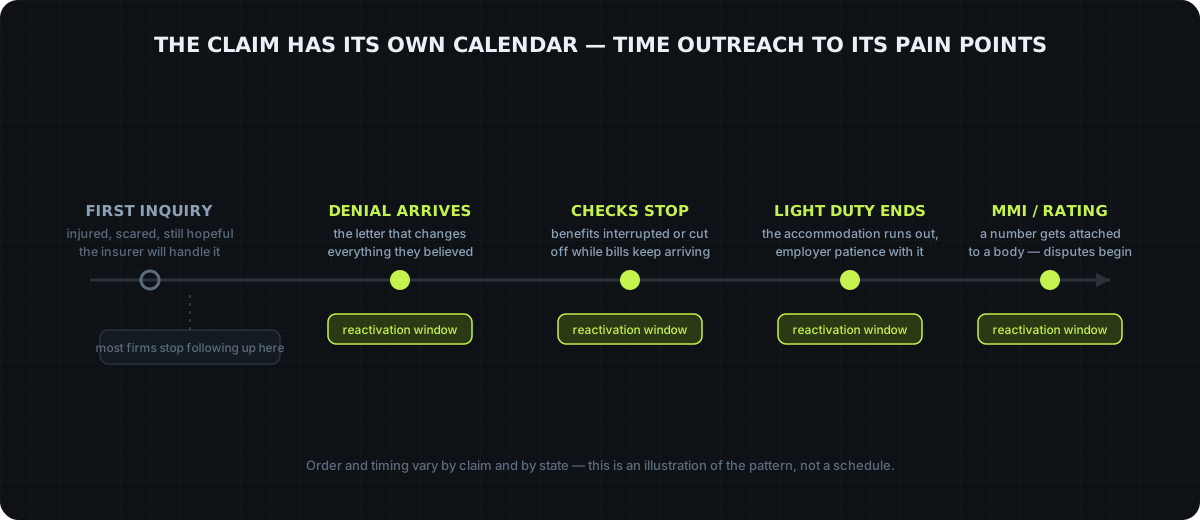
The denial arrived. The claim that was “being handled” got a letter saying some or all of it is not covered — the injury is disputed, the treatment is not authorized, the wage rate is wrong. For the worker who was politely waiting for the system to work, this is the moment the system visibly stops working. It is also, not coincidentally, the moment they start searching again — and if your firm is not the one that checks in, a stranger’s ad will be. The marketing side of that moment is its own discipline; we wrote about it in reaching denied claims.
The checks stopped. Benefit interruptions — late checks, reduced checks, terminated benefits after an adverse exam — turn an abstract legal question into a household emergency. A person who could afford to wait in month one cannot afford to wait when the mortgage is due against a check that did not come.
Light duty ran out. The accommodating employer of month one has a business to run. Modified duty ends, patience thins, hours get cut, and the worker starts hearing versions of “we need you back at full capacity.” The fear of employer retaliation that kept them from signing now cuts the other way — the relationship they were protecting is fraying anyway.
MMI and the rating. When a doctor declares maximum medical improvement and attaches a number to a body, the claim shifts from “getting better” to “settling up” — and disputes over that number are precisely where representation changes outcomes. Workers who never wanted to fight about treatment often decide to get help the day the fight becomes about the rest of their working life.
This is why reactivation should be timed to the claim’s natural pain points rather than the firm’s marketing calendar. A quarterly “just checking in” blast is better than nothing. But a sequence built around the moments when a claim actually turns — with message frames that speak to denial, stopped checks, ended light duty, and MMI — reaches people at the moment their original reason for waiting has collapsed. You cannot know each claim’s exact dates from the outside. You do not need to. Spread across a year of dormant leads, some meaningful share are at or near one of these turns at any given time — which is a statement about how claims progress, not a measured percentage.
The reactivation sequence
Multi-touch, multi-channel, and respectful — a check-in from a firm they already know, not a cold pitch.
The sequence itself is simple: text, call, and email, spread over about three weeks, then rest. What makes it work is not the channel mix — it is the frame. Every message must read like what it is: a firm they already contacted, checking back in. Never a stranger, never a telemarketer, never a countdown timer.
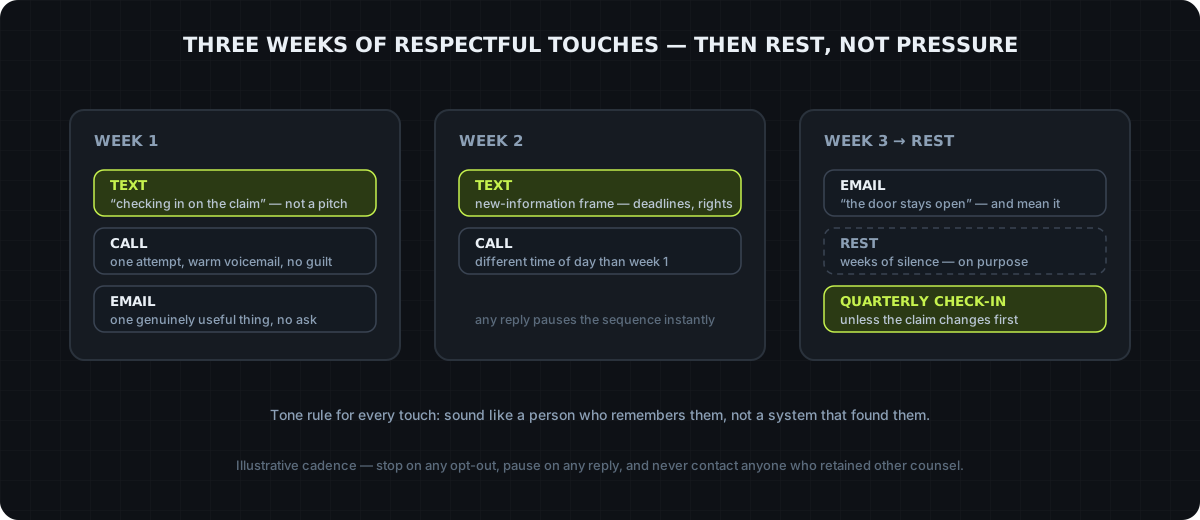
Open with a text, because a text is the least intrusive way to knock. Something like: “Hi Maria, this is [Name] from [Firm]. You reached out to us a while back about your work injury — just checking in on how the claim is going. No pressure either way; happy to answer questions if anything’s changed.” It names the prior contact, asks about the claim rather than the signature, and gives explicit permission to ignore it. Follow within a day or two with one call — warm voicemail if unanswered, no guilt — and later that week one email that contains something genuinely useful: what a denial letter actually means, what workers typically get wrong about adverse exams, what deadlines exist in your state to appeal.
Week two is where the new-information frames belong. Not “we’re following up again,” which is about you, but something true that they may not know: “A lot of the folks we talk to don’t realize denial appeals in [state] have a deadline — if you ever got a denial letter, it’s worth knowing your dates.” That message earns its place in their inbox whether they hire you or not. Week three closes the active window with an email that leaves the door open and means it — then the lead moves to a quarterly check-in rhythm unless the claim changes first.
| Frame | Example | Verdict |
|---|---|---|
| Claim check-in | “Checking in on how the claim is going” | Works — it is about them, not you |
| New information | “Appeal deadlines exist in [state] — worth knowing your dates” | Works — useful whether or not they hire you |
| Open door | “No pressure — we’re here if anything changes” | Works — matches how the slow yes actually happens |
| Fake urgency | “Final notice — your file will be closed!” | Backfires — they know there is no file to close |
| Manufactured scarcity | “We’re only taking 3 more cases this month” | Backfires — reads as exactly what it is |
Two operational rules complete the sequence. Any reply — even “who is this?” — pauses the automation instantly and routes to a human. And any lead who completes the three weeks without responding is not marked dead; they are moved to the long-cycle rhythm. In this business the no you respect this quarter is frequently the client of a later one.
Compliance guardrails
Reactivation done right is a follow-up to an inquiry they made. Keep it that way — and keep your counsel in the loop.
Everything in this playbook rests on one fact: these people contacted your firm first. Re-contacting someone who previously inquired is a fundamentally different act from cold solicitation — both in how bar rules generally treat it and in how texting rules are analyzed, where a prior inquiry and any consent language on your intake forms matter a great deal. But “different” is not “unregulated,” and the guardrails are not optional.
Honor every opt-out, forever. Anyone who ever said stop, unsubscribed, replied STOP to a text, or asked not to be contacted is out of the database for outreach purposes — permanently, across all channels, no matter how good the new sequence is. Your do-not-contact list is the first thing to reconcile before any campaign runs, and every outbound text needs a working opt-out.
Never contact anyone who retained other counsel. This is the brightest line in the article. If there is any indication a lead is represented — a disposition note, an attorney of record on the claim, a mention in the last call — the record is closed. Contacting represented persons is how reactivation programs become bar complaints.
Respect your state bar’s solicitation rules. Rules on written and electronic contact with prospective clients vary meaningfully by state — what must be labeled, what records must be kept, how prior-relationship exceptions are defined. Your bar’s rules, not a marketing article, govern. Have your own counsel review the sequence, the message templates, and the consent language on your intake forms before anything sends. That is not a disclaimer reflex; it is a cheap meeting that protects an asset worth protecting.
None of this is legal advice, and it is deliberately not state-specific. The point is narrower and practical: a reactivation program has a compliance layer, that layer is buildable in an afternoon with your counsel, and skipping it is the one way to turn found money into a liability.
Route reactivated replies like brand-new leads
A reply to a reactivation text is a live lead. It deserves the same five-minute discipline as one from an ad.
Here is where reactivation programs quietly die: the messages go out, a dormant lead finally replies — “actually yes, my claim got denied last month, can someone call me?” — and the reply sits in an inbox until tomorrow. The firm spent months building the courage to knock, the door opened, and nobody walked through it.
A reactivated reply is not a warm-ish maybe. It is arguably hotter than a fresh ad lead: this person has now raised their hand twice, and the second time was in response to your name, not a stranger’s ad. Every argument in our speed-to-lead piece applies with full force — the reply should route into the same queue, trigger the same instant alerts, and get the same fast human call as a brand-new inquiry. If your intake stack already does this for new leads, extending it to reactivation replies is configuration, not construction; if it does not, build it once and both streams benefit. This routing — sequences that pause on reply, alerts that interrupt a human, off-hours coverage — is exactly the plumbing our AI automation service installs.
One addition specific to reactivation: arm the intake team with context. The person calling back should know this lead’s history — when they first inquired, what was discussed, which segment they were in — so the conversation continues rather than restarts. “I see you talked with us back in March about your shoulder” is a different phone call from “can I get your name and how you heard about us?” The first sounds like a firm that kept their file open. The second tells them the last conversation never mattered.
Keep the database clean going forward
The first pass is a project. The goal is to never need another one — because nothing goes dormant again.
If the audit taught you anything, it is that the graveyard was built one shrug at a time: a lead unanswered, a disposition unrecorded, a follow-up unowned. The permanent fix is not an annual cleanup. It is a CRM discipline that makes dormancy structurally impossible.
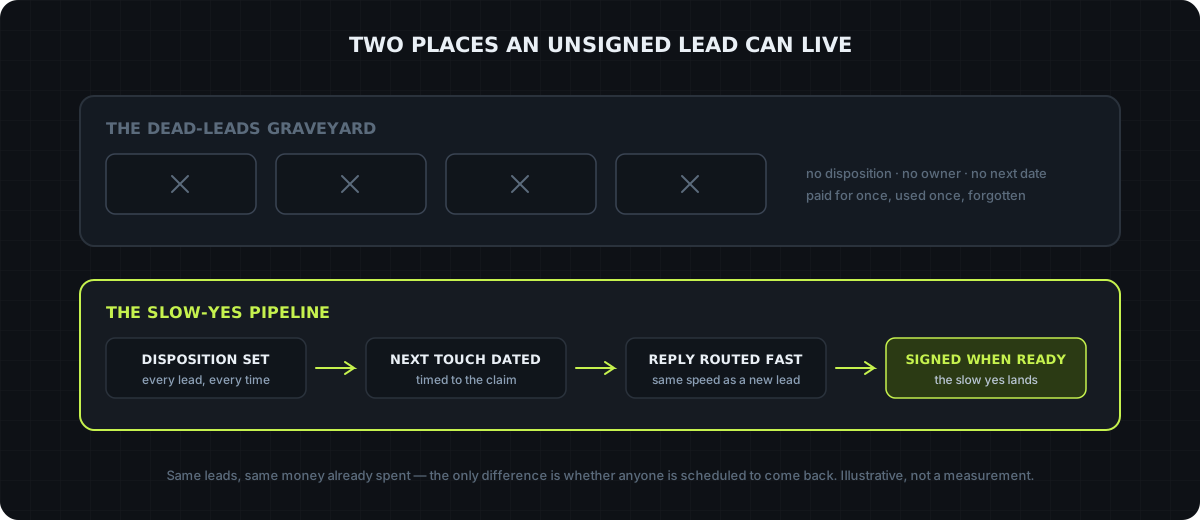
Three rules do most of the work. First: every lead gets a disposition, every time. “Never reached,” “spoke — waiting on claim,” “declined,” “represented — do not contact,” “opted out.” No record leaves an intake person’s hands without one; an unlabeled lead is the seed of the next graveyard. Second: every unsigned lead gets a next-touch date. Not “follow up eventually” — a date on which a specific touch fires, timed to whatever the last conversation revealed about the claim. Third: the pipeline has a name and an owner. We call it the slow-yes pipeline, after the nurture thesis this whole site is built on: most injured workers are not ready today, and the firm that stays respectfully present is the one they call when they are. A slow-yes pipeline is simply that thesis given a place to live in the CRM — with someone whose job includes tending it.
Structurally, this means your CRM stops having a “dead” bucket for anyone who has not opted out, retained counsel, or aged past viability. Leads are active, scheduled, or excluded — there is no fourth state where a record just quietly falls off the map. If your current system cannot enforce that (dispositions, scheduled sequences, exclusion lists, reply routing), that is a tooling problem before it is a discipline problem; it is the core of what we build in our intake and CRM service.
The honest math
No projections, no invented percentages — just the structure of the numbers, which you can verify with your own.
We are not going to tell you what response rate to expect, because we would be making it up, and because it depends on things we cannot see from here: how old your list is, how good your original intake was, how your market behaves. What we can show you is the structure of the math — and the structure is the argument. To be clear about what follows: this is reasoning about costs you already know, not a measurement of results.
Take the last twelve months. You know what you spent on lead generation, and you know how many leads it produced — real numbers from your own books, not ours. You also know roughly what share of those leads signed. Whatever that share is, its complement — the leads that did not sign — is the pile this article is about, and every dollar of media cost attached to that pile has already been spent. It does not come back if you ignore the pile, and no new dollar is required to work it.
Now the marginal cost of reactivation: staff hours to run the audit, a modest software cost for sequences most firms already pay for, a counsel review, and intake time on replies. No media. So the cost per signed case from reactivation is that labor divided by however many cases the database yields. For that to merely match a live channel’s cost per case — where every case carries its full share of media spend — the database would have to yield almost nothing at all. If even a small fraction of a year of paid, hand-raised, injury-confirmed inquiries becomes signed cases, the marginal cost per case beats any live channel you run, for the unremarkable reason that the expensive part already happened. That is not optimism about response rates. It is arithmetic about which costs are sunk.
Run the audit and the first sequence, then judge the program on your own numbers: cases signed from the database, labor hours in, cost per signed case out — side by side with each live channel. Our bet is that the comparison ends the debate. But it is your data that should end it, not our claims.
Key takeaways
-
Your dormant database is the cheapest case source you own. You already paid to acquire these leads; reactivating them is nearly free.
-
Leads go dormant for ordinary reasons. Timing, fear, and follow-up that stopped, not a hard no.
-
Audit it: export everything, sort into four piles. Not-yet-contacted, went-quiet, declined, and signed-elsewhere each get a different move.
-
Things changed since they first called. A denial, a stalled claim, or a new injury can reopen a dead lead.
-
Route reactivated replies like brand-new leads. Speed still decides; a reply that sits is a case lost twice.
Frequently asked questions
What is lead reactivation for a workers’ comp firm?
Lead reactivation is the systematic re-contacting of leads your firm already generated and paid for — the injured workers who inquired but were never reached, never signed, or said no — using a respectful cadence timed to their claim rather than your calendar. Because the acquisition cost is already sunk, any case signed from the database costs only the labor of the outreach.
How far back should we go in the lead database?
Twelve to twenty-four months is the practical window for most firms — recent enough that claims are often still open and statutes have usually not run, old enough to build a meaningful list. Older records can be worth a look, but check your state’s filing deadlines before spending effort there, and let a lawyer rather than a marketer judge whether a claim is still viable.
Is it legal to re-contact old leads?
Generally, responding to someone who previously contacted your firm is a different act from cold solicitation — the prior inquiry matters both under bar rules and in how texting regulations are analyzed. But solicitation rules vary by state bar, opt-outs must always be honored, and anyone who retained other counsel is permanently off-limits. Have your own counsel review the sequence before it runs; this article is practical guidance, not legal advice.
What should the first reactivation message say?
Check in on the claim, not on the signature. A short text like “You reached out to us a while back about your work injury — just checking in on how the claim is going” names the prior contact, asks about them rather than about you, and gives permission to ignore it. True new information — appeal deadlines, benefits questions — also earns its place. Fake urgency and manufactured scarcity backfire and damage the firm’s name.
How often should a firm run reactivation?
Run the first pass as a project: export, segment, clean the exclusions, and work the sequence over a few weeks. After that it should stop being a campaign and become a pipeline — every unsigned lead carries a disposition and a scheduled next touch, typically on a quarterly rhythm, so the database never goes fully dormant again.
What if a lead already signed with another firm?
Stop contacting them, immediately and permanently. A represented person is off-limits — continuing to reach out risks bar trouble and earns nothing. Record the disposition in your CRM so no future campaign touches the record. The right response to “I have a lawyer” is a genuine “glad you’re in good hands” and a closed file.
Sources & further reading
- 01
- 02
- 03
Benchmarks here draw on WorkersComp Marketing’s own managed-spend data across live firms; your numbers will differ. General marketing information, not legal advice.