Workers’ Comp Marketing Resources: Guides & Playbooks
Field notes

How workers' comp firms actually grow

The workers' comp marketing plays we run inside high-volume firms — written up in full, with the numbers.

Looking for the manuals instead? The Growth Library — 15 free playbooks, 1,547 pages.

Cost per signed case by marketing channel
Featured guide

Why most workers' comp ad campaigns leak cases — and how to plug them

SMSpencer Moeller18 min read
Read the guide →
The library

Browse every play

Free, complete, and the only thing we ask for is an email address.

We ask for your email and we send you the file — that is the whole transaction. No call to unlock it, no demo, no chapter held back to make you want a paid version, because there isn’t a paid version. Just 112 original diagrams and every page yours to keep — no strings. Unsubscribe whenever you like.

He Needs the Job. So He Doesn’t File.
Intake

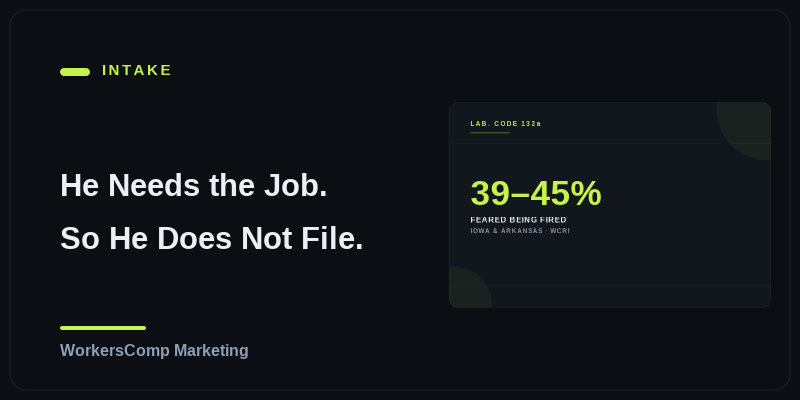
He Needs the Job. So He Doesn’t File.

Two WCRI state surveys found 39–45% of injured workers with lost-time claims were somewhat or very concerned they would be fired. Four states make that firing a separate legal wrong — and California’s remedy is only reachable from inside a case the frightened worker has not opened. What it changes in a comp firm’s intake script, follow-up sequence and unsigned-lead pool.
113 Employers. A Different Forum.
Intake

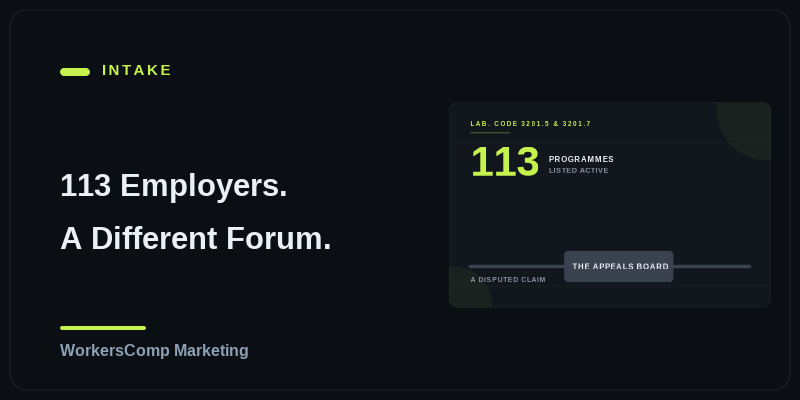
113 Employers. A Different Forum.

California must publish, every month, the employers whose injured workers’ disputes run through a private ADR system instead of the appeals board — 17 construction and 96 non-construction programmes, 29 named cities, and one outcome report showing 19 litigated claims out of 3,100.

You Keep the Data. Not the Permission.
Lead Quality

You Keep the Data. Not the Permission.

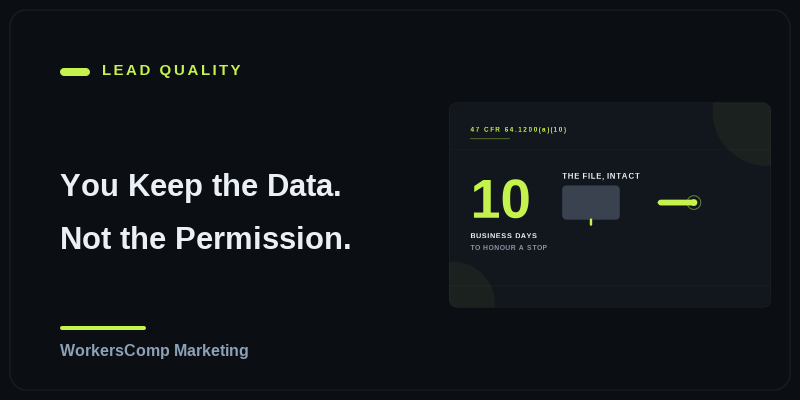
California publishes 625 data-broker filings, free, with each vendor's own disclosures — and the three rules that decide whether a bought comp lead is still callable all turn on a relationship the firm is not party to.

Nobody Denied It. The Checks Stopped.
Intake

Nobody Denied It. The Checks Stopped.

The demand triggers comp media is built around are all decisions somebody made. One benefit event is a count of weeks instead — arriving on a date your own CRM already holds.

The Add-On That’s Worth Nothing
Intake

The Add-On That’s Worth Nothing

California bars a psychiatric disorder from increasing a permanent disability rating — with two exceptions, neither of which turns on the psychiatric evidence. What the Appeals Board held twice en banc, and the seven facts intake has to record for any of it to be arguable.

The Case Won on the Wrong Theory
Lead Quality

The Case Won on the Wrong Theory

Transportation is the largest single category of fatal work injury in America, and the one a comp intake script is trained to decline fastest. A published 2025 decision shows which facts about a commute actually decide it — and which ones intake never writes down.

The Defect With No Letter and No Date
Intake

The Defect With No Letter and No Date

Comp intake screens for events, because events come with paperwork. A payment that arrives late has none — and it carries an automatic 10% that is conclusively extinguished the moment the case settles, unless one sentence is written into the order.

Somebody Else Pays the Interpreter
Scaling

Somebody Else Pays the Interpreter

Firms budget a Spanish-speaking caseload as if the language cost sits in case handling. California shifts almost all of it onto the employer at a published rate — and leaves the firm holding exactly the two conversations marketing owns.

The Prior Injury Is a Second Claim
Intake

The Prior Injury Is a Second Claim

Comp intake asks about prior injuries in order to subtract. In California the same answer is the entry condition for a claim against a second payer that paid $232M in 2022 — and since 13 July 2026 the evidence it needs has to exist before the injury, with a filing deadline running off two dates every firm already holds.

The Injury Leaves a Public Record
Reporting

The Injury Leaves a Public Record

Comp marketing is built on the premise that a workplace injury leaves no public record, the way a crash report does in personal injury. That is true of the worker and false of the workplace: OSHA publishes two establishment-level injury files by name, address and date — and the severe-injury one is largely dark in the 22 states that run their own plan, California included.

The Defence Pays By the Hour
Scaling

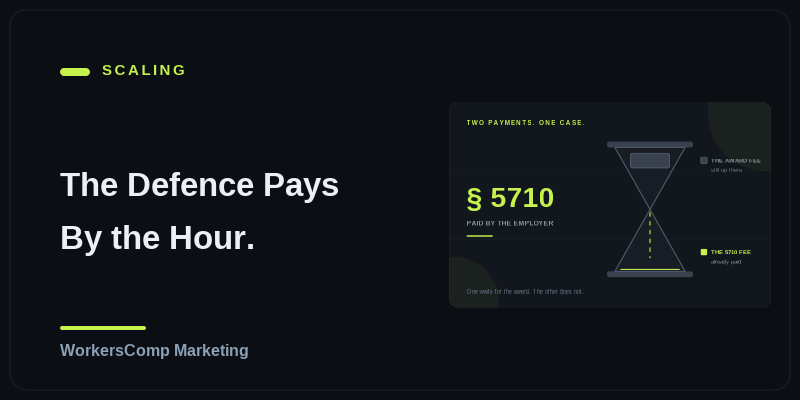
The Defence Pays By the Hour

Every acquisition number a comp firm keeps is priced against one revenue event. California makes the employer or its insurer pay the injured worker’s attorney by the hour for a deposition it asked for — no outcome condition, no share of the award — and the statewide price for it is eight years late.

Buy the Contact, Not the Client
Lead Quality

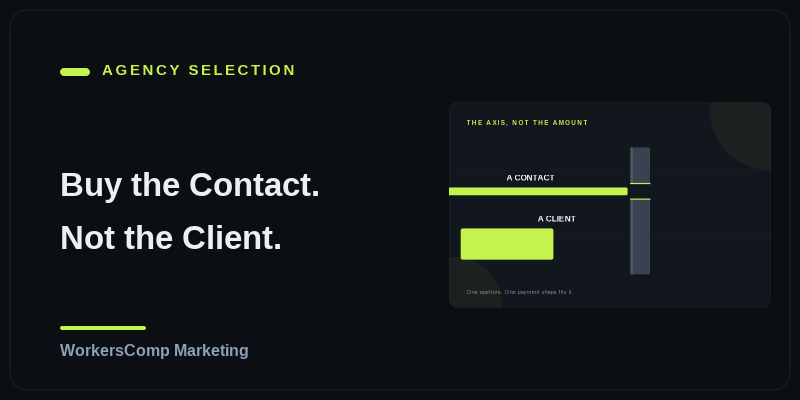
Buy the Contact, Not the Client

Comp firm owners nearly all want to buy marketing per signed case. Florida refuses “a flat charge per case accepted,” New York approved a per-enquiry fee only because it did not vary with retention, and New Jersey held that lawyers may pay per lead but not per client retained — plus the comp-specific obstacle that survives all of it.

Your Ads Say Fault Doesn’t Matter. One Section Pays Half Again When It Does.
Lead Quality

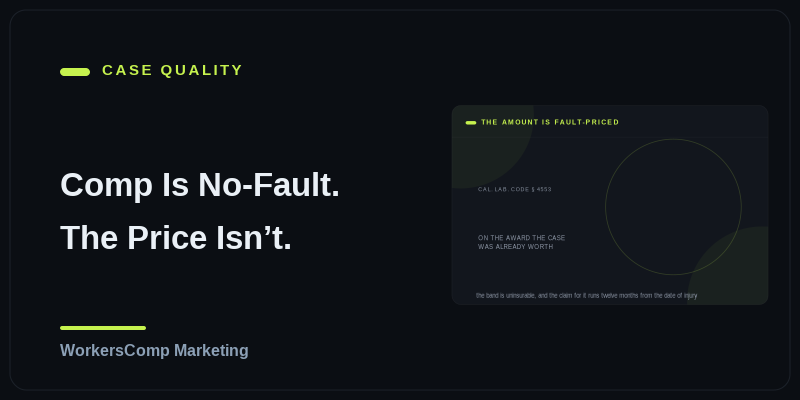
Your Ads Say Fault Doesn’t Matter. One Section Pays Half Again When It Does.

Comp is no-fault about whether an injured worker is paid and fault-priced about how much. California adds one-half for the employer’s serious and willful misconduct, on a twelve-month clock § 5407 refuses to extend — which makes it an intake screen, not a workup task.

Your Intake Has Two Boxes. The Statute Has Three.
Intake

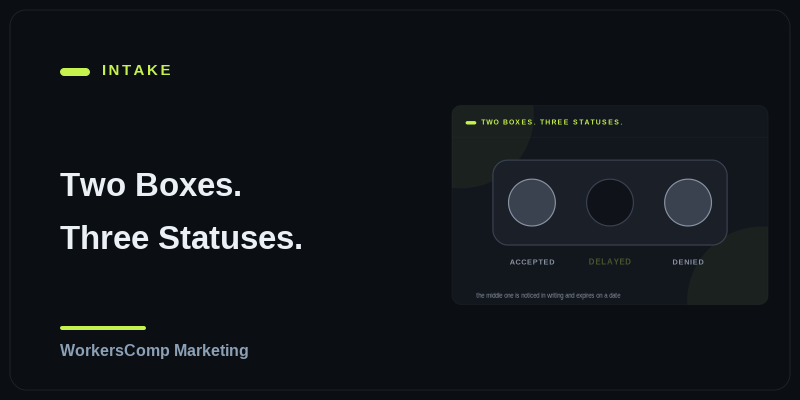
Your Intake Has Two Boxes. The Statute Has Three.

Comp intake qualifies callers on accepted or denied. California, Texas and Florida each define a third status — liability not yet determined — with a written notice, a dated expiry and, in California, $10,000 of authorized treatment while it runs.

Your Provider Referral Map Is Published Quarterly. By the Other Side.
Lead Quality

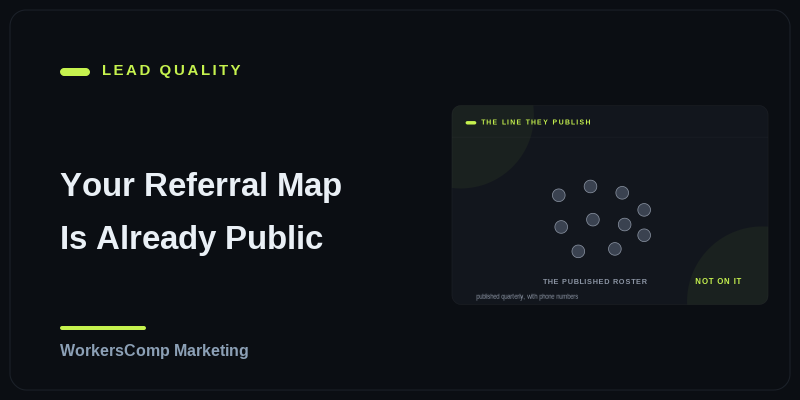
Your Provider Referral Map Is Published Quarterly. By the Other Side.

California makes every medical provider network post a public roster of all participating providers — name, office address, office telephone — at least quarterly, and makes the state publish the index. Read it as a map, and as the list you subtract from.

Your Media Plan Buys Age. The Rating Schedule Prices It.
Scaling

Your Media Plan Buys Age. The Rating Schedule Prices It.

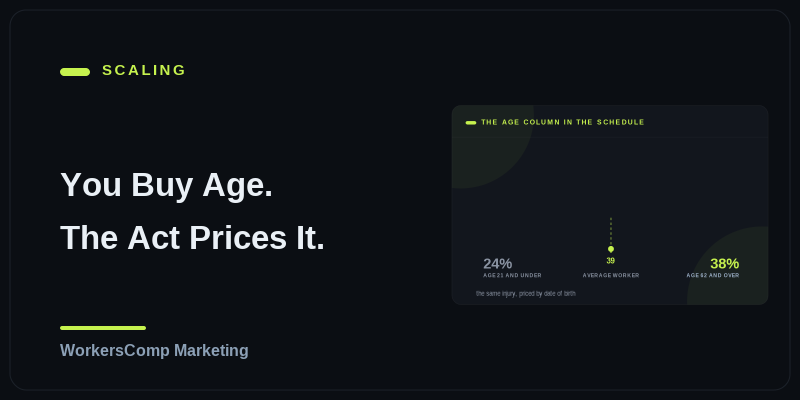
California’s schedule turns one injury into 24% permanent disability at 21 and 38% at 62 — about $27,695 against $54,230. Age is the only case-value input a firm buys by typing it, and almost no media plan prices it.

Your Intake Never Asks Who the Defendant Is
Intake

Your Intake Never Asks Who the Defendant Is

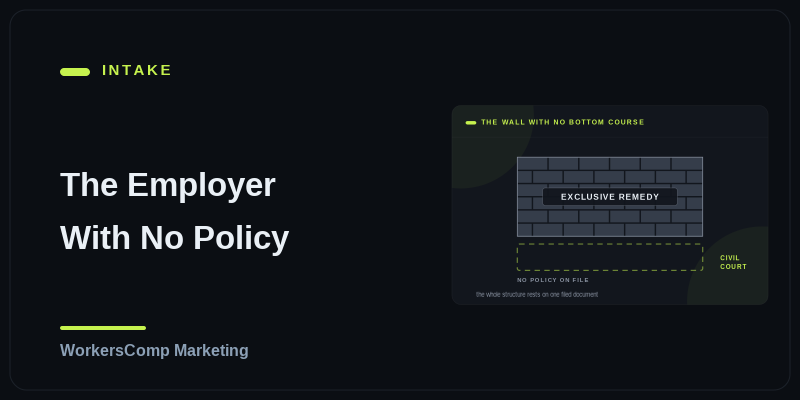
Workers’ comp is an exclusive remedy only where the employer secured coverage. Four states strip the same three defences when it didn’t — and Texas publishes 106,820 rows of non-subscribing employers by name and street address, free.

Your Marketing Budget Is a Loan to the Docket
Scaling

Your Marketing Budget Is a Loan to the Docket

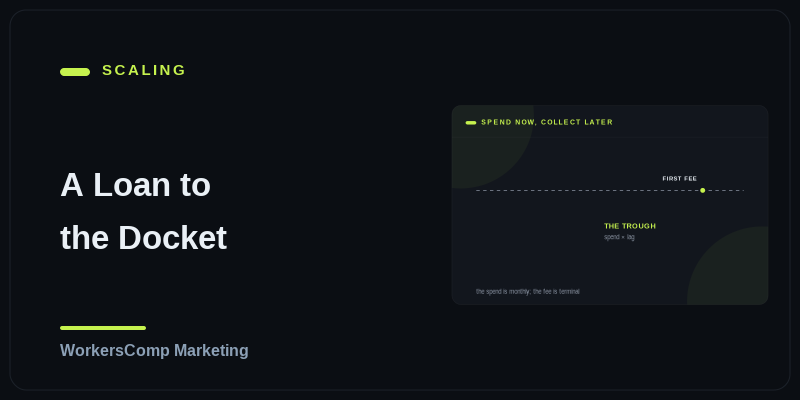
In workers’ comp a firm cannot lawfully collect a fee until a tribunal approves it, and the docket sets the date — Minnesota allows 180 days to schedule a settlement conference and 90 more to reach a hearing. The arithmetic of the cash trough every budget increase opens.

The Other Side Mails the Date
Intake

The Other Side Mails the Date

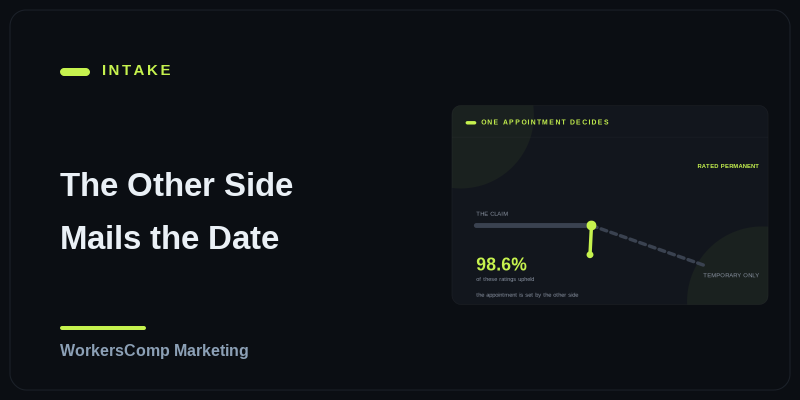
Comp marketing is built on two events with no dates. The medical-legal exam arrives as a letter with a date on it — and Texas found 98.6% of those ratings upheld on dispute across 27,866 appointments in 2024.

Presumed, and Denied Anyway
Lead Quality

Presumed, and Denied Anyway

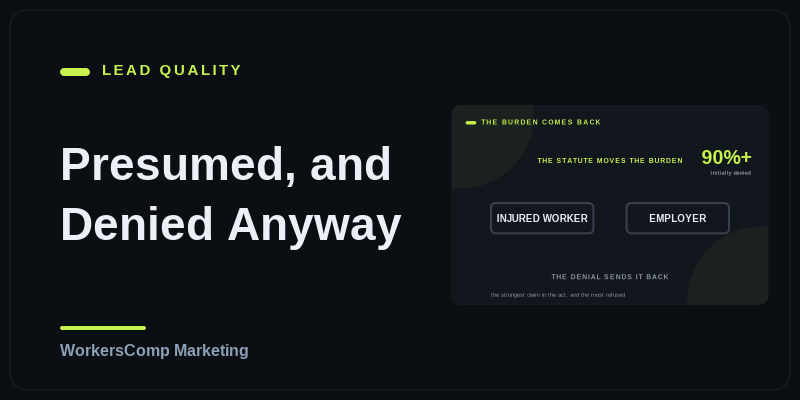
All fifty states presume a firefighter’s cancer came from the job — and the claims carrying that advantage are the most refused in the system. Minnesota: more than 90% of PTSD claims denied up front, against under 20% system-wide. Texas rejected up to 96%. Florida, 38 of 41. New York, every one of 24.

The Job Offer Is the Denial
Intake

The Job Offer Is the Denial

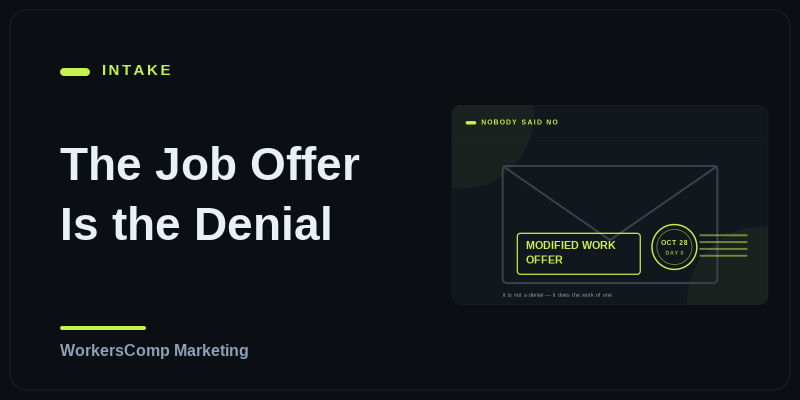
BLS counts 1,148,510 private-industry cases a year of job transfer or restriction — median 15 days against 8 for days away — and not one of those workers is ever denied anything. Their income is cut by a dated modified-work offer with a response clock measured in days.

Work Left the Building
Scaling

Work Left the Building

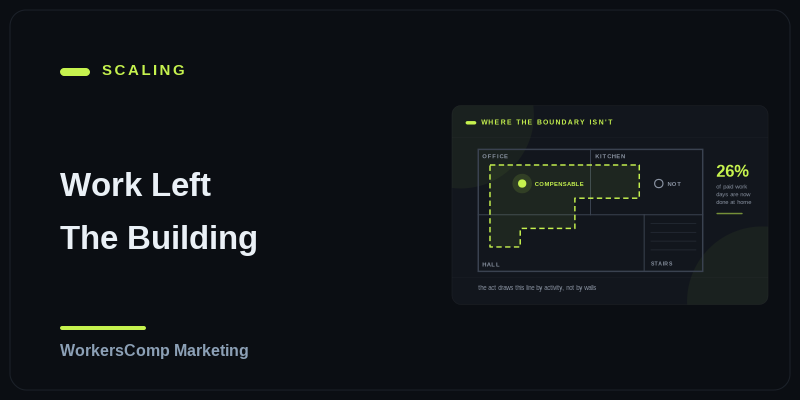
About 26% of paid full days are now worked from home — and workers’ comp decides those injuries on what the worker was doing, not where. NCCI measured a 40% frequency drop in the remote-friendly classes. Why that reads as an empty market, and isn’t.

The Claim With No Check
Intake

The Claim With No Check

Three in four workers’ comp claims never pay a day of wage benefit — and NCCI found that about one in six lost-time claims was sitting in that pile at the 90-day mark. Minnesota’s own numbers: 73% of claims, 8% of the money.

The Prior Injury Is Their Problem
Intake

The Prior Injury Is Their Problem

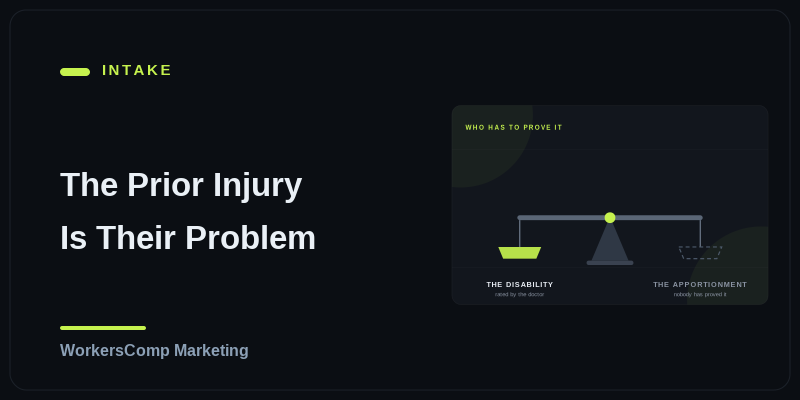
“Any prior trouble with that shoulder?” is the most common soft decline in comp intake — and apportionment is an affirmative defence the employer has to raise and prove. 37% of asymptomatic 20-year-olds and 96% of 80-year-olds have the finding anyway.

There Is No Insurance Company
Scaling

There Is No Insurance Company

Self-insured employers paid 25.6% of America’s workers’ comp benefits in 2023 — and in those claims there is no carrier at all. California publishes 629 of their names in a spreadsheet, and eight companies administer 75% of them.
The Claim the Worker Can’t Make
Intake

The Claim the Worker Can’t Make

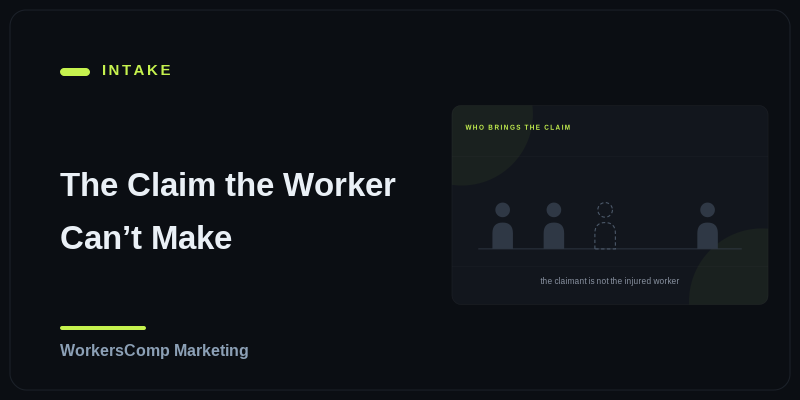
A workplace death produces the one comp case where the claimant is not the injured worker — and New York needs four filings from three different parties. Why no intake script in the country is built for that call.

The Check Was the Wrong Amount
Intake

The Check Was the Wrong Amount

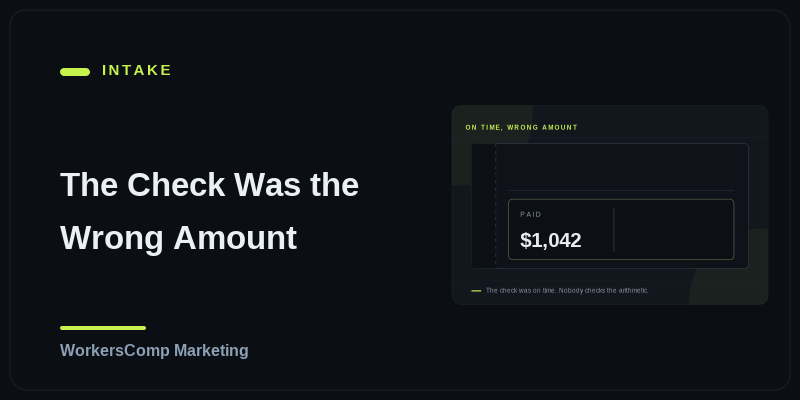
California auditors opened 2,698 claim files at random in 2024 and found unpaid indemnity in 10.19% of them — nearly half of it the weekly wage check, none of it in dispute. Your intake screens for events and misses the arithmetic.
Your Ads Count the Wrong Deadline
Intake

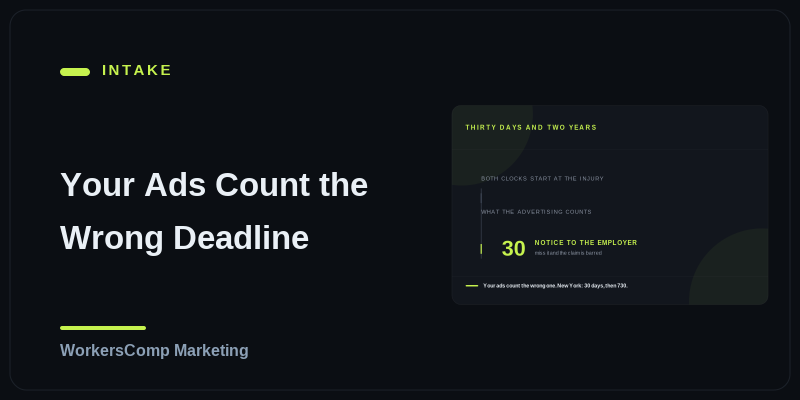
Your Ads Count the Wrong Deadline

New York gives an injured worker 30 days to tell his employer and 730 to file the claim — and only the second number appears in anybody’s advertising. The deadline that bars the claim expires before he has any reason to call you.

The Closed File Has a Date on It
Scaling

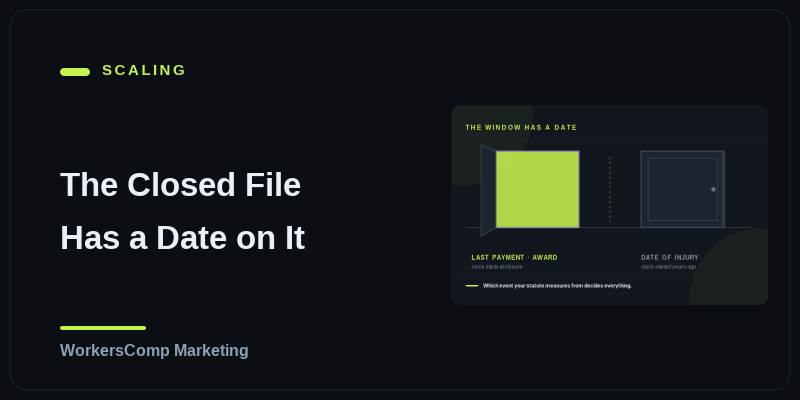
The Closed File Has a Date on It

California gives five years from the date of injury to reopen; most states give about two from the last payment. Which anchor your state uses decides whether your closed-file list is a pipeline or a graveyard.

The Denial Inside the Accepted Claim
Lead Quality

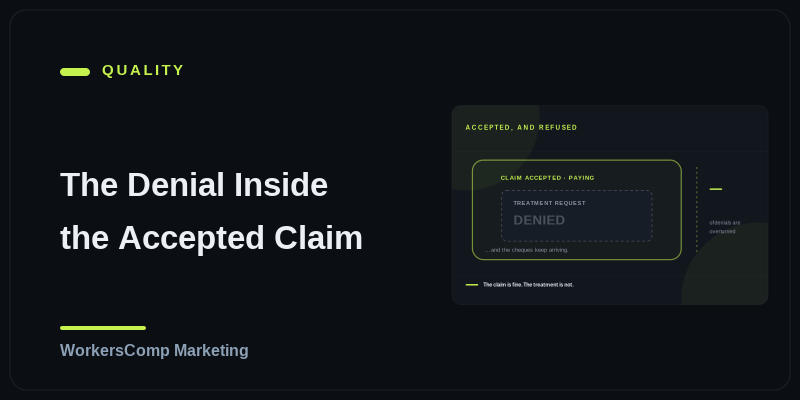
The Denial Inside the Accepted Claim

California received 201,037 independent medical review applications in 2025 and overturned 10.2% of denials. The treatment-denial market is huge, dated by statute — and 81 doctors generate 42.2% of the disputes.

The Adjuster Called First
Intake

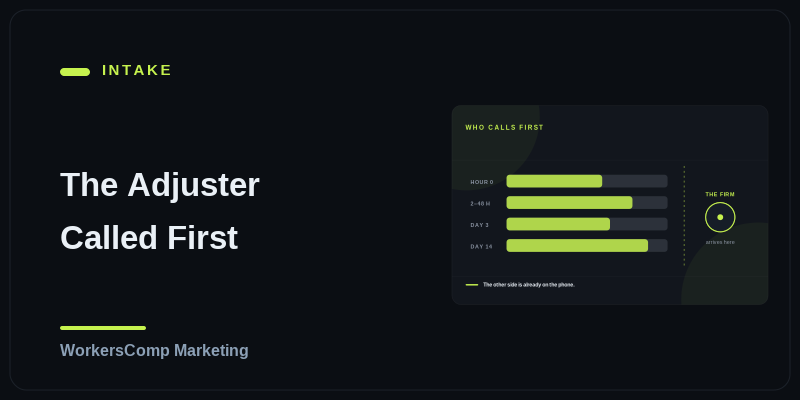
The Adjuster Called First

Workers’ comp is the only legal market where the other side is required by law to contact your prospective client — and a claims-handling standard puts them on the phone inside 24 hours. WCRI: 34% of lost-time claimants ever retain counsel.

The Claim With No Accident Date
Lead Quality

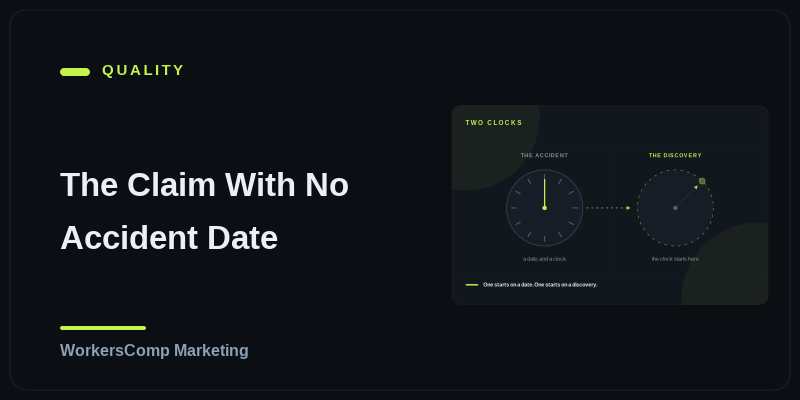
The Claim With No Accident Date

Cumulative trauma is 26% of California indemnity claims and 82% of them are litigated — and the statute starts the clock when the worker finds out, not when something happened.

Where Workers’ Comp Cases Actually Are
Scaling

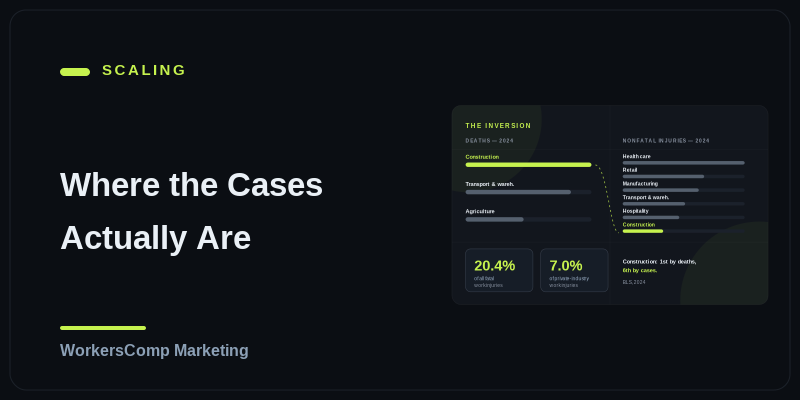
Where Workers’ Comp Cases Actually Are

Construction leads every private industry in workplace deaths — and ranks sixth for workplace injuries. Health care produces three times as many. Eight counties, costed from published data.

The Waiting Period Is Your Marketing Calendar
Intake

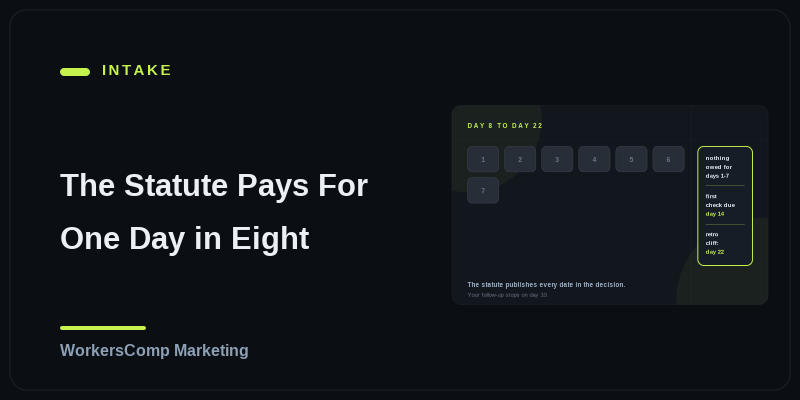
The Waiting Period Is Your Marketing Calendar

The median lost-time claim is eight days away from work — and Florida, New York and Texas each pay for one of them. No denial, no dispute. Every date in the injured worker’s decision is published, and your follow-up sequence ends before the first one arrives.

The Recording Starts Before the Disclosure
Intake

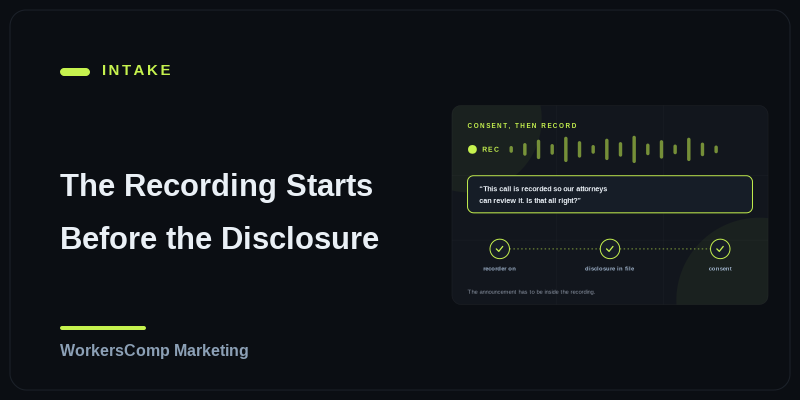
The Recording Starts Before the Disclosure

Recorded intake calls are the only instrument a comp firm has on close rate — and the only asset in the stack with a price per unit written into statute. The law that applies is the caller’s, not the firm’s: eleven states need everyone’s consent, a beep is the argument that lost in the California Supreme Court, and Washington requires the announcement itself to be inside the recording.

The One Claim Nobody Can Copy
Lead Quality

The One Claim Nobody Can Copy

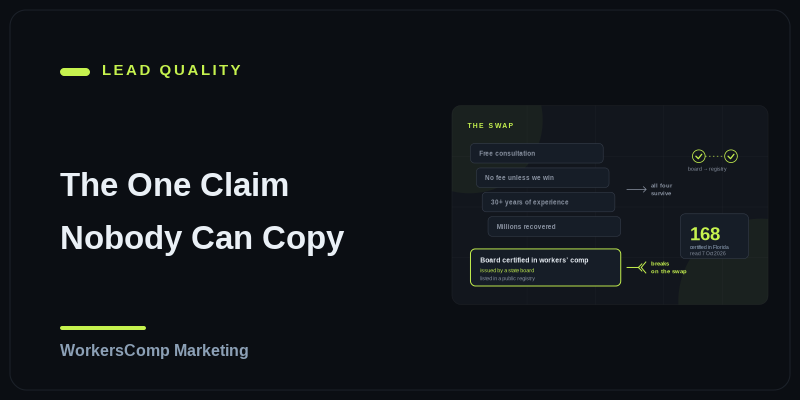
Strip the logos off four comp firms’ websites and you cannot tell them apart — because every sentence on them is one any rival could also write truthfully. There is exactly one claim in this category with a public registry, a supply constraint no budget can relieve and an expiry date. The Florida Bar lists 168 lawyers who hold it. Six jurisdictions have the programme; roughly 45 have nothing, and that absence is the more useful finding.

The Courtroom Moved. Your Map Didn’t.
Scaling

The Courtroom Moved. Your Map Didn’t.

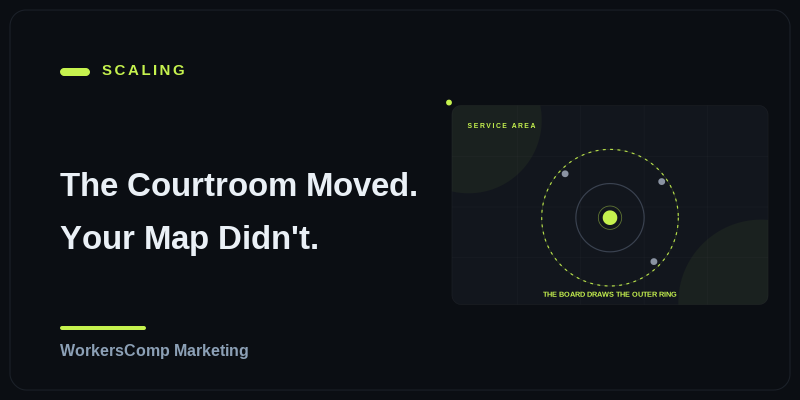
A comp firm’s serviceable area is set by its board’s appearance rules, not by its address — and New York, California, Texas and Florida each rewrote those rules between 2021 and 2025. Why the 25-mile ring is a procedural fact nobody re-read, which appearance still has an address, and the two-tier map that replaces the circle.

The Second-Opinion Market: Marketing to Represented Comp Clients
Lead Quality

The Second-Opinion Market: Marketing to Represented Comp Clients

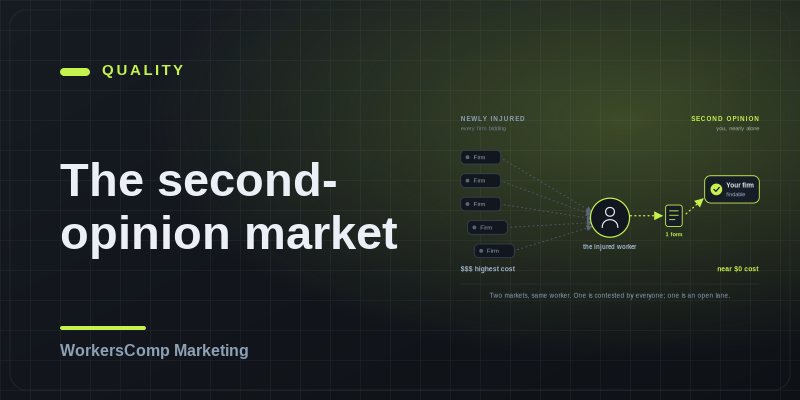
The most contested injured-worker market is the newly injured. The least contested is the worker who already hired a lawyer and stopped hearing back — high intent, near-zero media cost, and a single board form away from switching. Why it is real, what the ethics rules actually allow, and how to win it without poaching.

The Lead That Screens Itself Out
Lead Quality

The Lead That Screens Itself Out

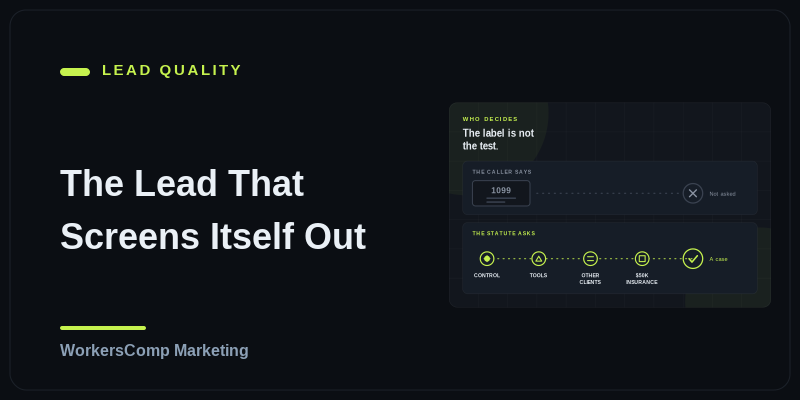
The most common disqualifying answer in comp intake is a layperson’s legal conclusion, and the caller reaches it before you ever hear from them. Coverage is decided by a published statutory test — California presumes employment, Pennsylvania wants $50,000 of liability insurance, Florida wants four business facts out of six — and none of them makes the worker’s tax form a criterion. Plus the three different wrong diagnoses one self-screening prospect produces.

Nobody Can Sell You a List of Injured Workers
Lead Quality

Nobody Can Sell You a List of Injured Workers

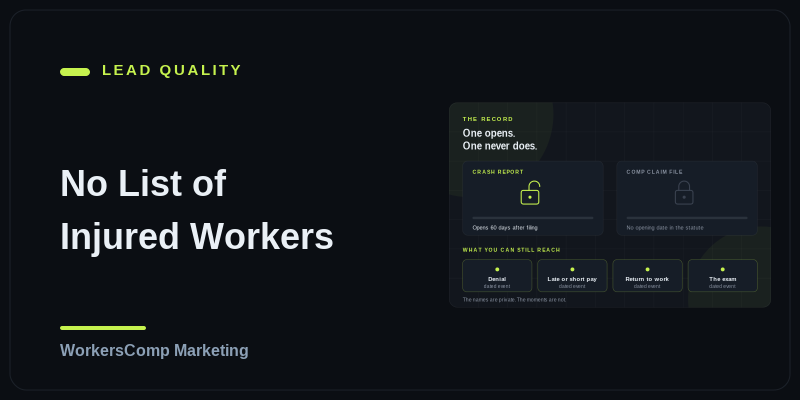
Personal-injury direct mail runs on a public crash report with a 60-day clock. Four state statutes close the comp claim file and none of them ever opens it — so the list has three possible provenances and all three are bad.

Whose Doctor Is It?
Lead Quality

Whose Doctor Is It?

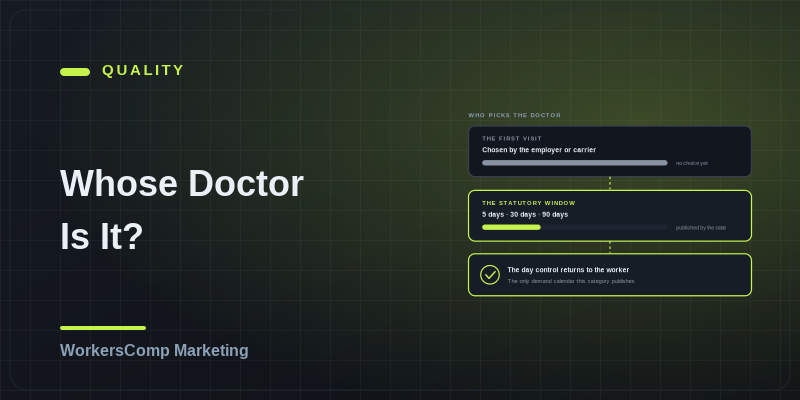
In most states the employer or carrier picks the treating physician — and the statute publishes the date that control lapses. Five days in Florida, thirty in a New York PPO, ninety in Pennsylvania.

Meta Ad Formats for WC Firms
Meta Ads

Meta Ad Formats for WC Firms

Video vs. image vs. carousel: the 3-second hook, why authentic beats polished, the anatomy of an ad that signs cases, and matching format to funnel stage.

Who You Can Reach on Meta
Meta Ads

Who You Can Reach on Meta

You can't target injured workers directly — sensitive interests are gone. Broad targeting, creative self-selection, and custom/lookalike audiences from your own data.

Meta Lead Ads vs. Landing Pages
Meta Ads

Meta Lead Ads vs. Landing Pages

Instant forms get more, cheaper, lower-intent leads; landing pages convert better. The qualifying questions that fix instant forms, and when each wins.

The Workers' Comp Marketing Plan
Scaling

The Workers' Comp Marketing Plan

A one-page decision framework — case goals, channel mix by stage, launch sequence, budget split, and the three numbers that tell you it's working.

Google Business Profile for WC Firms
SEO

Google Business Profile for WC Firms

The profile decides the map pack — the categories and fields that move ranking, the sections firms skip, review velocity, and how injury firms avoid suspension.

Workers' Comp Lead Generation
Lead Quality

Workers' Comp Lead Generation

The channels that generate injured-worker cases, ranked by intent — buy vs. build, speed-to-lead, and the only number that matters: cost per signed case.

How to Choose a Workers' Comp Marketing Agency
Scaling

How to Choose a Workers' Comp Marketing Agency

An honest buyer's guide — the questions to ask, the red flags, the pricing models, and whether a workers'-comp specialist beats a generalist.

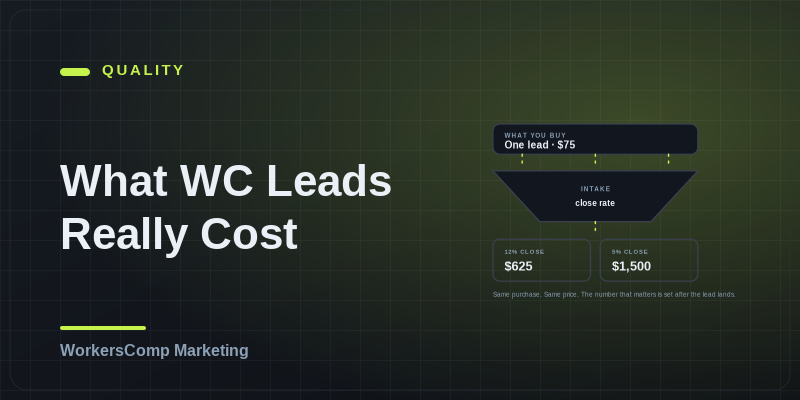
What Do Workers' Comp Leads Cost? (2026 Pricing)
Lead Quality

What Do Workers' Comp Leads Cost? (2026 Pricing)

Workers' comp lead prices by channel — shared vs. exclusive, Google, Meta and LSA — and why cost per signed case matters more than cost per lead.

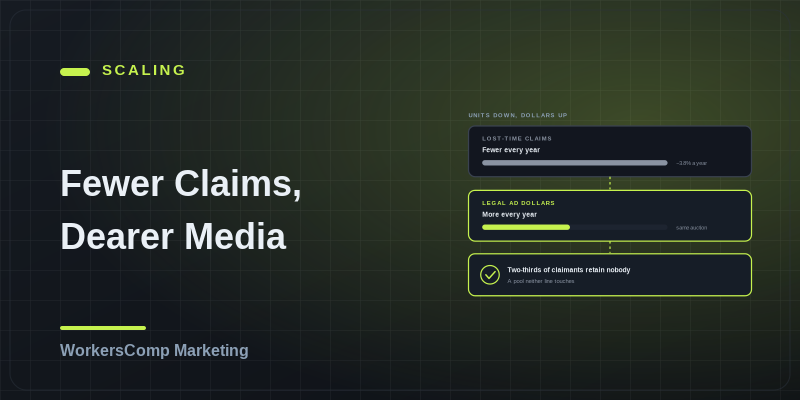
The Workers' Comp Market Is Shrinking. Your Growth Plan Assumes It Isn't.
Scaling

The Workers' Comp Market Is Shrinking. Your Growth Plan Assumes It Isn't.

Lost-time claim frequency falls at a long-run average of 3.8% a year, 2024 produced the fewest employer-reported injuries in the history of the BLS series, and legal advertising went the other way — in one state the same number of ads now costs twice as much. Why the category loses units and gains value at the same time, the nine-point share gain hiding inside an ordinary growth target, and the three numbers a firm can still grow.

Your Biggest Competitor Is a Free State Agency on the Break-Room Wall
Scaling

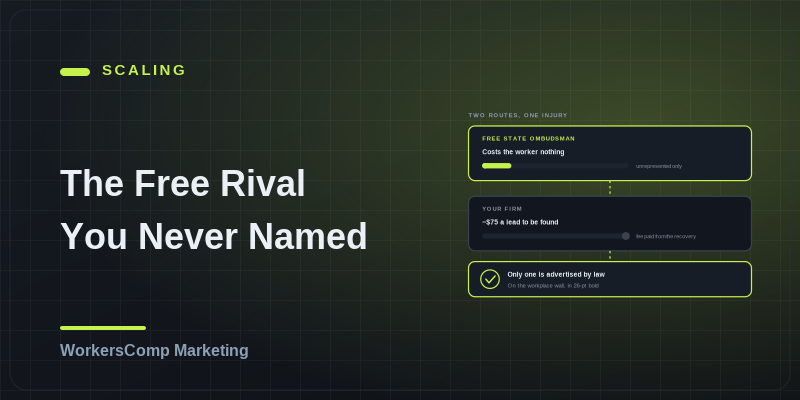
Your Biggest Competitor Is a Free State Agency on the Break-Room Wall

Most states fund an office that helps injured workers for free - and the law requires your prospect's employer to advertise it in the workplace, in English and Spanish, in 26-point bold. In Texas it serves unrepresented workers only, so hiring you ends it. Why two-thirds of lost-time claimants never retain anyone, what that does to the denominator of your cost per signed case, and the triage page almost no firm has.

Your Market's Live Ads Are a Public Record. We Read 877 of Them.
Reporting

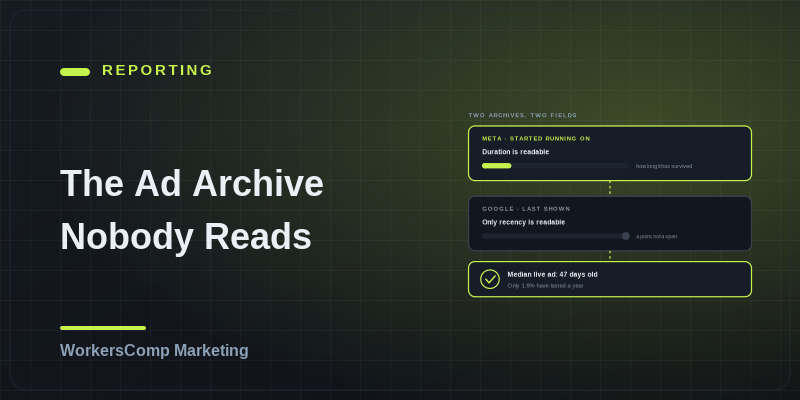
Your Market's Live Ads Are a Public Record. We Read 877 of Them.

Meta publishes a start date for every live ad and Google publishes only a last-shown date - so one archive makes duration readable and the other does not. We pulled 877 live US ads carrying the phrase “injured at work” on a single morning: median age 47 days, fewer than one in fifty past a year, and one advertiser page running a third of the inventory. What the archives measure, what they can never show you, and the ninety-minute read.

The Question Before the Question: Immigration Status in Workers' Comp Marketing
SEO

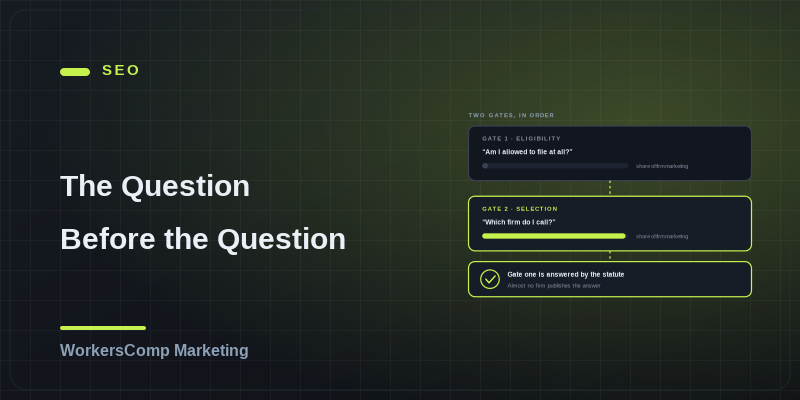
The Question Before the Question: Immigration Status in Workers' Comp Marketing

Most state comp acts define a covered employee to include a worker "whether lawfully or unlawfully employed" - and one state supreme court read its own definition list the other way. Your marketing spends its entire budget answering "why hire us" to an audience still stuck on "am I allowed to file at all". Why no ad platform can reach them, what the page has to say, and the one thing intake must never ask.

The Third-Party Case Hiding in Your Workers' Comp Lead Flow
Lead Quality

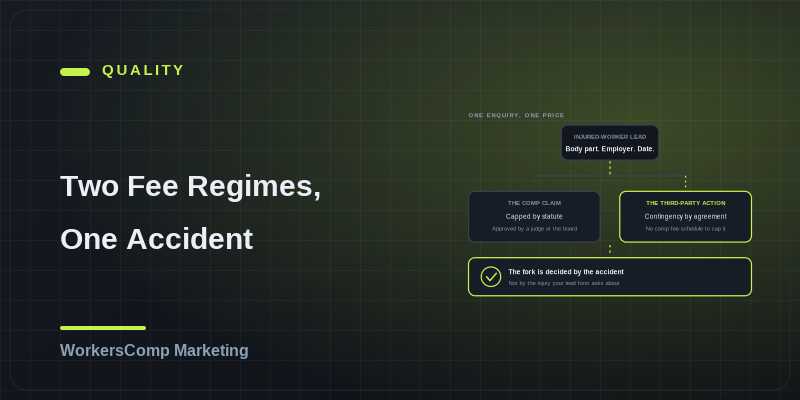
The Third-Party Case Hiding in Your Workers' Comp Lead Flow

Comp is the exclusive remedy against the employer and nobody else - so some share of your lead flow carries a second, uncapped matter alongside the capped one. Nothing on a lead form distinguishes them, because every field describes the injury and the fork is decided by the accident. The four intake questions that surface it, and how to send the value back without transmitting health data.

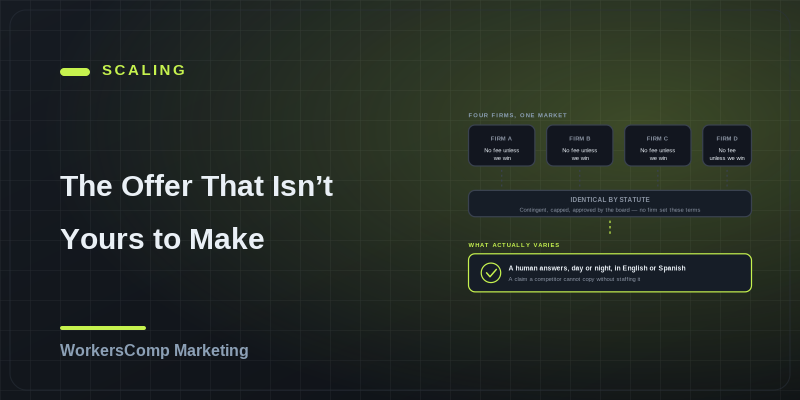
Your Fee Promise Is Not an Offer - It Is the Workers' Comp Fee Statute
Scaling

Your Fee Promise Is Not an Offer - It Is the Workers' Comp Fee Statute

Claimant fees in comp are contingent by law, capped by law and in most states approved by a judge or the board - so every competitor's fee promise is identical, and the largest type on your page carries no information a worker can choose on. What the caps say, why a capped fee is also a capped acquisition budget, and the four claims that survive the substitution test.

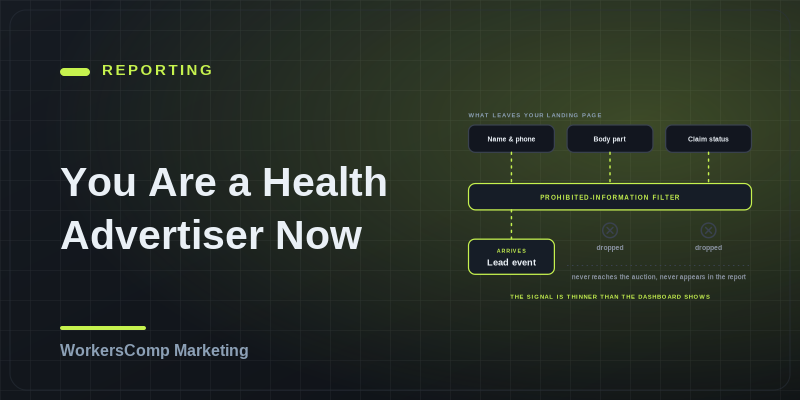
Why Meta and Google Treat Your Workers' Comp Firm as a Health Advertiser
Reporting

Why Meta and Google Treat Your Workers' Comp Firm as a Health Advertiser

Meta's prohibited-information list names "injuries" outright, and Google files Health as a sensitive interest category that withdraws four audience tools from your account. What the classification removes, why it reads as an ad-performance problem instead of a policy one, and the ninety-minute audit that finds it.

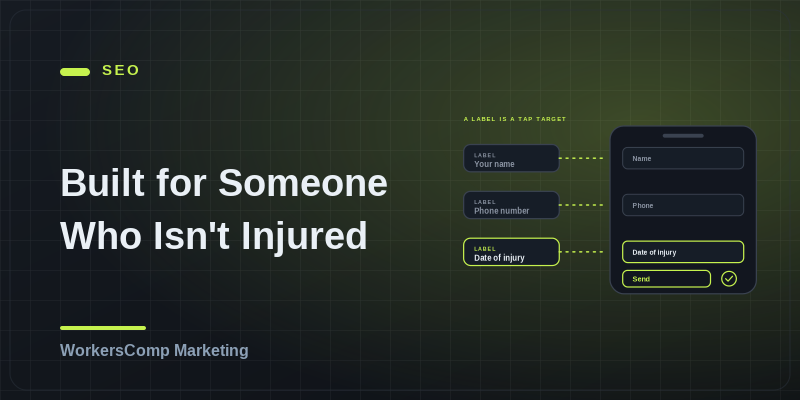
Your Website Is Built for Someone Who Isn't Injured
SEO

Your Website Is Built for Someone Who Isn't Injured

Workers' comp is the only practice area whose entire qualified audience is impaired on arrival. 95.9% of home pages fail the accessibility standard and a third of form inputs are unlabelled - which is why the accessibility fixes and the conversion fixes are the same fixes, in the same order.

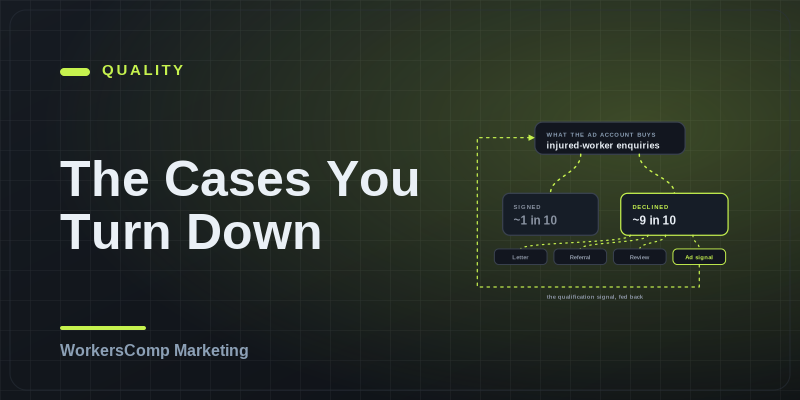
The Cases You Turn Down: What a Declined Workers' Comp Enquiry Is Worth
Lead Quality

The Cases You Turn Down: What a Declined Workers' Comp Enquiry Is Worth

Roughly nine in ten injured-worker enquiries never sign, which means about $700 of every $775 signed case is spent on the ones you turn away. What a decline is actually worth, the exposure a careless one creates, and why Meta and Google now want the one field your intake team never fills in.

Workers' Comp Client Retention: The Signed Case You Can Still Lose
Lead Quality

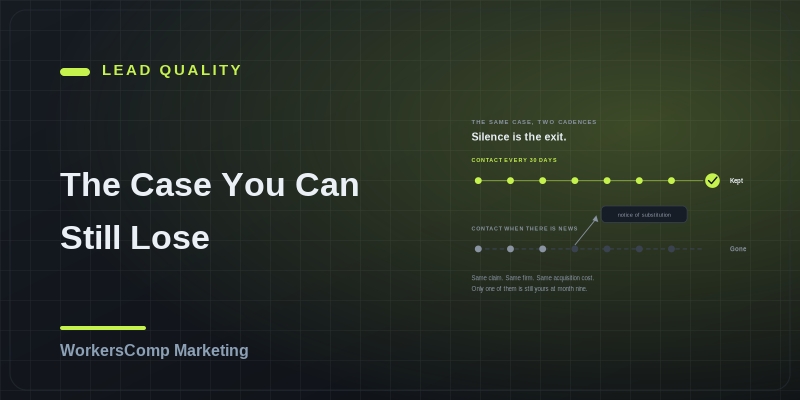
Workers' Comp Client Retention: The Signed Case You Can Still Lose

Every acquisition metric a firm keeps is fixed at the signature - in a practice area where the client can discharge you at any time and the board has a form for it. What a departure really costs, why clients leave, and how to compute cost per retained case from fifty files and an afternoon.

Workers' Comp Marketing Seasonality: The Slow Month That Isn't Real
Reporting

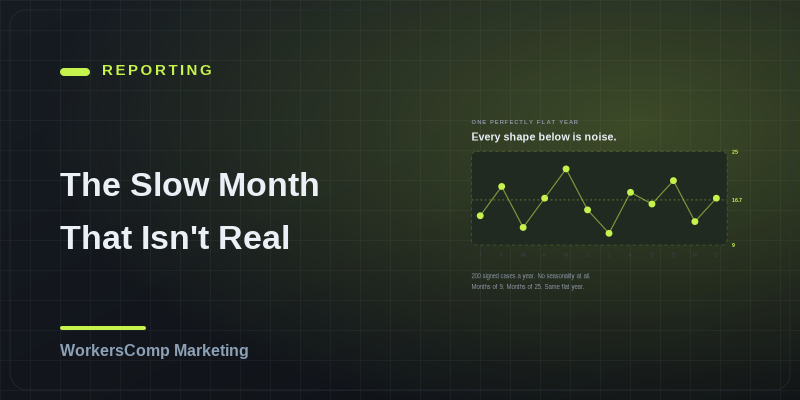
Workers' Comp Marketing Seasonality: The Slow Month That Isn't Real

Injuries are seasonal; hiring a lawyer is not. Why the trigger is a denial rather than a fall, why a 200-case firm can post months of 9 and months of 25 in a perfectly flat year, and the two things about your calendar that are actually worth managing.

Most Workers' Comp Ad Tests Are Coin Flips: The Sample-Size Problem
Reporting

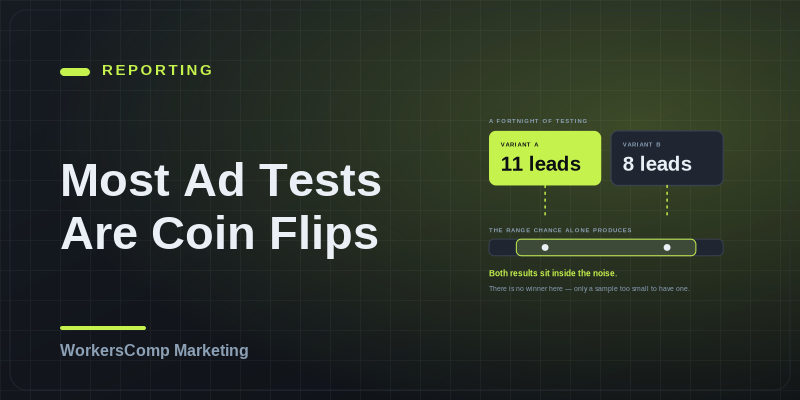
Most Workers' Comp Ad Tests Are Coin Flips: The Sample-Size Problem

At a typical firm's volume, most creative tests cannot produce a trustworthy answer - and the ones that decide profit are hundreds of times out of reach. The arithmetic worked in leads, what daily peeking does to the false-winner rate, the platform defaults nobody checks, and what to test instead.

Which Workers' Comp Cases Should You Market For? The Case Mix Decision
Lead Quality

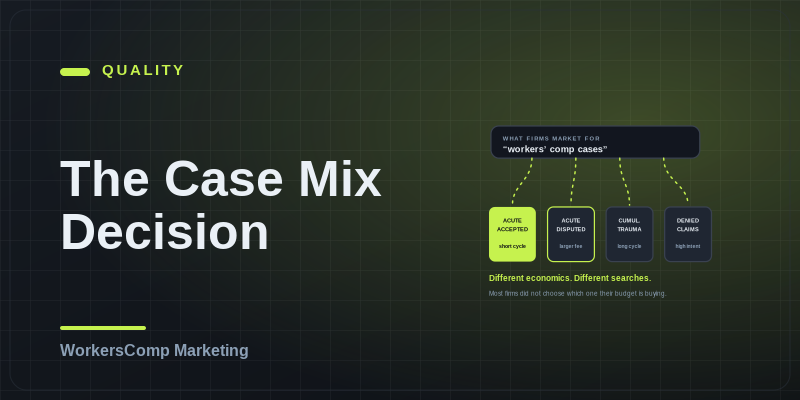
Which Workers' Comp Cases Should You Market For? The Case Mix Decision

Workers' comp is a legal category, not a market segment. The three axes that actually separate the claim types - fee economics, cycle length and winnability - why expected value beats average fee, how segments search differently, and the four-stage test to run before committing budget to one.

The First 90 Days With a New Marketing Agency: The Onboarding Checklist
Scaling

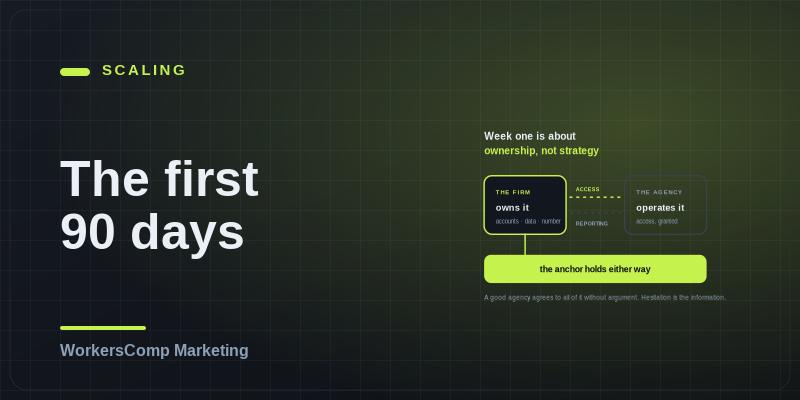
The First 90 Days With a New Marketing Agency: The Onboarding Checklist

Choosing an agency is well covered; what happens next is not. What to own in week one, the baseline you cannot recreate later, what should happen by day 30, 60 and 90, how to switch without a dark week, and the warning signs ranked by severity.

What a Workers' Comp Case Is Worth - and Why It Sets Every Other Number
Lead Quality

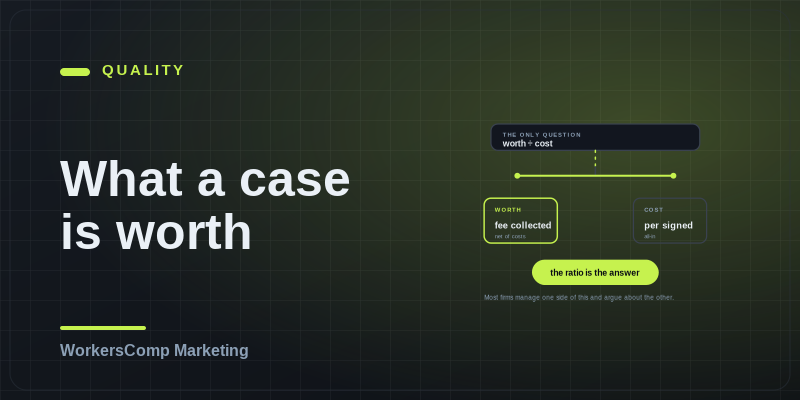
What a Workers' Comp Case Is Worth - and Why It Sets Every Other Number

Every firm knows what a case costs to acquire; far fewer know what one is worth. The fee that actually belongs in the calculation, why the median beats the average, the ratio that decides which channels can work at all, and the four honest responses when the number comes back low.

The Intake Leak Score: Five Places Injured Workers Fall Out of Your Firm
Lead Quality

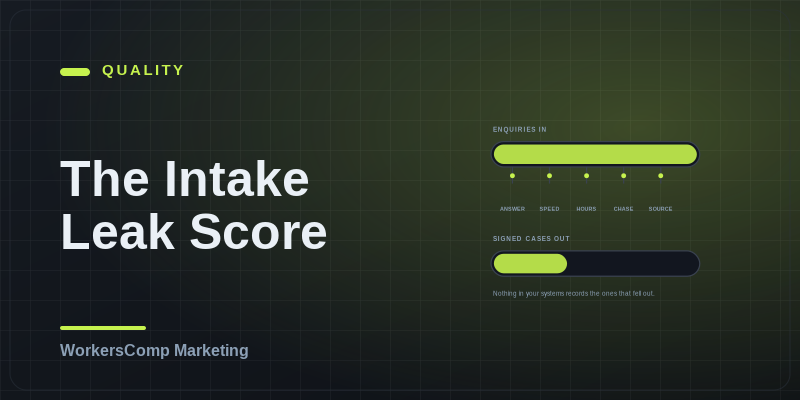
The Intake Leak Score: Five Places Injured Workers Fall Out of Your Firm

Every firm believes its intake is fine, because nobody measures the calls that never became conversations. A 100-point instrument with the weighting published - answer rate, speed, coverage, follow-up depth, source capture - the one-hour self-score, and the fix order that is arithmetic rather than preference.

The Cost Per Signed Case Model: The Only Marketing Number Worth Managing
Lead Quality

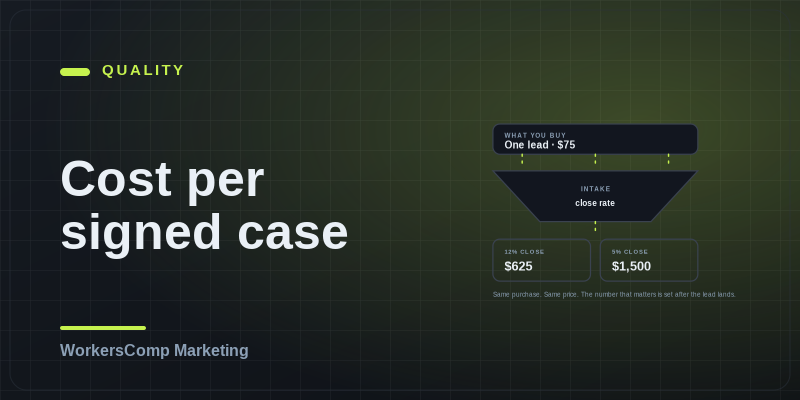
The Cost Per Signed Case Model: The Only Marketing Number Worth Managing

Cost per lead is a purchasing metric and is frequently inverted; cost per signed case is the one with revenue attached. The formula written down, the four inputs most firms cannot produce, what $16.5M of managed spend and 21,000 signed cases say, and the four levers ordered by what they actually cost to pull.

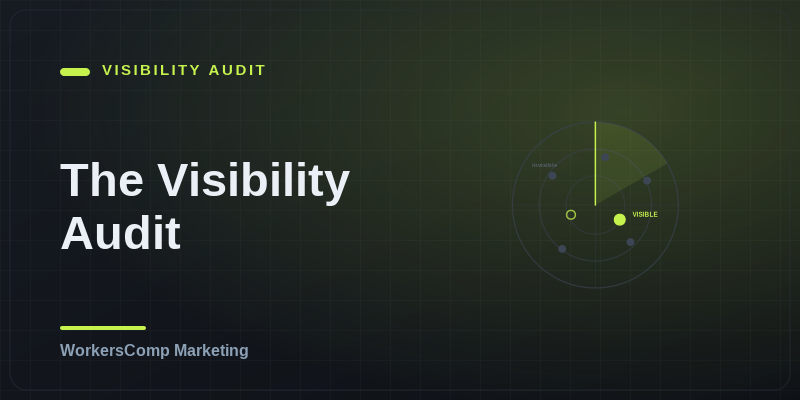
How Visible Is Your Workers' Comp Firm, Really? The One-Evening Market Audit
Lead Quality

How Visible Is Your Workers' Comp Firm, Really? The One-Evening Market Audit

Every firm believes it's visible; the injured worker's phone disagrees. The one-evening audit of the four doors - map pack, organic, ads and LSA, answer engines - plus what our 1,814-site Website Index scan says about the defect half the industry shares.

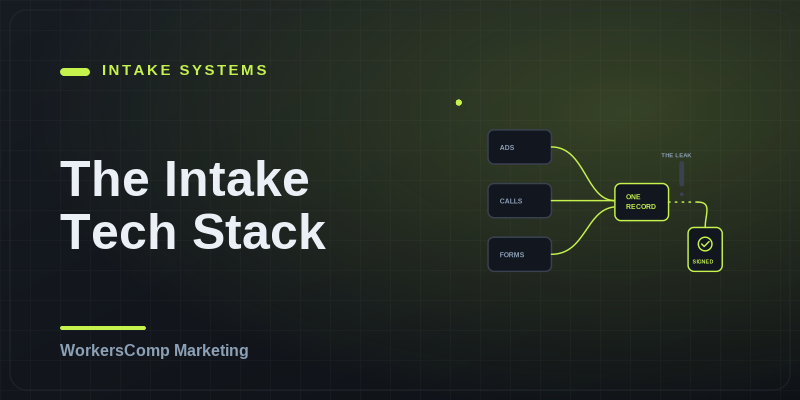
The Workers' Comp Intake Tech Stack: The Pipes Between Your Ads and Your Signed Cases
Lead Quality

The Workers' Comp Intake Tech Stack: The Pipes Between Your Ads and Your Signed Cases

Most firms don't have a lead problem - they have a plumbing problem. The five-piece intake stack (call tracking, CRM, scheduling, e-sign, follow-up automation), the four leaks it welds shut, and why integration beats every feature list.

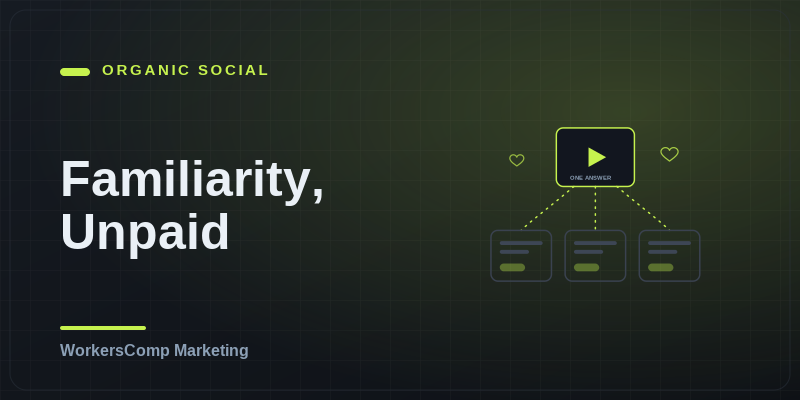
Organic Social for Workers' Comp Firms: Familiarity Without the Ad Budget
Scaling

Organic Social for Workers' Comp Firms: Familiarity Without the Ad Budget

Organic social won't make the phone ring this week - that's not its job. It builds the familiarity injured workers hire, one answered question at a time. The batch system, the platform priorities, and the compliance lines a firm can't cross.

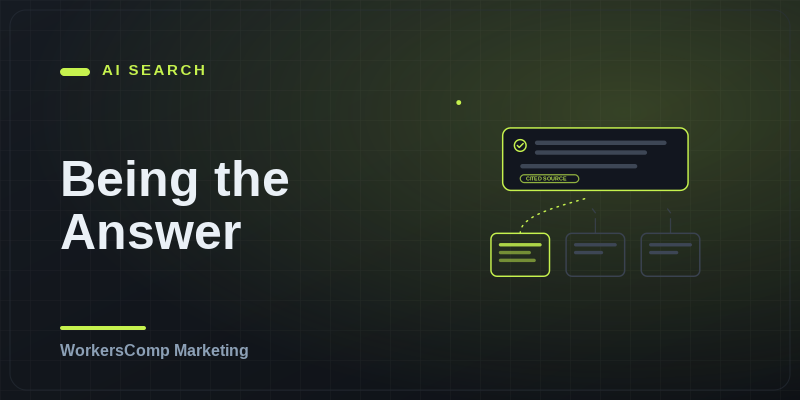
AI Search & Workers' Comp Firms: How to Be the Answer, Not the Tenth Link
Lead Quality

AI Search & Workers' Comp Firms: How to Be the Answer, Not the Tenth Link

Injured workers increasingly get one assembled answer instead of ten blue links. What makes a firm citable by AI Overviews and chat assistants - original data, entity clarity, question-shaped pages - and what to stop wasting effort on.

Conquesting: Bidding on Another Firm's Name - and Defending Your Own
Lead Quality

Conquesting: Bidding on Another Firm's Name - and Defending Your Own

Every firm asks whether to bid on competitors' names. Almost none check whether someone is bidding on theirs - which is the more expensive question. What Google's trademark policy permits, why the state bars split, and the three conditions that make conquesting worth funding.

The Second Market: What a Workers' Comp Firm Can Buy on Day One - and What It Has to Earn
Scaling

The Second Market: What a Workers' Comp Firm Can Buy on Day One - and What It Has to Earn

Only one of the four assets that make your home market profitable actually transfers when you expand - and it's the most expensive one. Why Google's guidelines and bona-fide-office bar rules close the virtual-office shortcut, the cost window nobody budgets for, and the sequence that works.

Billboards & Out-of-Home for Workers' Comp Firms: Making the Unmeasurable Pay
Scaling

Billboards & Out-of-Home for Workers' Comp Firms: Making the Unmeasurable Pay

Billboards are the most visible workers' comp channel and the easiest to waste - usually bought on ego and never measured. Where out-of-home earns its keep: the roads injured workers drive, the three-second rule, frequency over the trophy board, and how to actually measure it.

TV, Radio & Streaming for Workers' Comp Firms: When Broadcast Still Pays
Scaling

TV, Radio & Streaming for Workers' Comp Firms: When Broadcast Still Pays

Workers' comp is one of the most-advertised legal categories on TV - and one of the easiest to burn money on. When broadcast pays, how connected TV made it targetable and measurable, how to buy for frequency, and how to measure it in signed cases.

Email & Newsletters for Workers' Comp Firms: The Channel You Actually Own
Scaling

Email & Newsletters for Workers' Comp Firms: The Channel You Actually Own

Every other channel is rented - ads reset to zero, algorithms change. Email is the one injured-worker audience you own. How a WC firm uses it to nurture the slow yes, stay top of mind, and turn past clients into referrals, measured in signed cases not opens.

Recession-Proof Workers' Comp Marketing: Why Cutting Spend in a Downturn Costs You the Cases
Scaling

Recession-Proof Workers' Comp Marketing: Why Cutting Spend in a Downturn Costs You the Cases

Injured-worker demand is non-discretionary, the ad auction gets cheaper when rivals go dark, and firms that hold the line take share that compounds. Cut waste, not reach.

Workers' Comp Firm Branding: How to Become the Obvious Choice in a Commoditized Market
Scaling

Workers' Comp Firm Branding: How to Become the Obvious Choice in a Commoditized Market

Almost every WC firm says the same four things - aggressive, experienced, free consult, no fee. Branding is the cheap lever that makes you the obvious choice, and it quietly lowers your cost per signed case.

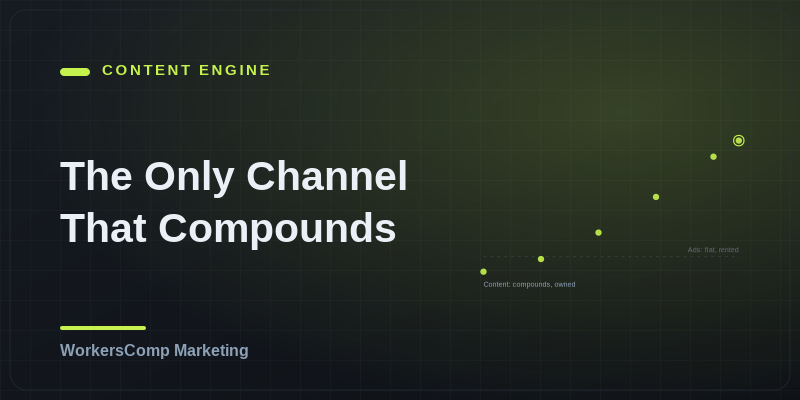
The Content Engine: The Only Workers' Comp Channel That Compounds
SEO

The Content Engine: The Only Workers' Comp Channel That Compounds

Ads reset to zero the month you stop paying; content keeps ranking for years. How a WC firm builds a pillar-and-cluster engine that produces signed cases, not pageviews.

AI Intake for Workers' Comp Firms: Answer First, or Lose the Case
Intake

AI Intake for Workers' Comp Firms: Answer First, or Lose the Case

Every channel ends at one doorway: someone reaches out. What AI intake should own - instant response, qualifying, booking - and the four jobs it must always leave to a human.

Workers' Comp Law Firm Reviews: The 901-Day Problem
SEO

Workers' Comp Law Firm Reviews: The 901-Day Problem

The median WC claim runs ~901 days. If you only ask at case close, your review engine is idle for two and a half years.

Marketing Attribution: Why Your Dashboard Is Lying to You
Reporting

Marketing Attribution: Why Your Dashboard Is Lying to You

Connect ad click to signed case — and stop funding the wrong channel.

How to win the Spanish-speaking injured-worker market
Scaling

How to win the Spanish-speaking injured-worker market

Bilingual marketing and intake — not translated English — is the edge in a trade where a large share of workers are Hispanic.

How Much Does Workers' Comp Marketing Cost? A 2026 Pricing Guide
Scaling

How Much Does Workers' Comp Marketing Cost? A 2026 Pricing Guide

The honest ranges for workers'-comp marketing in 2026 — cost by channel, by lead, and by signed case, how much to budget, and how agencies price it. Every figure is a cited third-party benchmark.

Workers' Comp Leads for Law Firms: Buy or Build Your Own Pipeline?
Lead Quality

Workers' Comp Leads for Law Firms: Buy or Build Your Own Pipeline?

Buy workers'-comp leads or build the pipeline that produces them? The real math on shared vs. exclusive lead costs, cost per signed case, why speed-to-lead decides it, and when each approach wins.

The Workers' Comp Firm Website: Built to Sign Cases, Not to Win Awards
SEO

The Workers' Comp Firm Website: Built to Sign Cases, Not to Win Awards

Your website is the hinge every marketing channel swings on — not a brochure. What a workers' comp firm's site actually needs to sign cases: the injured worker's real question, the missing comp page, phone-first speed, and the SEO foundation underneath.

Workers' Comp Retargeting: The Clicks You Already Paid For
Lead Quality

Workers' Comp Retargeting: The Clicks You Already Paid For

Most injured workers who click a workers' comp ad never call on the first visit — and most firms let them go for good. The tracking foundation, the three audiences worth rebuilding, the health-advertising rules, and how long to chase before it becomes harassment.

What Workers' Comp Firms Can and Can't Say: A Marketing-Compliance Guide
Lead Quality

What Workers' Comp Firms Can and Can't Say: A Marketing-Compliance Guide

The advertising rules that decide what a workers' comp firm may claim, promise, and send — false-and-misleading standards, solicitation limits, testimonial disclaimers, and texting consent — in plain English.

Workers' Comp Google Ads: Where Paid Search Leaks and What Converts
Lead Quality

Workers' Comp Google Ads: Where Paid Search Leaks and What Converts

Paid search is the highest-intent channel a workers' comp firm can run — and the easiest to quietly waste. The five leaks that drain a Google Ads budget, and what actually turns a click into a signed case.

How to Get More Workers' Comp Clients: The System, Not the Tactic
Scaling

How to Get More Workers' Comp Clients: The System, Not the Tactic

Firms don't get more workers' comp clients by finding a new tactic — they get them by fixing the system that turns attention into signed cases: channels, speed, follow-up, and one honest number.

Lead Reactivation: The Cases You Already Paid For
Intake

Lead Reactivation: The Cases You Already Paid For

Every firm that has run ads for a few months is sitting on a database of leads it already paid for — unreached, unsigned, or ‘not ready yet.’ The audit, the respectful re-contact sequence, and the compliance guardrails that turn a dead-leads graveyard back into signed cases.

After-Hours Intake: Where Workers' Comp Cases Go at Night
Intake

After-Hours Intake: Where Workers' Comp Cases Go at Night

Injured workers reach out after the shift, after the ER, and after the denial letter — while most firms' phones close at five and the ads keep billing all night. The self-audit, the five-rung coverage ladder, and the night-call script.

The Referral Engine: The WC Case Channel Money Can't Buy
Lead Quality

The Referral Engine: The WC Case Channel Money Can't Buy

Referred injured-worker cases arrive pre-screened, rarely shop around, and sign with almost no friction — yet nearly every WC firm treats referrals as weather instead of a channel. The four populations that send comp cases and the system that keeps them sending.

The Capacity Ceiling: Why Doubling Ad Budget Looks Broken
Scaling

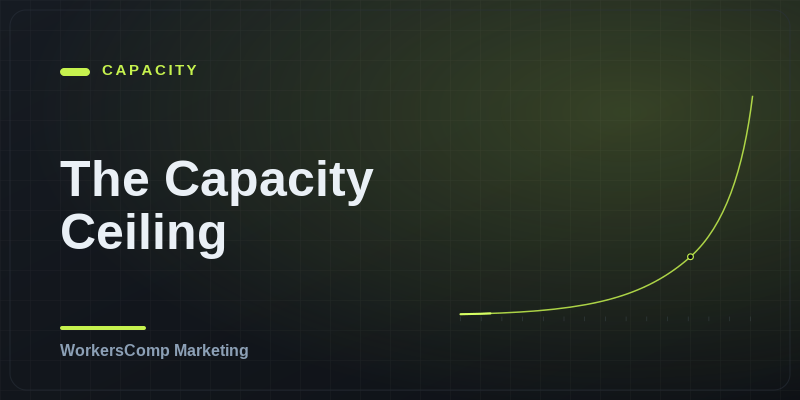
The Capacity Ceiling: Why Doubling Ad Budget Looks Broken

CPL holds, cost per signed case climbs, and the agency gets fired. What Erlang C says really happens to an intake desk when volume doubles — and the four numbers that prove which explanation is right.

The Intake Call: Where WC Cases Are Actually Won
Intake

The Intake Call: Where WC Cases Are Actually Won

Every marketing dollar funnels into one phone call. The anatomy of a call that signs injured workers on the spot — and the seven leaks that quietly lose them.

Video Content for WC Firms: Be Known Before the Injury
Scaling

Video Content for WC Firms: Be Known Before the Injury

Injured workers hire the firm they've already seen. How consistent attorney video builds that familiarity before the accident ever happens.

Local Services Ads for WC Firms: Winning Google Screened Leads
Lead Quality

Local Services Ads for WC Firms: Winning Google Screened Leads

The top spot on Google, pay-per-lead pricing, the ranking flywheel, and the weekly rhythm that separates profit from waste.

Lead Nurture for Workers' Comp: The Case for the Slow Yes
Intake

Lead Nurture for Workers' Comp: The Case for the Slow Yes

Speed wins the caller who's ready now. But most injured-worker leads aren't — and the firm still texting them in week three signs the cases everyone else wrote off.

Why denied claims are your best marketing opportunity
Lead Quality

Why denied claims are your best marketing opportunity

High-intent, underserved, and often strong cases. How to market to — and sign — the denied worker.

Local SEO for WC firms: how to win the Google map pack
SEO

Local SEO for WC firms: how to win the Google map pack

What Google actually says decides the map pack, the click statistics that dissolve when you trace them, and the category that does not exist for workers' comp firms.

How much should a WC firm spend on marketing?
Scaling

How much should a WC firm spend on marketing?

A budget framework built from unit economics — media vs. management fee, the ramp, and sizing spend to cost per case.

Landing pages that convert clicks into signed cases
Intake

Landing pages that convert clicks into signed cases

The anatomy of a page built to sign injured-worker cases — headline, trust, form, mobile speed, and the one-CTA rule.

The 3 creative angles that actually sign WC cases
Meta Ads

The 3 creative angles that actually sign WC cases

Hooks that speak to injured workers at the moment they're ready to call — and the ones that just waste budget.

Speed-to-lead: why the first 5 minutes decide the case
Intake

Speed-to-lead: why the first 5 minutes decide the case

What response time does to contact rate in workers' comp — and a simple routing setup that lifts it fast.

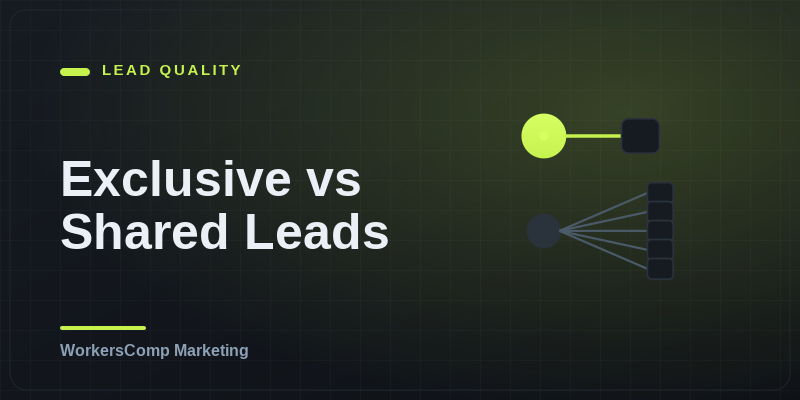
Exclusive vs. shared leads: the real cost per signed case
Lead Quality

Exclusive vs. shared leads: the real cost per signed case

Cheap shared leads look good on a spreadsheet until you calculate what it costs to actually sign one.

How to scale ad budget without blowing up CPL
Scaling

How to scale ad budget without blowing up CPL

The rules we follow before turning spend up — so volume grows and cost per case holds.

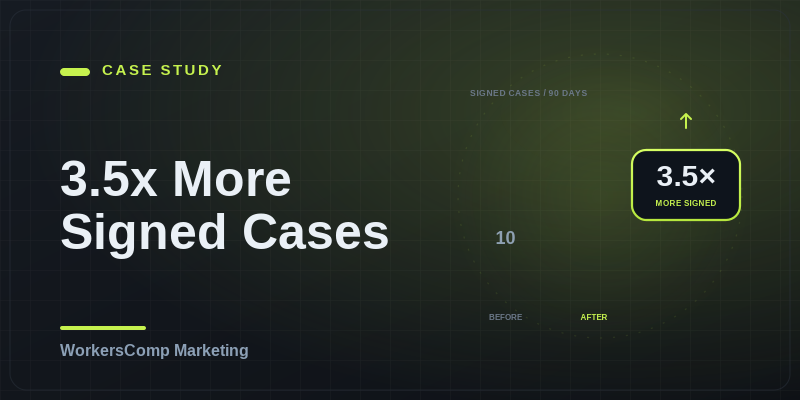
3.5× more signed cases in 90 days: a FL firm breakdown
Case Studies

3.5× more signed cases in 90 days: a FL firm breakdown

The full teardown — what was broken, what we changed, and the numbers that moved.

The only 3 metrics a WC firm owner should track
Reporting

The only 3 metrics a WC firm owner should track

Forget vanity clicks. These are the numbers that tell you if your marketing is actually working.

The Growth Library

These are the articles. The manuals are free too.

15 playbooks and workbooks — 1,547 pages — covering marketing, intake, SEO, creative and firm operations. No call, no demo, nothing held back.