A brand is not what you say about yourself. It is what the injured worker already expects before they dial — and in workers’ compensation, almost nobody has given them a reason to expect anything at all.
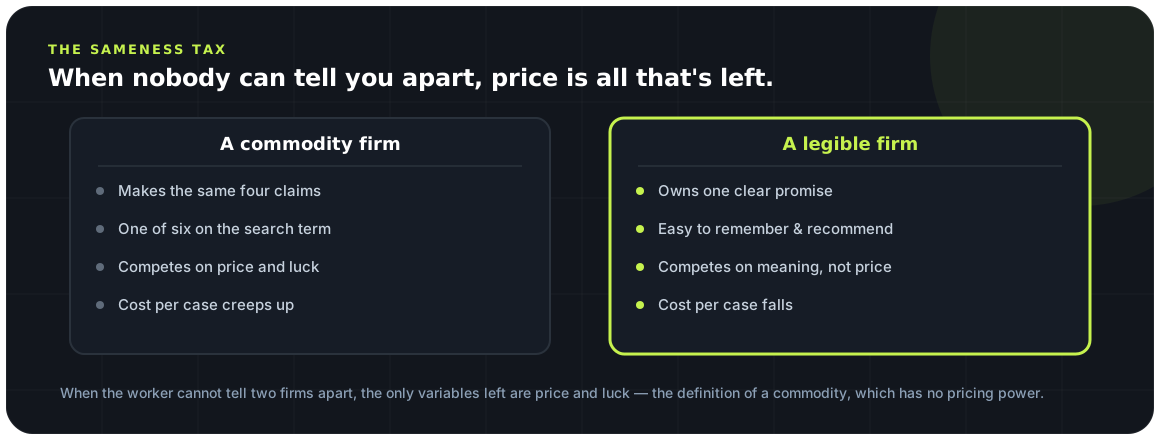
I have watched a lot of workers’ comp firms buy their way to the same result. They run competent ads, they build a clean site, they answer the phone — and their cost per signed case creeps up every quarter, because the market treats them as interchangeable with the six firms advertising on the same search term. When the customer cannot tell two options apart, the only variables left are price and luck. That is the definition of a commodity, and a commodity has no pricing power.
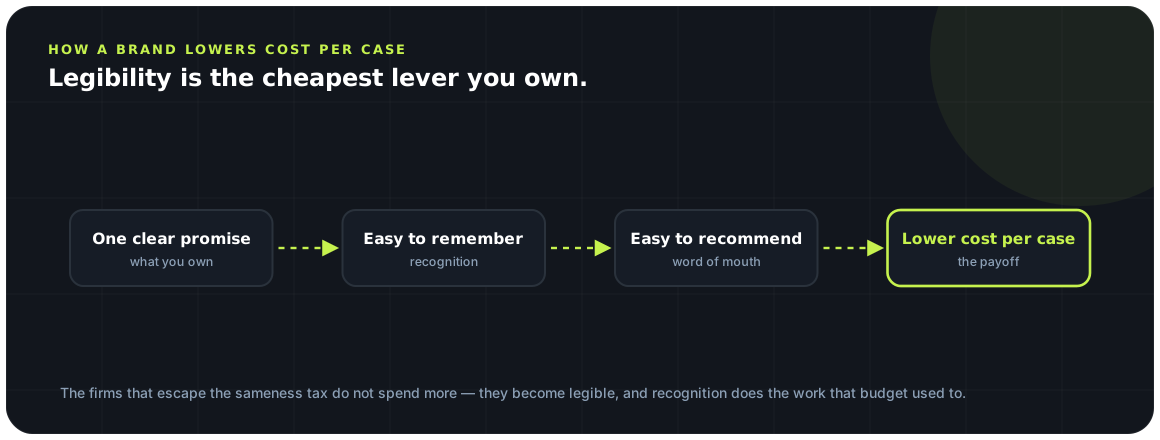
The firms that escape it do not spend more. They become legible — easy to understand, easy to remember, easy to recommend. That is all a brand is: a shortcut in the mind of a frightened person who has thirty seconds and four tabs open. This piece is about building that shortcut deliberately. Not a logo refresh — the strategy underneath it: how to pick what you stand for, how to say it so it lands, how to prove it so a skeptic believes it, and how a stronger brand quietly lowers the price of every case you buy.
The sameness tax: why firms look identical
When everyone makes the same promise, the promise stops being information.
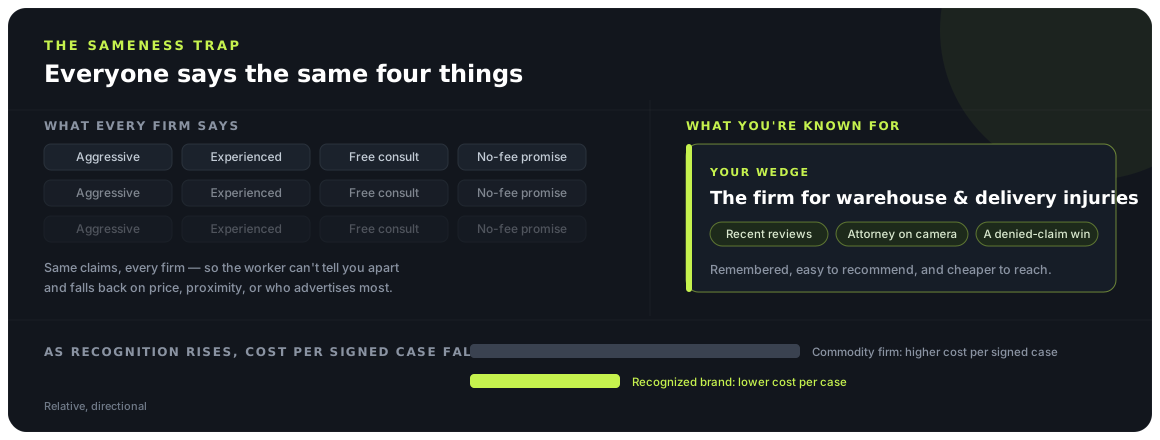
Think about the moment your prospect is in. Someone got hurt at work. They are scared of losing their job, worried the company thinks they are faking, and often in pain right now. They type something into a phone, they see a row of firms that all look the same, and they have no framework to choose. So they use the crude ones available to them: the ad that showed up first, the office nearest the freeway, the name a cousin half-remembers, the profile with the most stars.
Notice that every one of those default tiebreakers costs you money to win. Showing up first is a bidding war. Being nearest is geography you cannot change. Most stars is a reputation engine you have to build. The one tiebreaker that is nearly free — being the firm that obviously fits my situation — is the one almost no firm bothers to claim. That is the sameness tax: because you did not give the prospect a reason to choose you on meaning, you are forced to buy the choice on money.
And it compounds. A commodity brand has to outspend to be seen, converts worse when it is seen, and earns fewer referrals afterward because there is nothing memorable to pass along. Each of those is a small leak. Together they are why two firms running near-identical ad accounts can post wildly different costs per signed case. The cheaper one is almost never the better bidder. It is the more legible brand.
Why lawyers default to sameness
It is not laziness. Three forces push every firm toward the same four words. Compliance instincts make attorneys nervous about any claim that sounds bold, so they retreat to phrases nobody could challenge. Peer mimicry means the easiest way to write a homepage is to look at three competitors and average them. And risk aversion treats a sharp, specific position as a gamble — surely narrowing the message narrows the caseload. It does not, as we will see, but the fear is real and it keeps everyone huddled in the safe, grey middle where no prospect can tell them apart.
What a brand actually is for a WC firm
Not the logo. The promise, and the experience that keeps it.
When most firm owners hear “branding,” they picture a new logo, a color palette, maybe a fresh font. That is identity design, and it is the last five percent of the work. A brand is something earlier and more valuable: it is the meaning that arrives in the prospect’s mind before they interact with you, and the felt experience that confirms or destroys that meaning once they do.
Put concretely, your brand is the answer to the three questions an injured worker is actually carrying, whether or not they say them out loud:
Will they believe me? The single most common reason people hire a comp attorney is the fear that no one — the employer, the insurer, the doctor — takes the injury seriously. A brand that signals “we start by believing you” answers the deepest fear in the room.
Will they actually fight? The prospect has usually already been told “no” by someone. They want evidence you push back, not that you are “aggressive” as an adjective but that you fight as a documented habit.
Will someone answer? Nearly every horror story an injured worker has heard is about a lawyer who went silent. Responsiveness is not a service detail; for this audience it is a core brand promise, and it is one you can prove within the first five minutes of contact.
The reason this matters commercially is that meaning travels for free and adjectives do not. “Experienced” has to be paid for with impressions, because it means nothing until repeated a hundred times. “The firm that fights denied surgeries for warehouse workers” is remembered after one exposure and repeated by a friend at a barbecue, because it is specific enough to be a useful thing to say. A brand is simply meaning compact enough to carry.
Positioning: pick a wedge and own it
The riches are in the niches — and niching sharpens the message, not the caseload.
Positioning is the one decision that makes everything downstream easier: the ads write themselves, the site organizes itself, the referrals know what to say. And positioning, for a comp firm, almost always means choosing a wedge — a narrow, memorable thing to be first for — rather than trying to be mildly preferred for everything.
A wedge can be built on any of several edges, and the best ones stack two or three:
Injury or industry. The firm for warehouse and delivery injuries. The firm for construction falls. The firm for repetitive-strain and back injuries. An industry wedge is powerful because injured workers cluster by employer and talk to each other — win the message inside one industry and word of mouth does the rest.
Language and culture. In most comp markets a large share of injured workers are Spanish-speaking, and a firm that is authentically bilingual — not a translated page, but Spanish-first intake and Spanish-first ads — owns a market the grey-middle firms cannot touch. We made this case in depth in marketing to the Spanish-speaking injured worker.
Geography. Being unmistakably the county’s firm — named in local terms, visible in local places — beats being a faint statewide presence. Geography also feeds the map pack, which is the cheapest case flow you can build; see the local SEO playbook for winning the map pack.
The fight itself. The firm known specifically for overturning denials — for the case everyone else called hopeless — owns the exact fear the prospect walked in with.
The objection every owner raises here is the same: if I say I am the warehouse-injury firm, do I lose the construction case? No. A wedge sharpens the message, not the intake criteria. You still sign the general case that calls; you simply win the market you actually named, because specificity is what gets remembered and recommended. The firm that tries to be equally for everyone is remembered by no one.
| The prospect’s real fear | The commodity claim that ignores it | The brand answer that lands |
|---|---|---|
| “Will anyone believe me?” | “Experienced attorneys” | A message and proof built around being taken seriously from the first call |
| “Will they actually fight?” | “Aggressive representation” | A documented habit of overturning denials, shown not asserted |
| “Will someone answer?” | “We care about our clients” | A visible responsiveness promise, proved in the first five minutes of contact |
| “Is this firm for someone like me?” | “Serving all injury victims” | A wedge — an industry, a language, a county — that says yes on sight |
Message and voice: fear first, proof over adjectives
Say the true thing plainly, lead with the fear, and let evidence carry the weight adjectives cannot.
Once the position is chosen, the message is mostly a discipline of subtraction. Two rules do most of the work.
Lead with the fear, not the service. The prospect does not wake up wanting “representation.” They wake up afraid of losing the job, of not being believed, of the pain not stopping. A message that names that fear in the first line — “Hurt at work and worried they think you’re faking?” — earns attention that a feature list never will. You are not describing what you sell; you are describing what they feel, then showing you have a plan for it.
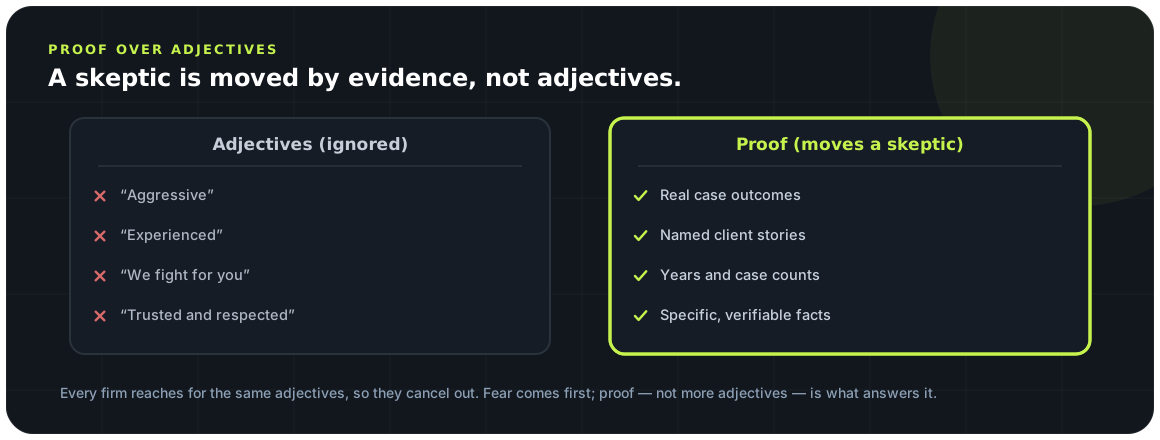
Trade adjectives for evidence. “Aggressive” is a claim the reader has to take on faith and has heard a hundred times. A one-line story — a denied surgery authorized, a stopped check turned back on — is proof the reader can feel. Adjectives are what you say when you have no evidence; evidence is what makes adjectives unnecessary.
Adjectives are what a firm reaches for when it has no evidence. Replace every adjective in your marketing with a thing that actually happened, and you will sound like the only honest firm in the row.
Spencer Moeller, WorkersComp MarketingVoice matters too, and for this audience it points one direction: plain, warm, and unmistakably human. Injured workers are not lawyers. The firm that writes at a ninth-grade reading level, explains the process in the language the client speaks, and sounds like a person rather than a statute is the firm that feels safe to call. Legalese is not authority; to a frightened non-lawyer it reads as distance.
Identity and consistency: the recognition test
A brand is a promise repeated. Break the repetition and you break the trust.
Consistency is the least glamorous part of branding and the part that quietly decides whether any of the rest works. A brand is a promise made repeatedly; recognition is what repetition buys. Every time the injured worker meets you — the ad, the website, the text back, the voice on the phone, the office if they visit — they are either adding to a single coherent impression or being introduced to a stranger all over again.
The failure mode is almost never one ugly asset. It is drift: the Meta ad promises “we fight for warehouse workers,” the landing page is a generic firm template, and the person who answers has never heard the phrase. The prospect does not consciously notice the seam, but they feel it — the warmth of the ad curdles into the coldness of a normal law office, and they bounce. You paid for the click and lost it at the handoff. This is why brand and the firm’s website and intake cannot be separate projects: they are the same promise at three moments, and the promise has to survive all three.
Visual identity serves recognition, nothing more. A consistent mark, one or two colors, one typeface, used the same way everywhere, so that a prospect who saw your ad on Tuesday recognizes your site on Thursday without reading a word. It does not need to be beautiful. It needs to be the same.
Proof: the only thing that moves a skeptic
The injured worker arrives having already been told “no.” Only evidence gets past that.
Every prospect in this category arrives skeptical, because someone — an employer, an adjuster, a doctor — has usually already doubted them. Skepticism is not moved by claims; it is moved by proof. The brands that win stack three kinds.
Reviews, fresh and specific. Nothing else does what a steady stream of recent, human reviews does for a frightened stranger: it is other people like them saying “this firm believed me.” Reviews are also a ranking and cost-per-lead lever, which is why we treated them as a case-management system in the piece on why asking at case close is broken. A brand with no recent proof is a promise with no witnesses.
Results, framed honestly. Not vague settlement figures, which every firm posts and no prospect believes, but the specific fights that map to the fear: the denial overturned, the surgery authorized, the checks restarted. Frame them as what you did for a person, not as a number, and keep them truthful — a brand caught exaggerating loses the one asset it was building.
A recognizable human. Injured workers hire people, not entities. An attorney who shows up on camera explaining the process in plain language becomes a face the prospect already half-trusts before the first call. In a category of faceless firms, being a specific, visible person is itself a differentiator.
| The commodity claim | What the skeptic hears | The proof that replaces it |
|---|---|---|
| “Aggressive representation” | “They all say that” | A denied-surgery-authorized story, dated and specific |
| “We care about our clients” | “Prove it” | A wall of recent, specific reviews and a same-day-callback promise |
| “Decades of experience” | “So does everyone” | The attorney on camera, in plain language, explaining the exact process |
| “Serving all injured workers” | “Not sure that’s me” | A named wedge — industry, language, or county — the prospect belongs to |
How a brand lowers your cost per case
This is a media-efficiency line item wearing a reputation costume.
Owners park branding under “nice to have,” which is a polite way of saying “nobody’s number.” But a brand is not decoration; it is a multiplier on every conversion step your paid media already runs through, and those steps are exactly where cost per case is decided.
Walk the funnel. A recognizable, specific brand earns a higher click-through rate, because the ad reads as for me rather than generic. It earns a higher landing-page conversion rate, because the promise is clear and proved. It lifts the quality signals — reviews, engagement, consistency — that feed Google’s local pack and Local Services Ads, which as we covered in the LSA playbook influence both how often you show and what you pay. And it earns referrals, which are the cheapest cases in the world because they arrive pre-sold. Improve each of those by a little and the effect on cost per signed case is not additive, it is multiplicative — every stage feeds the next.
That is why two firms with identical ad accounts can post very different economics. Across the roughly $16.5M in injured-worker media we have managed, the pattern is consistent: the sharper, better-proved brands turn the same clicks into signed cases at a rate the commodity firms cannot match, so the same $75 lead is simply worth more to them. Brand does not replace performance marketing — it is the reason the performance marketing performs. The firm that fixes its brand gets a quiet discount on everything else it buys.
None of this is a logo project, and almost none of it costs money — it costs a decision. The decision is what you refuse to be, so that what you are becomes legible. Make it once, apply it everywhere, and you stop paying the sameness tax the rest of the row is still quietly handing to Google every month.
Key takeaways
-
Sameness has a tax. When every firm says “aggressive, experienced, free consultation,” none of them says anything, and all of them pay more for attention.
-
A brand is a position, not a logo. For a comp firm it is the wedge you own in the worker’s mind, not your color palette.
-
Lead with fear, then proof, not adjectives. Speak to the worker’s worry and show evidence; superlatives persuade no one.
-
Consistency builds the recognition that converts. The same voice and look across every touch is what makes you familiar.
-
A brand lowers your cost per case. Recognition and trust convert at a lower price than cold attention ever will.
Frequently asked questions
What does branding mean for a workers’ comp law firm?
It is not your logo or your colors. For a workers’ comp firm, a brand is the specific promise you are known for and the experience that proves it — the answer, made legible before anyone calls, to the injured worker’s real questions: will they believe me, will they fight, will someone actually answer. A logo is a signature; the brand is what the signature stands for.
Why do most workers’ comp law firms look the same?
Because nearly all of them lead with the same four claims — aggressive, experienced, free consultation, no fee unless we win. Every one is true and none of them differentiates, so the injured worker cannot tell the firms apart and falls back on whoever is closest, cheapest, advertises most, or has the freshest reviews. Sameness forces the choice onto expensive levers.
How does branding lower a law firm’s cost per case?
A recognizable, specific brand lifts the boring conversion numbers that decide your media efficiency: click-through rate on ads, conversion rate on the landing page, quality signals that feed Google’s local pack and Local Services Ads, and word-of-mouth referrals that cost nothing. Same budget, more signed cases. Brand is not a substitute for performance marketing; it is the multiplier underneath it.
Should a workers’ comp firm niche down or stay general?
Pick a wedge. The firm known as the one for warehouse and delivery injuries, or for a specific language or county, is far easier to remember and recommend than the firm that does workers’ comp and personal injury and family law. Niching sharpens the message, not the caseload — you can still take the general case, but you win the market you named.
Do we need a rebrand or a new logo?
Almost never start there. A new logo changes nothing the injured worker cares about. Start with positioning — the one thing you want to be known for — then make the message, the proof, and the intake experience consistent with it. A rebrand is worth it only once the strategy underneath is decided; otherwise you have repainted a car with no engine.
How do we prove a brand instead of just claiming it?
Replace adjectives with evidence. Instead of saying aggressive, show a denied-surgery-authorized story; instead of saying we care, show a steady stream of recent, specific reviews and a real attorney on camera explaining the process. Proof — reviews, results framed honestly, a recognizable human — is the only thing that moves a skeptic, and the injured worker arrives skeptical.
Sources & further reading
-
01
Where the brand shows up
The surfaces that carry the brand.
- 02
- 03
Benchmarks here draw on WorkersComp Marketing’s own managed-spend data across live firms; your numbers will differ. General marketing information, not legal advice.