
An injured worker types “workers comp lawyer near me” into a phone. Before a single blue link appears, they see a map and a short list of firms. Most of them never scroll past it.
That box — the local pack, or the “3-pack” — is the most contested real estate in legal search, and it is the one surface a comp firm can win without outbidding anybody. It is also the surface with the most nonsense written about it. Nearly every article you will read on this topic opens with a click-share statistic that has no source, and closes with a checklist that would get your profile suspended.
So this piece does something slightly unusual: it tells you which numbers we refuse to print, and why. Everything that survives is either something Google states in its own documentation, something a named study measured with a disclosed method, or something we mark plainly as opinion.
What Google actually says decides the pack
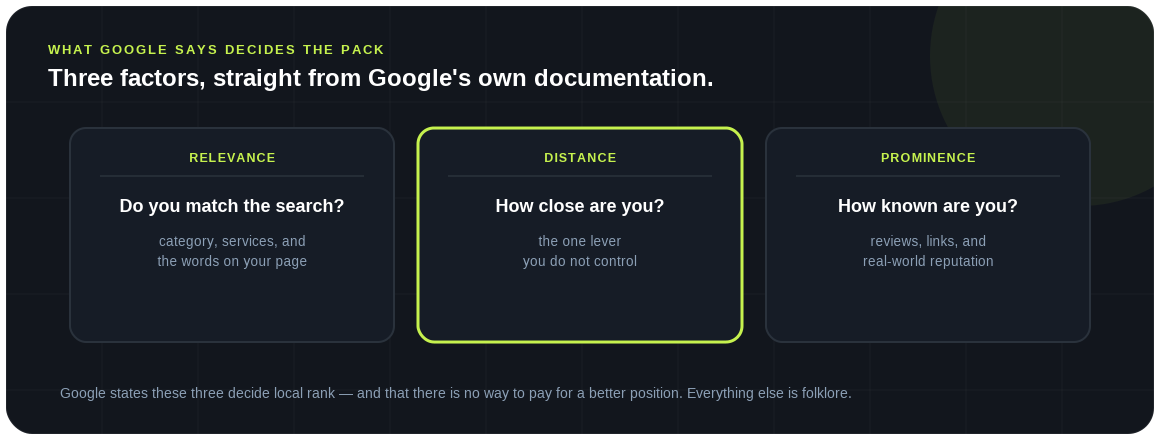
Three factors, stated plainly, in Google’s own words.
Google’s Business Profile help documentation is unusually direct about local ranking. It names three factors (Google Business Profile Help):
- Relevance — how well your profile matches what the person searched for.
- Distance — how far each business is from the searcher.
- Prominence — how well known the business is. Google explicitly ties reviews to this one, stating that more reviews and positive ratings can help local ranking.
The same page carries a sentence worth reading twice, because it is the shortest available answer to most cold-call pitches your firm receives: there is no way to request or pay for a better local ranking.
That is the entire published model. Everything beyond it — every weighting, every factor list, every “algorithm update” someone emails you about — is inference. Useful inference, sometimes. But inference, and it should be labelled that way.
Three statistics we won’t print — and what to use instead
We traced the numbers everybody quotes. They do not survive the trip.
An earlier version of this very article opened with the claim that the local pack captures around 44% of local-search clicks. We went looking for the study behind it before this rewrite. There isn’t one.
- “The local pack gets ~44% of clicks.” The trail runs into roundups citing other roundups. The figure drifts between 42% and 44% depending on who is copying whom, which is itself the tell. No sample, no method, no date. Notably, a real measured 43.9% does exist in the literature — but it was the organic share in a 2018 study, not the pack’s.
- “The #1 map-pack listing gets 17.8% of clicks.” No source produces 17.8%. The nearest real number is 17.3%, measured in 2018, in one metro, in home-service categories, on screenshots.
- “3-pack businesses get 126% more traffic.” This one has a genuine origin — a vendor analysis of a large listing set, around 2022 — but the report is gated, the method is unpublished, and everyone downstream misstates the comparison. The vendor compared pack listings against the Local Finder. The internet reports it as “versus positions 4–10.” Those are different populations.
Here is what we will stand behind instead, with the caveats attached rather than buried.
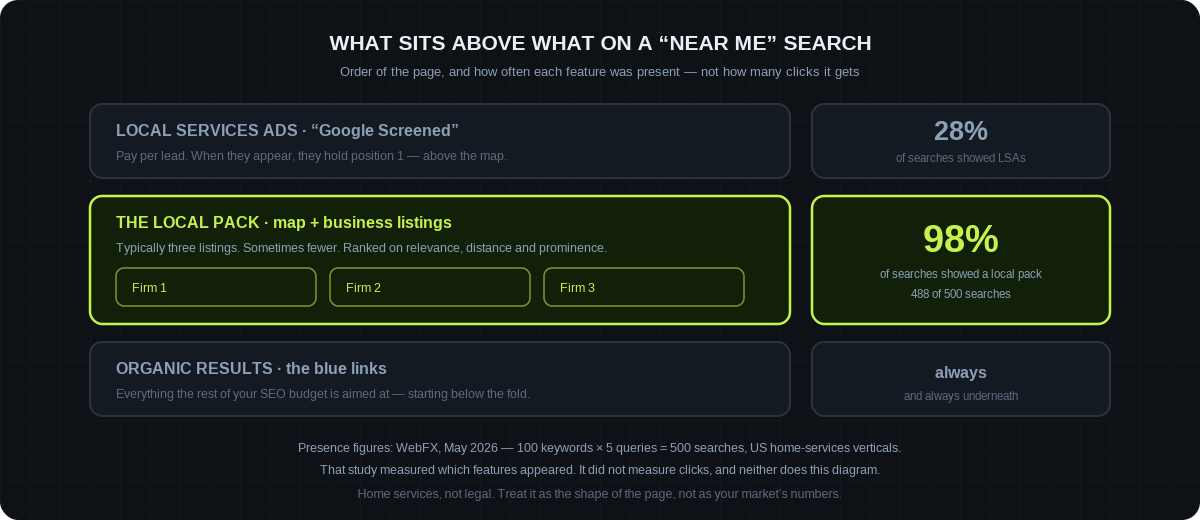
The pack is nearly always there. A May 2026 study by WebFX ran 100 keywords five times each — 500 US searches across home-service verticals — and found a local pack present in 488 of them (98%), Local Services Ads in 28%, and standard Google Ads in just 8%. Where LSAs appeared, they held position one, above the map. The study’s authors are explicit that they measured which features appeared, not what got clicked. Two honest caveats: it is home services, not legal, and presence is not attention.
The one real click study in this space is eight years old. BrightLocal’s 2018 Local Services Ads click study put SERP screenshots in front of 5,500 panellists in five service categories in San Francisco, and split them between pages with and without LSAs. Without LSAs, the three pack positions drew 17.3%, 12.0% and 2.9% of clicks. With LSAs on the page, the pack’s total fell from 32.3% to 28.8%. That last comparison is the useful part, and it still holds up as a demonstration of cannibalisation. The absolute percentages are from 2018, one city, panel-based, and should not be quoted as current.
The only legal-vertical click test we could find is small. Juris Digital ran three click tests of 100 participants each on screenshots of law-firm search results. Review count and rating correlated strongly with where people clicked — in all three tests, a listing with better reviews beat both ads and higher-placed listings. Three hundred people clicking a picture of a search page is suggestive, not authoritative. We report it that way.
What practitioners say moves it in 2026
The best available proxy for the algorithm is a survey — and it should be read as one.
Whitespark’s Local Search Ranking Factors study is the closest thing the field has to a shared reference. The 2026 edition, published in November 2025, asked 47 local SEO practitioners to score 187 factors. The top ten for the local pack:
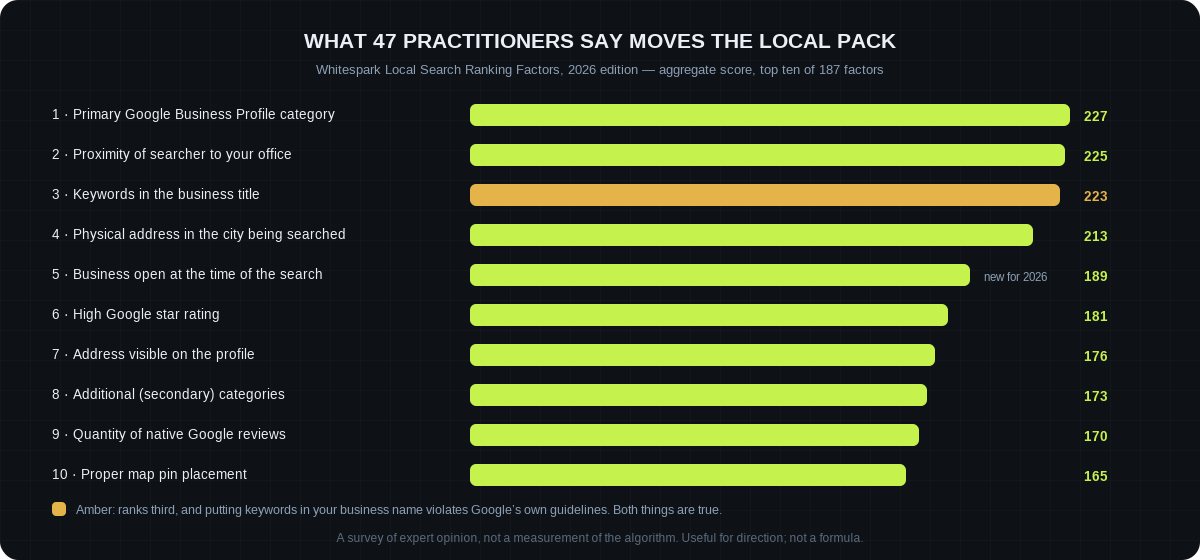
Three things in that list deserve a comp firm’s attention, and we spend the rest of this article on them: primary category ranks first and has no exact match for your practice area; keywords in the business title ranks third and is against Google’s rules; and “business open at the time of search” is new to the top ten for 2026 and points somewhere unexpected.
Whitespark’s own summary of the year’s movement: review signals and behavioral signals up, on-page and link signals down slightly, citations continuing a long slow decline. Treat those as direction, not dosage. You will find blogs printing precise percentage weights for each category group; several of the numbers in circulation are recycled from an older edition. If you want the weights, read them off Whitespark’s own chart.
The category that doesn’t exist
Primary category is the highest-weighted factor. There is no workers’ comp one.
Google’s category list runs to roughly four thousand entries and includes a generous spread of legal ones: personal injury attorney, employment attorney, labor relations attorney, social security attorney, bankruptcy, immigration, estate planning, and plain “lawyer,” among many others. It does not include workers’ compensation attorney. We checked two independently maintained mirrors of the list, both updated in 2026. Neither has it.
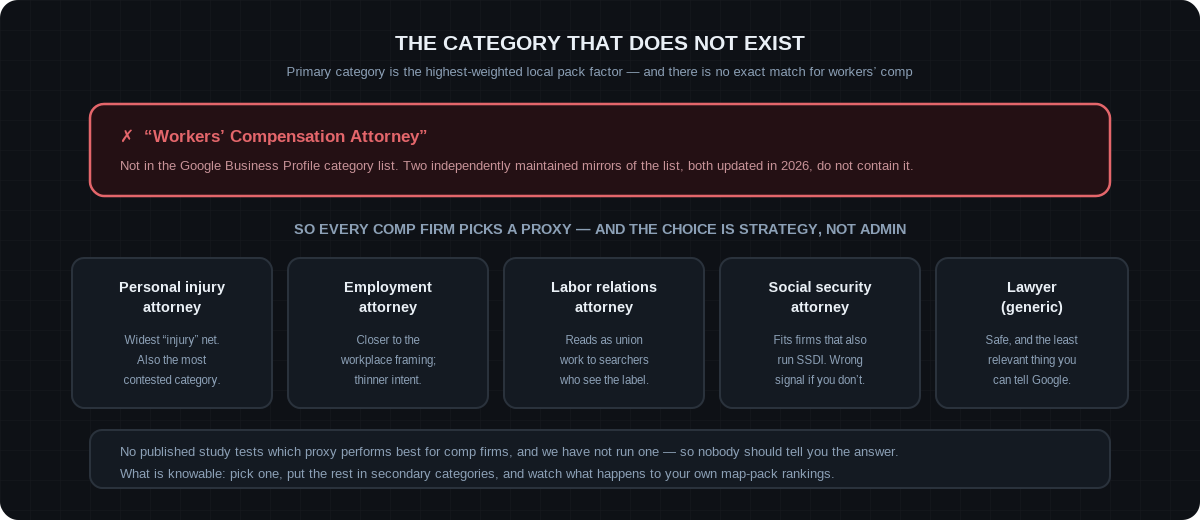
This is a real, structural disadvantage relative to the personal-injury firms you compete with for adjacent searches — they get an exact-match category, you get a proxy. And because the primary category is the top-weighted factor in the field’s own survey, the choice is a strategic decision, not a form field.
What we can tell you honestly: no published study tests which proxy performs best for comp firms, and we have not run one. Anyone who tells you the answer with confidence is guessing at you. What is knowable is the reasoning. Personal injury attorney casts the widest injury-shaped net and is the most contested. Employment attorney sits closer to the workplace framing but attracts thinner intent. Labor relations reads as union work to a human who sees the label. Social security attorney fits firms that genuinely run SSDI alongside comp, and misdescribes you if you don’t. Generic “lawyer” is the safest and the least informative thing you can tell Google.
The business-name question, answered honestly
It ranks third. It is also a guidelines violation. Both are true.
“Keywords in the business title” scored third in the 2026 practitioner survey. Meanwhile Google’s guidelines for representing your business say your name should be your real-world name as used consistently on your signage, site and stationery, and that adding unnecessary information — taglines, locations, service descriptors — is not permitted.
So “Alvarez Law — Workers Comp Lawyers Phoenix” is a violation. It also, demonstrably, works. That tension is why so much local SEO advice is quietly dishonest: agencies either pretend the tactic doesn’t work, or recommend it without mentioning what happens next.
What happens next is this: name violations are the single easiest thing for a competitor to report, the edit is trivial for Google to make, and profiles can be suspended. Reinstatement is a process, and while it is running your map-pack presence is zero. For a firm whose caseload depends on the phone ringing, that is not a growth tactic with a downside — it is a coin flip with your pipeline on it.
The legitimate version of the same lever is doing the actual renaming. If your firm genuinely trades as “Alvarez Work Injury Law” — on the door, the letterhead, the site, the bar registration — then that is your real-world name and it may be used. That is a business decision with real costs. It is also the only durable form of this play.
Where you are allowed to be listed
The rules that actually bind law firms, in Google’s own guidelines.
Google’s guidelines on representing your business name lawyers explicitly, and the rules matter more for comp firms than for most local businesses, because comp practices tend to sprawl across a state.
| Situation | What the guidelines say |
|---|---|
| Individual attorney profiles | Lawyers are named as individual practitioners and may hold their own profile if they are public-facing and directly contactable at that location during its stated hours. Where several practitioners share a location, a practitioner’s profile title should be only the practitioner’s name — not the firm’s. |
| The solo firm | If a practitioner is the only public-facing attorney at a location and represents a branded organization, Google says it is best to share one profile with the organization. One listing, not two. |
| Practice areas | A practitioner shouldn’t hold multiple profiles to cover different specialisations. The “one listing for comp, one for PI” tactic is foreclosed. |
| Virtual offices | A rented mailing address you don’t operate from is not eligible for a profile. Full stop. |
| Co-working space | Only listable if that office has clear signage, receives customers during business hours, and is staffed during business hours by your own staff. The building’s receptionist does not count. |
| Stated hours | The location must be staffed by your team and able to receive clients during the hours you publish. |
| Service areas | One profile at a central office with a defined service area. Google says the boundary shouldn’t extend beyond roughly two hours’ drive from your base. |
Read together, those rules kill the most commonly sold multi-location strategy in legal marketing: a scatter of virtual addresses across a state, each with its own listing, each supposedly winning its own map pack. That is not an aggressive tactic. It is an ineligible one, and the profiles built on it exist at somebody else’s convenience.
The legitimate version costs money and works: a real office, with your sign on it, staffed by your people during the hours you publish. If a satellite market is worth a listing, it is worth a room. If it isn’t, work it through service-area coverage, paid search, and content instead — which is what our SEO & content and paid search programs are for.
Open at the moment of the search
New to the 2026 top ten — and it points at your phone, not your website.
The most interesting entry in this year’s factor list is the newest one: whether the business is open at the time of the search. It sits fifth.
Think about when injured workers search. The shoulder that won’t lift is worst on Sunday. The decision to finally call a lawyer gets made at the kitchen table after dinner, or in a parked car before a second-shift start. If your profile says closed, you are less likely to be shown at exactly the hours when the most motivated searches happen — and if you are shown and the phone rings out, you have paid for the impression and handed the case to whoever answered.
Which means this local SEO factor is not really a local SEO project. It is an intake coverage question, and it belongs in the same conversation as the rest of your intake operation. Extending published hours without extending real coverage is worse than leaving them alone: the guidelines require that you can actually receive clients during your stated hours, and a caller who reaches nobody at 7pm is a worse outcome than one who sees “closed” and calls at nine.
Reviews, under two rulebooks
Google rewards them. The FTC and your state bar constrain how you get them.
Reviews are one of the few areas where Google’s own documentation and practitioner opinion agree: the help page ties reviews to prominence directly, and the 2026 survey puts star rating sixth and native review quantity ninth. We have written separately about the timing problem specific to comp — the median claim runs so long that a review program keyed to case close is idle for years.
One honest caveat before the tactics: review velocity and recency are asserted as ranking factors everywhere, and we could not find a primary source establishing either. Practitioner consensus, yes. Documented fact, no. Build for a steady flow because it is good practice and because bursts look unnatural to humans, not because someone proved it moves rankings.
What is documented is the constraint, and comp firms sit under an unusual amount of it.
The FTC rule. The Rule on Consumer Reviews and Testimonials (16 CFR Part 465) took effect in October 2024 and carries civil penalties for knowing violations. The parts that bite a law firm: asking clients generally for reviews is fine; conditioning any incentive on the review being positive is not; reviews from insiders — employees, family — require clear disclosure of the relationship; and suppressing negative reviews through threats or legal intimidation is prohibited. The “send the happy ones to Google and the unhappy ones to a private form” product still being sold to law firms sits squarely in the danger zone.
The ethics rule. The ABA’s Formal Opinion 496 addresses responding to online criticism, and its holding is narrower than most firms assume: a negative review is not a “controversy” or proceeding, so the self-defence exception to the confidentiality rule is not triggered by one. In plain terms, you cannot correct the record publicly using facts about the representation. The recommended responses are to say nothing, or to post something brief and non-substantive inviting the person to make contact directly.
We are a marketing agency, not your counsel, and workers’ comp is state-bound practice — your state’s rules govern, not the Model Rules, and they diverge. Read your own jurisdiction’s version before you build a review program, and have whoever handles your ethics compliance sign off on the request language.
What has not changed since 2021
There has been no confirmed local algorithm update in two and a half years.
Google confirmed several broad core and spam updates through 2025 and into 2026. None of them was local-specific. The last confirmed update aimed at local search remains Vicinity, in November 2021, which increased the weight of proximity and hurt a great many firms that had been ranking well outside their immediate area.
If you receive an email about the “March 2026 local update” and what it means for your firm, the honest response is that no such thing has been announced. Rankings move constantly; that does not make every movement an update, and naming one is a sales technique. The absence of confirmed local updates is, if anything, good news: the fundamentals have been stable for years, and a firm that does the boring things well is not standing on sand.
AI Mode, and what it does to local
Less “the pack is dead,” more “the pack is now personal.”
AI-generated answers now sit in front of a growing share of searches, and local results appear inside them. What is documented about how they behave: they draw on Business Profile data, third-party review platforms, unstructured mentions in articles and news, and social signals; they are personalised per user and per turn of the conversation; and the local sets they surface frequently show fewer than three businesses, sometimes without a click-to-call button.
Two practical consequences. First, rank tracking degrades as a management tool — if the result set is personalised per person, “what position are we” becomes a distribution rather than a number, and any agency reporting you a single confident rank is flattening something it should be showing you. Second, the inputs that feed those answers are broader than your profile: what gets written about your firm elsewhere now matters more, not less.
You will also see a specific statistic quoted here — that AI answers appear in 68% of local searches. We could not trace it to a primary source and are not printing it as fact. And note the honest bound on the pack itself: it typically shows three listings, sometimes fewer. “Always three” is not true.
The ads that sit above you
When Local Services Ads appear, they take position one from the map.
The 2026 presence study found LSAs in 28% of searches, and where they appeared they held the top of the page — above the local pack. The 2018 click study measured the cost of that directly: the pack’s share of clicks fell when LSAs were on the page.
For a comp firm this makes the two channels a single decision rather than two line items. Winning the pack in a market where LSAs run means winning the second-highest slot on the page. That may still be the best available economics — LSAs are pay-per-lead and the leads are not free — but it should be a choice you make with the page layout in front of you. Our Local Services Ads article covers that side in depth, including the ranking flywheel that runs on the same reviews your map pack does.
One operational note worth watching: Google announced in July 2026 that Local Services Ads are moving into the main Google Ads platform. That changes how firms buy and manage them, and anyone running LSAs should expect their workflow to change over the coming months.
Proximity: the lever you don’t hold
Second-highest factor in the survey, and almost entirely outside your control.
Distance from the searcher scores second in the 2026 factor list, and Vicinity made it heavier still. You cannot optimise your way out of geography. A firm downtown will not rank in a suburb forty minutes away for a “near me” search, no matter how good its profile is.
This has one clean implication and one uncomfortable one. The clean one: the levers you can pull — category, completeness, hours, reviews, pin placement, address in the city being searched — deserve disproportionate attention precisely because the biggest lever is fixed. The uncomfortable one: map-pack coverage of a metro is a function of where you have real offices, and a firm that wants pack visibility across a wide region is looking at a real-estate decision dressed up as a marketing one. That is worth saying out loud rather than selling around.
Where an office isn’t justified, the honest alternatives are the ones that don’t depend on proximity at all: organic content that ranks across the region, paid search that can be targeted anywhere, and referral relationships. Our County Opportunity Explorer exists for exactly this decision — it shows where the injured workers actually are, county by county, before you commit to a market.
A defensible first thirty days
Ordered by what the evidence says matters, not by what is easiest to bill.
- Week one — category and eligibility. Choose the primary category deliberately, with the reasoning written down. Fill secondary categories. Then audit every address you have listed against the virtual-office and co-working rules, and be honest about which listings would survive a complaint.
- Week one — the name. Check it against the real-world name on your door and letterhead. If it has keywords in it, decide consciously whether to keep the exposure or fix it. Don’t discover the answer through a suspension.
- Week two — completeness and pin. Services, description, real photos of the actual office and people, and a map pin dropped on your entrance rather than the middle of the block. Pin placement makes the top ten and takes four minutes.
- Week two — hours that match reality. Publish the hours you actually cover. Then look at your call distribution and decide whether the coverage should be wider.
- Week three — the review program. One ask, one moment, one tap, no sentiment filtering, replies that say nothing about the matter, and language your compliance person has read.
- Week four — local relevance that is real. City and area pages carrying genuine local detail: the local comp board, the industries in that county, the hospitals workers get sent to. Thin “comp lawyer + city” pages with the noun swapped are visible to Google and to readers, and they cost you more than they return.
- Ongoing — measure your own market. Track pack positions for your keyword set from your actual service area, and treat AI-surfaced results as a distribution rather than a rank. Your data beats everyone’s benchmarks.
What winning the pack won’t fix
The map pack does exactly one thing: it makes a phone ring. Everything that determines whether that ring becomes a signed case happens afterwards, in the building, and no amount of local SEO touches it.
This is not a rhetorical flourish. In the most recent mystery-shopper research of US law firms, a third-party researcher contacted 500 firms posing as prospective clients; 40% answered the phone and 33% answered an email, both down sharply from the same study five years earlier. Roughly half of firms were effectively unreachable by phone. Against that backdrop, moving from position four to position two mostly buys you more calls to miss.
So the sequence matters. Get the profile eligible, get the category right, get the reviews running — and in parallel, know what happens to the calls. We cover the conversation itself in the intake call article, and what happens when volume rises faster than the people answering it in the capacity ceiling. The map pack is worth winning. It is worth rather more if the phone gets picked up.
Key takeaways
-
The map pack is the first thing injured workers see. For “workers comp lawyer near me,” a map and three listings sit above the blue links and absorb most of the clicks and calls.
-
Google’s own documentation decides the pack, not myths. Relevance, distance, and prominence are the stated factors; chase those, not folklore.
-
Reviews live under two rulebooks. They move the pack and they move the caller, but for law firms they also sit under the bar advertising rules, so the ask has to stay clean.
-
Proximity is the lever you do not hold. You cannot move your office to the searcher; you win on relevance, prominence, and being open and answerable at the moment of the search.
-
A defensible first thirty days beats chasing hacks. Claim and complete the profile, build review velocity, and fix the fundamentals, not the moves Google penalizes.
Frequently asked questions
How do I rank in the Google map pack for workers’ comp?
Google says three things decide it: relevance, distance and prominence. In practice that means a correctly chosen primary category, a listing that is eligible at a real staffed address, complete profile information with an accurate map pin, published hours you actually cover, and a steady flow of genuine reviews. There is no way to pay for a better local ranking, and Google says so on its own help page.
Is there a “workers’ compensation attorney” category in Google Business Profile?
No. The category list contains personal injury, employment, labor relations, social security and general lawyer categories, among many others, but no workers’ compensation one. Every comp firm is therefore choosing a proxy for the single highest-weighted local ranking factor. No published study tests which proxy performs best, so treat anyone’s confident answer with suspicion — including ours.
Can I put “workers comp lawyer” in my Google business name?
Only if that is genuinely your firm’s real-world name, used consistently on your signage, website and stationery. Google’s guidelines prohibit adding descriptors, locations or taglines to the listed name. Practitioners rate keywords in the title as one of the strongest ranking signals, which is exactly why it is also the most commonly reported violation — and a suspension takes your map presence to zero while reinstatement runs.
Can I list a virtual office or co-working space to rank in another city?
A rented mailing address you do not operate from is not eligible for a profile. A co-working space is only eligible if it carries clear signage, receives clients during business hours, and is staffed during those hours by your own staff — not the building’s. The multi-listing strategy built on virtual addresses is not aggressive; it is ineligible.
Is the local pack always three listings?
Typically three, sometimes fewer — and local results surfaced inside AI answers frequently show fewer than three, occasionally without a click-to-call button. Where Local Services Ads appear, they sit above the pack entirely, which pushes the map down the page even when you are ranking well in it.
Was there a Google local algorithm update in 2025 or 2026?
No local-specific update has been confirmed. Google confirmed several broad core and spam updates across 2025 and 2026, but none of them was aimed at local search. The last confirmed local update is Vicinity, from November 2021, which increased the weight of proximity.
What are the rules on asking clients for reviews?
The FTC rule that took effect in October 2024 permits general requests for reviews but prohibits conditioning any incentive on the review being positive, requires disclosure when insiders review the business, and prohibits suppressing negative reviews through threats. Separately, ABA Formal Opinion 496 holds that a negative review does not trigger the self-defence exception to client confidentiality, so a firm cannot answer criticism with facts about the representation. State rules govern and diverge — check yours before launching a program.
Sources & further reading
-
01
How Google ranks the pack
Google Business Profile Help documents the relevance, distance, and prominence factors that decide local ranking.
-
02
The pieces around the pack
Reviews feed the pack and the decision; answering the phone converts it.
-
03
Further reading
Local opportunity, paid local, and organic alongside the pack.
External sources were accurate at publication and change over time; confirm current figures at the source. General marketing information, not legal advice.