
When an injured worker searches “workers comp lawyer near me,” Google shows three firms in a box with a map before it shows a single blue link. Getting into that box is the difference between a full intake queue and an empty one — and the lever that moves it most is not your website. It’s the profile most firms set up in an afternoon and never touched again. Here’s what actually moves it, what firms leave blank, and how injury firms get themselves suspended without meaning to.
Why the profile decides the map pack
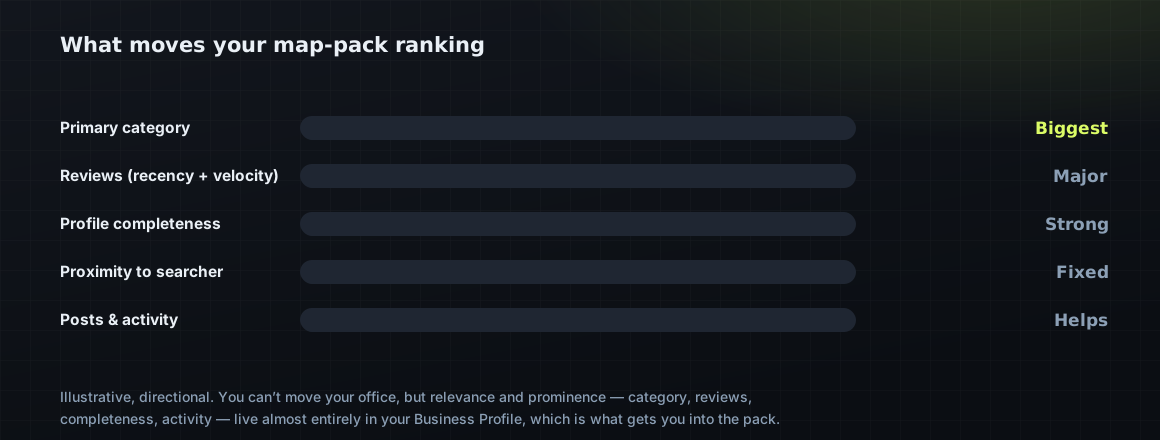
Google ranks the local pack on three things: proximity (how close the searcher is to your office), relevance (how well your profile matches what they typed), and prominence (how established and trusted you look). You can’t move your building, but relevance and prominence are almost entirely driven by your Business Profile — the categories you pick, the services you list, the reviews you’ve earned, and how actively the profile is maintained. The website matters for the organic links below the pack; the profile is what gets you into the pack itself.
This is why two firms on the same block can see wildly different results. The one with a precisely categorized, fully filled, actively maintained profile and a steady drip of recent reviews shows up in the box. The one with a bare listing and a dozen reviews from 2019 sits on page two, wondering why the phone is quiet. None of the difference is luck.
Proximity is the one factor you can’t change without moving offices, which is exactly why it’s the wrong thing to obsess over. The firms that win the pack don’t have better addresses — they have better-maintained profiles. They pour their energy into the two factors they control, relevance and prominence, and let those overcome a proximity disadvantage. An injured worker searching from a few miles outside your immediate radius will still see the firm whose profile is precisely categorized, fully filled, and thick with recent reviews over the closer firm whose listing has sat untouched since it was claimed.
It’s worth internalizing just how much of local search the pack captures. For “near me” and local-intent queries — which is most of how injured workers look for a lawyer on a phone — the three-result map pack sits at the very top, above the organic links, and takes the lion’s share of clicks and calls. Ranking fourth in the pack is effectively ranking on page two; the box shows three, and the tap goes to one of them. That is why the profile is not a nice-to-have that supports your website — for local intent, it is the main event, and the website’s job is to convert the click the profile earned.
The fields that actually move ranking
Not all profile fields carry equal weight. A handful move rankings; the rest build trust once someone finds you. Get these right first.
The business name field is where firms talk themselves into trouble. Your profile name must be your real business name — not “Smith Law | Workers Comp Lawyer Denver.” Stuffing keywords into the name can lift rankings briefly and get the whole profile suspended permanently, and competitors report violations precisely because it works so well against you. Put the keywords where they belong: the primary category, the services list, and the description.
Secondary categories are worth setting deliberately, not padding. Add the ones that genuinely fit — “Personal Injury Attorney,” “Legal Services,” “Social Security Attorney” if you handle it — because each one can match more searches, but a pile of loosely related categories dilutes rather than helps. The primary category still does the heavy lifting; the secondaries are supporting cast.
Completeness is quietly one of the strongest signals, and it’s entirely within your control. Every field you fill — hours (including holiday hours), service areas, a real description, the phone number that matches your website, attributes like “wheelchair accessible” or “online appointments” — tells Google your profile is real and tended, and gives the searcher one more reason to choose you. A half-built profile reads as a half-serious business. And your name, address, and phone number must match exactly across your website, your profile, and the major directories: inconsistent contact information confuses Google’s confidence in which business you even are, and confidence is what prominence is built on.
The description and services fields are underused conversion tools, not just ranking inputs. Your description has room to say, in plain language, who you help and what makes your firm the right call for an injured worker — write it for the scared person reading it, not for a keyword tool. The services list should enumerate every claim type you handle as its own entry: “workers’ compensation claims,” “denied claim appeals,” “third-party injury claims,” “permanent disability,” and so on. Each entry is another way an injured worker’s specific search can match your profile, and together they tell Google exactly what you do. Firms that leave these blank are handing both relevance and trust to whoever filled theirs in.
The parts firms leave blank
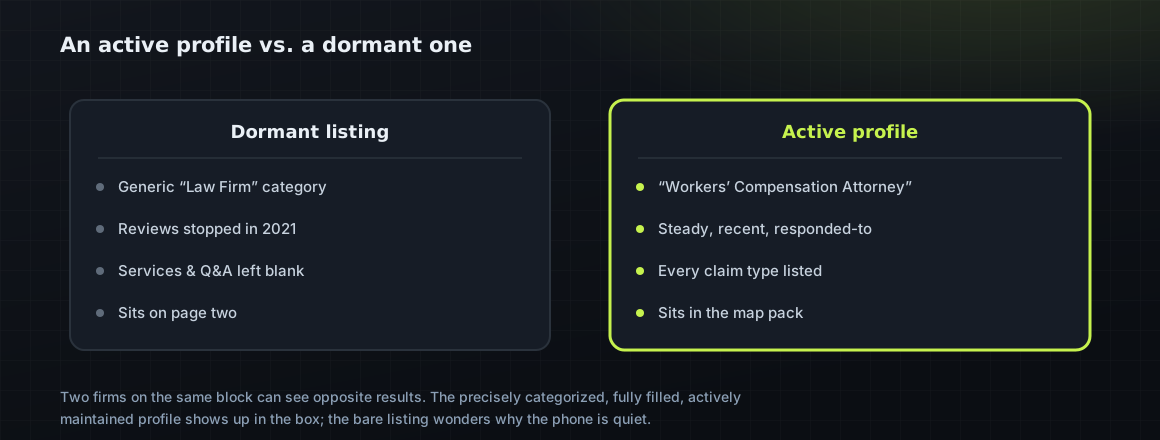
Most firms fill the obvious fields and stop. The sections they skip are exactly the ones that separate an active profile from a dormant one in Google’s eyes — and give a searcher a reason to call you over the firm next to you.
None of this takes special tools — it takes someone whose job it is to keep the profile alive. The firms that treat the profile as a channel rather than a directory entry are the ones sitting in the pack.
Photos deserve special attention because they do double duty. Real photos of your office, your team, and your building signal an active, legitimate business to Google, and they’re often the deciding factor for a nervous injured worker choosing between two firms — a face and a real place beat a logo and a stock image every time. Add them regularly rather than all at once; a steady trickle of fresh photos reads as an active business. And the Q&A section is a quiet battleground: if you don’t seed and answer the real questions injured workers ask, someone else’s answer — a competitor’s, or a wrong one — can end up sitting on your profile, unchallenged, shaping how a potential client sees you before they ever call.
Google Posts are the most overlooked activity signal of all. A short weekly post — a plain-language answer to a common question, a note about a recent result stated within the rules, a reminder of a filing deadline — does two things at once: it tells Google the profile is actively tended, and it gives a browsing injured worker something current and human to read. Posts expire, which is the point: a profile with a fresh post from this week looks alive, and a profile whose last post was eight months ago looks abandoned. You don’t need to be clever; you need to be consistent.
Reviews: velocity, recency, and response
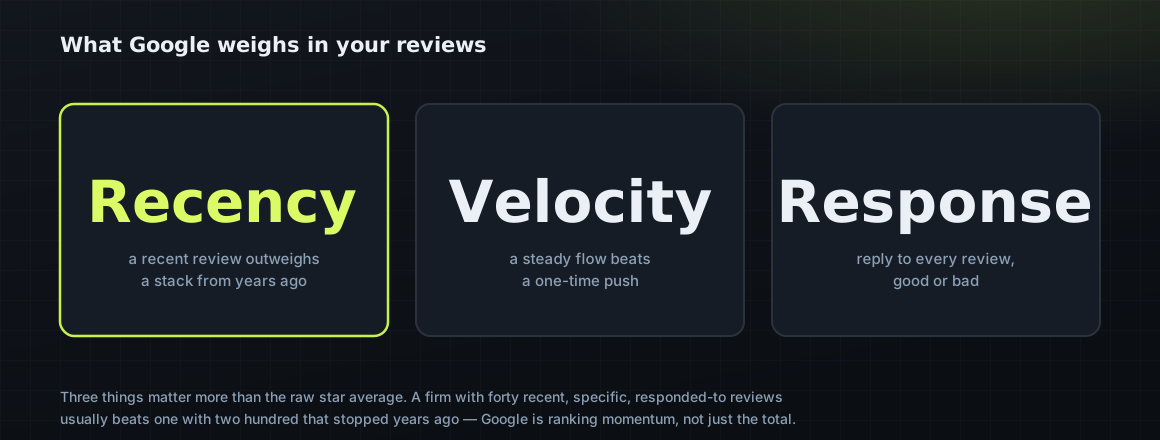
Reviews are the loudest prominence signal you control, and the one most firms fumble. Three things matter more than the raw star average: velocity (a steady flow, not a one-time push), recency (a review from last week outweighs a stack from three years ago), and response (replying to every review, good or bad, signals an engaged business to both Google and the reader).
A firm with forty recent, specific, responded-to reviews will usually beat one with two hundred that stopped in 2021. Google is ranking momentum, not just the total.
Getting reviews consistently requires a system, not good intentions. The firms that win at this ask every satisfied client at the natural high point — when a case resolves well — make leaving a review a single tap by texting a direct link, and never let a week pass without sending a handful of requests. The point isn’t a one-time push to inflate the count; it’s a steady flow that keeps recency and velocity high forever. A batch of thirty reviews in one week followed by silence looks worse to Google than three a week, every week.
One caution on review tactics: never gate or filter reviews, and never offer anything of value in exchange for one. Steering only happy clients to review you while diverting unhappy ones elsewhere (“review gating”) violates Google’s policies and can get your reviews wiped or your profile penalized, and paying or incentivizing reviews is both against the rules and, for a law firm, an ethics problem. The compliant approach is simple and it works: ask everyone, make it easy, and let the reviews be what they are. A handful of less-than-perfect reviews you responded to well is more credible to a real person than an implausible wall of unbroken five stars.
Responding matters as much as collecting. Reply to every positive review with something specific, and reply to every negative one with calm professionalism — never defensive, never disclosing case details, always signaling that a real, attentive firm stands behind the profile. A thoughtful response to a hard review often impresses future readers more than a wall of five stars, because it shows them how you behave when something goes wrong. Reviews and the way they decay are covered in depth in the workers’ comp law firm reviews guide.
Spencer Moeller, WorkersComp MarketingThe fix is a system: ask every satisfied client at the moment their case resolves, make it one tap, and respond to each review within a day. The mechanics — and why a review profile goes stale faster than firms realize — are in the workers’ comp law firm reviews guide.
Why injury firms get suspended — and how not to be
Legal is one of the most aggressively policed categories on Google, and workers’ comp sits right in it. Suspensions are common, appeals are slow, and a suspended profile means you vanish from the map pack overnight. Almost every avoidable suspension traces to the same handful of mistakes.
Because a workers’ comp firm advertises to injured people, it also inherits the compliance rules that govern legal marketing generally — what you can claim, how you describe results, and how you handle client information. Those overlap with what you say on the profile, and they’re covered in the marketing-compliance guide.
The weekly twenty minutes
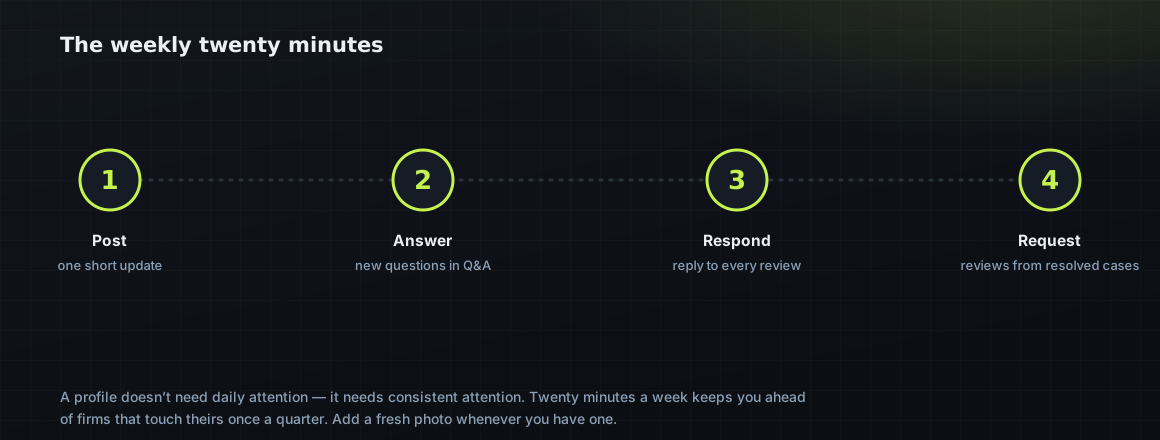
A profile doesn’t need daily attention — it needs consistent attention. Twenty minutes a week keeps it ahead of firms that touch theirs once a quarter: post one update, answer any new question, respond to every new review, request reviews from the week’s resolved cases, and add a fresh photo when you have one. That cadence is the entire secret. The profile is a map-pack ranking factor that rewards firms simply for showing up to it.
The compounding nature is what makes the twenty minutes worth it. A profile you tend every week pulls steadily ahead of competitors who touch theirs quarterly, and the lead widens over time — more recent reviews, more answered questions, more fresh photos, more signals of an active business, all stacking. Six months of consistent attention builds a moat a competitor can’t close with a single burst of effort, because they can’t manufacture recency and velocity retroactively. Consistency, not intensity, is the whole game.
Audit your profile like an injured worker
Before you optimize anything, look at your profile the way a hurt worker will — on a phone, in a moment of stress, comparing you to two other firms in the same box. Search your main term from a phone in your market and see whether you even appear in the pack. If you do, look at what the searcher sees first: your review count and rating, your primary category, your photo. Then tap in. Is the description written for a person or stuffed with keywords? Are the hours right? Is there a recent post, or does the profile look frozen in time? Are there unanswered questions sitting in Q&A?
Run the same check on the two firms ranking above or beside you, and the gap usually explains itself. More often than not, the firm in the top spot isn’t there because of a better address — it’s there because it has more recent reviews, a more complete profile, and visible signs of being tended, while the firms below it claimed their listing once and walked away. That audit, done honestly, becomes your to-do list: close the specific gaps you can see, then keep the weekly rhythm that widens them back in your favor.
The profile is where local visibility begins, but it isn’t the whole picture. The organic links below the pack, your citations across the web, and the site that has to convert the click all matter too, and they’re covered in local SEO for workers’ comp firms and the firm website built to sign cases. Get the profile right first, though: it’s the highest-return, lowest-cost move available, and most of your competitors haven’t made it.
None of this requires a budget, which is the best part. Winning the map pack for a workers’ comp firm is almost entirely a function of attention: pick the right category, fill every field, earn recent reviews and respond to them, post weekly, answer questions, add real photos, and stay strictly inside the guidelines. The firms that dominate their local box aren’t the ones who spent the most — they’re the ones who treated a free asset like it mattered while their competitors treated it like a phone-book entry. In a channel where the top three results take almost everything, showing up to your own profile every week is one of the highest-leverage twenty minutes in your entire marketing operation.
Where the profile ends, the rest of local visibility begins — the organic links below the pack, your citations across the web, and the site that has to convert the click. That wider picture is in local SEO for workers’ comp firms and the firm website built to sign cases.
The compounding advantage of a well-run profile is the part competitors never see until it’s too late to catch. Every week you post, answer, respond, and collect reviews, you add another small signal of an active, trusted business — and those signals stack into a lead that widens quietly month after month. A rival can match your address, your practice area, even your ad budget, but they can’t retroactively manufacture two years of steady reviews and consistent activity. In a channel where the top three results take almost all the clicks, a profile you’ve tended for a year is one of the most durable competitive moats a local firm can build, and it costs nothing but twenty minutes a week that most of your competitors will never spend.
Key takeaways
-
The profile decides the map pack. Before a blue link appears, Google shows three firms in a box; the profile is what gets you into it.
-
A few fields do most of the ranking work. Category, name, and completeness move the pack, and most firms leave the highest-leverage fields blank.
-
Reviews win on velocity, recency, and response. A steady stream and fast replies beat a one-time pile of reviews.
-
Injury firms get suspended for avoidable reasons. Know the rules that trip legal profiles and you keep the listing you worked to build.
-
Twenty minutes a week keeps it ranking. The profile is a maintenance asset, not a set-and-forget one.
Frequently asked questions
How do I get my workers’ comp firm in the Google map pack?
The map pack ranks on proximity, relevance, and prominence. You can’t move your office, but relevance and prominence come from your Business Profile: set the primary category to Workers’ Compensation Attorney, fill every field, list your services, and earn a steady flow of recent reviews. An actively maintained profile beats a bare one on the same street.
What is the best Google Business Profile category for a workers’ comp lawyer?
Set the primary category to ‘Workers’ Compensation Attorney’ — it’s the single strongest relevance signal. Add secondary categories like ‘Personal Injury Attorney’ or ‘Legal Services’ if they fit, but the primary category is what Google weighs most, so make it specific.
Can keyword-stuffing my Google business name help rankings?
It can lift rankings briefly and get your profile suspended permanently. Your profile name must be your real business name — not your name plus ‘workers comp lawyer [city].’ Competitors report violations because it works against them, and appeals are slow. Put keywords in the category, services, and description instead.
How many reviews does a workers’ comp firm need?
There’s no magic number — momentum matters more than total. A steady flow of recent, specific reviews that you respond to will usually outrank a larger pile that stopped years ago. Ask every client at case resolution, make it one tap, and reply to each review within a day.
Why do law firm Google profiles get suspended?
Legal is heavily policed. The common triggers are keyword-stuffing the business name, listing a virtual or unstaffed address, inconsistent phone numbers across the web, and duplicate profiles for one office. Follow Google’s guidelines exactly — a suspension removes you from the map pack overnight and appeals take weeks.
Sources & further reading
-
01
Google Business Profile documentation
Google Business Profile Help covers categories, verification, review policy, and the guidelines that prevent suspension.
-
02
Further reading
The local system around the profile.
Platform rules and benchmarks change over time; confirm current details in the platform’s own documentation. General marketing information, not legal advice.