
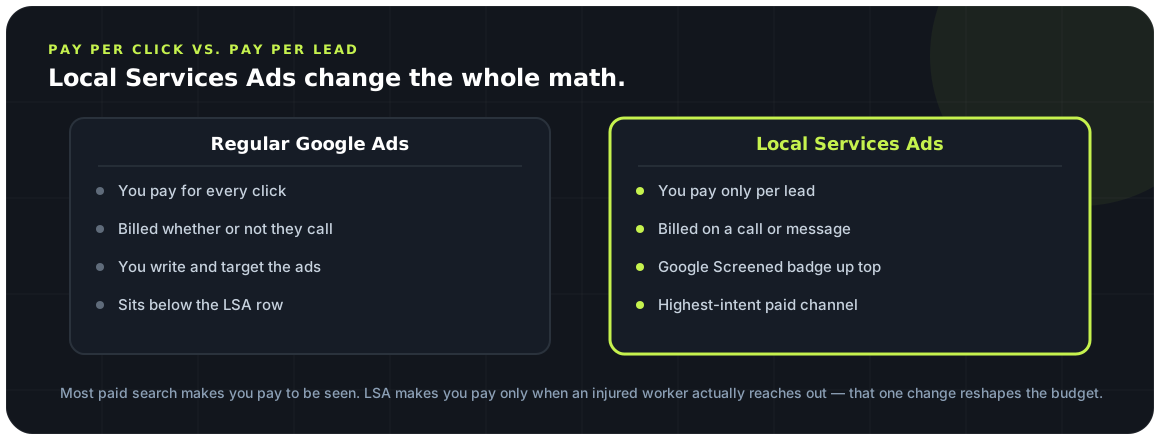
Most paid search makes you pay to be seen. Local Services Ads make you pay only when someone actually reaches out — and that single difference changes the whole math.
When an injured worker searches “workers comp lawyer near me,” the first thing they see isn’t the blue links. It’s a row of firms with photos, star ratings, and a green checkmark that reads Google Screened. That row is Local Services Ads, and it sits above everything else Google shows.
This guide explains exactly how LSA works for a workers’ comp practice, what it costs, how Google decides who ranks, and the operational habits that separate firms who profit from it from firms who quietly waste money on it.
What Local Services Ads actually are
A different product from regular Google Ads — priced, ranked, and displayed on its own rules.
Local Services Ads are a separate Google product from the search ads most firms already know. They don’t use keywords or bids on clicks. Instead, Google shows a small set of verified local providers for a given service and location, and you’re charged when a searcher contacts you directly through the ad.
For law, LSA is gated behind an identity and licensing check — that’s the Google Screened program. The badge is the whole point: it tells an anxious searcher that Google has vetted this firm, which is exactly the reassurance an injured worker is scanning for.
The unit you buy is a lead, not a visit. A “lead” is a phone call of meaningful length or a message sent through the ad. Someone who taps your listing, reads it, and moves on costs you nothing — a fundamentally different risk profile from standard Google search ads, where every click is billed whether or not it turns into anything.
Google Screened: passing the gate
Before you can spend a dollar, Google has to verify who you are.
You can’t just switch LSA on. To earn the Google Screened badge, a law firm has to clear a verification process before any ad runs. It generally includes business and license verification, background checks for the firm and often its attorneys, insurance confirmation, and a check that the practice is in good standing.
None of it is hard — but it takes time and clean paperwork, and a single missing document can stall the whole application for weeks. Treat it like an onboarding project, not a form.
How pay-per-lead pricing works
You set a budget by leads and target, not by keyword bids.
Instead of bidding on clicks, you tell Google roughly how many leads per week you want, and it charges a per-lead price that varies by market and practice area. Legal is a premium category, so a workers’ comp lead through LSA is not cheap — but you’re paying for someone who reached out, not someone who wandered past.
The honest way to judge LSA is the same scoreboard as every other channel: not cost per lead, but cost per signed case. A more expensive lead that signs at a high rate can easily beat a cheap lead that never does — and LSA leads, because of their intent, often sign well.
| Local Services Ads | Search Ads (PPC) | |
|---|---|---|
| You pay for | A lead (call or message) | A click |
| Position | Very top, above search ads | Top of results, below LSA |
| Trust signal | “Google Screened” badge + reviews | Ad label only |
| Ranking driven by | Reviews, responsiveness, proximity, profile | Bid, quality score, keywords |
| Bad-lead protection | You can dispute for credit | None — click is billed |
| Setup | Screening required first | Launch same day |
How Google decides who ranks
Budget gets you in the auction; behavior decides where you land in it.
Unlike search ads, you can’t simply outbid your way to the top of LSA. Google rotates and ranks Screened providers using signals that reward firms clients actually have good experiences with. The main levers:
1. Review quantity and quality
Your Google review count and average rating are among the strongest ranking factors in LSA — and they’re the badge of credibility a searcher reads first. A steady flow of recent five-star reviews lifts both your position and your click-through.
2. Responsiveness
Google watches whether you answer. Firms that pick up the phone and reply to messages quickly rank higher, because missed leads make for bad searcher experiences. This is speed-to-lead showing up as a ranking factor, not just a conversion one.
3. Proximity and service area
LSA is local by design. How close you are to the searcher, and how your service area is configured, shape who sees you. A tightly defined, accurate service area beats a sprawling one that dilutes relevance.
4. Profile completeness and standing
A complete profile — hours, photos, services, and a clean complaint record — signals a legitimate, active business. Responsiveness to any disputes or issues keeps you in good standing.
The flywheel: answering fast is a ranking strategy
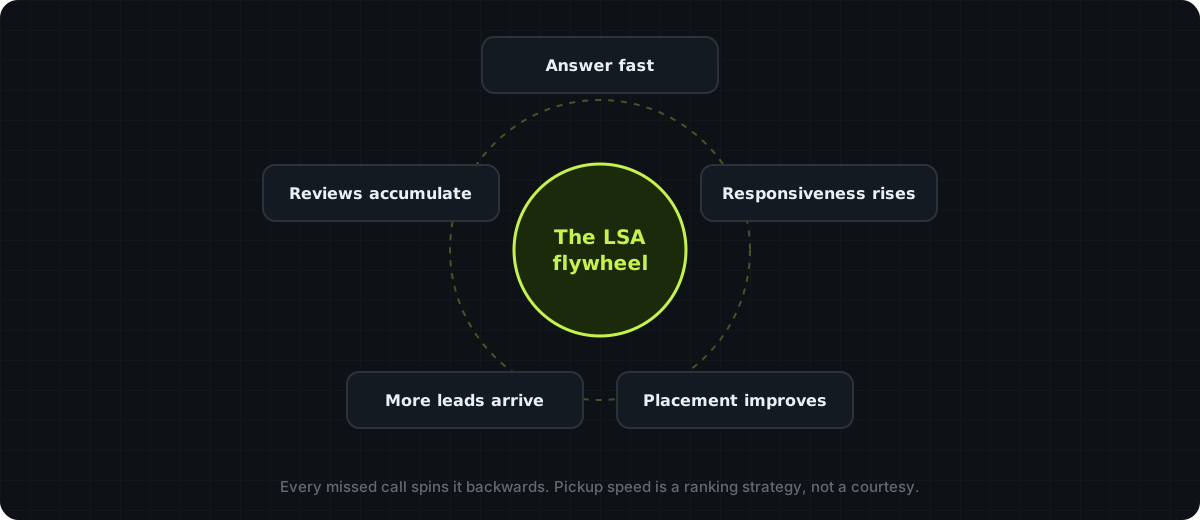
Everything about LSA rewards one operational habit above all others: picking up the phone. Google’s stated ranking inputs include how reliably and quickly a business responds to the leads it is sent — which means your receptionist is now part of your ad platform. A missed call is not just a lost lead; it is a signal to the system that sends you leads that maybe it should send fewer.
Played well, this becomes a loop that feeds itself. Fast answers keep your responsiveness strong, which protects your placement in the row. Better placement brings more of the highest-intent taps in the market. Every well-handled contact is a future review, and reviews strengthen the same ranking that placement depends on. Firms that treat LSA as a media buy watch the wheel spin backwards; firms that treat it as an operations commitment watch it compound.
This is also where LSA connects to the rest of your intake. The habits that win here — a human answering in minutes, nights and weekends covered, a text-back for missed calls — are the same ones covered in our speed-to-lead playbook, and the same ones a properly configured intake system makes automatic instead of heroic. LSA simply pays for those habits more directly than any other channel, because the platform itself is watching.
Reviews: the fuel — and the WC timing problem
The second ranking input you control is reviews — their quantity, their recency, and the rating they average to. In the LSA row, reviews are not social proof in the abstract: they are the number printed next to your name, in a lineup where every competitor has one too. An injured worker choosing between three Google-Screened firms is, in practice, often choosing between three star ratings.
Workers’ comp firms carry a structural handicap here: cases run long. If your only review ask happens at case close, your review engine sits idle for years at a time while shorter-cycle practices lap you. The fix is asking at the moments clients actually feel momentum — after the claim is accepted, after a benefit check arrives, after a hearing goes well — not just at the finish line. We’ve written a full system for this in the 901-day problem; for LSA purposes the summary is simple: the firm with a live, always-running review cadence owns the row’s most visible number.
Disputing leads you shouldn’t pay for
The single habit that protects your cost per case.
Because you’re billed per lead, Google gives you a way to dispute leads that don’t count — and using it consistently is what keeps LSA profitable. Legitimate grounds typically include spam or robocalls, wrong numbers, someone outside your service area, or an inquiry for a service you don’t offer (a family-law or personal-injury caller who reached a workers’ comp firm, for example).
Disputes are time-sensitive. The discipline is simple: review every billed lead on a set cadence, flag the ones that don’t qualify, and submit the dispute with a short, factual note. Approved disputes are credited back.
Profile setup that actually matters
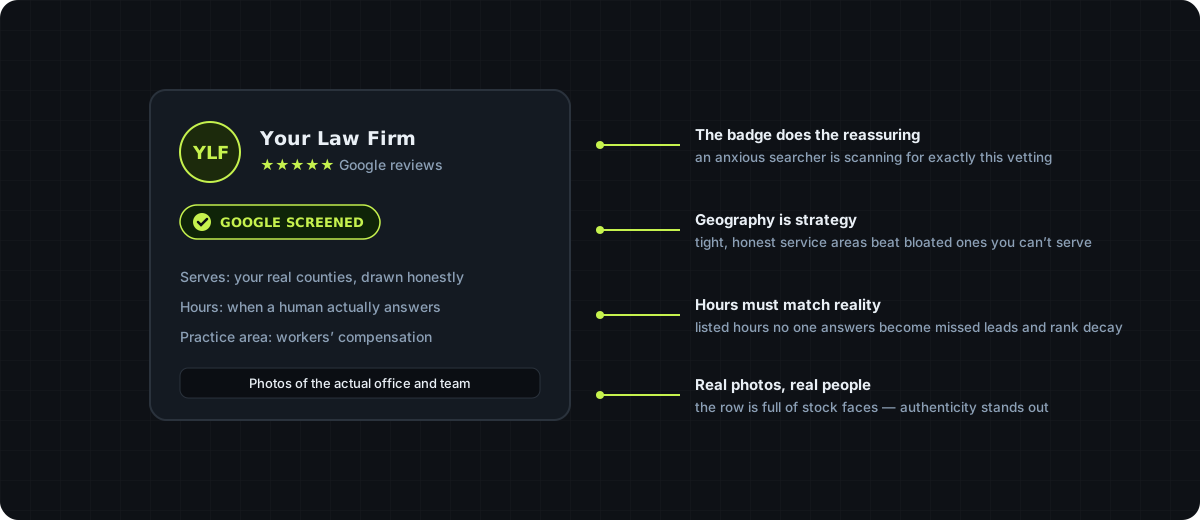
Most LSA profiles are set up once, in an afternoon, by whoever had the login — and it shows. A handful of configuration choices quietly shape both how often you appear and what a searcher does when you do:
- Service areas, drawn honestly. The temptation is to paint the whole metro. But leads from places you can’t serve well become disputes, declines, and slow responses — all of which feed the ranking system the wrong story. Tight geography you dominate beats broad geography you disappoint.
- Practice-area precision. Configure for the work you actually want. Sloppy category selection is the single biggest source of “wrong practice area” leads you’ll later burn goodwill disputing.
- Hours that match reality. Your listed hours are a promise about who answers. Advertising hours no one covers converts high-intent taps into missed-call penalties. If you extend hours, extend coverage first — answering services and after-hours routing exist for exactly this.
- Real photos. The row is a lineup of faces. Actual attorneys and an actual office read as trustworthy in a way stock photography never does — the same authenticity principle that powers everything else we build for firms.
- Budget set to appetite, not fear. LSA budgets cap how many leads Google tries to send you. Set it from your true case appetite and intake capacity; a starved budget hides you from searches you would happily have paid for.
The weekly operating rhythm
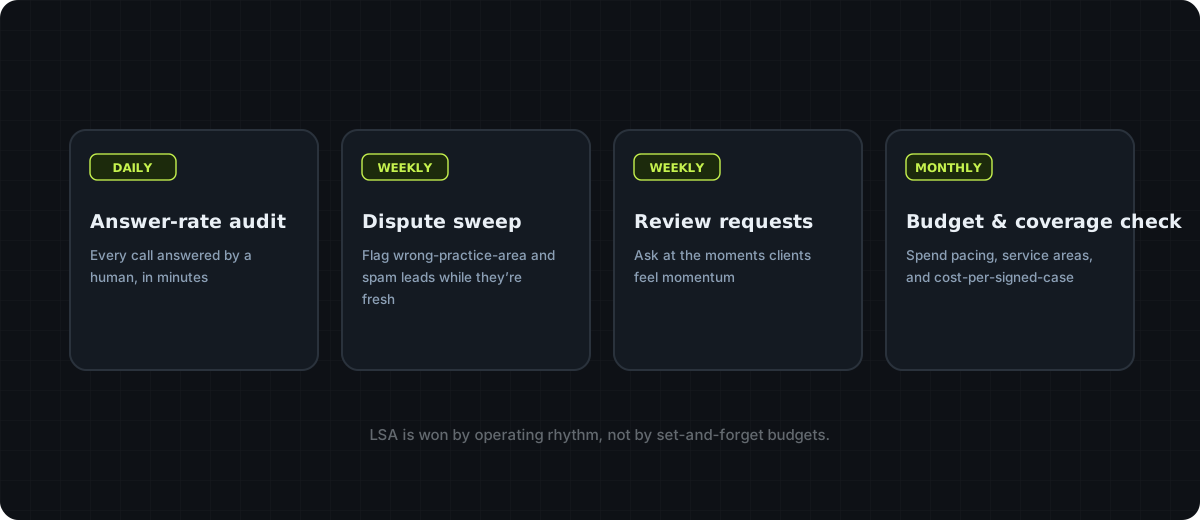
LSA is not a set-and-forget channel; it is a small weekly discipline that compounds. The firms that win it run the same loop every week, and none of it takes long:
Daily, someone owns the answer rate — every LSA call answered by a human, in minutes, with a text-back rescue for anything missed. Weekly, run the dispute sweep while leads are fresh, and send review requests to the clients who just felt progress. Monthly, step back: is spend pacing to budget, are the service areas still right, and — the only number that ultimately matters — what is this channel’s cost per signed case, not per lead? Measured that way, LSA earns its place in the budget on merit rather than momentum.
Where LSA fits in the full budget stack
The most expensive misunderstanding about LSA is treating it as a growth strategy on its own. It is not. LSA is a harvesting channel: it captures people who already decided to look for a workers’ comp lawyer today. It cannot create a single one of those people. Its ceiling is your market’s search volume, and no budget increase can raise that ceiling — only your share of it.
That is why the firms that dominate a market run a stack, with each layer doing the one job it is best at. LSA takes the highest-intent taps at the very top of the page. Standard search ads catch the research-phase queries LSA never shows for. SEO and content compound underneath, answering the questions injured workers ask in the weeks before they ever type “lawyer near me.” And demand itself — the recognition that makes a worker pick your row out of the lineup — is built upstream by paid social and consistent attorney content, long before the search happens. A searcher who has already seen your attorneys explain their rights doesn’t compare three Google-Screened strangers; they look for the name they know.
Budget accordingly. Fund LSA to its natural ceiling first, because nothing else buys intent this cleanly. But when the leads plateau — and in most WC markets they will, because search volume is finite — the next dollar belongs to the layers that create tomorrow’s searches, not to wishing the top of the page were taller. Firms that get this sequencing right stop asking “which channel is best” and start asking the sharper question: is each layer of the stack doing the job only it can do? A useful monthly exercise: write each channel’s job in one sentence, and check the results against that job alone. LSA judged on cost per signed case, content judged on recognition and branded search, PPC judged on research-phase capture — the stack stays honest when every layer answers only for its own assignment.
Is LSA right for your firm?
A great channel for most WC firms — with two honest caveats.
For most workers’ comp practices, LSA belongs in the mix. The intent is high, the badge does real trust work in a category where trust is everything, and the pay-per-lead model caps your downside. But it fits some firms better than others.
It works best when you can answer the phone fast and generate reviews consistently — the two levers that drive both ranking and ROI. It struggles when leads ring out to voicemail (you pay and lose the case) or when a firm has few reviews to compete with established local names.
LSA rewards the boring operational stuff — answering fast and earning reviews — more than clever ad tactics. That’s exactly why disciplined firms win it.
Spencer Moeller, WorkersComp MarketingThe biggest mistake is treating LSA as “set and forget.” It’s a channel that pays back attention: reviews in, disputes filed, phone answered. Firms that run it that way tend to find it among their lowest cost-per-signed-case sources. For how it fits alongside Meta and SEO in a full acquisition system, see the complete WC marketing playbook.
Key takeaways
-
LSA charges per lead, not per click. You pay only when someone actually reaches out, which changes the whole economics of paid search.
-
Google Screened is the gate. Passing the license and background check is the price of entry to the top of the pack.
-
Answering fast is a ranking strategy. LSA rewards responsiveness, so speed-to-lead is not just conversion, it is placement.
-
Dispute the leads you should not pay for. A disciplined dispute routine protects your real cost per lead.
-
Reviews fuel it, with a WC timing problem. Reviews rank you, but comp cases close slowly, so the ask has to be timed to the moment of help.
Frequently asked questions
What are Google Local Services Ads?
They’re a Google ad product that shows verified local providers at the very top of the results with a “Google Screened” badge. Unlike standard search ads, you pay per lead — a call or message — rather than per click, and firms are ranked by reviews, responsiveness, and proximity rather than by bid.
How much do LSA leads cost for a law firm?
Legal is a premium category, so a workers’ comp lead through LSA isn’t cheap and varies by market. The right way to evaluate it isn’t cost per lead but cost per signed case — because you only pay when someone contacts you, and high-intent LSA leads often sign at strong rates.
What is the Google Screened badge?
It’s a verification Google requires before a law firm can run Local Services Ads. It generally involves business and license verification, background checks, and insurance confirmation. The green checkmark that results is a trust signal searchers see before they ever click.
Can I get a refund for a bad LSA lead?
Yes. Google lets you dispute leads that don’t count — spam and robocalls, wrong numbers, callers outside your service area, or inquiries for services you don’t offer. Disputes are time-sensitive, so reviewing billed leads on a regular cadence and filing promptly is essential to keeping the channel profitable.
How do I rank higher in Local Services Ads?
Focus on the levers Google actually rewards: a steady flow of recent, positive Google reviews; fast responses to calls and messages; an accurate, tightly defined service area; and a complete profile in good standing. You can’t outbid your way to the top the way you can with search ads.
Sources & further reading
-
01
Local Services Ads documentation
Google Local Services Ads Help covers Google Screened, pay-per-lead pricing, ranking, and lead disputes.
- 02
Platform rules and benchmarks change over time; confirm current details in the platform’s own documentation. General marketing information, not legal advice.