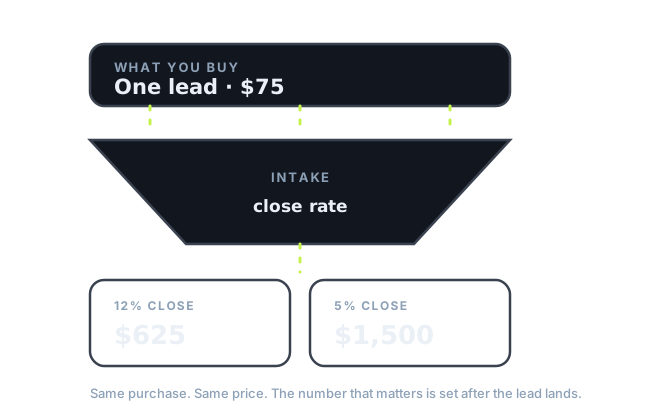
“What does a workers’ comp lead cost?” is the first question most firm owners ask a marketer, and it’s the wrong one — not because price doesn’t matter, but because the answer hides more than it reveals. Two firms can pay the exact same price per lead and get wildly different results, because one converts three times as many into cases. This is the real picture: what leads cost across every source, why the sticker price misleads, and the one number that turns lead pricing from a guess into a decision.
The honest answer, by source
There is no single price for a workers’ comp lead, because “a lead” isn’t one thing. A shared inquiry sold to several firms might cost a handful of dollars. An exclusive, high-intent lead — someone who searched for a lawyer and asked to be contacted — can run into the hundreds. The range is enormous, and where you land inside it depends entirely on the source and the intent behind it.
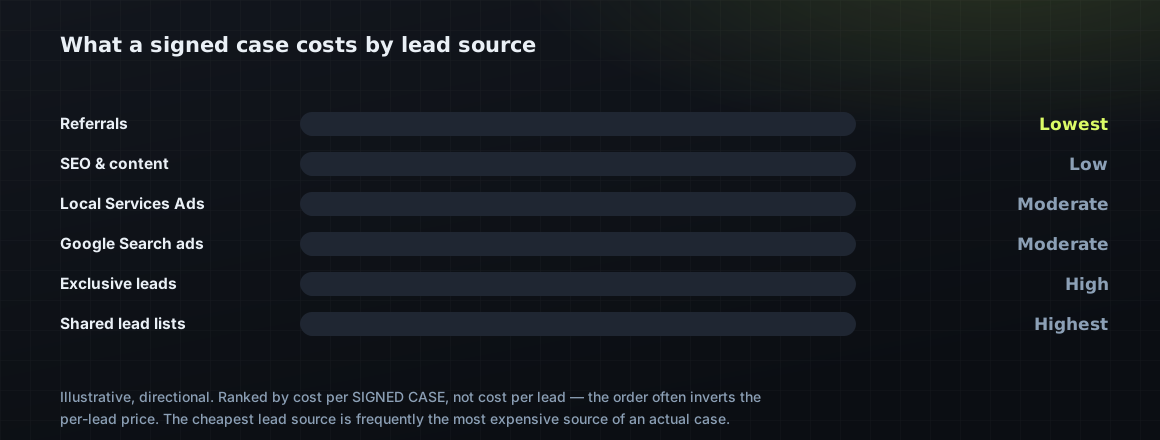
Notice the inversion in that picture. The sources with the lowest price per lead — shared lists especially — often produce the highest cost per signed case, because you are buying volume with little intent and racing other firms to close it. The sources that look expensive per lead, or that take real work to build, tend to produce the lowest cost per case. Sticker price and true cost point in opposite directions, which is exactly why the sticker price is a trap.
The width of the range has real causes. Intent is the biggest: a lead who searched “workers comp lawyer near me” is worth far more than one who filled a form to see if they “might have a case.” Exclusivity is next — a lead sold only to you commands a premium over one sold five times. Geography and competition matter too: in a crowded metro where dozens of firms bid on the same clicks, prices climb; in an underserved market they fall. And the practice area within workers’ comp shifts value — a lead hinting at a serious or disputed injury is worth more than a routine question. When someone quotes you “the going rate,” ask which of these they’re describing, because the going rate for one is triple the going rate for another.
Prices also drift over time, and the drift is upward. Legal is one of the most competitive advertising categories there is, and as more firms bid for the same injured workers, cost per click and cost per lead climb year over year. That trend is exactly why owning channels matters: a search lead that costs more every year is a rising expense, while a ranking you earned or a referral relationship you built holds its cost as the auction around it inflates. Budgeting off last year’s lead prices, and assuming they’ll hold, is how firms get surprised when the same spend buys fewer cases.
The three prices hiding in every lead
Every “lead cost” is really three different numbers, and they get conflated constantly. Cost per lead is what you pay for an inquiry — the most flattering figure and the one vendors quote. Cost per qualified lead divides that by the share who are actually compensable, in-state, and in time — a truer number that already exposes bad sources. And cost per signed case divides your total spend by the cases you actually signed — the only figure your P&L recognizes.
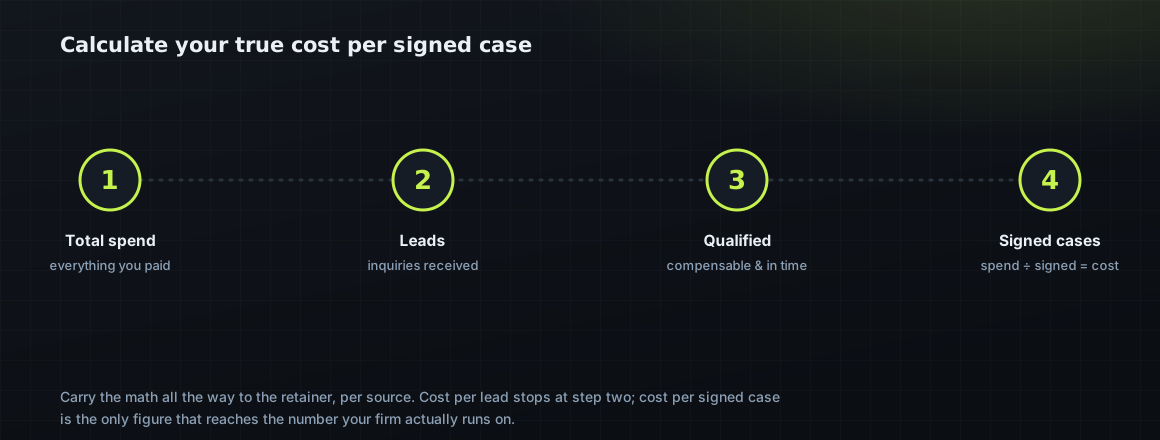
The distance between the first number and the third is where firms deceive themselves. A source quoting “$40 leads” sounds cheaper than one quoting “$180 leads,” but if the first qualifies at ten percent and closes at ten percent while the second qualifies at sixty percent and closes at thirty, the “expensive” source produces cases for a fraction of the price. The only way to see that is to carry the math all the way to the signed case — every time, per source.
Put numbers on it. Buy 100 shared leads at $30 — $3,000. Forty are compensable and in-state (cost per qualified lead: $75). You reach and sign six of those forty (cost per signed case: $500). Now buy 100 clicks through a well-run search campaign at $90 — $9,000 — that produce 50 inquiries, 35 qualified, and 12 signed (cost per signed case: $750). The shared list looks cheaper on every line until the last one, where the gap narrows to almost nothing — and if the shared list’s competitors are faster than you, its cost per case can pass the search campaign’s entirely. Only the full calculation tells you which to scale.
The hidden lever in all of this is the qualified-lead rate — the share of inquiries that are actually compensable, in-state, and in time. It’s the number that quietly separates two sources at the same price, and the one vendors mention least. A source at $60 per lead that qualifies at 60% is delivering qualified leads at $100; a source at $40 that qualifies at 15% is delivering them at $267. Before you ever get to close rate, the qualified-lead rate has already decided which source is really cheaper. Ask for it, and if a vendor can’t tell you, treat that as the answer.
What each source actually costs
Shared leads are the cheapest per lead and usually the most expensive per case. You are one of three to five firms buying the same injured worker, so your close rate is low by design and your speed-to-lead has to be inhuman. Exclusive leads cost more per inquiry but convert far better because nobody else has them — you’re paying to skip the footrace. Local Services Ads price by the lead too, but at high intent: these are people who clicked “call” on a screened result, and while the per-lead cost is real, the intent is among the best you can buy.
Google Search ads cost by the click, not the lead, and legal is one of the most expensive click categories anywhere — but those clicks come from people actively searching for a lawyer, so a well-built campaign turns pricey clicks into reasonable cases. SEO and content have almost no marginal cost per lead once they rank; you invest upfront and then collect inquiries for years, which is why the blended cost per case falls the longer you run it. And referrals — from past clients, doctors, and other attorneys — are the cheapest cases of all in dollars, though they cost you a system and a reputation to earn rather than a media budget.
The lesson isn’t that one source is best. It’s that comparing sources by price per lead is comparing things that aren’t alike. A dollar of referral, a dollar of SEO, and a dollar of shared-lead spend buy completely different odds of a signed case.
It helps to think in intent tiers rather than sources. At the top are people who searched for a lawyer and asked to be contacted — LSA, high-intent search, a direct call. In the middle are people researching their situation who found your content or profile. At the bottom are people who were interrupted — a scroll-stopping ad, a shared list they never asked to be on. Price tracks intent almost perfectly, and so does close rate, which is why the two roughly cancel: you pay more at the top and close more, pay less at the bottom and close less. The firms that win aren’t the ones who find a cheat code; they’re the ones who measure each tier honestly and put their next dollar where the cost per signed case is actually lowest for them.
Two more sources deserve mention. Legal directories and aggregators — the pay-to-be-listed platforms — sit in the middle: a strong, well-reviewed profile catches comparison-shoppers at moderate cost, while a thin one wastes the fee. And lead marketplaces that resell inquiries in real time blur into the shared-lead category on economics, however they brand themselves. The rule holds across all of them: the more firms an inquiry is shown to, and the less the person was actively seeking a lawyer, the higher your true cost per case will run regardless of the per-lead price.
Cost per lead vs. cost per signed case
Reframing from cost per lead to cost per signed case is the single most valuable shift a firm owner can make in how they think about marketing spend. One number measures how cheaply you can buy attention; the other measures how efficiently you turn attention into revenue. Only the second one pays the associates.
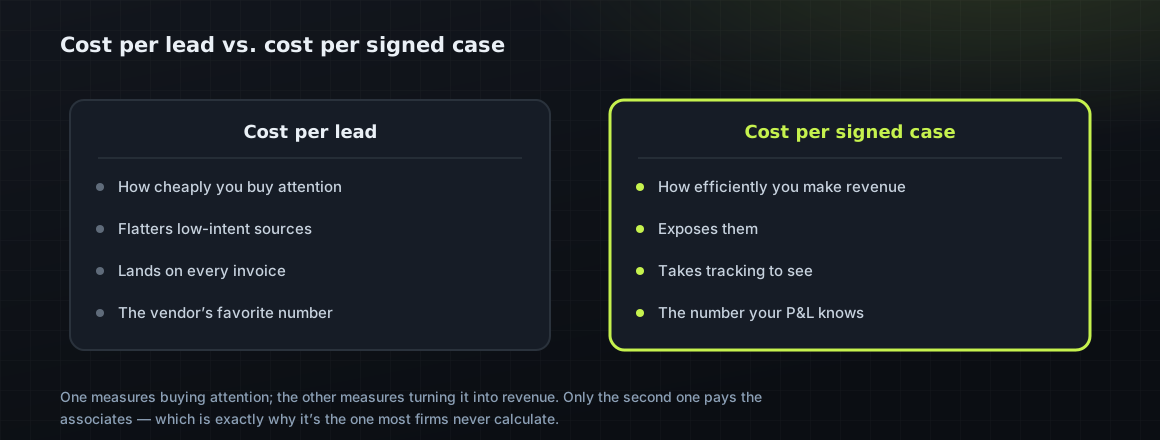
Here is the worked example that makes it concrete. Channel A sends 100 leads at $50 — $5,000 — and you sign 4, so each case cost $1,250. Channel B sends 40 leads at $150 — $6,000 — and you sign 8, so each case cost $750. On a cost-per-lead report, Channel A wins in a landslide. On the only report that matters, Channel B produces cases for forty percent less. A firm managing to cost per lead would scale A and cut B — exactly backwards — and never understand why the caseload didn’t grow.
This is not a hypothetical failure mode; it is the default one. Cost per lead is easy to see and lands on every invoice. Cost per signed case takes tracking and honesty to calculate. So most firms optimize the number they can see and quietly degrade the number they can’t. The full model is in the cost per signed case model.
Making the shift real requires one piece of infrastructure: tracking that follows a lead from its source all the way to a signed retainer. If you can’t tell which channel produced a case, you can’t calculate cost per case by channel, and you’re back to guessing. That means call tracking, a CRM that stamps each lead with its source, and a disciplined intake team that records outcomes. It isn’t glamorous, but it’s the difference between managing marketing and merely paying for it — the intake tech stack is where that plumbing lives.
What a case is worth sets what a lead is worth
There is no “right” price for a lead in a vacuum — only a right price relative to what a case is worth to your firm. If a signed workers’ comp case is worth many thousands of dollars in fees, then a lead that closes at a decent rate is worth far more than most firms are willing to pay for it. Underpaying is its own mistake: firms that cap their lead price too low to feel “efficient” hand the best inquiries to competitors who did the value math.
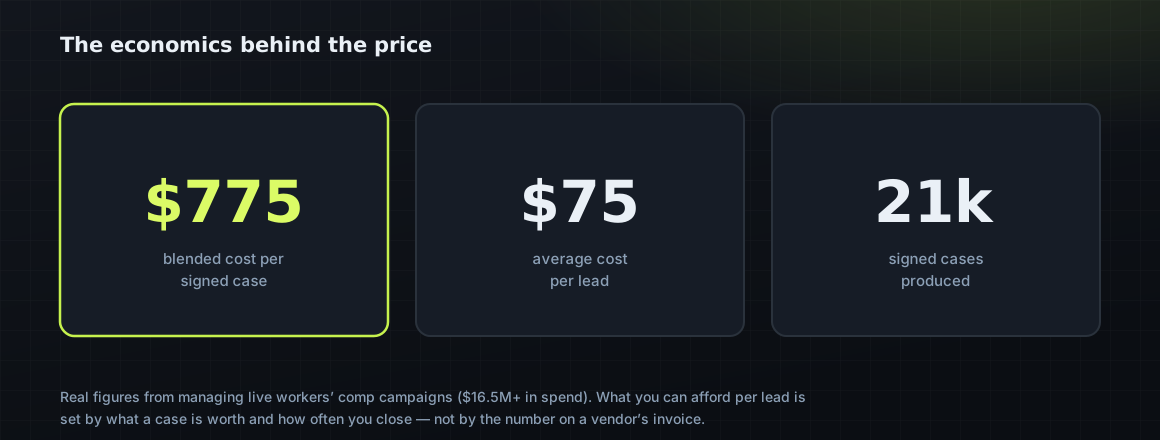
Start from case value and work backward. Decide what a case is worth, decide the most you’d pay to acquire one and still be happy, and that ceiling — divided by your realistic close rate — tells you what you can pay per lead. Run that math and the question stops being “is this lead cheap?” and becomes “does this lead produce cases below my ceiling?” That is a question you can actually answer, and act on. What a case is worth, and how to calculate it, is covered in what a workers’ comp case is worth.
Here’s the ceiling math in full. Say a signed case is worth $6,000 in fees on average, and you decide you’re happy acquiring one for up to a third of that — $2,000. If your qualified leads close at 25%, then you can afford to pay up to $500 per qualified lead ($2,000 × 0.25) and still hit your target. Suddenly a “$180 lead” that qualifies well isn’t expensive at all — it’s a bargain against a $500 ceiling. Firms that never do this math anchor on the raw lead price, cap it far too low, and lose the best inquiries to competitors who understood that the ceiling is set by the case, not by the invoice.
How to lower your cost per signed case
Once cost per signed case is the target, the levers that move it are clear — and most of them cost nothing. Close rate is the biggest: raising the share of qualified leads you sign lowers cost per case directly, and it’s usually an intake problem, not a marketing one. Speed-to-lead is next: reaching inquiries within minutes instead of hours can lift your close rate dramatically, especially against shared-lead competitors racing for the same worker. Speed-to-lead is often the cheapest cost-per-case reduction available.
Qualification keeps intake from drowning in claims that were never compensable, so your team spends its minutes on cases that can sign. And owning your pipeline — building SEO, referrals, and a retargetable audience instead of only renting leads — lowers the input cost over time, because an owned channel keeps producing after the spend stops. The mechanics of buying versus building are in leads for law firms: buy or build, and the volume-versus-quality tradeoff of shared versus exclusive is in exclusive vs. shared leads.
Don’t forget the cases you already paid for. Every qualified lead that didn’t sign the first time is a case you can still win with nurture and reactivation — a follow-up sequence that stays in front of a hurt worker who wasn’t ready on day one. Reactivating a lead you’ve already bought is often the lowest cost per signed case in the entire firm, because the acquisition cost is already sunk. Squeezing more cases out of the same lead flow lowers your blended cost per case without spending another dollar on media.
Red flags in lead pricing
Some pricing structures are designed to obscure your true cost per case, and recognizing them protects your budget. Rock-bottom shared leads are the most common trap — cheap per lead, brutal per case, and sold to whoever else will buy them. Blended pricing, where a vendor rolls media spend and their fee into one number, hides how much of your money actually reached the ad platforms and how much became margin. Marked-up ad spend does the same in reverse: you can’t see your real cost per case if you can’t see your real media cost.
The clearest red flag of all is a vendor who reports cost per lead enthusiastically and goes quiet when you ask about cost per signed case. A source confident in its lead quality will happily be measured on the case. One that isn’t will steer every conversation back to the lead. Insist on transparency — separated media and fee, visible close-through-to-case reporting — and the pricing that survives that scrutiny is the pricing you can trust.
Watch the contract terms, too. Long volume commitments that lock you into buying a fixed number of leads a month, regardless of quality, shift all the risk onto you — if the leads degrade, you’re still buying them. Auto-renewing agreements with no performance clause do the same. The healthiest arrangements let you measure a source against your own cost per signed case for a real test window, then scale or walk based on the result. A vendor confident in their leads will agree to be judged that way; a vendor selling volume will push for the commitment instead.
How to compare two lead quotes
When two vendors hand you two prices, resist comparing the prices. Compare the odds. Ask each source four questions and the real cost falls out. First, is the lead exclusive or shared — and if shared, with how many firms? Second, where does the lead come from: someone actively searching, or someone who filled a form for something else? Third, what qualification, if any, happens before it reaches you? And fourth — the one that separates partners from brokers — what does cost per signed case look like for their clients, not cost per lead?
Then run your own test before you commit. Buy a small, measurable batch from each, tag every lead with its source, and track them through your own intake to signed cases. Two weeks of honest data beats any sales deck. The source that produces cases below your ceiling wins, whatever its per-lead price — and the “expensive” quote frequently turns out to be the cheaper one once the math reaches the retainer. That single habit, testing sources on your own cost per signed case, is what turns lead-buying from a gamble into a decision.
Key takeaways
-
“What does a lead cost?” has no single answer. It depends on the source, the exclusivity, and what you count, which is why the honest answer is a table, not a number.
-
Every lead hides three prices. The quoted price, the real cost per contact, and the true cost per signed case, and only the last one matters.
-
Cost per lead and cost per signed case are different questions. A cheap lead that never signs is the most expensive one you can buy.
-
What a case is worth sets what a lead is worth. Your statutory fee ceiling decides what you can afford to pay to acquire one.
-
Lead pricing has red flags. Shared sourcing, vague attribution, and no exclusivity are the tells of a quote that costs more than it looks.
Frequently asked questions
How much does a workers’ comp lead cost in 2026?
Roughly $20-$60 for a shared aggregator lead, $60-$250 for a Google Local Services Ads lead, $150-$400+ for an exclusive Search lead, and $30-$120 for a Meta lead. SEO and referrals cost little to nothing per lead. The right comparison is cost per signed case, not cost per lead.
Are cheap workers’ comp leads worth it?
Usually not. Cheap shared leads are sold to several firms at once, so close rates are low and the cost per signed case is often higher than an exclusive lead that costs more upfront.
What is a good cost per signed workers’ comp case?
Well-run campaigns typically land in the four-figure range per signed case; one blended breakdown produced signed cases near $775. What matters is the gap between that cost and what a case is worth to your firm.
Should I buy workers’ comp leads or generate my own?
For most firms, generating exclusive leads via Google, Meta and SEO beats buying shared ones on cost per signed case, and it builds a pipeline you own. Watch the close rate, not the lead price.
How much does a workers’ comp lead cost in 2026?
It ranges widely — from a few dollars for a shared lead sold to several firms to a few hundred for an exclusive, high-intent inquiry. But the per-lead price is the wrong number to manage. What matters is cost per signed case, which can be lowest for a source that looks expensive per lead and highest for one that looks cheap.
Are cheap workers’ comp leads worth it?
Usually not. The cheapest leads — shared lists sold to multiple firms — tend to produce the highest cost per signed case, because you’re racing several competitors to a low-intent inquiry and closing few of them. A more expensive, exclusive, higher-intent lead often costs less per actual signed case.
Sources & further reading
-
01
From lead price to signed case
The number that actually decides it.
-
02
Buy or build the leads
Where the cheaper cost per signed case comes from.
- 03
Benchmarks here draw on WorkersComp Marketing’s own managed-spend data across live firms; your numbers will differ. General marketing information, not legal advice.