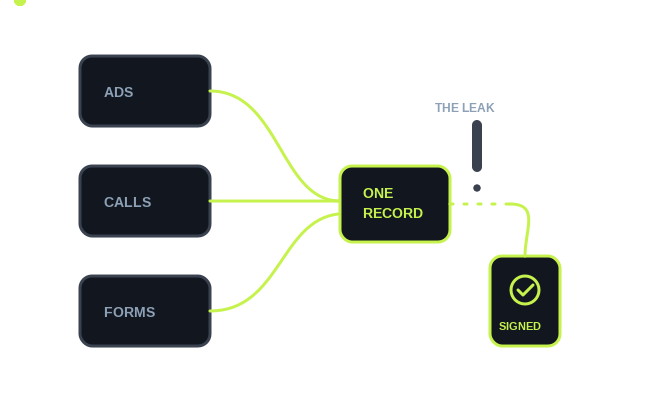
A managing partner who would never tolerate a leaking trust account will happily run intake through a shared inbox, a paper message pad, and somebody’s memory.
The difference is visibility. Money leaking from an account shows up in a reconciliation. Cases leaking from intake never show up anywhere — the injured worker who called at 7:40pm and got voicemail simply calls the next firm, and your books record nothing at all. The marketing budget bought the call; the plumbing lost it; the report blames the marketing.
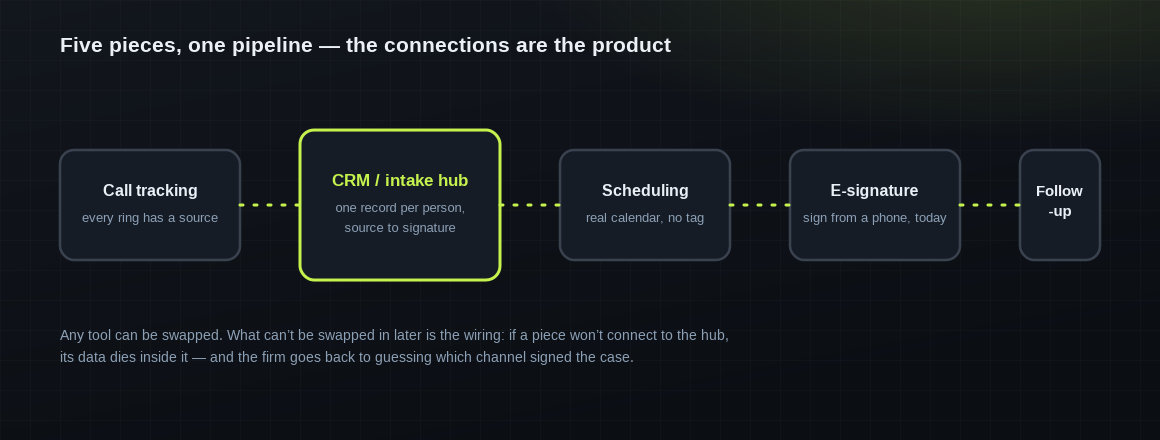
This article is about the plumbing. Not a tool roundup — products change quarterly and we sell none of them — but the durable architecture: what each piece does, how they must connect, and the order to build in if you’re starting from the shared inbox.
Start with the leaks, not the logos
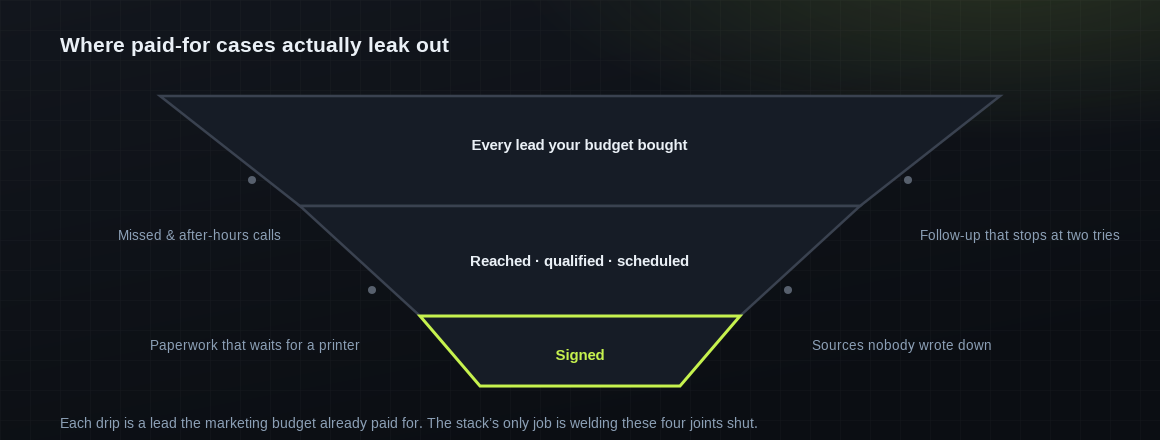
Stack decisions go wrong when they start from software demos. Start instead from where signed cases actually go missing between “lead exists” and “fee agreement signed.” In practice it is four joints:
The missed connection. Injury doesn’t keep office hours — the case for after-hours coverage is its own article — and even inside office hours, calls ring out while everyone is on other calls. Every unanswered ring is inventory walking away.
The stalled follow-up. Most injured workers don’t sign on the first call; they hesitate, compare, get talked to by a brother-in-law. The slow yes is won by the firm still politely present in week three — which no human reliably sustains from memory across two hundred open leads.
The paperwork gap. A worker who said yes on Tuesday and receives a fee agreement to print, sign and mail is un-signing all week. Distance between yes and signed is where changed minds live.
The amnesia. Nobody wrote down where the lead came from, so the firm cannot compute cost per signed case by source — and next quarter’s budget is set by anecdote.
The five pieces, and the one rule that governs them
1. Call tracking. Dynamic number insertion on the site, unique numbers per channel, every call logged with source, recording where lawful. Calls convert far better than forms in this practice area and are precisely the touch nobody writes down. Do it without wrecking your local SEO — the attribution article covers the NAP-safe way.
2. The CRM — the hub. One record per injured worker: source, every call and text, qualification notes, stage, and eventually the signed agreement. Legal-specific or general matters less than everyone actually living in it. The test of a working CRM is social: when someone calls back, does whoever answers see the whole story in five seconds?
3. Scheduling. A booking link and calendar sync kill the four-day phone-tag loop between “interested” and “consulted.” Every eliminated round trip is measured in retained momentum.
4. E-signature. The cheapest, least glamorous, highest-leverage piece: a fee agreement signed from a phone in the parking lot of the consultation. Same-day signature should be the norm, not the exception.
5. Follow-up automation. Sequenced, respectful, compliant touches — text and email — that keep unsigned leads warm on a schedule no human forgets. This is also where an AI intake layer plugs in for instant response; the stack below it is what makes that layer useful rather than a chatbot bolted to a leaky bucket.
The compliance plumbing nobody demos
Two legal realities shape an intake stack for a law firm, and vendors rarely bring them up.
Texting consent. Automated texts to consumers live under the TCPA, and the consent that authorizes them has to be captured and stored — a checkbox with clear language on every form, an affirmative yes logged from every caller before the sequences run. Build consent capture into the forms and scripts on day one; retrofitting it across a database of leads is somewhere between painful and impossible.
Confidentiality. Intake records hold injury details and employment facts about people who may never become clients — and prospective-client confidentiality still applies. Access controls, sensible retention, and a vendor agreement that treats the data as what it is. “It’s just marketing data” is a sentence with a bar-complaint shape; the broader rules are in the compliance article.
And the clause that decides whether any of it is really yours.
Every piece in this stack accumulates something the firm cannot easily rebuild: the call recordings, the message history, the source data on every lead, the phone number injured workers have been dialling for years. Almost nobody checks who owns that until they want to leave.
Four things to establish in writing before a system holds a year of your history.
| Asset | The question | The answer you want |
|---|---|---|
| Contact and case data | Can we export it in full, on demand? | A structured export of every field, not a PDF summary |
| Call recordings | Do we get the audio files, or only access to them? | The files, in a standard format, on request |
| The phone number | Is it ported to us, or owned by the vendor? | Yours, portable, in your name — this one is not negotiable |
| Message history | Does the text thread come with us? | Exportable, because it is part of the client record |
The tracking number matters more than firms expect. A number that belongs to a vendor is a number you lose when you leave, and it has been printed on letterhead, listed in directories, and dialled by former clients who are about to refer somebody. Losing it is a marketing cost that does not appear in any invoice.
None of this requires a hard conversation. Every credible vendor answers these plainly, because they have been asked before. The one who hesitates has told you something useful about what leaving would look like.
The build order, if you’re starting from the inbox
Nobody should buy five systems in a quarter. The order that pays for each next step:
| Step | Buy/build | Why this order |
|---|---|---|
| 1 | Call tracking + a “how did you hear about us” habit | Instant visibility into what you’re already buying — funds every later decision |
| 2 | CRM, with calls auto-logging into it | The hub exists; every lead now has a record and a stage |
| 3 | E-signature | Cheapest fix, immediate effect on the yes→signed gap |
| 4 | Scheduling | Kills phone tag once there’s a record to attach bookings to |
| 5 | Follow-up automation (then AI response on top) | Sequences need the hub’s data to be safe and smart |
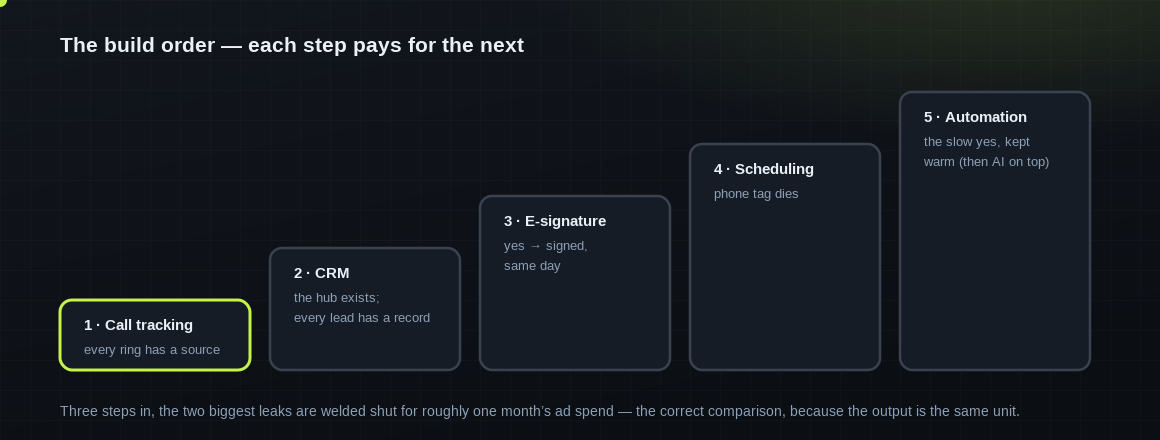
Each step works alone and makes the next one stronger. A firm three steps in has already welded the two biggest leaks shut for roughly the cost of one month’s ad spend — which is the correct comparison, because the stack’s output is measured in the same unit: signed cases that would otherwise have leaked.
The report blames the marketing. The plumbing lost the case.
A last word on the human layer, because a stack cynic will point out — correctly — that great intake teams predate all this software. True. The stack doesn’t replace the empathetic intake person who makes a scared caller feel heard; it protects that person’s work. It catches the call she couldn’t take, remembers the follow-up he would have forgotten on a Friday, and hands whoever answers the whole story instead of a blank screen. The first ninety seconds of the call are still a craft. The stack’s job is making sure that craft gets its chances.
The one-hour audit to run this week
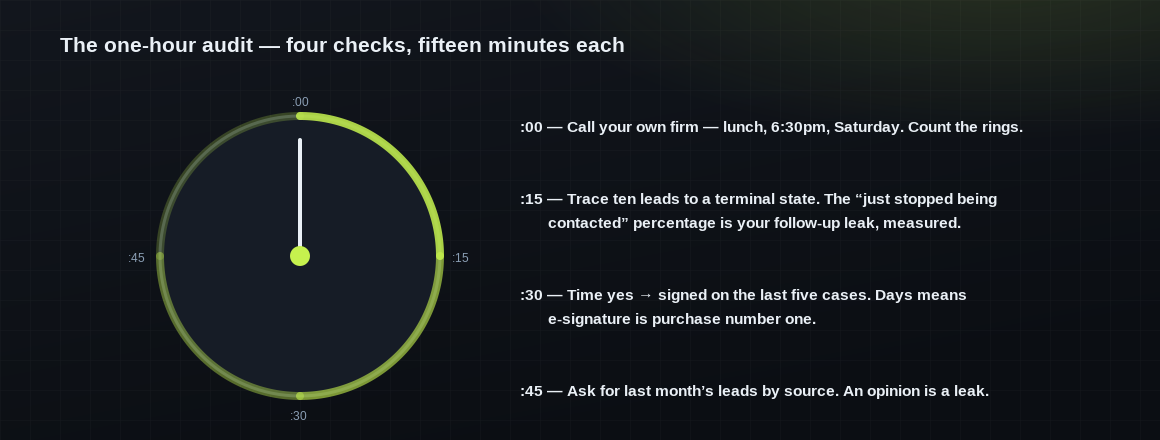
Before buying anything, measure your current pipes. One hour, four checks:
Call your own firm — at lunch, at 6:30pm, on Saturday morning. Count rings. Note what voicemail feels like when your shoulder hurts.
Pull ten recent leads and trace each to a terminal state: signed, declined, referred out, or — the number that stings — just stopped being contacted. That last percentage is your follow-up leak, measured.
Time your paperwork from “yes” to signed agreement on the last five signed cases. If the median is days, e-signature is your first purchase.
Ask for last month’s leads by source. If the answer takes more than five minutes or arrives as an opinion, that’s the amnesia leak — and the reason every marketing argument in the partnership is currently unwinnable by anyone.
What good looks like, in numbers you can hold
“Fix the leaks” needs a definition of fixed. These are the operating standards we hold funnels to — stated as standards, not industry statistics, because the honest sourcing for most published intake benchmarks is somewhere between thin and invented:
| Stage | The standard | Why this line |
|---|---|---|
| First response, business hours | Live answer, or callback inside 5 minutes | Injured workers call down a list; the firm that answers is usually the last one dialed |
| First response, nights/weekends | Some real response inside minutes — human service, or an AI layer that engages and books | Injury doesn’t keep office hours; voicemail at 9pm donates the case to whoever answers at 9:01 |
| Web form / chat / DM | Text or call back inside 5 minutes, automated is fine, human follows | A form submitter is comparison-shopping in a browser with your competitors already open |
| Follow-up cadence | Sequenced touches across at least 3–4 weeks; ends by human decision, never by forgetting | The slow yes is real; two attempts is where most firms stop and most value leaks |
| Yes → signed | Same day, e-signature, from a phone | Every night between yes and signature is a night to be talked out of it |
| Source on record | 100% of leads, no exceptions | One untagged lead is a rounding error; a habit of them is a blind budget |
Miss a standard occasionally and you have operations; miss one systematically and you’ve found the leak the stack should weld next. The point of writing them down is that they convert argument into measurement: “are we good at intake?” is a mood, but “what’s our median first-response time after 6pm?” has an answer someone can be responsible for.
The texting playbook — the channel that actually gets answered
Injured workers screen calls from numbers they don’t know — often including yours — but they read texts. That makes SMS the workhorse of the follow-up layer, and also the piece with real legal edges, so it deserves its own page of the spec.
Consent first, mechanically. Automated texting to consumers lives under the TCPA, and the safe pattern is unambiguous: every web form carries an unchecked-by-default consent checkbox with plain language (“I agree to receive calls and text messages from [firm] about my inquiry; message rates may apply; reply STOP to opt out”), every phone intake captures a spoken yes that gets logged, and the system honors STOP instantly and permanently. Build it this way on day one and the whole channel is boring; bolt texting onto an old lead list and you’re gambling with statutory damages.
What the sequence actually says. The texts that work read like a person, not a campaign. First touch, minutes after the inquiry: “Hi [name], this is [intake person] at [firm] — got your message about your injury. Do you have 5 minutes to talk today or tomorrow?” The nurture touches that follow are check-ins, not pitches: a “still here if you have questions” at day three; something genuinely useful at day seven (“a lot of people ask whether they can see their own doctor — short answer for [state]…”); a soft door at week three. Short, personal-sounding, never more than a couple a week, and every one of them logged on the CRM record so a human picking up the thread sees the whole conversation.
The handoff rule. Automation opens conversations; humans close them. The moment a reply contains a question, a fear, or a fact pattern, sequences stop and a person answers — fast, because a reply is the warmest signal in the whole funnel. The stack’s job here is choreography: notify the right person, pause the robot, surface the history.
Migrations: how firms lose their history, and how not to
Sooner or later you’ll outgrow a tool, and migration is where intake histories go to die — not in the new system, but in the transition. The failure pattern is always the same: the new CRM goes live on a Monday, the old one lingers half-alive for a quarter, leads land in both, nobody owns the cutover, and a year later the firm has two incomplete versions of the truth. The discipline that prevents it fits in a paragraph:
Export everything from the old system before anyone touches the new one — contacts, notes, call logs, sources, stage history — and archive the raw export somewhere the firm owns, independent of either vendor. Map fields before importing (“source” in the old system must land in a field the new reports can read, or your attribution history flatlines at the cutover). Pick a hard cutover date: after it, the old system is read-only, full stop. Run the new system’s auto-logging (calls, forms, texts) for a week before the cutover so the wiring is proven while the safety net still exists. And keep the old system’s read-only archive for at least a year — the question “what did we tell this caller in March?” will arrive, and it will matter.
Above all, resist the vendor’s cheerful offer to “start fresh — most firms find it simpler.” Simpler for whom? Your lead history is the dataset every future decision reads: which sources sign, which follow-up cadences work, what your real yes-to-signed lag is. A firm that starts fresh every three years is permanently three years old.
Budget the stack the way you budget media: as a per-signed-case input. If the five pieces cost $900 a month all-in and weld shut leaks that were losing even two signable cases a month, the stack is the cheapest “channel” in the whole portfolio — and unlike a channel, its price doesn’t rise with competition. That framing also ends the perennial partner debate about whether intake software is “overhead”: overhead is cost without output. This has output, it’s counted in the same unit as everything else, and after the first quarter the scoreboard will say so one way or the other.
“Are we good at intake?” is a mood. “What’s our first-response time after 6pm?” has an owner.
Key takeaways
-
Start with the leaks, not the logos. The tool matters less than the gaps it closes; buy for the leak, not the brand.
-
Five pieces, one rule. Capture, route, respond, track, and store, governed by the rule that nothing falls between them.
-
The compliance plumbing nobody demos. Consent, confidentiality, and retention protect the firm and never show up in a sales demo.
-
Texting is the channel that actually gets answered. Built right, it is the highest-response tool in the stack.
-
Migrations are where firms lose their history. Move the data deliberately or you lose the attribution you spent years building.
Frequently asked questions
Do we need a legal-specific CRM or will a general one work?
Either can work; both can fail. Legal-specific tools arrive knowing what a matter is and often include conflict checks; general CRMs are usually stronger on automation and integrations. The deciding questions are unglamorous: will your team actually live in it, does it auto-log calls and texts, can you export everything, and does it connect to the rest of the stack? A mediocre CRM used every hour beats an excellent one used on Fridays.
What does a reasonable intake stack cost?
Far less than the leads it saves. Call tracking, a mid-tier CRM, e-signature and scheduling together typically run a few hundred to low four figures a month depending on seats and volume — commonly less than one signed case’s fee, and usually less than what one month of your ad budget loses through the follow-up leak alone. Price it against the leak, not against zero.
Should we build the stack before spending more on marketing?
Fix the worst leak first, then scale spend — but don’t let plumbing become procrastination. The one-hour audit tells you the order: if you’re missing a third of calls, coverage and tracking come before new campaigns, because more budget would just buy more missed calls. If the pipes are basically sound, marketing and stack can grow together. Pouring more water is only wrong when the bucket is the problem.
Where does AI intake fit into this stack?
On top of it, last. AI answering, qualifying and booking is the layer that makes response instant at 2am — but it needs the plumbing underneath: a CRM to write into, a calendar to book against, consent records for its texts, and sequences to hand off to. Bolted onto a firm without those, it’s a chatbot in front of a leaky bucket. The AI intake article covers what it should and shouldn’t own.
How do we get the team to actually use the CRM?
Make it the only door. Leads enter nowhere else, calls log automatically so nobody is retyping, the morning huddle runs off its pipeline view, and the bonus math reads from its records — if it isn’t in the CRM, it didn’t happen. Adoption fails when the system is extra work beside the real work; it succeeds when the system visibly is the work, and when auto-logging does the tedious part.
We already have all five pieces and cases still leak. Now what?
Then the joints, not the pieces, are your problem — run the trace. Take twenty recent leads and follow each through the stack: did the call log a source, did the record advance stages, did follow-up fire, did the yes get a same-day signature request? Somewhere the handoff breaks — usually a form that doesn’t write to the CRM or sequences nobody turned on. Fixing wiring is cheaper than another migration, and migrations are where intake data goes to die.
Sources & further reading
-
01
The intake system it serves
The human workflow the stack supports.
- 02
-
03
Measure, comply, delegate
Keep it accountable and within the rules.
Benchmarks here draw on WorkersComp Marketing’s own managed-spend data across live firms; your numbers will differ. General marketing information, not legal advice.