Every workers’ comp firm says it wants more leads. Almost none can tell you what a lead costs them, how many become cases, or which channel actually pays. That gap is where most marketing budgets quietly disappear. This is the field guide to closing it — what a “lead” really is, the channels that generate injured-worker cases ranked by how ready the person is to hire, the buy-versus-build decision that silently sets your economics, the intake truth that decides whether a lead ever becomes a case, and the single scoreboard that keeps all of it honest.
What counts as a lead — and what doesn’t
Three different things get called a “lead,” and confusing them is the most expensive mistake in legal marketing. An inquiry is anyone who filled out a form or dialed your number. A qualified lead is an injured worker with a compensable claim, in a state you practice in, inside the statute of limitations. A signed case is a retainer. Your dashboard probably counts the first one, because it’s the biggest and the cheapest to produce. Your bank account only responds to the third.
This gap is not academic. A firm that celebrates 120 “leads” a month and signs nine of them does not have a lead-generation problem — it has a qualification-and-intake problem wearing a lead-generation costume. The distance between an inquiry and a signed case is where the real work lives, and it is invisible on any report that stops at “leads.”
It matters even more when someone else is selling you the leads. When a vendor bills by the each, they optimize for inquiries, because that is their product. Volume is what they are paid to deliver. Signed cases are what you need. The two are not the same, and the vendor has no incentive to close the gap — that cost lands entirely on you. A pile of inquiries that don’t qualify, don’t answer the phone, or were never really shopping for a lawyer is not an asset. It is a bill.
So the first discipline of lead generation is refusing to be flattered by the top number. Track inquiries so you can measure your funnel, but never manage to them. Manage to qualified leads and, above all, to signed cases — because the whole point of generating a lead is the case at the end of it.
The channels, ranked by intent
Every channel can produce cases. What separates them is intent — how close the person is to hiring a lawyer at the moment you reach them. Intent decides your close rate, your cost per signed case, and how much nurture you’ll need before a signature. Rank your channels by it and the budget decisions get obvious.
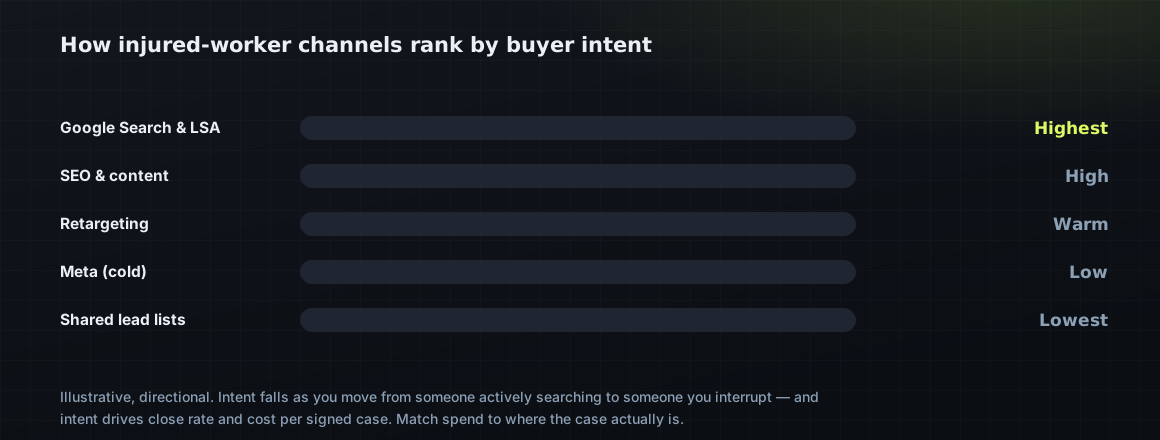
Local Services Ads and paid search sit at the top because they intercept demand that already exists. When someone types “workers comp lawyer near me,” they have already decided they want a lawyer; you are competing only to be the one they pick. That is the highest-intent moment in the entire market, which is why those clicks are also the most expensive in legal — and why they punish a weak intake hardest. Pay a premium to reach a ready buyer and then let the call go to voicemail, and you have bought the most expensive silence in your budget.
Content and SEO capture the same searches without paying per click, and they keep working after you stop spending — the one channel that compounds. An article that answers “how long do I have to file a workers’ comp claim in my state” earns its ranking once and then collects injured workers for years. It is slower to build and it is the closest thing to an owned asset in marketing.
Meta ads reach injured workers before they think to search. That makes reach cheap and intent lower: you are interrupting someone’s scroll, not answering a query. It works when the creative speaks directly to a hurt worker and when a real follow-up sequence is waiting behind it, because most of these people are not ready to sign the day they first see you. Treated as a volume channel with patient nurture, Meta fills the top of the funnel at a cost the high-intent channels can’t match.
The referral engine — past clients, treating physicians, and other attorneys — produces the highest-trust cases of all. A worker sent by their doctor or a friend arrives half-sold, which is exactly why money can’t buy the channel directly and a system has to earn it. And legal directories and review platforms sit in the middle: a strong, well-reviewed presence catches people who are comparison-shopping, but a thin profile does nothing.
The mistake is treating these as a menu to pick one item from. A durable pipeline runs several at once, because they cover different moments in the same worker’s decision. The high-intent channels pay the bills this month; the compounding ones lower your blended cost per case next year. A firm that lives entirely on paid search is one auction change away from a crisis; a firm that also owns rankings, a referral base, and a warm audience has a pipeline that bends instead of breaking.
Channel choice also depends on the case, not just the cost. High-value case types that people research carefully — a serious back injury, a denied claim, a dispute over permanent disability — reward the channels where you can earn trust before the call: content, reviews, video, referrals. Impulse-lighter situations, where a worker just wants someone to answer the phone today, reward the channels that intercept that moment: search and Local Services Ads. Map your channels to the cases you actually want, and you stop paying premium prices to attract the cases you’d rather not sign.
Buy leads or build your own pipeline
There are three ways to get injured-worker leads, and they are not close to equivalent on the number that matters. You can buy shared leads, buy exclusive leads, or build a pipeline you own.
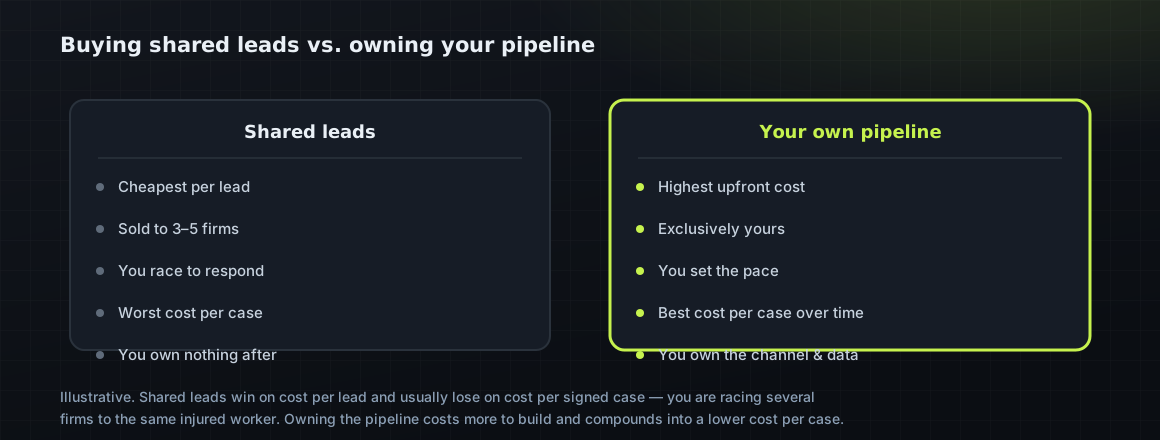
Shared leads are cheap by the each and expensive by the case, because you are one of several firms calling the same frightened person in the same hour. The sale goes to whoever calls first, not whoever is best, so you are paying to enter a footrace you often lose. The lead looked affordable at forty dollars; after your close rate against three competitors, the signed case cost more than a lead you could have generated yourself.
Exclusive leads fix the racing problem — the inquiry is yours alone — but you are still renting someone else’s pipeline at their margin, and when they raise prices or the supply dries up, you have no asset to fall back on. You improved the economics without changing who owns the machine.
Building your own costs the most to stand up and wins on cost per signed case once it’s running, because you keep the channel, the data, and the brand equity every campaign builds. The rankings you earn, the audience you retarget, the reviews you accumulate, the list of past clients who refer — none of it evaporates when a vendor changes terms. You are compounding an asset instead of renting access to one.
For most firms the answer isn’t purity — it’s sequencing. Buy to fill the gap today while you build the asset that makes buying optional tomorrow. A new office with no rankings and no reviews may need to buy leads to keep the lights on for a year; the mistake is still buying them in year five because nobody built anything in the meantime. The full math is in what workers’ comp leads actually cost and leads for law firms: buy or build.
If you do buy, vet the source the way you’d vet a hire. Ask how many firms each lead is sold to, where the leads come from, and — the question that separates real vendors from lead brokers — what their clients’ cost per signed case looks like, not their cost per lead. A vendor who can’t or won’t answer that last question is telling you something. And whatever you buy, track it against your own signed cases from day one, because a source that looks cheap in month one and never converts is the most expensive line in the budget by month three.
Speed-to-lead: the multiplier that beats budget
Here is the cheapest lead-generation upgrade in existence, and almost no firm uses it: answer faster. The odds of qualifying a web lead fall off a cliff within minutes of submission. Reach someone in the first five minutes and you’re talking to them while their intent is still hot; wait an hour and you’re leaving a voicemail for a person who already retained the firm that picked up. For injured workers — scared, in pain, calling three firms off the same search — first-to-respond usually just wins.
The reason is human, not technical. A worker who just filled out a form is, in that moment, as motivated as they will ever be. Every minute that passes, the fear cools, life intrudes, and another firm’s callback lands first. Speed-to-lead doesn’t just improve your odds on a given lead — it decides which firm gets the case among several that all paid to reach the same person.
Doubling how many leads you actually reach can add as many signed cases as doubling your ad budget — at a fraction of the cost. Most firms lose more cases to the phone than to the market.
Spencer Moeller, WorkersComp MarketingThis is why speed-to-lead and after-hours intake belong inside any conversation about lead generation, not in a separate bucket. A lead you paid for and didn’t reach is worse than a lead you never bought — you carried the cost and got nothing. Before you spend a dollar more on traffic, make sure every inquiry gets a human, or a capable AI agent, within minutes, every hour of the day. The firm that answers at 9pm on a Sunday signs the case the firm that opens the voicemail on Monday will never even know it lost.
The only scoreboard: cost per signed case
Cost per lead is a vanity metric. A forty-dollar lead that never signs is infinitely expensive; a two-hundred-dollar lead that signs one time in four costs you eight hundred dollars a case — and if a case is worth many multiples of that, you should buy every one you can find. The only figure that ties spend to reality is cost per signed case: everything you spent to acquire, divided by the cases you actually signed.
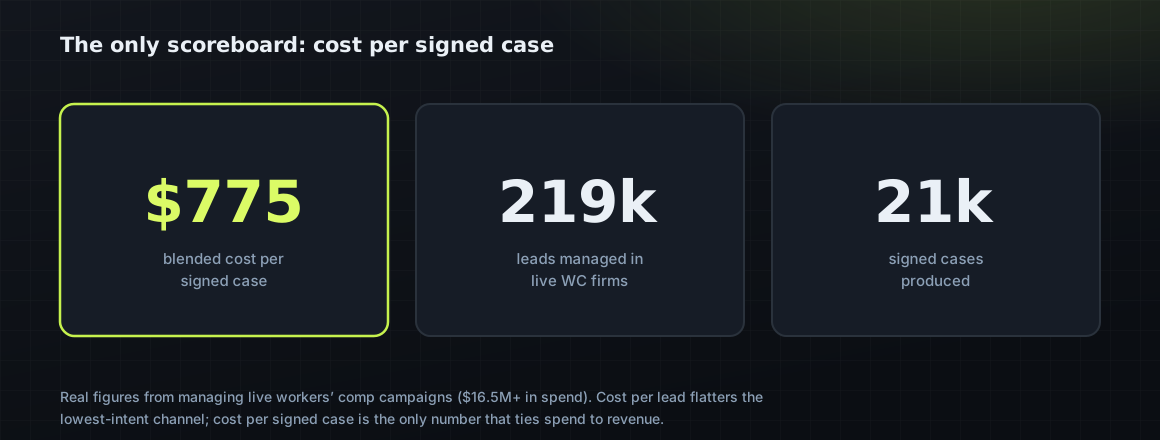
The arithmetic is simple and it changes how you buy. A channel sending cheap leads that rarely sign can carry a higher cost per case than a channel whose leads look expensive but close well. Cost per lead hides that; cost per signed case reveals it. Once you manage to the case, decisions that felt like arguments become math: which channels to feed, which to cut, when a budget increase is safe, and whether a lead vendor is actually cheaper than building.
Work a quick example. Channel A sends 100 leads at $50 each — $5,000 — and signs 4, for a cost per signed case of $1,250. Channel B sends 40 leads at $150 each — $6,000 — and signs 8, for a cost per signed case of $750. On a cost-per-lead report, Channel A looks three times better and Channel B looks like a waste. On the only report that matters, Channel B is the one to scale and Channel A is the one to fix or cut. Firms that manage to cost per lead systematically pour money into their worst channel and starve their best — and never understand why the growth doesn’t come.
Cost per signed case is the number this entire guide points at. Every earlier section is a lever on it: intent raises your close rate, speed-to-lead protects it, owning the pipeline lowers the input cost over time. The model behind it — and why it beats every other marketing metric a firm owner is handed — is laid out in the cost per signed case model.
What a real lead-gen system looks like
Stop picturing a source of leads and start picturing a machine with four moving parts. Each is necessary; none is sufficient alone.
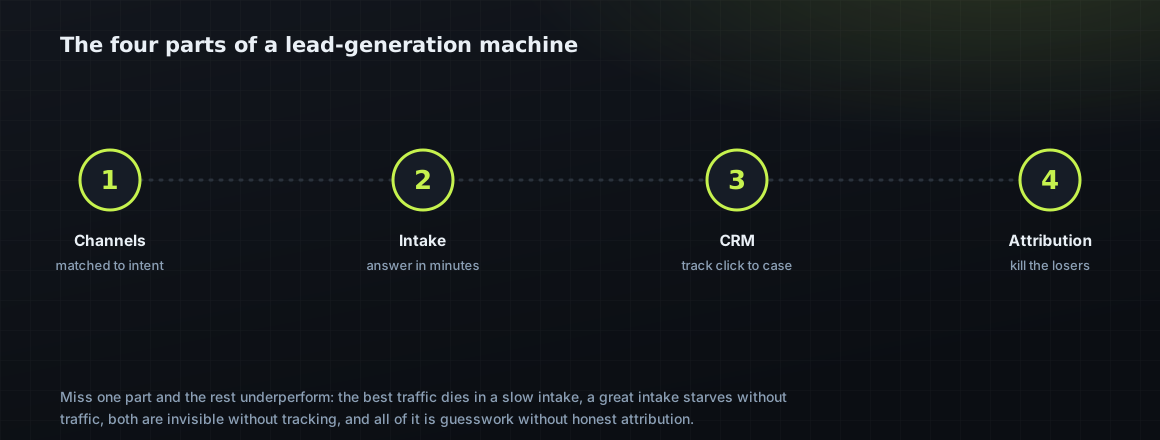
Channels matched to intent feed the top. A fast intake — human or AI, day and night — catches every inquiry before it cools. A CRM and tech stack tracks each lead from click to signed case so nothing leaks and everything is measurable. And honest attribution tells you which channels actually produced retainers, so you can kill the losers and pour budget into the winners.
Miss any one part and the others underperform. The best traffic in the world dies in a slow intake; a great intake starves without traffic; both are invisible without a stack that tracks them; and all of it is guesswork without attribution honest enough to disappoint you. This is why firms that “tried Google Ads and it didn’t work” so often had a channel problem that was really an intake problem, or an intake problem that was really a tracking problem — they fixed the wrong part because they couldn’t see which part was broken.
Get the four working together and lead generation stops being a monthly gamble and becomes something rarer in this industry: predictable. You know what a case costs, which channel produced it, and what to do next when a number moves. The pipes are covered in the intake tech stack; the reason your current dashboard may be lying to you is in marketing attribution.
The machine also needs a rhythm. Once a month at first, then once a quarter as it stabilizes, look at cost per signed case by channel and make two decisions: what to scale and what to cut. A channel beating its target gets more budget; a channel that can’t hit target after a fair test gets cut, and its budget moves to one that works. That single habit — reviewing the real number on a schedule and acting on it — is what turns a collection of tactics into a system that gets cheaper and more predictable every quarter instead of drifting.
The mistakes that quietly drain a budget
Most lead-generation budgets don’t fail dramatically. They leak. The same handful of mistakes show up in firm after firm, each one invisible on a cost-per-lead report and obvious on a cost-per-signed-case one.
The first is buying on cost per lead — chasing the cheapest inquiries and wondering why revenue doesn’t follow. The second is skipping qualification, letting every inquiry through so intake drowns in claims that were never compensable, never in-state, or never real. The third is slow follow-up, the quiet killer that turns leads you paid for into cases your competitors sign. The fourth is no attribution — spreading budget across channels with no idea which produced the retainers, so you cut the wrong one. And the fifth is betting everything on one channel, which feels efficient until an auction shifts, an algorithm changes, or a vendor raises prices and the whole pipeline goes dark at once.
None of this requires a bigger budget — it requires a better system. The firms that dominate their markets rarely outspend everyone; they out-convert them, because they fixed the leaks the competition never measured. Lead generation, done right, is less about finding more injured workers and more about refusing to waste the ones you already reach.
Key takeaways
-
Not everything called a “lead” is one. A form fill without intent is not a lead; define it by whether it can become a case.
-
Rank channels by intent, not volume. High-intent and low-volume beats the reverse for a comp firm.
-
Buy or build is the core decision. Rented demand versus an owned pipeline that compounds.
-
Speed-to-lead is the multiplier that beats budget. Answering fast lifts every channel at once.
-
The only scoreboard is cost per signed case. Everything else is a leading indicator at best.
Frequently asked questions
How do workers’ comp law firms generate leads?
By running channels ranked by intent — Google Search and Local Services Ads capture people already looking for a lawyer, SEO and content compound over time, Meta ads reach injured workers before they search, and referrals produce the highest-trust cases. The firms that win pair those channels with an intake fast enough to answer every inquiry within minutes.
How much does a workers’ comp lead cost?
It varies widely by channel and market, but cost per lead is the wrong number to manage. A cheap lead that never signs is expensive; the figure that matters is cost per signed case — everything spent to acquire, divided by the cases you actually signed. Well-run campaigns keep that comfortably below what a case is worth.
Are shared workers’ comp leads worth it?
Shared leads are cheap per lead and often the most expensive per signed case, because several firms are calling the same injured worker at once and the case goes to whoever responds first. They can fill a gap, but exclusive leads and your own pipeline convert far better and build an asset you keep.
What is the best channel for workers’ comp leads?
There isn’t a single best channel — there’s a best mix. High-intent channels like Local Services Ads and paid search pay this month; SEO, content, and referrals compound into a lower blended cost per case over time. Running several at once covers the same worker at different moments in their decision.
How fast should you follow up with a workers’ comp lead?
Within five minutes. The odds of qualifying a web lead fall sharply as the minutes pass, and injured workers often contact several firms off the same search, so first-to-respond usually wins. Doubling how many leads you actually reach can add as many signed cases as doubling your ad budget.
Sources & further reading
-
01
The channels that generate leads
Where injured-worker demand is captured.
-
02
Buy vs. build
Own the pipeline or rent it.
-
03
Convert and measure
Turn leads into signed cases, and prove it.
Benchmarks here draw on WorkersComp Marketing’s own managed-spend data across live firms; your numbers will differ. General marketing information, not legal advice.