Ask a workers’ comp firm why it buys shared leads and the answer is almost always the same: they’re cheaper. Fifty dollars a lead instead of a hundred and fifty feels like a decision that makes itself.
But “cheaper” is a claim about the top of the funnel. The number that pays your associates is at the bottom — cost per signed case. And that number tells a very different story.
This piece walks through the exact math, honestly, in both directions. Exclusive leads aren’t always right and shared leads aren’t always wrong — but you can’t judge either until you stop comparing the wrong number.
What “exclusive” vs “shared” actually means
The distinction is simple. Its consequences are not.
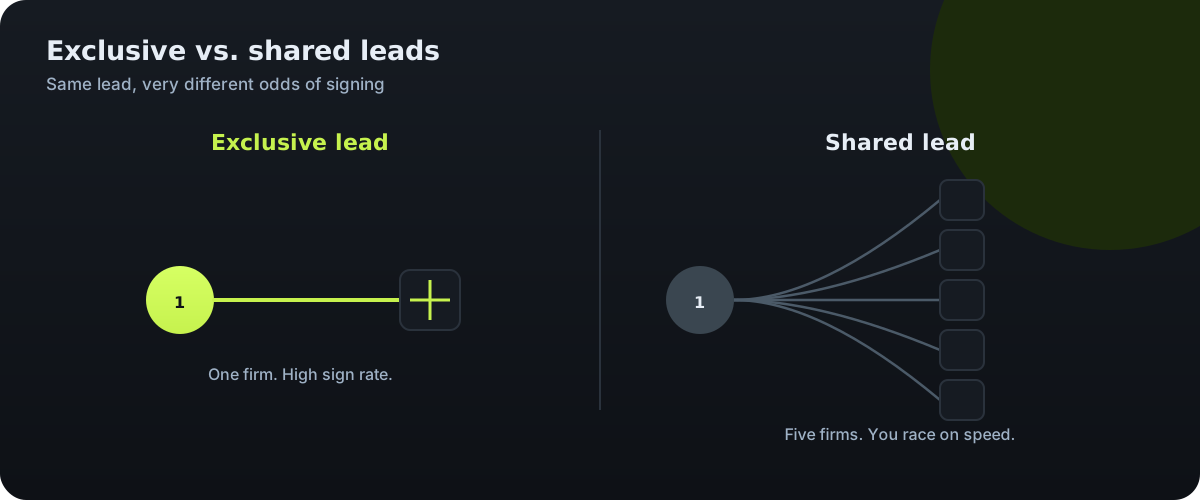
An exclusive lead is sold to exactly one firm — yours. When an injured worker fills out the form or picks up the phone, you are the only firm that gets their name and number. No one else is calling.
A shared lead is the same injured worker’s information sold simultaneously to several firms — commonly three to five, sometimes more. Everyone who bought it gets the contact at roughly the same moment, and the worker signs with whoever earns their trust first.
That single difference — one buyer versus many — is what drives every number in this article. It changes your sign rate, your intake workload, and ultimately what a signed case actually costs you.
The cost-per-signed-case math
One formula ends the argument. Everything else is just plugging in numbers.
Legal is the most expensive category in all of paid search, which is exactly why this discipline matters. According to WordStream’s 2026 benchmarks, Attorneys & Legal Services carry an average cost per click of $9.87 and an average cost per lead of $131.63 — while converting clicks to leads at about 10.53%, above the 7.52% all-industry average.
When leads cost that much, you cannot afford to compare vendors on price alone. You need one equation:
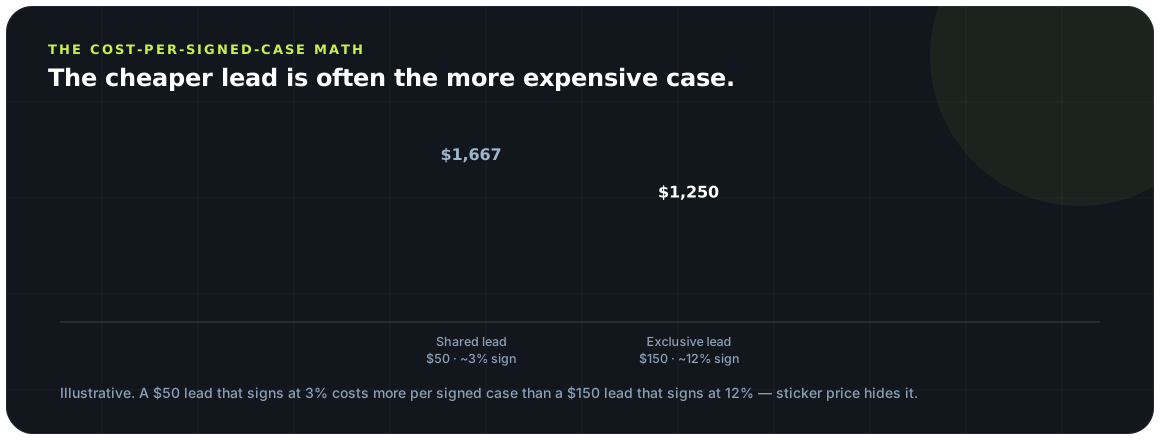
Cost Per Signed Case = Cost Per Lead ÷ Sign Rate
The True-Cost Formula — WorkersComp MarketingThat’s it. Divide what you pay for a lead by the share of those leads that become signed cases, and you get the number that actually matters. Watch what happens when we run four real-world lead types through it.
| Lead type | Cost per lead | Sign rate | Cost per signed case | Exclusivity |
|---|---|---|---|---|
| Exclusive (premium) | $150 | 12% | ~$1,250 | One firm only |
| Exclusive (mid) | $90 | 8% | ~$1,125 | One firm only |
| Shared aggregator | $50 | 2% | ~$2,500 | Sold to 3–5 firms |
| Referral | ~$0 | 40% | Lowest | Exclusive by nature |
The cost-per-lead and sign-rate figures above are illustrative industry-consensus ranges chosen to show how the formula behaves — not guarantees or quotes. Your real numbers depend on market, offer, and intake quality.
Read the two middle rows again. The shared lead costs one-third the price of the premium exclusive lead — and produces a signed case for twice the money.
That’s the whole trap in one line. The cheap lead was never cheap; it just moved the cost to a place the invoice doesn’t show.
This is the same math behind results we’ve produced at scale. Managing $16.5M in Meta spend inside live WC firms, we generated 219,000 leads at roughly $75 CPL and drove 21,000 signed cases at about $775 each — the economics you only reach with exclusive, well-qualified leads and fast intake. You can see real firm results for how those numbers play out case by case.
Why shared leads convert so poorly
It isn’t the lead quality. It’s the physics of the race you just entered.
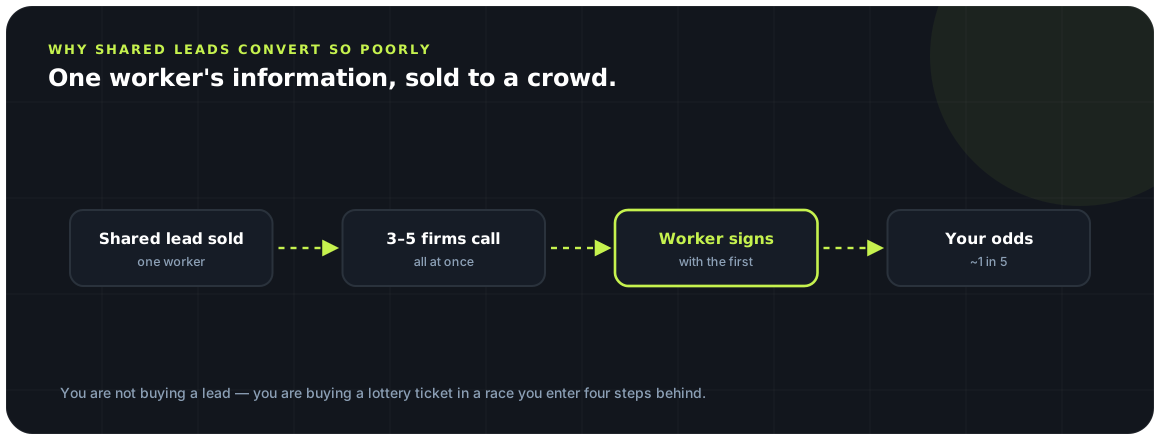
A shared lead isn’t a worse injured worker. Often it’s the exact same person an exclusive lead would have been. The difference is that four other firms bought them too — and now the sign goes to whoever gets there first.
That turns intake into a speed race, and the research on speed is unforgiving. Dr. James Oldroyd’s Lead Response Management study at MIT found that responding within five minutes rather than thirty makes a lead up to 21× more likely to qualify.
Now flip that finding onto a shared lead. You aren’t just racing the clock — you’re racing four competitors who are all watching the same clock. Even flawless five-minute intake only ties you with the other firms who also respond fast.
A shared lead sold to five firms isn’t a lead. It’s a footrace where four of the five runners walk away with nothing.
Spencer Moeller, WorkersComp MarketingThere’s a human cost too. By the third or fourth firm that calls, the injured worker is annoyed, suspicious, or simply done answering. The signal that felt warm on your dashboard has gone cold in the prospect’s pocket.
When shared leads can still make sense
The honest case for shared leads — because there is one.
Blanket advice is lazy, and “never buy shared leads” is blanket advice. There are real situations where shared leads earn their place in a mix.
If your intake team is genuinely elite — sub-five-minute response, disciplined follow-up cadence, and a script that converts — you can win the speed race often enough to make the low CPL work. Fast firms extract value from shared leads that slow firms simply can’t.
Shared leads can also serve as fill. When exclusive supply in your market runs dry and you have idle intake capacity, a controlled volume of shared leads keeps the team sharp and the pipeline moving, as long as you track the real cost per case and cut it the moment it climbs.
The point isn’t that shared leads are always wrong. It’s that they only work when you’ve earned the right to buy them — with intake fast enough to win a five-way race. Most firms haven’t, and buy them anyway.
How to vet a lead source
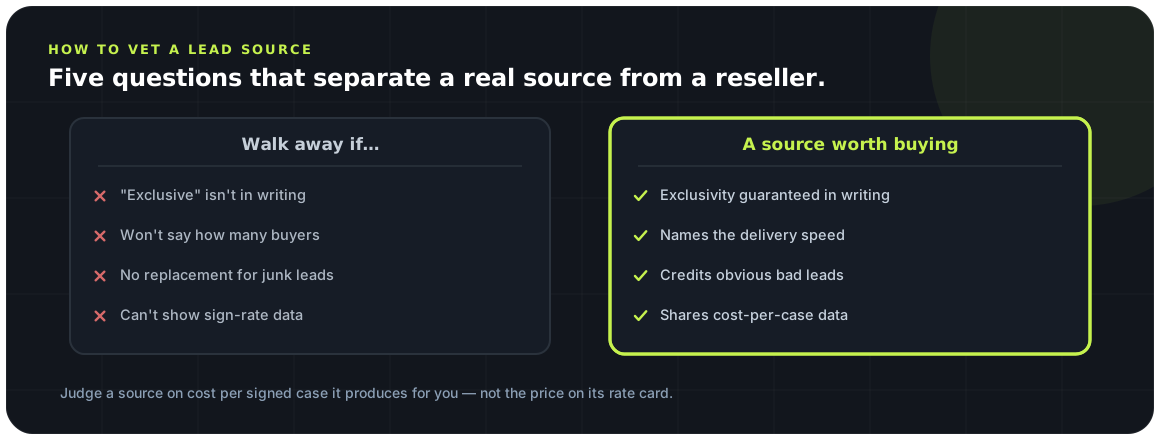
Six questions that separate a real pipeline from an expensive one.
Whether a vendor calls a lead exclusive or shared, the label matters less than the answers to a few pointed questions. Run any source through this before you sign a contract.
A source that answers all six plainly is worth testing. One that dodges the exclusivity and sign-rate questions is selling you the invoice, not the outcome.
For the full framework on how these numbers connect to channels, intake, and budget, see the full WC marketing playbook and the metrics that matter. If you’d rather have someone run your numbers, we build an exclusive WC lead system designed around this exact math.
| Factor | Exclusive leads | Shared leads |
|---|---|---|
| Sign rate | Higher — you’re the only firm calling | Lower — split across 3–5 firms |
| Competition | None on that lead | Direct, simultaneous, on every lead |
| Upfront cost | Higher cost per lead | Lower cost per lead |
| Cost per signed case | Often lower in the end | Often higher despite cheap CPL |
| Control | You own the relationship from first touch | You compete for it every time |
Key takeaways
-
“Cheaper” is the wrong frame. A shared lead at $50 looks cheaper than an exclusive at $150 — until you measure cost per signed case, where the shared lead usually loses.
-
Shared leads convert poorly for a structural reason. The same lead is sold to several firms at once, so the worker is called by all of them. Speed and luck decide it, and your conversion collapses.
-
The math flips on signed cases. Divide spend by signed cases rather than by leads and the “expensive” exclusive lead is often the cheaper case.
-
Shared can still make sense, narrowly. With genuine excess intake capacity and fast, disciplined follow-up, shared leads can work, but they are the exception, not the default.
-
Vet the source before you buy. Exclusivity, speed of delivery, and clean attribution are what separate a real lead source from a race you usually lose.
Frequently asked questions
What are shared leads?
Shared leads are an injured worker’s contact details sold to several firms at once — commonly three to five. Everyone who bought the lead reaches out around the same time, so the worker signs with whichever firm earns their trust first. You’re competing on the same lead you paid for.
Why are exclusive leads more expensive?
Because you’re the only firm buying that prospect, the vendor can’t spread the cost across multiple firms — you carry the full price of generating it. In exchange, no one else is calling the worker, so your sign rate is materially higher and your true cost per signed case is often lower.
Are shared workers’ comp leads worth it?
Sometimes, but rarely as a foundation. When you calculate cost per signed case rather than cost per lead, shared leads’ low sign rate often makes them more expensive than exclusive leads. They can work if your intake responds in under five minutes and you track and cap them carefully.
What is a good cost per case for workers’ comp?
It varies widely by market, channel, and case value, but many well-run WC campaigns land in the four-figure range per signed case. The right target is one that keeps acquisition comfortably below what a signed case is worth to your firm — not simply the lowest number a vendor quotes.
How do I know if a lead is exclusive?
Ask the vendor directly how many firms each lead is sold to, and get the answer in writing. Truly exclusive sources will confirm it plainly and let you verify sign rates. If a vendor is vague about exclusivity or dodges the sign-rate question, treat the lead as shared.
Sources & further reading
-
01
Conversion & cost benchmarks
Industry benchmarks for click, lead, and conversion costs that set the baseline for the cost-per-case math.
-
02
Why speed decides shared leads
Lead-response research shows how sharply contact rates fall with time, which is why a shared lead rarely converts.
-
03
Further reading
The economics and metrics behind the exclusive-vs-shared decision.
External sources were accurate at publication and change over time; confirm current figures at the source. General marketing information, not legal advice.