
Most workers’ comp firms think about their marketing as a series of first impressions: run an ad, catch a searcher, hope they call. But the overwhelming majority of the people who click never call on that first visit. They read half a page, get interrupted by the very pain that sent them looking, and close the tab. The firm paid for that click. Then it lets the person walk away forever.
Retargeting — showing ads specifically to people who have already visited your site — is the discipline of not letting them walk away. It is the paid-media cousin of lead reactivation: reactivation goes back through the named leads already sitting in your database, and retargeting goes back after the anonymous visitors who never became a lead at all. Both share the same quiet advantage. The expensive part — earning the attention in the first place — is already done and paid for. What remains is far cheaper, and most firms simply never do it.
This article is the whole discipline, in order: why retargeting is the cheapest audience you can buy, the tracking foundation most firms never finished, the three audiences actually worth rebuilding, the health-advertising rules that make workers’ comp retargeting different from selling shoes, what the return ad should actually say, how long to keep chasing before it becomes harassment, how to measure it without fooling yourself, and a thirty-day plan to set it up. None of it requires a bigger budget. It requires using the one you already spent more than once.
The cheapest audience you can buy
Every channel spends most of its money earning a stranger’s attention. Retargeting is the only one where that part is already done.
Think about what a cold click actually costs. To get an injured worker who has never heard of you to stop scrolling, click, and land on your site, you paid for reach, for the auction, for the creative, for all the impressions that did not click. By the time someone is standing on your page, the most expensive work in marketing is finished. If they leave without calling and you do nothing, you have thrown that entire investment away and you will pay the full cold price all over again to meet the next stranger.
Retargeting changes the math because it starts from warm. The person already found you, already showed enough interest to click, already saw your name attached to their problem. Bringing a warm visitor back is structurally cheaper than finding a cold one, because you are no longer paying to create awareness — only to renew it at the right moment. That is why, dollar for dollar, a well-built retargeting audience is usually the most efficient spend in the account, even though it is almost never the biggest.
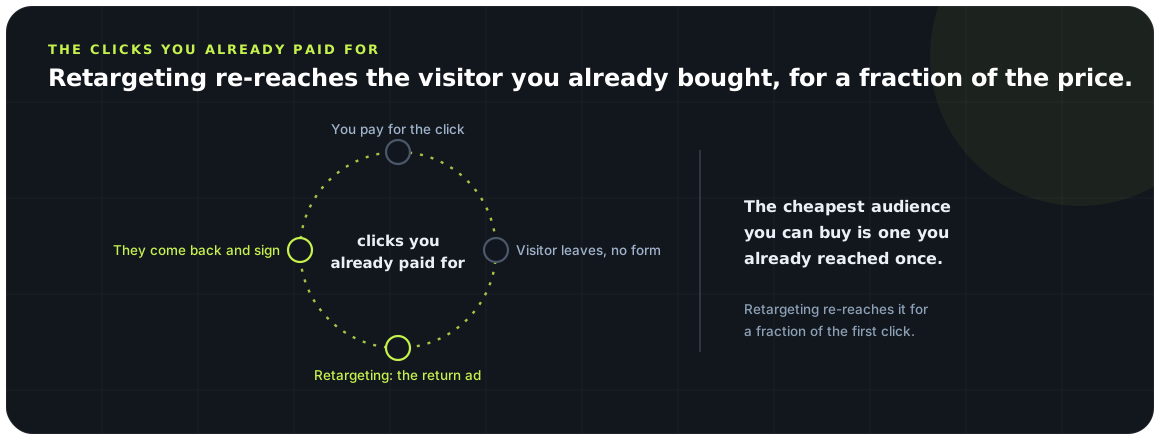
It helps to see the loop it creates, because the value is in the return trip, not the first visit. A click becomes a recorded visit, a visit becomes a place on a warm list, and a matched message brings that person back at a fraction of what the first click cost — this time closer to ready.

There is a catch worth stating up front, because it is what separates firms that profit from retargeting from firms that just annoy people. Retargeting only works if there was traffic worth recording in the first place, and only stays cheap if you are disciplined about who you chase, what you say, and when you stop. The mechanism is nearly free; the judgment is the whole game. The rest of this article is that judgment.
The foundation most firms never finished
You cannot bring back visitors you never recorded. The tracking setup is unglamorous, and it is where most retargeting quietly dies.
Retargeting depends on one boring thing being done correctly: a piece of tracking code — the Meta pixel, the Google tag — installed on every page of your site, firing on every visit, and feeding those visits into audiences you can advertise to. It is a five-minute idea and a job that a surprising number of firms have half-finished. The tag is on the homepage but not the landing pages the ads point at. It fires, but no audiences were ever built from it. It was installed a year ago by an agency that is no longer around, and nobody can confirm it still works.
The consequence is invisible and expensive. Every day the foundation is broken, your paid traffic arrives, looks around, leaves, and is never recorded — so it can never be brought back. You are not losing a report; you are losing the audience itself, permanently, because a visitor you did not capture today cannot be retargeted tomorrow. Unlike most marketing mistakes, this one cannot be fixed retroactively. The cases that got away while the pixel was down are simply gone.
So the first real step in any retargeting effort is not creative or strategy — it is verification. Confirm the tag is present and firing on every template your site uses, especially the pages your ads actually send people to. Confirm the visits are landing in an audience. Confirm that audience is large enough and recent enough to advertise against. This is plumbing, and like the attribution plumbing in the attribution guide, it is the thing that has to be right before any downstream cleverness matters at all.
| Check | What “working” looks like | If it is broken |
|---|---|---|
| Tag on every page | Fires on homepage, landing pages, articles | Ad-traffic visitors are never recorded |
| Audiences built | Visitors flow into named, growing lists | Nothing to advertise to |
| List size and recency | Enough recent visitors to deliver ads | Ads under-deliver or will not run |
| Consent handling | Firing respects your consent banner | Compliance and data-quality risk |
The three audiences worth rebuilding
“Everyone who visited” is not an audience — it is a crowd. The value is in separating them by how close they came to calling.
The single biggest mistake in law-firm retargeting is treating every past visitor the same. Someone who bounced off the homepage in four seconds and someone who read your entire workers’ comp page and started dialing your number are not the same person, do not deserve the same message, and are not worth the same spend. Lumping them together means you either overspend on tire-kickers or underspend on the people who were nearly clients. The fix is to segment visitors by depth of intent, and to treat those segments differently.

At the top, coldest and largest, are all site visitors — people who touched any page and did nothing. They are worth a light, cheap familiarity play: a low-frequency reminder that you exist, capped hard so it never becomes wallpaper. Do not spend heavily here; most of these people were never going to call, and the ones who were will graduate into a warmer segment on their own.
In the middle are the page readers — visitors who actually consumed something substantive, like your workers’ comp practice page or a case-results page. They told you the topic by what they read. That earns a more specific message: answer the question that page raised, show proof, and give them a reason to come back now rather than someday. This is where a modest budget does real work.
At the bottom, smallest and hottest, are the contact abandoners — people who started a form, opened the call widget, or reached the booking page and did not finish. Something interrupted them: a phone call, a child, a flicker of doubt. These are nearly-clients, and they are the most valuable retargeting audience a firm owns. They deserve the strongest message, the tightest window, and the clearest single next step — because for many of them, one respectful nudge at the right moment is the difference between a signed case and a stranger who meant to call and never did.
The health-advertising rule you cannot ignore
Workers’ comp retargeting touches injury and health, and the ad platforms treat that as a special category with its own rules. This is not optional.
This is where workers’ comp retargeting stops resembling ordinary e-commerce remarketing. An injured worker’s visit to a comp attorney’s site is, in the eyes of the major ad platforms, sensitive information — it brushes up against health conditions, physical injury, and legal jeopardy. Both Google and Meta maintain policies that restrict how advertisers may build audiences from, and target ads around, sensitive categories like health. In practice that limits certain kinds of granular targeting and audience-building precisely because the subject is a person’s injury. The platforms enforce this, and getting it wrong can mean disapproved ads or a suspended account.
The safe posture is straightforward in spirit even when the fine print shifts: retarget based on the fact that someone visited your site, not on inferences about their specific medical condition, and keep the creative respectful and non-stigmatizing rather than something that would make a stranger looking over the worker’s shoulder wince. You are reminding a person that a firm they visited can help — you are not broadcasting that they are hurt. That distinction is both the compliant path and, not coincidentally, the humane one.
Two honest caveats. First, these platform policies change, and the exact mechanics of what you can and cannot do are set by Google and Meta, not by any agency — so the current rules should be checked against the platforms’ own policy pages before a campaign launches, not assumed from an article. Second, retargeting also intersects with the broader advertising-conduct rules every law firm operates under, which we cover in plain English in the marketing-compliance guide. Between the platform’s health rules and your own bar’s advertising rules, the theme is the same: in this practice area, restraint is not just compliance, it is good taste.
What the return ad should actually say
A retargeting ad that just repeats your logo is a billboard you are renting inside someone’s phone. The message has to earn the second visit.
The laziest possible retargeting is to take your prospecting ad and simply show it again to people who already saw it. It technically qualifies as retargeting, and it mostly just teaches the injured worker to resent your brand. Seeing the identical “Injured at work? Call us today” for the ninth time is not persuasion; it is noise, and it burns the goodwill that made the first click possible. The return ad has to do something the first ad did not: give a specific reason to come back now.

The strongest return messages address the reason the person hesitated, not the reason they clicked. Injured workers stall for predictable, human reasons: fear that hiring a lawyer costs money they do not have, worry that their employer will retaliate, uncertainty about whether they even have a case, exhaustion at the thought of a fight. A return ad that quietly answers one of those — that consultations are free, that retaliation is unlawful, that a quick call can tell them if they have a case — does real work, because it removes the specific pebble in the shoe rather than shouting the same slogan louder.
The message should also shift with the audience it is shown to. The cold all-visitors crowd gets gentle familiarity: a reminder that you exist and that you handle exactly this. The page readers get an answer to the question their page raised and proof that you win these cases. The contact abandoners get the simplest, warmest nudge of all — one clear next step, framed as easy and low-stakes, because they were already most of the way there. In every case the tone stays calm and respectful; an injured worker in pain does not need urgency theater, they need to feel that calling you will make things simpler, not scarier.
Finally, whatever the return ad promises has to land somewhere that keeps the promise. If the ad says “free case check in one call,” the page it points to should say the same thing and make that call effortless, and the phone behind it has to actually get answered — the whole point of speed-to-lead applies double to a warm visitor you spent twice to bring back. Retargeting that drives a re-visit into a slow, generic homepage undoes its own advantage.
How long to chase, and when to stop
The line between helpful and creepy is frequency and time. Cross it and retargeting stops recovering cases and starts destroying your brand.
Retargeting has a failure mode that prospecting does not: it can follow the same person around until they hate you. Everyone has felt it — you glance at a product once and it stalks you across the internet for a month. For a shoe, that is merely annoying. For a workers’ comp firm, where the person is injured, frightened, and in a vulnerable moment, being relentlessly followed by injury ads is worse than annoying; it is the kind of experience that makes someone actively choose the other firm. Frequency discipline is not a nicety here. It is brand protection.
The rule of thumb is that the warmer the audience, the harder and shorter you press — and then you release. A contact abandoner is worth an intense, focused nudge for a few days while the moment is still alive, and then you stop, because if a week of respectful reminders did not bring them back, more will only sour them. A page reader deserves a slightly longer, gentler window. The broad all-visitors crowd should see you rarely and only for a limited stretch before they age out entirely. Past those windows, the honest move is to stop advertising and let a slower, quieter nurture channel carry the relationship instead.

Two settings make this real in the account. The first is a frequency cap, so no one sees your ad more than a small number of times in a given stretch — enough to be remembered, not enough to be resented. The second is a membership duration on each audience, so people automatically fall out of the retargeting pool after their window closes rather than being pursued indefinitely. Set both deliberately. An account without them will, left alone, gradually concentrate its spend on a shrinking group of people who have already decided not to call, showing them the same ad until the money and the goodwill are both gone.
Measuring it without fooling yourself
Retargeting is the easiest channel in marketing to make look brilliant on a report — and the easiest to fool yourself with.
Here is the uncomfortable truth about retargeting attribution: it takes credit for cases it did not cause. Because a retargeting audience is by definition made of people already interested enough to visit, many of them would have come back and called on their own. When your reporting counts every one of those as a retargeting win, the channel looks like the best-performing thing in the account — low cost per case, sky-high return — when some of that is just credit-stealing from people who were already coming back. Believe the raw report and you will over-invest in reminding people who needed no reminder.
The mental correction is to ask not “how many cases did retargeting touch” but “how many cases did retargeting actually add that would not have happened otherwise.” That is the incrementality question, and while measuring it perfectly is hard, keeping it in mind changes decisions. It is why retargeting should be judged on its contribution to the firm’s overall cost per signed case, in the context of everything else running, rather than on its own flattering in-platform numbers. A channel that only recycles existing intent can still be worth running — it just should not be credited as if it created the demand.
| What the report shows | Why it flatters | The honest question |
|---|---|---|
| Very low cost per case | Audience was already warm | Would they have returned anyway? |
| High return on ad spend | Claims credit for existing intent | What did it add, not touch? |
| View-through conversions | Counts people who never clicked | Does that view deserve the credit? |
| Rising conversions at scale | May just be reaching more warm users | Is blended cost per case improving? |
The practical discipline is the same one that governs the whole account, from the system view down: manage to cost per signed case, blended across channels, and treat any single channel’s self-reported glory with friendly suspicion. Retargeting earns its place when turning it on measurably improves the firm’s overall economics — not when its own dashboard says it is a genius.
A 30-day retargeting setup
You do not need a big budget or a new agency to start. You need the foundation verified, three audiences, honest creative, and firm limits.
The order matters, because each step makes the next one worth more. Fix the tracking before you build audiences, build audiences before you write ads, and set the limits before you scale spend — do it out of order and you will either advertise to no one or chase everyone into resentment.
| Week | Focus | Why first |
|---|---|---|
| 1 | Verify the tag fires on every page and feeds audiences | You cannot retarget visitors you never recorded |
| 2 | Build the three audiences and set membership windows | Depth of intent is the whole strategy |
| 3 | Write matched creative + confirm platform health rules | The message and compliance do the real work |
| 4 | Launch small with frequency caps, then judge on blended cost per case | Limits and honest measurement keep it profitable |
Notice what is not on the list: a huge budget, a clever hack, or a promise that retargeting will transform the firm. It will not transform anything — it will recover the cases your other channels were already quietly losing at the edges, at a cost lower than any cold click. That is not a small thing. Across the live firms behind this playbook — roughly $16.5M in managed spend, 219,000 leads at about $75 each, and 21,000 signed cases — the pattern holds: the firms that treat their own past visitors as an asset, rather than a one-time impression, get more signed cases from the exact same top-of-funnel spend. Retargeting is simply the tool that stops the leak between a click and a call.
Key takeaways
-
Retargeting is the cheapest audience you can buy. People who already engaged convert far below the cost of cold reach.
-
Most firms never finished the foundation. Pixels, events, and audiences are half-built, so the cheap audience never forms.
-
Three audiences are worth rebuilding. Site visitors, video viewers, and form-abandoners each deserve a different return message.
-
The health-advertising rule you cannot ignore. Injury data limits how you build and target these audiences; compliance comes first.
-
Know when to stop chasing. A frequency cap protects both your budget and the anxious prospect you are trying to reassure.
Frequently asked questions
What is retargeting for a workers’ comp firm?
Retargeting means showing ads specifically to injured workers who already visited your website but did not call or sign. A tracking tag records those anonymous visitors, groups them by how close they came to contacting you, and lets you show them a matched follow-up message. Because you already paid to earn that first visit, bringing them back is far cheaper than finding a brand-new stranger — which makes retargeting one of the most efficient dollars in a firm’s marketing, even though it is rarely the largest.
Is retargeting injured workers even allowed?
It can be done, but workers’ comp touches health and injury, which the major ad platforms treat as a sensitive category with extra rules. The compliant approach is to retarget based on the fact that someone visited your site rather than on inferences about their specific medical condition, and to keep the creative respectful. The platforms set and update these policies themselves, so confirm the current health and personal-hardship advertising rules on Google’s and Meta’s own policy pages, and check against your state bar’s advertising rules, before launching.
Why does my retargeting look so profitable in the report?
Because it takes credit for people who were already coming back. A retargeting audience is made entirely of people interested enough to visit once, and many would have returned on their own — but the platform counts them as retargeting wins anyway. That makes the channel look brilliant. The honest measure is incrementality: how many cases retargeting actually added that would not have happened otherwise. Judge it on your firm’s blended cost per signed case, not its own flattering numbers.
How often should the same person see my ad?
Rarely enough to be remembered, not so often they resent you. Injured workers are in a vulnerable moment, and being relentlessly followed by injury ads pushes them toward the other firm. Set a firm frequency cap and give each audience a membership window — roughly a week for the hottest contact-abandoners, longer and gentler for colder visitors — after which they age out of retargeting entirely and, if appropriate, move into a slower nurture channel instead of being chased forever.
Do I need a big budget to start retargeting?
No. Retargeting audiences are small by nature, so it is inexpensive to run — the constraint is having enough recent site traffic to advertise to, not budget. The real prerequisites are a correctly installed tracking tag firing on every page, a few well-segmented audiences, honest matched creative, and firm frequency and window limits. Get those right and a modest spend quietly recovers cases your other channels were already losing at the edges.
How is retargeting different from lead reactivation?
They are cousins that work on different populations. Lead reactivation goes back through the named leads already sitting in your database — people who gave you their contact information and were never signed. Retargeting goes after the anonymous visitors who came to your site but never became a lead at all. Both exploit the same advantage: the expensive work of earning attention is already done, so re-engaging is cheap. Most firms should run both, since they recover different cases.
Sources & further reading
- 01
-
02
Stay compliant
The rules that govern retargeting a health audience.
-
03
Fit it to the system
Where retargeting sits in the whole engine.
Benchmarks here draw on WorkersComp Marketing’s own managed-spend data across live firms; your numbers will differ. General marketing information, not legal advice.