
Hiring a marketing agency is one of the highest-stakes decisions a workers’ comp firm owner makes, and it’s usually made on the worst possible information: a polished pitch, a confident promise, and a number. This is the honest buyer’s guide — the questions that separate a real partner from a vendor, the pricing models and what each one hides, the red flags that predict regret, and how to decide when two agencies both sound good in the room.
Specialist vs. generalist
The first fork is whether to hire an agency that markets workers’ comp firms specifically, or a capable generalist that markets everything. It matters more than it sounds. Workers’ comp has its own economics, its own compliance rules, its own buyer — an injured worker who is scared, often in pain, sometimes worried about their immigration status or their job, and choosing a lawyer in a moment of crisis. A generalist has to learn all of that on your budget. A specialist already knows it.
That learning curve isn’t free — it’s paid in cases you didn’t sign. The months a generalist spends discovering that a certain creative angle gets rejected, that a certain audience never converts, that intake is where your real leak is, are months your budget funded the education. In a high-cost category like legal, where a single signed case is worth thousands, a slow first quarter is a five-figure tuition bill. A specialist compresses that curve because they’ve already paid it with someone else’s budget.
Compliance is where specialization pays off most quietly. Workers’ comp advertising runs into rules that don’t apply to a plumber or a boutique: what you can claim about outcomes, how you handle a potential client’s information, how you describe fees, and the platform-level restrictions that come with being classed as a health advertiser. A specialist writes ads that convert without crossing those lines. A generalist can write a great ad that gets your account flagged, or worse, creates bar-complaint exposure — and you won’t know until it’s a problem. Marketing that ignores the compliance line isn’t a bargain; it’s a liability with good production values.
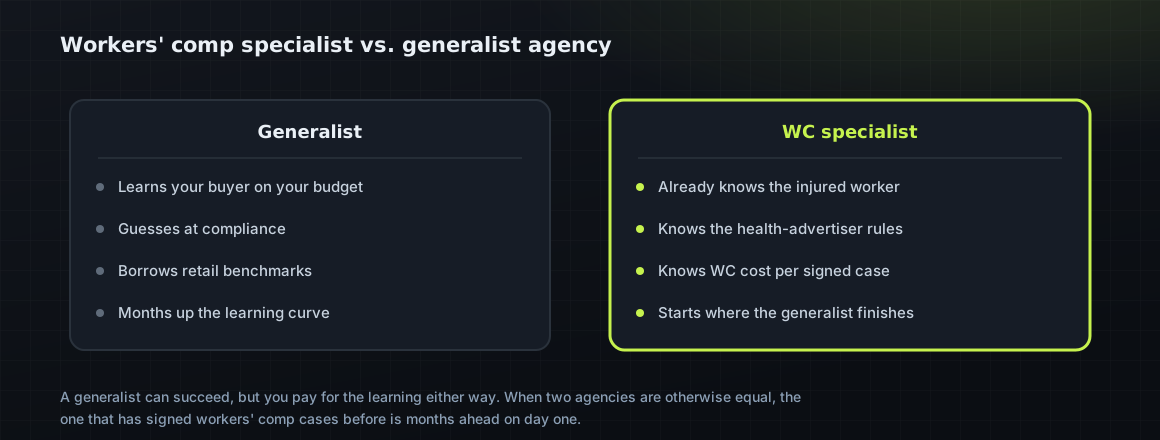
Specialization shows up in specifics. A specialist knows that a workers’ comp firm is treated as a health advertiser by Meta and Google, with the extra scrutiny that brings. They know which creative angles move an injured worker and which get an ad rejected. They have benchmarks — what a signed case should cost in your kind of market — instead of guessing from a retail or e-commerce playbook. And they know the compliance line on what a firm can and can’t claim, so your ads don’t create bar-complaint risk.
None of this means a generalist can’t succeed; some are excellent and will learn fast. But you are paying for the learning either way, and with a specialist most of it is already done. When two agencies are otherwise equal, the one that has signed workers’ comp cases before is starting several months ahead. The full case is in hiring a marketing agency for your workers’ comp firm.
Verify the specialization rather than taking it on faith. “We work with law firms” is not the same as “we sign workers’ comp cases,” and “personal injury” is a different animal with different economics. Ask specifically how many workers’ comp firms they run right now, in what kinds of markets, and what those firms’ cost per signed case looks like. Ask to see a real campaign — the actual ads, the actual targeting, the actual reporting — not a case-study PDF. Specialization that’s real survives specific questions; specialization that’s marketing collapses under them.
The questions that reveal a real agency
You learn more from four questions than from any pitch deck. Ask them directly, and watch not just the answer but how comfortable they are being asked.
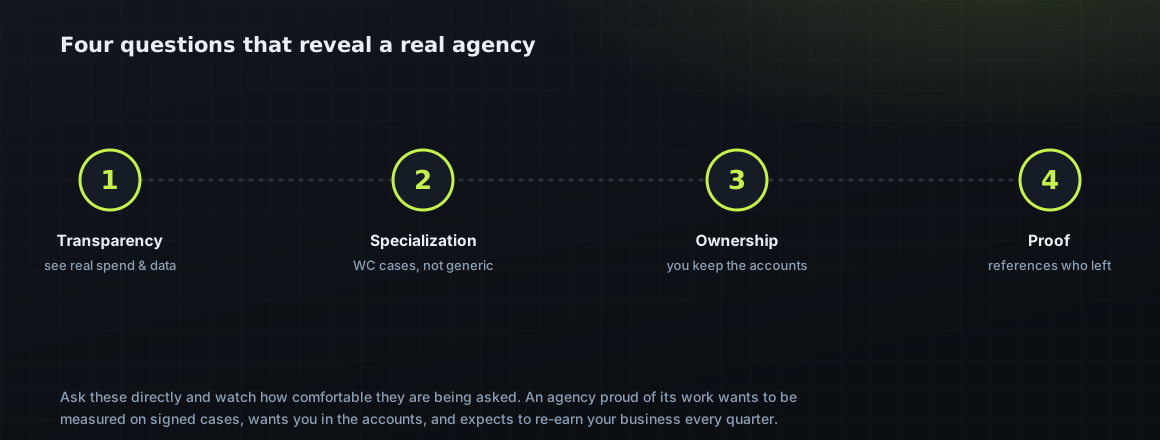
Will I see my real ad spend and my real data? A real partner gives you direct access to your ad accounts and reports separated media and fee. An agency that keeps your accounts behind a curtain and reports a single blended number is hiding something — usually a markup, sometimes worse. Do you specialize in workers’ comp, and can you prove it? Ask for signed-case results, not impressions or clicks, from firms like yours. Who owns the accounts, the data, and the creative if we part ways? The answer should be “you do.” And can I talk to a client who left? A confident agency will connect you with references; a nervous one will only offer the happy ones.
Push hardest on that last question. Any agency can produce three delighted references; the signal is whether they’ll connect you with a firm that left. How a relationship ends reveals more than how it’s going — did the agency hand back the accounts cleanly, was the data portable, did the results hold up under a fair look? An agency that says “we don’t really have clients who leave” is either very good or not telling the truth, and a five-minute call with a former client usually tells you which.
The pattern to listen for is comfort with scrutiny. An agency proud of its work wants you to see the numbers, wants to be measured on signed cases, and expects to earn renewal every quarter. An agency that deflects — “our system is proprietary,” “leads are what we deliver, not cases,” “you don’t need access to the accounts” — is telling you how the relationship will feel when a month goes badly.
How agencies price — and what each model hides
There are four common ways agencies charge, and each shapes their incentives. Understanding the model tells you what behavior it quietly rewards.
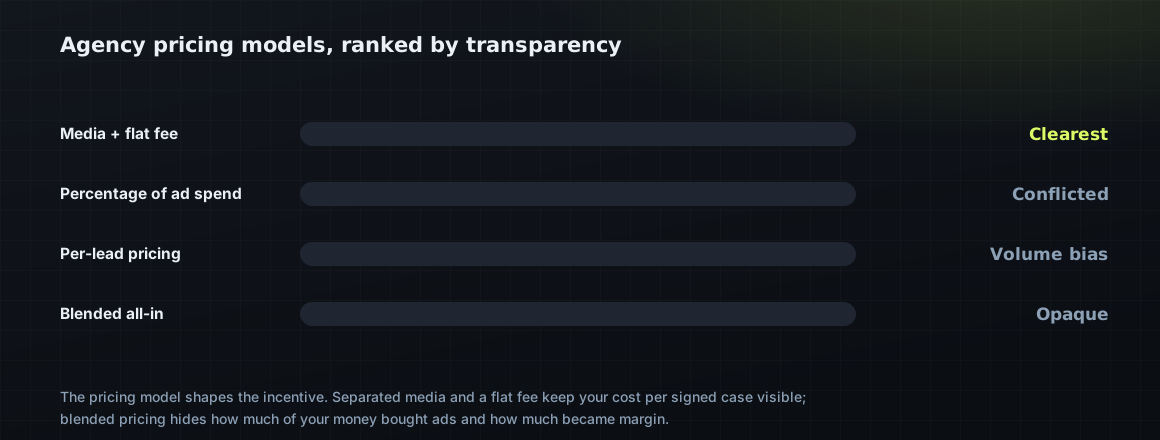
Media plus a flat management fee is the cleanest: you see exactly what reaches the ad platforms and exactly what you pay the team, so your cost per signed case is always visible. Percentage of ad spend is common but creates a subtle conflict — the agency earns more when you spend more, whether or not spending more produces cases. Per-lead pricing aligns the agency to volume, which as covered elsewhere is not the same as cases, and can incentivize cheap, low-intent leads. And blended, all-in pricing — one number covering media and fee together — hides how much of your money bought ads and how much became margin, which makes your true cost per case impossible to calculate.
No model is automatically disqualifying, but they are not equal on transparency, and transparency is what lets you manage the only number that matters. If an agency insists on a model that hides your media cost, ask why — and weigh the answer heavily. The clearest arrangements keep media and fee separate and let you see your cost per signed case at all times. How much these arrangements typically cost is covered in what workers’ comp marketing costs.
See the difference on paper. Under separated pricing, an invoice reads “$12,000 media, $3,000 management” — you know exactly what bought ads and what paid the team, and you can divide either by your signed cases. Under blended pricing, the same relationship reads “$15,000, all in,” and you have no idea whether $12,000 or $8,000 actually reached the platforms. If spend and results ever diverge, the blended invoice gives you nothing to diagnose with. The separated one lets you see immediately whether the problem is media, management, or intake. That visibility is worth more than a small discount on an all-in number.
The percentage-of-spend model deserves a closer look because it’s so common and its conflict is so easy to miss. When an agency earns a fixed percentage of what you spend on ads, every recommendation to “scale up” also scales their fee — regardless of whether the extra spend produces cases at your target cost. Most agencies on this model are honest, but the incentive quietly pulls toward more spend rather than more efficiency, and over a year that pull adds up. If you use this model, watch cost per signed case like a hawk, and treat any push to increase budget as a claim to be verified against the case math, not a favor.
The red flags
Some signals reliably predict a bad relationship, and the most seductive one is a guarantee. An agency that guarantees a number of cases or a cost per case is either inexperienced or willing to say anything to close you — no one controls a market, a competitor’s budget, or an auction well enough to promise results, and the guarantee usually comes with fine print that makes it meaningless.
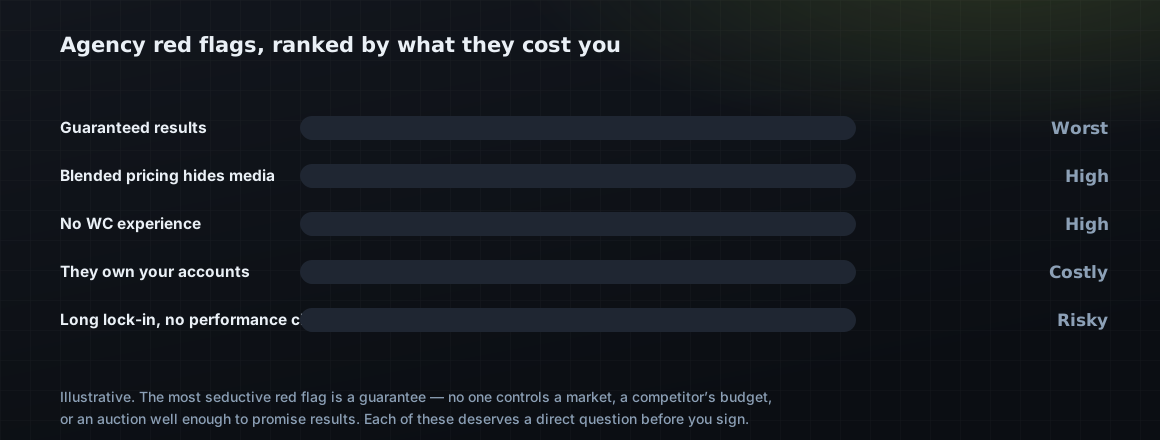
The others are quieter. Blended pricing that hides your media cost. No demonstrable workers’ comp experience, dressed up as “marketing is marketing.” Agency-owned accounts you can’t take with you, which turns a normal breakup into a hostage negotiation. And long lock-in contracts with no performance clause, which shift all the risk to you — if the work is good you won’t want to leave, so a long lock-in mainly protects an agency that expects you might. None of these is always fatal, but each one deserves a direct question and a straight answer before you sign.
One modern red flag deserves its own mention: the proprietary black box. Some agencies market a “custom dashboard” or “AI-powered system” that shows you curated metrics while keeping the underlying ad accounts and raw data out of reach. A dashboard is fine as a convenience and a problem as a substitute for access. If the only way you can see your marketing is through a screen the agency controls, you don’t have transparency — you have a nicer-looking curtain. Insist on direct account access underneath any dashboard, and treat reluctance as the answer.
Who should own what
Ownership is the least glamorous part of the decision and one of the most important, because it determines what happens when the relationship ends — and every relationship eventually ends. As a rule, you should own the ad accounts, the analytics, the data, the domain, and ideally the creative your budget produced. The agency brings the skill; you keep the assets.
This isn’t about distrust — it’s about leverage and continuity. If your agency owns your Google and Meta accounts, your years of conversion history and your audiences live in their possession, and leaving means starting the algorithm’s learning over from zero. If they own your call-tracking and CRM data, you can’t even measure them honestly. Insist that every account is created under your ownership with the agency granted access, not the other way around. A good agency has no problem with this; it’s how they’d want to be treated too. The plumbing of who owns which system is covered in the intake tech stack.
Put the transition in writing before you need it. A short offboarding clause — the agency will, on termination, transfer or maintain your ownership of all accounts, hand over creative files, and export your data within a set number of days — costs nothing when the relationship is good and saves you enormously when it isn’t. The time to negotiate a clean exit is when both sides are optimistic, not in the middle of a breakup. An agency that balks at a reasonable transition clause is telling you they plan to use lock-in as leverage.
Continuity is worth protecting for a concrete reason: the ad platforms learn. A Google or Meta account that has run for a year has accumulated conversion history, audiences, and optimization the algorithm uses to find your buyers more cheaply over time. If that account belongs to the agency and you leave, that learning doesn’t come with you — the next agency starts a fresh account from zero and your cost per case spikes during the relearning. Owning the accounts isn’t paperwork; it’s protecting an asset that gets more valuable every month it runs. Make ownership a condition of signing, not a conversation for later.
The onboarding test
The first ninety days tell you almost everything about the next two years. A serious agency treats onboarding as discovery: they learn your best case types, your economics, your intake, your market’s competitors, and your goals before they touch a campaign. A weaker one launches ads in week one to look fast, then spends months guessing at the market they never studied.
Watch what they ask for. An agency that wants your historical case data, your intake process, your best and worst case types, and your definition of a good month is building a strategy. One that only wants your logo and your credit card is buying media. The onboarding checklist a good agency should run — and what your side of it looks like — is in the first 90 days with a new marketing agency. If the early weeks feel like a real intake of your firm rather than a rush to spend, you’ve probably chosen well.
The opposite pattern is easy to spot once you know it. Red-flag onboarding is a logo, a card, and live ads inside a week, with no discovery of your case types, your intake, or your market. It feels fast and reassuring, and it’s a warning sign — speed at the start usually means the agency is running a template, not a strategy, and the template was built for someone else’s firm. Real onboarding can feel slow because it’s doing the work that makes the spend pay off later. Judge the depth of the questions, not the speed of the launch.
Making the decision
When two agencies both sound good, decide on the things that are hard to fake. Specialization you can verify with signed-case references. Transparency you can test by asking to see a sample of the real reporting they’d give you. Ownership you can settle in the contract. Fit you can feel in how they answer a hard question — do they get defensive, or do they engage? Price should be the last tiebreaker, not the first filter, because the cheapest agency that hides your cost per case will cost you far more than the transparent one that charged a fair fee.
Above all, choose the agency that wants to be measured on the same number you care about: signed cases at a cost below what a case is worth. An agency that volunteers that standard, gives you the data to check it, and expects to re-earn your business every quarter is a partner. One that wants a long contract, a blended price, and control of your accounts is a risk wearing a nice suit. The questions in this guide will tell you which one is sitting across the table.
When you can, structure the start as a trial rather than a leap. A shorter initial term, or a defined pilot with clear success criteria and a clean exit, lets both sides prove the fit on real results instead of promises. A confident agency welcomes a trial because they expect to earn the renewal; an agency pushing for a long commitment up front is asking you to bet on the pitch. Give yourself a real off-ramp, agree in advance on what a good first quarter looks like — signed cases at a target cost, not impressions — and let the actual numbers, not the sales conversation, make the long-term decision for you.
Finally, trust the gut-check, because you’ll be talking to these people every week for years. Do they explain things clearly or hide behind jargon? Do they push back when you’re wrong, or just agree to keep you happy? Do they seem to understand that your business is signing injured workers, not winning marketing awards? The best agency relationships feel like adding a smart, honest member to your team — someone who tells you the uncomfortable truth about your intake or your close rate because they’re measured on the same outcome you are. If the relationship feels transactional or evasive during the courtship, it will not improve after the contract is signed.
And don’t let urgency choose for you. The pressure to “get marketing going” pushes firms into fast decisions they regret, and agencies know it — an artificial deadline or a “this rate expires Friday” is itself a small red flag. A good agency will still be a good agency next month. Take the time to ask the questions, check the references, read the contract, and run a small pilot if you can. A month of diligence up front is nothing against a year locked into the wrong partner. The firms that choose well are rarely the ones who chose fastest; they’re the ones who refused to sign until the answers held up.
Key takeaways
-
Choose on how an agency thinks, not what it promises. The right agency is decided by questions about transparency, specialization, and ownership — not by who guarantees the most or charges the least.
-
A specialist beats a generalist where comp is specific. Injured-worker demand, attorney-advertising rules, and intake all behave differently enough that general law-firm marketing misses them.
-
Every pricing model hides a different incentive. Percentage-of-spend, flat retainer, and per-lead each push an agency somewhere; know which direction before you sign.
-
Decide who owns what on day one. Accounts, data, and creative should be yours no matter who runs them, so switching never means starting over.
-
The onboarding test predicts the engagement. How an agency handles the first 90 days — access, baselines, reporting — tells you more than any pitch deck.
Frequently asked questions
How do I choose a workers’ comp marketing agency?
Judge on four verifiable things: transparent media spend separate from the fee, reporting in signed cases and cost per case, genuine workers’ comp focus, and exclusive rather than shared leads. Ask to see a case study and speak to a current client, and prefer short contracts with clean exits.
Should I hire a specialist or a general legal-marketing agency?
A capable generalist can serve you well, but a workers’ comp-only specialist starts ahead on the injured-worker mindset, bilingual demand, intake urgency and creative, so it does not spend your first months learning the niche.
What are the red flags in a marketing agency?
Bundled media and fee you cannot separate, guarantees of a specific number of cases, reporting that is all clicks and no cases, shared leads sold as exclusive, and long lock-ins with big upfronts. Any one is a reason to keep looking.
How much should I pay a workers’ comp marketing agency?
The cleanest structure is transparent media spend plus a flat management fee, so you always know your true cost per signed case. Most firms running paid acquisition seriously invest a few thousand to low five figures a month in media plus a separate fee.
Should I hire a workers’ comp specialist or a general marketing agency?
A specialist that markets workers’ comp firms starts months ahead: they already know the injured-worker buyer, the health-advertiser compliance rules, and what a signed case should cost in your market. A capable generalist can succeed, but you pay for the learning either way — with a specialist, most of it is already done.
What should a workers’ comp marketing agency contract include?
You should own the ad accounts, data, domain, and creative, with the agency granted access rather than control. Media spend and management fee should be listed separately so your cost per signed case stays visible. Avoid long lock-ins with no performance clause, and make sure results are reported as signed cases, not just leads or clicks.
Sources & further reading
-
01
Go deeper on the decision
The two guides that bookend choosing well.
-
02
Price and systems
What it costs, and the systems a good agency expects to inherit.
Benchmarks here draw on WorkersComp Marketing’s own managed-spend data across live workers’ comp firms; your numbers will differ. General marketing information, not legal advice.