
The cheapest signed case a workers’ comp firm will ever get comes from a person it already paid to reach once. Email is how you reach them the second, fifth, and twentieth time — for almost nothing.
Here is the pattern I see in firm after firm. They spend real money to generate a lead — on our own numbers, roughly $75 for an injured-worker lead — the intake team calls once or twice, the person does not sign on the spot, and the lead is quietly abandoned. Meanwhile a database of hundreds or thousands of past leads and past clients sits in a CRM doing nothing. The firm goes out and buys more strangers next month. It is the marketing equivalent of filling a bucket with a hole in the bottom.
Email is the patch. Not the promotional junk everyone’s inbox is drowning in — the deliberate, useful, owned channel that catches the leads your ads already bought and keeps them warm until the day they are ready. This piece is about the three jobs email actually does for a comp firm, what to send when you feel like you have “nothing to say,” how to stay on the right side of the rules, and how to measure the whole thing in cases instead of vanity numbers.
Rented vs. owned: why email is different
You can lose every other channel overnight. You cannot lose the list.
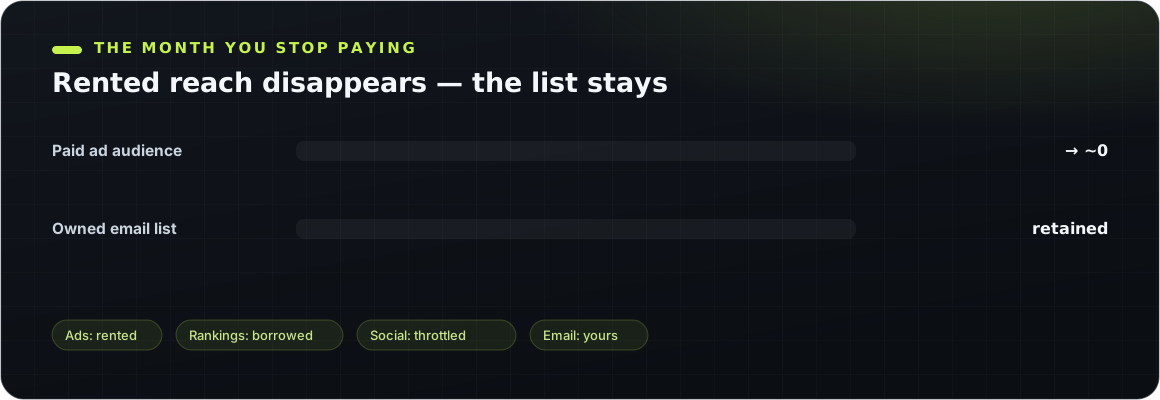
Think about what you are actually buying with a paid channel. You rent attention for as long as the meter runs. Pause the Meta account and the leads stop the same day; the thousands of people who saw last quarter’s ads are gone, re-addressable only by paying again. Search rankings are borrowed from Google’s algorithm, which reorders your world without warning. Organic social reach is metered out by a platform that would prefer you pay to reach the audience you already built.
An email list is the exception. It is a direct line to people who raised a hand — a former lead, a past client, someone who downloaded your benefits guide — that no platform sits between you and. It does not reset when a budget pauses. It does not get reordered by an algorithm. It is, in the most literal sense, the only marketing asset a firm owns rather than rents, and every dollar you spend acquiring a lead is also, quietly, a dollar spent building that asset — if you capture the address and actually use it.
That reframing changes the math on everything upstream. A $75 lead looks expensive as a one-shot phone call. It looks very different when that same address stays reachable for years, catches the person on the week they finally decide, and later sends two friends. The list is where a rented click becomes an owned relationship.
The three jobs email does for a comp firm
Not “a newsletter.” Three specific, measurable jobs.
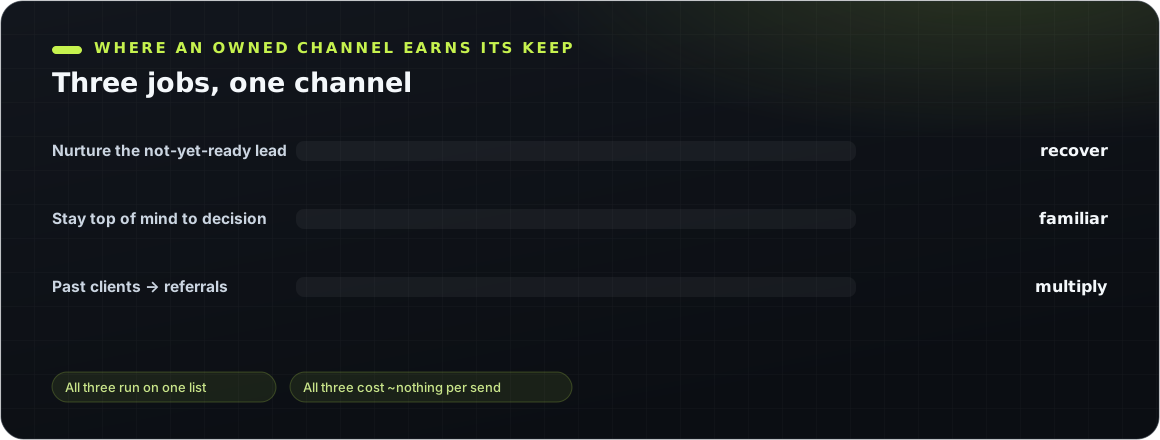
“Should we do email?” is the wrong question, because it treats email as one thing — a newsletter you either have or you don’t. In a comp firm it is really three separate jobs that happen to run on the same list:
Nurture the lead who is not ready. Most injured workers do not hire on the first call. Email is what keeps the conversation alive across that gap instead of letting the $75 lead go cold. This is the automated safety net under your speed-to-lead effort.
Stay top of mind until the decision. A worker who is still deciding — still hoping the employer does the right thing — needs to remember you exist the week that hope runs out. A steady, useful presence in the inbox is how a firm stays the familiar name at the moment of choice.
Turn past clients into a referral and review engine. The people you already helped are your best marketers, and email is the cheapest way to stay in their lives so that when a coworker gets hurt, your name is the one they hand over. It is also how you ask for the reviews that lower everyone else’s cost per lead.
Notice that none of these is “sell harder.” Each is a relationship a rented channel cannot maintain. The rest of this piece takes them one at a time.
Nurturing the “slow yes”
The gap between the click and the hire is where most leads are lost — and where email pays for itself.
An injured worker’s decision to hire a lawyer is rarely fast. They are scared of retaliation, unsure they even have a case, hoping the whole thing resolves on its own. So they inquire, they take the first call, and then they wait — sometimes days, often weeks. We wrote a whole piece on why abandoning that lead after two calls is the most expensive habit in intake. Email is the mechanism that makes not-abandoning actually scalable.
The move is a simple automated sequence that fires the moment a lead comes in and does not sign. Not a sales drip — a reassurance-and-usefulness drip. The first email confirms a real human has their information and tells them exactly what happens next. The following few, spaced over the first couple of weeks, answer the fears in order: Can they fire me for filing? What if the insurance doctor says I’m fine? How long does this take? What does it cost to talk to you? Every message is genuinely helpful whether or not they ever hire you — which is precisely why it builds the trust that makes them hire you.
Nobody signs with the firm that chased them hardest. They sign with the firm that was still useful on the day they were finally ready.
Spencer Moeller, WorkersComp MarketingThe reason this is an email job and not a phone job is leverage. Your intake team cannot call a lead thoughtfully every three days for a month across hundreds of open leads; a well-written sequence does it automatically, identically, and forever, and it flags the moment someone replies or clicks so a human can step back in at exactly the right time. You are not replacing the personal touch — you are making sure no one falls through the crack between touches.
The newsletter engine: what to send
“We’re a law firm, we have nothing to say” is a failure of imagination, not of material.
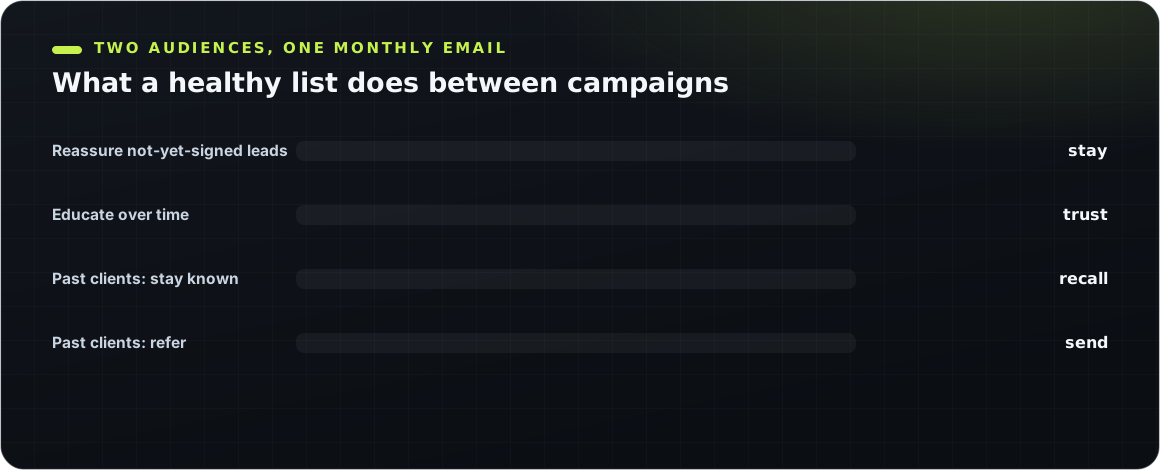
The reason most firm newsletters die is that they are written about the firm: a partner’s award, a new hire, a conference photo. Nobody subscribed to a law firm to hear that. People stay on a comp firm’s list for one reason — it consistently answers the questions they are afraid to ask out loud. So write the newsletter the injured worker would actually open:
Plain-English explainers. What to do in the first 48 hours after a work injury. What a denial actually means and how firms overturn them. How your weekly check is calculated and why it might be wrong. What a permanent-impairment rating is and why the number matters. This is the same well of injured-worker questions that powers the content engine — the newsletter is that engine’s distribution arm.
Deadlines and changes. The statute of limitations that quietly ends claims. The annual benefit-rate updates. A rule change in your state. Timely, useful, and a natural reason to send.
One human note. A short, real word from an attorney — not a bio, a perspective. This is where a faceless firm becomes a person the reader half-knows before they ever call.
Then hold a cadence, because consistency beats volume every time. A genuinely useful monthly email that always arrives builds more trust than a flurry of six in one week followed by a year of silence. Monthly is enough to stay familiar without training people to ignore you; pick the date, protect it, and let compounding do the work.
Past clients: the referral & review flywheel
The people you already helped are the cheapest cases you will ever get — if you stay in their lives.
A signed and satisfied client is worth far more than the case in front of you, because they sit inside exactly the network you are trying to reach: coworkers, family, and friends who do the same kind of work and face the same kind of injuries. But goodwill has a half-life. The client who loved you the month their case settled has forgotten your name two years later when their cousin gets hurt — unless you have stayed gently present the whole time.
Email is how you stay present at scale. The same monthly newsletter that nurtures leads keeps you top of mind with past clients for pennies, so that when a referral moment arrives, yours is the name on the tip of their tongue and, ideally, already forwarded. A light, occasional, explicit nudge — if someone you know gets hurt at work, we’re here — makes the ask without being needy, because it rides on a year of having been useful first.
It is also your best channel for reviews, which are both a ranking factor and a conversion lever for every other campaign you run. The trick is timing: the request lands not at case close, when the client is exhausted and just wants it over, but at the earlier moments of relief — the surgery authorized, the checks turned back on. Email lets you trigger that ask at the right milestone instead of the convenient one.
| Job | Audience | What it sends | The number it moves |
|---|---|---|---|
| Nurture | New, not-yet-signed leads | Automated reassurance-and-usefulness sequence | Lead-to-signed rate on paid traffic |
| Stay top of mind | The whole list | Useful monthly newsletter | Consults from “I’ve been meaning to call” |
| Referrals & reviews | Past clients | Value + occasional ask, timed to relief | Referred cases and fresh reviews |
Deliverability and the rules
An email that lands in spam, or crosses a line, does worse than nothing.
Two things quietly decide whether any of this works: whether your email arrives, and whether it stays inside the rules that govern a law firm emailing about injuries.
Deliverability is mostly list hygiene and restraint. Send to people who genuinely opted in; never buy a list. Authenticate your sending domain (the technical SPF/DKIM/DMARC setup your provider walks you through) so mailbox providers trust you. Prune addresses that never open, because a list full of dead weight drags your whole domain’s reputation down and lands even your good email in spam. A smaller list of engaged people outperforms a big list of ghosts on every metric that matters.
The rules. Commercial email is governed by CAN-SPAM, which is not complicated but is not optional: tell the truth in your “from” name and subject line, include a real physical mailing address, and give every recipient a working one-click unsubscribe that you honor promptly. On top of that sit attorney-advertising rules, which vary by state and generally frown on anything that reads as a guarantee or a misleading claim — the same restraint we covered in the piece on what comp firms can and can’t say. None of this is legal advice; it is the shape of the guardrails, and your own counsel sets the exact lines for your state.
Measuring email in signed cases
Open rates are theater. Cases are the number.

Open rate used to be the headline email metric. It is now close to meaningless — privacy features on major mail apps auto-load the tracking pixel and inflate opens for people who never read a word. Chasing it will make you optimize subject lines for a number that does not connect to revenue.
Measure the channel the way you measure every other one: in signed cases. Tag the links in your emails so clicks show up in analytics. Connect your email tool to your CRM so that when a nurtured lead books a consult or a past client sends a referral, the credit lands where it belongs. Then report email next to paid search and Meta on a single line each: cases sourced or assisted, and cost per signed case. Email will almost always post the lowest cost per case on the board — not because it is magic, but because it works an audience you already paid to acquire, at a marginal cost that rounds to zero.
None of this requires a big budget or a copywriting team. It requires deciding that the address is worth as much as the phone number, and then building the small, boring machine that keeps talking to the people you already paid to meet. The firms that do it stop refilling a leaky bucket and start compounding an asset the rest of the row keeps throwing away.
Key takeaways
-
Email is owned, not rented. Unlike ad audiences, your list is an asset no platform can take or re-price.
-
Email does three jobs for a comp firm. Nurture the slow yes, stay present with past clients, and drive reviews and referrals.
-
Most comp cases are a slow yes. Email is how you stay in the picture until the worker is ready to act.
-
Past clients are a referral-and-review flywheel. A simple cadence turns closed cases into new ones.
-
Deliverability has rules. Consent, clean lists, and honest subject lines keep you in the inbox and on the right side of the law.
Frequently asked questions
Does email marketing actually work for workers’ comp law firms?
Yes, but not as a broadcast blast. Its value is in three specific jobs: nurturing leads who are not ready to hire on the first call, staying top of mind between the injury and the decision, and turning past clients into a steady source of referrals and reviews. Measured in signed cases rather than opens, email is usually the cheapest case source a firm has, because the audience is one it already paid to acquire.
What should a workers’ comp firm send in a newsletter?
Send what an injured worker actually needs to know, in plain language: what to do after a work injury, what a denial means and how it gets overturned, how benefits are calculated, deadlines that quietly end claims. Value, not firm news. Nobody signed up to read that you attended a conference; they stay subscribed because you consistently answer the questions they are afraid to ask.
How often should a law firm email its list?
Consistency matters more than frequency. A useful monthly email that always arrives beats a burst of six in one week and then silence for a year. For active, not-yet-signed leads a tighter early sequence is appropriate; for past clients and a general list, monthly is a sustainable cadence that keeps you familiar without training people to ignore you.
Is emailing injured workers legal and compliant?
Commercial email is governed by CAN-SPAM, which requires accurate headers and subject lines, a real physical mailing address, and a working unsubscribe honored promptly. Attorney-advertising rules also apply, and you should avoid revealing sensitive information — never let a subject line or preview announce that someone is an injured-worker lead. This is general information, not legal advice; confirm your obligations with counsel.
What is the difference between email and retargeting or reactivation?
They overlap but are distinct. Retargeting is paid media that follows visitors around the web and stops when the budget stops. Reactivation is a campaign to wake a dormant database. Email marketing is the ongoing owned channel underneath both: the list you keep, the relationship you maintain, and the automated sequences that catch every new lead whether or not you are running ads that month.
How do you measure whether firm email is working?
Not by open rates, which are increasingly unreliable. Measure the outcomes that matter: how many consultations and signed cases the channel assisted or sourced, and the cost per signed case once you account for the near-zero marginal cost of emailing an audience you already own. Tag links, connect the CRM, and report email the same way you report every other channel — in cases.
Sources & further reading
- 01
- 02
-
03
Keep it measured and compliant
Attribute it, and stay inside the rules.
Benchmarks here draw on WorkersComp Marketing’s own managed-spend data across live firms; your numbers will differ. General marketing information, not legal advice.