The most expensive billboard in your market is the one bought because a partner wanted to see the firm’s face on the way to work. The cheapest one is the same board bought because that is the road ten thousand injured workers drive every morning.
Out-of-home — billboards, bus and transit wraps, bench ads, the digital boards over the freeway — is the most visible channel a workers’ comp firm can buy, and visibility is exactly the trap. Because everyone can see it, it feels like it must be working, and because almost nobody measures it, that feeling never gets tested. Firms sign twelve-month contracts on a handshake and a traffic-count sheet, admire their own board for a year, and re-sign without ever knowing whether it produced a case.
It does not have to be that way. Out-of-home is a real familiarity engine with a specific mechanism, specific rules for buying it well, and — despite the reputation — real ways to measure it. This piece is about spending out-of-home money like an operator instead of an owner with an ego: what it actually buys, where to place it, what it can say, why frequency beats the trophy board, and how to prove whether the thing on the freeway is doing anything at all.
The vanity trap
The board that makes you feel like a big firm and the board that makes you cases are rarely the same board.
Every out-of-home mistake starts the same way: the decision is about how the board makes the firm feel, not about where the prospect is. The trophy board — the giant one on the busiest interchange, the one your friends will text you about — is chosen for prestige and priced for it, and its enormous traffic count is mostly people who will never be injured workers and would never remember your name if they were.
The tell is in how the buy gets justified. “A hundred thousand cars a day” sounds like a lot until you ask how many of those drivers are your prospect, how many times each one passes it, and whether a single one could recall your firm a week later. Impressions are not the product; remembered impressions among the right people are. A board bought on raw traffic count is buying the wrong number.
None of this means out-of-home is vanity by nature. It means the vanity version and the effective version look almost identical from the outside — both are big and visible — and differ entirely in the thinking behind placement, creative, frequency, and measurement. The rest of this piece is that thinking.
What out-of-home actually buys
Repetition, locality, and unavoidability — the things a scrollable screen can’t give you.
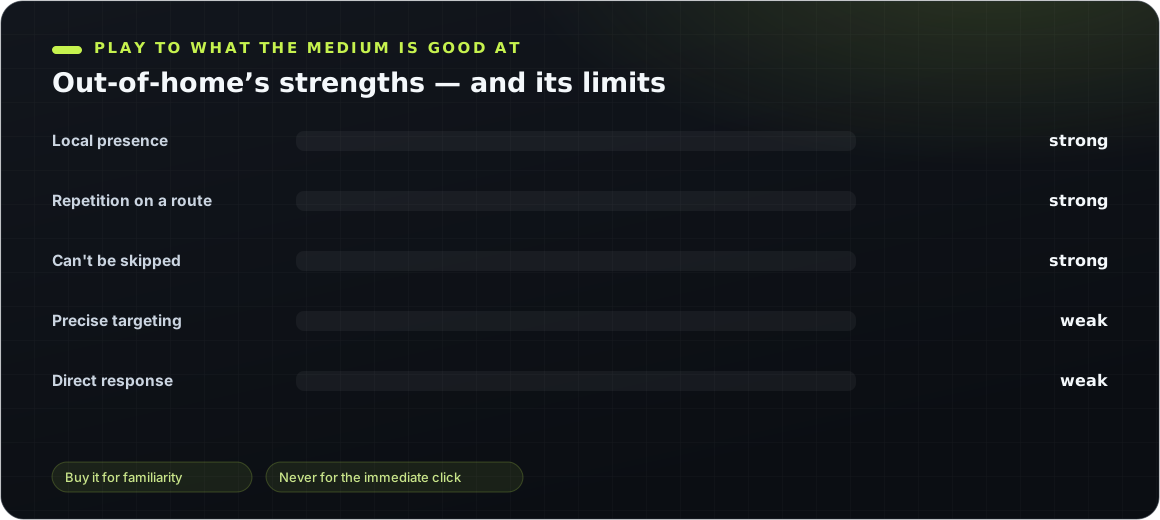
Out-of-home does three things almost nothing else can. It is relentlessly local — it plants your name in the physical world your prospect lives in, which reads as permanence and rootedness in a way a digital ad never will. It is repetitive by nature — the commuter passes the same board twice a day, five days a week, and that drumbeat is exactly how familiarity forms. And it is unavoidable — it cannot be scrolled past, ad-blocked, or skipped, so it reaches people who have tuned digital advertising out entirely.
What it cannot do is target precisely or drive immediate action. A board on a highway is seen by everyone on that highway, and no one is going to pull over to write down a lawyer’s number. That is not a flaw to fix; it is the nature of the medium, and the whole art of out-of-home is choosing placements where “everyone on this road” happens to overlap heavily with “people who get hurt at work,” then letting repetition do the slow work of becoming familiar. As with television, this is a top-of-funnel familiarity buy that makes your demand-capture channels convert better — not a channel that closes cases on its own.
Where to place it: the roads that matter
Follow the commute of the injured worker, not the map of the most famous intersections.
Placement is where out-of-home is won or lost, and the principle is simple: go where injured workers already are. That is not the glamorous skyline board. It is the working infrastructure of your market — the corridors that carry people to and from physical jobs.
Industrial and logistics corridors. The highways and arterials around warehouses, distribution centers, ports, factories, and construction zones carry a dense concentration of exactly the workers most likely to be hurt on the job. A board on the road out of a warehouse district at shift-change is worth more than a far bigger one downtown.
The neighborhoods where they live. Boards, bus wraps, and transit ads in and around working-class residential areas reach your prospect at home and on the daily commute, and they reach the family members who will recommend you. Transit is especially efficient here — it rides the exact routes your audience travels.
Language and community fit. In many markets a large share of injured workers are Spanish-speaking, and out-of-home in the right neighborhoods, in the right language, reaches an audience the grey-middle firms ignore — the same opportunity we mapped in marketing to the Spanish-speaking injured worker. A billboard is a powerful, plain way to say “this firm is for you” in the community itself.
The three-second rule
One idea, one number, giant type. Everything else is a word the driver won’t read.
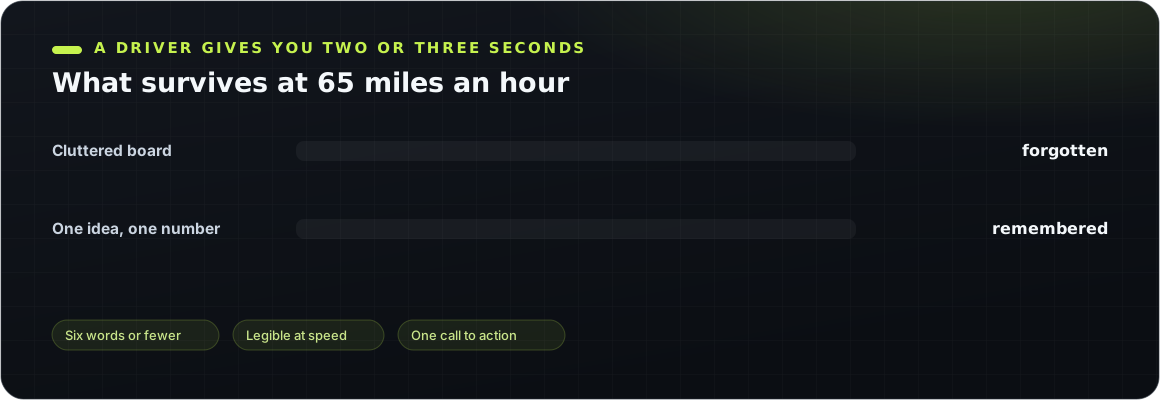
A driver has two or three seconds with your board, at speed, while doing something else. That single constraint dictates everything about the creative, and it is unforgiving: whatever cannot be absorbed in three seconds is not just wasted, it actively crowds out the one thing you needed them to keep.
So a billboard can carry one idea, one way to reach you, and almost nothing else. Name the situation in the fewest possible words — “Hurt at work?” does more than a paragraph of practice areas. Give a single memorable contact: one easy phone number or one short, spellable web address, never both, never three. Make the type enormous and high-contrast, readable from far away by someone not trying to read it. And show, if anything, one human face rather than a collage.
The discipline here is the same one that separates a strong brand from a commodity one, which we covered in the branding piece: lead with the prospect’s fear, prove nothing you can’t prove in a glance, and cut every word that is there to make the firm feel thorough rather than to help the reader. On a billboard the cost of clutter is just more visible — it is the difference between a board thousands remember and a board thousands drive past.
Frequency beats the trophy board
One spectacular location loses to a network of the right ones, every time.
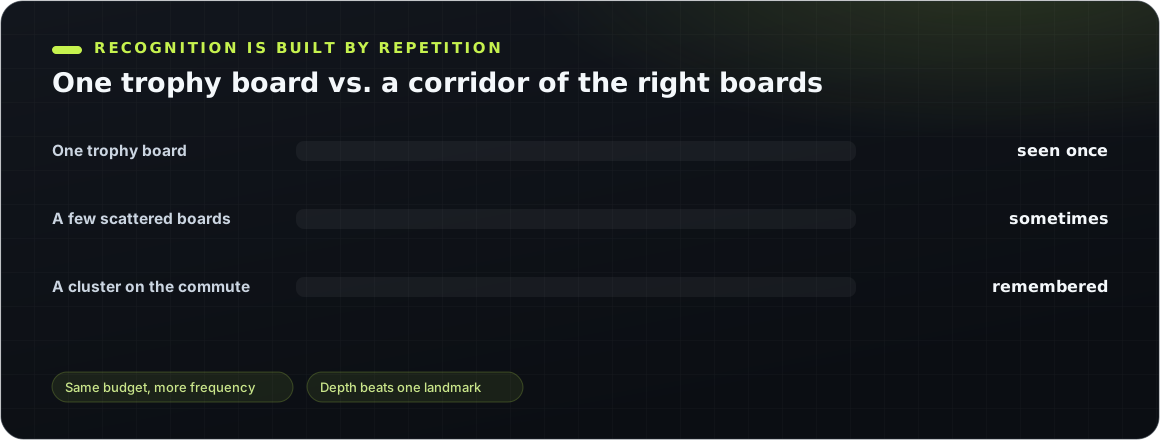
The instinct is to spend the whole budget on one great board. It is almost always the wrong move, because out-of-home works on the same principle as broadcast: frequency, the number of times the same person sees you, matters more than raw reach. One trophy board delivers a huge pile of one-time impressions to strangers and very little repetition against your actual prospects. The same money spread across a coordinated cluster of well-placed boards on the corridors your prospects drive delivers the drumbeat that builds recognition.
This is where digital out-of-home earns a look. Digital boards let you rotate creative, change the message by time of day — commute hours for injured workers, say — and buy shorter, more flexible flights, which makes them an excellent way to test a corridor before committing to a static board there for a year. The trade-off is that a digital board shares its slot with other advertisers, so your message is not always up, which can thin the very frequency you are trying to build. A reasonable pattern is to test corridors with flexible digital, then own the ones that prove out with constant static presence.
Either way, the mindset is a network, not a monument. You are trying to become the name a warehouse worker has seen on the way to work two hundred times this year — not the name a stranger admired once from the far lane of a freeway.
Measuring out-of-home honestly
It feels unmeasurable. It isn’t — if you measure lift instead of asking who called off the board.
Out-of-home’s reputation for being unmeasurable is really a reputation for being measured badly — by counting the handful of people who call the number straight off the board, which is close to none. Measure the lift it creates instead, and the fog clears. Three methods do the work.
A dedicated number or vanity URL. Put a phone number or a short, memorable web address on your out-of-home that appears nowhere else. Every call or visit to it is unambiguously from the boards. It will undercount the total effect — most people who become familiar with you from a billboard later find you by searching your name — but it gives you a clean, honest floor.
Branded-search and direct-traffic lift. When out-of-home is working, more people in the covered area search your firm by name and type your URL directly. Watch branded search and direct traffic, segmented to the billboard’s geography, before and during a flight. A rise that tracks your boards is the fingerprint of familiarity forming — the same lift logic we used for attribution.
The geographic comparison. The strongest evidence available: run out-of-home in some corridors and not in comparable ones, and compare signed-case volume between them over time. If the covered areas pull ahead, the boards are working; if they don’t, you have learned something that just saved you a year’s contract. Hold out-of-home to the same standard as every other channel — cost per signed case — and it stops being an act of faith.
When out-of-home pays — and when to skip it
It is an amplifier, not a foundation. Build the machine first, then make it louder.
Out-of-home pays when a few things are already true. Your website, search, and intake are working, so the familiarity a billboard builds has somewhere to convert — there is no point making a warehouse worker recognize your name if the search they run afterward finds a broken site or an unanswered phone. You have a defined geography with real clusters of injured workers to concentrate on. You can afford enough boards for frequency, not just one for show. And you have the patience to let recognition build over months and the discipline to measure the lift.
Skip it — for now — when the fundamentals aren’t in place, when the budget only stretches to a single trophy board, or when you are tempted to buy it for how it will feel rather than what it will do. A young firm almost always gets more signed cases putting that money into demand capture and intake first, then adding out-of-home once there is a working machine for it to amplify. Out-of-home is a lever on a system that works; it is not the system.
| Decision | The vanity version | The version that pays |
|---|---|---|
| Placement | The biggest, most famous board | The corridors injured workers actually drive |
| Number of boards | One trophy location | A cluster built for frequency |
| Creative | Logo, taglines, two numbers, a QR | One idea, one number, giant type |
| Reason for buying | How it makes the firm look | Where the prospect is |
| Measurement | “Everyone says they saw it” | Dedicated number, search lift, geo holdout |
A billboard is not proof that a firm has made it, and it is not a relic either. It is a familiarity amplifier that, aimed at the right roads and measured with honesty, can make a whole market recognize your name — or, bought for the view from the partner’s commute, the most visible way to waste a year’s marketing budget. The board looks the same from the highway. The difference is entirely in the thinking behind it.
Key takeaways
-
Billboards are a vanity trap more often than a channel. The trophy board on the freeway flatters the partners and rarely signs cases.
-
Out-of-home buys familiarity, not clicks. It builds recognition over time; it does not produce trackable leads.
-
Placement is the whole game. The roads that matter are the ones your prospects actually drive, not the ones that impress.
-
Frequency beats the trophy board. Repeated exposure on the right routes outperforms one dramatic placement.
-
It pays in narrow conditions. Dense market, strong brand, and real frequency; otherwise skip it.
Frequently asked questions
Do billboards work for workers’ comp law firms?
They can, but only as a familiarity channel, not a direct-response one. A billboard’s job is to make your firm the recognized name an injured worker recalls when they later need a lawyer — so it works when it is placed on the roads your prospects actually drive, repeated enough to stick, and paired with strong search and intake to catch the demand it warms up. It fails when it is a single trophy board bought for prestige and judged by whether anyone calls the number off the highway, which almost no one does.
Where should a workers’ comp firm place billboards?
On the commuter corridors that carry injured workers — the highways and arterials near industrial parks, warehouses, ports, construction zones, and the working-class neighborhoods where they live. The goal is repetition on the routes your prospect drives every day, not the single most expensive board with the biggest traffic count. A cluster of well-placed boards along a daily commute beats one landmark board everyone photographs and no prospect remembers.
What should a workers’ comp billboard say?
Almost nothing. A driver has two or three seconds, so a billboard can carry one idea, one number or short web address, and giant, legible type — and that is all. Name the situation (“Hurt at work?”), give one memorable way to reach you, and make it readable at 65 miles an hour. Every extra word, phone number, or practice area is one the driver will not read, and clutter is the single most common reason out-of-home fails.
How many billboards does a firm need?
Enough to create frequency, which usually means several coordinated boards rather than one. Out-of-home works by repetition — the same driver passing your message day after day — so one trophy board produces a lot of impressions but very little frequency against the people who matter. A network of smaller, well-placed boards along the corridors your prospects travel builds recognition far more efficiently than a single spectacular location.
How do you measure whether a billboard is working?
Not by calls off the board, which are rare and unreliable. Measure the lifts it creates: a dedicated phone number or vanity URL used only on out-of-home, a rise in branded searches for your firm and in direct traffic from the billboard’s area, and cleanest of all a geographic comparison — track signed cases in the covered corridors against similar areas with no boards. Out-of-home is a familiarity medium, so judge it by the lift it produces, not by a caller’s memory.
Are digital billboards better than traditional ones?
Digital out-of-home adds flexibility — you can change the message, rotate creative, run different ads by time of day, and buy shorter flights — which lowers the commitment and lets you test. But it shares the slot with other advertisers, so your message is not always on the board, which can dilute frequency. Traditional static boards give you constant presence in one spot. Neither is universally better; digital is often the smarter way to test a market, static the better way to own a corridor once you know it works.
Sources & further reading
-
01
The awareness channels
Where out-of-home sits among brand plays.
-
02
Where demand is captured
The channels that catch the search a billboard triggers.
- 03
Benchmarks here draw on WorkersComp Marketing’s own managed-spend data across live firms; your numbers will differ. General marketing information, not legal advice.