Nine days ago we published a piece arguing that a workers’ compensation firm’s marketing budget is a loan to the docket: the money goes out monthly, the fee comes back once, late, on a calendar somebody else controls. That article was about the shape of the hole. This one is about the only thing in the act that partly fills it before the end.
It is not a loophole and it is not new. It has been sitting in the California Labor Code in substantially its current form since well before anybody in this industry was buying leads, and every applicant’s attorney in the state knows it by its number. What is new is that the state is, this autumn, finally writing down what an hour of it is worth — eight years after the statute told it to — and that nobody in marketing has ever asked what it does to the arithmetic.
So the claim of this article, stated plainly: a workers’ compensation practice is not a pure contingency business, and the part of it that is not contingent is the only revenue line a firm earns by being retained rather than by recovering. It changes the payback period on a marketing dollar, it is concentrated in exactly the cases most intake scripts treat as the hard sell, and it is about to be repriced by regulation.
Your case math has one revenue event in it
Open the spreadsheet the partners actually use. Count the places money comes in.
Every acquisition model we have ever been shown by a comp firm — and we have been shown a lot of them — has the same skeleton. Spend goes in at the top. Leads come out at a cost per lead. Some proportion of them sign, which produces a cost per signed case. And then, on the other side of a gap nobody draws, there is one arrow labelled something like average fee, and the business case is whatever survives the subtraction.
That model is right about the direction of every term in it. It is wrong in one structural way: it assumes the firm has exactly one way to be paid, and that the way is a percentage of what the client eventually receives.
In a personal-injury practice that assumption holds almost perfectly. In workers’ compensation it does not, and the reason is worth sitting with. Comp is not a lawsuit between two private parties with a contingency agreement bolted on. It is an administrative scheme in which the legislature wrote down who pays for what, line by line — including, in some states, who pays for the injured worker’s lawyer in defined circumstances. Once a legislature is in the business of allocating costs, it does not always allocate them to the claimant.
The figure below is the whole argument in one picture. Two payments, one case, one of them a very long way from the other.
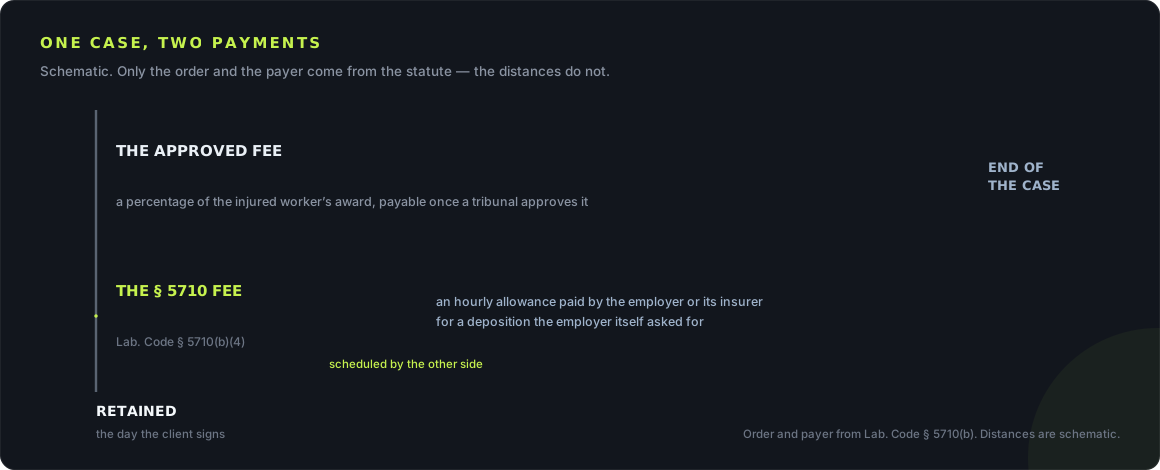
One more thing about that diagram before we take the statute apart. The lime marker is not an early instalment of the grey one. It is a separate obligation owed by a different party, and it does not reduce the fee at the end. That distinction is the entire commercial interest of this subject, and it is why “we already know our fees are slow” is not an answer to it.
Section 5710(b)(4), in full
Thirty-nine words of operative text, and every one of them matters to a business model.
Here is the provision, read at the official California Legislative Information site on 11 November 2026. Subdivision (b) opens: “If the employer or insurance carrier requests a deposition to be taken of an injured employee, or any person claiming benefits as a dependent of an injured employee, the deponent is entitled to receive in addition to all other benefits” — and then lists five things. The first three are expenses, wage loss and a free transcript. The fourth is the one nobody outside the practice has read:
“A reasonable allowance for attorney’s fees for the deponent, if represented by an attorney licensed by the State Bar of this state. The fee shall be discretionary with, and, if allowed, shall be set by, the appeals board, but shall be paid by the employer or his or her insurer.”
Read that as a commercial term rather than as procedure. It has four properties that the contingency fee does not have, and the table below sets them against each other.
| The approved fee | The § 5710 fee | |
|---|---|---|
| Who pays it | The client, out of the compensation recovered | The employer or its insurer, out of its own money |
| What it is a function of | The size of the award | Time spent, at an hourly rate |
| Does the firm have to win? | In substance, yes — there must be compensation to take a share of | Subsection (b) imposes no outcome condition |
| Who decides when it is triggered | The docket, and ultimately the tribunal | The defence, by asking for the deposition |
| Who sets the amount | The appeals board, on approval | The appeals board, in its discretion |
| When the cash lands | At resolution | During the case |
The row that should stop a managing partner is the fourth one. In a contingency practice, every event that produces revenue is one the firm or the tribunal initiates. Here is a revenue event initiated by the opposing party, for its own reasons, on its own timetable — and the firm’s only role in causing it is to have been retained.
Four conditions, and the one that is absent
A rule is as valuable as its gate is wide. This gate is wide.
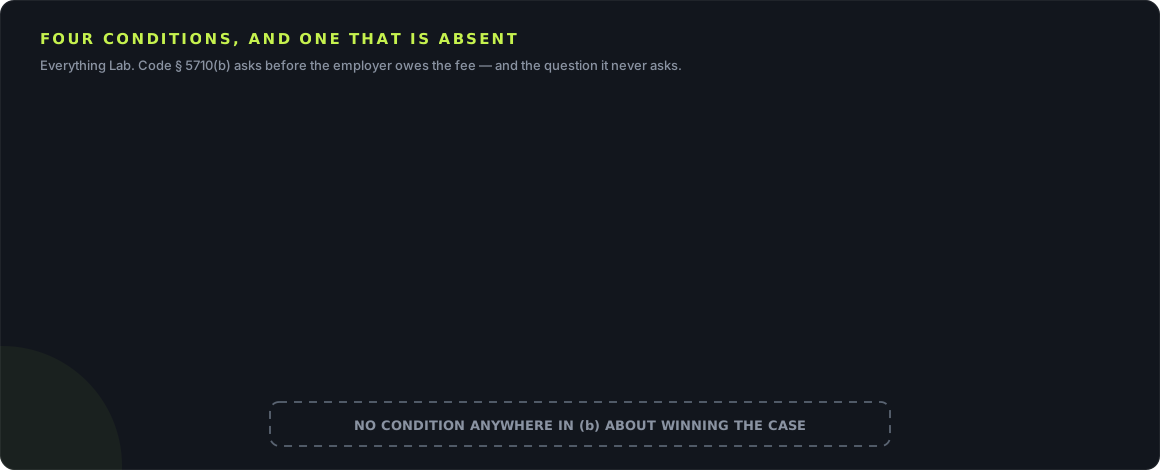
Strip subdivision (b) back to its conditions and there are four. The employer or insurance carrier must be the one requesting the deposition. The deponent must be an injured employee or a person claiming benefits as a dependent of one. The deponent must be represented. And the attorney must be licensed by the State Bar of California.
That is the whole test. There is no requirement that the claim be accepted, no requirement that the case eventually resolve in the worker’s favour, no minimum award, no percentage cap tied to the recovery, and no requirement that the deposition prove useful to anybody. The amount is discretionary and the appeals board sets it — that is a real constraint and we come back to it — but the entitlement itself does not hang on an outcome.
Two cautions, because an absence is an easy thing to over-read.
The first is that “discretionary” is doing real work. The appeals board decides whether to allow a fee at all and in what amount, and a judge who thinks an invoice is padded can say so. The entitlement is not an invoice the firm writes and the carrier pays; it is a claim on which a judge rules if the parties cannot agree. In practice the overwhelming majority are agreed rather than litigated, which is precisely why the amounts have drifted and why the state has got involved.
The second is that this is one subdivision of one state’s act. We have read two acts for this article. We have not read fifty, and the honest position at the end of this piece is that you should go and read your own.
Eight years without a price
The statute named a deadline. The deadline was 2018. The draft went out for comment last month.
The last sentence of § 5710(b)(4) reads: “The administrative director shall, on or before July 1, 2018, determine the range of reasonable fees to be paid.” That instruction arrived with SB 1160, effective 1 January 2017. The range it called for has still not been adopted.
What filled the gap is in the state’s own words. The Division of Workers’ Compensation’s newsline of 28 October 2026 states that “Currently, attorney rates for depositions are guided by local policies established by presiding judges in each district” and that “individual rate awards may be disputed and litigated before WCAB judges.” The same release confirms that the Administrative Director “is responsible for establishing a range of reasonable attorney rates for depositions” under § 5710(b)(4), and that the proposed regulation would add section 9795.6 to Title 8 of the California Code of Regulations. Public comments on the revised draft closed at 5 p.m. on 9 November 2026.
So what are the numbers? Here the sourcing gets weaker and we are going to say so rather than paper over it. The text of the initial draft went out in January 2026, and two California defence firms published summaries of it that agree with each other line for line. Laughlin, Falbo, Levy & Moresi and Bradford & Barthel both report the same four maximum hourly rates and the same list of charges the draft would disallow.
| Who is appearing | Proposed maximum | Previously, per the district memoranda |
|---|---|---|
| State Bar certified workers’ compensation specialist | $500 / hour | $400 |
| Attorney, five or more years in the field | $450 / hour | $350–$400 |
| Attorney, fewer than five years | $400 / hour | $300 |
| Non-attorney hearing representative | $250 / hour | $150–$200 |
Both summaries also report that the draft would require billing in tenths of an hour, forbid minimum or flat fees, and disallow four categories outright: general file review, travel time and travel expenses, review of the deposition transcript, and administrative or clerical tasks. One of the two, writing from the defence side, describes receiving invoices “over $3,000” for a deposition it considered unremarkable, itemised with exactly those four categories.
What it does to the arithmetic
One honest comparison, three numbers, and a warning about what they are.
Across the workers’ compensation ad accounts we run, the aggregate is roughly $16.5M of Meta spend, about 219,000 injured-worker leads at an average cost per lead near $75, and about 21,000 signed cases at roughly $775 each. Those are our own numbers across our own book. They are not an industry benchmark and we do not publish them as one.
Take the $775 and hold it next to two hours of attorney time at the top rate in the January draft. Two hours at $500 is $1,000. On those figures, a single deposition attended by a certified specialist is worth more to the firm than the entire advertising cost of acquiring that client — and it lands while the case is still open.
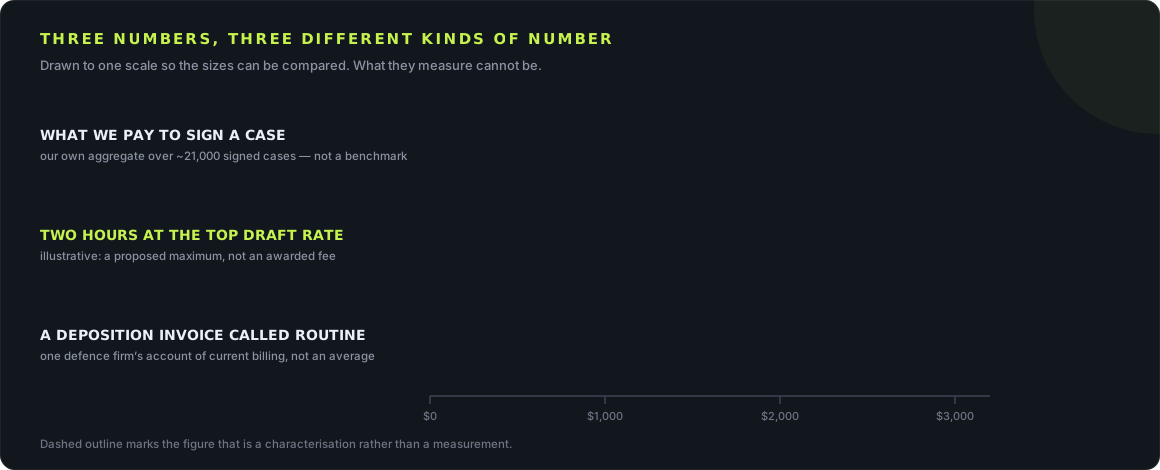
Resist the temptation to turn that into a business case, because three things stop it being one.
Not every signed case produces a deposition. We could find no published figure for what share of California comp claims involve a defence deposition of the applicant, and we are not going to estimate one. The rate is discretionary, so the top of a proposed range is a ceiling and not an expectation. And the hours are an assumption we made to have something to multiply.
What survives all of that is still worth having. It is a floor contribution on a defined subset of the book, arriving well before the fee. In a business whose central constraint is that money leaves monthly and comes back once, a term that lands in the middle changes the payback curve even when it is small, and it changes it most on exactly the files that take longest to resolve.
Florida has the same idea and a narrower gate
This is the part we nearly got wrong, and the reason to read your own act rather than ours.
The first draft of this article said that California was the only state that did this. That was an assumption, and it survived until somebody went and read Florida’s deposition section. Fla. Stat. § 440.30, read at the Florida Legislature’s own site on 11 November 2026, ends with this sentence:
“If no claim has been filed, then the carrier or employer taking the deposition shall pay the claimant’s attorney a reasonable attorney’s fee for attending said deposition.”
Same instinct, different gate. California’s condition is about who asked for the deposition. Florida’s is about where the case has got to: the fee attaches only while no claim has been filed. Once a petition is on file, the claimant’s fee runs through § 440.34 instead, which is a percentage of benefits secured, is payable by the claimant as the default, and shifts to the carrier only in four defined situations — and even then “attorney’s fees shall not attach under this subsection until 30 days after the date the carrier or employer, if self-insured, receives the petition.” Those printed percentages are not the whole of Florida law, either: in Castellanos v. Next Door Company the Florida Supreme Court held in April 2016 that the mandatory schedule “creates an irrebuttable presumption that precludes any consideration of whether the fee award is reasonable to compensate the attorney, is unconstitutional under both the Florida and United States Constitutions as a violation of due process.”
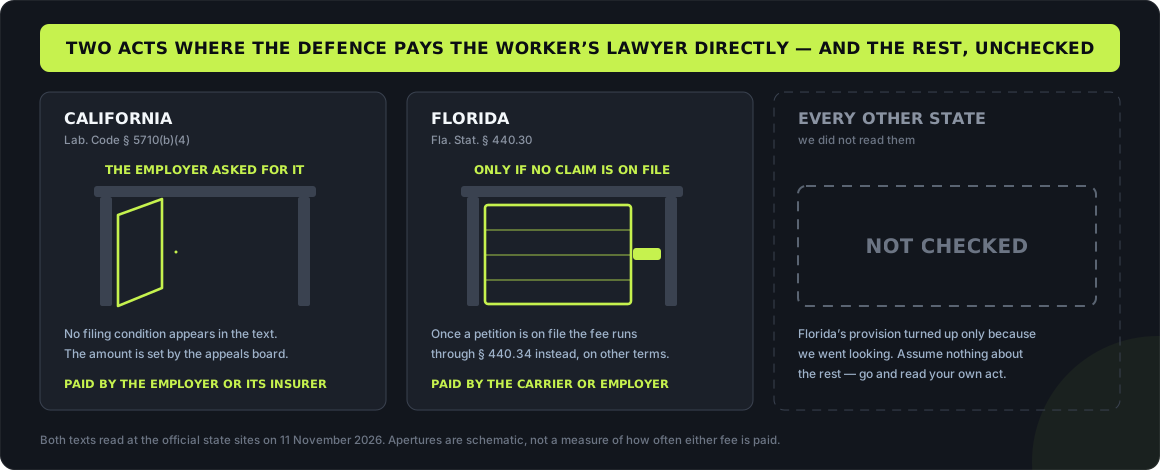
There is a lesson in that sentence being there at all. We went looking for a Florida analogue expecting to find none, found one in a section about depositions rather than a section about fees, and had to rewrite a claim that would otherwise have shipped as a confident falsehood. If a provision like this is hiding in the deposition section of two acts we happened to read, assume nothing about the forty-nine jurisdictions we did not. The question to put to your own counsel is not “do we have a 5710” — nobody outside California will know what you mean — but “does our act make the carrier pay us for anything, and if so, when.”
One thing is true of both provisions and it is the thread worth holding on to: in neither case is the money a share of the injured worker’s compensation. California says the fee “shall be paid by the employer or his or her insurer.” Florida says “the carrier or employer taking the deposition shall pay the claimant’s attorney.” Two legislatures, writing decades apart, both decided that when the defence wants the worker in a chair answering questions, the defence buys the lawyer’s time.
What to do with this on Monday
Four things, in order of how cheap they are.
Measure it before you believe us. Run the four-question query in the box above. If the answer is that your firm billed almost nothing under § 5710 last year, that is also an answer, and a more interesting one than this article — it means either your case mix is unusually uncontested or the billing is not happening. Both are worth knowing and neither is a marketing problem.
Put it in the payback model, not the revenue forecast. This is not a line to grow. It is a timing correction on a line you already have. The right place for it is wherever you currently answer the question “how long until a marketing dollar comes back,” because that is the number that decides how fast a firm can raise spend. We walk through the rest of that calculation in cost per signed case, and the cash-flow consequence in the case float.
Know which part of the book it sits in. Defence counsel do not depose the uncontested. The files that attract depositions are the contested ones: disputed causation, a prior injury in the record, no witnessed accident, a claim with no single date. Several of those are case types a comp intake script is trained to treat as a soft decline — we have written about the prior injury and the claim with no accident date separately. We are not telling you to sign difficult cases for the deposition fee. We are saying that if your case-mix policy was set by a model with one revenue line in it, the model was incomplete when the policy was written.
Watch the rulemaking, and say something next time. The comment window on the revised draft closed on 9 November 2026. If section 9795.6 is adopted as drafted, the price of this line is fixed statewide and four billing categories disappear from it. The applicant’s bar has been vocal; by the account of one defence firm, the defence side has been broadly in favour. Whichever way a firm leans, the thing not to do is find out about it from an adjuster’s remittance advice.
And the general point, which outlives the California regulation. A workers’ compensation practice is governed by a statute that decides, in detail, who pays for what. Most firms read that statute for the client’s benefits and never read it for their own. It is the only body of law in legal marketing that will tell you, in writing, what one of your hours is worth to the other side — and at the moment it is being rewritten while almost nobody on the business side of the industry is watching.
Key takeaways
-
Your acquisition model has one revenue event in it. Comp is a statutory scheme that allocates costs line by line, and it does not always allocate them to the claimant.
-
California’s § 5710(b)(4) is the second one. When the defence deposes a represented injured worker, the fee “shall be paid by the employer or his or her insurer” — hourly, not a share of the award.
-
Subdivision (b) sets no outcome condition. The allowance is discretionary and the appeals board sets it, but the entitlement does not wait on winning the case.
-
The statewide price is eight years late. The administrative director was told to set a range by 1 July 2018; a revised draft closed for public comment on 9 November 2026.
-
Two hours at the top proposed rate is $1,000, against our own ~$775 to sign a case. Illustrative only: not every case is deposed, and a proposed maximum is a ceiling, not an expectation.
-
Florida has a narrower version; the rest are unread. § 440.30 pays the fee only while no claim is on file. We read two acts, not fifty — go and read your own.
WorkersComp Marketing is a marketing agency, not a law firm. Nothing here is legal advice, advice about fee arrangements, or advice about your professional-conduct obligations. Statutes, regulations and rules about attorney’s fees are set state by state, they vary, and they change — the provisions quoted here are quoted to show that they exist and that they differ, not to tell any firm what it may bill or how it may bill it. The California rulemaking described here was a draft out for public comment when this was published and may be adopted, amended or abandoned. Read your own act and your own regulator’s current rules, and take advice from your own counsel, before changing anything about how your firm bills.
Frequently asked questions
Does this mean a workers’ comp case is worth more than we thought?
In California, on contested files, probably yes — but the honest answer is that we cannot tell you by how much and neither can anybody else, because the inputs are not published. What is certain from the statute is that the money exists, that it is paid by the employer or its insurer rather than out of the client’s compensation, and that it arrives during the case rather than at the end of it. What is unknown is what share of your own files attract a defence deposition and what your firm actually collects on them. That is a query against your own case-management system, not a figure anyone can hand you, and running it is the first recommendation in this article for exactly that reason.
Is any of this true outside California?
Florida has a narrower version: Fla. Stat. § 440.30 provides that where no claim has been filed, the carrier or employer taking the deposition pays the claimant’s attorney a reasonable fee for attending. Once a petition is on file that route closes and fees run through § 440.34 instead, on quite different terms. Beyond those two states we do not know, and we are not going to guess — we read two acts for this article, not fifty. The useful thing is the question rather than the answer: ask your own counsel whether your act makes the carrier pay your firm for anything, and under what conditions. Florida’s provision is in the section about depositions, not the section about fees, which is a reasonable hint about where to look.
Can the firm bill it if the claim is ultimately denied?
Subdivision (b) of § 5710 does not condition the entitlement on the outcome of the claim. Its conditions are about who requested the deposition, who the deponent is, and whether that deponent is represented by a California-licensed attorney — nothing in the text we read turns on the case being won. That said, the allowance is expressly discretionary and is set by the appeals board, so the amount is never automatic and a judge can decline or reduce it. We are a marketing agency reporting what the statute says, not advising you on what to bill; the operational question of how a particular file is handled belongs with your own counsel.
Does this money offset the contingency fee at the end?
The statute frames the deposition entitlements as things the deponent receives “in addition to all other benefits,” and the attorney’s fee allowance in (b)(4) is payable by the employer or its insurer rather than out of the worker’s compensation — which is the structural reason it is a second revenue line and not an advance on the first. Exactly how any given firm’s retainer treats it, and how the appeals board would view that treatment, is a legal and professional-conduct question with a state-specific answer, and it is outside what a marketing agency can usefully tell you. If your model currently nets this against the fee, that assumption is worth putting in front of counsel before it goes into a forecast.
The rates are only a proposal. Why act on it now?
Because the direction is already fixed even though the number is not. California has been running on presiding judges’ local memoranda for the whole of the eight years since the statute’s own deadline, and the Division has now twice posted a draft that would replace them with one statewide range and would disallow four billing categories outright — general file review, travel, transcript review, and administrative or clerical work. Whatever the final figures are, a capped statewide rate with fewer billable categories is a different input from an uncapped district practice. A firm that knows today what proportion of its cash flow sits in this line will be able to plan; one that finds out when a remittance advice arrives will not.
We do not practise in California or Florida. Is there anything here for us?
One thing, and it is the more durable half of the article. Workers’ compensation is an administrative scheme in which a legislature wrote down who pays for what, and most firms read their act for the client’s benefits and never read it for their own revenue. Two legislatures we looked at both decided that when the defence wants the injured worker in a chair, the defence buys the lawyer’s time. Whether yours did is a question with a written answer. It is also worth noticing how the question is usually missed: both provisions sit in procedural sections about depositions, not in the sections headed attorney’s fees.
Should this change what we are willing to pay for a lead?
Not directly, and we would be suspicious of anyone who said otherwise. The thing it changes first is the payback period — how long after the marketing spend the first cash comes back — and payback period is usually the real constraint on how fast a comp firm can raise budget, far more than the headline cost per signed case. If a measurable slice of your book returns something during the case rather than only at the end, the trough your budget has to finance is shallower than your model says. Raise the bid only once you have measured that slice; treat this as a correction to the timing of a number you already track, not as a new reason to spend.
Sources
-
01
California — the provision
Lab. Code § 5710(b)(4): a reasonable allowance for attorney’s fees for the deponent, “discretionary with, and, if allowed, … set by, the appeals board, but shall be paid by the employer or his or her insurer.” Official text read at leginfo; the same wording was confirmed word for word at two independent third-party reproductions.
-
02
California — the rulemaking
DIR newsline 2026-90, 28 October 2026: rates are “guided by local policies established by presiding judges in each district”; the proposal would add § 9795.6 to Title 8; comments closed 9 November 2026. We did not read the official text of the revised draft — only the agency’s description of it.
-
03
The proposed rates — secondary, and superseded
$500 / $450 / $400 / $250 per hour, the 2011–2015 memoranda baselines, the tenth-of-an-hour rule and the four disallowed categories come from two California defence-firm summaries of the initial January 2026 draft, which agree line for line. Both are secondary reproductions by parties with a position, and the October revision may differ. The “over $3,000” invoice is one practitioner’s characterisation, not a measured average.
-
04
Florida — the deposition fee
Fla. Stat. § 440.30: “If no claim has been filed, then the carrier or employer taking the deposition shall pay the claimant’s attorney a reasonable attorney’s fee for attending said deposition.” Official 2026 text. The fee attaches only while no claim is on file — the condition is the whole of the difference from California.
-
05
Florida — fees once a petition is filed
Fla. Stat. § 440.34: percentages of benefits secured, four defined situations in (3) where the carrier pays, and fees that “shall not attach … until 30 days after” the carrier receives the petition. In Castellanos v. Next Door Co. (Fla., 28 Apr 2016) the Supreme Court held the mandatory schedule an unconstitutional irrebuttable presumption, so the printed percentages are not a conclusive ceiling; we did not confirm the reporter citation.
-
06
Our own figures, and what they are not
~$16.5M of managed Meta spend, ~219,000 injured-worker leads at ~$75 CPL and ~21,000 signed cases at ~$775 each are our own aggregate across our own book, not an industry benchmark. The $1,000 two-hour figure is arithmetic on a proposed maximum: illustrative, not an observed award, and we found no published figure for how often applicants are deposed.
-
07
Further reading
The cash-flow problem this line partly offsets, the measurement model it belongs in, and two of the case types that attract depositions.
Statutes and fee regulations vary by state and change — confirm the current text with the official source and with your own counsel before relying on any of it. General business information from a marketing agency, not legal advice. Provisions read at the official state sites on 11 November 2026.