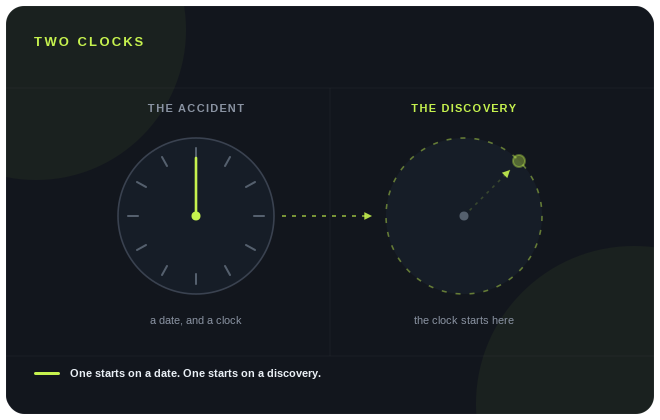
Open any workers’ compensation firm’s ad account and the architecture is the same, because the category agrees on what a case looks like. There is an event. The event has a date. From that date three clocks start: the worker’s duty to tell his employer, the firm’s window to reach him before someone else does, and the statute’s outer bar on filing at all. Everything downstream is built to beat those clocks — the five-minute callback, the after-hours cover, the recently-injured ad set, the intake script that opens by asking what happened.
It is a good machine. We have helped build a lot of it, and we are not about to argue against it. But it is a machine for one of the two kinds of claim a comp act recognises, and it is the kind that needs a lawyer least.
The other kind arrives with no event to report. A warehouse picker’s back does not fail on a Tuesday; it fails across eleven years of Tuesdays. A nurse’s shoulder is not destroyed by one patient transfer but by about four thousand of them. A machinist does not lose his hearing at 2:15pm. There is no moment, no first report filed that afternoon, and frequently no belief on the worker’s part that anything happened to him at work at all — he thinks he is getting older. Every statutory clock in the file has to start somewhere, so the act does something unusual: it defines the date of injury in terms of what the worker knows.
So the claim of this article, stated plainly: the workers’ compensation claim most likely to need a lawyer is the one with no accident date — and because its clock starts when the worker understands his own condition rather than when something happened to him, almost nothing a comp firm has built to win the first kind of case is pointed at it.
This is the article we promised at the end of the industry-mix piece, which ranked where injuries actually happen and ended on the observation that the sectors with the most cases produce injuries that do not announce themselves as accidents. That article told you which industries. This one is about which claim type, and about the clock that governs it.
Two clocks, one media plan
One clock starts on a date that already exists. The other starts on a discovery that may not have happened yet.
Take the accident claim first, because it is the one every system in this category is shaped around. A roofer falls on 3 March. That date is fixed before any lawyer is involved: it is on the incident report, in the employer’s log, on the emergency-room chart. New York gives him thirty days to tell his employer and two years to file the claim itself. Everything a firm does to win that case is a race against a clock that began without anyone’s permission, which is exactly why speed is worth paying for. The asset perishes.
Now take the cumulative claim. A hotel housekeeper has been cleaning sixteen rooms a shift for nine years. Her wrists have been bad for three of them. She has not reported anything, because there is nothing to report — no date, no incident, nothing her supervisor would log. At some point she stops being able to work. At some other point, possibly much later, a doctor or a colleague or a search result tells her the condition is probably from the job. The statute cares about both of those moments, and until the second one has happened there is, in the eyes of the act, no date of injury at all.
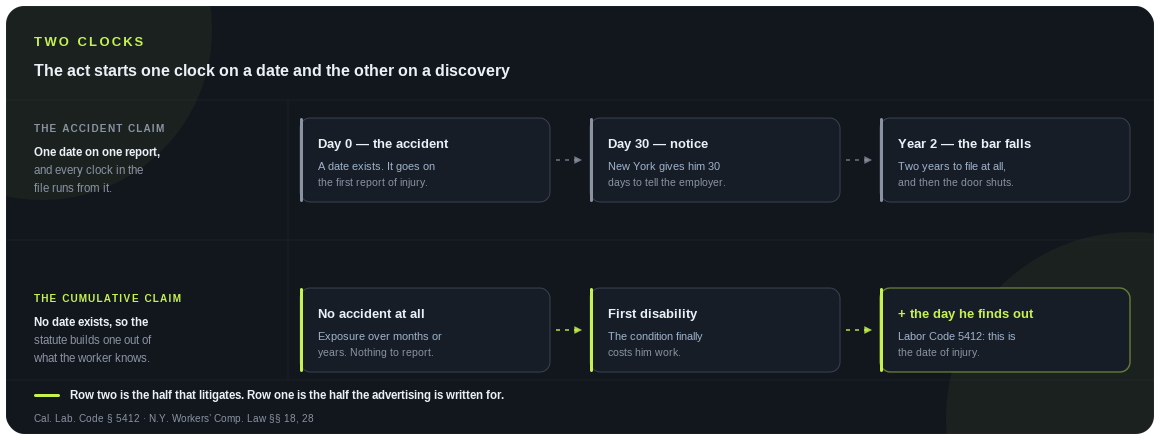
That difference is not a technicality. It is the entire reason the two claim types behave differently as marketing problems. One is a race you can lose by being slow. The other is a recognition problem you can only lose by being absent — and absence is much cheaper to maintain accidentally, because nothing in the ad account reports it.
What has to be true before the claim has a date
Two conditions, joined by an “and.” Neither of them is an accident.
California states the rule in a single sentence. Labor Code § 5412: “The date of injury in cases of occupational diseases or cumulative injuries is that date upon which the employee first suffered disability therefrom and either knew, or in the exercise of reasonable diligence should have known, that such disability was caused by his present or prior employment.”
Read it as an engineer would. There are two inputs and they are joined by an and. The first is disability — the condition has to actually cost him something, usually work. The second is knowledge, actual or constructive. Until both are true, the date does not exist, and a limitations period that runs from a date that does not exist does not run. That is why a cumulative claim can surface years after the exposure that produced it, and why “this happened too long ago” is a judgement about two dates most intake forms never capture.
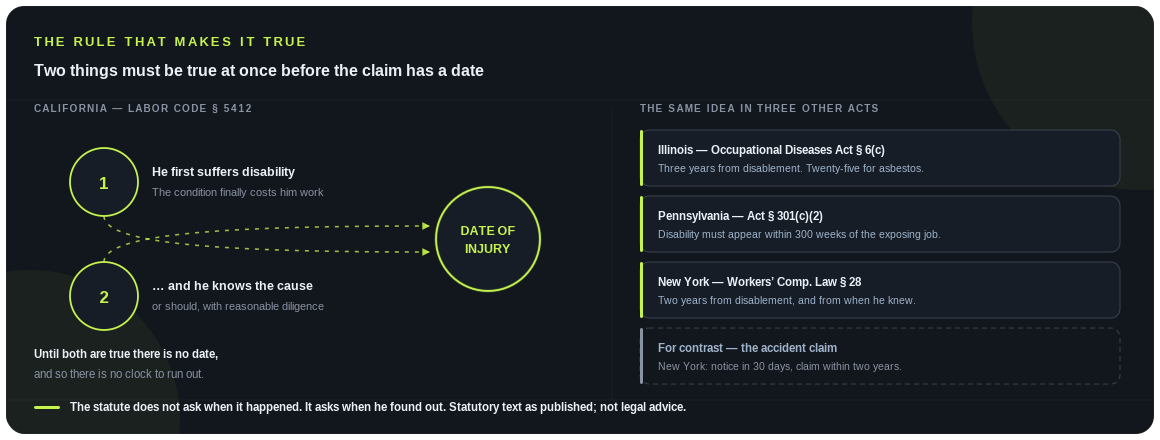
Other states reach the same wall and build different doors, which is worth knowing because the shape of the door decides how far back a firm’s addressable market extends. Illinois runs three years from disablement where no compensation has been paid, with disablement itself required to occur within two years of the last exposure — except for coal workers’ pneumoconiosis, where the window is five years from last exposure, and asbestos or radiological disability, where it is twenty-five. Pennsylvania puts the constraint on the condition rather than the filing: disability or death from an occupational disease has to appear within 300 weeks of the last date of employment in the exposing occupation. New York runs two years from disablement and from the point the claimant knew or should have known the disease was work-related.
| Jurisdiction | Provision | The rule as published |
|---|---|---|
| California | Lab. Code § 5412 | The date of injury for an occupational disease or cumulative injury is the date the employee first suffered disability from it and knew, or with reasonable diligence should have known, that work caused it. |
| Illinois | Occ. Diseases Act § 6(c) | Application filed within three years of disablement where no compensation has been paid, or within two years of the last payment — whichever is later. |
| Illinois | Occ. Diseases Act § 1(f) | Disablement must occur within two years of the last day of last exposure. Five years for coal workers’ pneumoconiosis; twenty-five years for asbestos or radiological disability. |
| Pennsylvania | Act § 301(c)(2) | Disability or death from the disease must occur within 300 weeks of the last date of employment in the exposing occupation. Firefighter cancer claims under § 108(r) run 600 weeks, with the presumption available in the first 300. |
| Pennsylvania | Act § 311; claim petition | Notice within 21 days to collect from the date of disability; after 120 days compensation is barred unless the employer already knew. Claim petition within three years of the date of disability. |
| New York | Workers’ Comp. Law §§ 18, 28 | Accident: notice within 30 days, claim within two years of the accident. Occupational disease: two years from disablement and from when the claimant knew or should have known the disease was due to the nature of the employment. |
Notice what every one of those rules has in common. None of them asks when the injury happened, because none of them can. They ask when the worker stopped being able to work, when he was last exposed, or when he found out. Two of those three facts live inside the worker’s own head, and the third one lives in a payroll record he probably still has. All three are reachable by a firm that asks. None of them is reachable by an ad that opens with the word accident.
Why the federal table makes this look like a rounding error
The national data counts conditions, not claims — and it draws its line in a different place than the comp act does.
If you size this market the way most of us size markets, you go to the federal survey, and the federal survey tells you not to bother. In 2024 the Bureau of Labor Statistics recorded about 2,488,400 nonfatal injury and illness cases in private industry. Of those, 148,000 were illnesses — 5.9% of the total, at a rate of 13.9 per 10,000 full-time workers. That is down 26.0% from 200,100 the year before, and the fall is almost entirely one category: respiratory illnesses dropped 46.1%, from 100,200 to 54,000, as the last of the pandemic-era reporting washed out of the series.
Read at face value, that table says the non-accident side of workplace harm is small and collapsing. It says no such thing, for two reasons, and the first one is a classification artefact that almost nobody in legal marketing knows about.
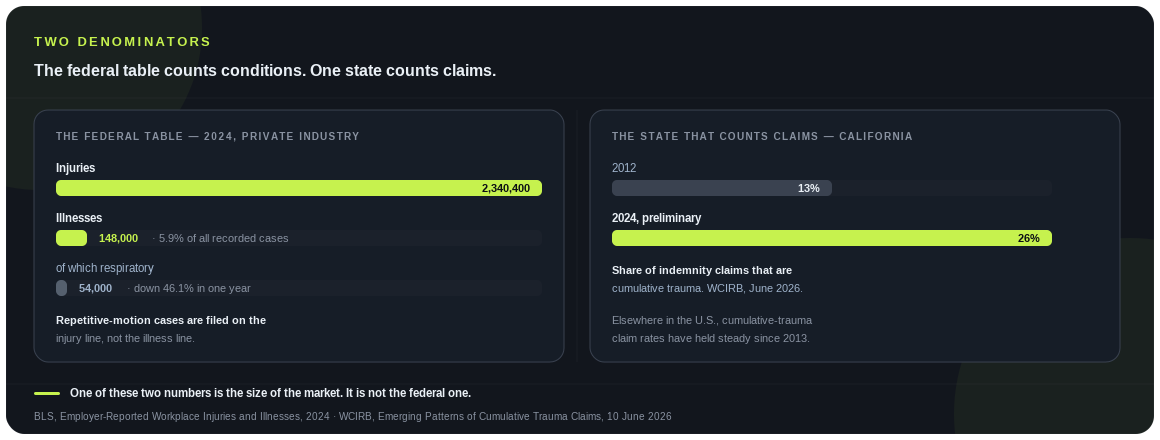
Here is the artefact. The BLS “illness” line is not the comp system’s “cumulative” line. Repetitive-motion and overexertion cases are recorded as injuries, not illnesses: the agency’s own musculoskeletal-disorder factsheet describes MSDs as ergonomic injuries and names overexertion and repetitive motion as their primary causes. So the carpal tunnel, the rotator cuff ground down over four years, the lumbar spine built up over a decade of lifting — the precise claims a comp act treats as cumulative — are sitting on the 2,340,400 injury line, mixed in with the falls and indistinguishable from them. The 148,000 illness figure is mostly respiratory and dermatological conditions. It was never the number you were looking for.
The second reason is the denominator itself, and it is the same objection we raised about the industry tables. A recordable is what an employer logs under federal rules. A claim is what a worker files under a state act. An indemnity claim — one paying wage benefits, the kind that produces represented cases — is a subset of that. No federal series maps one onto another. To see the thing at all you need a system that counts claims, and exactly one jurisdiction publishes that at the resolution this question needs.
The one state that counts it
California’s rating bureau publishes the share, and the share has doubled.
The Workers’ Compensation Insurance Rating Bureau of California released Emerging Patterns of Cumulative Trauma Claims on 10 June 2026. It is the closest thing this question has to a primary source, and the headline figure is the one worth memorising: cumulative trauma accounted for 26% of California indemnity claims in preliminary 2024 data, against 13% in 2012. The share has roughly doubled, and the 2023 and 2024 levels are the highest in the period the bureau examined. Cumulative trauma now represents about a quarter of total pure premium; its costs have more than doubled since 2021, while non-cumulative costs rose by more than 30% since 2020.
Then the figure that makes this a marketing article rather than an actuarial one. 82% of cumulative-trauma claims are litigated. Of those filed after employment had already ended — 58% of cumulative-trauma claims in accident years 2022 to 2024, up from 44% in 2013 to 2015 — the litigation rate is 99%. Medical-legal costs have risen to 37% of paid cumulative-trauma medical cost in the first two years, from 24% in 2017 to 2019. Geographically the claims cluster in Southern California, highest around Los Angeles and then San Diego, though every region in the state rose at least five points between 2017–2019 and 2022–2024.
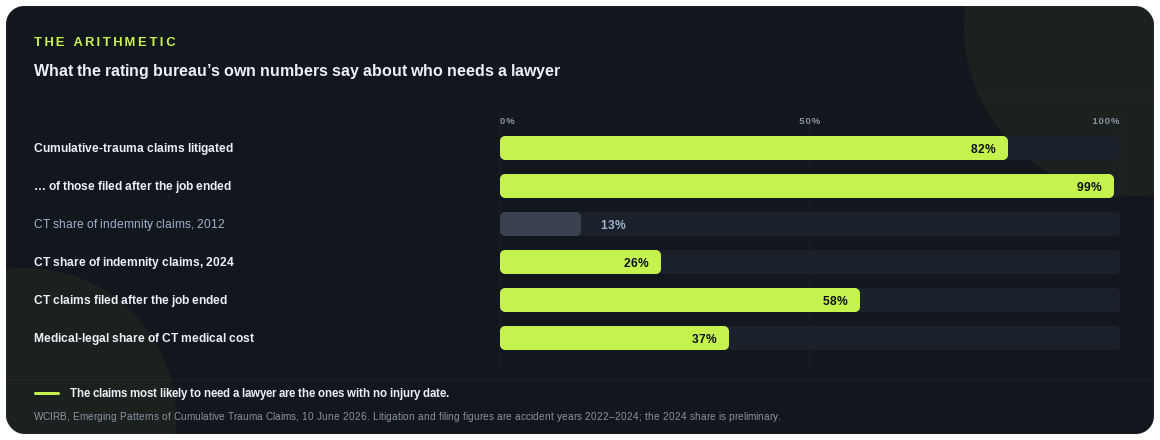
Two pieces of honesty belong here, and they both cut against a simple reading of those numbers.
The first is about whose report this is. The WCIRB is an insurance rating bureau. It published this because its members find the pattern expensive, and the document is a cost analysis, not a brief for underserved claimants. We are reading its numbers for a purpose it did not have, which is legitimate but worth saying out loud. The 58% post-termination share and the 99% litigation rate are, in the bureau’s framing, evidence of a problem. Read as market data they say something different — that this is where the represented work is — but they are the same facts and a firm entering the segment should expect to meet the bureau’s members on the other side of it.
The second is about size. Average paid indemnity on cumulative-trauma claims has been roughly flat since 2017, while non-cumulative claims grew about 5% a year. These are not bigger cases. They are more contested cases, which is a different and much more specific proposition: higher probability of needing a lawyer, not higher value per case. Anyone selling this segment as a windfall is selling something the data does not contain.
The claims that need a lawyer are the ones the statute cannot date. That is not a coincidence — a claim whose elements include what the worker knew is a claim built to be argued about.
A stock, not a flow
Speed is the right instrument for a flow. This is not a flow.
An accident claim is a flow. Each day produces a fresh cohort of people who were fine yesterday, and a firm’s job is to reach some share of today’s cohort before anyone else does. That is why speed to lead is worth what it is worth, and why we have spent years telling firms to answer the phone faster. The enquiry perishes measurably, in hours.
A cumulative claim is a stock. The hotel housekeeper with nine years of wrists behind her was a potential claimant last year and will still be one next year. What changes over time is not her condition but her understanding of it. There is no cohort to be first to, because there is no day on which she joined the market. Three things follow, and they invert most of the standard playbook.
There is no decay curve to beat. Calling in five minutes does not help, because she was never going to call within five minutes of anything. The speed that matters here is not response speed; it is the speed at which your explanation reaches her relative to the day she starts looking, which could be any day for years.
The acquisition asset is explanatory, not responsive. What converts an accident enquiry is availability. What converts this one is a sentence that lets her recognise herself — that a claim can exist without an accident, that a condition which built up over time can be compensable, that her supervisor saying it is not work-related does not settle the question. That is content work, and it compounds, because the stock does not refresh and the page does not expire.
The channel mix moves toward search and away from interruption. Interruption channels are efficient when you can define an audience that has just entered a state. Here you cannot: the audience has been in the state for years and the trigger is internal. The channel that catches an internal trigger is the one she reaches for when it fires, which is a search box.
We should be straight about one thing we cannot give you. We are not going to publish a cumulative-trauma cost per lead or cost per signed case, because we do not have one we would stand behind. Across roughly $16.5M of managed workers’ comp Meta spend we have recorded about 219,000 injured-worker leads at an average $75 CPL and about 21,000 signed cases at roughly $775 each — a blended lead-to-signed rate near one in ten. What those records do not contain is a field for statutory claim type. We can tell you which campaign produced a signed case. We cannot tell you whether that case had an accident date. That omission is not an oversight peculiar to us; it is the industry norm, and it is the reason this question has gone unexamined for as long as it has.
“Hurt at work?” is a screening question
It screens out the exact claimant this article is about, and it does it in the first three words.
Almost every comp ad in circulation opens on the same premise: something happened to you. Hurt at work? Injured on the job? Workplace accident? Each of those is a question, and the housekeeper with the bad wrists answers no to all three. She was not hurt at work. Her wrists are just bad. They have been bad for three years and she assumes that is what happens to a body that cleans sixteen rooms a day for nine years, which is a perfectly reasonable thing to assume and is also, in most states, a potential claim.
What she would say, if you handed her a microphone, is not in the vocabulary of the category at all. She would say her wrists go numb at night. She would say she cannot grip. She would say her supervisor told her it was carpal tunnel and that lots of people get it. She would say she has no idea whether this is anyone’s fault. The word “injury” does not appear, and neither does “claim,” “compensation” or “attorney.”
We want to be careful here, because the temptation is to follow that observation with a keyword table and a set of search volumes we have not measured. We have not run a keyword study on cumulative-trauma language and we are not going to invent one. The claim is directional and we are labelling it as such: the language a cumulative claimant uses to describe his situation is symptom-and-dispute language, not remedy language, and an account built entirely on remedy language will not meet him. If you want to test that cheaply, pull your own search terms report and count how many of the queries that reached you contain a body part and no legal word at all.
One boundary, firmly. None of this licenses telling an injured worker he has a claim. Whether a cumulative claim exists is a statutory question with contested elements and a date a judge may ultimately set, and the honest version of the copy says so: that a comp claim does not always require an accident, that conditions building up over time are compensable in many states, and that the deadlines run from specific dates worth asking a lawyer about. That is accurate, it is useful, and it stays inside the advertising rules. The version that promises a claim is both wrong and, in this segment particularly, the kind of thing that attracts attention a firm does not want.
The five fields your intake form does not have
An intake script written for accidents asks one date. This claim type has three, and two of them are in the worker’s head.
Everything above is wasted if the enquiry arrives and the intake call cannot handle it. The standard script opens by establishing what happened and when, which is the correct opening for an accident and a dead end for a cumulative claim: the caller does not know what happened, cannot date it, and will often apologise for wasting your time. An intake team that has only ever been trained on accidents will agree with him.
| Field | Why it is missing | What it decides |
|---|---|---|
| Claim type: specific incident or cumulative | The form assumes an incident, so the question is never asked | Everything downstream — without it the firm cannot measure its own case mix, evaluate a campaign, or know whether this article applies to it |
| Last date worked in the exposing job | Irrelevant to an accident claim, where the date of injury is the date of injury | The outer window in acts that measure from last exposure — 300 weeks in Pennsylvania, two years to disablement in Illinois |
| Date the condition first cost him work | Conflated with the incident date on an accident form | The disability half of the California test, and the start of the Illinois and New York periods |
| Date he was first told it might be work-related | No accident claim needs it, so no form has it | The knowledge half of the test. On the facts as presented this is frequently the single most load-bearing date in the file |
| Whether employment has ended, and when | Rarely relevant at accident intake | Whether this enquiry sits in the 58% of cumulative claims filed post-termination, which is where litigation runs at 99% |
Two of those five are dates nobody has written down anywhere — they exist only in the caller’s memory, and they get less accurate every month. That is an argument for asking early and recording verbatim, and it is also the reason this segment rewards intake quality more than most: the facts that decide the case are collected on the phone or not at all.
What this does not prove
The honest version of the argument is narrower than the headline version.
The volume figure is one state’s. 26% is California, and California is not a typical comp market in any respect. The same reporting notes that cumulative-trauma claim rates have been relatively stable across the rest of the United States since 2013. Do not take 26% to Ohio and build a budget on it. What generalises is the statutory mechanism — every act has to answer the no-accident-date problem, and the ones we read answer it with disablement, knowledge, or a window from last exposure — not the share.
The 2024 figure is preliminary. Claim-share data at that reporting age moves. Treat 26% as the current best estimate of a doubled share rather than as a settled number.
Litigated is not the same as represented by you. An 82% litigation rate says these claims draw lawyers. It does not say the claimants find them through marketing; some arrive through referral, some through medical providers, some through channels nobody has measured. The inference that advertising can reach them is ours, not the bureau’s.
And the ethical line matters more here than usual. None of this is an argument for generating claims, encouraging filings, or suggesting to anybody that a sore shoulder is money. It is an argument for being findable by people who already have a condition the law already covers, and who currently cannot find anyone because the entire category is shouting a question they would answer no to. If a firm cannot tell those two things apart, it should stay out of this segment — and we would say the same thing about the misclassified worker, for the same reason.
What remains after all of that is still the article’s claim, and we think it survives intact. The one measurement system in this country that distinguishes claims with an accident date from claims without one finds that the second group has doubled to a quarter of indemnity claims and litigates at 82%. The federal data most firms plan with cannot see the distinction at all. And the acquisition apparatus the category has spent a decade perfecting — speed, notice clocks, fresh enquiries, the accident-first ad — is pointed, with great precision, at the half that needs it least.
Key takeaways
-
A comp act runs two clocks, and only one of them starts on a date. California’s Labor Code § 5412 dates a cumulative injury at first disability plus knowledge that work caused it.
-
Cumulative trauma is 26% of California indemnity claims, double its 13% share in 2012. It is now about a quarter of total pure premium.
-
82% of them are litigated — 99% of those filed after the job ended. The claims the statute cannot date are the ones built to be argued about.
-
The federal data cannot see the category. BLS counted 148,000 illnesses in 2024, but repetitive-motion and overexertion cases are filed on the 2,340,400 injury line.
-
Accident claims are a flow; cumulative claims are a stock. There is no cohort to be first to, so the asset that wins is explanatory rather than responsive, and the channel mix moves toward search.
-
Nobody’s intake form has the fields. Last date in the exposing job, first date the condition cost him work, the date he was told it might be work-related — two of the three exist only in the caller’s memory.
WorkersComp Marketing is a marketing agency, not a law firm. Nothing here is legal advice, and nothing here should be read as an opinion about whether any particular condition is compensable. Statutory provisions are summarised from published text for a marketing audience and are not a substitute for the act that governs your jurisdiction or for counsel who practises in it. The claim-share, litigation and cost figures are California’s and are not national.
Frequently asked questions
What is a cumulative trauma claim?
It is a workers’ compensation claim for a condition produced by repeated exposure rather than by a single incident — a shoulder ground down over years of overhead work, a back built up over a decade of lifting, hearing lost to a decade of noise, a respiratory condition from a decade of dust. Because there is no accident, there is no accident date, so the statute has to construct one. California’s Labor Code § 5412 sets the date of injury for occupational diseases and cumulative injuries at the date the employee first suffered disability from the condition and either knew, or in the exercise of reasonable diligence should have known, that the disability was caused by present or prior employment. Other states reach the same problem differently: Illinois runs three years from disablement, Pennsylvania requires that disability appear within 300 weeks of the last exposing job, New York runs two years from disablement and from knowledge. The practical point for a marketer is that the clock is tied to the worker’s understanding, not to an event, and understanding can arrive years late.
Is this just a California story?
The volume figures are, and we want to be exact about that. The 26% share comes from the Workers’ Compensation Insurance Rating Bureau of California, and the same reporting notes that cumulative-trauma claim rates have been relatively stable across the rest of the United States since 2013. So do not take 26% to your own state and plan against it. What does travel is the statutory mechanism: every comp act has to decide what to do about a condition with no accident date, and the ones we looked at all answer with some version of disablement plus knowledge, or a window measured from last exposure. The marketing consequence follows from the mechanism rather than from California’s volume — a claim whose clock starts when the worker understands his condition is reached by explanation, not by speed, in every state.
Isn’t cumulative trauma the segment carriers complain about?
Yes, and anyone marketing into it should read the complaint rather than ignore it. The WCIRB report we have used here is a cost report: it exists because the bureau’s members find this pattern expensive. It documents that 58% of cumulative-trauma claims in accident years 2022 to 2024 were filed after employment had ended, up from 44% a decade earlier, that 99% of those were litigated, and that medical-legal costs have risen to 37% of paid cumulative-trauma medical cost in the first two years. That is a description of a contested segment and it is a real reason for caution. It is not, however, a reason to pretend the claims do not exist. The responsible position is that a firm entering this segment needs intake that screens on the statutory elements — last exposure, first disability, the date he learned the cause — rather than on volume, because a book acquired without that screen is a book that gets litigated at the bureau’s rate and loses.
Why can’t I see this in the federal injury data?
Because the federal survey draws its line in a different place than the comp act does. In 2024 the Bureau of Labor Statistics recorded about 2,488,400 nonfatal injury and illness cases in private industry, of which 148,000 were illnesses — 5.9%, down 26.0% year over year, almost entirely because respiratory cases fell 46.1% to 54,000. If you size this market from that line you conclude it is tiny and shrinking. But BLS treats repetitive-motion and overexertion cases as injuries rather than illnesses: its own musculoskeletal-disorder factsheet describes MSDs as ergonomic injuries and names overexertion and repetitive motion as their primary causes. The cumulative claims a comp act handles are therefore counted on the 2,340,400 injury line, mixed in with the falls and indistinguishable from them. The federal table can tell you how many conditions were recorded. It cannot tell you which of them had an accident date.
What do I actually change in the ad account on Monday?
Start with the cheapest thing, which is measurement rather than creative. Add a claim-type field to intake — specific incident or cumulative — and a field for the date someone first told the enquirer his condition might be work-related. Until those exist you cannot evaluate anything else in this article against your own firm, and almost no firm has them. Then look at your landing pages and count how many of them work for someone who would answer “no” to “were you hurt at work?” In most accounts the answer is none, because every page opens on an incident. The creative project that follows is real work and should be sequenced behind anything you are currently doing to fix speed to lead or close rate on the claims you already get, for the usual reason: a better-reached enquiry that nobody answers is worth nothing.
Doesn’t speed to lead still matter?
Enormously, and nothing here argues otherwise. For an accident claim the enquiry is perishable in a way that is genuinely measurable, and a firm that cannot answer the phone will lose those cases no matter what else it does. The argument is narrower: speed is the right instrument for a flow and the wrong instrument for a stock. The worker whose shoulder has been failing for four years was a potential claimant last year and will be one next year; what changes is not his condition but his understanding of it. You cannot beat a competitor to him by five minutes, because he was never going to call within five minutes of anything. You reach him by being the firm whose page explains, in plain language, that what he has may be a claim.
Is any of this legal advice about whether a claim exists?
No, and this is the one place where the marketing has to be most careful. WorkersComp Marketing is a marketing agency, not a law firm, and nothing in this article is legal advice. More to the point, no ad and no landing page should tell an injured worker that he has a claim, because whether he does is a statutory question with contested elements and a date a judge may ultimately set. The honest and effective version of this copy says that a workers’ compensation claim does not always require an accident, that conditions which build up over time can be compensable in many states, and that the deadlines are tied to specific dates worth asking a lawyer about. That is accurate, it is useful to the reader, and it stays inside every advertising rule we are aware of.
Sources
-
01
The claim-share, litigation and cost figures
WCIRB, Emerging Patterns of Cumulative Trauma Claims (10 June 2026), preliminary 2024 data: cumulative trauma at 26% of California indemnity claims against 13% in 2012; about a quarter of total pure premium; 82% of CT claims litigated and 99% of post-termination ones; post-termination filings 58% of CT claims in accident years 2022–2024 against 44% in 2013–2015; medical-legal 37% of first-two-year paid CT medical cost against 24% in 2017–2019. CT rates elsewhere in the U.S. stable since 2013.
-
02
The California rule the article is built on
Cal. Lab. Code § 5412: “The date of injury in cases of occupational diseases or cumulative injuries is that date upon which the employee first suffered disability therefrom and either knew, or in the exercise of reasonable diligence should have known, that such disability was caused by his present or prior employment.”
-
03
The other three acts
Illinois Workers’ Occupational Diseases Act § 6(c): three years from disablement if no compensation paid, or two years from last payment, whichever is later — five years from last exposure for coal workers’ pneumoconiosis, twenty-five for asbestos or radiological disability; § 1(f), disablement within two years of last exposure. Pennsylvania § 301(c)(2): disability or death within 300 weeks of last employment in the exposing occupation; notice in 21 days, barred after 120, petition within three years; firefighter cancer 600 weeks under § 108(r). New York §§ 18 and 28: accident, 30 days’ notice, two years to file; occupational disease, two years from disablement and from knowledge.
-
04
The federal table, and why it cannot see this
BLS, Employer-Reported Workplace Injuries and Illnesses, 2024: about 2,488,400 private-industry cases, of which 148,000 illnesses at 13.9 per 10,000 FTE — down 26.0% from 200,100 — and respiratory illnesses 54,000, down 46.1% from 100,200. Injuries, 2,340,400. The BLS musculoskeletal-disorder factsheet describes MSDs as ergonomic injuries and names overexertion and repetitive motion as their primary causes, which is why repetitive-motion cases sit on the injury line.
-
05
Our own figures, and further reading
The agency figures quoted are our own records across managed workers’ comp Meta spend: ~$16.5M managed, ~219,000 injured-worker leads at ~$75 average CPL, ~21,000 signed cases at ~$775 each. They are blended across all claim types; our intake records do not carry a statutory claim-type field, which is the limitation described in the article.
California claim-share and litigation figures are published by an insurance rating bureau for cost-analysis purposes and are read here for a different one. The 2024 claim share is preliminary and subject to revision. Federal counts measure recorded workplace conditions rather than workers’ compensation claims or represented cases, and the two are not the same population. Statutory summaries are for a marketing audience and are not legal advice.