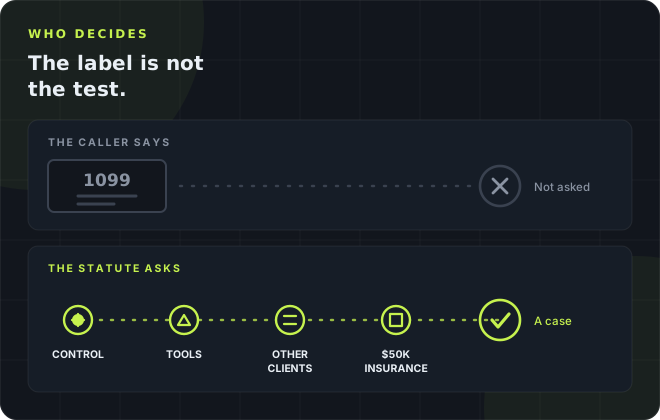
There is one prospect in this market who costs a firm money without ever appearing in a single report. He was hurt at work. He has a case, or at least a question worth an hour of somebody’s time. And he is not going to call you, because three weeks ago his employer told him he was a contractor and that workers’ comp does not apply to contractors, and he believed it — which is reasonable, because it sounds like the kind of thing an employer would know.
He does not become a bad lead. He does not become an expensive lead. He does not become a lead. He is simply absent from a pool you are measuring with great care, and his absence looks exactly like a small market.
This article is not about helping firms argue coverage. That is legal work and we do not do legal work. It is about a narrower thing that is squarely a marketing problem: comp firms advertise to people who already believe they are covered, and they screen on an answer the statute does not ask for. Both halves of that are fixable in an afternoon, and neither of them requires more budget.
So the claim, stated plainly: coverage is a question of law with a published test; the person least qualified to apply that test is the injured worker; and because he applies it anyway — before the search, before the click, before the call — the resulting loss is invisible in your cost per lead, invisible in your close rate, and invisible in your decline codes. One cause, three wrong diagnoses, and the fix is a page and a question rather than a bid.
The decline that never reaches your decline log
The same cause produces three different symptoms, and each one gets treated by a different department.
We have argued before that the largest output of a firm’s marketing is the enquiries it turns away, and that a firm with one “unqualified” bucket has destroyed the information in every decline it ever made. Self-screening on coverage is the version of that problem which happens one step earlier — before the enquiry exists — and it is worse, because at least a decline leaves a row in a CRM.
Follow one person through four possible paths and watch where each one lands.
The illustration below is the structure of the whole article: a single belief, held before any marketing touches it, arriving in your reporting as three unrelated failures.
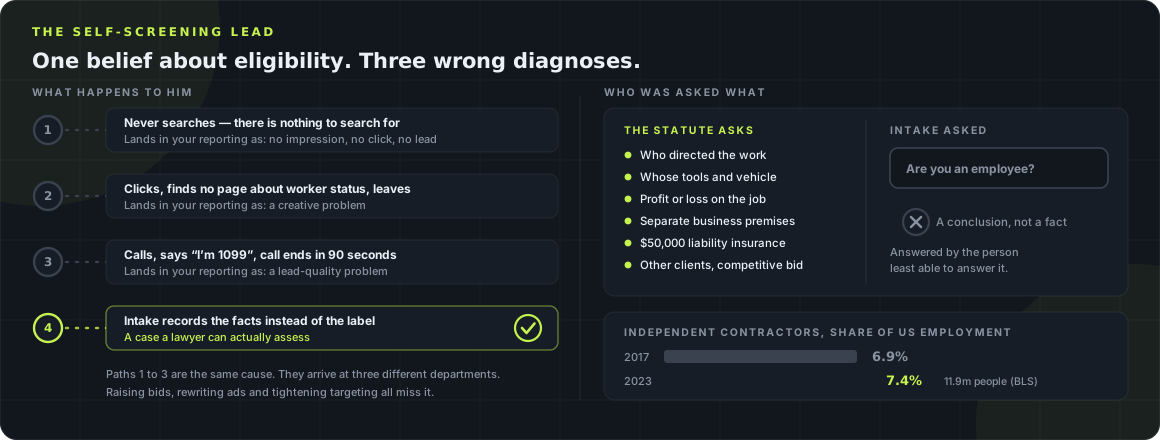
Path one is the expensive one and it is completely silent. He never searches, because he does not believe there is anything to search for. He is not an impression you lost to a competitor; he is not in the auction at all. Nothing in any platform, any dashboard or any agency report will ever indicate that he existed. The only trace is that your market appears to contain fewer injured workers than the injury statistics say it does — and firms almost universally read that as a volume ceiling, which is the one reading that leads nowhere.
Path two is the one that gets misdiagnosed as creative. He searches something adjacent — a question about whether he is covered, or what to do when the person who hired him says the injury is not their problem — lands on a page that opens with twenty years of experience and a free consultation, finds nothing addressing the only thing he is uncertain about, and leaves. You paid for that click. It is now sitting in a bounce-rate column, and bounce rate is where creative teams go looking for work.
Path three is the one that gets misdiagnosed as lead quality. He calls. Within ninety seconds somebody asks whether he is an employee, he says he is 1099, and the call ends politely. The lead cost full price. It is now coded “not a case,” which is the code that gets read back to the agency as evidence that the traffic is wrong.
Path four is the only one that produces usable information, and it is not a sales tactic. It is simply declining to accept a legal conclusion from someone who has not been asked a legal question. The caller does not know whether he is covered. Neither does intake. What intake can do is write down the facts the statute actually cares about and let a lawyer read them.
The question is a question of law — and the test is published
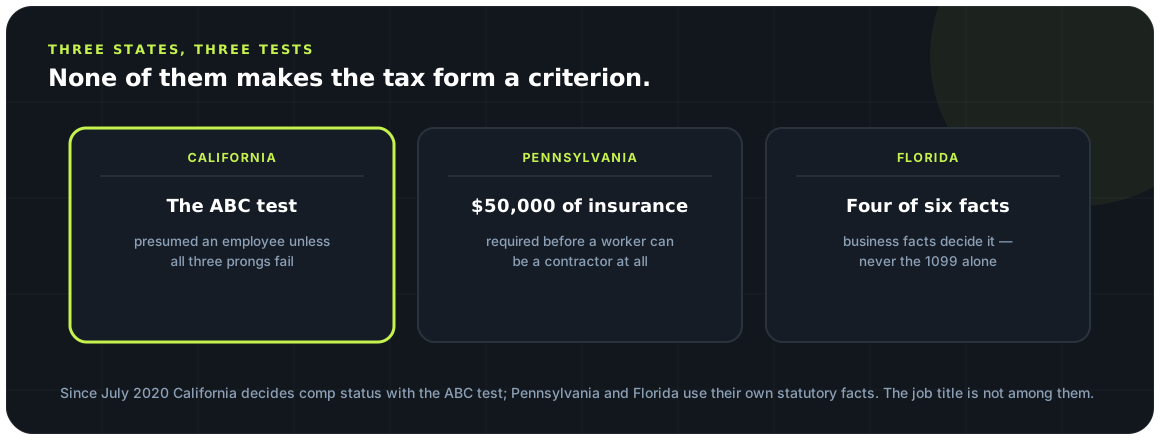
Four states, four instruments, and not one of them asks what the worker calls himself.
The reason this is a marketing article and not a legal one is that the tests are public, short, and written in plain enough language that a marketing director can read them in twenty minutes. You are not being asked to form a view about any individual case. You are being asked to notice that the test exists and that your intake script is not aligned with it.
Start with California, because its comp act is unusually blunt about where the burden sits. Labor Code §3357, enacted in 1937 and one sentence long, provides that any person rendering service for another, other than as an independent contractor or unless expressly excluded, is presumed to be an employee. The default in California is coverage. Somebody has to displace it. And since 1 July 2020, the displacing has to clear the ABC test: the state’s own labour agency states that for workers’ compensation insurance, “the ABC test applied beginning July 1, 2020” for a worker who suffers a compensable injury on or after that date, subject to the occupational exemptions (California Labor & Workforce Development Agency). A presumption of employment, and then a test the hiring business has to pass. Neither of those is a question an injured worker can answer about himself.
Pennsylvania is the most useful state to quote to a sceptical partner, because its construction statute reduces the question to things you can verify. Under the Construction Workplace Misclassification Act (Act 72 of 2010), an individual performing construction services is an independent contractor only if three things hold — a written contract for the services, freedom from control or direction over how they are performed, and being customarily engaged in an independently established trade — and that third limb is itself unpacked into six factors: the individual possesses the essential tools, realises a profit or suffers a loss on the project, has a proprietary interest in a business, has a business location separate from the premises where the work is done, has independently performed the same services for others or was available to, and maintains liability insurance of at least $50,000 for the term of the contract.
A 1099 is a tax document. It is evidence of what the employer decided, not of what the worker is.
Read that $50,000 line again and then picture the caller. A man framing houses, paid weekly in cash or by cheque, using the crew’s nail gun, with no business premises and no other clients, who has never heard the phrase general liability. In Pennsylvania construction he does not come close to the statutory definition of the thing his employer told him he was. The same statute also prohibits requiring an individual to sign a document that results in their improper classification — which is to say the legislature anticipated the paperwork and said it does not settle the question.
Florida takes the opposite drafting approach and arrives somewhere similar. Fla. Stat. §440.02 defines “employee” expansively and then provides a checklist for independent-contractor status requiring four of six business facts — a separate business with its own facility, truck, equipment or materials; holding or having applied for a federal employer identification number; compensation paid to a business entity rather than to the individual; business bank accounts; performing work for multiple entities without filing an employment application; and compensation on a competitive-bid or per-task basis under contract. The construction industry gets a further rule on top: persons paid by a construction contractor as a subcontractor are employees unless a valid exemption has been secured.
Note what the Florida list does and does not do. It asks whether the worker holds an employer identification number — a fact about his own business. It does not ask how the person who hired him chose to report the payment. That distinction is the entire marketing lesson, because a 1099 describes a decision made by the payer, and every one of these tests is interested in facts about the worker.
| State | Instrument | What it actually asks | Asks about the 1099? |
|---|---|---|---|
| California | Lab. Code §3357 presumption; ABC test for comp from 1 Jul 2020 | Employment is presumed. The hiring business must displace it against A, B and C. | No |
| Pennsylvania (construction) | Act 72 of 2010, §3 | Written contract, freedom from control, and six independence factors including $50,000 liability insurance | No — and a signed document that misclassifies is prohibited |
| Florida | Fla. Stat. §440.02(15) | Four of six business facts; construction subcontractors are employees absent a valid exemption | No — it asks whether the worker holds his own FEIN |
| Maryland | Workplace Fraud Act enforcement, via the Joint Enforcement Task Force | Presumption of employment in covered industries, enforced by audit | No |
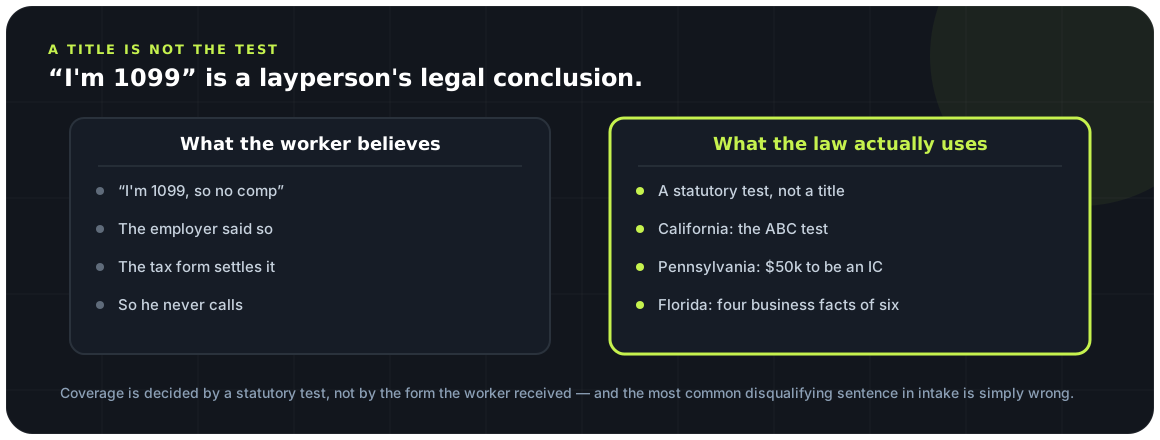
Four different drafting traditions, one shared structure: the test is about the working relationship, and the label is not an input. Your intake script, meanwhile, almost certainly contains one question about status, and it is the label.
How many people are we actually talking about
The honest answer is that nobody publishes the number. The bracketing numbers are still worth having.
We are not going to print a figure for how many injured workers in the United States have been misclassified, because no such figure exists and anyone who quotes you one has either modelled it or made it up. What does exist is a set of numbers that bracket the problem from different directions, and they are worth putting side by side.
The first is the size of the contractor population, measured properly. The BLS Contingent and Alternative Employment Arrangements supplement, run in July 2023, counted 11.9 million independent contractors — 7.4% of total employment, up from 6.9% when the supplement was last fielded in May 2017; contingent workers came to 6.9 million, or 4.3%, up from 3.8% (BLS). That is a count of people in alternative arrangements, correctly or otherwise. It tells you the pool that will answer an intake question about status with something other than “employee” is large and has grown.
The second is enforcement, which is where you find actual counts of people found to have been classified wrongly. Pennsylvania’s most recent Act 72 report, covering calendar 2025, records 390 cases filed, 2,236 employees identified as misclassified as independent contractors by the Office of Unemployment Compensation Tax Services, $46.9 million in underreported wages, and $762,635.49 collected from 150 construction employers. Maryland’s Joint Enforcement Task Force on Workplace Fraud, reporting in February 2025 on 2024, found more than 5,500 workers misclassified and estimated roughly 23,700 misclassified construction workers — about 11% of the state’s construction workforce — costing insurers some $58–59 million a year in workers’ compensation premiums (Insurance Journal).
That Maryland figure is the most load-bearing number in this section, and it is worth being precise about what it is. It is a state task force’s estimate for one industry in one state, and the dollar figure is about premium leakage to carriers, not about injured workers losing claims. But the 11% is the kind of number that reframes an intake script: in the industry that produces the most severe injuries in the category, roughly one construction worker in nine in that state is carrying a label the state believes is wrong.
The older and much-repeated range — that 10–30% of employers misclassify at least some workers — traces to a study commissioned by the Department of Labor in 2000 and to the National Employment Law Project’s synthesis of state reports, and it is cited again in the Economic Policy Institute’s 2025 update. We quote it with two warnings attached. It is an employer-level rate, not a worker-level one, so it cannot be read as a share of the workforce. And it is a quarter of a century old. It belongs in your thinking as an order of magnitude and nowhere near a forecast.
The only national series that sees them counts deaths
The injury statistics your plan is built on exclude the self-employed by design.
Here is a structural detail that deserves to be better known among people who plan comp marketing against BLS data, as we routinely do.
The Survey of Occupational Injuries and Illnesses — the series that produces the headline count of workplace injuries, and the series we have used in these pages to size markets — is built from employer records. Its scope covers private, state and local government wage-and-salary workers. The self-employed are outside it; as the BLS Handbook of Methods puts it, self-employed workers are not covered by the Occupational Safety Act of 1970, and private households and the smallest farms are excluded too. The Census of Fatal Occupational Injuries, by contrast, “also covers workers on small farms, the self-employed, family workers, and federal government workers.”
Put those two scopes next to each other and the consequence is uncomfortable. A worker whose employer treats him as a contractor is not on an OSHA log, so his injury is not in the survey. He is, however, in the fatality census if the injury kills him. The national measurement system sees this population reliably in exactly one circumstance.
This is not an accusation of bad statistics; both series are doing precisely what they were designed to do, and the exclusion is documented in the open. But it has a direct planning consequence that nobody states. When a firm or an agency sizes a market from injury counts, the sizing systematically omits the segment that is least likely to be represented — and the omission is largest in construction, which is where the misclassification is concentrated and where 1,032 of the 5,070 fatal work injuries in 2024 occurred among construction and extraction occupations.
We have argued elsewhere that the comp category is losing units and gaining value, and that the pool which is not shrinking is the two-thirds of lost-time claimants who retain nobody. This is a second cut of the same pool, and a more tractable one, because the self-screening worker is not undecided about hiring a lawyer. He has decided he is not allowed to.
The driver who does have coverage — just not comp
California wrote the clean case into statute, with the benefit levels printed.
There is an adjacent group it would be sloppy to lump in with misclassification, and separating them properly makes the intake question better rather than worse.
California’s Proposition 22 made app-based drivers independent contractors by statute: Business and Professions Code §7451 provides that an app-based driver is an independent contractor and not an employee or agent where the stated conditions about scheduling, accepting requests and working across platforms are met. These workers are not misclassified. They are classified, by a law the state’s voters passed and its Supreme Court upheld.
What Prop 22 then does is instructive for anyone writing an intake script. It requires network companies to provide occupational accident insurance, and it prints the levels: coverage for medical expenses incurred up to at least $1,000,000, and disability payments equal to 66% of the driver’s average weekly earnings from all network companies as of the date of injury, for up to 104 weeks (text of Proposition 22, §7455).
So a Californian delivery driver who is hurt on a shift has something. It is not workers’ compensation; it is a different instrument with different numbers, a different claims process and a different adversary. A layperson will not draw that distinction, and the two plausible errors run in opposite directions: he assumes he has nothing when he has a $1,000,000 medical limit, or he assumes he has comp when he has an occupational accident policy. Either way the sentence he says on the phone — “I drive for an app, so I’m not covered” — is not information about his coverage.
What self-screening does to your acquisition arithmetic
It does not raise your cost per lead. That is precisely the problem.
Across the ad accounts we manage — roughly $16.5 million in managed workers’ comp spend, about 219,000 injured-worker leads at around $75 each, and about 21,000 signed cases at around $775 — the arithmetic that governs everything is cost per lead divided by close rate. Both of those terms are measured on people who contacted you.
Now add a group who do not contact you, for a reason that has nothing to do with your media. Every published number holds still. Cost per lead: unchanged. Close rate: unchanged. Cost per signed case: unchanged. Lead volume: lower. Nothing in the report moves except the one line that is always read as a property of the market rather than a property of the message.
| Metric | If nobody self-screens | If 12% self-screen | How it reads in the monthly report |
|---|---|---|---|
| Qualified injured workers in market / month | 100 | 100 | Not visible at all |
| Reachable by any advertising | 100 | 88 | Not visible at all |
| Cost per lead | $75 | $75 | “On target” |
| Close rate | 9.6% | 9.6% | “Holding” |
| Cost per signed case | ~$775 | ~$775 | “Efficient” |
| Signed cases | 9.6 | 8.4 | “The market is small” |
Every efficiency metric is clean and the volume is short, which is the exact signature a firm reads as a saturated market. The two standard responses to a saturated market are to raise bids until cost per lead rises, or to open a second market. One of those makes the numbers worse and the other is the most expensive growth decision available. Neither touches the cause.
There is also a quieter effect on intake measurement. A firm that declines on the word “contractor” is generating declines that look like qualification working correctly. Answer rate is fine. Speed to contact is fine. The leak is in the content of the conversation, which is the one place a scorecard built on timing cannot see.
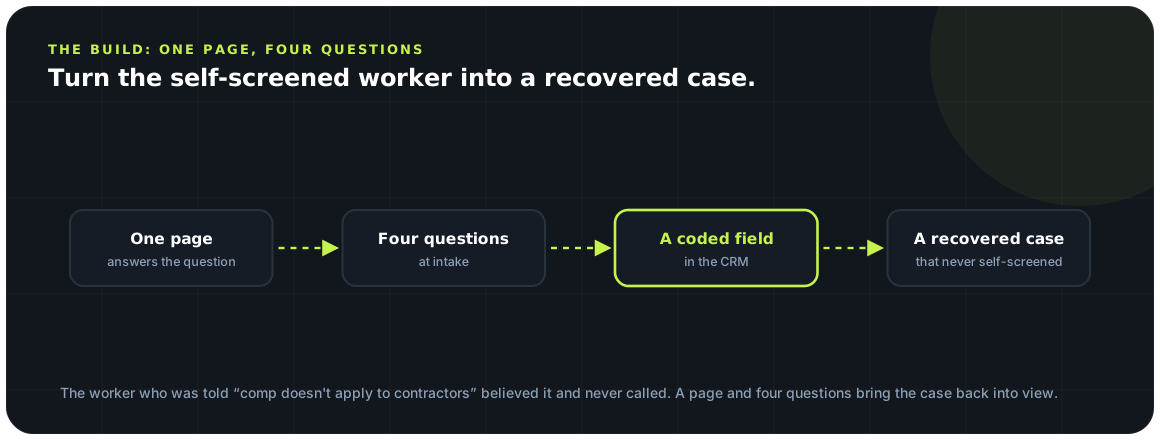
The page, the four questions, and the eighth decline code
Three artefacts. None of them needs budget approval.
One: a page that answers the question rather than describing the firm. We have made the case that question-shaped pages are what get cited when an answer engine compresses ten links into one response, and this is the clearest example of a question no comp firm’s site answers. The page is not “we handle 1099 cases.” That is a claim, and it fails the substitution test — any competitor could paste their logo on it and run it unchanged. The page explains that classification is decided by a test, that the test asks about control and tools and premises and insurance rather than about tax forms, that the state presumes employment in places like California, and that nobody can tell you where you fall without the facts. It then asks for the facts. It is a useful page to a person who will never call, which is the standard everything in the Growth Library is written to.
Two: four intake questions, replacing one. Not a script change so much as a swap of one closed question for four open ones.
| Ask | Which statutory limb it speaks to |
|---|---|
| Who told you what to do, and when to be there? | Control and direction — the common limb of every test read above |
| Whose tools, vehicle and materials were you using? | Essential tools; separate business with its own facility or equipment |
| Were you working for anyone else at the time? | Customarily engaged in an independent trade; work for multiple entities |
| Do you carry your own liability insurance, and did you bid this job? | Act 72’s $50,000 insurance factor; competitive-bid or per-task compensation |
Note what is absent. Nobody asks whether the caller is an employee, because that is the conclusion. And nobody at intake answers it either — the four facts go to a lawyer, and the caller is told the truth, which is that the question is decided by a test and somebody at the firm is going to look at it.
Three: an eighth decline code. The decline-desk article specified a seven-value code list. Add one: declined on worker-status statement — not reviewed. Read it monthly by source, exactly as you read the others. It will do two things. It will tell you whether this is a real volume in your market or a rounding error, which nobody currently knows at any firm we have seen. And it will make a pattern visible if one exists — if these declines cluster in one source, that source is reaching an audience your intake is not equipped for, and the fix is a script rather than a pause.
One more link worth drawing. We wrote earlier this year about the question before the question in immigration status, and the structure here is identical: a belief about eligibility, formed outside the legal system, that stops a person before any marketing reaches them. In both cases the firm’s only available move is upstream of the claim — a page that answers the eligibility question honestly, and an intake process that does not accept the prospect’s own ruling on it. If your market has an industry mix heavy in construction, delivery, agriculture or building services, the two articles describe the same hole from two directions, and the Intelligence Center will tell you what that mix looks like in your counties.
Key takeaways
-
A disqualified prospect costs you without ever appearing in a report. The misclassified worker was hurt, has coverage, and self-screens out before you ever see him.
-
Coverage is a question of law, and the test is published. California presumes employment; Pennsylvania’s Act 72 and Florida’s statute set explicit tests, none of which asks about a 1099.
-
The most common disqualifying answer is a layperson’s legal conclusion. “I’m an independent contractor” is often wrong, and it ends the call before intake can correct it.
-
The only national series that sees them counts deaths. There is no clean national count of the misclassified except in fatal-injury data.
-
Fix it with a page, four questions, and a decline code. A self-screening page that corrects the myth, plus an eighth decline code to count what you have been missing.
WorkersComp Marketing is a marketing agency, not a law firm. Nothing here is legal advice, and nothing here is advice about your professional-conduct obligations. Worker classification is state law, it varies by state and by industry, and the statutes quoted here are quoted to show what the tests ask — not to suggest an answer in any particular case. Read your own act, and ask your own counsel, before you publish anything about eligibility.
Frequently asked questions
Isn’t this just telling firms to take cases they can’t win?
No. It is telling firms to stop making the decision at the wrong desk. The question of whether somebody is an employee for workers’ compensation purposes is decided by a statutory test that asks about control, tools, profit and loss, premises, other clients and insurance. An intake coordinator cannot apply that test and should not try. Neither can the caller. What the caller can do is answer four factual questions in ninety seconds, and what a lawyer can then do is read them and decide in about the same time. The volume of extra lawyer time involved is small; the volume of cases currently ending on a single word is unknown at every firm we have looked at, which is the actual problem.
Our state isn’t California, Pennsylvania, Florida or Maryland. Does any of this apply?
Read two short things and you will know. First, your comp act’s definition of “employee” and any independent-contractor provision, which is usually in the definitions section near the front and usually a page or less. Second, whether your state has a separate misclassification statute or a task force that publishes enforcement figures — many do, and the reports are public. What you are looking for is narrow: does the test turn on facts about the working relationship, and does it mention the tax form? We read four states with four different drafting traditions and found the same structure four times. That is evidence about the default, not proof about all 51 jurisdictions, and if yours is genuinely different that is worth knowing precisely.
How is this different from the article about denied claims?
A denial is an event on a claim. Somebody filed, a carrier or employer responded, and there is a letter with a date on it — which is precisely why denial is such a reachable marketing moment. This is one step earlier and much quieter: the worker never filed, because he was told the system did not apply to him. There is no letter, no date, no record, and no event to time anything against. That is what makes it a message problem rather than a timing problem, and it is why the answer is a page and an intake question rather than a campaign.
Can we run ads targeting misclassified workers?
You cannot target on it and you should not try to. Platforms do not offer an audience for it, and building one out of your own data would run straight into the sensitive-category rules we have written about at length — an audience or conversion name that reflects or implies an injury or a medical condition is prohibited information on Meta’s business tools, and health sits among Google’s restricted interest categories. What you can do is answer the question in content, where the person is already searching for it, and in the intake conversation, where they have already called. Both of those are on your own property and neither one encodes anything about anybody.
What about the firm that genuinely does not want these cases?
That is a legitimate position and this article does not argue against it. A firm with a deliberate case mix may well conclude that contested-classification matters cost more to work up than they return, and that is a decision about what the firm accepts. But notice that it is a decision, and that almost no firm has made it. What happens at most firms is that the decision gets made a hundred times a month by whoever picks up the phone, with no record, no review and no number attached. Deciding not to take these cases and recording the decline code is a coherent strategy. Not deciding is not.
Is there a number for what a page like this converts at?
Not one we will print. We have no published data on the conversion performance of eligibility-shaped content in workers’ compensation, no credible third party publishes any, and the figures that circulate for “legal content conversion rates” come from companies that sell legal content. If you build the page, you will have something better within a quarter: your own cost per signed case from that page’s traffic, measured over a window long enough for cases to land. Compare it with your other pages and the question answers itself locally, which is the only way it has ever been answerable.
Where does this sit against everything else we could be doing?
Low effort, unknown size, and unusually uncontested — which is a rare combination. The three artefacts cost an afternoon between them and no media. The size is genuinely unknown until you count your own declines, so this is not a channel to fund ahead of measurement. What makes it worth the afternoon is the last part: the public ad archives show the whole market advertising the same thing to people who already know they are covered. The eligibility question is not being answered by anybody, which means the cheapest version of this is being early rather than being loud.
Sources & further reading
-
01
The employment tests
The statutory tests that decide coverage, which turn on control and the nature of the work, not a 1099.
-
02
Pennsylvania’s misclassification law
The Construction Workplace Misclassification Act (Act 72) and its enforcement reporting.
-
03
Scale of contingent work
BLS data on contingent and alternative employment arrangements, the population misclassification hides in.
-
04
Further reading
Counting the declines nobody counts.
Statutes, caps and rules vary by state and change over time — confirm the current rule in your state with counsel. General marketing information, not legal advice.