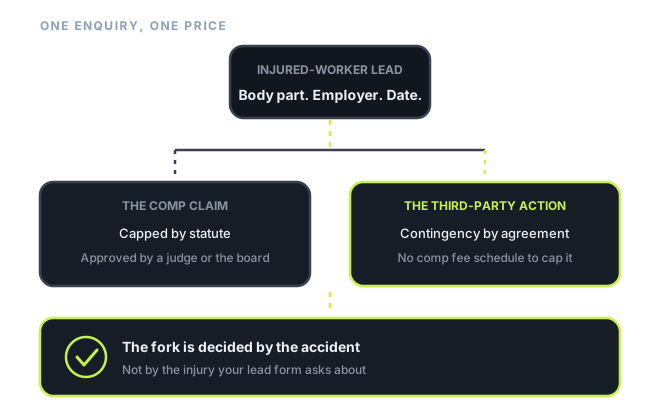
Two enquiries arrive within an hour of each other. Both came from the same campaign, both cost about $75, both are shoulder injuries, both are men in their forties, both were hurt at work last Tuesday.
One of them fell from a ladder in his employer’s warehouse. The other was rear-ended in a company van, on a public road, by a driver who works for nobody either of them has ever met.
To your lead form they are the same record. To your reporting they are two entries in the same row of the same weekly table. To your bidding system they are two identical conversions, worth exactly the same, and the system will go out tomorrow and buy more of whichever one happened to be cheaper. To your fee ledger, eighteen months from now, they will not resemble each other at all.
This article makes one claim: the single largest source of variance in what a workers’ comp enquiry is worth is not the body part, the employer, the state or the channel. It is whether somebody other than the employer caused the injury — and that is the one variable your marketing stack is structurally incapable of seeing.
One accident, two fee regimes
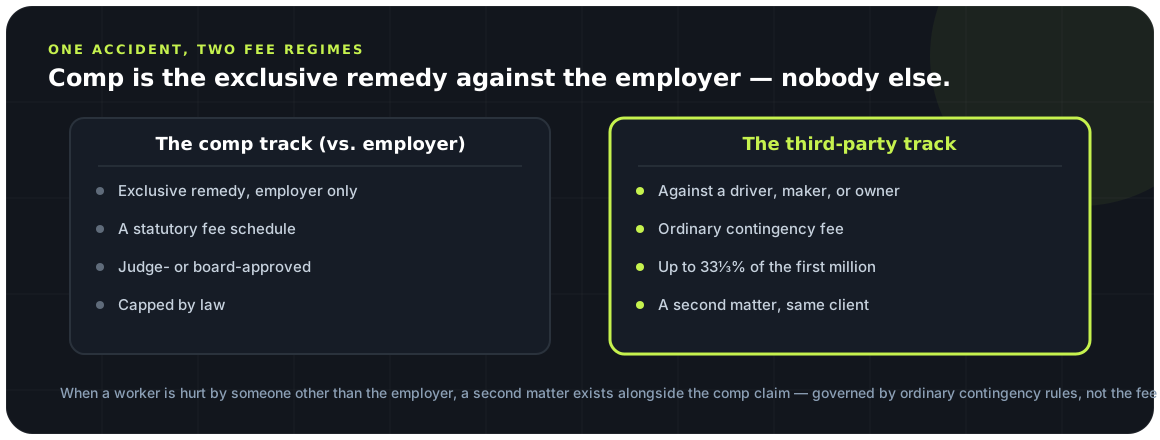
The comp bargain trades away the right to sue the employer. It does not trade away the right to sue anyone else — and the statutes say so explicitly.
Every comp firm knows the exclusive-remedy bargain: the worker gets benefits without proving fault, and gives up the tort action against the employer. What gets less attention in a marketing conversation is the boundary of that bargain. It stops at the employer’s door.
California states it about as plainly as a statute can. Under Labor Code §3852, an employee’s claim for compensation “does not affect” that employee’s right of action for all damages proximately resulting from the injury against any person other than the employer. New York does the same work at greater length in WCL §29, which opens by saying that a worker injured by the negligence of another not in the same employ “need not elect” between taking compensation and pursuing that other party. Both may proceed. They are separate matters about one accident.
And they are paid for in entirely different ways. We argued last week that the comp fee promise is not an offer but a paraphrase of the fee statute — contingent by law, capped by law, and in most states unpayable until a judge or the board approves it. All of that is true of the comp track. None of it is true of the other one.
| The comp claim | The third-party action | |
|---|---|---|
| Defendant | The employer and its carrier | Anyone else whose negligence contributed — a driver, a manufacturer, a property owner, another contractor |
| Fault | Not required | Must be proved |
| What is recoverable | Statutory benefits: medical, indemnity, permanency — bounded by the schedule | Ordinary tort damages, which in most states include categories the comp system does not pay at all |
| The fee | A statutory percentage, frequently approved case by case | A contingency percentage set by agreement, within the bar’s limits |
| Florida, concretely | The sliding statutory schedule under §440.34, judge-approved | Up to 33⅓% of the first $1M before an answer is filed, rising to 40% once the case is contested |
Sources for the Florida figures: The Florida Bar, “Attorney’s Fees” (contingent fee limits in tort matters) and Fla. Stat. §440.39. Percentages, approval requirements and lien formulas differ by state and change; this is a marketing article and not legal advice, and your own comp and civil counsel govern.
Hold those two columns side by side and the point stops being legal and becomes commercial. Your firm buys enquiries at a single price, sorted into a single bucket called “workers’ comp.” Some fraction of that bucket is a matter whose fee is capped by a legislature. Some smaller fraction is a matter whose fee is not, sitting inside a case that also has a capped-fee claim attached to it. The two fractions arrive through the same ad, the same form and the same phone line, and almost nothing downstream separates them.
The variable your lead form cannot see
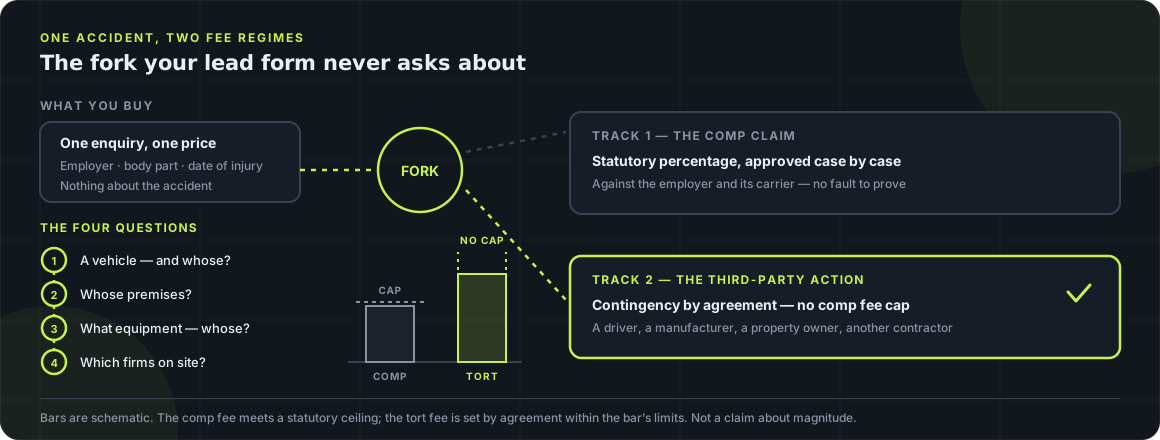
Every field a comp firm collects describes the injury or the employment. The field that predicts value describes the accident.
Look at a typical injured-worker lead form. Name. Phone. State. Employer. Date of injury. Body part, sometimes. Has the claim been denied, if somebody has been paying attention to what actually triggers the call. Every one of those fields describes either the worker’s employment or the worker’s body.
None of them describes the accident. And the accident is where the second matter lives.
This is not an oversight so much as an inheritance. The fields on a comp lead form are the fields a comp claim needs, and a comp claim genuinely does not care who caused the injury — that is the whole point of a no-fault system. The form is a faithful reflection of the statute it was designed around. It is simply the wrong instrument for valuing a lead, because the statutory question and the economic question are different questions.
Your bidding system has been told that every injured-worker lead is worth the same. Your fee ledger has known otherwise for years.
Spencer Moeller, WorkersComp MarketingWe have written before about the two numbers that discipline a comp firm’s marketing: cost per signed case on the acquisition side, and what a case is actually worth on the revenue side. The argument in the second of those was that most firms manage a cost they can measure against a value they have never computed. This article narrows that to its sharpest case. It is not that value is unknown in general. It is that one specific, binary, cheaply-observable fact moves value by more than anything else in the file, and it is recorded nowhere that a report can reach.
The figure below is how we draw the problem for firms. One enquiry, one price, one form — and a fork three questions deep that the form never asks about.
Where the second matter actually clusters
You cannot know the rate from public data. You can know the shape — and the federal injury statistics are a decent map of mechanism.
Let us be exact about what the public numbers can and cannot tell you. There is no national dataset of workers’ comp claims with a viable third-party action attached, because the denominators sit in fifty state systems and the numerators sit in private files. Anyone quoting you a confident percentage is quoting something they cannot source. We are not going to print one.
What federal data does give you is a reliable picture of how American workers get hurt, and mechanism is the thing that correlates with a second defendant. The Census of Fatal Occupational Injuries for 2024, released in February 2026, records 5,070 fatal work injuries. The single largest category is not falls, not machinery, not violence.
Read that top line as a marketer rather than as a safety officer. A roadway incident is, almost by construction, an event involving a vehicle the employer does not own or a driver the employer does not employ. Roughly four in ten American workplace fatalities happen in the one category where a second, uncapped defendant is most likely to exist — and the nonfatal version of the same event, the one that generates a claim rather than a death certificate, is the far more common case and does not appear in that table at all.
Construction is the other cluster, for a different reason. OSHA has formalised the fact that several employers control one site: its Multi-Employer Citation Policy (CPL 02-00-124), in force since 1999, sorts employers on a shared worksite into creating, exposing, correcting and controlling roles and allows more than one of them to be cited for the same hazardous condition. That is a regulator writing down, in enforcement terms, the thing that makes a construction injury structurally different from a warehouse injury: the person who created the hazard is frequently not the person who employs the worker standing in it.
| Mechanism | Who the other party usually is | What intake has to capture |
|---|---|---|
| Vehicle collision on a public road | The other driver, and their employer if the vehicle was commercial | Who owned each vehicle, who was driving, whether a police report exists |
| Struck by a vehicle on foot | The driver; often a delivery, haulage or plant operator from another company | Whose vehicle, whose employee, whose site |
| Machinery, tool or equipment | The manufacturer, the lessor, or the company that maintained it | The make of the machine, who owned it, who serviced it, whether a guard was fitted |
| Fall or hazard on premises | The property owner or the occupier, where that is not the employer | Whose building or site, and who controlled the area |
| Multi-contractor construction site | The general contractor or another sub — subject to the immunity question below | Every company present, and who directed the work |
| Defective or contaminated product | The manufacturer or supplier | What the product was, and where it came from |
Notice that every entry in the third column is a question about the accident and none is a question about the injury. That is the whole operational content of this article, and it is why the fix is cheap: you are not adding clinical detail to intake, you are adding narrative detail, and narrative detail is what an injured worker most wants to give you anyway.
The complications: statutory employers and the lien
Two doctrines stop this from being as simple as “construction injury equals second case.” Both matter commercially, and neither cancels the argument.
If we left it at the table above, we would be selling you something. Two things complicate it, and a firm that does not know about them will over-value its flow.
The statutory employer. In a large number of states, a general contractor that secures workers’ compensation coverage for a subcontractor’s employees is treated as those employees’ statutory employer — and inherits the employer’s immunity along with the obligation. Where that doctrine applies, the most obvious candidate defendant on a construction site is the one you cannot sue. States vary considerably in whether the immunity attaches at all, whether it depends on the upstream party actually paying, and how far up the contractual chain it reaches. The practical consequence for intake is not that construction cases are worthless; it is that “who else was on site” needs to be a list rather than a single name, because the viable defendant is often the equipment manufacturer, the property owner or a sub with no contractual relationship to the injured worker at all.
The lien. The comp carrier that has been paying benefits has a statutory interest in any third-party recovery, and it is not a polite one. Florida’s §440.39 requires the employee to sue for their own benefit and for the use and benefit of the carrier, and resolves the carrier’s share through an equitable-distribution formula rather than by negotiation. California gives the employer a right of reimbursement out of the recovery. New York goes furthest in a direction that matters here: under WCL §29(5), a claimant who settles the third-party action without the carrier’s written consent, or without a court’s approval of the settlement, can lose future compensation benefits — the rule applies regardless of whether the carrier was actually prejudiced.
There is a third complication that is purely economic, and it cuts the other way. The second matter typically runs on a longer clock than the comp claim. A firm that shifts its mix toward cases with tort components is shifting toward cases that pay later, which is the cash-flow trap we set out at length in the piece on case mix. Higher expected value per file is not the same as a healthier practice if the practice cannot fund the wait.
Four questions that cost sixty seconds
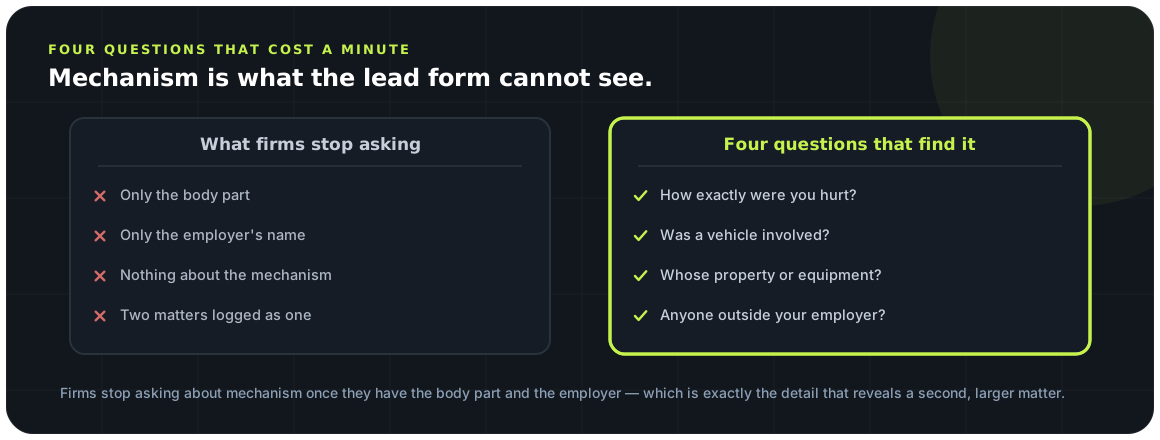
The judgement is legal. The fact-gathering is not, and it belongs at first contact rather than at the first attorney meeting.
Nobody is suggesting an intake coordinator should decide whether a manufacturer is liable, or whether a general contractor is immune. They should not, and in most firms they are not qualified to. What they can do — in about a minute, during a conversation that is already happening — is record four facts that let a lawyer make that decision in week one instead of never.
- Was a vehicle involved, and who owned it? Any vehicle, on any road or yard. If yes: who was driving each one, what company each belonged to, and whether police attended. This single question catches the largest cluster in the federal data.
- Whose property were you on? Not the employer’s name — the name on the building, the site, the store, the yard. A worker delivering to a warehouse, servicing a machine in a client’s plant, or cleaning an office block is standing on someone else’s premises, and that someone else has their own duties.
- What equipment or machine was involved, and whose was it? Make and model if the worker knows it, otherwise a description. Who owned it, who maintained it, whether it was hired in, whether anything was missing from it.
- Who else was working there that day? By company, not by name. On a multi-contractor site this is the only question that produces the list of candidate defendants, and the injured worker is usually the best-informed person alive about the answer.
Then record the answer as a code. One custom field on the matter record, with a short closed list: no other party identified; vehicle; premises; equipment or product; other contractor; more than one; unknown, needs review. Seven values, written by intake at first contact, never free text. This is the same discipline we argue for with declined enquiries, and for the same reason: a fact recorded in prose is a fact that cannot be counted, and a fact that cannot be counted cannot reach a report, a budget or a bidding system.
Sending value back without sending health data
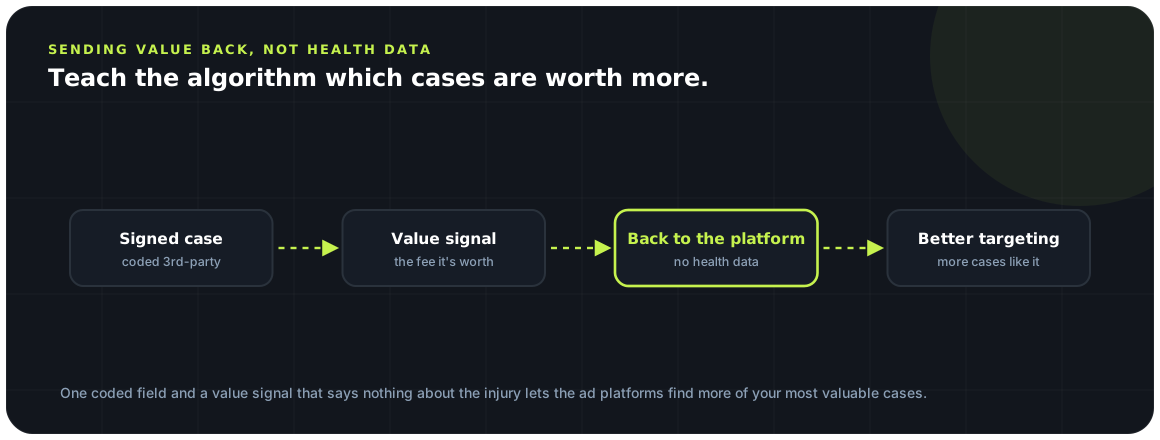
The platforms have a slot for what a lead turned out to be worth. Filling it is what stops the account bidding as though every enquiry were identical.
Capturing the flag inside the firm changes what the partners know. Sending it back out changes what the account buys — and this is where the argument becomes operational rather than clinical.
Google’s offline conversion imports exist precisely so that an advertiser can tell the system what happened after the click, and attach a value to it. The bidding difference is not subtle and it is documented: Maximize conversions optimises for the number of conversions and does not consider value at all, while Maximize conversion value optimises for the total value and will bid more into auctions it expects to produce higher-value conversions. An account that imports no values is an account in which every lead is, as far as the system is concerned, interchangeable — which is exactly the assumption this article is arguing against.
And here is the part that is specific to this practice area, and that follows directly from what we published on Monday about how Meta and Google classify comp firms as health advertisers. You may not encode the injury. Meta’s prohibited-information rules reach event names, conversion names, custom audience names and criteria, and URL parameters — a conversion called “Back Injury Lead” is a policy problem, not a reporting choice. But a third-party flag is not an injury. It is a fact about who else was involved in an accident, and it can be expressed as a neutral tier or a currency value that transmits nothing about the worker’s body at all.
| What you want the system to learn | Do not send this | Send this instead |
|---|---|---|
| This lead became a higher-value matter | An event or conversion named after the injury or body part | A single Qualified Lead conversion carrying a numeric value |
| Which campaigns produce them | An audience named for a diagnosis, condition or body part | Standard campaign and ad-group reporting, read against imported values |
| How the case was categorised | A URL parameter carrying the injury or claim type | A neutral internal code — tier A/B/C — mapped to a value in the import file |
| How much it was worth | Anything resembling a medical description in a custom field | Your own modelled value per tier, from your own closed files |
Two honest warnings about the values themselves. First, use a modelled value per tier rather than the actual fee on an actual file: real fees arrive far too late and far too lumpily to steer a bidding system, and the point of the value is to rank auctions, not to do your accounting. Second, resist the temptation to make the tier spread dramatic. If you tell a system that one tier is worth twenty times another on thin evidence, you have not fed it information — you have fed it your hypothesis, at full confidence, and it will spend accordingly.
The build: fifty files and one field
Before you change a single bid, find out whether the variance is real at your firm. It is an afternoon’s work and it settles the question.
We are sceptical of articles that end with a strategy, so this one ends with an afternoon. The method is the same one we use for case value, because it is the same fifty files.
- Pull fifty fully resolved matters. Fully resolved, not open — a matter with an unknown ending cannot contribute to a value figure. Take them consecutively from a closed window rather than choosing them, because choosing is how a book gets flattered.
- Code each one for the other party. Use the seven-value list. You are reading for the accident, not the injury, so the police report and the first narrative statement matter more than the medicals.
- Compute two medians, not two averages. The median fee where another party was identified, and the median where none was. Comp caseloads are lumpy enough that one outlier will rewrite an average and tell you nothing.
- Look at the time as well as the money. Median months from signature to fee, split the same way. If the higher-value group is also substantially slower, you have a financing question before you have a marketing one.
- Trace the survivors back to their source. Which campaigns, which terms, which referral relationships produced the cases with a second matter? This is the number that changes a budget, and it is usually the first time anyone has asked the question in this direction.
- Only then, open the accounts. Add the field, start coding new enquiries, and let three months of coded data accumulate before you let it move a bid. The volume on any single mechanism-shaped search term is small, and the sample-size problem is unforgiving about small volumes.
One final limit, stated plainly because the alternative is to imply something we cannot support. We do not know what share of comp enquiries nationally carry a viable third-party action, we have not found a credible published figure, and we are not going to estimate one to make this article land harder. The claim here does not need a national rate. It needs only two things to be true: that the fee regimes differ materially, which the statutes settle; and that your own book has a mix you have never measured, which fifty files will settle by Friday.
Key takeaways
-
One accident can carry two fee regimes. Comp fees are capped by statute; the third-party tort claim from the same accident is not — so the same injury can be worth far more to the right firm.
-
The biggest value driver is invisible on the lead form. Whether a third-party case exists never shows up in the lead or the bidding system; it is a legal fact you have to surface at intake.
-
Third-party exposure clusters predictably. A worker hurt by a non-employer vehicle, product, or premises is where the second matter concentrates, by industry and accident type.
-
Four intake questions surface it in sixty seconds. A short, conflicts-aware set of questions tells you whether a lead carries third-party value without collecting health data.
-
Feed the answer back without transmitting health data. Tag the value signal in your CRM and bidding, not the diagnosis: the economics, not the protected health information.
WorkersComp Marketing is a marketing agency, not a law firm. Nothing here is legal advice and none of it is a prediction about any particular claim. Exclusive-remedy provisions and the exceptions to them, statutory-employer doctrines, lien and subrogation rights and the limitation period on a third-party action are set state by state and are actively litigated. Whether any individual enquiry carries a second matter alongside the comp claim is a question of law applied to facts no article can know, and how a firm may refer, co-counsel or share a fee on one is governed by its own state’s rules of professional conduct. Check your own state’s current law and have a lawyer at your firm write the intake rule.
Frequently asked questions
We are a comp-only firm and we refer these out. Does any of this apply to us?
More than it does to a firm that keeps them, because you are the one making an economic decision without the information. A referral relationship is a perfectly respectable answer to the question of who litigates the tort case. It is not an answer to the question of what the enquiry was worth when you bought it. If a meaningful share of your signed cases carry a second matter that leaves the building, that is a fact about the value of your lead flow, and it belongs in the model whether the fee lands in your ledger or somebody else’s. The fee-sharing rules in your jurisdiction govern what you may receive and on what terms, and that is a question for your ethics counsel rather than for us.
Isn’t identifying a third-party claim a legal judgement rather than an intake task?
The judgement is legal. The fact-gathering is not. Nobody is asking an intake coordinator to opine on whether a general contractor is a statutory employer, or whether a manufacturer is liable for a guard that had been removed before the machine arrived. They are being asked to record who owned the vehicle, whose premises it happened on, what equipment was involved and who else was on site. Those are four answers an injured worker can give in sixty seconds, and they are the difference between a lawyer spotting the second matter in week one and nobody spotting it at all.
What share of workers’ comp claims actually carry a viable third-party action?
We do not know, and neither does anyone else who is being straight with you. There is no credible national figure, because the denominator sits with fifty different state systems and the numerator sits inside private case files and carrier subrogation ledgers that nobody aggregates. You will see percentages quoted confidently in vendor material; they are not sourced to anything you can check. What we can tell you is that the share inside your own book is knowable in an afternoon from fifty closed files, and that it is the only figure that should influence your budget.
Doesn’t the carrier’s lien eat the recovery anyway?
It takes a share of it, and in every state it takes that share under a formula rather than at the carrier’s discretion. Florida resolves it through the equitable-distribution calculation under section 440.39(3)(a); California gives the employer a right of reimbursement subordinate to a statutory allocation; New York conditions the claimant’s continued benefits on the carrier consenting to the settlement or a court approving it. A lien reduces a recovery. It does not turn a tort claim into a capped-fee comp claim, and the fee the firm earns on the gross is computed under the contingency rules of the civil case, not the fee schedule of the comp system.
Can we just bid harder on search terms like “injured in a work truck”?
You can, and mechanism-shaped terms are the most under-used inventory in this category, because almost every comp firm bids on the practice area rather than on how the accident happened. But bid with the same discipline you would apply anywhere else. The volume on any single mechanism term is small, so you will not read a result from it quickly — the sample-size problem we set out in our piece on ad testing applies here with full force. Treat it as a mix decision to be judged over a long window in cost per signed case, not as a test to be called in three weeks.
Our CRM has nowhere to record this. Where does it go?
One custom field on the matter record, with a short closed list of values, written by intake at first contact and never as free text. Free text cannot be counted, and a value you cannot count cannot reach a report or a bidding system. If the field has to live somewhere awkward for now, that is still better than a note in a call summary. The rule we apply to the whole intake stack applies here too: everything writes to the CRM, and anything that does not write to the CRM did not happen.
Sources & further reading
-
01
Subrogation, the lien & statutory employers
The statutes that govern how a comp carrier recovers from a third-party tort award, and who counts as a statutory employer.
-
02
Attorney fees in a third-party recovery
The Florida Bar consumer guidance on how fees work when a comp claim and a tort claim overlap.
-
03
Where serious third-party injuries cluster
BLS fatal-injury data and OSHA multi-employer policy point to the accident types that carry third-party exposure.
-
04
Further reading
What this does to lead value and intake.
Statutes, caps and rules vary by state and change over time — confirm the current rule in your state with counsel. General marketing information, not legal advice.