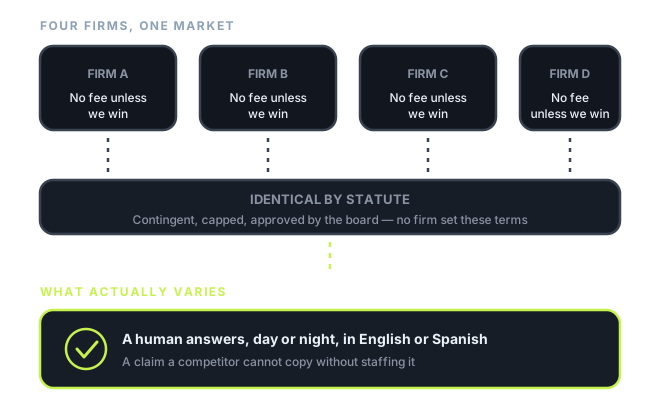
Open four workers’ compensation firms’ websites in four tabs. Somewhere above the fold on all four, in a slightly different typeface, you will find the same sentence: Free consultation. You pay nothing unless we win.
The usual reading of that is a branding failure — four firms with no imagination, all reaching for the same reassurance. We have written about that problem elsewhere, and it is real. But it is not what is happening here, and treating it as a copywriting problem is why it never gets fixed.
This article makes a narrower and more uncomfortable claim: in workers’ compensation, the fee promise is not a marketing decision at all. It is a description of the statute. The four firms are identical on that point because the legislature made them identical, and no amount of better writing will separate them on a term none of them set.
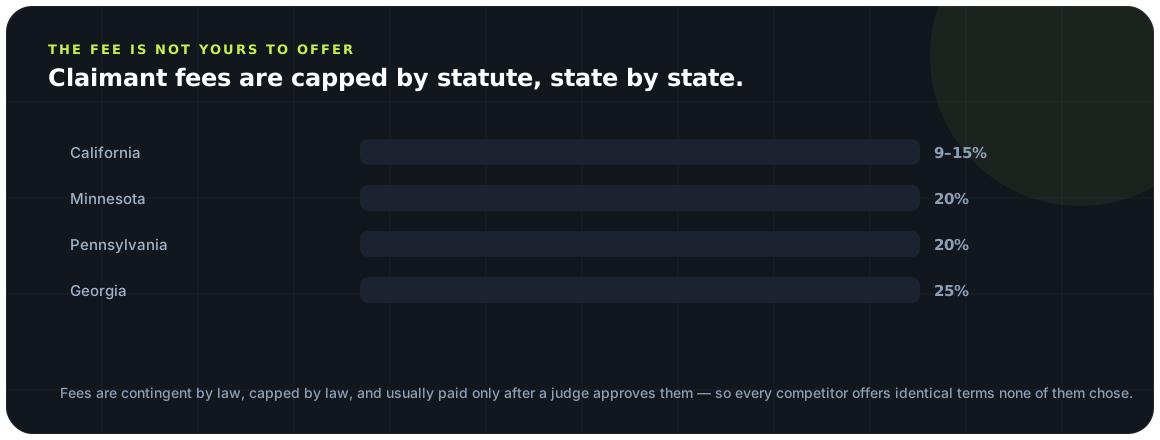
The fee is not yours to offer
In most states a claimant’s attorney cannot set the fee, cannot bill hourly, and cannot collect at all until somebody in a robe signs off.
Personal injury lawyers choose a contingency percentage. It is a real commercial decision: a firm that takes 33⅓% and one that takes 40% are making different offers, and a client can prefer one to the other. Workers’ compensation does not work that way, and the difference is not a matter of degree.
In comp, the fee is a creature of statute in most jurisdictions. It is contingent because the law says so. It is capped at a percentage the law fixes. And in a large number of states it is not payable until a judge or the board has reviewed it against factors written into the rules — complexity, time, responsibility, the result obtained. The client is not choosing a price. Neither is the firm.
| State | The cap | Who approves it |
|---|---|---|
| California | Fees are contingent by law and run roughly 9–15% of the recovery; the WCAB’s own guideline puts average-complexity cases in the 9–12% band and below-average cases as low as 1% | A WCAB judge, case by case. Labor Code §4906 makes charging more than the approved amount a misdemeanour |
| Pennsylvania | 20% of the amount awarded | The Workers’ Compensation Judge or the Board, under §442 of the Act |
| Georgia | 25% of weekly benefits or of a settlement | The State Board of Workers’ Compensation approves any fee over $100 |
| New York | Set by the Board; WCL §24 fixes the death-benefit formula at 15% of compensation due in excess of prior payments, plus a sum equal to 15 weeks of compensation | The Workers’ Compensation Board |
| Minnesota | 20% of the first $275,000, capped at $55,000 per injury | Set by statute, §176.081 |
Sources: California DWC, §442 of the Pennsylvania Act, Georgia State Board practice, NY WCL §24, Minn. Stat. §176.081. Figures change; confirm your own state with your own counsel before you print anything.
There is one more feature of the comp fee that has no real analogue in personal injury: because the fee is frequently carved out of the injured worker’s own benefits and approved against the result, the firm has limited ability to make the offer more generous. It cannot meaningfully undercut a competitor. It cannot advertise a lower rate as a differentiator without running into the approval process that will set the rate anyway. The usual lever of commoditised markets — price — has been removed from the board before the game starts.
Why the whole market says the same thing
Nobody copied anybody. Four firms independently described the same statute and arrived at the same sentence.
This is the part worth sitting with, because it changes what you do about it. The conventional explanation for identical legal advertising is imitation: one firm ran “no fee unless we win,” it worked, everyone copied it, and now the category is beige. That story implies a solution — be braver, write better, hire someone with taste.
The convergence here has a different cause. Each firm, independently, asked what an injured worker most needs to hear, concluded correctly that the answer is this will not cost you money you do not have, and then wrote down the true fact that answers it. The true fact is the same for all of them. You cannot out-write a statute, because the statute is not a claim you are making — it is a condition you are both operating under.
Four firms did not copy each other’s headline. They each read the same chapter and reported it accurately.
Spencer Moeller, WorkersComp MarketingThe practical consequence is that the injured worker cannot use the fee promise to choose. It carries no information, because it does not vary. And when the most prominent element of four ads carries no discriminating information, the decision falls through to whatever does vary — who appeared first, who answered the phone, who had a real person in the photo, who spoke Spanish, who was nine minutes away. That is not a failure of the worker’s judgement. It is the only signal left in the room.
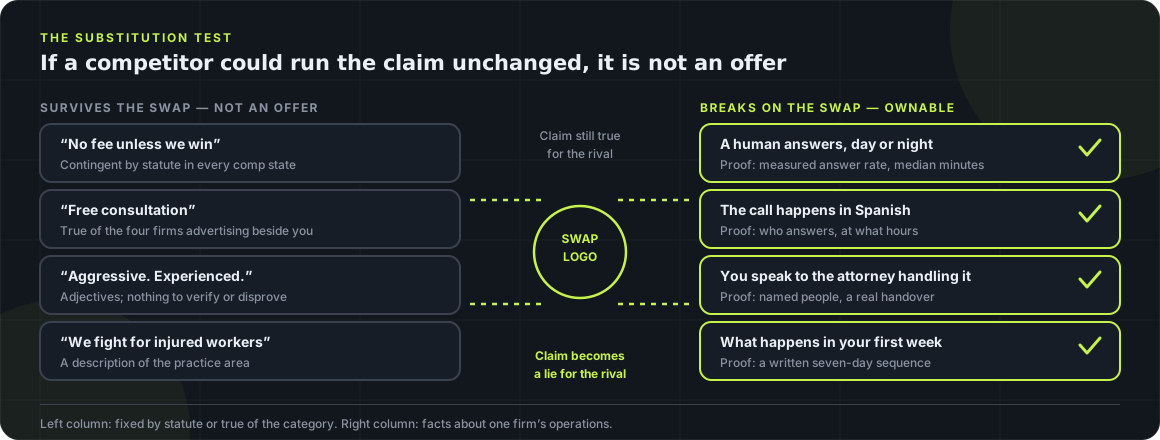
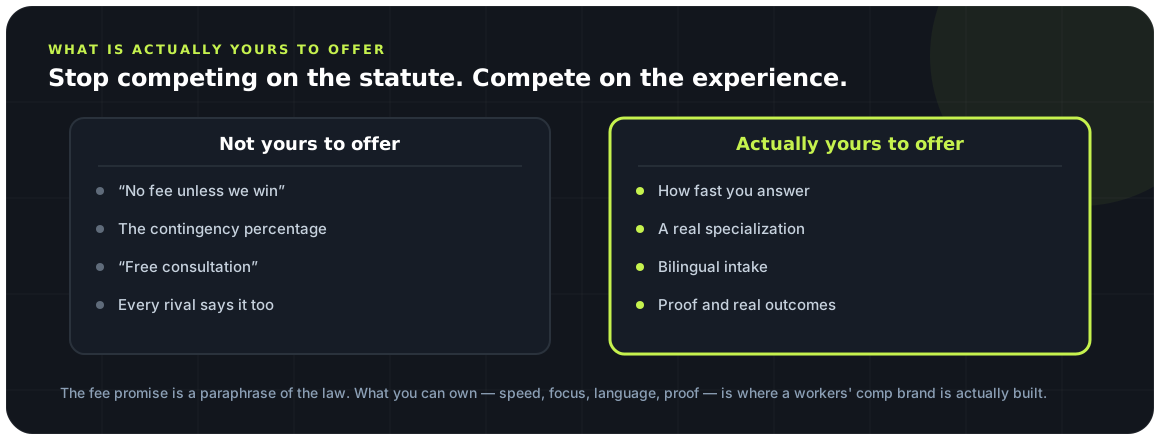
The figure below is the test we use on client copy. Take any claim in an ad and ask whether a competitor could paste their own logo onto it and run it unchanged. If they could, it is not an offer; it is a category description that you are paying to distribute.
A capped fee is a capped acquisition budget
Statutory fee caps do not only flatten the advertising. They set a hard ceiling on what a case can be worth — and therefore on what you may rationally pay to acquire one.
We have argued at length that what a case is worth sets every other number in a firm, and that the value-to-cost ratio decides which channels can work at all. In workers’ compensation there is a second author of that number, and it is not the firm. A capped percentage on a statutorily bounded benefit is a ceiling on revenue per case that no amount of operational excellence lifts.
That has a consequence most firms feel without naming. Across our own book — roughly $16.5M of managed workers’ comp Meta spend, about 219,000 injured-worker leads at an average $75 cost per lead, and about 21,000 signed cases at roughly $775 each — the cost side is the part a firm can move. The revenue side has a lid on it. A personal injury firm facing rising acquisition costs can, in principle, pursue larger cases. A comp firm in a capped state cannot do the equivalent, because the cap travels with the practice area.
Two things follow, and they point in opposite directions from the usual advice. First, in a capped market, efficiency is not a virtue — it is the only lever. Firms in categories with uncapped fees can grow by raising revenue per matter; a comp firm mostly grows by lowering cost per signed case and by keeping more of the cases it signs. Second, and less obviously, the cap makes the differentiation problem more urgent rather than less. When you cannot charge a premium, the entire return on being the preferred firm shows up as a lower acquisition cost. Preference is the only way a capped-fee firm gets paid for being better.
$1.53 an hour: what happens when the cap is wrong
Florida spent a decade demonstrating that the fee statute is not background scenery. It is a live variable that can reprice an entire state’s market overnight.
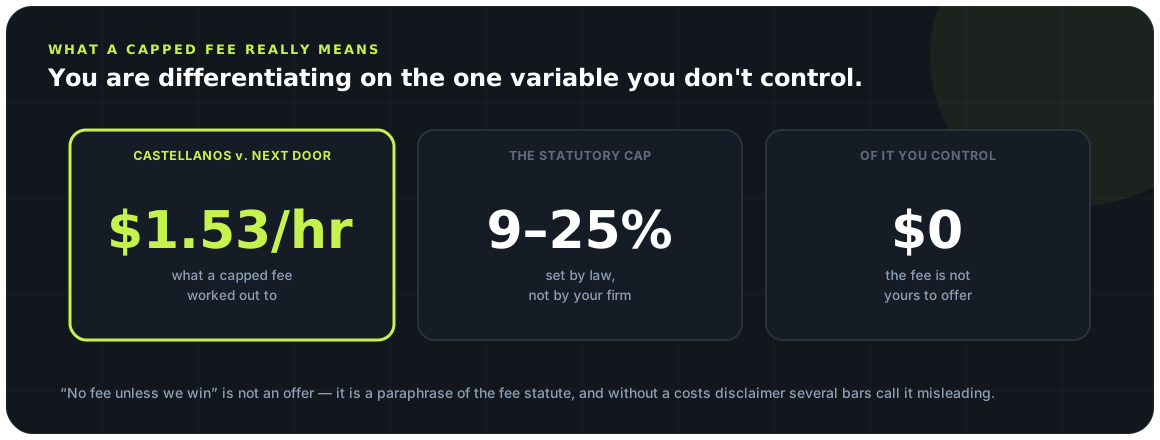
Marvin Castellanos was injured at work, hired a lawyer, and won. His attorney beat back every defence the employer and carrier raised. Then the fee was computed under Florida’s mandatory sliding scale in section 440.34, and it came to $1.53 per hour for 107.2 hours of work.
In April 2016, in Castellanos v. Next Door Co., the Florida Supreme Court held 5–2 that a mandatory fee schedule creating an irrebuttable presumption of reasonableness — one that forecloses any inquiry into whether the fee actually compensates the attorney — violates due process under the state and federal constitutions. The schedule fell, and Florida reverted to a reasonableness standard.
We raise it here for one reason, and it is not the constitutional doctrine. A single decision in a single state changed what a comp case was worth to every claimant firm operating there, and therefore changed what every one of them could rationally pay for a lead, in a quarter. Firms that treat acquisition cost as a purely internal decision — a matter of budget discipline and agency performance — are treating half the equation as fixed when it is in fact legislated, litigated, and occasionally overturned.
The inverse case is worth stating too, because it is the more common one: in a state where the cap has been stable for a decade, the ceiling is genuinely fixed and the firm’s entire room to manoeuvre is on the cost and conversion side. That is not a gloomy conclusion. It is a clarifying one — it tells you exactly which projects can possibly pay.
The phrase is also a compliance exposure
Several bar authorities treat “no fee unless we win” as misleading when it runs without a costs disclaimer — because clients do not distinguish fees from costs, and firms usually do.
There is a second, sharper reason to stop leading with the fee promise: in a number of jurisdictions, running it bare is a rules problem, not merely a dull one.
The reasoning is consistent wherever it appears. A contingent-fee arrangement typically makes the client responsible for costs and expenses — filing fees, records, depositions, expert charges — regardless of outcome, unless the firm actually waives them. The public does not reliably distinguish “fee” from “costs.” So an advertisement promising “no fee unless you recover,” with nothing further, communicates something the client will not experience. The North Carolina State Bar put it plainly: unless the lawyer always waives advanced costs in contingent matters, it is misleading to state in an advertisement that there is no fee unless you recover. Several states go further and prescribe the disclaimer language and its prominence — that the phrase refers only to attorney fees, and that court costs and other expenses are usually payable by the client.
| What the ad says | What the client will experience | What the rules generally require |
|---|---|---|
| “No fee unless we win” | A cost bill if the firm does not waive advanced costs | A conspicuous statement that the phrase refers to attorney fees only, and that costs may be payable regardless |
| “Free consultation” | Accurate — and true of every competitor | Nothing, which is precisely the problem: a claim with no compliance weight usually has no competitive weight either |
| A percentage in the ad | A percentage a judge or board may adjust downward | Nothing misleading about the approval process, in states where approval is mandatory |
None of this is legal advice, and your own ethics counsel governs. We have set out the wider landscape in our piece on marketing compliance for comp firms. The narrow point for a marketing decision is this: the single most repeated sentence in the category is simultaneously the least informative thing you can say and the sentence most likely to need a disclaimer bolted to it. That is an unusually poor return on the largest type on your page.
What is actually yours to offer
Four things vary between comp firms in the same market. None of them is the fee, and all of them are operational facts rather than adjectives.
If the fee cannot differentiate and the adjectives cannot either — aggressive, experienced, dedicated, and the rest of the interchangeable vocabulary — the question becomes what is genuinely different, and provable. In our experience there are four, and they are all things a firm does rather than things a firm says.
| Ownable offer | Why it survives the substitution test | The proof it needs |
|---|---|---|
| When a human answers | Answer rate and speed to first human contact vary enormously between firms in the same market, and the worker experiences the difference within minutes | Your own measured answer rate and median time to a human — see the Intake Leak Score |
| What language the conversation happens in | A firm with genuinely bilingual intake, not a translation line, is doing something most of its competitors are not | Who answers in Spanish, at what hours, and whether the ad, the page and the intake all match — see bilingual marketing |
| Who actually handles the case | “You will speak to an attorney” is false at many firms and true at some; the ones where it is true can prove it and the ones where it is not cannot copy it | Named people, and a description of the handover that matches what happens |
| What happens in the first week | Process is the most under-advertised asset in the category, because it is unglamorous and specific — which is exactly why it cannot be swapped | A written sequence of the first seven days that your own staff recognise |
Notice what these have in common. Each one is falsifiable. A competitor cannot claim your answer rate without having it, cannot claim bilingual intake without staffing it, and cannot describe your first week without running it. That is the whole property you are looking for in an offer: a claim that would be a lie in a rival’s mouth.
Notice also what they are not. They are not values, positioning statements or promises about outcomes. Outcome promises are the other trap in this category, and they are worse than dull — a guarantee of results is a straightforward rules problem almost everywhere, and we treat “guaranteed cases” as a walk-away signal when firms are vetting an agency for the same reason.
Rewriting the offer in an afternoon
This is not a rebrand. It is a re-ranking of things you already have, plus one thing you probably have to measure first.
The work here is smaller than it sounds, because almost every firm already possesses the material. What it lacks is the evidence for the strongest claim and the nerve to put it in the largest type.
- Collect the four competitors. Screenshot the homepage hero and the top paid ad for the four firms you lose cases to. Put them on one page beside your own. This takes twenty minutes and it is the most persuasive internal document you will produce this quarter, because nobody in the firm has ever seen them side by side.
- Run the substitution test on every claim. Cross out anything that would survive a logo swap. On most firms’ pages this removes the headline, the sub-headline and two of the three badges.
- Measure the one number you want to claim. If the claim is going to be about answering, you need your real answer rate and your real median time to a human — from records, not recollection. A week of call data is enough to start, and if the number is bad, you have found something more valuable than a headline.
- Write the headline as a fact. One sentence, with the number or the specific in it. If your own intake manager reads it and winces, it is either false or you have just discovered your next operational project.
- Demote the fee promise and dress it properly. Near the form, in body copy, with the costs disclaimer your jurisdiction requires, set to be read rather than to be technically present.
- Make the ad, the page and the phone agree. A headline about answering that is contradicted by a voicemail at 6pm is worse than the beige version, because it converts a click into a grievance. Message match is a delivery problem before it is a copy problem.
One honest caveat about expectations. We cannot tell you what this is worth in signed cases, because we have no clean experiment to point to and we are not going to manufacture one. The mechanism is sound and directional — a claim that discriminates gives the worker a reason to choose, and preference in a capped-fee market shows up as a lower cost per signed case — but the size of the effect at your firm is an empirical question only your own before-and-after can answer. Hold the window long enough to mean something, and read it in cost per signed case rather than in click-through rate.
Key takeaways
-
The fee is not yours to offer. In workers’ comp the claimant fee is contingent by law, capped by law, and in most states approved by a judge or the board. “No fee unless we win” describes the statute, not your firm.
-
Every competitor says the same thing. When the fee promise is identical across the market, your largest headline carries no information a worker can actually choose on.
-
A capped fee is a capped acquisition budget. The statutory cap sets the ceiling on what a signed case can be worth, and therefore what you can afford to spend to acquire one.
-
The phrase is also a compliance exposure. Rule 7.1 bars misleading claims — a fee promise that implies something the statute does not allow can invite a grievance.
-
Differentiate on what is actually yours. The process, the responsiveness, and the honest explanation of cost are the claims that survive the substitution test, and where a firm can really compete.
Frequently asked questions
Are you telling us to remove “no fee unless we win” from our website?
No. Remove it from the headline, not from the site. Injured workers genuinely worry about cost, and the reassurance does real work at the moment someone is deciding whether to fill in a form. What it cannot do is help them choose between you and the firm advertising beside you, because that firm is operating under the same statute and saying the same thing. Put it near the form, dress it with the costs disclaimer your jurisdiction requires, and give the headline to a fact that varies.
Our state does not cap fees the way yours does. Does the argument still hold?
The differentiation half holds everywhere, because it does not depend on the cap — it depends on whether your competitors are saying the same thing, and in every comp market we have looked at they are. The economics half is weaker where the fee is genuinely negotiable, because you then have a revenue lever as well as a cost lever. Check your own provision rather than assuming either way; the range across states is wide, the approval requirements vary more than the percentages, and some states shift the fee to the carrier in defined circumstances.
Isn’t this just the branding article again?
It is the floor underneath it. The branding piece argued that comp firms repeat the same four adjectives and should niche down and lead with proof. This one identifies why one specific claim — the one in the biggest type — cannot be fixed by better writing at all: it is not a claim, it is a report on the fee statute. That changes the remedy from “write it better” to “stop asking it to differentiate and move something else into the position.”
What disclaimer do we actually need?
That is a question for your ethics counsel or your state bar, and the requirements differ in both wording and prominence. The general shape is consistent: a conspicuous statement that the no-fee language refers only to attorney fees, and that court costs and other expenses of the action are usually payable by the client regardless of outcome. Some jurisdictions prescribe the sentence; some regulate how visible it must be. The one position we would avoid is treating a disclaimer as satisfied by grey six-point type in a footer, which is how a compliance item becomes a credibility item.
How do we know whether our answer time is good enough to advertise?
Measure it before you decide. Pull a week of inbound calls and compute two things from the records: the share that reached a human at all, and the median minutes from first contact to a human conversation. Use the median, not the mean, because one three-day outlier will flatter or ruin an average. Our Intake Leak Score sets out the full instrument with the weighting published. If the number is not one you would put on a billboard, you have found a more valuable project than a headline.
If we cannot compete on fee, what actually drives an injured worker’s choice?
Whatever varies. When the fee promise is constant across four firms, the decision falls through to the signals that are not: who appeared in front of them first and most often, who answered, who spoke their language, who sounded like a person rather than a script, and who was close enough to feel real. That is why familiarity and intake are the two investments we argue for most often in a capped-fee practice area — in a market where you cannot charge a premium, being the firm people already recognise shows up as a lower acquisition cost rather than a higher price.
Sources & further reading
-
01
How the fee is set and capped
Claimant attorney fees are contingent and capped by statute in every state; the cap and the approval process vary.
-
02
When the cap itself is litigated
Florida’s Supreme Court struck down a rigid attorney-fee schedule as unconstitutional in Castellanos v. Next Door Co. (2016).
-
03
Advertising the fee without misleading
State bars treat fee claims under the lawyer-advertising rules; a promise must not be false or misleading.
-
04
Further reading
Where differentiation actually lives once the fee is off the table.
Statutes, caps and rules vary by state and change over time — confirm the current rule in your state with bar counsel. General marketing information, not legal advice.