AI Search & Workers’ Comp Firms: How to Be the Answer, Not the Tenth Link
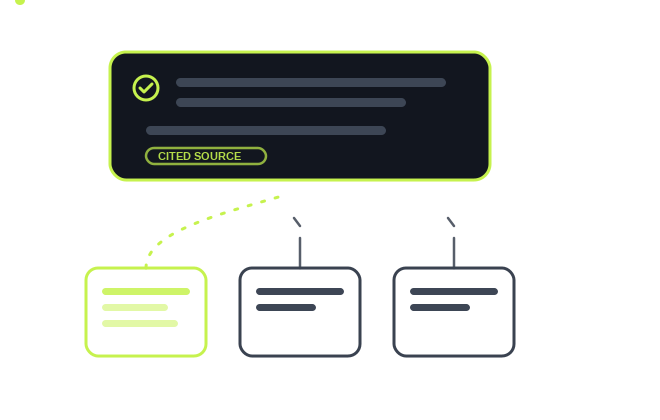
For twenty years, ranking meant being one of ten blue links an injured worker could compare. Increasingly they never see ten of anything — they see one assembled answer, with two or three sources cited inside it. You are either one of those sources or you are invisible. Here is what answer engines actually reward, what they ignore, and how a comp firm earns the citation without abandoning the SEO that still pays the bills.
SMBy Spencer Moeller WC Marketing SpecialistUpdated August 202617 min readAnswer engines · citations · zero-click
An injured worker doesn’t search the way they did three years ago. They ask a question — often a full sentence, often from a phone in a parking lot — and something answers it.
Sometimes that something is still a page of results. But more and more, it is an answer: a few assembled sentences at the top of Google, or a chat assistant’s reply, with a small number of sources cited. Google began rolling AI Overviews out broadly in 2024, and assistants like ChatGPT added web search the same year. The exact share of searches that end without a click is argued about endlessly; the direction is not argued about by anyone.
That direction changes what “visibility” means for a workers’ comp firm. The old contest was for position on a list the injured worker would read. The new contest is for a citation inside an answer they will read instead of the list. Different judges, different rules — but not, it turns out, a different kind of work.
What actually changed — and what didn’t
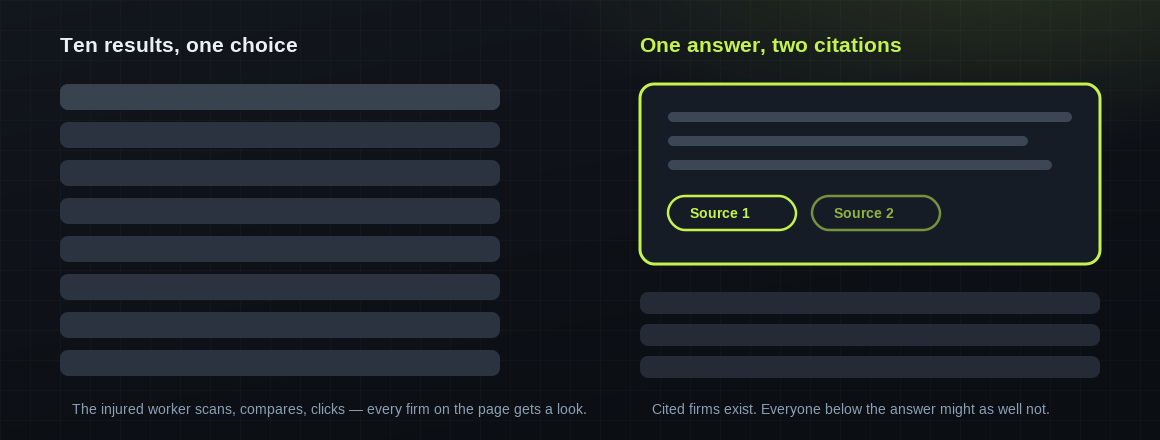
The old search results page was a menu. Ten options, scanned and compared; even position seven got some looks. The answer box is not a menu — it is a verdict with footnotes. The engine reads the sources it trusts, writes its own summary, and attributes a few of them. An injured worker asking “can I be fired while on workers comp in Ohio” may get everything they wanted without ever seeing the results below.
The contest moved from a menu the injured worker reads to a verdict they accept. Cited firms exist; everyone below the answer might as well not.
What did not change is just as important. The answer engines learned to read from the same web the crawlers indexed. They lean on the same signals of authority and trust that ranking always leaned on — which is why the firms being cited today are overwhelmingly the ones that were already doing serious content and local-SEO work. AI search is not a reset of the leaderboard. It is a compression of it: fewer winners per query, chosen by mostly familiar rules, displayed with less room for second place.
The questions injured workers actually ask
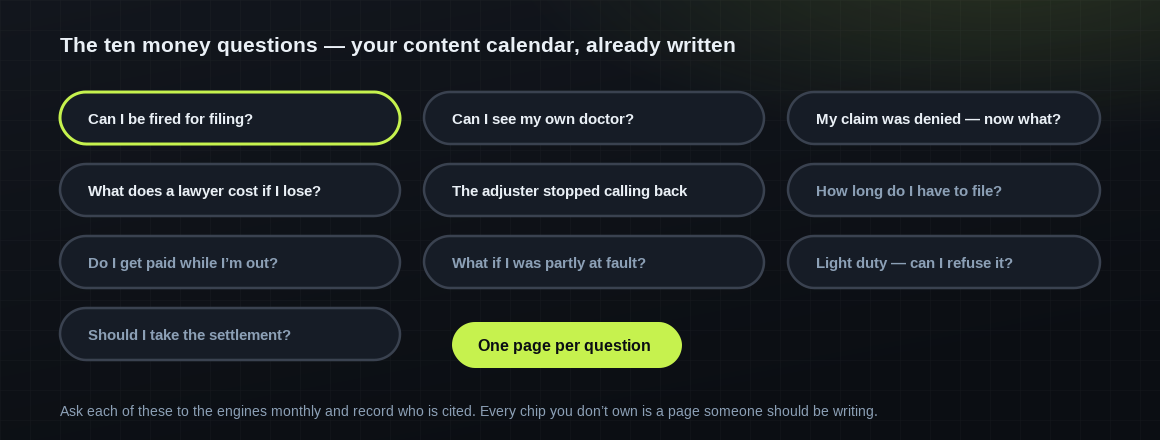
Answer engines are built for questions, and injured workers have nothing but questions. Not “workers comp lawyer near me” — that still happens, and still routes through the map pack — but the anxious, specific, midnight questions: Can I see my own doctor? What if I was partly at fault? My claim was denied — now what? How much does a lawyer cost if I lose?
Each of those is a query your firm can be the answer to, and each happens earlier in the injured worker’s journey than the hiring search. That is the strategic point most firms miss: AI search mostly intercepts the research phase. The firm quoted when the worker is learning is the firm remembered when the worker is choosing. Familiarity has always been the quiet engine of legal marketing — the answer box is a new place to earn it.
The questions injured workers ask at midnight are the calendar. Every chip you don’t own is a page someone should be writing.
The practical move is unglamorous: build your content plan from real question language, the way the content engine article lays out — one question, one page, the answer in the first two sentences, the nuance below. Pages structured that way were already winning featured snippets; they are exactly the shape an answer engine finds easiest to lift.
One more habit worth building early: treat every citation you do earn as evidence about the judge. When an assistant cites your denied-claims page, read what it chose to quote — almost always the plainest, most declarative sentences on the page. Engines quote claims, not prose. Writing one clean, quotable sentence per section (“In [state], you generally have N days to report a work injury to your employer”) gives the machine a handle, and gives the injured worker the answer — the same sentence doing both jobs is the entire craft of this surface.
What makes a firm citable
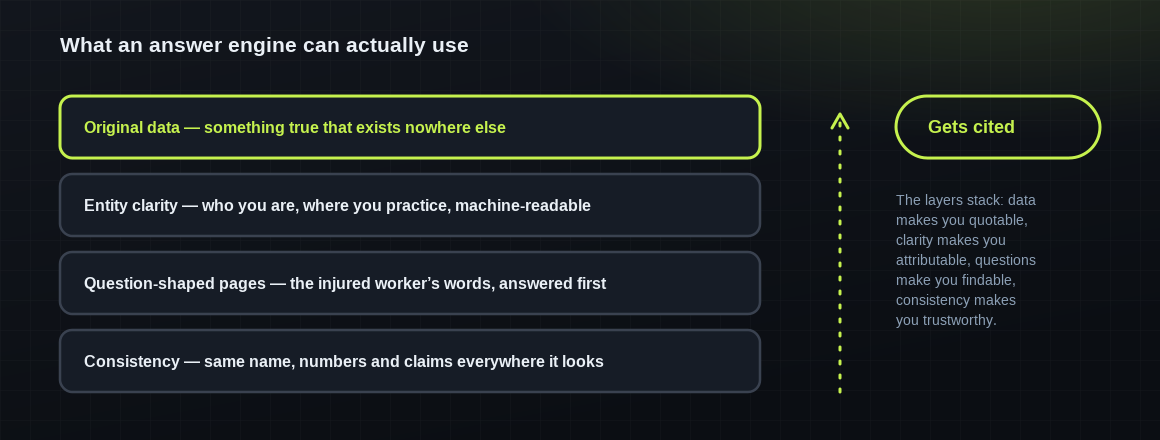
Look at what gets cited across legal queries and a pattern shows up. Four layers, stacked in order of leverage.
Data makes you quotable, clarity makes you attributable, question-shaped pages make you findable, consistency makes you trustworthy. Most firms invest in none of the four.
Original information. An answer engine summarizing twenty near-identical “what to do after a work injury” pages has no reason to cite yours. Give it a reason: something true that exists nowhere else. Your state’s claim timelines explained from real case experience. Data you gathered yourself. This is why we publish original research — engines (and journalists, and other sites) cite sources, and a source is someone with something of their own to say.
Entity clarity. Engines resolve who is saying this before deciding whether to trust it. Unambiguous name, address, practice area; attorney bios with real credentials; Article, FAQPage and LocalBusiness structured data; an About page a machine can parse. Boring, foundational, mostly done once.
Question-shaped pages. The direct answer first, in plain language, then the depth. A visible FAQ that matches its schema. Headings that are the question, not a pun about it.
Consistency. The engine cross-checks. If your site, your Business Profile, your directories and your reviews tell slightly different stories, you read as noise. Same identity, same claims, everywhere — the same discipline reviews and local SEO already demanded.
And when the answer names a competitor instead of you.
At some point you will ask an assistant a question you should own, and it will cite somebody
else. That is useful information rather than a verdict, because there are only three reasons it
happens and each one has a different fix.
They published a number and you published an adjective. The most common cause
by a distance. Engines quote figures far more readily than claims, because a figure with a stated
source can be checked and a claim cannot. If the cited page contains a benchmark, a rate, a
timeline or a cost and yours contains “experienced” and “aggressive”, the
engine has not made a mistake. It has made the only choice available to it.
The engine cannot work out who you are. Entity confusion is quiet and
corrosive: a firm name that differs between the website, the Business Profile and the directory
listings, an address that appears three ways, no clear statement of what the firm does and where.
The engine is not deciding you are worse. It is deciding it cannot say anything about you with
confidence, which produces the same outcome.
Your own pages disagree with each other. If one page says the deadline is
thirty days and another says ninety, an engine assembling an answer has to pick a source it can
trust, and internal contradiction is the fastest way to stop being one. This is worth a genuine
audit if you have been publishing for years, because the contradictions accumulate quietly and
nobody reads the whole library at once.
What to stop doing
Compression punishes filler. Three habits that were already weak are now close to worthless.
Thin location pages. Fifty near-duplicate “workers comp lawyer in [suburb]” pages were a marginal tactic under ranking; under summarization they are invisible, because they contain nothing to quote. One strong state or metro resource beats fifty templates.
Word-count content. The 2,000-word page that says what every other page says was written for a crawler that counted. The new reader doesn’t count words; it extracts claims. A page with one original claim beats a page with none at any length.
Chasing every query. You will not be the answer for everything, and don’t need to be. A firm cited for a handful of high-anxiety questions in its own state owns more decision-shaping real estate than a firm ranking eighth for two hundred.
How to measure any of this
Zero-click visibility is real but not unmeasurable. Four honest signals, none requiring a new tool:
Assistants are sending real visitors — small numbers, high intent
Branded search volume
Search Console, over quarters
People who met you in an answer are looking you up by name
Spot-check citations
Ask the engines your ten money questions monthly
Whether you (or a competitor) are the cited source, and for what
Signed-case sources
Intake — “how did you hear about us?”
“ChatGPT told me” is already appearing in intake logs; count it
Then hold it to the same standard as everything else: cost per signed case, not impressions. The point of being the answer is that the person who read it eventually calls. Track whether they do.
The firm quoted while the injured worker is learning is the firm remembered when they are choosing.
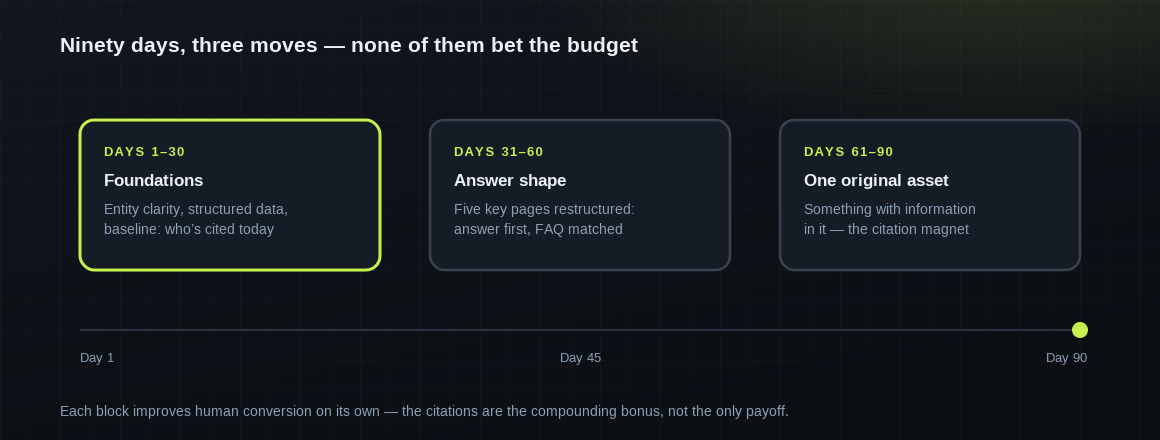
A 90-day plan that doesn’t bet the budget
Days 1–30: foundations. Fix entity clarity — structured data on every article and practice page, bios with credentials, one consistent identity across site, profile and directories. Write your ten money questions down; ask the engines each one and record who gets cited today.
Days 31–60: answer shape. Take your five most important existing pages and restructure them — direct answer first, question headings, visible FAQ matched to schema. This usually improves conversion on its own, which pays for the exercise regardless of what the engines do.
Days 61–90: one original asset. Publish something with information in it — a state claim-timeline guide from your real caseload, a piece of data only you have. Promote it the way you’d promote anything. This is the asset citations attach to.
Three moves in ninety days, each one valuable even if the engines never noticed — which is what makes the plan safe.
Want to know if AI search already cites you?
Book a free strategy call. We’ll run your market’s money questions through the answer engines live, show you who gets cited today, and map the shortest path from where your site is to being the source — alongside an honest read on the rest of your acquisition system.
You just read what good marketing looks like — now see where your own site stands. We grade it against 40+ factors, free, in about 30 seconds. Score on screen, full report in your inbox.