There is a conversation that happens in every workers’ compensation firm that has ever bought leads, and it is always about two numbers. What does a lead cost, and is it exclusive. Those are good questions. They are also the only two questions most firms ask, and together they describe a transaction that does not exist — the purchase of an asset. What actually changes hands is narrower and stranger than that: a row of contact details, and an assertion by somebody else that the person behind them agreed to hear from you.
The row of contact details is durable. It will sit in your CRM for years. The assertion is not. It was made by a company you have never audited, on a form you have never read, to a person who has never heard of your firm, and it can be withdrawn by that person at any time without anyone telling you. A firm that buys ten thousand leads over three years is not accumulating ten thousand records. It is holding ten thousand permissions of unknown and unequal remaining life, and it has no instrument on its own premises that measures how many are still good.
None of that is new. What is new is that California has started publishing the counterparty’s own paperwork, and has wired a deletion switch into the middle of the market.
This article is about what a firm should do with that. It is a marketing argument, not a legal one: the point is not that lead buying is unlawful — it plainly is not — but that the single variable which determines the return on a purchased list is invisible on every report a firm currently runs, and that there is now a free public file which tells you more about your vendor than your vendor will.
What actually changes hands
A row of data and somebody else’s promise, priced as though they were the same thing.
Set the vocabulary straight first, because it is doing damage. A lead is not a case, and it is not a contact; it is a permission attached to a contact. The permission is what distinguishes a bought lead from a list of names scraped off a licensing register, and it is the entire reason the price is $40 or $90 rather than a tenth of a cent. You are paying for the right to ring the phone.
The right has three properties a firm’s accounting never records. It was granted to somebody else, on terms the firm has not read. It is revocable by a person who owes the firm nothing. And it decays, invisibly, from the moment it is granted — so that the same row of data is worth less in month nine than in week one, by an amount no report in the building measures.
Compare that with the leads a firm generates itself. When somebody fills in a form on your own site, your firm is the business the consumer intentionally interacted with. The permission was granted to you, in words you wrote, with an artefact you hold. That is not a small difference in quality. It is a difference in what kind of thing you own, and it is the difference every rule in this article turns on.
None of this makes buying leads a mistake. Plenty of firms buy well, and a purchased lead that converts at a defensible cost per signed case is a perfectly good line in a media plan. What it is not is an owned asset, and the trouble starts when a firm treats it as one — when it builds a reactivation programme on top of three years of purchased rows, or values an acquisition partly on the size of its lead database, or budgets as though a lead bought in January is the same object in October. Each of those decisions prices a permission as though it were a record.
Three rules, three phrasings, one question
A registration statute, a definitions section and a telephone rule, each resolving the same way.
Start with the one that is most specific to lead vendors. California’s Delete Act defines a data broker, at Civil Code § 1798.99.80(c), as “a business that knowingly collects and sells to third parties the personal information of a consumer” with whom “the business does not have a direct relationship.” Four categories are carved out in (c)(1) to (c)(4): entities regulated by the Fair Credit Reporting Act, by Gramm-Leach-Bliley, by California’s Insurance Information and Privacy Protection Act, and HIPAA-related entities exempt under § 1798.146. Everything turns on that one phrase. A business that collects a consumer’s information through its own consumer-facing form, and has a relationship with him, is arguing it sits outside the definition. A business that buys names and resells them is inside it.
Next, the definitional machinery the deletion duty runs on. Civil Code § 1798.140(ai) defines a “third party” as “a person who is not” any of three things: the business the consumer intentionally interacts with, “a service provider to the business,” or “a contractor.” Both of the latter are defined by what their contract forbids. A service provider, under (ag)(1), processes personal information “on behalf of a business” under a contract that prohibits it from “retaining, using, or disclosing the personal information for any purpose other than for the business purposes specified in the contract.” A contractor, under (j)(1), carries the same prohibition. A law firm that buys a lead in order to work it for itself is doing precisely the thing those contracts forbid, which is why, on the face of the definitions, it lands in the residual box: a third party.
Last, the federal rule that decides whether you may dial. The TCPA’s definition of prior express written consent, at 47 C.F.R. § 64.1200(f)(9), is “an agreement, in writing, bearing the signature of the person called that clearly authorizes the seller” to deliver the calls or texts to the number given. Singular: the seller. Paragraph (f)(10) defines the seller as the entity on whose behalf the call is made to encourage a purchase — which, when your intake team dials, is your firm. So the instrument that makes the call lawful names you, and you have never seen it. Somebody else is holding the only document that would answer for your conduct.
| Instrument | The words it uses | What turns on it | Where the firm sits |
|---|---|---|---|
| Cal. Civ. Code § 1798.99.80(c) | “a consumer with whom the business does not have a direct relationship” | Whether the vendor must register with the state as a data broker, and so whether it is reachable by the deletion platform at all | Not the subject of the test; the vendor is |
| Cal. Civ. Code § 1798.140(ai) | “a person who is not … the business with which the consumer intentionally interacts” | Whether a recipient is a third party, a service provider or a contractor — which is what the deletion duty is drawn around | A third party, on our reading — so outside the duty |
| 47 C.F.R. § 64.1200(f)(9) | “clearly authorizes the seller” | Whether written consent exists for the call your intake team is about to make | The named seller — holding none of the evidence |
Three different statutes, three different phrasings, and we are not claiming they are one test — they have different subjects, different consequences and different enforcers. What they share is the shape of the question. Each resolves by identifying the business the consumer actually dealt with, and in a purchased lead that business is the vendor, in all three.
The file your vendor has already filed
625 companies, 78 columns, and a download button.
Here is the part that is immediately useful, and that almost nobody in this category appears to know about. The California Privacy Protection Agency publishes the Data Broker Registry as a public web page with a Download Registration Information button that hands you the whole thing as a CSV. We downloaded it on 18 November 2026. It contains 625 registrants and 78 columns, and the page states that “the businesses in this registry operated as data brokers in 2025.”
Registration is not optional for a business inside the definition. Section 1798.99.82(a) requires registration “on or before January 31 following each year in which a business meets the definition of data broker,” the agency’s current stated fee is $6,000 plus payment processing, and § 1798.99.82(c)(1) provides an administrative fine of “two hundred dollars ($200) for each day the data broker fails to register.” That is a per-day meter, not a one-off.
What a registrant must disclose is a diligence questionnaire somebody else already made them answer. Each row carries the legal name, any DBA, the primary website, a contact address and email, and the URL where consumers exercise their privacy rights. Then a block of yes-or-no disclosures about what the broker collects — minors’ information, account logins, government-issued identification numbers, citizenship and immigration status, union membership, sexual orientation, gender identity, biometrics, precise geolocation, reproductive health care data. Then a block about who it sold or shared to in the past year: a foreign actor, the federal government, other state governments, law enforcement outside a subpoena or court order, and the developer of a generative AI system. Then the four regulatory exemptions, with free-text descriptions. Then, finally, the numbers: for each of five consumer request types, how many were received, how many were complied with in whole, how many in part, how many were denied, and the mean and median days to respond.
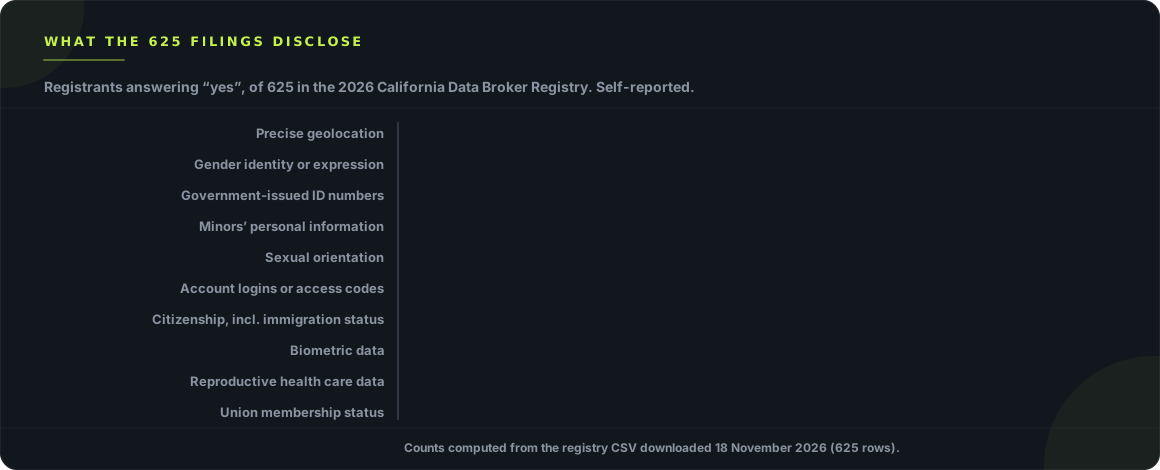
Two of those lines matter more to a workers’ compensation firm than to almost any other buyer. Seven registrants disclose collecting union membership status, and twelve disclose collecting citizenship data including immigration status. Both are categories that sit close to the centre of comp caseloads, and both are sensitive personal information under California law, which is what makes them subject to the limitation right and to deletion. If a vendor’s pitch to you leans on either, the register is where you check whether it has said so to the state.
That last number is the one to sit with. We searched the 625 business names and trading names for the obvious tokens. One contains “legal.” None contains “lawyer,” “attorney,” “injury,” “claim” or “accident.” Twenty contain “lead.” Name-matching is a crude instrument and we are not using it to say that any particular company should have registered and did not — a vendor may trade under a name that reveals nothing, and the register lists DBAs too. But the shape of the result is worth a firm’s attention, and there are only two readings of it.
The first is that legal lead generators genuinely sit outside the definition, because they collect through their own consumer-facing properties and therefore claim a direct relationship with the injured worker. That is probably right for a good many of them, and it is a more interesting fact than it looks: it means the vendor’s whole regulatory position rests on being the business the worker dealt with — the position your firm wanted and did not get. The second reading is that some resellers in the chain are inside the definition and have not registered, which is a $200-a-day exposure sitting at your counterparty. You cannot tell which from the outside. You can, in about four minutes, look up every vendor you use.
Deletion empties their file, not yours
One request, every registered broker, every 45 days — and a boundary that stops short of your CRM.
Civil Code § 1798.99.86 required the Privacy Protection Agency to build an accessible deletion mechanism by 1 January 2026. It exists, it is called DROP, and the agency describes it as letting California residents “submit a single deletion request to all active data brokers.” Consumers could begin submitting in January 2026. The duty on the other side started on 1 August 2026: under § 1798.99.86(c)(1) a data broker must access the mechanism at least once every 45 days, and under (c)(1)(A) process each request and delete the consumer’s personal information within 45 days. Unverifiable requests are processed instead as opt-outs of sale or sharing, under (c)(1)(B). The agency says the interval drops to every 30 days from 1 January 2027 under AB 883.
Three further provisions matter commercially. Subdivision (c)(1)(C) requires the broker to “direct all service providers or contractors associated with the data broker to delete all personal information” for the requesting consumers. Subdivision (d)(1) makes the deletion recurring rather than one-off: the broker must keep deleting that consumer’s information at least once every 45 days. And (d)(2) provides that the broker “shall not sell or share new personal information of the consumer” thereafter. Failure carries its own meter — § 1798.99.82(d)(1) sets a $200 fine for each deletion request for each day of non-compliance.
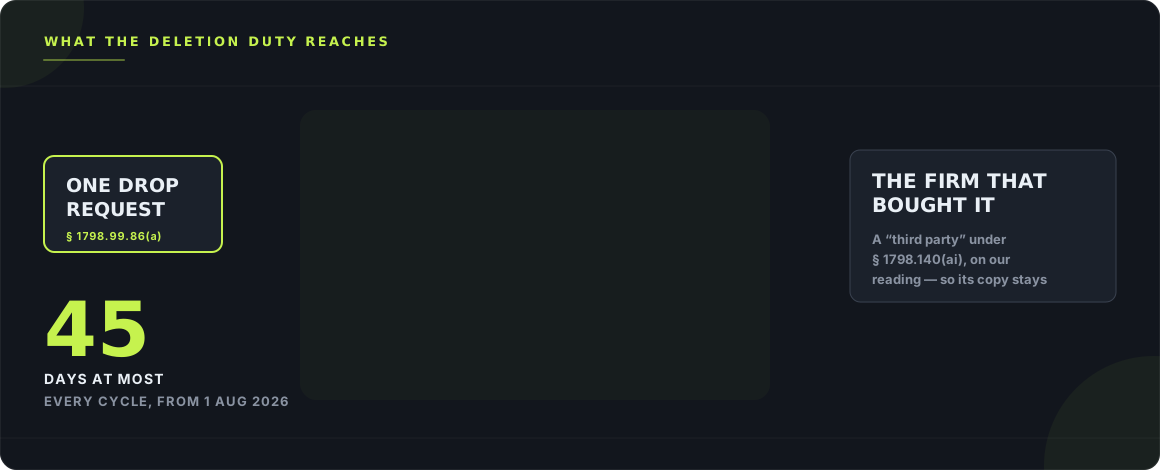
Read that boundary carefully, because it cuts the opposite way to most privacy intuitions. A Californian who uses DROP empties the vendor’s file and shuts off the vendor’s ability to sell him again. It does not, on the text we read, reach backwards into the CRM of a law firm that bought his details last spring. Your copy stays.
A firm could file that under good news. It is better understood as a repricing. What DROP does is sever the two halves of what you thought you bought: the record, which is now permanently yours and permanently un-refreshable, and the vendor’s relationship with that person, which is gone. You can no longer ask the vendor to re-verify, re-confirm or re-supply. Whatever your copy says about that person is now the only version in your possession and it will never be corrected. And the consent evidence — the artefact under § 64.1200(f)(9) that names your firm as the seller — sits inside the file the vendor has just been required to delete.
| Request type | Received | Complied in whole | Denied | Registrants reporting none | Median of reported medians |
|---|---|---|---|---|---|
| Opt out of sale or sharing | 98,816,914 | 98.1% | 1.7% | 209 of 625 | 1 day |
| Delete | 58,035,883 | 98.2% | 1.5% | 180 of 624 | 2 days |
| Limit use of sensitive information | 30,949,163 | 99.6% | 0.4% | 495 of 625 | 0 days |
| Know what is collected | 4,311,724 | 99.0% | 1.0% | 279 of 625 | 1 day |
| Know what is sold or shared | 2,832,329 | 98.9% | 1.0% | 341 of 625 | 0 days |
Every cell above is ours, summed or taken across the same columns of the same 625 filings, so the headings are true of each row by construction rather than by generalisation. What they are not is a population rate: these are the requests 625 self-selected registrants say they received, not a measure of how often a Californian exercises a right. The column worth arguing over is the last one. A median registrant turning a deletion around in two days is a market that has already built the plumbing — which is why a vendor that cannot tell you its own numbers is telling you something.
The switch that costs you — and the date it widens
Ten business days, any reasonable method, and a scope change arriving on 31 January 2027.
Deletion is the dramatic mechanism. Revocation is the expensive one, because it happens constantly and in your own channels. Under 47 C.F.R. § 64.1200(a)(10), a called party may revoke consent “by using any reasonable method to clearly express a desire not to receive further calls,” and several methods are reasonable per se — replying to a text with stop, quit, end, revoke, opt out, cancel or unsubscribe among them. The rule requires that a revocation “must be honored within a reasonable time not to exceed ten business days from receipt of such request.”
Now the part worth putting in a calendar. The rule also provides that once a called party uses one of those methods, “that consent is considered definitively revoked and the caller may not send additional robocalls and robotexts.” The Federal Communications Commission has twice postponed the application of that sentence across unrelated subjects. Its Consumer and Governmental Affairs Bureau granted a waiver in April 2025 running to 11 April 2026, and then on 6 January 2026 released DA 26-12, extending the waiver “to the extent that it requires callers to apply a request to revoke consent made in response to one type of message to all future robocalls and robotexts from that caller on unrelated matters.” Its ordering clause puts the new date plainly: “the effective date of section 64.1200(a)(10) is extended to January 31, 2027 to the extent discussed herein.” The stated grounds are good cause under 47 C.F.R. § 1.3 — room to review the record from a pending Further Notice, and avoidance of “potentially unnecessary compliance costs” for parties who said they would need “substantial funds, personnel resources, and time.”
A firm that keeps revocation at the campaign level today is building a liability that matures on a date the Commission has already published.
So, as matters stand on the day this is published: the ten-business-day duty and the any-reasonable-method standard are in force, and the cross-subject application is not. The order says the waiver “extends only to section 64.1200(a)(10) to the extent discussed herein and does not alter the status quo relating to any other prior Commission rules or rulings addressing revocation of consent,” but it does not discuss the ten-day deadline or the reasonable-method standard in terms, so we read them as untouched rather than as expressly preserved. That distinction is worth taking to your own counsel.
For a marketer the operational reading is simple and has a date on it. Many comp firms run intake confirmation, appointment reminders, nurture sequences and reactivation campaigns as separate streams with separate suppression lists. On 31 January 2027, absent a further extension, a STOP sent to any one of them becomes a STOP for all of that caller’s robocalls and robotexts on unrelated matters. Building person-level, cross-channel revocation now costs a sprint. Building it in February costs a sprint plus whatever ran in the meantime.
One more piece of the consent story belongs here, because it explains why the artefact is so hard to get. On 24 January 2025 the Eleventh Circuit decided Insurance Marketing Coalition Ltd. v. FCC, No. 24-10277, holding that “the FCC exceeded its statutory authority under the TCPA because the 2023 Order’s new consent restrictions impermissibly conflict with the ordinary statutory meaning of ‘prior express consent,’” and ordering: “PETITION GRANTED; ORDER VACATED IN PART AND REMANDED.” What it vacated was Part III.D of the 2023 Order — both the one-to-one consent restriction and the logically-and-topically-related restriction. The current text of § 64.1200(f)(9) carries no one-identified-seller limit. Which means a single form on a single website can still gather consent naming a long list of sellers, and you are one entry on a list your firm has never read.
Why this lands hardest on the list you were told to mine
The cohort selected for age is the cohort selected for decay.
The standard advice to a comp firm with a tight month is to work the list it already has — the old enquiries, the declines, the ones that went quiet. We have given that advice ourselves and we still think it is right about case value. It is nearly backwards about permission, for a reason that is purely structural: a reactivation cohort is selected on exactly the variable that degrades. The older the record, the more likely the permission attached to it has been withdrawn, superseded or, since August, deleted at source.
Three things compound with age on a purchased record, and only one of them is visible in a CRM.
- Revocations accumulate. Every month the record sits in somebody’s database is another month in which the person could have replied STOP to someone — possibly to the vendor, possibly to another buyer of the same name, possibly to you, on a campaign whose suppression list is not the one you are about to dial from.
- Numbers move. Reassignment and disconnection are ordinary and they do not announce themselves. This is the one most firms already scrub for, which is why it is the one they think is the whole problem.
- The source goes dark. Since 1 August 2026, a DROP request means the vendor must delete and must not sell new personal information about that person. Your vendor’s ability to re-verify a name you bought in 2024 can disappear without any message reaching you, because nothing in the mechanism requires one.
The firm-level consequence is that the oldest cohort — the one with the best case-value story — carries the worst and least measurable permission position, and that a reactivation programme built on purchased rows is the single place in a comp firm’s marketing where these three rules all bite at once. The same programme built on first-party enquiries is in a materially different position, because the firm is the business the consumer intentionally interacted with and holds its own artefact. That is not a reason to stop reactivating. It is a reason to run the purchased and first-party halves of the list as two different programmes, with different evidence requirements and different expectations.
What an unreachable share does to your number
Define the terms, then watch the one you cannot see move the answer.
Cost per signed case is spend divided by signed cases attributable to that spend, over a stated window. The numerator is what you paid the vendor plus what you paid to work the list; the denominator is signings, not retainers sent and not consultations booked. Attribution is imperfect, and on a purchased cohort it is worse than usual, because the vendor’s own marketing may have touched the same person.
Now add the term nobody models. Call u the share of a purchased cohort that cannot lawfully or practically be contacted by the time you work it — revoked, deleted at source, or simply gone. Those names still sit in the denominator of the price you paid, and they produce no signings. So the effective cost per signed case multiplies by roughly 1 ÷ (1 − u).
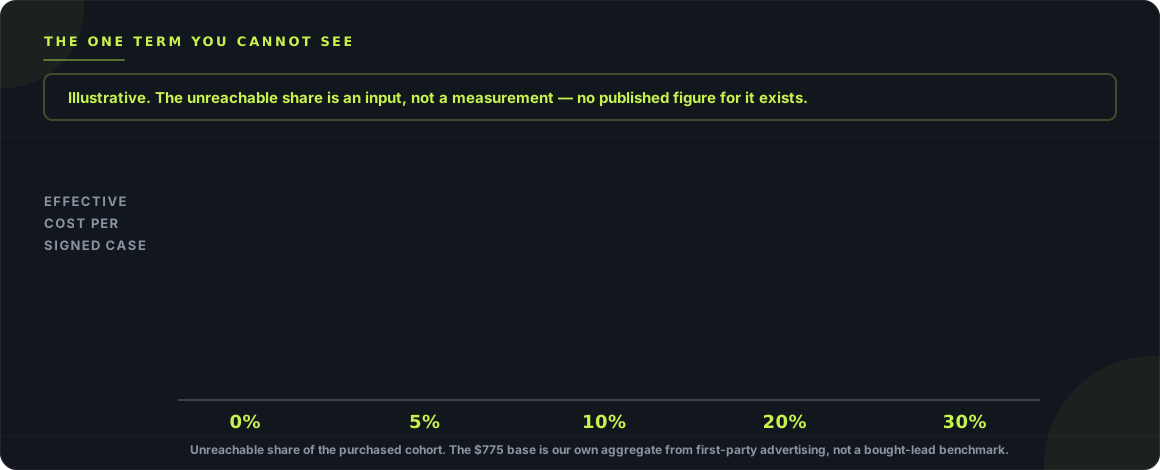
Three observations follow and none of them depends on knowing u. First, the sensitivity is steep in the range that matters: a tenth of a cohort going dark costs about eleven per cent on the headline number, which is larger than most of the optimisations a firm will attempt this quarter. Second, u is the only term in the model that a firm cannot see, and the only one that is worse on the cohorts it likes best. Third — and this is the useful part — u is measurable inside your own building, without anyone’s cooperation.
The measurement is not complicated. Instrument the dialler and the text platform to record outcome codes at the person level, bucket each purchased cohort by months since purchase, and report the share of attempted contacts that terminate in a revocation, an invalid number or a hard refusal to engage on the basis of never having asked to hear from you. That last bucket is the interesting one and almost nobody records it. Run it monthly, by vendor, and you will have something no benchmark will ever give you: your own decay curve, by source.
Monday
Four minutes, four contract terms and one report that does not exist yet.
Start with the free part. Open the California Data Broker Registry, download the CSV, and look up every lead vendor you currently buy from, by legal name and by trading name. If a vendor is listed, read its own disclosures: what it says it collects, who it says it sold to in the past year, and how many deletion and opt-out requests it reports receiving against how many it denied. If a vendor is not listed, that is a question, not a verdict — ask it directly on what basis it concludes it has a direct relationship with the consumer.
Then fix the paperwork, which is where the leverage actually is. Four terms, in the next contract you sign or the next renewal you negotiate:
- Delivery of the consent artefact with each lead, or on demand within one working day — the record that satisfies § 64.1200(f)(9) for a call made by your firm, which the rule says names the seller, which is you.
- The full disclosed partner list the form presented at the moment of consent. Since the one-to-one restriction was vacated, that list can be long. You are entitled to know how long, because it tells you how many other firms hold the same permission.
- A written statement of registration status under § 1798.99.82, with the registered name, or the vendor’s stated basis for falling outside § 1798.99.80(c).
- Notice to you of any deletion or opt-out event touching a record previously supplied. Nothing we read requires this — which is exactly why it has to be a contract term rather than an assumption.
Then the internal work: add the six fields above to your CRM, move revocation from campaign-level to person-level across every channel before 31 January 2027, split your reactivation list into purchased and first-party halves and report them separately, and stand up the decay-curve report. None of that needs a vendor’s cooperation and all of it survives a change of vendor.
Key takeaways
A bought lead is a permission, not a record. The data is durable; the right to use it is granted by someone else and withdrawn without notice to you.
Three rules, one question. Each asks who the consumer actually dealt with — in three different phrasings — and in a purchased lead the answer is the vendor.
The state publishes your vendor’s file. 625 registrants, downloadable as a CSV, with each one’s own disclosures and its deletion and opt-out request counts.
Deletion stops at the vendor. On our reading of § 1798.99.86(c)(1) it reaches the broker and its contractors, not your copy — so your file survives and the source goes dark.
31 January 2027 is a real date. A revocation on one message stream becomes a revocation across unrelated ones, unless the Commission extends again.
Measure the decay yourself. Outcome codes by cohort age and by vendor give you a curve no benchmark can.
WorkersComp Marketing is a marketing agency, not a law firm. This article reads California Civil Code §§ 1798.99.80, 1798.99.82, 1798.99.86 and 1798.140, title 47 of the Code of Federal Regulations § 64.1200, an FCC bureau order and one federal appellate decision, and it reads them in order to explain what a firm is buying when it buys a lead and what to put in the contract. Nothing here is legal advice, nothing here is a compliance opinion on your vendor agreements or your dialling practices, and nothing here tells you whether any particular call may lawfully be made. Two readings in this article are ours rather than any court’s — that a lead-buying firm is a “third party” under § 1798.140(ai) and therefore outside the § 1798.99.86 deletion duty, and that the ten-business-day and reasonable-method elements of § 64.1200(a)(10) are untouched by the DA 26-12 waiver — and both are flagged where they appear. Take them to your own counsel before you rely on either.
Frequently asked questions
If a worker deletes himself through DROP, do we have to delete our copy?
Nothing in the text of Civil Code § 1798.99.86 that we read extends the deletion duty to a third party the broker previously sold to. The duty runs to the data broker, and through subdivision (c)(1)(C) to its service providers and contractors; a firm that bought a lead to work for itself appears to be a third party under § 1798.140(ai) rather than either of those. That is our reading of the definitional text, not a holding, and we could not reach the official leginfo copy of either section during this run. It is also only the Delete Act question — a consumer may have other rights against you directly, and your own privacy obligations are a separate matter for your counsel.
Our lead vendor is not in the register. Is that a problem?
It is a question rather than a finding. A business is only inside Civil Code § 1798.99.80(c) if it sells personal information about consumers with whom it has no direct relationship, and a vendor that collects through its own consumer-facing site will say it has one. That answer is worth having in writing, because it is also an admission about who the injured worker dealt with — which is the same fact that decides who holds the consent artefact naming your firm as the seller. The alternative reading, that a reseller inside the definition has not registered, carries a $200-per-day exposure under § 1798.99.82(c)(1) at your counterparty rather than at you.
We only buy exclusive leads. Does any of this change?
Exclusivity governs how many other firms get the same name. It says nothing about who holds the consent artefact, whether the vendor is registered, whether the consumer can delete himself at source, or whether he has replied STOP to anybody. An exclusive lead and a shared lead sit in exactly the same position under all three instruments in this article. Exclusivity is worth paying for; it is not the term that determines whether the name is still callable.
What actually changes on 31 January 2027?
On the FCC’s current order, the part of 47 C.F.R. § 64.1200(a)(10) requiring a caller to apply a revocation made in response to one type of message to all future robocalls and robotexts on unrelated matters takes effect. Until then it is waived; DA 26-12, released 6 January 2026, extended the effective date “to January 31, 2027 to the extent discussed herein.” The ten-business-day deadline and the any-reasonable-method standard are in force now and the order does not discuss them. The Commission has already extended this twice, so a third extension is possible — but building person-level suppression is the right answer either way, and it is cheap now.
Is there a published figure for how many purchased leads go dark?
Not that we could find, and we have not estimated one. The illustration in this article uses an unreachable share as an input and says so on the figure itself. The register gives scale rather than a rate: 58.0 million deletion requests and 98.8 million opt-out requests reported across 625 registrants, with one registrant accounting for 45.3% of the deletion total and 180 registrants reporting none at all. The number you can actually get is your own, from outcome codes bucketed by months since purchase and by vendor.
Does this apply to a firm outside California?
Partly. The TCPA and 47 C.F.R. § 64.1200 are federal and reach your dialling wherever you sit. The Delete Act is California law and binds data brokers doing business in California — which a national legal lead vendor generally is, whatever state your firm is in, so the register and DROP are usually relevant to your supply chain even if they are not relevant to you directly. Other states have enacted their own data-broker registration laws; we did not read them for this article and make no claim about what they require.
Sources
- 01Cal. Civ. Code § 1798.99.80(c)
Sells personal information about “a consumer with whom the business does not have a direct relationship”; (c)(1)–(4) exclude FCRA, GLBA, IIPPA and HIPAA-related entities. Official leginfo unreachable all run; two publishers agree.
- 02Cal. Civ. Code § 1798.99.82
Register “on or before January 31” after each qualifying year; (c)(1) “two hundred dollars ($200) for each day” unregistered; (d)(1) the same per request per day for failing to delete. Official text not read; same two publishers.
- 03Cal. Civ. Code § 1798.99.86
From 1 Aug 2026, access and delete within 45 days; (c)(1)(C) “direct all service providers or contractors” to delete; (d)(2) no selling new personal information after. That nothing here reaches a prior purchaser is our inference from the text read, not express wording.
- 04Cal. Civ. Code § 1798.140(ag), (ai), (j)
A third party is “a person who is not” the business the consumer intentionally interacts with, a service provider or a contractor — the latter two needing a contract barring other use. Publishers state currency 1 Jan 2026. That a lead buyer is a third party is our reading, not a holding; the agency’s regulations were not read.
- 05California Data Broker Registry (CSV)
Every count here is ours, from the CSV downloaded 18 Nov 2026: 625 rows, 78 columns. All fields are registrants’ self-reports, not audits. Response-time columns are labelled “in 2024” while request counts carry no year label, and the page calls the registrants businesses that operated as data brokers in 2025 — so the two do not clearly align. The HTML page showed a count of zero while the CSV carried rows.
- 06CalPrivacy — data broker and DROP pages
DROP takes “a single deletion request to all active data brokers”; brokers process “beginning August 1, 2026”; fee “$6,000 plus” processing. The $200-a-day figure and the AB 883 move to 30 days from 1 Jan 2027 appear on these pages with no code citation.
- 0747 C.F.R. § 64.1200(a)(10), (f)(9), (f)(10)
Revocation by “any reasonable method”, honoured “within … ten business days”; (f)(9) needs an agreement that “clearly authorizes the seller”, with no one-identified-seller limit now. Official eCFR unreachable; read at Cornell LII against the 2024 GPO edition, where (a)(10) is still “[Reserved]”. LII flags a later amendment, 91 FR 67219 (26 Oct 2026), whose effect we could not confirm.
- 08FCC, DA 26-12 (CGB, 6 Jan 2026), CG Docket 02-278
Waives (a)(10) so far as it applies a revocation on one message type “to all future robocalls and robotexts from that caller on unrelated matters”; effective date “extended to January 31, 2027”. The predecessor April 2025 waiver (40 FCC Rcd 2395) was not read directly, only as this order describes it. The order does not discuss the ten-day deadline, so our reading that it survives is an inference.
- 09Ins. Marketing Coalition Ltd. v. FCC, No. 24-10277 (11th Cir., 24 Jan 2025)
“ORDER VACATED IN PART AND REMANDED,” striking Part III.D of the 2023 Order — the one-to-one and logically-and-topically-related consent restrictions. Slip opinion marked [PUBLISH]; no reporter citation on its face and subsequent history not checked.
- 10WorkersComp Marketing — our own figures
~$16.5M managed comp Meta spend, ~219,000 leads at ~$75 CPL, ~21,000 signed at ~$775. Ours, aggregate, across firms and years, from first-party advertising rather than purchased leads — not an industry benchmark. The $775 illustration and the unreachable share are inputs, not measurements.
Two readings here are inferences rather than express wording — that the § 1798.99.86 deletion duty does not reach a prior purchaser, and that the DA 26-12 waiver leaves the ten-business-day deadline intact — and both are marked wherever they appear. A marketing article about what a purchased lead is worth, not legal advice.