Every firm we’ve ever audited believed it was visible. About the feeling, they were sincere. About the market, roughly half were wrong — and the interesting part is that they were wrong in different doors.
The feeling comes from a bad experiment: partners search their own firm name, on their own phone, logged into an account that has visited the firm’s site a thousand times. Google obligingly serves the firm back to them. Meanwhile the injured worker — logged out, three towns over, typing “work injury lawyer” with a throbbing hand — sees a page you might not be on at all.
So this article is a lab protocol: how to see your market the way the injured worker sees it, score all four doors, and know — rather than feel — where you stand. It takes one evening and costs nothing but comfort.
The four doors an injured worker can walk through
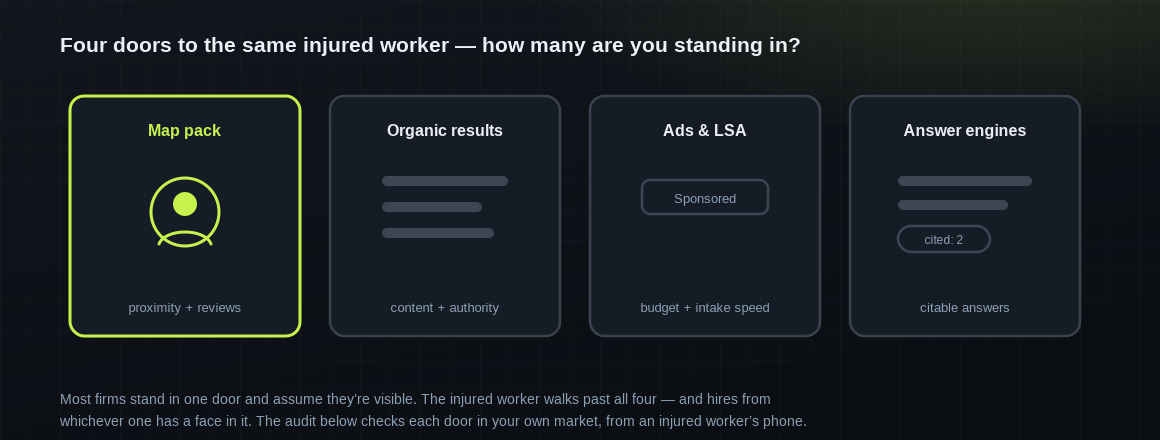
Door one: the map pack. Three firms above everything else on the searches with hiring intent, governed by proximity, relevance and prominence — the terrain of the local SEO article. A firm can rank here and nowhere else, and vice versa.
Door two: organic results. The classic listings, won by content and authority — and increasingly compressed from above by everything else on this list.
Door three: the paid slots. Local Services Ads and search ads sit above all of it. Presence here is rented by budget and — for LSA — earned by answering the phone. Absence here while competitors show is a choice, whether or not you remember making it.
Door four: the assembled answer. AI Overviews and chat assistants answer more of the early, anxious questions every month — the newest door, with the fewest firms standing in it.
The doors are scored separately because they fail separately: we routinely meet firms dominant in the pack but invisible organically beyond their suburb, firms with excellent content that never claimed their LSA eligibility, and — most commonly — firms visible in three doors whose site quietly repels everyone who walks through, which is where the Index data comes in.
The protocol: see it like the injured worker sees it
The experiment is only honest if the conditions are. Use a phone, not your desktop. Log out of Google or use a private window; better, drop off the office Wi-Fi entirely — personalization and location will otherwise flatter you. Then run the searches your market actually types, from three vantage points: your office ZIP, the industrial side of town where the work injuries actually happen, and the suburb where you think your reach ends.
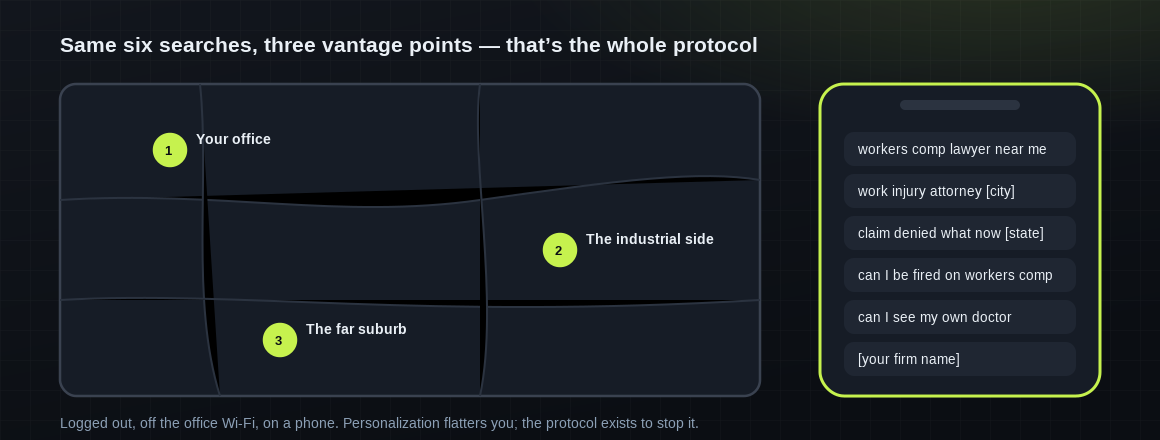
The search set, ten minutes to write: two hiring searches (“workers comp lawyer near me,” “work injury attorney [city]”), three anxious questions (“claim denied what now [state],” “can I be fired workers comp,” “can I see my own doctor workers comp”), and your own firm name — because the branded result page, with its reviews and profile, is itself a door people check before calling.
| Door | Check | Score yourself |
|---|---|---|
| Map pack | Hiring searches from all three locations | In the three? In the expanded list? Absent? |
| Organic | Hiring + question searches | Page one anywhere? Whose content outranks yours? |
| Ads & LSA | Top of every results page | Present? Which competitors are, every single time? |
| Answers | Ask the question searches in the AI tools | Cited? Is a competitor? Is a national site? |
The fifth check: the door you own
Every door ends at the same place: your website. Which is why the fifth check isn’t a search — it’s your own site, on a phone, on cellular, timed. And it’s the check we can put industry numbers behind, because we scanned for it at scale.
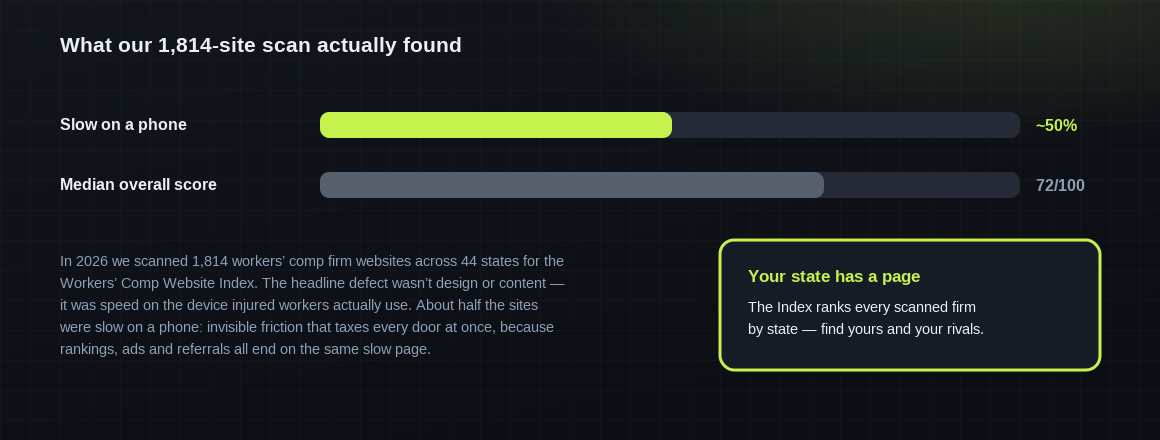
For the Workers’ Comp Website Index we scanned 1,814 workers’ comp firm websites across 44 states. The median site scored 72 of 100. The single most common revenue-relevant defect — present on roughly half the sites — was mobile speed. Not aesthetics, not missing content: seconds, on a phone, while a person in pain decides whether to wait.
Slowness is the one defect that taxes every door at once. The map-pack click, the ad click you paid for, the referral who was told your name — all of them land on the same page, and abandon it at the same rate. That’s what makes it the highest-leverage fix on most firms’ lists: one repair, four doors improved. The website article covers the triage.
Two refinements make the protocol sharper the second time you run it. First, add one Spanish-language search if your market has a meaningful Spanish-speaking workforce — “abogado de accidente de trabajo [city]” — because that door often has one-tenth the competition of its English twin, and the audit will tell you in thirty seconds whether anyone in your market has noticed. Second, run your firm-name search with a skeptic’s eye: the branded results page is your lobby, and it contains things you don’t control — review snippets, third-party profiles, occasionally a directory outranking your own site. Anything on that page you wouldn’t want a scared caller to see at 11pm is an action item exactly as real as a missing ranking, and usually cheaper to fix.
Reading the scorecard: four patterns, four plans
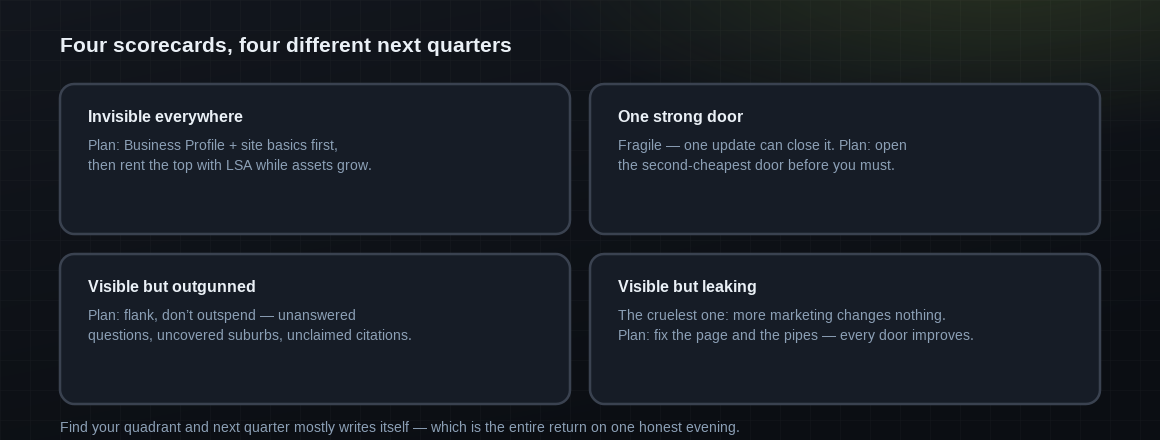
Most audits land in one of four patterns, and each implies a different next quarter.
Invisible everywhere. Usually a young or referral-built firm. Good news: the order is known. Claim and build the Business Profile, fix the site’s speed and conversion basics, then rent visibility with LSA while the owned assets grow. Don’t start with the hardest door (organic) — start with the fastest two.
One strong door. The commonest pattern — and fragile, because a single algorithm update or a competitor’s budget decision can close your only door. The plan is the second door, chosen by cost: pack-strong firms usually add paid; ad-dependent firms build the owned assets that lower their blended cost per signed case.
Visible but outgunned. You’re present in every door; two firms are simply bigger in all of them. Displacement is door-by-door — take the questions they haven’t answered, the suburbs their proximity doesn’t cover, the answer citations nobody has claimed yet — not a spending contest on their strongest ground.
Visible but leaking. Strong doors, slow site, or strong doors and an intake stack that loses what walks through. The audit’s cruelest finding, because more marketing would change nothing. Fix the page and the pipes first; every door improves the same day.
You are not competing for a market. You are competing for four doorways into it — one scared person at a time.
One caution on interpreting a single audit: search results have natural jitter. Rankings breathe day to day, ad presence depends on budgets and dayparting, and one evening’s snapshot can catch a competitor’s campaign on an off hour. That’s not a flaw in the protocol — it’s the reason for the cadence. One audit is weather; four audits are climate. Make decisions on climate.
And the fifth pattern, which is the most frustrating one to be in.
There is a scorecard result the four patterns above do not cover, and it is the one firms find hardest to act on: every door scores well, and signed cases are flat.
The instinct is to distrust the audit. Do not — a good scorecard is usually telling the truth. What it means is that visibility has stopped being your constraint, and the problem has moved downstream to what happens after somebody finds you. That is genuinely good news, because downstream problems are cheaper to fix than visibility problems and they do not require buying anything.
Confirm it in an afternoon rather than assuming it. Pull the raw call log for a full month and count how many enquiry calls were answered live, versus rolled to voicemail, versus abandoned while ringing. Take thirty recent form enquiries and find the median time until a human actually spoke to the person. Plot both by hour and day of week. If the answer rate is below ninety per cent, or the median wait runs past thirty minutes, or a wall appears in the chart at five o’clock, the audit was right and the leak is downstream.
Make it quarterly, make it boring
Run the same protocol every quarter — same searches, same three locations, same scorecard — and date the results. The value compounds exactly like the assets it measures: a single audit is a snapshot; four in a row are a trend line, and trend lines settle arguments that opinions never will. Rankings drifting down two quarters running is a fact you can budget against; “I feel like the phone’s slower” is not.
Twenty minutes of the quarterly version goes to the answer engines, because that door is moving fastest: ask your ten questions, record who’s cited, watch whether a competitor starts showing up. The firm that notices that shift first in your market gets a year’s head start on the cheapest visibility there is.
And bring one witness: have your intake lead run the same six searches on their own phone the same evening. Two people, two devices, two result sets — where they agree you have signal, where they differ you have personalization noise worth knowing about. It also does something quieter: the person who answers the phone all day sees, usually for the first time, exactly what an injured worker saw thirty seconds before dialing — and intake scripts improve on their own after that.
The scoring sheet, in full
The scorecard works best written down the same way every quarter, so here is the full rubric — five lines, each scored 0–2, ten points total. Not because the number itself is sacred, but because a number forces the honesty that adjectives dodge.
| Line | 0 points | 1 point | 2 points |
|---|---|---|---|
| Map pack | Absent from all three vantage points | In the expanded list, or in the three from one location only | In the three-pack from two or more locations |
| Organic | Not on page one for any search | Page one for branded + one question | Page one for hiring terms or multiple questions |
| Paid / LSA | Absent while competitors show consistently | Present intermittently or in one format only | Present in LSA and search across the set |
| Answers | Never cited; competitors or national mills own your questions | Cited for one or two questions | Cited repeatedly, including a hiring-adjacent query |
| The site itself | Slow on cellular; no speed test run this year | Passable speed, untested conversion path | Fast on a phone; call path tested this quarter |
Read the total loosely — a seven with all its points in two doors is more fragile than a six spread across four — but track it exactly, dated, in the same spreadsheet each quarter. When the number moves two quarters in the same direction, believe it over any feeling in the building, including yours.
Reading your competitors’ hands from the outside
The audit’s by-product deserves its own pass, because everything a competitor does in your market is visible if you know where the tells are — no tools required, though the free ones sharpen it.
Budget tells. Google’s Ads Transparency Center shows every ad an advertiser is running; Meta’s Ad Library does the same, including how long each creative has run. A competitor whose ad library suddenly triples, or whose ads start appearing on every one of your audit searches, has raised budget or changed agencies — both worth knowing before their volume shows up in your intake’s “we almost hired them” stories. An ad that has run unchanged for a year is its own tell: it’s working.
Strategy tells. Watch what they publish. A burst of suburb-named pages telegraphs a geographic push; a run of Spanish-language content telegraphs an audience one; a new “denied claims” hub tells you which caseload they want more of. Their review velocity — not the total, the monthly pace — tells you whether they’ve systematized asking, which usually means the rest of their intake got systematized too.
Weakness tells. The audit exposes these for free: the dominant firm whose site takes six seconds on cellular, the heavy TV spender invisible in the map pack, the pack leader who has never answered a question anywhere and owns no citations. Every gap in a strong competitor’s doors is a flank you can take without outspending them — which is the entire displacement doctrine in one sentence: attack where they are absent, never where they are entrenched.
From scorecard to budget: making the audit spend money well
An audit that doesn’t move the budget is a hobby. The translation step is mechanical once the quadrant is known: rank the doors by expected cost to improve one level, and fund from the top of that list until the marginal dollar looks better spent deepening a strength than patching the next weakness.
The ranking follows a stable pattern. Site fixes come first when flagged — not because they’re a door, but because they multiply all four; a speed repair is typically a one-time cost that pays on every click you already buy. Business Profile and review systematization come next: near-zero cash, mostly discipline, and they move the map-pack line within quarters. LSA and paid adjustments are third — fast to change, priced monthly, judged by cost per signed case inside a quarter. Content and citations rank last on speed and first on compounding — fund them steadily from stable budget, never from panic money, because they pay the year after you write them.
Then close the loop the same way every time: next quarter’s audit is the invoice review. Did the funded door move a level? Keep funding until diminishing returns. Did it not? The audit just saved you a year of doubling down on a wrong guess — which, run quarterly at the cost of one evening, makes it the highest-ROI ninety minutes in this entire library.
Key takeaways
-
An injured worker can walk through four doors. Search, map, social, and referral, and you have to be visible at each.
-
See it like the injured worker sees it. Run the searches they run, on a phone, and score what actually shows up.
-
The fifth check is the door you own. Your site and profile are the one surface you fully control.
-
Four patterns, four plans. The scorecard tells you whether you are invisible, outranked, present-but-leaking, or winning.
-
Make it quarterly and boring. Visibility is a habit, not a project; a dull recurring audit beats a heroic one.
Frequently asked questions
How do I check my visibility without Google personalizing the results?
Use a phone in a private/incognito window, signed out, ideally on cellular rather than office Wi-Fi — and repeat the searches from more than one physical area, because proximity shapes local results more than any other single factor. For a rough remote check you can set a location in some SEO tools, but the honest baseline is the cheap one: your feet, three parts of town, six searches.
Which door should a small firm prioritize first?
Almost always the map pack plus the site itself, then Local Services Ads. The Business Profile and reviews are free and compound; the site is where every door already dumps its traffic; LSA rents presence at the top while the owned assets mature, and its pay-per-lead model is forgiving of small budgets. Organic content is a wonderful third-year asset and a punishing first-year priority.
How visible do I need to be in the AI-answer door today?
Today it is the smallest door by volume — and the fastest-growing, with the least competition. The practical bar for now: know who gets cited for your market’s ten money questions (twenty minutes a quarter), make sure your entity basics and FAQ pages are machine-readable, and publish something with original information worth quoting. Firms doing that much are, in most markets, ahead of everyone.
My firm ranks well but cases haven’t grown. What’s wrong?
That’s the ‘visible but leaking’ pattern, and it’s common: the doors are open but the destination loses people. Speed-test your site on a phone on cellular; then audit what happens to the leads that do arrive — missed calls, slow follow-up, paperwork lag. Our 1,814-site scan found about half of WC firm sites slow on mobile; if yours is one, fixing that single defect typically beats any new campaign, because it improves every existing door simultaneously.
What is the Workers’ Comp Website Index, exactly?
Our ongoing scan of workers’ comp firm websites nationwide — 1,814 firms across 44 states in the 2026 edition — scored on the technical and conversion factors that decide whether a visitor becomes a caller, and ranked state by state. It exists to give firms an external benchmark measured the same way for everyone. Your state’s page shows your firm, your competitors, and where the local bar for ‘good’ actually sits.
How often do these rankings actually change?
Enough that the quarterly cadence earns its keep: Google ships local and core updates continuously, competitors change budgets and agencies, and the AI-answer surfaces are visibly rearranging quarter to quarter right now. Most quarters your scorecard moves a little; occasionally a door swings visibly open or shut. The firms that notice in week two instead of month eight are the ones running the same boring protocol on the same boring schedule.
Sources & further reading
-
01
The doors the audit scores
Every place a firm can be found.
- 02
-
03
Turn visibility into cases
Measure what the visibility actually produces.
Benchmarks here draw on WorkersComp Marketing’s own managed-spend data across live firms; your numbers will differ. General marketing information, not legal advice.