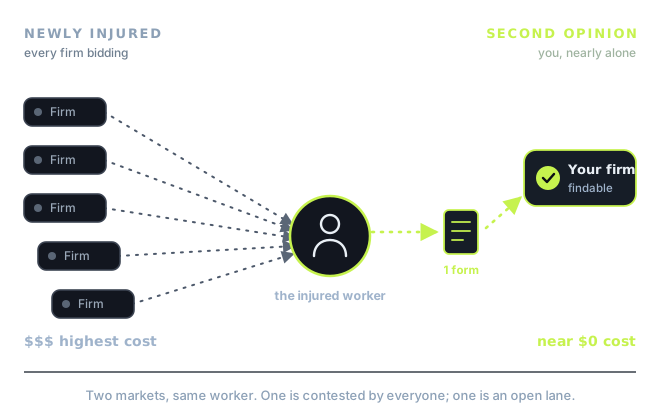
Count the firms advertising to a newly injured worker in your city. Now count the firms advertising to the worker who hired one of them in March and has not had a call returned since July. The first number is every competitor you have. The second is almost always zero.
That gap is the entire article. The represented-but-neglected client is the highest-intent, lowest-cost case source in workers’ comp, and it is the one almost no firm works — not because the economics are poor, but because reaching for it feels like taking another lawyer’s client, and most owners assume the advertising rules put it off-limits. Both instincts are wrong in the ways that matter. The rules draw a sharp, knowable line, and inbound marketing sits comfortably on the permitted side of it.
What follows is the whole case: why this market exists in documented numbers rather than wishful ones, why switching costs the client almost nothing by statutory design, exactly what the ethics rules do and do not let you do, and the four-piece build that captures the market without a single cold call — or a single word about the other firm.
The market your plan has no line for
Every acquisition channel in a normal plan aims at one instant — the exact instant everyone else is aiming at too.
Open any workers’-comp marketing plan and read the channels down the page: Google search for “workers comp lawyer near me,” Meta ads to injured workers, local SEO for the map pack, Local Services Ads, maybe TV or a billboard on the freeway. Every one of them is pointed at the same moment — the newly injured worker who does not yet have a lawyer and is choosing one right now. That is a correct target. It is also the most expensive and most contested target in the category, for one reason: it is the only target anyone bids on.
We have watched that auction from the inside for years. Across our own work — roughly $16.5M in workers’-comp Meta ad spend, 219,000 injured-worker leads at about $75 each, producing 21,000 signed cases at roughly $775 apiece — the newly injured market is where the money goes and where the price of a signed case gets set. It is a good market, and we will keep winning in it. It is simply not the only market, and it is the one where your next dollar buys the least ground.
There is a second market hiding in plain sight, and it has one defining feature that explains everything about it: it produces no lead. When a represented worker becomes unhappy, nothing fires. No form is submitted, no tracking number rings, no pixel sees them. They sit inside another firm’s case file, growing quietly more willing to leave, and because they generate no measurable event, every instrument a marketer uses to find demand is blind to them. The ad libraries cannot see them. The keyword planner barely registers them. They are in no one’s funnel — so they are in no one’s plan.
In the newly injured auction, your bid competes with every firm in the city. In the second-opinion market, there is frequently no one bidding at all — not because it is forbidden, but because it never occurred to anyone to show up. The worker who types “can I change my workers comp lawyer” into their phone at 11pm is as high-intent as a prospect ever gets: they have already decided something is wrong. And in most markets, what they find is a thin page from a national directory, a four-year-old Reddit thread, and not one local firm saying, calmly, “Yes. Here is exactly how that works.”
The evidence that unhappy clients exist in numbers
You cannot size this market precisely. You can prove, from the regulators’ own files, that it is real and that it never stops refilling.
The honest difficulty with the second-opinion market is that no one publishes its size, and we are not going to invent a figure for how many represented workers are quietly unhappy or how many switch in a given year. Anyone who hands you a number for that made it up. What can be shown is sturdier than a fabricated statistic: the conditions that manufacture dissatisfaction are documented, continuous, and structural — they are built into how comp works.
Start with the regulators, because their files are public and their incentives are not yours. The Florida Bar’s 2024 discipline review opened 3,659 complaint files and brought 235 formal disciplinary cases, and it named neglect as the second-most-common complaint category of the year; its Lawyer Regulation Division director added that communication “is always in the top 10” complaints, year after year. That is one state, one year, and a complaint is not proven misconduct. But it points exactly where every state bar’s data points: the thing clients complain about most is not losing their case — it is being neglected, left in the dark, and never called back.
Now lay the clock over it. Representation in comp tracks the benefit, not the injury, and benefits can run for months or years; across a large multi-state dataset the Workers Compensation Research Institute put the share of lost-time claimants who are represented at about 34%, with representation concentrated in exactly the longer, higher-stakes claims. A long case is a long window of exposure. Every month a claim stays open is another month in which a firm can go quiet, miss a hearing date, or stop returning calls — and the client has nowhere to put that frustration except, eventually, a search bar.
Put those two facts together and the market resolves without a single invented number. Roughly a third of lost-time claimants are represented; those cases run long; and the most common complaint against lawyers, everywhere, is silence. You do not need a precise count to know there is a steady, self-replenishing population of represented workers who would change firms tomorrow if a credible one made it easy. You only need to decide to be the credible one.
Switching is a form, not a fight
The reason this market is frictionless is written into the fee statute: changing comp lawyers rarely costs the client an extra dollar.
The quiet engine under this entire market is a feature of how comp fees work — and it runs precisely opposite to what clients assume. Most people believe that firing a lawyer means paying two lawyers, so they stay put, trapped by a fear that has no basis at all in a workers’-comp claim.
In workers’ compensation, the claimant does not pay an hourly bill. The attorney’s fee is contingent, capped by statute, and approved by a judge or the board, and it is paid out of the award — the structure we take apart in the piece on the fee promise that is really a fee statute. Because the fee is a single, board-controlled slice of the recovery, changing attorneys does not create a second fee. It triggers an apportionment of the one fee between the outgoing and the incoming lawyer. The pie does not get bigger. It gets cut differently.
New York makes the mechanism explicit, and it is worth seeing one state in the concrete. A change of representation runs through the Workers’ Compensation Board’s substitution process and Form OC-400.1; the Board — not the client — divides the approved fee among successive attorneys, and an incoming attorney who skips the required notice can end up with no fee at all. The client signs a form. The lawyers sort out the single fee under the Board’s supervision. Nobody pays twice.
New York is not special in this. The form has a different name in every state, but the shape is identical everywhere: the client files a substitution, and a board, a judge, or a commission — never the client — approves and divides the single capped fee. A switch page that can name the real instrument in your state reads as the work of a firm that has actually done this, not one guessing.
| State | What the client files | Who approves & divides the one fee |
|---|---|---|
| New York | Form OC-400.1 (substitution) | WC Board apportions the single approved fee |
| California | DWC/WCAB Form 36 (Substitution of Attorneys) | WCAB approves and apportions the fee |
| Florida | Substitution of counsel before the JCC | Judge of Compensation Claims approves it (Fla. Stat. §440.34) |
| Texas | Substitution filed with the Division (TDI-DWC) | Division approves and allocates the fee (28 TAC §152) |
| Pennsylvania | Substitution before the Workers’ Compensation Judge | WCJ approves; the fee, capped at 20%, is split between counsel |
Form names, caps, and procedures change by jurisdiction and over time — this is illustrative of the mechanism, not legal advice; confirm the current form and rule in your state. Sources: NY WCB Form OC-400.1; CA DWC/WCAB Form 36; Fla. Stat. §440.34; TX DWC attorney-fee rules (28 TAC §152); PA Workers’ Compensation Act §442.
This is the fact that turns the second-opinion market from a nice idea into a real one. The barrier to switching is not money. It is information and nerve: the client does not know they can change firms without penalty, and does not know how it is done. A firm that supplies both — clearly, honestly, with no pressure — removes the only thing standing between a neglected worker and a new case on your books.
The thing keeping a neglected client with the wrong firm is not a contract or a cost. It is that no one has told them, calmly, that leaving is a form.
Spencer Moeller · WorkersComp MarketingWhat you are actually allowed to do
The ethics rules draw a bright line between advertising and solicitation. Inbound marketing lives entirely on the right side of it.
Here is where most firms stop before they start, because “marketing to someone who already has a lawyer” sounds like it must break a rule. It is worth reading the actual rule, because the rule says something far narrower — and far more useful — than the fear assumes.
Under ABA Model Rule 7.3, “solicitation” is a communication initiated by or on behalf of a lawyer, directed to a specific person the lawyer knows or reasonably should know needs legal services. The rule then bars solicitation only by live, person-to-person contact — in person, by live telephone, or by real-time electronic exchange — when a significant motive is the lawyer’s own financial gain, with narrow exceptions for other lawyers and people with a family or prior professional relationship. What the rule pointedly does not restrict is advertising that is neither live nor person-to-person: a website, a search ad, recorded or written material, content that answers a question.
That single distinction is the whole game. Running a page titled “Thinking about changing your workers’ comp lawyer?” and letting it rank, or bidding on the search “second opinion workers comp,” is advertising governed by Rule 7.1 — it must simply not be false or misleading. Cold-calling or live-texting a specific worker you know is represented, to pitch your firm, is solicitation, and it is barred. One is being findable. The other is chasing. This market is won entirely by the first and lost entirely by the second.
Two further rules shape the work, and both point toward restraint rather than away from the market. First, the moment a represented worker calls to ask about switching, they become a prospective client under Model Rule 1.18 — which means you owe them confidentiality even if they never sign, you must run a conflicts check, and you must avoid collecting confidences you do not need. Second, Rule 7.1 means you cannot disparage the other firm or imply a result; you speak to the client’s experience and the process, never to the competitor’s character. These are not obstacles. They are the shape of a program that is durable precisely because it is clean.
This is general information about marketing and the ABA Model Rules, not legal or ethics advice. The rules are adopted and amended state by state; confirm your jurisdiction’s version of Rules 7.1, 7.3 and 1.18, and your state’s advertising and solicitation provisions, with your own bar counsel before you launch anything.
The build: own the second opinion
Four pieces, all inbound — and all things a competitor would first have to notice the market to copy.
The program is small, and the smallness is the point: there is almost no one to outspend, because almost no one is there. It is four pieces, and you can stand up the first one this quarter.
1 — The page that answers the question honestly
Build one dedicated page aimed at the exact worry: “Can I change my workers’ comp lawyer, and what happens if I do?” It explains the substitution process in your state, states plainly that changing firms usually costs nothing extra because the single board-approved fee is apportioned, names the honest exceptions (advanced costs, liens, a companion third-party case), and describes when switching actually helps versus when the client is simply in the slow middle of a normal claim. The tone is a calm second opinion, not a sales pitch. This page is the asset. Everything else merely points at it.
2 — The searches that signal the switch
There is a small, high-intent query family here that your newly injured campaigns never touch: “second opinion workers comp,” “change workers comp lawyer,” “my workers comp lawyer won’t call me back,” “fire workers comp attorney,” “switch comp lawyer [state].” You can confirm these exist in thirty seconds in your own keyword tool; we are not going to print invented volumes for them. Point search ads and SEO at this family specifically, in a separate campaign from your main account, so the intent is never diluted and the spend is never buried inside a “workers comp lawyer” campaign that optimizes toward the crowded market.
3 — The intake path for “I already have a lawyer”
Add one question near the top of intake: “Do you currently have a lawyer for this claim?” A yes routes to a different, conflicts-aware script that treats the caller as a prospective client under Rule 1.18 — confidentiality attaches, a conflicts check runs, and intake explains options without pressuring a switch on the call. This is the opposite of your speed-to-lead script for a fresh lead. The job here is to be the trustworthy source of information, and the trust is exactly what earns the case.
Is a second opinion warranted?
When a caller already has a lawyer, three questions separate a real switch from the normal slow middle of a claim. Answer honestly — pushing every caller to switch is how a clean program becomes a grievance.
How to read this
Answer all three. Any “yes” points to a real second opinion — treat the caller as a prospective client under Rule 1.18, run a conflicts check, and explain their options without pressure. All “no” usually means the normal slow middle of a claim: tell them the wait sounds typical and to call back in two weeks.
4 — The measurement that proves it is working
This market produces no lead at the top, so you measure it at the bottom. Tag the source in your CRM and track one number: the share of your signed cases that arrived already represented. That figure folds straight into cost per signed case, and because the media cost of this channel is close to zero, even a handful of switched cases a quarter moves the blended number in a way the crowded auction cannot easily match.
| The newly injured | The second opinion | |
|---|---|---|
| Who is bidding | Every firm in the market | Usually no one |
| Intent at contact | High, but shopping several firms | Highest — already decided to leave |
| Media cost | The priciest leads in marketing | Near zero |
| Main barrier | Speed and differentiation | The client not knowing switching is easy |
| How you win it | Be fast, be chosen | Be findable, be honest |
The four ways this goes wrong
The market is clean if you keep it clean. Here is precisely where firms cross the line — and how to not.
Everything that makes this market attractive — the high intent, the near-zero cost, the absence of competitors — also makes it tempting to push. And pushing is the one thing that turns a durable program into a grievance. Four traps account for almost all of the damage.
Chasing instead of being found
The fastest way to convert a permitted advertising program into barred solicitation is to go get the specific person: buying lists of represented claimants, cold-calling or live-texting someone you already know has a lawyer. Rule 7.3 draws the line at live, person-to-person contact for your own gain. Stay inbound. Let them come to the page; never go to them. If a tactic involves you reaching out to a named, known, represented worker, assume it is over the line until your bar counsel says otherwise.
Disparaging the other firm
It feels persuasive to say the prior lawyer dropped the ball. It is a Rule 7.1 risk, it invites a complaint from a competitor who can respond, and it reads as aggressive to a prospect who is already anxious and tired of conflict. Speak to the client’s experience and the process of switching. The other firm’s name never appears — not in the copy, not in the ad, not on the call.
Taking confidences you do not need
A prospective client under Rule 1.18 can hand you details that later conflict you out, or that you had no business collecting before a conflicts check cleared. Train intake to confirm representation and run the check before the caller narrates the whole history of their claim. Restraint here is not caution for its own sake; it protects the case and it protects you.
Promising “free”
“Switch for free” is the kind of tidy claim that is usually true and occasionally, expensively, not — advanced costs and liens exist, and a companion third-party case can change the fee math entirely (see third-party cases). Say what is actually true: changing firms usually costs you nothing extra because the single approved fee is divided, and here are the exceptions. Honesty is not the weaker pitch in this market. To a client who was just neglected, it is the entire pitch.
Key takeaways
-
There are two markets. The newly injured, where every firm bids and a signed case costs the most — and the represented-but-neglected worker, where almost no one shows up at all.
-
The second market is real and self-replenishing. About a third of lost-time claimants are represented, cases run long, and neglect and poor communication are perennially among the top bar complaints. No one can size it; everyone can see the conditions that keep feeding it.
-
Switching is a form, not a fight. Comp fees are capped and board-approved, so changing firms apportions one fee rather than creating two — the client usually pays nothing extra.
-
Advertising is not solicitation. Being findable — a page, a search ad, content — is permitted under the Model Rules. Only live, cold, person-to-person contact of a known client is barred.
-
Win it clean or not at all. Inbound only, never disparage the other firm, treat callers as prospective clients, and tell the truth about cost. The compliant version is also the one that converts.
WorkersComp Marketing is a marketing agency, not a law firm. Nothing here is legal advice and none of it is a prediction about any particular claim. Marketing that reaches a worker who is already represented sits close to two separate bodies of rule — the solicitation and direct-contact provisions of a state’s attorney-advertising rules, and the no-contact rule governing communication with a represented person — and both are state-specific, fact-specific and actively enforced. Nothing here should be read as approval of any particular campaign, message or audience. The substitution and fee-apportionment mechanics described are cited to show that the procedure exists, not to describe what any individual client may do. Have a lawyer at your firm approve the audience and the copy before anything runs.
Frequently asked questions
Is it ethical to market to workers who already have a lawyer?
Advertising is not solicitation. ABA Model Rule 7.3 restricts live person-to-person contact — in person, by live phone, or real-time electronic — initiated for the lawyer’s financial gain. A website, a search ad, or content that answers “can I change my workers’ comp lawyer?” is advertising under Rules 7.1 and 7.2, not solicitation, and it is generally permitted. What is barred is live cold contact of a specific person you know already needs legal services. The clean play is inbound: be the firm that is findable when a dissatisfied client goes looking, not the firm that chases them.
Does a client pay two legal fees if they switch comp lawyers?
Usually no. Workers’ comp attorney fees are approved and capped by the board or a judge and paid from the award, not billed hourly to the client. When a claimant changes attorneys, the fee is typically apportioned between the outgoing and incoming lawyer by the board rather than doubled. In New York, for example, substitution runs through Form OC-400.1 and the Board divides the single approved fee. The exact mechanics vary by state, so a switch page should explain the real process in your state rather than promise “free.”
How big is the second-opinion market in workers’ comp?
No one publishes a credible figure, and we will not invent one. What is documented is that roughly a third of lost-time claimants are represented, that cases run for many months, and that neglect and poor communication are perennially among the top drivers of bar complaints. That establishes a real, persistent population of represented-but-unhappy clients without pretending to size it. Measure it where it is real: the share of your own signed cases that arrive already represented.
Can I say the prior lawyer did a bad job?
Be careful. Rule 7.1 bars false or misleading statements about a lawyer’s services, and disparaging a named competitor invites a complaint and a credibility problem with the prospect. Speak to the client’s experience and the process of switching, not to the other firm’s character. “Not hearing back from your lawyer?” is a question about the client. “Your lawyer is incompetent” is a claim about someone who can respond.
What should intake do when a caller already has a lawyer?
Treat the caller as a prospective client under Model Rule 1.18 the moment they consult you, which means confidentiality attaches even if they never sign. Ask whether they currently have a lawyer early, run a conflicts check, avoid taking detailed confidences you do not need, and explain the substitution process honestly. The goal is to be a clear, calm source of information about their options, not to pressure a represented person into switching on the call.
When should a client not switch workers’ comp lawyers?
Not every frustrated client should change firms, and an honest page says so. A second opinion is usually warranted when there has been no meaningful contact for weeks, a deadline or hearing was missed, calls and messages go unanswered, or the client genuinely does not understand what is happening with their claim. It is usually just the slow middle of a normal case when the claim was filed recently, everyone is waiting on a scheduled IME, a surgery authorization, or a hearing date, or the quiet has been explained and is temporary. The firm that tells a caller “this sounds like the normal waiting period — give it two weeks and call me back” earns more trust, and more of the switches that are actually real, than the firm that pushes every caller to change.
How do I measure the second-opinion channel?
This channel produces no lead at the top, so you measure it at the bottom. Tag the source in your CRM and track one number over time: the share of your signed cases that arrived already represented. Fold that into your cost per signed case — because the media cost of being findable here is close to zero, even a few switched cases a quarter can pull your blended acquisition cost down. The intake question “Do you currently have a lawyer for this claim?” gives you the first real count within a month, measured on your own phones instead of a report that does not exist.
Sources & further reading
-
01
Representation & case duration
About 34% of lost-time claimants are represented across a large multi-state dataset — concentrated in the longer, higher-stakes claims.
-
02
Top complaint categories
The Florida Bar’s 2024 discipline review: 3,659 complaint files, 235 formal cases, with neglect the #2 category and communication perennially in the top 10.
-
03
Advertising vs. solicitation
ABA Model Rules of Professional Conduct — the line between permitted advertising and barred live solicitation, plus the duties owed to a prospective client.
-
04
Fee apportionment on a switch
How the single capped fee is divided when a client changes firms — the governing form or statute in five states.
Rules and figures are current as of October 2026 and change over time; this article is general marketing information, not legal or ethics advice. Confirm your own state’s rules with bar counsel before acting.