Open any workers’ comp firm’s homepage and count how long it takes to reach the no-fault promise. Usually one scroll. You don’t need to prove your employer did anything wrong. You don’t need to blame anyone. The system doesn’t work that way. It is good copy, because it is the single most load-bearing reassurance in the category: the injured worker’s first private fear is that he caused it, and the second is that saying so out loud will cost him the claim.
Then listen to what the caller does with that reassurance. He has been told, by the firm’s own advertising, that the circumstances do not matter. So he does not mention the guard that had been missing off the machine for five weeks, or the supervisor who told him to go up the ladder anyway, or the three near-misses before his. He reports the injury and the body part, which is what he was asked for. The intake agent writes down the injury and the body part, which is what the form has fields for. The one fact in the whole conversation that could add half again to the award goes unrecorded by two people who both did exactly as they were instructed.
That is not a litigation failure. The lawyers will get to the circumstances eventually. It is an acquisition failure, and it has a date on it.
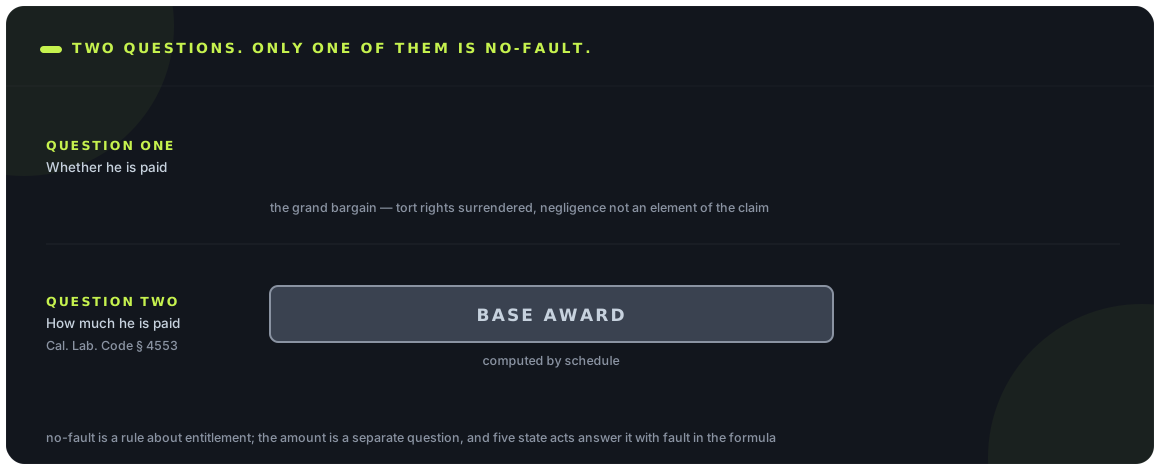
The act asks two questions, and only one of them is no-fault
No-fault is a rule about entitlement, not a rule about quantum. Every comp act separates the two, and several of them put fault back into the second one on purpose.
The grand bargain is familiar enough that it gets compressed into a slogan. The worker gives up the right to sue the employer in tort, and in exchange he does not have to prove negligence to be compensated. Fault drops out of the entitlement question. That is the half of the sentence the advertising repeats.
What the slogan omits is that an act has to answer a second question after entitlement, and that question is arithmetic: how much. Nothing about the no-fault bargain requires that answer to be fault-blind too, and in a handful of states the legislature deliberately decided it should not be. The mechanism is always the same shape: a base amount computed by schedule, and a statutory multiplier or percentage applied to that base when a particular kind of employer conduct caused the injury.
It is worth being precise about what that means for a firm, because the practical consequence is not “comp is secretly a fault system.” It is narrower and more useful. Two cases with identical injuries, identical wages, identical impairment ratings and identical treatment can carry different statutory values, and the variable that separates them is a fact about the employer that lives in nobody’s medical record. We have written before about the value side of the acquisition equation and how rarely a firm knows what a signed case is worth. This is the sharpest version of that gap: a case-value input that is invisible to every system a firm owns.
What § 4553 actually says, including the $250 nobody has touched since 1982
It is two sentences long, it names exactly who has to have done it, and the companion section lists the findings a tribunal has to make. None of it is obscure; all of it is specific.
Here is the operative text in full, because it is short and because paraphrases of it circulate widely in a form that drops the limits:
“The amount of compensation otherwise recoverable shall be increased one-half, together with costs and expenses not to exceed two hundred fifty dollars ($250), where the employee is injured by reason of the serious and willful misconduct of any of the following: (a) The employer, or his managing representative. (b) If the employer is a partnership, on the part of one of the partners or a managing representative or general superintendent thereof. (c) If the employer is a corporation, on the part of an executive, managing officer, or general superintendent thereof.”
Three things in that text matter to a firm’s intake form rather than to its brief bank.
The increase is one-half of the compensation otherwise recoverable — not a penalty with its own schedule, and not a tort measure. It is a multiplier on the award the case was already going to produce, which means it scales with everything that makes a case valuable in the first place: wage, impairment, duration. A 50% uplift on a modest award is modest. On the firm’s best cases it is the largest single line item in the file.
The misconduct has to be the employer’s, or that of a named class of people. A co-worker’s carelessness is not in the section. Neither is a stranger’s. For a corporation it must be “an executive, managing officer, or general superintendent thereof.” That is a screening question an intake agent can actually ask — who told you to do it that way, and what was their job? — and it is a far better question than whose fault was it?, which invites the caller to confess.
And the costs-and-expenses figure is two hundred and fifty dollars. The section was last amended in 1982. Nobody has indexed that number in forty-four years, which is a small, clarifying detail about what this provision is and is not: it is a compensation multiplier with a nominal costs rider attached, not a damages mechanism. Firms that describe it to clients as “penalties and costs” are overselling the second half by a wide margin.
The companion section is where the evidentiary weight sits. Lab. Code § 4553.1 provides that to support a holding of serious and willful misconduct based on violation of a safety order, the appeals board must specifically find the manner in which the order was violated, that the violation proximately caused the injury and the manner in which it did so, and that the safety order and the conditions making it applicable were “known to, and violated by, a particular named person” — or that the condition was obvious, “created a probability of serious injury,” and the failure to correct it “constituted a reckless disregard for the probable consequences.”
Read that as a checklist and it tells a firm exactly which facts are load-bearing: a named person, their knowledge, the specific requirement, and causation. Three of those four are things the injured worker knows on the day he calls, and all three decay. He will remember the supervisor’s name in week one and the job title in week six and neither reliably in month nine, by which point the crew has turned over and the machine has been fixed.
The one clock in the act that nothing in the act restarts
California’s ordinary limitation period moves. It runs from the last date benefits were furnished, or from the end of a period of disability payments. The serious-and-willful period does not move, and the act says so twice.
This is the part that converts a case-handling detail into a marketing problem, so it is worth laying the two provisions side by side.
The ordinary limitation is Lab. Code § 5405. Proceedings for the collection of medical and disability benefits must be commenced within one year from any of: “(a) The date of injury. (b) The expiration of any period covered by payment under Article 3… (c) The last date on which any benefits provided for in Article 2… were furnished.” Subdivisions (b) and (c) are the ones that do the work in practice. A claim that is being treated and paid is a claim whose clock keeps being pushed forward, which is why an ordinary comp file does not feel like it has a deadline sitting on it.
Now the serious-and-willful period, § 5407, in full:
“The period within which may be commenced proceedings for the collection of compensation on the ground of serious and willful misconduct of the employer, under provisions of Section 4553, is as follows: Twelve months from the date of injury. This period shall not be extended by payment of compensation, agreement therefor, or the filing of application for compensation benefits under other provisions of this division.”
Read the second sentence as a list of the three things that would otherwise have extended it, and notice that all three are the ordinary life of a comp claim. Benefits being paid: does not extend it. An agreement to pay them: does not extend it. The filing of the claim itself: does not extend it. The act has taken a deadline and insulated it from every event that normally moves one.
And then it says it again somewhere else. § 5410 is the new-and-further-disability provision, the one that gives the appeals board continuing jurisdiction for five years from the date of injury. Its last sentence is eight words long: “This section does not extend the limitation provided in Section 5407.” The legislature wrote a five-year continuing-jurisdiction rule and then carved this one period out of it by name.
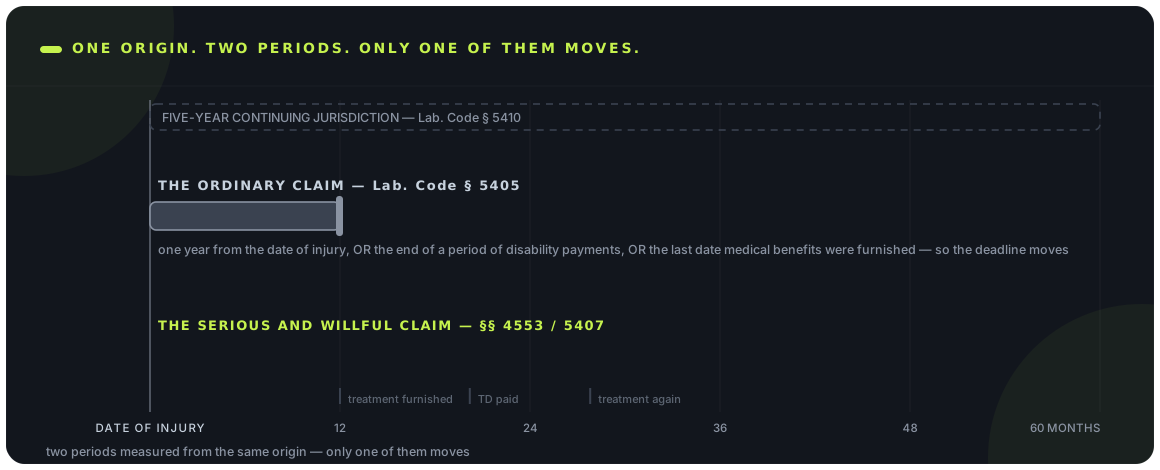
Put the two provisions next to a firm’s actual acquisition timeline and the problem states itself. A worker is hurt. He waits — because he is being treated, because he hopes it will resolve, because he does not want to be the one who sued, because the first benefit cheque arrived and nothing seemed wrong. Months pass. Something goes sideways: a denial, a cut-off, a return-to-work offer he cannot do. Then he calls a lawyer. A great deal of comp advertising is deliberately built to catch him at exactly that moment, and it works.
On the ordinary claim, that is fine. The clock has been moving with the benefits. On the serious-and-willful claim, the firm has just signed a case in month nine with sixty days left on a period it did not know was running, and nothing it does to the main file will buy it another day.
Five acts price employer fault; three price the worker’s
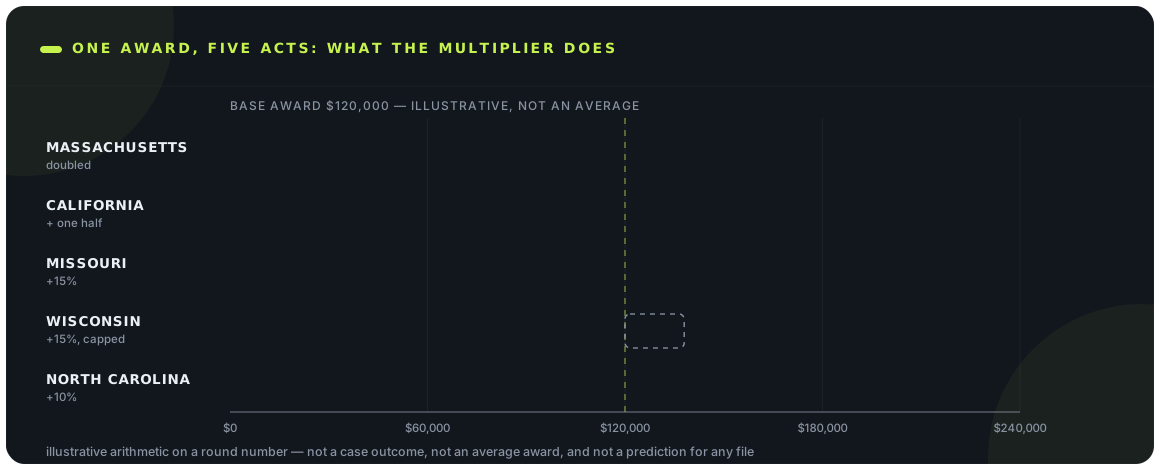
The rates range from 10% to a straight doubling, two of them are capped, and the statutes do not agree on who writes the cheque — two of them do not say.
If a firm works one state, this reduces to one number. If it buys media across a footprint, the spread is the whole problem, and so is the fact that the triggers are not the same test.
California and Massachusetts use a misconduct standard: Massachusetts’ ch. 152, § 28 doubles compensation where the injury is caused “by reason of the serious and wilful misconduct of an employer” or of a supervisory person, and deems the employment of a known minor in breach of listed child-labour provisions to be serious and wilful misconduct. Missouri, Wisconsin and North Carolina use a narrower and more objective non-compliance standard: the increase attaches to the employer’s failure to comply with a statute, rule or lawful order. Mo. Rev. Stat. § 287.120.4 increases compensation and death benefits “fifteen percent” where the injury was caused by the employer’s failure to comply with a state statute or a lawful division or commission order. Wis. Stat. § 102.57 increases them “by 15 percent but the total increase may not exceed $15,000.” N.C. Gen. Stat. § 97-12 provides that on the “willful failure of the employer to comply with any statutory requirement or any lawful order of the Commission,” compensation “shall be increased ten percent (10%).” Note the qualifier in that last one: North Carolina does not attach the increase to non-compliance as such but to the willful failure to comply, so the group label is a convenience and the three triggers are not interchangeable.
The symmetry is the part most marketing conversations miss. Three of those same acts run the adjustment in the other direction when the worker is the one who broke the rule. North Carolina reduces compensation by the same ten percent for the employee’s willful failure to use a safety appliance or perform a statutory duty, and puts the burden of proof “upon him who claims an exemption or forfeiture under this section.” Wis. Stat. § 102.58 mirrors its own increase with a 15% reduction subject to the same $15,000 cap. Missouri is the harshest: § 287.120.5 reduces compensation “at least twenty-five but not more than fifty percent” where the worker failed to use provided safety devices or obey a reasonable rule he had actual knowledge of, and § 287.120.6(1) reduces it “fifty percent” for an injury sustained in conjunction with alcohol or non-prescribed controlled drugs in violation of the employer’s policy.
One scope note, because the figure below has empty cells in it and an empty cell is easy to misread. For California and Massachusetts we read the increase provisions and not the whole act, so “not in this provision” means exactly that — it is not a finding that neither act reduces compensation for a worker’s own conduct somewhere else. Check your own.
Which means the fault conversation is not optional for an intake department in those states. It is going to happen; the only question is whether the firm hears the facts first or the defence does.
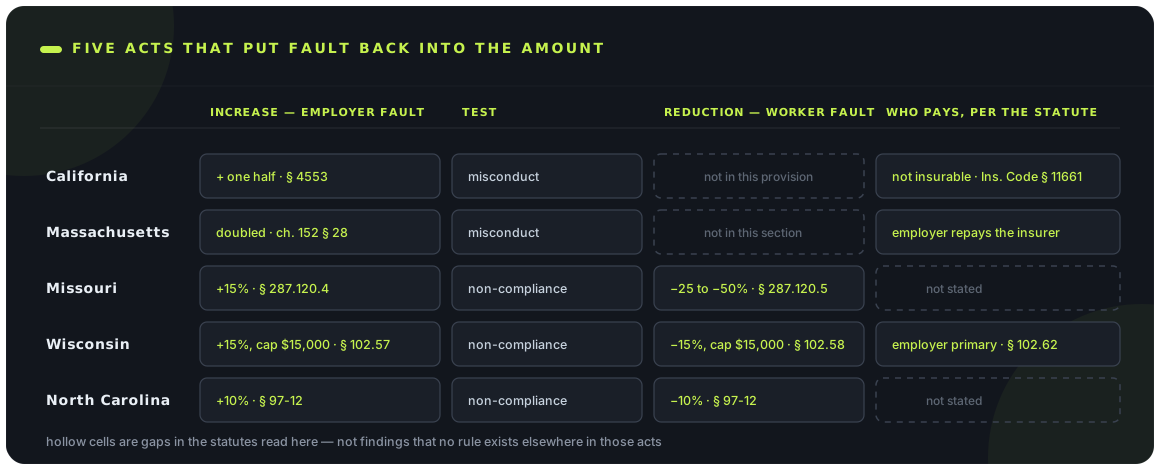
| California | Massachusetts | Missouri | Wisconsin | North Carolina | |
|---|---|---|---|---|---|
| Increase for employer fault | Increased one-half, plus costs and expenses to $250 (§ 4553) | Compensation doubled (ch. 152, § 28) | Increased fifteen percent (§ 287.120.4) | Increased 15 percent (§ 102.57) | Increased ten percent (§ 97-12) |
| What triggers it | Serious and willful misconduct of the employer or a named officer class | Serious and wilful misconduct of the employer or a supervisory person | Failure to comply with a state statute or lawful division or commission order | Failure to comply with a statute, rule or order of the Department of Safety and Professional Services | Willful failure to comply with a statutory requirement or lawful order of the Commission |
| Cap on the increase | None on the one-half; $250 on costs | None stated | None stated | $15,000 total increase | None stated |
| Reduction for worker fault | Not in this provision | Not in this section | 25–50% (safety device or rule, § 287.120.5); 50% (drug or alcohol policy, § 287.120.6(1)) | 15%, capped at $15,000 (§ 102.58(1)) | 10% (safety appliance or statutory duty, § 97-12) |
| Who pays, per the statute read | Not insurable — Ins. Code § 11661 | Employer “shall repay to the insurer the extra compensation paid” | Not stated in the subsection | Employer primary, insurer secondary (§ 102.62) | Not stated in the section |
The increase is not in the policy, which changes who you are talking to
California forbids an insurer from covering it. Massachusetts makes the employer reimburse the carrier. Wisconsin makes the employer primary. The money comes out of a different pocket, and the pocket has an opinion.
California is categorical about it. Ins. Code § 11661 provides that an insurer “shall not insure against the liability of the employer for the additional compensation recoverable for serious and willful misconduct of the employer or his agent,” and then allows exactly one thing through: an insurer “may, however, provide insurance against the expense of defending any suit” for serious and willful misconduct. The defence is insurable. The money is not.
Massachusetts gets to the same place by a different route: under ch. 152, § 28 the insurer pays the doubled compensation and the employer “shall repay to the insurer the extra compensation paid to the employee.” Wisconsin does it through § 102.62, which makes the employer’s liability for the § 102.57 increase “primary” and the carrier’s “secondary.” Three states, three drafting styles, one result: the increase lands on the employer rather than on the insurance company.
That is worth a paragraph in a marketing article because of a sentence we have taken apart before. The most repeated line in comp advertising after the no-fault promise is some version of we fight the insurance company — a line that already misdescribes the defendant in a large share of claims. On a serious-and-willful claim it misdescribes it again, in the opposite direction: here the insurer is not even the party whose money is at stake. An employer that will shrug at an indemnity reserve it does not fund will behave very differently about an uninsurable increase it does, and a firm whose entire external messaging points at the carrier has no account of that.
We are not going to pretend to know what that does to settlement behaviour in aggregate, because we have not seen data on it and we do not think anyone publishes any. Directionally, the structure is plain enough to state: an increase that is uninsurable by statute is paid by someone who is in the room for a different reason than the adjuster is.
The screen is three questions and a date field
It does not ask the caller whose fault it was, it does not require the agent to form a view, and it adds under a minute to the call.
The whole operational change here is small, which is the reason it is worth doing before anything expensive. A firm does not need a new campaign, a new landing page or a new practice area. It needs its intake form to capture four things it currently does not.
| Add this | Why | What it must not do |
|---|---|---|
| “Who told you to do it that way, and what was their job?” | § 4553 limits the misconduct to the employer or a named class — for a corporation, “an executive, managing officer, or general superintendent.” The job title is the screen. | Ask whose fault it was. That invites the caller to accuse or confess, and neither is the statutory question. |
| “Had anyone raised this before it happened?” | § 4553.1 requires a finding that the requirement and the conditions were “known to, and violated by, a particular named person,” or that the condition was obvious and uncorrected. | Characterise the answer. The agent records names, dates and who was told; a lawyer decides what it amounts to. |
| “Did an inspector ever come, before or after?” | In the three non-compliance states the trigger is breach of a statute, rule or order, so an inspection is directly on point — and OSHA publishes inspection data for anyone to look up. | Tell the caller a citation means his case is worth more. It does not follow, and the sections say what has to be found. |
| Date of injury, as a required field | In California the twelve months under § 5407 run from that date and from nothing else. Without the field the deadline cannot be computed at all. | Treat it as a soft field. Most CRMs capture a date of contact and not a date of injury, which is how this gets missed. |
Two of those are already on good intake forms in some version. The fourth is the one that reliably is not, and it is the one everything else depends on: a comp CRM that records when the lead arrived but not when the injury happened cannot tell a firm which of its open files have a deadline inside the next sixty days. We built the Intake Leak Score around the wider family of places enquiries disappear without leaving a record; this is the version where the enquiry is signed, the file is open, and the asset inside it expires unobserved.
On the inspection question, one note on what is and is not available. OSHA’s own data page states that “employers, workers, safety professionals, and other interested parties may view and download OSHA’s publicly available data provided online,” and lists inspection search tools including an establishment search and a NAICS search, with the note that they reflect inspection data through a stated date. That much we read. We did not verify the fields those search screens return, because the search page itself refuses automated access, so treat “you can look up an employer’s inspection history” as directional until someone at the firm has opened it in a browser and seen what comes back for a local employer. California publishes its own Cal/OSHA citation statistics separately, on the Department of Industrial Relations site, in aggregate form — most frequently cited standards, complaints and citations, inspections with initial penalties of $100,000 or more — rather than as an employer-level lookup.
What it does to the media plan, and where it stops
Not much, and that is the correct answer. This is a case-selection and intake change with a small, specific media consequence, and overstating it is how a good screen turns into a bad campaign.
The temptation at this point is to turn a statutory multiplier into an ad angle, and it should be resisted for three reasons.
The query space belongs to somebody else. Search for the statutory phrase and what comes back is two audiences, neither of them a law firm: injured-worker pages from claimant firms, and employer-side risk content from defence firms, insurers and HR publishers warning about exposure. There is no firm-facing content on it, which is why we have written this one — but there is also no meaningful firm-side search demand to capture. Building a campaign on the term would mostly buy clicks from people who are not prospects, in a test that could not resolve itself at ordinary law-firm volume anyway.
The honest version of the message is not an offer. “We check whether your employer broke a rule” is a process claim, and process claims convert badly in a category where the caller is frightened and in pain. The place for this is not the ad; it is the second minute of the call.
And the fault frame has a failure mode. Marketing fault to an injured-worker audience risks attracting the caller who wants to sue his employer — which, against the employer, comp generally forecloses. A firm that leans into blame in its creative will raise the share of enquiries it has to turn away, which is its own cost. The apportionment piece makes the same point from the defence side: the words a firm uses in public shape which conversations it has to have in private.
What does change in the plan is narrower, and real.
First, the date-of-injury field becomes a reporting dimension. Once a firm captures it, it can segment its own signed cases by the age of the injury at the moment of first contact, and that distribution is a media fact, not a legal one: it tells the firm how far downstream its advertising is actually catching people. A firm whose median signed case arrives nine months post-injury is buying a different population from one whose median is three weeks, and almost no comp firm knows which one it is. We have made a version of this argument about industry mix — the plan is usually inherited rather than chosen, and the first step is measuring what you already bought.
Second, that distribution has a cost consequence the firm can compute. If a measurable share of signed cases arrive with the serious-and-willful window already closed, then the firm is paying full acquisition cost for files with one case-value component permanently unavailable. That is not an argument for spending more. It is an argument for knowing what the current spend is buying, which is the only kind of argument this site is interested in making.
Key takeaways
-
No-fault answers the entitlement question, not the amount question. Five state acts put fault back into the second one. The advertising repeats only the first half of that sentence, and the intake script inherits the omission.
-
California increases the award by one-half. Lab. Code § 4553: “The amount of compensation otherwise recoverable shall be increased one-half, together with costs and expenses not to exceed two hundred fifty dollars ($250).” The $250 has not been amended since 1982.
-
The misconduct must be the employer’s or a named officer’s. For a corporation, “an executive, managing officer, or general superintendent thereof.” A co-worker’s carelessness is not in the section — which is why the intake question is about job titles, not blame.
-
In California the claim has twelve months from the date of injury. § 5407, and the period “shall not be extended by payment of compensation, agreement therefor, or the filing of application for compensation benefits under other provisions of this division.”
-
The ordinary claim’s clock does move. § 5405 runs one year from the date of injury, from the expiration of a period covered by disability payments, or from the last date medical benefits were furnished — so an active file feels deadline-free while the § 5407 period runs out underneath it.
-
The act carves this period out of its own five-year rule. § 5410 gives the appeals board five years of continuing jurisdiction for new and further disability and then adds: “This section does not extend the limitation provided in Section 5407.”
-
The rates differ and two of them are capped. California one-half; Massachusetts doubled; Missouri and Wisconsin 15%, Wisconsin’s capped at $15,000; North Carolina 10%. The trigger differs too — misconduct in California and Massachusetts, non-compliance with a statute, rule or order in the other three.
-
Three of the five cut the award for the worker’s own conduct. Missouri 25–50% and a further 50% on its drug-and-alcohol provision; Wisconsin 15% capped at $15,000; North Carolina 10%, with the burden “upon him who claims an exemption or forfeiture.” The fault conversation is happening either way.
-
Where the statutes name a payer, it is the employer. California forbids insuring the increase (Ins. Code § 11661, defence costs excepted); Massachusetts makes the employer repay the insurer; Wisconsin makes the employer primary. Missouri’s and North Carolina’s increase provisions name no payer — do not assume one.
-
The fix is a required field, not a campaign. Capture date of injury, add three recording questions, get a one-page state answer from a lawyer, then measure injury age at first contact across twelve months of signed cases. Do not build creative on this; the query space is injured-worker and employer-side, not firm-side.
WorkersComp Marketing is a marketing agency, not a law firm, and nothing here is legal advice about any claim, any employer or any firm’s intake practices. Whether particular conduct amounts to serious and willful misconduct under Cal. Lab. Code § 4553, whether the findings required by § 4553.1 can be made, when a limitation period began or ended on a given set of facts, whether an increase is recoverable at all in a particular state, and what any inspection record does or does not establish are questions of state law that turn on circumstances we do not have. The provisions cited here — California Labor Code §§ 4553, 4553.1, 5405, 5407 and 5410 and Insurance Code § 11661; Massachusetts General Laws ch. 152, § 28; Missouri Revised Statutes § 287.120; Wisconsin Statutes §§ 102.57, 102.58 and 102.62; and North Carolina General Statutes § 97-12 — were read on 9 November 2026 and are amended from time to time; the current official versions govern, and the sources block below records which route each text came from. Nothing here should be read as advising any firm to tell a caller what his claim is worth. Rules of professional conduct on advertising, solicitation and client communication vary by state and are not addressed here. Verify the current rule, and any ethical question, with counsel before putting any of it into a script.
Frequently asked questions
Is workers’ compensation really a no-fault system?
Yes, on the question it is about. No-fault describes entitlement: the worker does not have to prove the employer was negligent in order to be covered, and in exchange he gives up the right to sue the employer in tort. It does not describe quantum. Five of the state acts we read put employer fault back into the amount: Cal. Lab. Code § 4553 increases the compensation otherwise recoverable by one-half; Mass. Gen. Laws ch. 152, § 28 doubles it; Mo. Rev. Stat. § 287.120.4 and Wis. Stat. § 102.57 add 15 percent, Wisconsin’s capped at $15,000; N.C. Gen. Stat. § 97-12 adds ten percent. So the accurate sentence for a firm’s copy is one clause longer than the one most firms use: you do not have to prove fault to be covered, and if someone was at fault, that can be worth more.
What exactly does California Labor Code § 4553 add?
One-half of the award, plus a nominal costs figure. The text: “The amount of compensation otherwise recoverable shall be increased one-half, together with costs and expenses not to exceed two hundred fifty dollars ($250), where the employee is injured by reason of the serious and willful misconduct” of the employer, of a partner or managing representative or general superintendent where the employer is a partnership, or of “an executive, managing officer, or general superintendent” where it is a corporation. Two consequences follow for a firm. Because it is a multiplier on “compensation otherwise recoverable,” it is worth most on the cases the firm already values most. And because the misconduct has to be the employer’s or a named officer’s, a co-worker’s carelessness does not engage the section — which is why the useful intake question is about job titles rather than about blame. The $250 has not been amended since 1982.
How long does a serious-and-willful claim have in California?
Twelve months from the date of injury. Lab. Code § 5407: “The period within which may be commenced proceedings for the collection of compensation on the ground of serious and willful misconduct of the employer, under provisions of Section 4553, is as follows: Twelve months from the date of injury.” Whether that period has run on any particular claim, and what follows if it has, is a legal question for the firm’s lawyers. The marketing point is only that the date exists, that it is computed from an event the caller knows on the first call, and that it cannot be computed at all unless the intake form has a date-of-injury field.
Does paying benefits or filing the claim extend that twelve months?
No, and the act says so expressly in two places. The second sentence of § 5407 is a list of the three things that do not extend it: “This period shall not be extended by payment of compensation, agreement therefor, or the filing of application for compensation benefits under other provisions of this division.” And § 5410, which gives the appeals board continuing jurisdiction for five years from the date of injury on the ground of new and further disability, closes with: “This section does not extend the limitation provided in Section 5407.” Contrast the ordinary period in § 5405, which runs one year from the date of injury, from the expiration of a period covered by disability payments, or from the last date medical benefits were furnished — so an active, treated, paid claim is a claim whose main deadline keeps moving forward while this one does not.
Can the employer’s insurance company pay the increase?
In California, no. Ins. Code § 11661: “An insurer shall not insure against the liability of the employer for the additional compensation recoverable for serious and willful misconduct of the employer or his agent.” The same section allows one thing through — an insurer “may, however, provide insurance against the expense of defending any suit” for serious and willful misconduct. So the defence is insurable and the money is not. Massachusetts reaches a similar result differently: under ch. 152, § 28 the insurer pays and the employer “shall repay to the insurer the extra compensation paid to the employee.” Wisconsin’s § 102.62 makes the employer’s liability for the increase primary and the carrier’s secondary. Missouri’s and North Carolina’s increase provisions name no payer, and we did not search the rest of either act for one — so do not assume the position is the same there.
Which other states adjust the amount of compensation for employer fault?
The five we read and verified are California, Massachusetts, Missouri, Wisconsin and North Carolina, and the triggers fall into two groups. California and Massachusetts use a misconduct standard — “serious and willful misconduct” of the employer or of a supervisory or named officer class. Missouri, Wisconsin and North Carolina use a non-compliance standard: the increase attaches to the employer’s failure to comply with a statute, a rule or a lawful order of the relevant department or commission. That difference matters more than the rate does, because it decides what an intake agent can usefully ask. We are not claiming these are the only five states with such a provision; they are the five whose text we read in full, and any firm should confirm its own act rather than reasoning from this list.
Do any states reduce compensation for the worker’s own conduct?
Three of the five do, and in two of them the reduction mirrors the increase exactly. North Carolina’s § 97-12 cuts compensation by the same ten percent for the employee’s willful failure to use a safety appliance or perform a statutory duty, or a willful breach of a Commission-approved rule made known to him beforehand, and places “the burden of proof… upon him who claims an exemption or forfeiture under this section.” Wisconsin’s § 102.58(1) cuts 15 percent subject to the same $15,000 cap as its increase. Missouri is the broadest: § 287.120.5 reduces compensation “at least twenty-five but not more than fifty percent” where the employee failed to use provided safety devices or obey a reasonable rule he had actual knowledge of, and § 287.120.6(1) reduces it by fifty percent for an injury sustained in conjunction with alcohol or non-prescribed controlled drugs in breach of the employer’s policy. The practical consequence for intake is that in those states the circumstances of the injury are going to be examined whatever the firm does; the choice is only whether the firm hears them first.
Does an OSHA or Cal/OSHA citation prove serious and willful misconduct?
No, and a firm should be careful not to imply it to a caller. A federal OSHA classification is a finding under the Occupational Safety and Health Act, not under a state compensation act, and the compensation provisions set out their own tests — Cal. Lab. Code § 4553.1, for instance, requires the appeals board to find the specific manner in which a safety order was violated, that the violation proximately caused the injury and how, and that the order and the applicable conditions were “known to, and violated by, a particular named person,” or that the condition was obvious, “created a probability of serious injury,” and went uncorrected in “reckless disregard for the probable consequences.” An inspection record is a lead on facts, nothing more. On availability: OSHA’s own data page says its data may be viewed and downloaded by “employers, workers, safety professionals, and other interested parties” and lists an establishment search among its tools, but that search screen refuses automated access, so we have not verified what fields it returns and neither should you until someone has opened it and looked.
Isn’t this a case-handling question rather than a marketing one?
It would be, except for the order the events happen in. Every other case-value variable in a comp file can be developed after signing — impairment is rated later, wage is reconstructed from records, apportionment is argued for months. This one is measured from the injury rather than from the engagement, and in comp the engagement is usually the last event in the sequence: the worker waits while he is being treated and paid, something goes wrong, and then he calls. A great deal of comp advertising is deliberately built to catch him at that moment and it works. Which means a firm can sign a case in month nine, entirely properly, with a window it never knew was open about to shut. The screen has to sit at the front of the funnel because that is the only place in the funnel it still fits.
What is the smallest version of this a firm can do this week?
Make date of injury a required field, and add three recording questions to the script: who told you to do it that way and what was their job; had anyone raised it before it happened; did an inspector ever come. The agent records and does not assess — names, job titles, dates, and whether anything was put in writing — and the file goes to a lawyer the same week. That is a short change in most CRMs and it touches no media, no creative and no budget. Then, separately, have a lawyer answer four questions from your own act on one page: does it adjust the amount for employer fault and at what rate and cap; is the test misconduct or non-compliance; what is the limitation period for that claim specifically and from what event; and does the act adjust the amount down for the worker’s conduct. Everything else in this article is downstream of those two things.
Sources & further reading
-
01
California — the one-half increase and the findings required to support it
Cal. Lab. Code § 4553: “The amount of compensation otherwise recoverable shall be increased one-half, together with costs and expenses not to exceed two hundred fifty dollars ($250), where the employee is injured by reason of the serious and willful misconduct of any of the following: (a) The employer, or his managing representative. (b) If the employer is a partnership, on the part of one of the partners or a managing representative or general superintendent thereof. (c) If the employer is a corporation, on the part of an executive, managing officer, or general superintendent thereof.” Read 9 November 2026 on three independent publishers of the code whose texts agree word for word: California Public Law (marked verified 2 November 2026), FindLaw (stating it is current as of 1 January 2026) and Justia (2025 code, which also carries the amendment note “Amended by Stats. 1982, Ch. 922, Sec. 10” — the basis for the statement in this article that the $250 figure has not been changed since 1982). The companion section, § 4553.1, requiring the appeals board to find the manner of violation, proximate cause and that the safety order and the applicable conditions were “known to, and violated by, a particular named person” or that the condition was obvious and “created a probability of serious injury,” was read on FindLaw only; the Public Law route for that section returned a client error and it is therefore single-sourced here. The official text at leginfo.legislature.ca.gov was not read in this run; the official version governs.
-
02
California — the twelve-month period, and the two sections that refuse to extend it
Cal. Lab. Code § 5407, in full: “The period within which may be commenced proceedings for the collection of compensation on the ground of serious and willful misconduct of the employer, under provisions of Section 4553, is as follows: Twelve months from the date of injury. This period shall not be extended by payment of compensation, agreement therefor, or the filing of application for compensation benefits under other provisions of this division.” Contrast § 5405, which runs the ordinary one-year period from any of “(a) The date of injury. (b) The expiration of any period covered by payment under Article 3 (commencing with Section 4650) of Chapter 2 of Part 2. (c) The last date on which any benefits provided for in Article 2 (commencing with Section 4600)… were furnished.” And § 5410, which gives the appeals board continuing jurisdiction “within five years after the date of the injury” on the ground of new and further disability, and closes: “This section does not extend the limitation provided in Section 5407.” All three sections read 9 November 2026 on two independent publishers — California Public Law and FindLaw — whose texts agree in substance in every subdivision; the differences are formatting only (paragraph breaks and whitespace). Note that § 5405(b) is keyed to the expiration of a period of Article 3 disability payments and (c) to the last furnishing of Article 2 medical benefits; neither subdivision uses the phrase “last payment of compensation,” and this article does not attribute that phrase to the act.
-
03
California — why the increase is not in the policy
Cal. Ins. Code § 11661: “An insurer shall not insure against the liability of the employer for the additional compensation recoverable for serious and willful misconduct of the employer or his agent. An insurer may, however, provide insurance against the expense of defending any suit for serious and willful misconduct against an employer or his agent.” Read 9 November 2026 on California Public Law and FindLaw; the texts are identical save for one double space. The section contains no exception beyond the defence-costs sentence, and it does not cross-reference Labor Code § 4553 by number — the connection is made by the phrase “additional compensation recoverable for serious and willful misconduct,” which is § 4553’s subject matter. A Justia route for this section returned a client error and was not read.
-
04
Massachusetts — doubling, and the employer’s repayment of the insurer
Mass. Gen. Laws ch. 152, § 28 provides that where the injury is caused “by reason of the serious and wilful misconduct of an employer” or of a person regularly entrusted with and exercising the powers of superintendence, “the amounts of compensation hereinafter provided shall be doubled,” and that where the employer is insured “he shall repay to the insurer the extra compensation paid to the employee.” The section also deems the employment of a knowingly under-age minor in breach of listed child-labour provisions to be serious and wilful misconduct. Read 9 November 2026 on the Massachusetts Legislature’s own site, which is the official publisher — the only state in this comparison for which the official route was reachable in this run. There is no percentage and no dollar cap in the section; the adjustment is a doubling. The section contains no reduction for employee fault.
-
05
Missouri — fifteen percent up, and twenty-five to fifty percent down
Mo. Rev. Stat. § 287.120.4: where the injury is caused by the employer’s failure to comply with a state statute or a lawful order of the division or the commission, “the compensation and death benefit provided for under this chapter shall be increased fifteen percent.” § 287.120.5: compensation is reduced “at least twenty-five but not more than fifty percent” where the employee failed to use provided safety devices or to obey a reasonable safety rule, subject to conditions including “that it is shown that the employee had actual knowledge of the rule” and a prior reasonable employer effort to enforce it. § 287.120.6(1): reduced “fifty percent” where the injury was sustained in conjunction with alcohol or non-prescribed controlled drugs in violation of the employer’s policy; (2) provides for forfeiture where that use is the proximate cause. Read 9 November 2026 on the Missouri Revisor of Statutes, the official publisher (page showing the provision effective 28 August 2017). Neither the increase nor the reductions carry a dollar cap, and subsection 4 does not name the party who bears the increase — the rest of chapter 287 was not searched for a provision that does, which is why this article declines to state one.
-
06
Wisconsin — fifteen percent each way, capped at $15,000 each way
Wis. Stat. § 102.57: where the injury is caused by the employer’s failure to comply with a statute, rule or order of the Department of Safety and Professional Services, compensation and death benefits “shall be increased by 15 percent but the total increase may not exceed $15,000”; failure to reasonably enforce employee compliance counts as the employer’s failure. § 102.58(1) mirrors it: compensation “shall be reduced by 15 percent, but the total reduction may not exceed $15,000” for the employee’s failure to use required and adequately maintained safety devices, or to obey a reasonable employer safety rule of which he had notice and which the employer reasonably enforced; § 102.58(2) provides that no compensation or death benefits are payable where a violation of the employer’s drug or alcohol policy caused the injury. § 102.62 makes the employer’s liability for the § 102.57 increase “primary” and the carrier’s “secondary.” Sourcing note: the official Legislature page for § 102.57 declines automated access, so its text was read from the official § 102.58 page, which reproduces § 102.57 alongside it, and checked word for word against Justia’s 2025 Wisconsin Statutes; the two agree. § 102.58 itself was read on the official site (2021–22 text updated through 2023 Act 272).
-
07
North Carolina — ten percent each way, and who carries the burden
N.C. Gen. Stat. § 97-12: on “the willful failure of the employer to comply with any statutory requirement or any lawful order of the Commission,” compensation “shall be increased ten percent (10%)”; on the employee’s “willful failure… to use a safety appliance or perform a statutory duty,” or a “willful breach” of a Commission-approved employer rule made known to him before the injury, compensation “shall be reduced ten percent (10%).” The section adds: “The burden of proof shall be upon him who claims an exemption or forfeiture under this section,” and separately bars compensation entirely where the injury or death was proximately caused by intoxication, unprescribed controlled substances, or willful self-injury. Read 9 November 2026 on the North Carolina General Assembly’s own site, the official publisher. Neither adjustment carries a dollar cap and the section names no payer for the increase.
-
08
Inspection records — what we verified, and what we did not
OSHA’s data page states that “employers, workers, safety professionals, and other interested parties may view and download OSHA’s publicly available data provided online,” and lists inspection search tools including an Establishment search and a NAICS search, each annotated as reflecting inspection data through a stated date. The Establishment search screen itself declines automated access, so the fields it returns — whether the violation classification and the initial and current penalties appear against a named employer — were not verified in this run, and the article says so rather than assuming it. Cal/OSHA publishes its own citation data in aggregate on the Department of Industrial Relations site: “Cal/OSHA publishes data and statistics about inspection activity, complaints and citations,” listing most frequently cited standards, complaints received and citations issued, an inspection overview, and inspections with initial penalties of $100,000 or more. No employer-level Cal/OSHA lookup was found from that page. For the statutory meaning of a “serious” federal violation, OSH Act § 17(k) turns on whether “there is a substantial probability that death or serious physical harm could result”; the Act does not define “willful,” which comes from policy and case law not read here. A federal OSHA classification is not a finding under any of the state compensation provisions above, and nothing in this article suggests otherwise.
-
09
Our own figures, and what is directional
The firm figures in the author box are ours: approximately $16.5M in managed workers’ compensation Meta ad spend, approximately 219,000 injured-worker leads at an average cost per lead of about $75, and approximately 21,000 signed cases at about $775 per signed case. The $120,000 base award in the arithmetic figure is a round illustrative number chosen so that the Wisconsin cap is visible; it is not an average award, not a case outcome, and should not be quoted as either. The statement that no firm-facing content exists on this subject rests on our own reading of the query landscape on 9 November 2026, which returned claimant-side pages for injured workers and defence-side risk content for employers and no agency or firm-growth material — that is an observation about search results on one day, not a measured claim. The observation that comp intake scripts do not contain a fault screen is drawn from the intake calls and scripts we have reviewed inside client firms; it is not a survey, and it is stated as experience rather than as data.