A roofer falls eleven feet onto a driveway in Hialeah on a Tuesday afternoon. He is taken to an emergency room, treated, told to stay off the leg, and sent home. Nobody from his employer calls. Six weeks later he is still not working, still not paid, and has not spoken to a lawyer.
He has seen your billboard. He has scrolled past your ad twice. He is not weighing your firm against the one on the next billboard, because he never got as far as the comparison. He got stuck one step earlier, on a question your marketing does not acknowledge exists: is any of this for me?
Everything a comp firm publishes is built for the worker who has already answered that question yes. The landing page argues why this firm rather than that one. The ad promises a free consultation. The intake script qualifies the claim. All of it assumes a reader who believes there is a claim to have.
This article makes one claim: in immigrant-heavy markets, the binding constraint on enquiry volume is not price, language or ad spend. It is an unanswered eligibility question — and the answer is sitting in the state’s own statute, free, checkable, and almost entirely unpublished by the firms who would benefit most from publishing it.
Two gates, and your budget sits at the second one
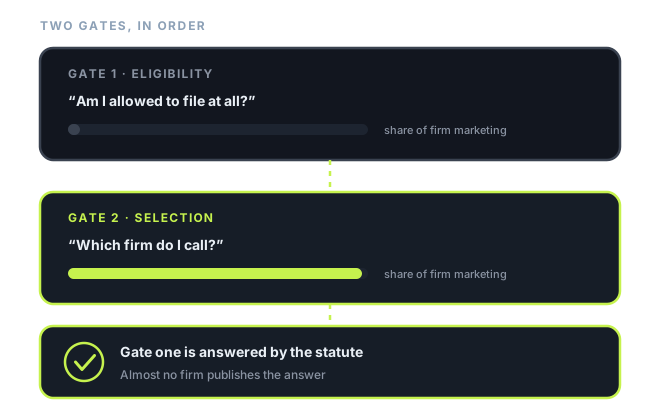
Every injured worker passes through two decisions in order. Comp marketing is an enormous, well-funded apparatus for winning the second one.
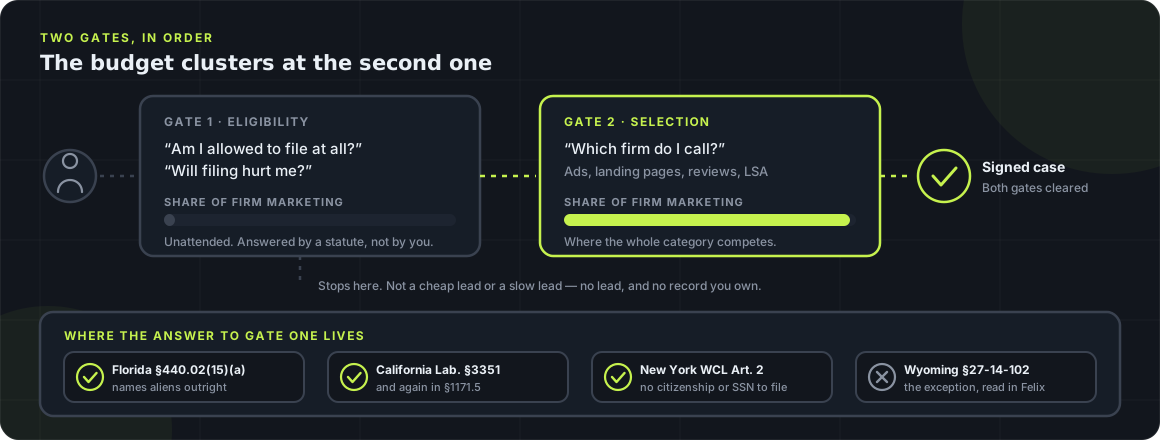
The first gate is eligibility: does this system apply to me, and will using it hurt me? The second is selection: which firm do I call? They are not two framings of one decision. They are sequential, and the first one is binary. A worker who answers it no does not become a cheap lead or a slow lead. They become no lead at all, and they leave no trace in any system you own — which is precisely why the problem is invisible from inside a firm.
For most of your audience the first gate is not a gate at all. It opens automatically, because nothing in their situation raises the question. They were hurt at work, they know work injuries are covered, they move straight to selection, and your marketing meets them there. This is why the sequence goes unnoticed: for the median lead, stage one is a formality.
For a worker who is undocumented, or married to someone who is, or simply unsure what their cousin’s bad experience five years ago actually means, the first gate is the whole decision. It absorbs all of the deliberation. And it is a question with a real legal answer — one that most state legislatures wrote down explicitly, decades ago, in language a non-lawyer can read.
We have written before about the Spanish-speaking injured-worker market, and the temptation is to file this under the same heading. Resist it. Language is a delivery problem: the worker knows what they want to ask and cannot ask it in English. Eligibility is a content problem: the worker does not know there is anything to ask about. A firm can solve the language problem completely — native Spanish creative, a Spanish landing page, a bilingual coordinator answering the phone at eight in the evening — and still never hear from a worker who concluded two months ago that the system is closed to him. He is not searching for a lawyer in any language.
What the acts actually say — and the state that says the opposite
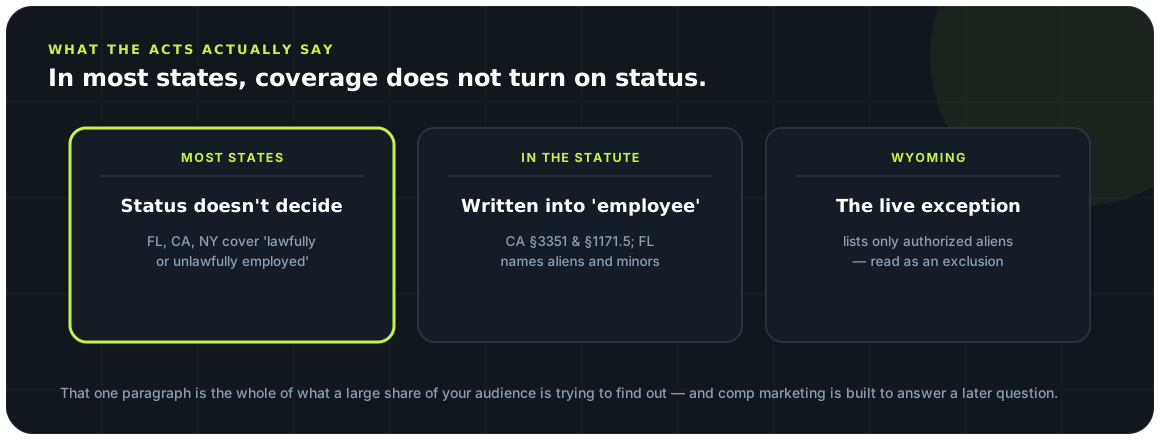
This is not a grey area in most jurisdictions. It is a definition, and the legislatures wrote it in plain words.
Start with Florida, because Florida’s drafters left no room for interpretation. Under Fla. Stat. §440.02(15)(a), “employee” means any person who receives remuneration from an employer for work “whether lawfully or unlawfully employed”, and “includes, but is not limited to, aliens and minors”. The phrase is not tucked into a proviso. It is in the definition that the entire chapter runs on.
California does the same job twice. Labor Code §3351 defines an employee as every person in the service of an employer “whether lawfully or unlawfully employed”, and expressly includes aliens. Then Labor Code §1171.5 generalises it: all protections, rights and remedies available under state law, except a reinstatement remedy prohibited by federal law, are available to all individuals regardless of immigration status. The California Supreme Court confirmed the working of it in Salas v. Sierra Chemical Co. (2014).
New York adds an administrative layer that matters more to a frightened caller than any statute. The Workers’ Compensation Board has stated publicly that it does not treat immigration status as a tool available to employers, and in a January 2024 announcement committed to supporting noncitizen workers who are party to a comp claim. The Board also holds a discrimination power under WCL §120 against employers who retaliate for claiming compensation. The relevant point for marketing is not the programme — more on that below — but the posture: the agency has said out loud that its job is processing injury claims.
And then there is Wyoming, which is why this article cannot end with a national reassurance. Wyoming’s definition of employee in Wyo. Stat. §27-14-102 enumerates aliens authorized to work, and aliens the employer reasonably believed to be authorized on the basis of documents in its possession. The Wyoming Supreme Court, in Felix v. State ex rel. Wyoming Workers’ Safety & Compensation Division, read the enumeration the way courts usually read enumerations: naming one class excludes the others. The coverage answer in Wyoming came out of a list, not out of a sentence about coverage.
| State | Where the answer lives | What it says |
|---|---|---|
| Florida | §440.02(15)(a), the definition of “employee” | Covers a person employed “whether lawfully or unlawfully”; expressly includes aliens |
| California | Lab. Code §3351 and §1171.5 | Same phrase in the comp definition; §1171.5 extends every state labour protection regardless of status |
| New York | WCL Art. 2 plus Board policy and WCL §120 | No citizenship or SSN requirement to file; the Board has a discrimination power against retaliating employers |
| Wyoming | §27-14-102, read in Felix | The definition names authorized aliens only; the court treated the omission as an exclusion |
The practical instruction is narrow and it is the opposite of what an agency usually tells a national client: do not write a national page. Write your state’s. Cite the section. Date it. If you practise in more than one state, write more than one page, and if one of your states is the exception, say that too — a firm that will tell a worker the hard answer is the firm that gets believed about the easy one.
The size of the silence
The honest answer is that nobody can measure this precisely, because the population is defined by not appearing in the records. Here is what can be measured.
The best-known attempt is old but it is not vague. The 2008 Broken Laws, Unprotected Workers survey of 4,387 workers in low-wage industries across Chicago, Los Angeles and New York found that around 12% had suffered a serious work-related injury in the previous three years — and that only about 8% of those workers had filed a workers’ compensation claim. Read that as a low-wage-worker figure rather than a status-specific one, and read it as evidence that the gap is enormous rather than as a number to quote at a partner meeting. It is nearly two decades old. We are not going to dress it up as current.
What is current is where the injuries are. The Bureau of Labor Statistics’ Census of Fatal Occupational Injuries for 2024 recorded 5,070 fatal work injuries. Of the 1,229 fatalities among Hispanic or Latino workers, 68.5% — 842 — were foreign-born. Construction and extraction occupations accounted for 1,032 fatalities on their own. Fatalities are not claims, and a fatality figure cannot be converted into a lead forecast. What it does establish, from a federal census rather than a vendor deck, is that the exposure is concentrated in exactly the workforce most likely to be stuck at the first gate.
Put the two together and you get the shape of the problem rather than its size. The exposure is measurable and large. The claiming is measurably far below it. The part in between — how much of the gap is fear about status, versus employer pressure, versus not knowing a claim exists at all — is not measurable from public data, and anyone who hands you a percentage has made it up.
You can, however, measure your own version of it. Pull your last fifty declined or unconverted enquiries from the markets in question and look for the ones that ended with a question rather than a decision. We set out the machinery for that in the piece on declined enquiries; the relevant code value here is not “unqualified”.
The diagram below is the whole argument in one frame: two gates in sequence, one of them unattended.
Why you cannot buy your way to this audience
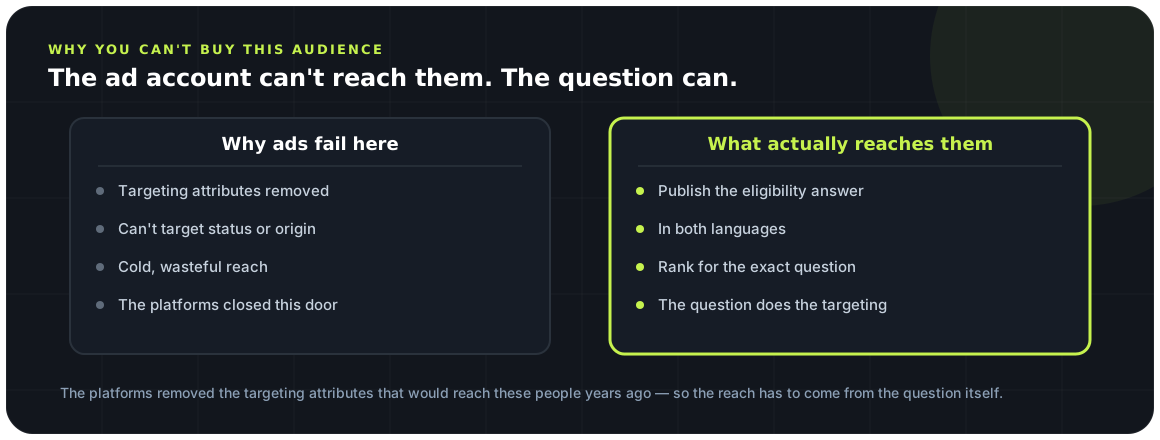
There is no targeting attribute for “worried about whether the system applies to me”, and there is not going to be one.
The instinct of every firm that accepts the argument so far is to take it to the ad account. It does not survive the trip.
Google’s personalized advertising policy treats race and ethnicity as a sensitive interest category and does not permit ads to be personalized on it. Meta removed detailed-targeting options relating to sensitive topics — including those referencing race or ethnicity — on 19 January 2022. Immigration status has never been a targeting input on either platform and will not become one. This is not an optimisation puzzle with a clever answer; it is a structural property of the channel.
It gets narrower still. As we set out in the piece on why the platforms treat your firm as a health advertiser, a comp advertiser is already operating inside a sensitive category, which removes advertiser-curated audiences from the Google account entirely — Customer Match, your own data segments, audience expansion, lookalikes. So the two tools a firm would reach for to approximate this audience, list-building and lookalikes, are the exact tools the classification has already taken away.
The people you most need to reach are the people the ad platforms have deliberately made unreachable by attribute. What is left is the question they type and the person they ask.
Spencer Moeller, WorkersComp MarketingWhich leaves two routes, and they are the two oldest ones in the business.
The first is the question itself. A worker who has not decided whether to call a lawyer will still look up whether the thing that happened to him is covered — and that search is a question, not a service. Question-shaped pages are the only inventory this audience generates, which makes this a content problem of exactly the kind we described in the content engine piece: write the search the worker actually performs, not the service the firm sells. It is also the kind of page that answer engines quote, for the reason set out in the piece on AI search — a sourced, specific, question-shaped answer with a statute behind it is exactly what a citation-hungry assistant reaches for, and being the quoted answer to the eligibility question is worth more here than ranking third for a commercial term.
The second is the referral surface, and for this audience it outruns everything else. A worker who is unsure whether the system applies to him asks a person before he asks a search engine: the clinic that treated him, the community organisation down the street, the union hall, the church, the interpreter, the co-worker who filed two years ago. Those relationships are built the slow way, and we covered the machinery in the referral engine. The only thing to add here is the content point: a referral partner can only pass on an answer they have. Give them the one-page version — in Spanish, with the citation and the date on it — and you have handed a hundred trusted intermediaries the sentence that opens the first gate.
What the page has to say, and what it must not
The content is not hard. The discipline is in what you refuse to put on it.
An eligibility page has one job: let a reader who is frightened establish, in under a minute and without talking to anyone, what the general rule in their state is. Everything else on the page is in service of that or is in the way.
There is a structural point hiding in that list. The most persuasive thing this page does is refuse to ask. A page that states the rule and then says, in the same breath, that the firm does not collect status and does not need it, is making a claim about the firm’s conduct that the reader can verify immediately by looking at the form. Almost nothing else in legal marketing offers that — a promise the reader can check on the spot, before they ever pick up the phone.
Whether your firm can publish a given sentence is a question for your counsel and your state bar, not for your agency. We are a marketing agency and not a law firm. What we can tell you is the distinction firms use in practice: stating what a statute says, with a citation and a date, is not the same act as telling a particular reader what will happen in their particular case. State agencies publish the first kind of material as a matter of routine. The second kind belongs in a consultation, which is where the page should be pointing anyway.
An eligibility page is a maintained asset, not a publish
This is the one content area on a comp firm’s site where going stale is worse than never publishing.
Here is a live example, and it is instructive precisely because the page in question belongs to a state agency doing its job properly.
The New York Board announcement cited above, from January 2024, described the Board’s participation in a federal process — Deferred Action for Labor Enforcement — under which workers party to a comp claim could seek temporary protection from removal. In July 2025 the Department of Homeland Security ended that programme and stopped processing applications, as Legal Aid at Work sets out in its current factsheet. The Board’s announcement is still published, because a press release is a dated record of what was announced. That is entirely proper for an agency archive.
It is not proper for a law firm’s marketing page. A firm that copied that reassurance onto its site in 2024 and left it there is now telling frightened readers about a route that no longer exists. On most of a firm’s website, a stale page costs a little credibility. On this page, a stale page sends a person toward a decision with real consequences on the strength of something that stopped being true.
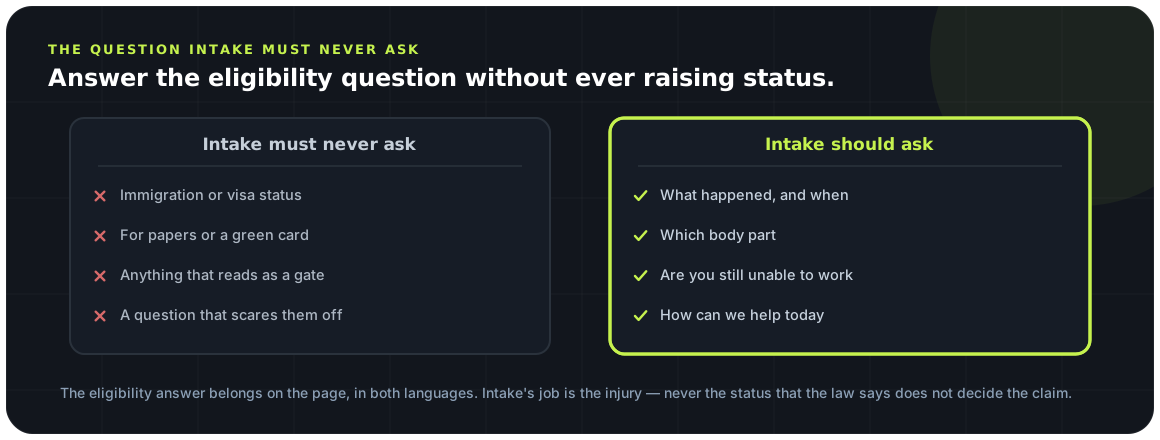
The question intake must never ask
The page opens the first gate. The phone call can close it again in eight seconds.
Everything above is wasted if the caller reaches an intake coordinator who asks whether they have a social security number.
There is no version of that question the firm needs answered at intake. The firm needs to know who the employer was, what happened, when it happened and whether the worker has been treated. It does not need a status field, and creating one produces a record that serves the client badly and the firm worse — a data point with no operational use, sitting in a CRM, attached to a person who was already afraid of exactly this.
| What intake must not do | What intake does instead |
|---|---|
| Ask about immigration status, a social security number, or work authorization | Ask for the employer’s name, the date, what happened and where treatment was received |
| Reassure the caller that filing is “safe” or that nothing will happen | State the firm’s eligibility position for this state, at the level the firm has authorised, and stop there |
| Answer an immigration question because the caller asked it | Say the firm does not give immigration advice, and route it to an attorney or an outside referral |
| Record what the caller volunteered about status in the notes | Record nothing about status; record the claim facts |
| Treat a status-related hesitation as an unqualified lead | Code it as a question rather than a decline, and give it a callback |
When a caller raises status themselves — and they will, because it is the thing they are most worried about — the workable pattern is three short sentences. That the firm handles work-injury claims and the general rule in this state is X. That the firm is not giving immigration advice and does not ask about status. That an attorney will go through the specifics. Then move to the claim facts, which is what the caller phoned about.
This is the highest-stakes moment of an intake call in this segment, and it is a scripted moment, which means it can be trained and scored. The rest of the anatomy of that call is in the piece on the first ninety seconds, and the mechanics of building the whole conversation sit in The Workers’ Comp Intake Playbook in the Growth Library.
The build: one afternoon, one page, one script
This is a small piece of work with an unusually long shelf life. It is not a quarter-long project.
Do it in this order, because the order protects you.
1. Get the answer for your state, from your own lawyers. Not from an agency, not from another firm’s blog, and not from an AI assistant. The output is one sentence, one statutory citation, and any separate note about wage-loss benefits. An hour of a lawyer’s time.
2. Agree what intake is authorised to say. Write the three sentences down and put them in the script. Remove any status field from every form and every CRM template at the same time — if the field exists, somebody will eventually fill it in.
3. Publish the page, in English and Spanish, at two URLs. Native Spanish, not machine-translated. Link them to each other. Put the last-reviewed date on both. Keep it short; this is not a pillar page and length will not help it.
4. Give it to your referral surface. The clinics, the community organisations, the interpreters, the union contacts. One page, printable, in both languages. This step is what converts a content asset into a distribution channel, and it is the step firms skip.
5. Diarise the six-month review and name the owner. A calendar entry with a person’s name on it. That is the whole governance requirement.
6. Measure it honestly, and expect the measurement to be poor. You will see the page’s own traffic, its share of Spanish-language sessions, and eventually enquiries that mention it. You will not see a clean causal line from the page to signed cases, because the mechanism runs through a delay and a conversation you do not observe. That is a reason to keep expectations calibrated, not a reason to skip it — the same distinction between an account and an experiment we drew in the piece on ad testing.
Key takeaways
-
Most comp acts cover a worker regardless of immigration status. Several states define a covered employee explicitly as one “whether lawfully or unlawfully employed.”
-
One state’s supreme court read it the other way. Wyoming is the outlier, which is exactly why a firm must get its own state right.
-
Your budget is stuck at the second gate. Your ads answer “why hire us” to an audience still asking whether they are allowed to file at all.
-
You cannot buy your way to this audience. No platform lets you target by immigration status; an honest eligibility page is how they find you.
-
There is a question intake must never ask. Affirm the right to file generally, route specific immigration questions to counsel, and never collect status you do not need.
Frequently asked questions
Isn’t this just the Spanish-language conversation again?
No, and conflating the two is the specific error this article is about. Language is a delivery problem: the worker knows what they want to ask and cannot ask it in English. Eligibility is a content problem: the worker does not know whether there is anything to ask about. A firm can solve the language problem completely — native Spanish ads, a Spanish landing page, a bilingual intake coordinator answering at eight in the evening — and still never reach a worker who has concluded the system is closed to them, because that worker is not searching for a lawyer. Both problems are real and they are solved with different work. The bilingual build is the delivery layer; the eligibility answer is the thing being delivered.
Is publishing an eligibility answer giving legal advice?
We are a marketing agency and not a law firm, and the line is drawn by the firm’s own counsel rather than by us. What we can say is that the distinction most firms use in practice is between stating what a statute says, with a citation and a date, and telling a particular reader what will happen in their particular case. State agencies publish the first kind of material routinely. The second kind belongs in a consultation. In practice the page that works is short, sourced, state-specific, explicit that it is general information rather than advice, and ends by inviting the reader to ask about their own situation — which is the only honest answer anyway, because the general rule is not the whole of anyone’s case.
Can’t we just target this audience in the ad account instead?
There is no attribute to target. Google’s personalized advertising policy treats race and ethnicity as a sensitive interest category and does not permit ads to be personalized on it, and Meta removed detailed-targeting options relating to sensitive topics — including race and ethnicity — on 19 January 2022. Neither platform has ever offered immigration status as a targeting input, and neither is going to. That is not a loophole to find; it is a structural fact about the channel. It means this audience is reachable by the question they ask and by the people they trust, not by an attribute you can buy — which is why the answer here is a page, in two languages, and a referral surface, rather than a campaign.
What share of injured immigrant workers never file? Give us a number.
There is no credible current figure isolated to immigration status, and we will not print one. The closest well-known measurement is the 2008 Broken Laws survey of 4,387 workers in low-wage industries across Chicago, Los Angeles and New York, in which about 12% had suffered a serious work-related injury in the previous three years and only 8% of those had filed a workers’ compensation claim. That is a low-wage-worker figure, not a status-specific one, and it is now well over a decade old. Treat it as evidence that the gap is large rather than as a number to quote in a pitch. The honest position is that nobody can size this precisely, because the people it describes are defined by not appearing in the records.
Our state might be the exception. How do we find out?
Read your own act’s definition of “employee” and then ask your counsel what the courts have done with it, because the answer can live in either place. Florida’s definition names aliens and the phrase “whether lawfully or unlawfully employed” outright. California says it in Labor Code §3351 and repeats it for all state labour protections in §1171.5. Wyoming’s definition enumerates authorized aliens and the state Supreme Court read the omission of everybody else as an exclusion — the coverage answer there came out of a list, not out of a sentence about coverage. A second question worth asking separately is how your state treats wage-loss benefits specifically, because several jurisdictions that plainly cover the medical side have litigated the lost-wage side.
What should intake say when a caller raises their status?
Answer the question that was asked, at the level the firm has authorised, and then hand it to a lawyer. A workable pattern is three short sentences: that the firm handles work-injury claims and the eligibility rule in this state is X; that the firm is not giving immigration advice and will not ask about status; and that an attorney will go through the specifics. What intake must never do is volunteer a prediction about immigration consequences, promise that nothing will happen, or ask a question whose answer the firm has no use for. The firm needs to know who the employer was and what happened. It does not need a status field, and creating one produces a record that serves the client badly and the firm worse.
Sources & further reading
-
01
Who the acts cover
State statutes and case law defining a covered employee broadly, regardless of work authorization.
-
02
The state that reads it the other way
Wyoming law and the Felix decision excluding unauthorized workers from coverage.
-
03
Enforcement protecting undocumented workers
New York’s announcement protecting undocumented workers during labor investigations.
-
04
Further reading
Reaching an audience you cannot target.
Statutes, caps and rules vary by state and change over time — confirm the current rule in your state with counsel. General marketing information, not legal advice.