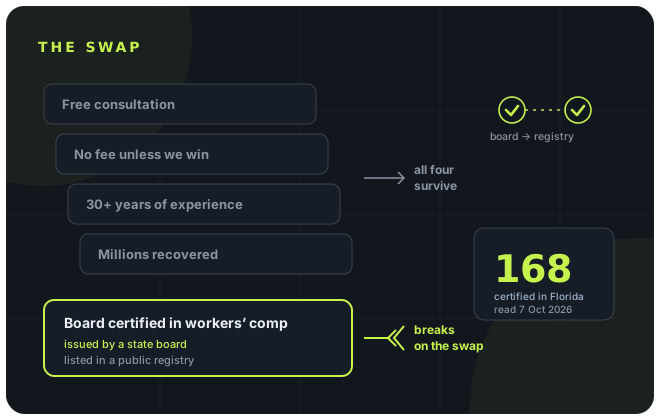
We published a piece three weeks ago about the most common sentence in workers’ compensation advertising — free consultation, no fee unless we win — and the finding was that four competitors converge on it not by imitation but because each of them independently reported the same true fact about the fee statute. The instrument we used was a substitution test: if a rival could paste their logo onto this claim and run it unchanged, it is not an offer.
That article ended on a slightly unsatisfying note. It identified four claims that do survive the test — whether a human answers, what language the call happens in, who handles the case, what happens in week one — and all four are operational. They are things a firm must build and then prove, and building them takes quarters.
What it did not say is that there is a fifth, and the fifth is different in kind. It is not operational, it is not verbal, and it cannot be built by a marketing department at all. It is a credential, and the reason it defeats the substitution test is structural: a competitor cannot copy it by writing better, because a third party controls the supply and publishes the list.
So the claim of this article, stated plainly: board certification in workers’ compensation law is the only differentiator in this category with a registry, a supply constraint and an expiry date — which makes it the single most under-advertised asset held by the firms that have it, and a decisive reason for everyone else to stop hunting for words that cannot be copied and go build operations instead.
What survives the swap
Run the test on your own homepage before you read any further. It takes ten minutes and it is unpleasant.
Open your firm’s website. Take each claim above the fold, one at a time, and ask whether it would still be true if the firm named next to it were your nearest competitor. Free consultation: still true. No fee unless we win: still true, and in most states a paraphrase of the fee statute rather than a decision. Decades of combined experience: still true somewhere nearby, in a number of the competitor’s own choosing. Aggressive representation. We fight for injured workers. Millions recovered. Available 24/7.
Almost nothing on a typical comp firm’s homepage breaks on the swap. This is worth saying carefully, because it is not a criticism of the copywriting. Every one of those sentences is true, legally safe and reasonably well written. The problem is that truth is not scarce here. When four firms in one market all tell the prospect something accurate about contingent fees, the information content of the claim is zero and the decision falls through to whatever does vary — which is usually who picked up the phone.
The illustration below is the structure of the whole article: four claims pasted intact onto a rival’s page, and the one that shatters.
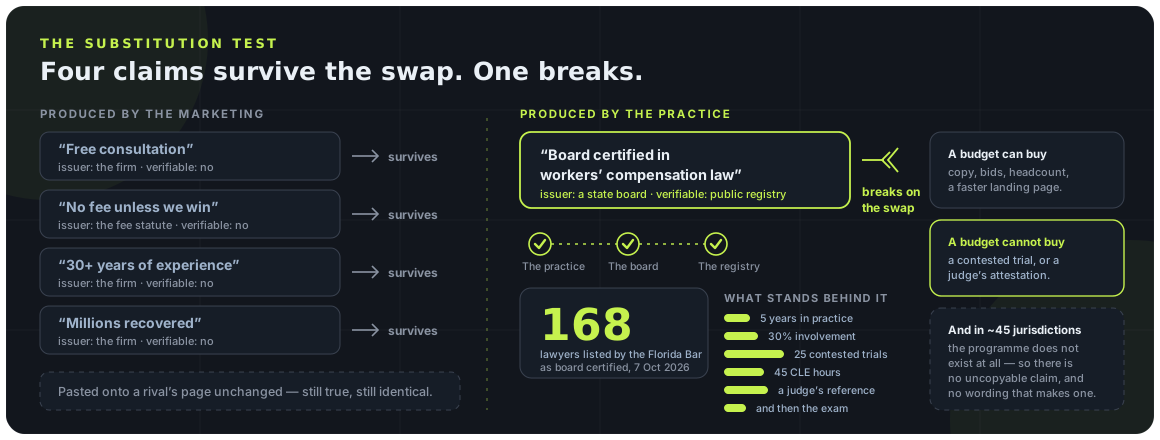
Notice what the diagram is not saying. It is not saying the four copyable claims should be removed; they are table stakes, and a page without them looks evasive. It is saying that a page made only of table stakes contains no reason to choose.
One hundred and sixty-eight
The number is the argument. A differentiator you can count is a different species from one you can assert.
On 7 October 2026 we read The Florida Bar’s own directory of lawyers board certified in workers’ compensation law. It reported 168 results. Not an estimate from a marketing page, not a figure quoted in a press release — the Bar’s searchable list, which anybody can open and page through, and which exists precisely so that a member of the public can verify a claim.
Two things about that number matter more than its size.
The first is that it is published by the regulator. Every other differentiator in comp marketing is self-reported. Years in practice, cases won, amounts recovered, client satisfaction — all of them come from the advertiser. This one comes from the body that can take it away, and it is listed next to the lawyer’s bar number and standing.
The second is that the pool is not what a firm owner assumes. Workers’ compensation is a two-sided practice area, and the certification does not distinguish sides. The first page of ten entries alone contained lawyers at defence firms and a sitting Judge of Compensation Claims. Nobody publishes a split, and we are not going to invent one — but the direction is certain: the number of certified lawyers actually competing for injured workers’ cases in Florida is meaningfully below 168, and in any single metropolitan market it is a number you could write on one line.
Compare that with the scale of the market those lawyers serve. Florida’s Office of the Judges of Compensation Claims recorded 76,633 petitions filed in its 2022–23 annual report. We are deliberately not dividing one of those numbers by the other — a petition is not a client and certified lawyers are not the only lawyers — but holding the two figures beside each other tells you the shape of the thing. The credential is rare in a system that is not.
A supply curve made of trials
The requirements are published. Read them as a moat rather than as a bureaucracy.
Here is what Florida requires before a lawyer may sit the examination, from the Bar’s certification rules for workers’ compensation law: at least five years in practice, of which at least 30 per cent has been active participation in workers’ compensation law; the trial of a minimum of 25 contested workers’ compensation cases, in each of which the applicant was responsible for all or a majority of the presentation of evidence; 45 hours of approved continuing legal education in the field within the preceding three years; five peer references, of whom at least one must be a judge of compensation claims before whom the applicant has tried a case in the last two years; and then the exam.
And it does not stay earned. Recertification runs on a five-year cycle requiring continuous substantial involvement, a further 15 contested trials or their substantial equivalent, fresh peer references, and another 75 hours of continuing legal education.
Read that list as a marketer rather than a lawyer and something jumps out. Every single requirement is a thing the practice does, and not one of them is a thing the marketing department can influence. There is no budget line that produces a contested trial. There is no agency in the country that can arrange for a judge of compensation claims to attest to a lawyer’s competence. This is the rarest structure in advertising: a claim whose production function sits entirely inside the work.
| Claim | Who issues it | Can a prospect verify it? | What a competitor needs to match it |
|---|---|---|---|
| “Free consultation” | The firm | No — and no need; everyone says it | One sentence |
| “No fee unless we win” | The firm, paraphrasing the fee statute | No | One sentence, already written |
| “30+ years of experience” | The firm, in a number of its choosing | No public register of the figure as advertised | A different, equally unverifiable number |
| “Millions recovered” | The firm | No | A bigger number |
| Board certified in workers’ compensation law | A state board | Yes — a searchable public registry | 5 years, 30% involvement, 25 contested trials, 45 CLE hours, peer review including a judge, and an exam |
Every other claim in comp marketing is produced by the marketing. This one is produced by the practice, and that is exactly why it cannot be copied.
What you are allowed to say
Two rules do almost all the work here, and they point in opposite directions.
The first is Peel v. Attorney Registration and Disciplinary Commission of Illinois, decided by the Supreme Court in June 1990. A lawyer’s letterhead stated that he was a “Certified Civil Trial Specialist” by the National Board of Trial Advocacy. Illinois had a categorical rule against holding yourself out as a specialist and moved to discipline him for it. The Court held that the statement was truthful, verifiable commercial speech, not inherently misleading on that record, and that Illinois’s blanket prohibition was broader than reasonably necessary when less restrictive measures were available (496 U.S. 91).
That is the floor. A real certification, stated accurately, is speech a state cannot simply forbid.
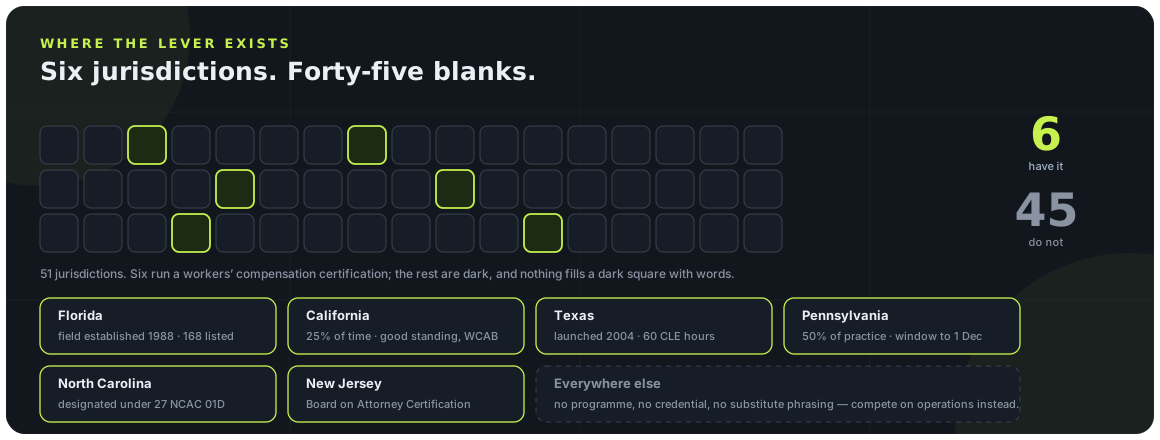
The second rule is the ceiling, and it is the reason this article has a second half. Under the ABA Model Rules as amended in 2018 — the certification provisions were moved out of the old Rule 7.4 and into Rule 7.2(c) — a lawyer shall not state or imply that they are certified as a specialist in a field of law unless they have been certified by an organisation approved by the appropriate state authority or accredited by the American Bar Association.
Put the two together and you get a sharp little result. Where a programme exists and you hold the certification, you may say so and the state may not stop you. Where it does not exist, or you do not hold it, there is no clever phrasing available. “Certified workers’ compensation specialists” in a state with no such programme is not an aggressive claim; it is a conduct problem wearing a marketing costume. Most states also require a disclaimer or specific identification of the certifying body, and the certifying board usually publishes its own rules about how its mark and logo may be used.
Six programmes, forty-odd blanks
This is the part most articles about credentials leave out, and it is the part that decides what you do on Monday.
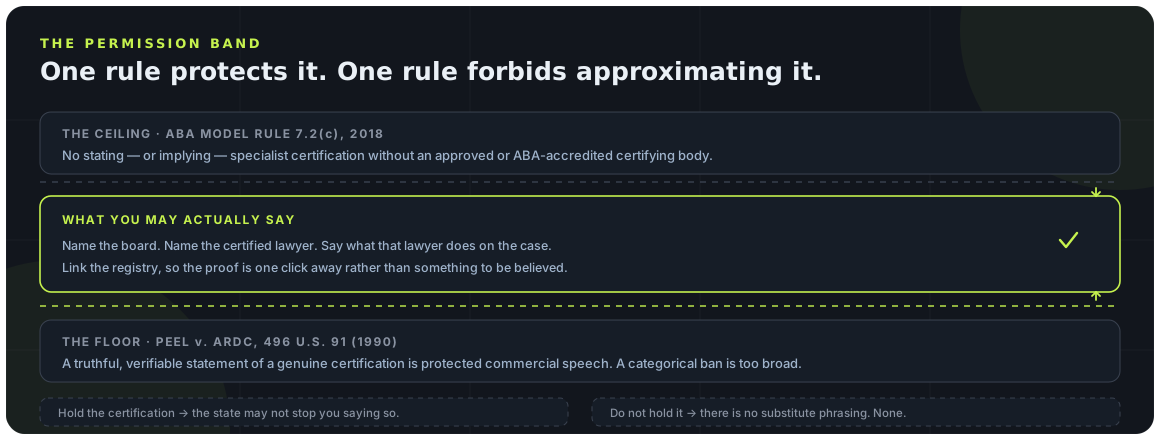
Workers’ compensation is not a universally certified field. Most states that run specialty certification at all do not include it, and most states run no programme at all. The jurisdictions we were able to confirm with a workers’ compensation certification are California, Florida, Texas, North Carolina, New Jersey and Pennsylvania — Pennsylvania’s being run by the Pennsylvania Bar Association’s Workers’ Compensation Law Section, which the Pennsylvania Supreme Court recognised as a certifying organisation on 12 January 2012.
That is six, in a 51-jurisdiction system. Which means that for most firms reading this, the honest finding of this article is a negative one, and we would rather state it plainly than pad it: in most of the country there is no uncopyable claim available, and no sentence anyone can write will create one.
| Jurisdiction | Certifying body | A requirement worth knowing |
|---|---|---|
| Florida | The Florida Bar, Board of Legal Specialization & Education | Field established 1988; 25 contested trials; 168 lawyers listed on 7 Oct 2026 |
| California | The State Bar of California, Legal Specialization | Five years in practice, at least 25% of time in the field, good standing with the WCAB, and an exam |
| Texas | Texas Board of Legal Specialization | Specialty launched 2004; 60 hours of approved CLE; under 100 lawyers certified, on published counts that disagree with each other |
| Pennsylvania | PBA Workers’ Compensation Law Section (recognised by the Supreme Court, 12 Jan 2012) | 50% of practice in the field; applications 1 Oct – 1 Dec; $325 fee; one exam a year |
| North Carolina | N.C. State Bar Board of Legal Specialization | Workers’ compensation designated as a field for certification of specialists |
| New Jersey | N.J. Board on Attorney Certification (Supreme Court of New Jersey) | Workers’ compensation law among the certified fields |
One date on that table is operational rather than informational. Pennsylvania’s application window opens on 1 October and closes on 1 December, with a single examination date in the following March. If you are a Pennsylvania firm reading this in the first week of October, the window is open right now and it closes in under eight weeks — which makes this a decision for this quarter and a credential for next year. There is no version of this that helps your cost per lead in November.
What it does to the arithmetic
And, just as important, what it does not do. This is where credential articles usually start inventing numbers.
Cost per signed case is cost per lead divided by close rate. Across the book we manage — roughly $16.5M of workers’ comp Meta spend, about 219,000 injured-worker leads at around $75 each, and about 21,000 signed cases at around $775 apiece — those two terms are the only levers that exist. Nothing about a credential touches the first. An auction does not price a certification; it prices an audience.
So the entire effect, if there is one, lands on close rate. And for a practice area with statutory fee caps, that is the lever that matters most, because a capped percentage fee means revenue per case has a ceiling and cost per signed case is where the available return lives. One point of close rate, from 9.6 to 10.6 per cent, takes $775 to roughly $708 — a nine per cent gain with no additional media at all.
| Close rate | Leads per signed case | Cost per signed case at $75 CPL | Change |
|---|---|---|---|
| 9.6% (our book’s average) | 10.4 | ~$775 | — |
| 10.6% | 9.4 | ~$708 | −9% |
| 11.6% | 8.6 | ~$647 | −17% |
| 12.6% | 7.9 | ~$595 | −23% |
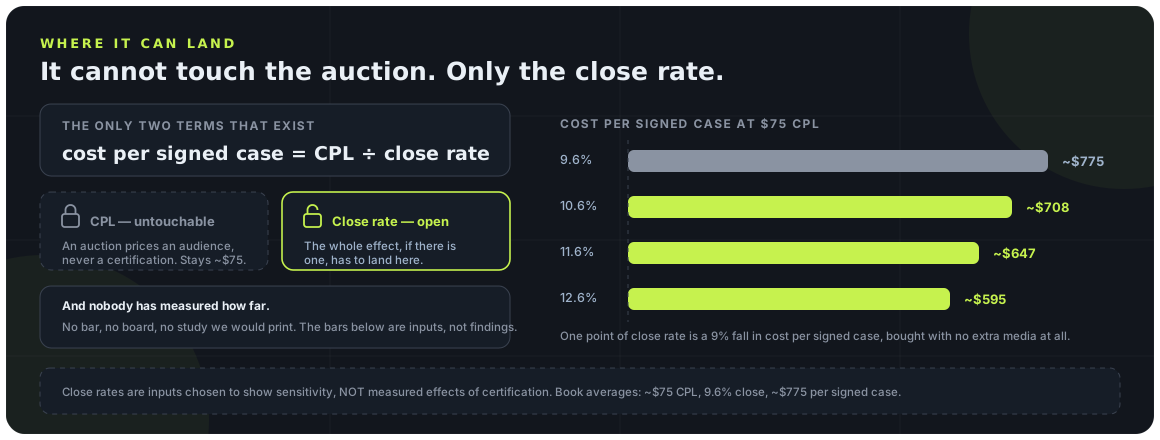
Now the honest limit, and we are going to state it twice because the temptation to fill this gap with a confident number is enormous. No credible published figure exists for what a specialist certification does to an injured worker’s decision to hire one firm over another. We looked. No bar association measures it, no board publishes it, and we found no study we would be willing to put in print. Anyone quoting you a conversion lift for board certification is quoting you something they made up.
There is a second-order effect worth naming, because it is more reliable than the conversion story. A credential is a referral asset at least as much as an advertising one. The peer references, the judge who attested, the recertification cycle that keeps a lawyer in front of the same bar section for decades — that is the machinery of a professional network, and the referral engine it feeds does not cost media. We cannot size that either. We can say that it is the half of the credential’s value that nobody puts in a marketing plan.
The build, both halves
Two lists. Use the one that applies to you and ignore the other entirely.
If a lawyer at your firm holds the certification. You have already paid for this asset, in years, and the odds are good that it currently appears in one place: a line in a biography that nobody reads.
One. Put the certified lawyer’s name next to the credential, everywhere. Homepage, the practice page, the ad, the intake script. Not “our board certified team” — the person, with what they do on a case.
Two. Link the registry. One line: here is the state board’s public list, check us on it. The proof being one click away is most of the claim’s power, and almost nobody does this.
Three. Teach intake to say it in one sentence a layperson can use. “The lawyer who will handle your claim is one of a small number in this state the Bar has certified specifically in workers’ compensation — you can look him up on the Bar’s own list.” Then stop. The temptation to explain the examination is strong and it loses the caller.
Four. Check your advertising permissions before any of the above goes live — the bar rule, the board’s designation and logo rules, and your state’s advertising review requirement if it has one.
Five. Put the recertification date in the firm’s calendar, not the lawyer’s. An expiring credential that is still on the website is a worse problem than never having claimed it.
If nobody at your firm holds it. Then there are two questions, in this order, and only one of them is a marketing question.
Six. Does the programme exist in your state at all? If not, close this article and go and work on close rate. If it does, the decision is a practice decision for the partners — it is measured in years of trials, not in quarters of budget — and it should be argued on the merits of the practice first, with the advertising value as a secondary consideration rather than the reason. Then find the application window, because it is annual and it will not wait for your planning cycle.
Finally, the synthesis with the piece this one grew out of. The fee-statute article found that the most prominent sentence in comp advertising carries no discriminating information, and concluded that a capped-fee firm gets paid for being better only through brand preference. This article is the one place in the category where that preference has a documentary form. It is rare, it is checkable, it is owned by a person rather than a brand, and in roughly 45 jurisdictions it does not exist — which is the most useful thing here, because knowing that your category has no magic words is what finally makes a firm go and fix the phone.
Key takeaways
-
Almost nothing on a comp firm’s homepage breaks on the substitution test. Every claim is true, which is the problem: truth is not scarce when four firms report the same fee statute.
-
A state-issued certification is the one claim with a registry, a supply cap and an expiry date. The Florida Bar listed 168 certified workers’ compensation lawyers on 7 October 2026 — defence counsel and judges included.
-
Its supply curve is made of trials, not budget. Florida wants five years, 30% involvement, 25 contested trials, 45 CLE hours, a judge’s reference and an exam. None of it is buyable.
-
Peel protects saying it; Rule 7.2(c) forbids approximating it. Where no programme exists there is no substitute wording, so “certified specialist” is a conduct problem rather than a bold claim.
-
Six jurisdictions have the programme; roughly 45 do not. For most firms the useful finding is the negative one: your category has no magic words, so go fix the phone.
-
Nobody has measured what it does to conversion, and we refuse to invent a figure. It cannot touch cost per lead; the only place it could land is close rate, where one point takes $775 to about $708.
WorkersComp Marketing is a marketing agency, not a law firm. Nothing here is legal advice, and nothing here is advice about your professional-conduct obligations. Certification programmes, advertising rules and professional-conduct rules are set state by state, they vary, and they change; the rules and requirements quoted here are quoted to show that they exist and that they differ, not to tell any firm what it may say. Read your own bar’s current advertising rule and your certifying board’s own usage rules, and ask your own counsel, before you publish a claim about credentials.
Frequently asked questions
Does board certification actually win more cases?
We do not know, and nobody has published a figure we would print. No bar association, no state board and no academic study we could find measures what a specialist certification does to an injured worker’s decision to hire one firm over another. What we can say is structural rather than statistical: it is the only claim in this category that a competitor cannot match by rewriting a page, it is verifiable by the prospect in about forty seconds against a public registry, and it is the one differentiator whose supply is capped by something other than willingness to spend. Treat it as a durable asset of unquantified size, measure it yourself against your own close rate, and be suspicious of anyone who quotes you a conversion lift for it.
My state does not have a workers’ compensation certification. What now?
Then the honest answer is that this particular lever does not exist for you, and no amount of copywriting creates it. Under the model rule, stating or implying that a lawyer is a certified specialist requires certification by an organisation approved by the state or accredited by the ABA, so there is no substitute phrasing — a line like “certified workers’ compensation specialists” in a state with no such programme is not a bold claim, it is a conduct problem. What you do instead is compete on the things that are measurable and also hard to copy because they are operational rather than verbal: who answers the phone and how fast, what language the call happens in, which lawyer actually handles the file, and what happens in the first week. Those break on the substitution test too.
Is it legal to advertise a specialist certification at all?
Truthfully stating a genuine certification is protected commercial speech. In Peel v. Attorney Registration and Disciplinary Commission of Illinois (1990) the Supreme Court held that a lawyer’s accurate statement of a private professional certification was not misleading and could not be categorically banned, and Illinois’s blanket prohibition was broader than necessary. That is the floor, not the whole picture: states layer their own requirements on top, often about which organisations count and what disclaimer must accompany the claim, and the certifying board itself usually publishes rules about how its mark may be used. So the answer is yes in principle, with the detail set by your own jurisdiction — read your bar’s advertising rule and your board’s usage rules before the claim goes live.
Can a firm say it is a board certified firm if one of its lawyers is certified?
This is the single most common way a legitimate credential turns into a misleading advertisement. The certification belongs to a named individual, not to a letterhead, and a firm-level claim implies that the certified lawyer handles the matter when very often the certified lawyer is the founder and the file is handled by an associate. Name the certified lawyer, say what that lawyer does on a case, and do not let the credential migrate from a person to a brand. If the certified lawyer will not be on the file, saying so plainly is both safer and, in our experience of what injured workers ask about on intake calls, more persuasive than the vaguer version.
We advertise decades of experience. Isn’t that the same thing?
No, and the difference is the whole point of this article. Experience is a claim the firm makes about itself, in a number it chooses, with no registry behind it and no way for a prospect to check it in the moment. Every competitor can make a version of it, and most do, which is why four comp websites in one city read as four copies of one website. A certification is issued by a third party, recorded in a list anybody can search, and withdrawn if it is not maintained. Experience is an input to the credential — Florida requires five years of practice and twenty-five contested trials before you may sit the exam — but advertising the input while a rival advertises the same input is not a differentiator, it is noise.
How long does it take to get certified, and when can we apply?
Longer than a campaign and on a calendar you do not control, which is exactly why it holds its value. The experience requirements are measured in years, not months, and the application windows are annual. Pennsylvania’s workers’ compensation certification, for example, opens applications on 1 October and closes them on 1 December, with a $325 application fee and a single examination date. Read that as a planning fact rather than a marketing one: if the window for your state is open now, the decision is this quarter’s, and the credential arrives next year. There is no version of this that helps your cost per lead in November.
Where should this rank against everything else on the marketing list?
Below fixing intake and above almost every creative project. If a firm already holds the certification, surfacing it properly — on the site, in the ad, on the intake script, with the certified lawyer named — is a few hours of work on an asset the firm has already paid years for, and it is close to the cheapest thing on any list. If no lawyer at the firm holds it and the programme exists in your state, it is a multi-year decision for the partners rather than a marketing project, and it should be argued on practice grounds first. If the programme does not exist in your state, it should not be on the list at all, and the honest move is to spend the attention on close rate instead.
Sources
-
01
Florida — the registry and the requirements
The Florida Bar’s searchable directory of board certified workers’ compensation lawyers, which reported 168 results as of 7 October 2026, and the Bar’s published certification requirements for the field.
-
02
The Supreme Court on stating a certification
Peel v. Attorney Registration & Disciplinary Commission of Illinois, 496 U.S. 91 (1990): a truthful, verifiable statement of a genuine professional certification is protected commercial speech, and a categorical state ban is broader than necessary.
-
03
The rule that forbids approximating it
ABA Model Rule 7.2(c), which since the 2018 amendments carries the certification provisions formerly in Rule 7.4: no stating or implying specialist certification without an approved or ABA-accredited certifying organisation.
-
04
The other programmes
California’s legal specialization rules for workers’ compensation law, the Texas Board of Legal Specialization’s workers’ compensation area, and the Pennsylvania Bar Association section recognised by the Pennsylvania Supreme Court on 12 January 2012 — with its 1 October to 1 December application window.
-
05
Further reading
The substitution test this article extends, the arithmetic a close-rate gain has to survive, and the playbook the whole claim strategy sits inside.
Certification programmes, advertising rules and professional-conduct rules vary by state and change over time — confirm the current rule and the current requirements with the certifying board and with your own counsel before publishing any claim. General marketing information, not legal advice. Counts read from public registries on the date stated and will change.