The request arrives in almost exactly the same words every time. I don’t want to pay for leads. I don’t want to pay for impressions. I’ll pay you for a signed case — name your number.
It is an entirely reasonable thing to want. The owner saying it has usually spent a year paying for volume and getting volume: a dashboard full of enquiries, an intake team that cannot get half of them on the phone, and a signed-case count that did not move in proportion to the invoice. Paying per case puts the risk where the owner thinks it belongs. It makes the vendor care about the thing the firm cares about. It converts an expense into something that looks like a cost of goods sold.
And it is the one term a specialist vendor will almost always decline, usually with a vague answer about how it is “not how we structure things.” That vagueness is a disservice, because there is a real answer with a real citation behind it, and the firm owner is better off knowing it than being managed around it.
The answer has two halves, and they are independent. The first is a conduct-rule problem that applies to every practice area: in most American jurisdictions a nonlawyer may not share in a legal fee, and regulators have repeatedly read a per-client price as exactly that, whatever the invoice calls it. The second is specific to workers’ compensation and almost nobody writes it down: the fee in a comp case is not an ordinary contingency fee. It is a statutory slice of the injured worker’s compensation, its ceiling is set by the act or by a tribunal rather than by the firm, and in most states it cannot be collected at all until the amount has been approved. A per-case price asks a vendor to be paid out of a pot that does not exist yet, cannot be enlarged, and is not entirely the firm’s to allocate.
The pricing term everyone asks for first
Why the request is rational, and why “performance pricing” in this category means something narrower than it does anywhere else.
Outside the professions, paying for outcomes is unremarkable. An affiliate gets paid when a sale closes. A recruiter gets paid when a hire starts. A mortgage broker gets paid on funding. In each case the buyer has transferred performance risk to the seller, and the seller has priced that risk in. Nobody writes articles about whether it is permitted.
Legal services sit under a different regime, and the reason is not commercial. The rules that constrain how a firm pays for client acquisition exist to keep the lawyer’s judgement about a client’s case free of a third party’s financial interest in that same case, and to stop money changing hands for a recommendation that the person receiving it believes to be disinterested. Whether that regime is well drawn is a live argument — it is the argument Arizona and Utah are conducting in public. But it is the regime, and a firm buying marketing has to buy inside it.
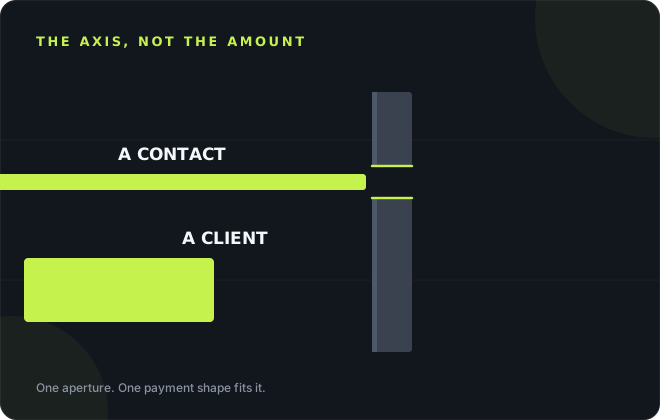
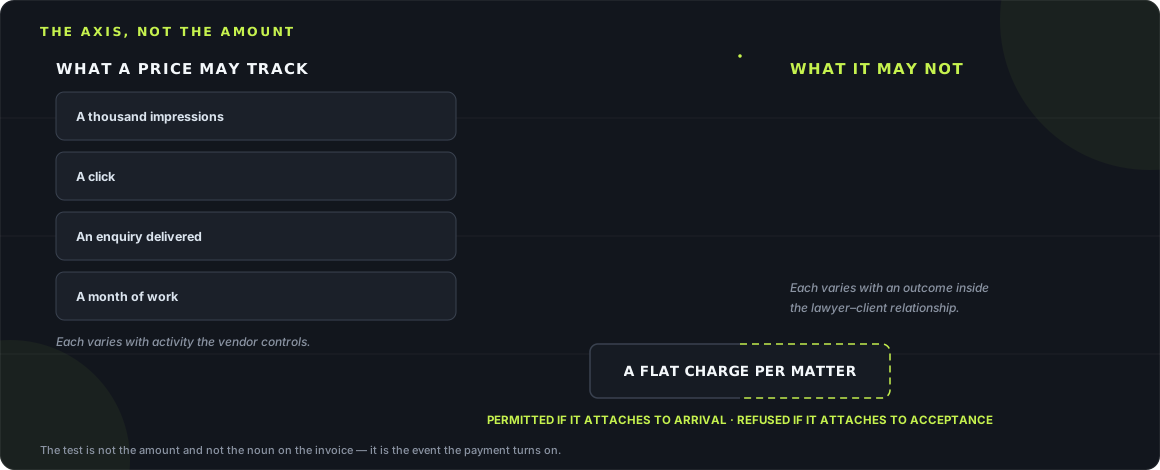
What makes this genuinely confusing is that the rules do not prohibit buying client acquisition. They prohibit buying it on one particular axis. A firm may spend without limit on advertising that produces enquiries. It may pay a flat monthly fee, a percentage of media, a per-click price, or a price per enquiry delivered. What it may not generally do is make the payment turn on whether the enquiry became a client — which is precisely the axis a per-case price is built on, and precisely the axis the firm wanted to buy.
Three regulators, one line: the contact, not the client
Three jurisdictions, three different rule numbers, three different procedural postures — and the same dividing line in each.
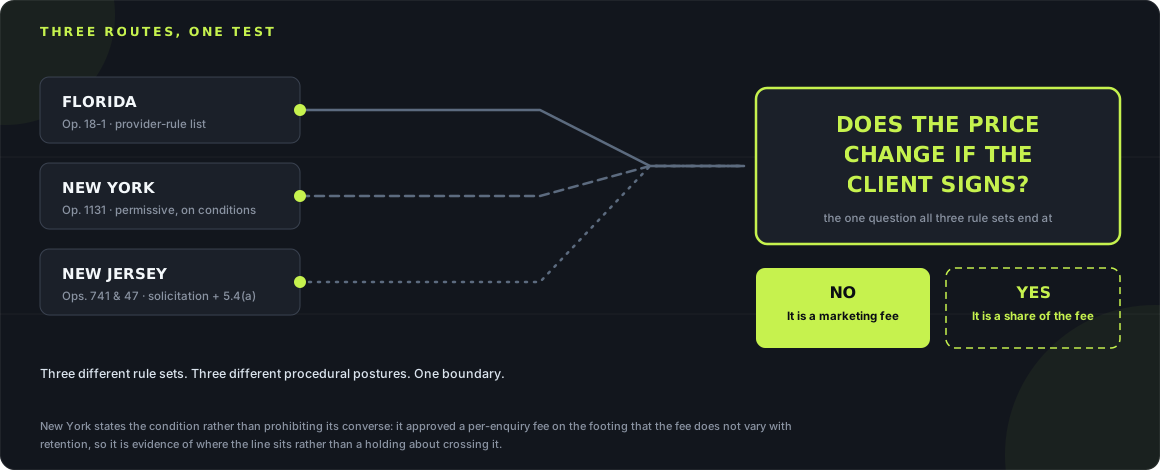
Start with Florida, because its ethics committee did the unusual thing of publishing a list. Florida Bar Ethics Opinion 18-1, dated 14 December 2018, addresses how a Florida lawyer may pay a for-profit service that sends it work. It sorts charging methods into two groups. Among those it treats as generally permissible are fixed periodic charges, pay-per-click, and a fixed charge per matter that “does not vary based on the amount at issue in the matter.” Among those it treats as generally impermissible are “a charge calculated as a percentage of the fee received by a lawyer,” “a charge calculated as a percentage of the client’s recovery in the matter,” and — the one that matters here — “a flat charge per case accepted by a participating lawyer.” Among the factors it treats as pointing towards permissibility is that “the charge is imposed regardless of whether the lawyer is hired by the prospective client.”
Note what that third impermissible item is not. It is not a percentage of anything. A flat charge per case accepted is a fixed dollar figure, exactly like the fixed per-matter charge the same opinion permits. The difference between the permitted and the prohibited version is one word: accepted. The charge the opinion allows attaches to a matter arriving. The charge it refuses attaches to a matter being taken on.
Florida’s list permits “a fixed charge per matter” that “does not vary based on the amount at issue” and refuses “a flat charge per case accepted by a participating lawyer.” The same dollar amount, the same invoice line — the only difference is what triggers it.
New York arrives at the same place from the opposite direction. New York State Bar Association Ethics Opinion 1131, dated 7 August 2017, approved an arrangement in which a lawyer pays a for-profit internet service either a fixed monthly fee or a fee for each potential client it sends. It is a permissive opinion, and it is worth reading carefully for what the permission rests on. The facts recite that “the fee does not vary depending on whether the lead results in retention of the lawyer or the amount of the fee the lawyer charges the client.” The committee characterised the arrangement as “essentially paying a marketing fee,” described the payment as “a fixed sum to participate, unrelated to the lawyer’s retention or the amount the lawyer charges in legal fees,” and in passing cited Oregon and South Carolina opinions resting on the same condition — Oregon requiring that the fee not be “based on number of referrals, retained clients or revenue generated by listing,” South Carolina that payments not be “based on whether user ultimately becomes a client.”
Two honest caveats about Opinion 1131. It is advisory, not binding. And because it approved a per-enquiry fee rather than ruling on a per-client one, it does not contain a sentence expressly forbidding retention-based payment; the condition appears in the facts the committee approved and in its reasoning, not as a prohibition. It is evidence of where the line sits, not a holding that crossing it is misconduct.
New Jersey supplies the sentence New York does not. In a joint opinion of the Advisory Committee on Professional Ethics and the Committee on Attorney Advertising, numbered 741 and 47 respectively and decided 21 June 2021, the committees considered an out-of-state marketing company that had emailed New Jersey lawyers offering to connect them with mass-tort clients at per-claimant prices running from $700 to $1,800, advertising an “86% retention rate.” The committees held that lawyers “may pay per lead but may not pay per client retained,” that “purported leads offered by marketing companies may be disguised referrals,” and that “payment of a referral fee is considered impermissible fee-sharing” under New Jersey’s RPC 5.4(a). On the retention claim specifically: the committees observed that the company’s services were “priced according to the potential for the establishment of an attorney-client relationship,” and that “a high price per claimant supports the notion that the company is selling a client, not a lead on a client.”
A sourcing note, because it matters: the official New Jersey judiciary copies of that opinion were not reachable when this article was written, and the text relied on here is the reproduction on Justia. Florida’s and New York’s opinions were read on the websites of the bodies that issued them. The argument in this section does not depend on New Jersey alone — Florida’s list and New York’s conditions reach the same line independently — but New Jersey is the crispest formulation and it is the one with the weakest sourcing in this run.
Three jurisdictions is not fifty, and none of these opinions binds a firm in a state that has not adopted the reasoning. What three independent formulations do establish is that the line is not an idiosyncrasy of one committee. Florida reached it by listing charging methods under a provider rule; New York by approving a per-enquiry fee on stated conditions; New Jersey by refusing a per-claimant price under a solicitation rule and a fee-sharing rule. Different routes, same boundary.
| Jurisdiction | Citation & date | Rules relied on | What it permits | What it refuses | Status |
|---|---|---|---|---|---|
| Florida | Fla. Bar Ethics Op. 18-1, 14 Dec 2018 | Rules 4-7.22(d) and (d)(2); 4-5.4; 4-1.7(a)(2) via the comment | Fixed periodic charges; pay-per-click; a fixed charge per matter that “does not vary based on the amount at issue” | A percentage of the lawyer’s fee; a percentage of the client’s recovery; “a flat charge per case accepted” | Advisory; the Bar states advisory opinions are not binding. Case-by-case. |
| New York | N.Y. State Bar Op. 1131, 7 Aug 2017 | Rule 7.2(a) and Comment [1]; Comment [1] routes payment through Rules 1.5(g) and 5.4 | A fixed monthly fee, or a fee per potential client, where the service does not recommend the lawyer and selection is by “transparent and mechanical methods” | Does not expressly refuse anything; its approval is conditioned on a fee that does not vary with retention or with the fee charged | Advisory. Overrules N.Y. State 902 (2012) as to the marketing fee. |
| New Jersey | ACPE Op. 741 / CAA Op. 47, 21 Jun 2021 | RPC 7.3(d); RPC 5.4(a); RPC 7.1 within 7.3(d) | Payment per lead, and payment “for public communications permitted by RPC 7.1” | Payment “per client retained”; a referral fee, as “impermissible fee-sharing” | Committees appointed by the N.J. Supreme Court. Official copy not reachable in this run; text from Justia. |
In comp the fee is not yours to divide
The half of this that is specific to workers’ compensation, and that survives even where the conduct rule does not.
Everything above applies equally to a personal-injury firm, an immigration practice and a bankruptcy shop. The workers’ compensation layer is separate, and it is the one a firm owner is least likely to have had explained, because it is not an ethics question at all. It is an arithmetic and timing question created by the comp act itself.
In an ordinary contingency practice the fee is a private contract between the firm and the client. The firm sets the percentage. If a vendor is to be paid out of that fee, the money exists as soon as the case resolves, and the firm can in principle decide how much of it to part with. Neither of those things is reliably true in comp.
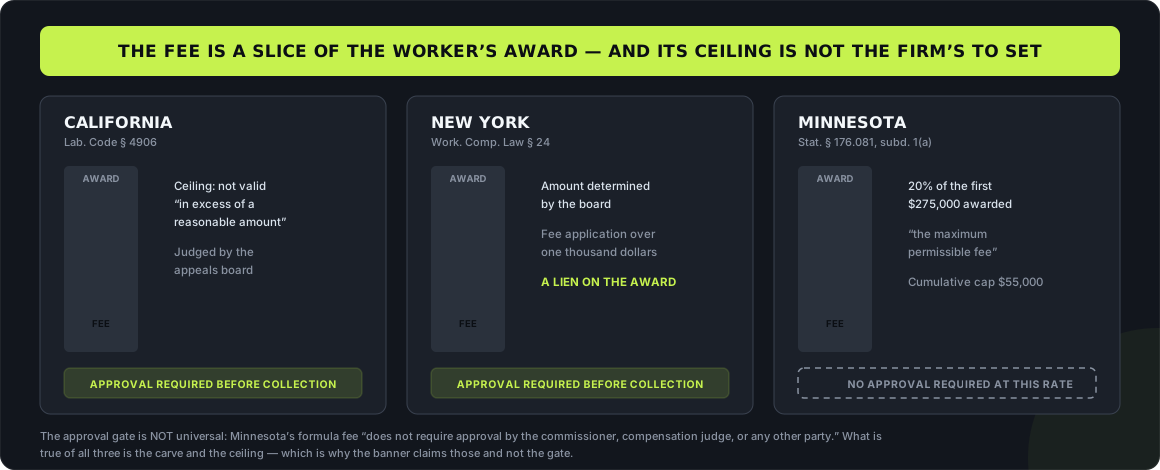
California is the clearest on the collection point. Labor Code § 4906 provides at subdivision (b) that an attorney “shall not demand or accept any fee from an employee or dependent” — and that this holds “until the amount of the fee has been approved or set by the appeals board.” Subdivision (a) tells you who decides how big it may be: a fee “is not enforceable, valid, or binding in excess of a reasonable amount,” with the appeals board the judge of that. Subdivision (c) adds a filing step: “Any fee agreement shall be submitted to the appeals board for approval within 10 days after the agreement is made.”
New York reaches the same result and then goes further. Workers’ Compensation Law § 24 provides at subdivision 2 that attorneys’ claims for services “shall not be enforceable unless approved by the board,” with a written fee application required on the board’s own form “for all legal fees in excess of one thousand dollars.” Subdivision 4 then says what an approved fee actually is: “When so approved, such claim or claims shall become a lien upon the compensation awarded.” Not a debt of the client. A lien on the award.
The same subdivision carries a provision worth reading twice, and worth reading only as far as its words go. “Any other person, firm or corporation who shall exact or receive fee or gratuity for any services rendered on behalf of a claimant except in an amount determined by the board, shall be guilty of a misdemeanor.” Whether that clause reaches a marketing vendor, and in what circumstances, is a question of New York law that this article does not attempt and that no marketing agency should be answering. Quoted at face value it establishes something narrower and still striking: when New York drafted the provision that fixes the claimant-side fee, it put a criminal sanction next to it. That is not how legislatures treat money they regard as freely divisible.
Then Minnesota, which is where the tidy version of this argument breaks and the honest version gets better. Minnesota Statutes § 176.081, subdivision 1(a), sets a fee of “20 percent of the first $275,000 of compensation awarded to the employee” and says of it that this “is the maximum permissible fee and does not require approval by the commissioner, compensation judge, or any other party.” So the approval gate that California and New York impose is simply absent in Minnesota at the formula rate. A firm reasoning from California to a national rule would get Minnesota wrong.
That is the claim this section rests on, and it is deliberately the narrow one. A comp fee is not revenue the firm generates and then allocates. It is a statutorily bounded portion of money that belongs, until it is carved, to the injured worker — which is why Minnesota describes it as withheld from “periodic compensation awarded to the employee” and New York as a lien on the award. The firm is not in a position to promise a third party a fixed dollar amount out of it, because the amount of it is not the firm’s to decide, and in two of the three states read here it is not even payable until somebody else has signed off.
Two places the wall has moved: Arizona and Utah
Because “no state permits this” is false, and the two exceptions are more instructive than the rule.
Arizona removed the rule. Effective 1 January 2021, the Arizona Supreme Court eliminated the state’s version of Rule 5.4 rather than amending it. The court’s own explanation of the change says it “unanimously adopted the elimination of Rule 5.4” and states the consequence plainly: “Lawyers will be permitted to split fees.” In its place Arizona licenses Alternative Business Structures — entities with nonlawyer owners that may deliver legal services — through the Certification and Licensing Division of the Supreme Court, under Supreme Court Rules 31, 31.1(c) and 33.1 and § 7-209 of the Arizona Code of Judicial Administration. A committee reviews applications and recommends to the court.
The public directory of licensed entities now runs to several score; the figure is genuinely hard to state precisely, because the directory page carries no “as of” date and a court announcement earlier in 2026 put approved applications at “currently around 150,” which does not reconcile with a count of the directory’s own entries. Treat it as “well over a hundred and growing” and do not quote a number.
Utah took the other approach: keep the rule, suspend it for supervised participants. The Utah Office of Legal Services Innovation administers a regulatory sandbox under the state Supreme Court’s authority. Its current status is the part that matters for a firm reading this in late 2026, and it is narrowing rather than widening: the Office’s own site states that the sandbox “is set to sunset on August 14, 2027,” that it “is closed to new applications,” and that Phase 3 was announced on 15 May 2026 “with a focus on sunsetting the Sandbox.” The alternative-business-structure portion closed at the end of 2024.
So the accurate national sentence is not that nobody may share a legal fee with a nonlawyer. It is that one state has removed the bar and licenses the arrangement, one state is winding down a supervised exception to it, and the rest retain it — and that none of that changes the comp-specific problem in the previous section, which is created by the compensation act rather than by the conduct rules. An Arizona comp firm may lawfully split a fee and still cannot promise a vendor a fixed sum out of a statutory award whose size it does not set.
What a per-case price costs you even if you could buy it
The argument a firm should find most uncomfortable is not the ethics one. It is that per-case pricing is a bad deal for exactly the firms most likely to ask for it.
Suppose the rules were not in the way. Suppose you operate in Arizona, your bar counsel has blessed the structure, and a vendor has quoted you a flat price per signed case. Should you take it?
Here is what per-case pricing does, stated as plainly as we can put it: it converts your cost per signed case from an output you can improve into an input somebody else sets.
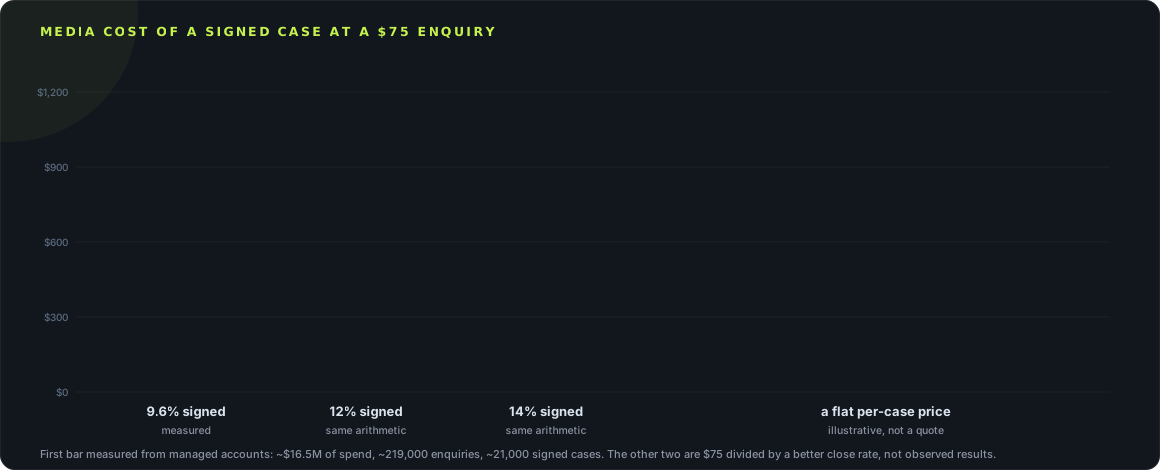
Across the comp campaigns we manage, roughly $16.5M of Meta spend has produced around 219,000 injured-worker enquiries at about $75 each, and about 21,000 signed cases. That is a lead-to-signed rate of about 9.6%, and it is why the media cost of a signed case lands where it does: $75 divided by 0.096 is about $781. The agency fee sits on top of that; the $781 is what the media alone bought.
Now improve the intake and change nothing else. At a 12% lead-to-signed rate, the same $75 enquiry produces a signed case for $625. At 14%, $536. Nothing about the advertising changed in that calculation — same creative, same audiences, same cost per enquiry. The entire gain came from the firm answering its phone faster and following up longer, and the entire gain accrued to the firm, because the price it pays is attached to enquiries and the improvement happened downstream of them.
Under a per-case price, that line is flat. A firm paying, say, $1,200 a signed case pays $1,200 whether its intake converts at 9% or 19%. Improving intake still produces more cases — it just produces them at the same unit cost, forever. The firm has sold its own operating leverage to the vendor for the comfort of a predictable unit price. For a firm whose intake is genuinely poor and is going to stay poor, that may be a trade worth making. For a firm that intends to get better at intake, it is the opposite of what it wants: the better it gets, the more of the benefit sits with the counterparty.
There is a second effect, and it is the one that should decide the question for a well-run firm. A vendor pricing per signed case is carrying conversion risk it cannot control. It does not answer your phone, it does not staff your evenings, it does not decide whether a caller who does not pick up gets six more attempts or two. So it has to price for the intake it might encounter, not the intake you happen to have — which means a per-case price pools conversion risk across every buyer who takes it.
In a pooled price, the firms with good intake subsidise the firms with bad intake. That is not a criticism of the vendor; it is what pooling does, and it is the same reason a healthy thirty-year-old pays more for community-rated insurance than their own risk warrants. If your close rate is above the average of the vendor’s book, a per-case price is a worse deal for you than an activity price, and the better your intake gets the worse it becomes. The firms best placed to demand per-case pricing — organised, well-staffed, already measuring — are precisely the firms it serves least well.
Per-case pricing pools conversion risk across the vendor’s whole book. The firms that convert above the pool’s average are the ones paying for it — and they are the firms most likely to ask for the price in the first place.
| Priced on | Payment triggered by | Varies with retention? | Carries media risk | Carries conversion risk | Your cost per signed case is |
|---|---|---|---|---|---|
| Flat monthly fee + separated media | A month of work | No | Firm | Firm | An output you can improve, and can see |
| Percentage of media spend | Dollars placed | No | Firm | Firm | An output you can improve; the fee rises with spend |
| Per click | A click | No | Vendor, partly | Firm | An output you can improve |
| Per enquiry delivered | A contact arriving | No | Vendor | Firm | An output you can improve; quality definition becomes the live issue |
| Blended, one number for media and fee | A month of work | No | Opaque | Firm | Not computable — you cannot separate media from margin |
| Per signed case | A retainer being signed | Yes | Vendor | Pooled across the vendor’s book | A contract input, flat at every close rate |
What to buy instead, and what to hold a vendor to
The thing a per-case price was meant to achieve is accountability, and accountability does not require that pricing basis.
The firm asking to pay per case is not really asking about pricing. It is asking to stop paying for activity that does not turn into cases, and it has reached for the only mechanism it can think of. There are others, and they survive both the conduct rules and the arithmetic above.
Buy on activity; be reported to on outcomes. There is no rule anywhere that constrains what a vendor must measure and show you. The payment basis and the accountability basis are separate choices, and conflating them is the error. Pay a flat fee with media separated, and require reporting in signed cases and cost per signed case, by source, by campaign and by month. That is the arrangement under which the number in this article’s fourth figure is visible to you every month without anyone having to price on it.
Attach rollback conditions to budget increases. The practical version of accountability is not a bonus; it is a pre-agreed failure condition. A recommendation to add spend should arrive with the cost per signed case at which the vendor would call it a failure and reverse it. A vendor unwilling to name that number in advance is asking for a raise rather than making a recommendation.
Keep the term short and own the accounts. The leverage a per-case price was supposed to provide is more reliably provided by the ability to leave. Ad accounts, analytics, tracking numbers, creative and the conversion history inside the platforms should be the firm’s regardless of who operates them. Our buyer’s guide to choosing a comp marketing agency covers the ownership checklist in detail, and our first-90-days piece covers what a serious handover looks like.
Measure the number yourself. Cost per signed case is not a price you can buy; it is a calculation you can run, and the inputs are all on your side of the wall. We published the model openly — the numerator, the denominator, the attribution limits and the four levers — in the cost per signed case article, and there is a calculator if you would rather type than derive. A firm that computes this monthly has everything a per-case price was supposed to give it, minus the ethics problem and minus the pooled premium.
Our own interest in this answer
We are a marketing agency that charges monthly retainers, writing about why the alternative is hard to buy. Discount accordingly.
This article reaches a conclusion that happens to favour how we are paid. Typical engagements here run $8,000–$25,000 a month, media separated, and we do not price per case. So the honest thing to say is that we have an interest in the answer, and that a reader should weigh the argument on its citations rather than on our account of it.
What we would say in our own defence is that the citations are the point. Florida’s list, New York’s conditions, New Jersey’s four words, and the three comp fee statutes are all linked below and all readable in a few minutes; none of them was written by anyone with a commercial interest in how comp firms buy marketing. The operating-leverage argument is arithmetic, and it is arithmetic a reader can rerun with their own close rate in about a minute. And the conclusion is not “hire a retainer agency.” It is narrower: pay on activity, insist on outcome reporting, and run the cost per signed case calculation yourself.
One more disclosure of a different kind. Two older pages in this library mention per-case pricing in passing and do not agree with each other — one calls it the model that “aligns best but is rare and heavily qualified,” the other says a per-signed-case performance model is “functionally fee-sharing with a nonlawyer in most states.” Neither cited a rule. This article is the sourced treatment, and where it conflicts with those passing mentions, this one is the position.
Key takeaways
-
The price may track the contact, not the client. Florida refuses “a flat charge per case accepted”; New Jersey: lawyers “may pay per lead but may not pay per client retained.”
-
Renaming it does not move it. Bonus, success fee, “qualified case” fee — the test is the event that triggers payment, not the noun on the invoice.
-
Comp adds a second obstacle. The fee is carved from the worker’s award and its ceiling is set by the act or the board, so there is no pot to promise a slice of.
-
Two states moved the rule; neither moved the statute. Arizona eliminated Rule 5.4 in 2021. Utah’s sandbox sunsets in 2027 and is closed to new entrants.
-
Per-case pricing flattens your own leverage. At a $75 enquiry, a better close rate takes a signed case from $781 to $536. A flat per-case price keeps that gain.
-
Pay on activity; be reported to on outcomes. Nothing limits what a vendor must measure and show you. Separate the two and you lose nothing a per-case price offered.
WorkersComp Marketing is a marketing agency, not a law firm, and nothing here is legal advice — least of all on a subject this close to the rules that govern lawyers rather than their vendors. Whether a particular payment arrangement is permissible for your firm is a question of your own state’s rules of professional conduct, decided on the arrangement’s actual terms, and it is a question for your bar counsel. The two ethics opinions cited here from Florida and New York are advisory and expressly non-binding even in their own states; the New Jersey opinion was issued by committees appointed by that state’s Supreme Court and is relied on here from a third-party reproduction because the official copies were not reachable. We do not interpret, and no marketing agency should interpret, the reach of New York Workers’ Compensation Law § 24(4)’s misdemeanour clause, or whether any statute or rule applies to any particular vendor relationship. The provisions cited — California Labor Code § 4906; New York Workers’ Compensation Law § 24; Minnesota Statutes § 176.081 (parts of which were held unconstitutional in Irwin v. Surdyk’s Liquor, 599 N.W.2d 132 (Minn. 1999)); and the Florida, New York and New Jersey conduct rules referenced in those opinions — were read on 10 November 2026, are amended from time to time, and the current official versions govern. Arizona’s and Utah’s programmes are described from those jurisdictions’ own published material as at the same date and both are actively changing. Nothing here is an opinion about any named vendor, and nothing here should be read as advice to adopt or refuse any pricing arrangement without counsel.
Frequently asked questions
Can my workers’ comp firm pay a marketing agency per signed case?
In most states, probably not, and there are two separate reasons. The conduct-rule reason is that a payment which varies with whether an enquiry becomes a client is widely treated as a share of the legal fee rather than a marketing cost: Florida’s Ethics Opinion 18-1 lists “a flat charge per case accepted by a participating lawyer” among generally impermissible charging methods, and New Jersey’s committees held in Opinion 741 that lawyers “may pay per lead but may not pay per client retained.” The workers’-compensation reason is independent of that and survives it: the claimant-side fee is a statutorily bounded slice of the injured worker’s own compensation, so the firm is not in a position to promise a third party a fixed sum out of it. Which of those bites first, and whether either does in your state, is a bar-counsel question — ask it before you ask a vendor for a quote.
Is paying per lead the same problem?
No, and that is the central distinction. Per-enquiry pricing is the arrangement New York’s Opinion 1131 actually approved, on facts where “the fee does not vary depending on whether the lead results in retention of the lawyer or the amount of the fee the lawyer charges the client,” and the committee characterised it as “essentially paying a marketing fee.” Florida’s list permits a fixed charge per matter that does not vary with the amount at issue. The conditions attached are real — the service must not be recommending or vouching for the lawyer, and New York required selection by “transparent and mechanical methods” rather than by any assessment of the legal problem — but the pricing basis itself is not the obstacle. Our separate objection to per-lead pricing as a primary structure is commercial rather than ethical: it rewards volume at the point where your economics reward quality.
What if the contract calls it a bonus, a success fee, or a “qualified case” fee?
New Jersey’s committees anticipated that. They instructed lawyers to “question whether the marketing company is improperly labelling its services” and set out the signals that a client rather than a contact is being sold: an advertised retention rate, a per-claimant price well above the plausible cost of generating a contact, and contract terms that read as a sale of clients. In the arrangement before them the company was quoting $700 to $1,800 per claimant and advertising an “86% retention rate” — and the committees observed that the services were “priced according to the potential for the establishment of an attorney-client relationship.” The analysis follows the trigger for payment, not the noun on the invoice.
Does this apply in Arizona?
Arizona is the one clear exception on the conduct-rule half. The Arizona Supreme Court eliminated the state’s Rule 5.4 effective 1 January 2021 — its own published explanation says the court “unanimously adopted the elimination of Rule 5.4” and that “Lawyers will be permitted to split fees” — and it licenses Alternative Business Structures with nonlawyer owners through the Supreme Court’s Certification and Licensing Division. What Arizona does not change is the comp-specific half. The fee in a compensation case is still a bounded portion of the worker’s award under whichever act governs, and an Arizona firm still cannot promise a vendor a fixed dollar amount out of a quantity it does not set. Utah’s supervised sandbox is the other exception and it is closing: authorised to 14 August 2027, closed to new applications, with Phase 3 announced in May 2026 focused on sunsetting it.
Why is this harder in workers’ comp than in personal injury?
Because the fee is not a private contract. In a PI practice the firm sets the percentage, and once the case resolves the money is the firm’s to allocate. In comp the claimant-side fee is fixed or bounded by the act and in most states cannot be collected until the amount has been approved. California Labor Code § 4906(b) says an attorney “shall not demand or accept any fee from an employee or dependent” until it “has been approved or set by the appeals board”; New York Workers’ Compensation Law § 24(2) makes attorneys’ claims unenforceable “unless approved by the board” and § 24(4) makes an approved fee “a lien upon the compensation awarded”; Minnesota Statutes § 176.081, subd. 1(a), names 20% of the first $275,000 of compensation awarded as “the maximum permissible fee,” with a cumulative cap of $55,000 on the same injury. Note the real variation: Minnesota’s formula fee “does not require approval by the commissioner, compensation judge, or any other party,” so the approval point is not nationwide. What is common across all three is that the fee is carved from the worker’s compensation and its ceiling belongs to someone other than the firm.
If we cannot buy a cost per signed case, how do we hold an agency accountable?
By separating two decisions that firms routinely treat as one: what the payment attaches to, and what the agency is reported on. Nothing in any rule constrains what a vendor measures and shows you. Pay a flat fee with media separated, and require reporting in signed cases and cost per signed case, broken out by source, campaign and month. Attach a pre-agreed rollback condition to every budget increase — the cost per signed case at which the agency would itself call the increase a failure and reverse it. Own the ad accounts, the analytics, the tracking numbers and the creative outright, so leaving is cheap. And compute cost per signed case from your own case management system monthly, from a twelve-month baseline you established before anyone quoted you a target. That delivers everything a per-case price promised, without the ethics exposure and without the pooled premium described above.
Is a per-case price ever actually the better deal?
For one kind of buyer, yes. Because a vendor pricing per signed case has to price for the intake it might encounter rather than the intake you have, a per-case price pools conversion risk across its whole book — which means firms converting above that book’s average are subsidising firms converting below it. If your intake is genuinely weak, you have no plan to invest in it, and you want a predictable unit cost, that pooling works in your favour. If your close rate is above average, or you intend to improve it, the pooling works against you and gets worse as you get better. The arithmetic is worth running on your own numbers: at a $75 enquiry, moving from a 9.6% to a 14% lead-to-signed rate takes the media cost of a signed case from about $781 to about $536, and under a flat per-case price none of that reaches you.
What about paying our own intake staff a bonus per signed case?
That is a genuinely different question and this article does not answer it. Payments to a firm’s own employees sit under a different part of the fee-sharing rule from payments to outside vendors, and the Model Rules contain an exception addressed to employee compensation and profit-sharing arrangements — but the operative text could not be verified against the American Bar Association’s own published rule in the research for this piece, and state adoptions of that provision vary. So we are not going to characterise it. Put it to bar counsel as its own question, with the actual proposed compensation plan in front of them, and do not reason across from anything in this article.
What is the smallest useful version of this for a firm deciding how to buy marketing this quarter?
Three questions to bar counsel, then one calculation. The questions: may a payment to a marketing vendor vary with whether an enquiry becomes a client in our state, and under which rule; does our comp act require approval of the claimant-side fee before collection, and is the fee capped by formula or by a reasonableness standard; and is there anything in our act addressing persons other than attorneys receiving money for services rendered on a claimant’s behalf. The calculation: pull twelve months of signed cases with the source against each one, divide all-in marketing cost by signed cases, and do it by source. That baseline is what every pricing conversation should start from, and almost no firm we have asked has it to hand.
Sources
- 01Florida Bar Ethics Opinion 18-1 (14 Dec 2018)
Lists “a flat charge per case accepted by a participating lawyer” as generally impermissible; permits a fixed charge per matter that “does not vary based on the amount at issue.” Advisory, not binding; decided case by case. floridabar.org
- 02N.Y. State Bar Ethics Opinion 1131 (7 Aug 2017)
Approved a per-enquiry fee where “the fee does not vary depending on whether the lead results in retention.” Advisory — and it conditions a permission rather than prohibiting the converse. nysba.org
- 03N.J. ACPE Opinion 741 / CAA Opinion 47 (21 Jun 2021)
Lawyers “may pay per lead but may not pay per client retained”; purported leads “may be disguised referrals.” Official New Jersey copies were unreachable, so this is Justia’s reproduction — the weakest-sourced item here. justia.com
- 04Cal. Lab. Code § 4906
No fee may be demanded or accepted “until the amount of the fee has been approved or set by the appeals board”; not valid “in excess of a reasonable amount.” Read on two publishers agreeing word for word; the official leginfo text was not read. public.law · FindLaw
- 05N.Y. Work. Comp. Law § 24
Attorneys’ claims “not enforceable unless approved by the board”; an approved fee becomes “a lien upon the compensation awarded.” Subdivision 4’s misdemeanour clause is quoted in the article and expressly not interpreted. nysenate.gov
- 06Minn. Stat. § 176.081, subd. 1
20% of the first $275,000 awarded is “the maximum permissible fee” and “does not require approval by the commissioner, compensation judge, or any other party”; $55,000 cumulative cap. Parts held unconstitutional in Irwin v. Surdyk’s Liquor, 599 N.W.2d 132 (Minn. 1999). revisor.mn.gov
- 07Arizona — Rule 5.4 eliminated, effective 1 Jan 2021
The court “unanimously adopted the elimination of Rule 5.4”; “[l]awyers will be permitted to split fees.” Alternative Business Structures are licensed by the Supreme Court. No entity count is given here: the public directory and a March 2026 announcement do not reconcile. azcourts.gov
- 08Utah Office of Legal Services Innovation
The sandbox is “set to sunset on August 14, 2027” and “closed to new applications”; Phase 3 was announced 15 May 2026. No start date is stated in this article because no source read gave one. utahinnovationoffice.org
- 09Our own figures, and what is illustrative
~$16.5M of managed comp Meta spend, ~219,000 leads at ~$75, ~21,000 signed cases — a ~9.6% lead-to-signed rate. Aggregate across firms and periods, not an industry benchmark; agency fees sit on top. The 12% and 14% cases are the same arithmetic at better conversion, and the $1,200 per-case price is illustrative, not a quote. Related: cost per signed case · choosing an agency · calculator