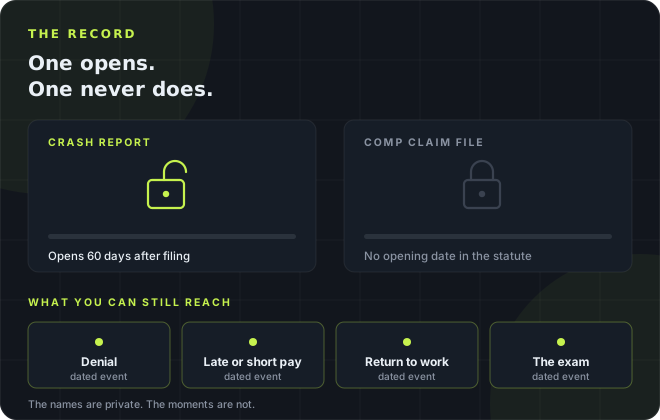
Hire a marketing director out of personal injury — which comp firms do constantly, because that is where the experienced people are — and within about a month you will be asked a question that has no good answer: where do we get the list?
It is a reasonable question. It is the right question in the market they came from. In personal injury, the list is the foundation the whole acquisition model is poured onto, and a competent PI marketer can describe the pipeline from the accident to the mailbox in one breath. They are not confused about workers’ comp. They are correctly applying a playbook whose central asset, in this category, does not exist.
What follows is not an argument that direct mail is tacky, or that it does not work, or that the bar rules forbid it. Two of those three are false and the third is beside the point. It is a narrower and more useful claim, and it is checkable in an afternoon with four statutes and no marketing expertise at all.
So the claim: the personal-injury acquisition model runs on a public record of the accident, workers’ compensation has no such record and no date on which one appears, and every product sold to comp firms as “injured worker data” is therefore either unlawfully sourced, modelled, or mislabelled. The money a mail programme would consume has one honest destination — presence at the dated moments when the worker decides to look — and those moments are knowable even though the people at them are not.
The playbook that has no comp version
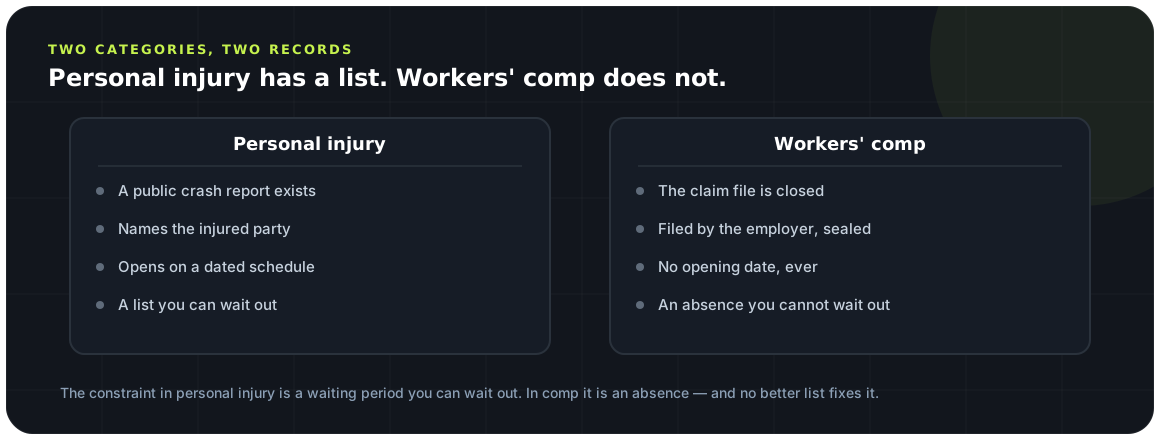
Strip the creative away and personal-injury mail is a records operation with a stamp on the end.
Describe PI direct mail honestly and it has three parts, in this order: a government record that names an injured person and says where they live, a statutory date on which that record becomes obtainable, and a letter timed to arrive as close to that date as the rules allow. The letter is the least important of the three. Anybody can write a letter. The asset is the record, and the skill is the timing.
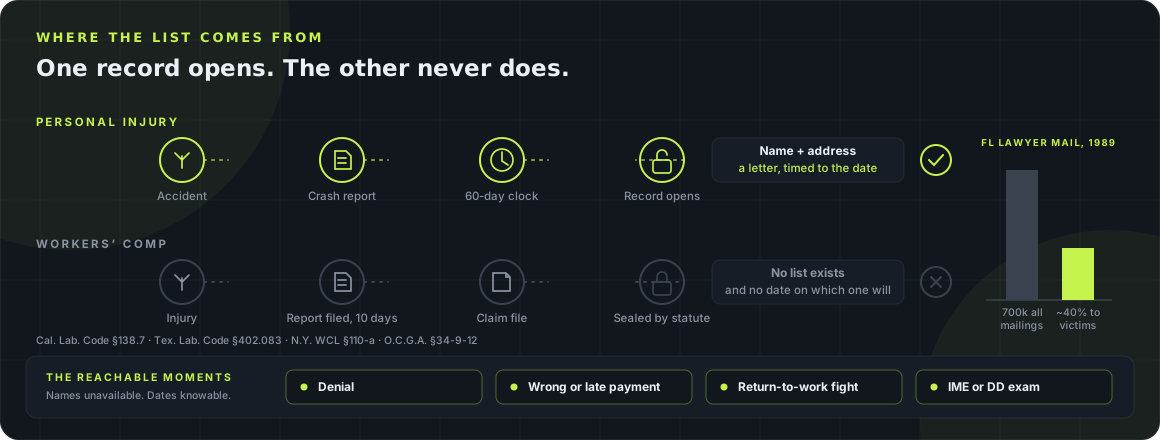
Florida is worth reading closely, because the legislature wrote the whole mechanism down in one section. Under Fla. Stat. §316.066, a crash report held by an agency is confidential and exempt for a period — but subsection (2)(b) names the people who may have it immediately, and that list includes “the parties involved in the crash, their legal representatives, their licensed insurance agents, their insurers or insurers to which they have applied for coverage”, along with law enforcement, victim-services programmes and government agencies. Subsection (2)(f) then provides that reports “may be made available 60 days after the date the report is filed”. And subsection (3)(c) makes it a third-degree felony for a person who knows they are not entitled to the confidential information to obtain it or attempt to obtain it.
Read that as a marketer rather than a lawyer and it says something very specific. There is a document. It contains a name and an address. There is a date on which it becomes available. There is a defined set of people who can get it sooner, and a criminal penalty for everyone else who tries. That is not a loophole; it is a designed system, with a clock in it. A clock is something you can build a campaign around.
The scale this produced is documented in an unlikely place — the United States Supreme Court. In Florida Bar v. Went For It, Inc., 515 U.S. 618 (1995), the Court recited the Florida Bar’s own study: as of June 1989, lawyers were mailing roughly 700,000 direct solicitations a year in Florida, and about 40% of them went to accident victims or their survivors. Nearly a quarter of a million letters a year, in one state, thirty-odd years ago, generated by reading public records. That is the machine. It is real, it is large, and it has been running for decades.
Now go looking for its comp equivalent.
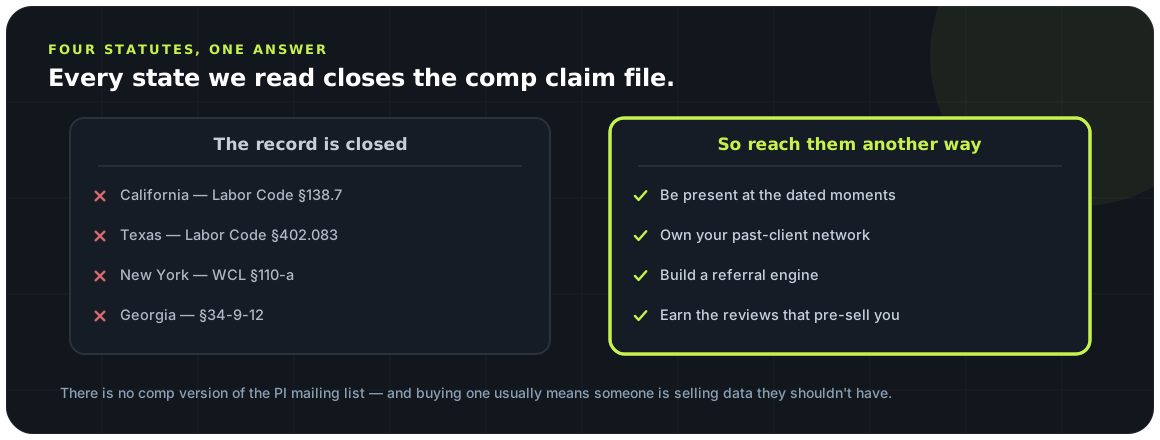
Four statutes, one answer
The report exists. Every copy of it goes to somebody on the other side of the claim.
Workers’ compensation is not short of paperwork. An injury generates an employer’s report, usually on a statutory deadline, and that report goes to the carrier and to the state. Georgia’s version is typical and blunt: under O.C.G.A. §34-9-12 an employer must keep a record of all injuries received by employees in the course of employment and file a written report with the board within ten days of notice, where the injury requires medical treatment or causes more than seven days’ absence. So there is a document, it names an injured person, and the state has it inside a fortnight.
Then the same section closes it. “The records of the board, insofar as they refer to accidents, injuries, and settlements, shall not be open to the public but only to the parties satisfying the board of their interest in such records.” One sentence, and the marketing model dies in it.
That is not a Georgia quirk. Read three more:
- California. Labor Code §138.7 permits individually identifiable information from the Division of Workers’ Compensation only to a short list — the administrative director and its statistical agent, named state departments for public-health and Medi-Cal recovery purposes, divisions carrying out their own duties, the Commission on Health and Safety and Workers’ Compensation for research, and bona fide statistical research that does not divulge identifiable information. It then closes the onward route: it is unlawful for a person who has received individually identifiable information under the section to provide it to anyone not entitled to it.
- Texas. Labor Code §402.083(a) is one sentence: “Information in or derived from a claim file regarding an employee is confidential and may not be disclosed by the division except as provided by this subtitle or other law.” Note the reach of derived from — a scrubbed extract is still the claim file.
- New York. WCL §110-a provides that except on the order or subpoena of a court of competent jurisdiction, no workers’ compensation record shall be disclosed without authorisation, and lists who may receive one: board personnel on official duties, government units investigating fraud or processing benefit applications, the claimant and their attorney or representative, the carrier and employer on the claim, judicial and administrative officers, researchers under confidentiality agreements, and certain health insurers and treating providers. Unauthorised disclosure is a class A misdemeanour, with fines up to $1,000 and civil penalties on top.
Four states, four statutory schemes, one answer. And notice the pattern in who is on those access lists. The employer knows about the injury on the day it happens. The carrier knows within days. The state knows inside the statutory deadline. Every one of them is either the opposing party on the claim or a regulator of it. The claimant’s prospective lawyer is the only interested party in the entire system who receives no notice that the event occurred.
| Record | Who may obtain it | When it opens | Penalty for improper access |
|---|---|---|---|
| Police crash report (FL, §316.066) | Immediately to parties, their legal representatives, their insurers, law enforcement, victim services, government agencies | 60 days after filing, more broadly | Third-degree felony to obtain knowing you are not entitled |
| Comp claim file (CA, §138.7) | Administrative director and statistical agent; named state departments; divisions on their own duties; research bodies; de-identified statistical research | Never — no opening date in the section | Unlawful to pass received information to anyone not entitled |
| Comp claim file (TX, §402.083) | As the subtitle or other law provides; otherwise nobody | Never; covers information “derived from” the file | Statutory confidentiality on the division |
| Comp record (NY, WCL §110-a) | Board staff, government fraud/benefit units, claimant and their representative, carrier and employer, tribunals, researchers under agreement, certain providers | Never absent authorisation or court order | Class A misdemeanour; fines to $1,000 plus civil penalties |
| Comp board record (GA, §34-9-12) | Parties who satisfy the board of their interest in the record | Never — “shall not be open to the public” | Access refused; board controls release |
One honest qualification, because the four-for-four result is suggestive rather than conclusive. There are 51 jurisdictions, each with its own act, and there are edges. Texas’s own section names one: information concerning an employee finally adjudicated of wrongfully obtaining payment is not confidential — an exception that exists to expose fraud, and one no firm should want to build a marketing list on. If your state genuinely differs, that is an unusual local advantage and worth knowing precisely. Read your act’s records provision rather than taking ours, or anyone’s, on faith. It is usually a paragraph.
The one mandated advertisement isn’t yours
The law does put a notice in front of the injured worker at the moment of injury. It advertises somebody else.
Here is the inversion that makes the whole thing sting. Comp firms cannot reach the worker at the moment of injury — but the law does require an advertisement to be in front of that worker at exactly that moment, in the break room, in prescribed type sizes, in English and Spanish. It is the notice telling them the state runs an office that will help them for free.
We have written that argument out in full elsewhere and will not repeat it here: see your biggest competitor is a free state agency on the break-room wall. The relevant point for this piece is structural rather than competitive. The statutory machinery around a workplace injury contains exactly one mandated communication to the injured worker, and the legislature gave that slot to the free advocate, not to the bar. Everything a private firm does has to be built in the space the statute left empty.
What it means when someone offers you the data
There are only three places an injured-worker list can come from, and you should be comfortable with none of them.
You will still be offered one. Comp firms get pitched injured-worker data regularly, sometimes by outfits that are otherwise perfectly respectable, and the pitch is rarely specific about sourcing. It does not need to be, because almost nobody asks. So ask, and ask in a particular way: what is the dated event in your file, and which record produced it? There are only three possible answers.
| Where it came from | What that makes it | How you can tell |
|---|---|---|
| A state claim file or first report of injury | Unlawfully sourced. Somebody in the chain breached a confidentiality statute — and in New York that is a misdemeanour. Your firm is the buyer. | Rows carry a real injury date, a claim number, an employer, or a body part. The precision is the tell. |
| A data broker’s model | Inferred health information about identifiable people. No claim file was touched; the exposure moved somewhere else entirely. | The vendor talks about signals, propensity, or audiences. There is no injury date because there is no injury record. |
| An occupational or demographic list with a label on it | Mislabelled. It is a list of people who work in industries where injuries happen. Most of them are not injured. | Ask what share of the file is currently injured. The answer is a guess or a silence. |
The second row is the one that catches sophisticated firms, because it feels cleaner. Nobody stole a claim file; a model inferred who is probably hurt. But inferred health data about identifiable people is precisely the category the advertising platforms and the newer state privacy statutes have spent two years building rules around — including rules that expressly reach inferences drawn from non-health data. We have set out what the platforms themselves say, and what the enforcement record looks like, in why Meta and Google treat your firm as a health advertiser. Buying a modelled injury list is not a way around that problem. It is the purest possible form of it, with a receipt.
The solicitation rule is not what’s stopping you
The bar rules permit the letter. It is the record that does not exist.
Firms frequently reach the right conclusion by the wrong route — deciding that mail is off the table because the ethics rules forbid it. Broadly, they do not, and getting this wrong matters, because it leads firms to discard the lists they can use along with the one they cannot.
The Supreme Court settled the shape of this in two cases. In Shapero v. Kentucky Bar Association (1988) it held that a state may not categorically ban truthful, non-deceptive targeted direct mail to people known to face a particular legal problem. Seven years later, in Florida Bar v. Went For It, Inc., it upheld — 5 to 4 — a Florida rule barring targeted direct-mail solicitation of accident victims and their relatives for 30 days after the accident. Put those together and the position is: the letter is constitutionally protected commercial speech, and the timing of it is regulable.
ABA Model Rule 7.3 reflects that. It defines solicitation as a communication initiated by a lawyer, directed to a specific person the lawyer knows needs legal services in a particular matter, offering to provide them. What it prohibits is soliciting employment by live person-to-person contact where a significant motive is the lawyer’s pecuniary gain — and it prohibits any solicitation where the recipient has said they do not want to be contacted, or where the approach involves coercion, duress or harassment. Written contact is not the prohibited mode. State rules vary, some materially, and this is a paraphrase of a model rule rather than advice about yours.
The constraint in personal injury is a waiting period. The constraint in workers’ comp is an absence. One of those you can wait out.
That distinction is the whole article in two sentences. A Florida PI firm facing the 30-day rule has a scheduling problem: the record will open, the clock will run down, and the letter will go. A comp firm has no clock to wait out, because there is no record that will ever open. Firms that came from PI experience the two as the same obstacle and go shopping for the same solution.
And now the part almost everyone misses. Model Rule 7.3’s restrictions carve out contact with other lawyers, with people who have a family, close personal, or prior business, professional or legal relationship with the lawyer, and with those who routinely use the kind of legal services being offered. The rule that closes the cold list holds the warm one open. The only injured-worker list a comp firm can lawfully hold is the one it generated itself — and that is also the only one the solicitation rules were never aimed at.
One caution on tone, which the Court itself supplies. The Went For It majority quoted the Florida Bar’s survey data: 54% of Floridians said contacting people about accidents violates privacy, 45% of recipients believed the mailings were designed to take advantage of gullible or unstable people, and 27% said their regard for the legal profession fell after receiving one. Those are 1989 Florida figures about personal-injury mail, cited in a 1995 opinion; they are directional for comp and are not a measurement of it. But they are the reason we would not recommend cold mail to strangers about their injuries even in a state that somehow made the list available.
You can’t reach the injury. You can reach the decision.
The names are private. The dates are not, and the dates are what you were actually buying.
Go back to what the PI product really is: a date attached to a name. Comp withholds the name permanently. It does not withhold the dates — because the events that turn an injured worker into somebody looking for a lawyer are structural features of the claim, and they happen on a schedule anyone can describe.
There are four of them, and they have almost nothing to do with the injury itself.
- The denial. The single highest-intent event in the category. A worker who has been told no is a worker who has just been given a reason to search. We have written this one out at length in why denied claims are your best marketing opportunity.
- The first payment that is wrong or late. Nothing converts a compliant claimant into a sceptical one faster than a benefit cheque that is smaller than the rent. This is the moment the worker stops assuming the system is working.
- The return-to-work fight. Light duty they cannot physically do, a release they disagree with, a job that is not there when they arrive. This is where a claim stops being administrative and starts being adversarial.
- The examination. An independent or designated-doctor exam whose result the worker does not understand and did not choose. The control of medical treatment is statutory, and the statute publishes the dates on which control shifts — which is the argument in whose doctor is it?
| Moment | Who holds the date | Can you get the list? | Can you be there when they look? |
|---|---|---|---|
| Claim denied | Carrier, employer, state file | No — confidential in all four statutes above | Yes. Denial-shaped search is specific, high-intent and cheap relative to generic injury terms. |
| Benefit payment wrong or late | Carrier | No — never in a public record at all | Yes. The worker searches the amount, the delay, or the rule. |
| Return-to-work dispute | Employer, treating physician | No | Yes, and this one is badly under-served in most markets. |
| IME or designated-doctor exam | Carrier, state | No | Yes. The exam is scheduled in advance, so the search happens before and after it. |
That table is the reason we think the mail question is worth this much space. It is not that comp firms have fewer options than PI firms. It is that the option they keep reaching for is the one thing the category does not sell, while four reachable moments sit there unbought, because none of them can be turned into a spreadsheet you receive by email.
There is a lead-quality consequence worth stating plainly, because it cuts the other way from most channel arguments. A list-sourced enquiry, if one existed, would reach people at the moment of injury — before the claim has gone wrong, when a large share of them will never need a lawyer at all. The four moments above select for people whose claim has already gone wrong. That is a structurally better filter than any targeting parameter, and it arrives for free with the constraint.
The diagram below sets the two paths beside each other, because the difference is easier to see than to describe. Both begin with an injured person and a government document, and both documents name them. Follow each one to its end and only the left-hand path ever produces something a marketer can buy — which is why everything useful on the right-hand side lives in the track along the bottom.
The two lists you can legally own
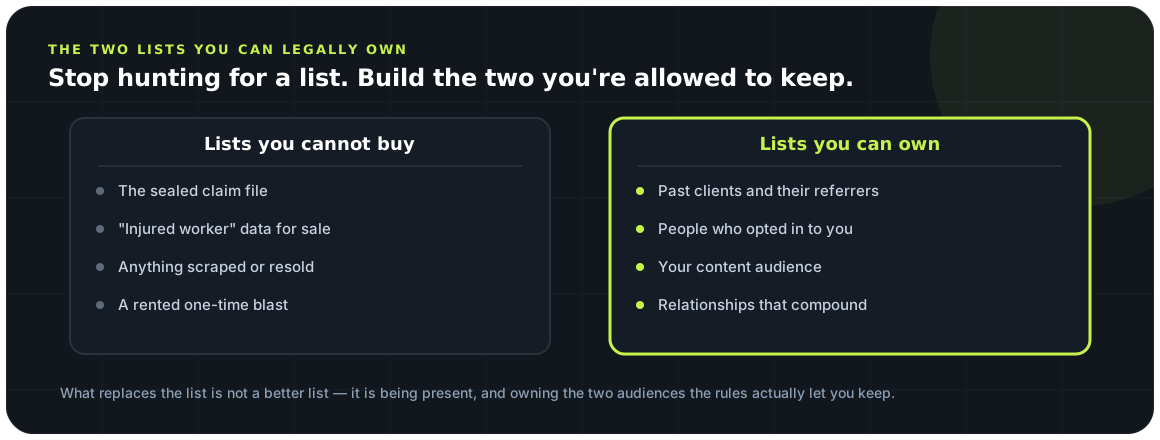
You cannot buy an injured-worker list. You can manufacture two of them, and most firms are throwing both away.
If the cold list is unavailable, the warm ones are not — and they are the lists the solicitation rules were never aimed at. There are exactly two, plus a third asset that is not a list at all.
One: past clients and the households around them. Every closed file is a person who has been through the system, knows what a denial feels like, and is related to or works alongside other people in injury-generating jobs. This is the list Model Rule 7.3 carves out by name, and it is the one comp firms neglect most reliably, because a comp case ends with a recovery and a handshake and then nothing for years. Mail works here in a way it cannot work cold, for the ordinary reason that the recipient knows who you are.
Two: the enquiries you did not sign. Every firm turns away far more people than it signs, and the volume is not marginal — at a lead cost around $75 and a signed-case cost around $775, most of what a comp firm buys is enquiries that did not become cases. Some of those were never a case. Some were somebody else’s case. And a meaningful share were not yet a case, because the channel reached them before the denial that would have made them a client. That third group is a list, it is yours, it is lawfully held, and it is usually deleted. We have set the whole decline architecture out in what a declined workers’ comp enquiry is worth; the part that matters here is that the consent has to be captured at the decline, in the moment, or the list does not exist later.
Three, and not a list: the page that is there on Tuesday night. This is where the mail budget goes. Not as a rhetorical substitution — as the same money aimed at the point in the sequence where the person is actually deciding. Presence on denial-shaped and payment-shaped questions, a page that answers the question rather than describing the firm, and intake that picks up when the answer prompts a call. If the phone is not answered, none of the above matters; that is a separate argument, made in full across the Growth Library’s intake material.
The last thing to say is about who this argument is really for. A firm that has never considered direct mail loses nothing by reading it. A firm that has just hired a talented marketer out of personal injury gains something specific: a way to have the conversation in the first month rather than the sixth, without the new hire concluding that comp is simply a worse market. It is not a worse market. It is a market whose central record is sealed, which changes where the money goes and changes nothing about how much of it there is.
Key takeaways
-
Personal-injury direct mail has no comp version. PI mail runs on the public crash report; comp has no equivalent public record of the injured.
-
Four statutes close the claim file. State laws keep workers’-comp injury records confidential, and none of them ever opens the list.
-
If a vendor offers you the data, something is wrong. No one can legally sell a list of injured workers; the offer itself is the red flag.
-
Solicitation rules are not what is stopping you, the data is. The bar’s mail rules permit compliant letters; you just have no one to mail.
-
You cannot reach the injury, but you can reach the decision. Two legally ownable lists, built around dated public moments, are what direct mail can actually target.
WorkersComp Marketing is a marketing agency, not a law firm. Nothing here is legal advice, and nothing here is advice about your professional-conduct obligations. Records statutes and solicitation rules are state law and they differ; read your own act and your own bar’s rule, or ask your ethics counsel, before you mail anything to anyone.
Frequently asked questions
Is buying a list of injured workers actually illegal, or just a bad idea?
That depends entirely on where the list came from, which is exactly why the provenance question is the one to ask first. If the names were taken from a state comp claim file, somebody broke a statute to get them: New York makes unauthorised disclosure of a workers’ compensation record a class A misdemeanour, California’s Labor Code section 138.7 makes it unlawful for a recipient of individually identifiable information to pass it on to anyone not entitled to it, and Texas declares information in or derived from a claim file confidential outright. If instead the names were modelled — inferred from occupation, geography, search behaviour or purchase data — then nobody touched a claim file, and what you have bought is inferred health information, which is its own exposure. We are a marketing agency and this is not legal advice; the practical point is narrower and holds either way. A vendor who cannot name the dated record behind each row is selling you a guess with an injury label on the outside.
Doesn’t every state publish workers’ compensation decisions? Isn’t that a list?
Many do, and it is the closest thing in the category to a public record of injured workers — but look at when it appears. A decision, an award, a hearing calendar or an appeals-panel opinion exists because a dispute reached a tribunal, and by that point the worker is almost always already represented. The public record in comp is generated downstream of the decision you wanted to influence. It is genuinely useful for other things: reading what the disputes in your venue are actually about, seeing which firms appear in them, understanding how your state’s judges write. It is not an acquisition list, because the names on it have already chosen.
Personal-injury firms mail constantly. Why can’t we just do the comp version?
Because the comp version has no substrate. The PI letter is not really a letter; it is a record plus a date. Florida’s crash-report statute is explicit about both: reports go immediately to the parties involved, their legal representatives and their insurers, and then open more broadly 60 days after filing. A marketer can plan against that. The comp equivalent — the employer’s report of injury and the claim file it feeds — is closed on day one and carries no opening date at all. The constraint in PI is a waiting period, which you can wait out. The constraint in comp is an absence, which you cannot. Firms that hire out of PI tend to treat the two as the same problem and go looking for the same vendor.
So is direct mail simply off the table for a workers’ comp firm?
No — cold prospecting by mail to strangers who may or may not be injured is off the table, which is not the same thing. Mail to lists you generated yourself remains available and is often underused: past clients and their households, referral sources, and enquiries you declined or could not sign, where you captured consent at the time. Model Rule 7.3 is instructive here, because its restrictions on solicitation carve out people with a prior professional or legal relationship with the lawyer. The rule that closes the cold list holds the warm one open. Check your own state’s version, which may differ, and check your consent record before you mail anything.
What should we do with the budget a mail programme would have consumed?
Put it where the decision happens. The moments when an injured worker starts looking for a lawyer are dated events on their claim — a denial, a benefit payment that is wrong or late, a fight about light duty, an examination whose result they do not understand — and you cannot buy the list of people at those moments, but you can reliably be present when they search. In practice that is search presence on denial-shaped and payment-shaped questions, a page that answers the question rather than describing the firm, and intake that answers the phone when the answer prompts a call. That is not a rhetorical substitution. It is the same money aimed at the point in the sequence where the person is actually deciding.
Our state might be an exception. How do we check?
Read two things. First, your comp act’s records or confidentiality provision — it is usually short, usually in the administrative chapter, and it will tell you plainly who may inspect a claim file. Georgia’s is a single sentence: board records on accidents, injuries and settlements are not open to the public but only to parties who satisfy the board of their interest. Second, your state bar’s solicitation rule and any written-contact waiting period, because the two questions get conflated constantly and they are separate. We have looked at four states and found the same answer four times, which is evidence about the default rather than proof about all 51 jurisdictions. If yours is genuinely different, that is a real and unusual local advantage, and it is worth knowing precisely rather than assuming in either direction.
Is there a number for what legal direct mail actually returns?
Not one we are willing to print. The response-rate figures circulating for legal direct mail come overwhelmingly from companies that sell direct mail, the methodology is rarely stated, and the ranges are wide enough to support any conclusion you arrive with. We are not going to launder a vendor’s number into a benchmark. If you already run mail to a list you own, you have something better than a benchmark: your own cost per signed case from that channel, measured over a window long enough to let cases land. Compare that with your other channels and the question answers itself locally.
Sources & further reading
-
01
The statutes that close the claim file
State laws making workers’-comp injury records confidential, with a crash-report statute for contrast.
-
02
What the bar rules permit
The Supreme Court decision on targeted direct-mail solicitation and its limits.
-
03
Further reading
The reachable moments comp mail can target.
Statutes, caps and rules vary by state and change over time — confirm the current rule in your state with counsel. General marketing information, not legal advice.