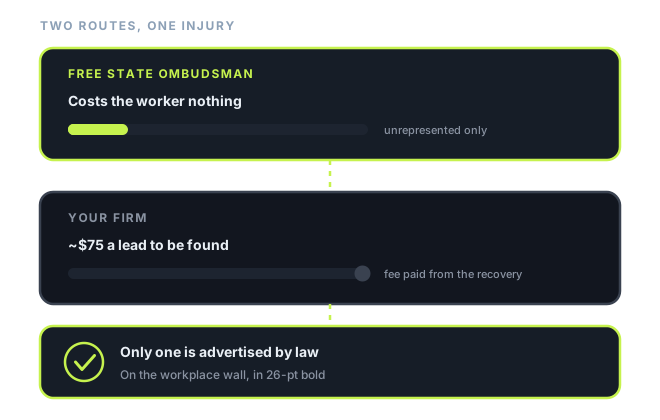
There is a document in your prospect’s workplace, on a wall they walk past most days, that names a free alternative to your firm and prints a toll-free number for it in type large enough to read from across the room. It is there because the law requires it. Your competitors did not put it there and cannot take it down, and neither can you.
In Texas the relevant rule is unusually precise about it. Division rule 110.101(e)(1) prescribes the exact words of the employee notice, requires it in English, Spanish and any other language common to the employer’s workforce, sets a minimum type size of 26-point bold for the title and 16-point for the body, and requires the notice to be “located about the workplace in such a way that each employee is likely to see” it on a regular basis. Failure to post it is a violation of the Act subject to administrative penalties. The text itself, on Notice 6, tells the worker that the Division provides free information, and that the Office of Injured Employee Counsel “also provides free assistance to injured employees and will explain your rights and responsibilities”, with the number.
It does not mention your firm. It does not mention any firm.
This article makes one claim: in workers’ compensation the default alternative to hiring your firm is not a different firm — it is a free, state-funded advocate the law obliges employers to advertise, and because no firm competes with it directly, the entire category spends its budget answering “why us” while the injured worker is still on “why anyone”.
The competitor with no ad account
It does not bid, does not retarget and does not appear in any archive you read. It is still taking share.
When a managing partner lists competitors, the list is other firms. That list is produced by the tools the firm uses to look: the Meta Ad Library, the map pack, a keyword report, the four billboards on the interstate. Every one of those instruments can only show you things that buy advertising. An organisation that takes share without buying advertising is invisible to all of them simultaneously, which is a poor reason to conclude it is not there.
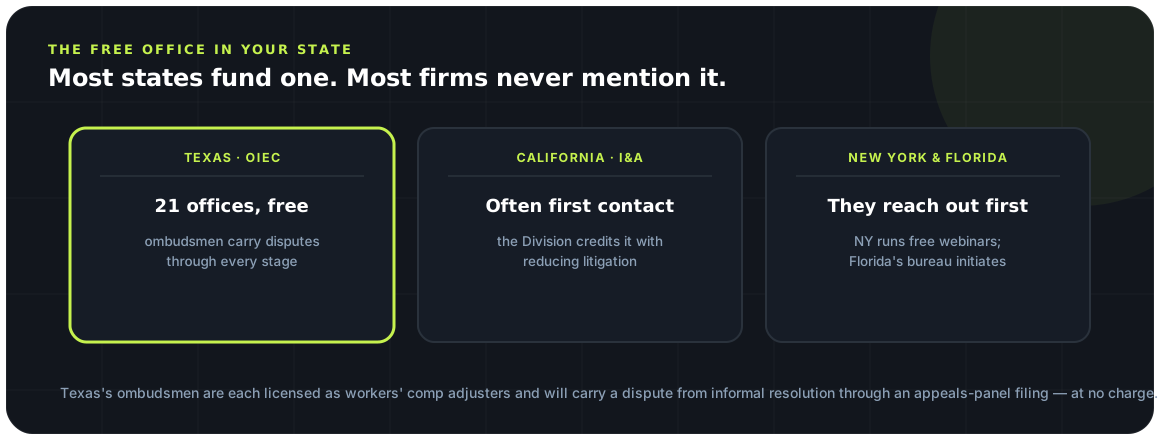
The offices vary in name and power, and the variation matters more than the similarity. Texas built a whole separate agency for it. Under Texas Labor Code chapter 404, the Office of Injured Employee Counsel exists to “assist, educate, and advocate on behalf of the injured employees of Texas”, deliberately structured apart from the Division that regulates the system. Its ombudsmen hold workers’ comp adjuster licences and are trained to take a dispute through informal resolution, preparation for a designated doctor examination, a benefit review conference, a contested case hearing and an appeals-panel filing. There is a dedicated unit for first responders. All of it is free.
California went a different way and embedded the function inside the Division of Workers’ Compensation. The Information and Assistance Unit staffs more than thirty district offices, runs free workshops for injured workers, and answers a single statewide number. The Division’s own description of the unit is the most revealing sentence any state has published on this subject: it says the unit plays a major role in reducing litigation before the Appeals Board, and is often the first contact an injured worker has with the Division. Read that from a firm’s side of the table. The unit’s stated purpose includes producing fewer contested cases, and it gets to the worker first.
Florida’s Bureau of Employee Assistance and Ombudsman, created by section 440.191 of the statute, is the most aggressive of the four in marketing terms, because it does outbound. Among its published core functions: it “initiates contacts with injured workers to discuss their rights and responsibilities and advise them of services available”, and it reviews claims in which benefits have been denied, stopped or suspended. A denied claim is the single highest-intent moment in this entire market — it is the moment we have argued elsewhere is the real trigger for hiring a lawyer — and in Florida a state office is contacting that worker as a matter of routine, with a toll-free number, before any firm’s retargeting has recognised anything happened.
New York’s Advocate for Injured Workers sits closer to education: free monthly “Workers’ Comp 101” and “202” webinars, licensed social workers at no cost, free language assistance. That is a content programme with a state seal on it, published against exactly the queries a firm’s blog is trying to rank for.
| State | Office | Statutory basis | What it will actually do | Who it is for |
|---|---|---|---|---|
| Texas | Office of Injured Employee Counsel (OIEC), a standalone agency | Labor Code ch. 404 | Ombudsman assistance through informal resolution, designated doctor prep, benefit review conference, contested case hearing and appeals panel | Unrepresented injured employees and beneficiaries |
| California | Information & Assistance Unit, inside the DWC | Part of the Division | Information, forms, dispute help, free workshops; described by the Division as reducing litigation before the WCAB | Injured workers, primarily those without attorneys |
| Florida | Bureau of Employee Assistance and Ombudsman (EAO) | Fla. Stat. §440.191 | Investigates disputes, reviews denied/stopped/suspended claims, initiates contact with injured workers, reemployment services | Injured workers and other system participants |
| New York | Advocate for Injured Workers, at the WCB | Board programme | Free monthly Workers’ Comp 101 and 202 webinars, complaint resolution, licensed social workers, free language assistance | Any injured worker |
The one placement you cannot buy
A mandatory workplace notice reaches the injured worker before the injury, in their own language, with a phone number on it.
Marketers spend a great deal of money trying to be familiar before the moment of need. That is the whole argument for broadcast, for out-of-home, for organic social. The state does it for free and by statute, and it does it better than any of them, because the placement is inside the building where the injury will happen.
California’s version is worth reading closely, because it does something no firm would ever do voluntarily. The mandatory DWC 7 notice devotes a numbered item to attorneys: a worker “may consult a licensed attorney” and, immediately, “In most instances, attorney’s fees will be paid from your recovery.” Two sentences later the same poster offers free information from an Information and Assistance Officer, gives the toll-free number and the website, and points to a free guidebook. The English and Spanish versions sit on the same sheet.
So the state has already written the comparison your page is avoiding, and it is not a flattering draft. Option A costs money out of the worker’s own recovery. Option B is free, has a phone number, and is printed by the government. If the injured worker’s first structured exposure to the choice is that poster, then the frame in which they arrive at your website is already set, and your headline about fighting for maximum compensation is answering a question they have not reached yet.
The state is not competing with you. It is doing something more inconvenient: it is explaining the choice to your prospect before you get to.
Spencer Moeller, WorkersComp MarketingThe bilingual point compounds it. We have argued at length that the Spanish-speaking injured-worker market is the most underserved audience in this category, and it is. But the free office is not underserving it. Texas requires the notice in Spanish and in any other language common to the workforce. California prints both languages on one sheet. New York’s Advocate publishes a free language-assistance line. In the segment where firms are weakest, the free alternative is at its strongest — which means the bilingual opportunity is real but the competitive assumption behind it is wrong. You are not arriving in an empty room. You are arriving second.
Why it is a fork, not a supplement
In Texas the free advocate is defined by the absence of a lawyer. That converts a nice-to-have into a decision.
If the state office were simply an extra resource, none of this would matter much to a firm — a worker could take the free information and hire you anyway, and many would. The Texas design forecloses that. OIEC’s published description of the ombudsman programme is explicit: ombudsmen “assist unrepresented injured employees and beneficiaries at no cost”. Representation is the condition that ends the service. California’s framing is softer but points the same way: the Division describes the Information and Assistance Unit as helping an unrepresented injured worker resolve disputes, and its primary duty as helping workers who do not have attorneys navigate the system.
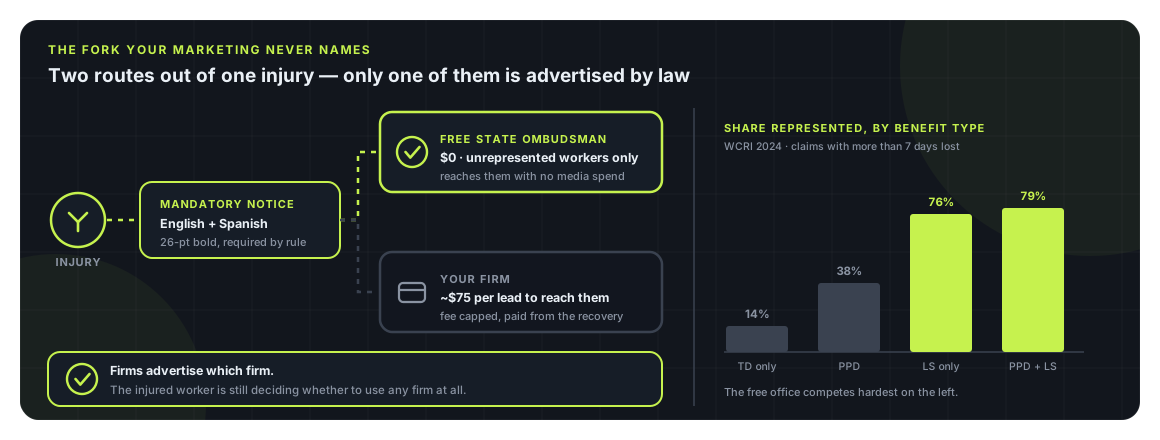
Set that beside what hiring a lawyer costs the same worker in the same state. Under Texas Labor Code §408.221, a claimant’s attorney fee must be approved by the commissioner or a court, is computed from the attorney’s time and expenses on written evidence, may not exceed 25% of the claimant’s recovery, and is paid from that recovery. The Division’s attorney-fee rule, 28 TAC §152.4, sets a maximum hourly rate on top of that. We have written before about how a capped, judge-approved fee removes price as a competitive variable between firms. The free ombudsman removes it in the other direction, by making the comparison not “which firm’s percentage” but “a percentage of my money, or nothing”.
Stated plainly: keep a free, licensed, state-employed advocate who will attend the hearing with you, or give that up and pay a portion of your recovery to a private one. A firm whose advertising never acknowledges the first option is asking the worker to abandon something it has never named. That is an unanswered objection, and unanswered objections are the most expensive thing in any funnel, because they get settled silently and off your property.
The diagram below sets out the fork, where each route is advertised, and the narrow strip in the middle where firms actually compete with one another.
What the representation data actually shows
Roughly two-thirds of lost-time claimants never hire anyone — and the share swings by a factor of four across states.
The best public measurement of the addressable market is the rate at which injured workers retain counsel at all. The Workers Compensation Research Institute’s 2024 study by Bogdan Savych and David Neumark, covering workers injured between October 2012 and September 2019 across 31 states with experience through March 2022, found that 34% of workers absent more than seven days had an attorney at some point in the claim. The study analysed more than 950,000 such claims and estimated that attorney involvement raised indemnity payments by between $7,700 and $12,400 — with the authors themselves cautioning that further work is needed before that is read as a settled causal effect.
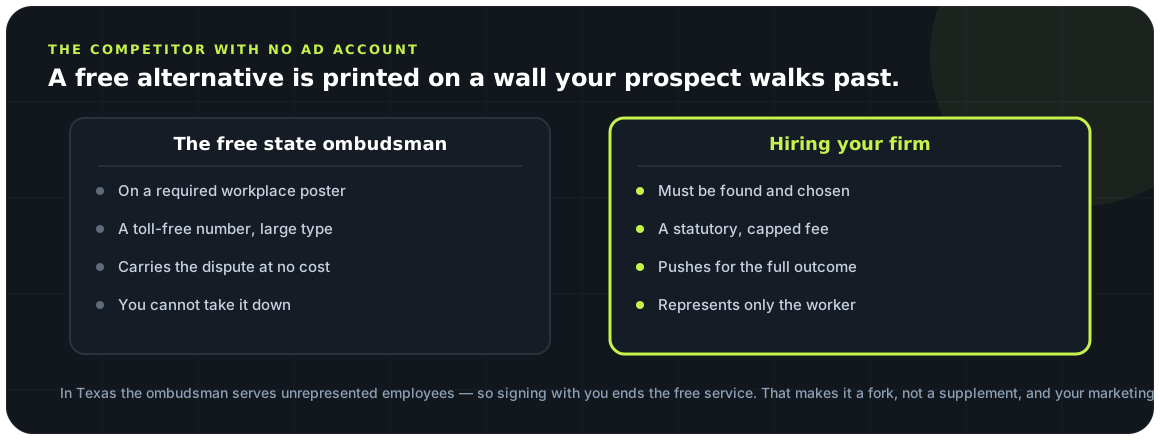
Two things follow, and they point in opposite directions. The unserved majority is enormous — about two-thirds of workers who lost more than a week never retained anyone, a pool far larger than the one every firm in the country is fighting over. But that pool is not uniform, and its shape is extremely informative: attorney involvement tracks the kind of benefit at stake almost exactly.
| Claim type | Share of sample | Represented | Average indemnity |
|---|---|---|---|
| Temporary disability payments | 61% | 14% | $6,918 (median $2,198) |
| Permanent partial disability / lump sum, combined | 39% | 64% | $39,150 (median $22,653) |
| — PPD only | — | 38% | $22,292 |
| — PPD and lump sum | — | 79% | $55,001 |
| — Lump sum only | — | 76% | $45,583 |
Fourteen per cent against seventy-nine per cent is not a marketing gap. It is a description of when a lawyer is genuinely load-bearing. Where the claim is a wage-replacement claim that is being paid, the overwhelming majority of workers handle it themselves — and at a $2,198 median, the arithmetic of a contingency fee explains most of why. Where there is a permanent rating or a settlement, representation becomes the norm. The free office is at its most competitive in the first row and least competitive in the last.
That is the case-mix argument arriving from a new direction. We have argued that which cases a firm markets for is a decision most firms inherited by accident from whichever segment their advertising was cheapest against. This table says the free alternative is a second, invisible filter on the same decision: media that reaches early, accepted, wage-replacement claims is buying an audience that mostly does not need you and has a free place to go.
The state-level spread is the part worth sitting with. An earlier WCRI flash report measured worker-attorney involvement across 18 states on 2013 claims with more than seven days of lost time, experience through March 2016. It ranged from 13–14% in Wisconsin and Texas to 49–52% in New Jersey and Illinois, with the 18-state median near 30%. WCRI attributed at least part of the variation to system features rather than to worker behaviour.
Texas sits at the bottom of that range, and Texas is the state that built an entire separate agency to advocate for unrepresented workers. We are not going to pretend that is proof. Texas differs from Illinois in half a dozen other ways that plausibly bear on representation — it is the one state where an employer can decline to subscribe to the system at all, its claimant fees are hourly, capped and judge-approved, and its dispute process is front-loaded with informal steps. OIEC is one feature among several, and the flash report is a decade old now; we could not find a more recent public state-by-state breakdown, so treat the ordering as directional and the levels as historical.
What the spread does establish, and what no firm should ignore, is that the propensity to hire anyone at all is a property of the state, not of your advertising. A four-fold difference in the addressable share is larger than any difference creative will ever produce. A firm operating at the bottom of that range is not running a worse version of a New Jersey firm’s campaign. It is running in a market whose default answer is no.
What a free alternative does to your cost per signed case
It moves the denominator, not the media price — which is why the number looks like a media problem and is not one.
We publish our own cost model openly: across roughly $16.5M of managed workers’ comp Meta spend, about 219,000 injured-worker leads at roughly $75 each produced about 21,000 signed cases at roughly $775 per signed case. The method for computing that number is arithmetic, and one of its properties is frequently missed. Cost per signed case is all-in marketing cost divided by signed cases. The media market sets the numerator. The denominator is set by how many of the people you reach will hire a lawyer at all.
Two firms can buy identical leads at an identical $75 and land in different places for reasons that have nothing to do with their intake, their creative, or their agency — because the share of their audience for whom “handle it myself with the free office” is a satisfactory answer is different. That share is a function of state system design, claim stage and case segment. It is stable, structural and invisible on any dashboard.
| Scenario | Cost per lead | Share who will hire any lawyer | Of those, share who choose you | Cost per signed case |
|---|---|---|---|---|
| High-representation state, denial-stage traffic | $75 | 60% | 25% | $500 |
| Blended, mixed claim stages | $75 | 35% | 28% | $765 |
| Low-representation state, early-claim traffic | $75 | 18% | 30% | $1,389 |
The middle row lands close to the $775 we actually observe, which is coincidence rather than validation — the point of the table is the columns, not the rows. Note what happens across them: the firm in the bottom row is winning a larger share of the people who decide to hire someone and still paying nearly three times as much per case. If you only ever look at cost per lead and cost per signed case, that firm looks like it has a media problem, and every available lever — new creative, a new agency, a bigger budget — is aimed at the wrong column.
The page almost no comp firm has
“Do I even need a lawyer for this?” is the highest-intent question in the category, and the standard answer is disbelieved on sight.
Type that question into any search engine and count the firm pages whose answer is, in substance, yes. It is close to all of them, and the reader knows why before they finish the first paragraph. A page that says yes to everyone is not information; it is an advertisement wearing an article’s clothes, and readers have been trained to detect that. Meanwhile the state agency page that says “here is free help, and here is when you might want a lawyer” is credible precisely because the author gains nothing from the answer.
This is now a ranking problem as well as a conversion one. We have argued that the contest has shifted from ranking to being quoted: assistants and answer engines compress ten results into one response with citations, and they reward pages that read as reference material rather than as persuasion. A page that gives a conditional answer, names the free option accurately and cites the agency is a page an answer engine can safely quote. A page that says everyone needs a lawyer is not quotable about anything except itself.
The page to build is a triage page, and its structure is the honest structure of the decision.
| Situation | The honest answer | What the page does |
|---|---|---|
| Claim accepted, benefits arriving on time, straightforward recovery under way | The free state office is very likely enough. Here is its name and number. | Gives the number. Explains what the office will and will not do. Invites the reader back if anything changes. |
| Claim denied, benefits stopped or suspended, rating disputed, a lump sum on the table, a return-to-work fight, a fatality | This is the situation where representation changes outcomes, and here is specifically why. | Explains the mechanism rather than asserting aggression. Offers the consultation. |
| Not yet clear — injury recent, nothing decided, worker unsure what stage they are at | Nothing needs deciding today. Here is what to watch for, and here are both numbers. | Captures consent for follow-up. Feeds the nurture sequence. Wins the case later. |
Three observations about that table, all of which firms resist.
The first row gives away a caller. It does, and the caller it gives away is one you were going to lose anyway, several phone calls later, after paying for the lead. At our book’s economics roughly nine in ten enquiries never sign, which means about $700 of every $775 signed case is already being spent on people who do not become clients. We have made the case that the decline desk is the largest unmanaged line in a firm’s acquisition budget. Declining faster, in writing, with something useful attached, is not a loss. It is the same loss with better margins and a better reputation.
The second row is the only one that pays, so it is where the writing has to be genuinely good. Explaining why a denied claim or a disputed impairment rating behaves differently — what happens at each step, what a represented worker gets that an unrepresented one does not — is the substance of the page. A firm that can explain the mechanism is credible; a firm that can only assert its own aggression is interchangeable with the four others asserting theirs, which is the commoditisation problem in its natural habitat.
The third row is the one firms skip entirely, and it is the one the free office cannot serve. A state ombudsman does not run a nurture sequence. It does not call back in six weeks when the denial letter arrives. Its service is reactive by design and generally limited to the dispute in front of it. A firm that captures that worker with consent and a genuinely useful follow-up — not a drip of promotional emails, but a short sequence about what happens next in a claim — owns the relationship at the exact moment the category question resolves itself in your favour. That is the structural advantage a private firm has over a state office, and almost nobody uses it.
The build: four changes, one afternoon
None of this requires a new campaign. It requires naming a competitor you have been pretending does not exist.
1. Read your own state’s free office and its notice. Find the agency page and the mandatory employee notice, and copy the exact wording into a document. You now have the two pieces of competitor copy that reach more of your prospects than any ad you have ever run. Note specifically whether your state restricts the service to unrepresented workers, because that single fact determines whether you are writing a comparison or a coexistence.
2. Write the triage page. One page, the three rows above, the state office named with its real phone number, and the mechanism explained for the cases where representation matters. Link it from your main comp page and from your denial content. Expect it to convert at a lower rate and a higher quality than your existing practice-area page, and measure it that way — signed cases per hundred visitors, not form fills.
3. Add one value to your decline-code list. “Referred to state office / self-handling”, recorded as a coded field rather than free text, on every enquiry that ends that way. Read it monthly by lead source. Within a quarter you will know whether particular channels are systematically buying workers whose claims are being paid on time — which is a media targeting fix, not an intake one, and is otherwise undetectable.
4. Give intake one question and one script. The question is about claim status rather than injury severity: has anything been denied, stopped or reduced? The script is what to say when the answer is no — a short, warm handoff to the state office, with the number, and an offer to be called back if anything changes. That call ends in about ninety seconds instead of nine minutes, which is worth something on its own, and it ends with a person who has a reason to think well of your firm.
Key takeaways
-
Your biggest competitor has no ad account. In most states a free, government-funded advocate helps injured workers, and the law often requires employers to post it in the workplace, in English and Spanish.
-
It is the one placement you cannot buy. The workplace notice naming the free advocate reaches every injured worker before you do; you cannot outbid a mandated poster.
-
It is a fork, not a supplement. In Texas the free advocate is only available to workers who do not hire a lawyer, so every worker it keeps is a case you never see.
-
It changes your cost per signed case. A free alternative quietly raises what you pay per signed case; it has to be priced into the model, not ignored.
-
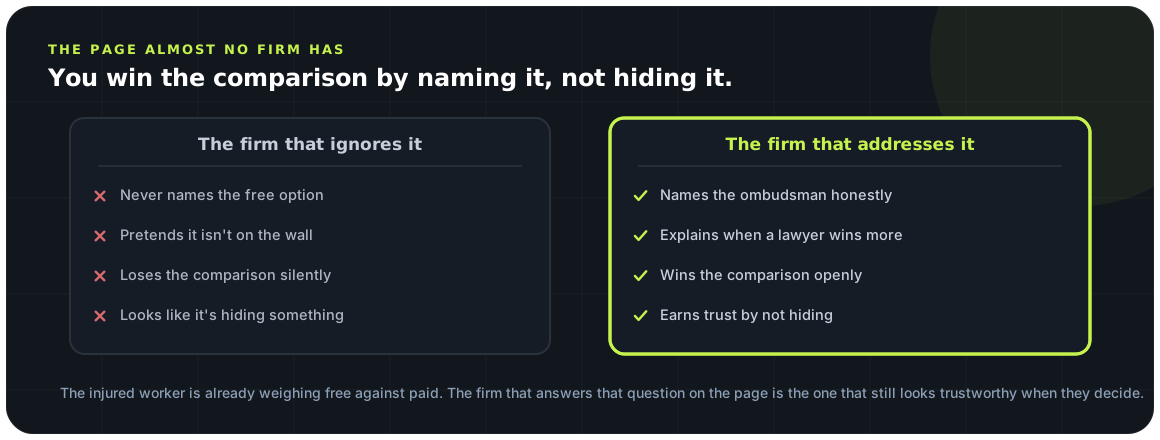
Answer the question the advocate cannot. The page almost no firm has is the one that explains honestly when a worker is better off with counsel than with the free program.
Frequently asked questions
Is it really true that hiring a lawyer costs an injured worker the free state help?
In Texas, yes, and the agency says so in plain language: OIEC’s ombudsmen assist unrepresented injured employees. Representation is the condition that ends the service. California’s Information and Assistance Unit is likewise aimed at workers without attorneys — the Division’s own FAQ frames it as assisting an unrepresented injured worker in resolving disputes. Other states are looser: New York’s Advocate for Injured Workers runs free public webinars anyone can attend, and Florida’s Bureau of Employee Assistance and Ombudsman reviews claims that have been denied, stopped or suspended. The practical point holds everywhere: the worker is choosing between two routes, not adding one to the other, and your marketing has never acknowledged that a second route exists.
Doesn’t this argument just talk our prospects out of hiring us?
It talks some of them out of it, and those are the ones who were going to cost you money. Roughly nine in ten enquiries do not sign, and at our book’s economics that means about $700 of every signed case is spent on people who did not. A page that names the free option and explains precisely when it is sufficient does two things at once: it loses you a caller who would have declined anyway three phone calls later, and it earns the trust of the caller who now understands why their situation is the other kind. The firms that lose from this are the ones whose answer to “do I need a lawyer” is “yes” regardless of the facts. That answer is already being disbelieved — it is just being disbelieved silently.
Which cases genuinely need an attorney rather than the state office?
We are a marketing agency and not a law firm, so treat this as the pattern in the published data rather than as advice. WCRI’s 2024 analysis shows attorney involvement tracking the shape of the benefit almost exactly: 14% on claims with temporary disability payments only, 38% where permanent partial disability is involved, 79% where there is both PPD and a lump sum, and 76% on lump-sum-only claims. In other words, representation clusters where a permanent rating or a settlement is in play and the dispute is about the value of a body, not the processing of a form. A denied claim, a disputed rating, a lump-sum offer, a claim where light duty has become a dispute about earnings, a fatality claim, and a claim with a possible third-party defendant are the situations where the fork matters. A claim that is accepted, paid on time and heading for a clean return to work is the situation where the state office is a real answer.
How would we even measure whether the free option is costing us cases?
Add one value to your decline-code list — “referred to state office / self-handling” — and read it monthly by lead source. That single code turns an invisible outcome into a line item, and it will tell you two things within a quarter. First, how much of your paid traffic is arriving at a question you are not equipped to answer profitably, which is a media targeting problem rather than an intake one. Second, whether particular sources over-produce it: a channel that brings you a disproportionate share of workers whose claims are being paid on time is a channel buying the wrong stage of the claim, not a channel buying bad leads. We deliberately do not publish a benchmark for the rate, because no credible one exists and inventing one would be worse than useless.
Is the mandatory workplace poster the same in every state?
The requirement is near-universal; the contents vary. Texas is the most explicit example we found: Division rule 110.101(e)(1) prescribes the exact wording, requires the notice in English, Spanish and any other language common to the employee population, sets minimum type sizes of 26-point bold for the title and 16-point for the body, requires it to be placed so that each employee is likely to see it on a regular basis, and makes failure to post a violation subject to administrative penalties. California’s DWC 7 notice names the Information and Assistance Officer and the toll-free number, in English and Spanish on the same sheet. Check your own state’s required notice before you write a word of the comparison page — it is the single most useful competitive document available to you, and it is free.
Does a lower attorney-involvement rate in a state mean it is a worse market?
It means the market has a different shape, and treating it as a worse version of the same market is the mistake. WCRI found representation ranging from 13–14% in Wisconsin and Texas up to 49–52% in New Jersey and Illinois, with the eighteen-state median near 30%. A firm operating at the low end is not selling to a smaller pool of the same buyers — it is selling into a system where the default is do-it-yourself, which raises the persuasive burden on every impression and lowers the share of enquiries that can profitably sign. That is an argument for different creative, a different page and a different cost-per-signed-case expectation. It is not an argument for spending more on the same ad.
Sources & further reading
-
01
The state free-advocate programs
The government ombudsman and assistance offices that are the free alternative to hiring a firm.
-
02
The mandated workplace notices
The posters employers are required to display that advertise the free advocate to every injured worker.
-
03
The rule that makes it a fork
Texas law limits the free ombudsman to workers who are not represented by an attorney.
-
04
Further reading
Where a firm competes against a free alternative.
Statutes, caps and rules vary by state and change over time — confirm the current rule in your state with counsel. General marketing information, not legal advice.