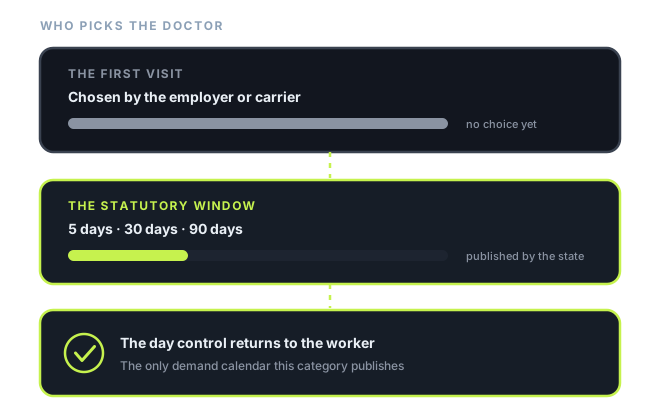
Ask a managing partner when their marketing should reach an injured worker and you will get an answer about speed. Immediately. Within five minutes of the form fill. The whole speed-to-lead literature, ours included, is about the gap between a person raising their hand and a human calling them back, and it is correct as far as it goes. But it takes the raised hand as given. It says nothing about what produced it.
Something did produce it. In the overwhelming majority of claims the first authoritative figure an injured worker deals with after the injury is not a lawyer, an adjuster or an ad. It is a doctor. And in most of the country that doctor was selected by the employer or by the carrier — the party whose interests will diverge from the worker’s the moment the claim is worth arguing about.
This is not a scandal and we are not going to write it as one. Employer-directed care exists for defensible reasons, the physicians involved are mostly doing ordinary competent work, and plenty of claims run through a panel doctor and close without anybody being unhappy. The point is narrower and, for a marketer, much more useful.
The claim: who picks the doctor is set by statute, it varies enormously between the states a firm advertises in, and the rule always carries a date on which the worker’s control returns. That date is the closest thing workers’ compensation has to a published demand calendar. It explains why identical creative buys different amounts of demand in different states, it belongs in the denominator of cost per signed case rather than in a creative review, and it points at the single most convertible page most comp firm websites do not have.
Whose doctor is it, in the statute’s own words
Five states, five different answers, all of them published by the state that wrote them.
Marketing arguments about workers’ compensation tend to run on generalities because the system is fifty systems. The way to avoid that is to quote the states directly and let the variation be the finding rather than the excuse.
Pennsylvania. Where an employer posts a list, the Department of Labor and Industry says the employer “establishes a list of at least 6 designated health care providers, no more than 2 of whom may be a Coordinated Care Organization and no fewer than 3 of whom shall be physicians”, and that the employee “shall be required to visit one of the physicians or other health care providers so designated and shall continue to visit the same or another designated physician or health care provider for a period of 90 days from the date of the first visit”. Ninety days is a long time in a soft-tissue claim. It is most of the period in which the medical narrative of the case is established.
Georgia. The employer “shall maintain a list of at least six physicians” who are reasonably accessible, and must post that panel “in prominent places upon the business premises”. The worker may take the employer’s selection from the panel or pick another from it, and “may make one change from one physician to another on the same panel without prior authorization of the board”. And then the sentence that matters most commercially: if the employer fails to provide those procedures, “an employee may select any physician to render service at the expense of the employer”. Compliance with the posting requirement is, in other words, the thing standing between a directed claim and an undirected one.
Florida. The carrier furnishes and authorises care. On the worker’s written request the carrier “shall give the employee the opportunity for one change of physician during the course of treatment for any one accident”, and “shall authorize an alternative physician who shall not be professionally affiliated with the previous physician within 5 days after receipt of the request”. If it does not: “If the carrier fails to provide a change of physician as requested by the employee, the employee may select the physician and such physician shall be considered authorized if the treatment being provided is compensable and medically necessary.” Florida also provides that a treating provider “may not refer the employee to another health care provider … without prior authorization from the carrier, except when emergency care is rendered”. So both the doctor and the onward referral sit behind the same gate.
New York. The baseline is broad worker choice among Board-authorised providers, which makes New York the contrast case. But where the employer or carrier has joined the PPO programme and given written notice, employees “must seek initial treatment from the PPO”, and the Board states that the employee “may seek medical treatment from a provider outside of the PPO network only after 30 days from the date of their initial visit to a PPO provider”. The opt-out is per injury, and the employer keeps the right to ask for a second opinion inside the network afterwards.
California. The Division of Workers’ Compensation puts it flatly: “All employees of an employer using an approved and implemented MPN are required to receive medical treatment through the MPN” — with the exception of employees who properly pre-designate a physician before an injury occurs, a step almost nobody takes because it requires knowing the rule exists while you are still uninjured.
| State | Who picks first | What the worker can do | The published date |
|---|---|---|---|
| Pennsylvania | Employer, from a posted list of at least six providers | Must keep treating within the list | 90 days from the first visit |
| Georgia | Employer, from a posted panel of at least six physicians | Choose from the panel; one change without Board authorisation; any physician at all if the panel was not properly maintained | No fixed clock — the gate is panel compliance |
| Florida | Carrier authorises the physician and every onward referral | One change per accident on written request | Carrier has 5 days to authorise an alternative, or the worker selects |
| New York (PPO in place) | PPO network, on written notice | Initial treatment inside the network, then opt out in writing | 30 days from the initial PPO visit |
| California (MPN in place) | Employer’s Medical Provider Network | Treat within the network unless a physician was pre-designated before the injury | No exit date — the route runs through second and third opinions inside the network |
The clock: what each rule actually starts
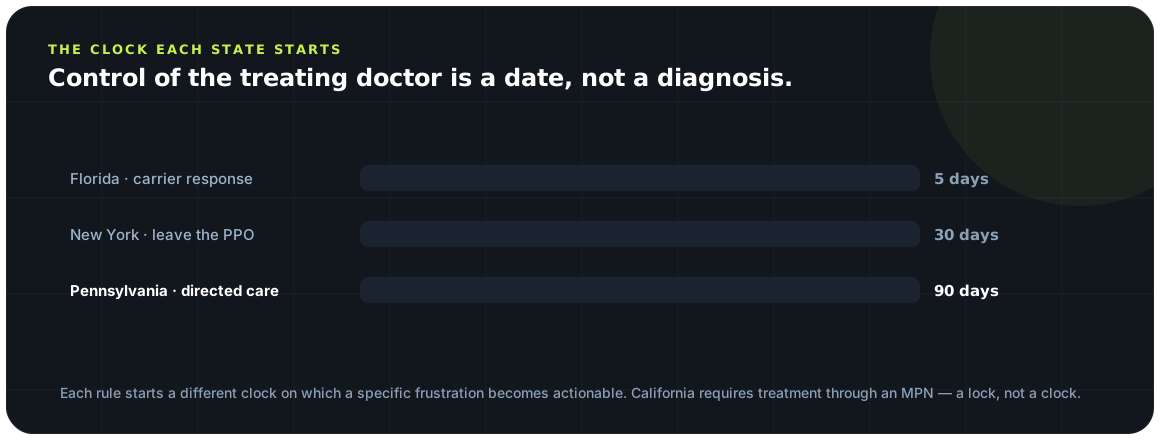
Every one of those provisions is a countdown with a knowable start date, and the start date is an event the firm can see.
Read the five rules again and notice what they have in common. None of them is a description of a permanent state. Each one is a window that opens on a specific event and closes on a specific day.
In Pennsylvania the clock starts at the first visit and runs ninety days. In New York it starts at the first PPO visit and runs thirty. In Florida it starts when the worker puts a change request in writing and runs five days, after which the failure to respond hands the choice to the worker. In Georgia there is no date at all, which is its own kind of information: the worker’s leverage is not time-based but compliance-based, and it turns on whether a piece of paper was properly posted on a wall.
Marketers spend a great deal of effort trying to infer intent timing from behaviour — search recency, site visits, video completion, the whole apparatus of retargeting windows. Here is a category where part of the intent timing is legislated, published, and identical for every claimant in the state. That is unusual enough that it is worth saying plainly: this is the one place in workers’ comp marketing where you can know something about the prospect’s calendar without observing the prospect at all.
Intent timing here is not inferred from behaviour. It is printed in the statute, and it is the same date for every claimant in the state.
One caution before anyone builds a campaign on a countdown. The firm does not usually know the worker’s day zero. It knows when a lead arrived, which is a different thing and usually later. What the statute gives you is not a targeting parameter; it is a structure for the argument and a calendar for the content. The difference matters, and we come back to it below.
Why directed care manufactures the moment
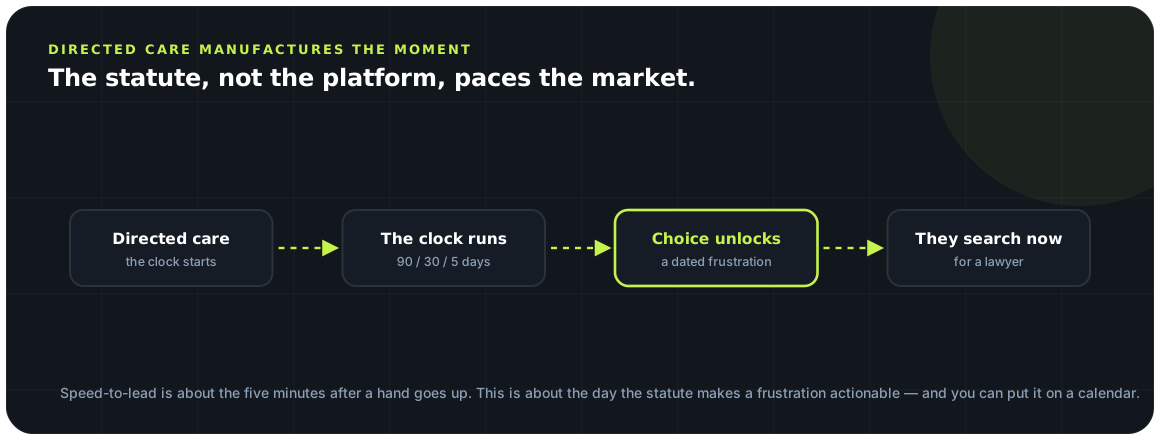
The system produces the dissatisfaction on its own. Marketing arrives afterwards and takes credit for it.
Here is the mechanism, and it is worth being precise about because the sloppy version of this argument — company doctors are bad — is both unfair and useless.
An injured worker under directed care encounters three things in sequence. First, a physician they did not choose, at a moment when they are in pain and have no idea how the system works. Second, a set of decisions made by that physician — work restrictions, a return-to-work date, whether an MRI is warranted — that determine the entire economic content of the claim. Third, the discovery that they cannot simply go elsewhere, or can only do so through a procedure with a form and a deadline attached.
That third discovery is the marketing event. It is the first moment the worker learns the system is not neutral, and it typically arrives without anyone explaining it.
Two further frictions sit on top of it, and California measures them. In a presentation to the state’s Commission on Health and Safety and Workers’ Compensation in April 2026, the research programme run under Labor Code §5307.2 put the average wait for an initial visit at about five days and the wait for specialty care at about twenty-eight, reported that rural injured workers travel roughly three times farther than urban ones, and described the “realised” network — the providers actually seeing patients — as much narrower than the directories suggest. A directory with a thousand names in it and a realised network of forty is not a choice; it is a choice on paper.
And the network is where nearly all of the care is. The California Workers’ Compensation Institute, examining 181,309 claims from January 2019 through June 2020, found that roughly 90% of injured worker medical care was delivered through networks, with 91% of treatment costs going to MPN providers, and counted 2,457 active MPNs since the programme began in 2004. The data is five years old and we flag that; the direction of it is not in serious doubt.
Does any of this actually bother workers, or is it only a lawyer’s complaint? There is at least one measurement. WCRI’s surveys of injured workers, reported in trade coverage of its four-state reports, found that in Georgia — a posted-panel state — 17% of workers said they had “big problems” getting the primary provider they wanted and 19% said they had big problems getting the services they or their provider wanted. Roughly one worker in six, volunteering in a survey, that the care question specifically went badly.
We have made a neighbouring argument before, about the denial letter as the highest-intent event in the category. The control-of-care moment is the same species of event and it happens earlier — often much earlier, and to many workers whose claims will never be denied at all.
Same ad, different market
Control of care lands in the denominator of cost per signed case, where it is invisible and gets blamed on media.
Now the part that costs money. We have written at length that cost per signed case is cost per lead divided by close rate, and that two firms buying identical leads can land in completely different places because of what happens after the lead arrives. There is a layer beneath even that one, and it is geographic.
A firm’s addressable market is not injured workers. It is injured workers who become dissatisfied enough to look for help. The rules above are one of the inputs to that share — alongside the ones we covered when we wrote about the free state advocate that competes with every comp firm and about the statutory caps that make the fee promise an artefact of the fee statute. Control of care sits in the same family: it is a property of the state, it moves the share of claimants who ever enter the market, and no amount of creative moves it at all.
The table below is illustrative arithmetic, not a benchmark. It holds cost per lead constant at our own book’s ~$75 and varies only how many of the people who raise their hand are ready to sign with anybody.
| Market condition | Cost per lead | Close rate | Cost per signed case | How it gets discussed internally |
|---|---|---|---|---|
| Worker chose their own physician; no directed-care friction | $75 | 7.0% | ~$1,071 | “Leads are weak, change the creative” |
| Our book, blended across markets | $75 | 9.6% | ~$781 | The benchmark everything is judged against |
| Directed care plus a recent access problem | $75 | 12.0% | $625 | “Great month, the new ads are working” |
Nothing in that table is a media difference. The ads, the budget and the price of attention are identical in all three rows. What moved is how many of the people reached were already in a position to act, and that was decided by a statute before the campaign launched.
The practical consequence is a diagnostic one. When a firm opens a second market and the cost per signed case comes back forty per cent worse, the first three explanations offered are always the same: the creative does not travel, the agency took its eye off it, the competition is tougher. A fourth explanation is available for the price of reading two state pages, and it is the only one of the four that can be checked in an afternoon. We said much the same thing about what a firm can buy on day one in a new market and what it has to earn; this is a specific, cheap addition to that checklist.
The page your site does not have — and the line not to cross
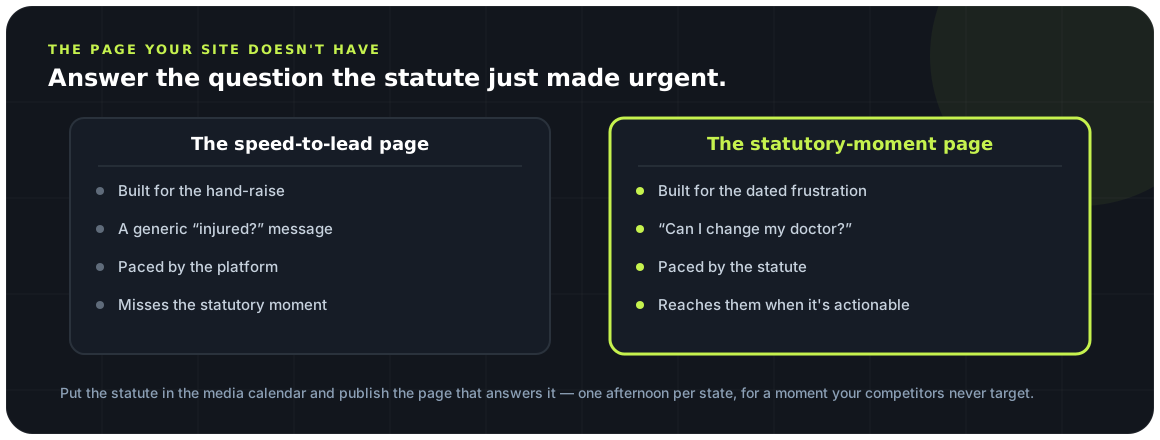
The highest-intent question in the category has a state-specific answer with a deadline in it. Most firm sites answer it generically or not at all.
Run the thought experiment. It is day nine of a back injury. The worker has seen a doctor they did not choose, been told to return to light duty, and does not agree. They pick up a phone and type a question. It is not “best workers comp lawyer near me”. It is closer to can I see my own doctor.
We are not going to print a search volume for that phrase, because we do not have a figure we would stand behind and inventing one would be exactly the thing we criticise. Treat it as directional and test it yourself: it costs nothing to look at what your own intake team is already being asked. In our experience it is among the first two or three questions on a first call in a directed-care state, and it almost never appears as the primary subject of a page on the firm’s website.
What sits there instead is a general practice-area page, an attorney bio, and a contact form. Those are pages about the firm. The worker at day nine has no question about the firm yet.
This is the sort of asset we had in mind when we argued that content is the only comp channel that compounds: it answers a question the worker actually has, it is specific enough that a national content mill will not produce it, and it survives every change to the ad auction. It also sits naturally next to the state pages a firm already has, which are usually written about the firm rather than about the system.
Putting the statute in the media calendar
You cannot target a statutory deadline. You can shape content, nurture and retargeting around it.
The obvious misreading of this article is that a firm should build audiences of people who are on day eighty-five of a Pennsylvania ninety-day window. It cannot, it should not try, and the reasons are worth stating because they cover several adjacent temptations.
The firm does not know the claim date for anyone who has not contacted it. The platforms will not tell it. And for the people it does know about, the injury and its treatment are exactly the sort of information that both major ad platforms prohibit from appearing in event names, audience names and URL parameters — the constraint we set out in full when we wrote about why Meta and Google treat a comp firm as a health advertiser. A “Day 85 — Panel Exit” custom audience would be a policy problem and a bad idea on its own merits.
What is available is less glamorous and more durable.
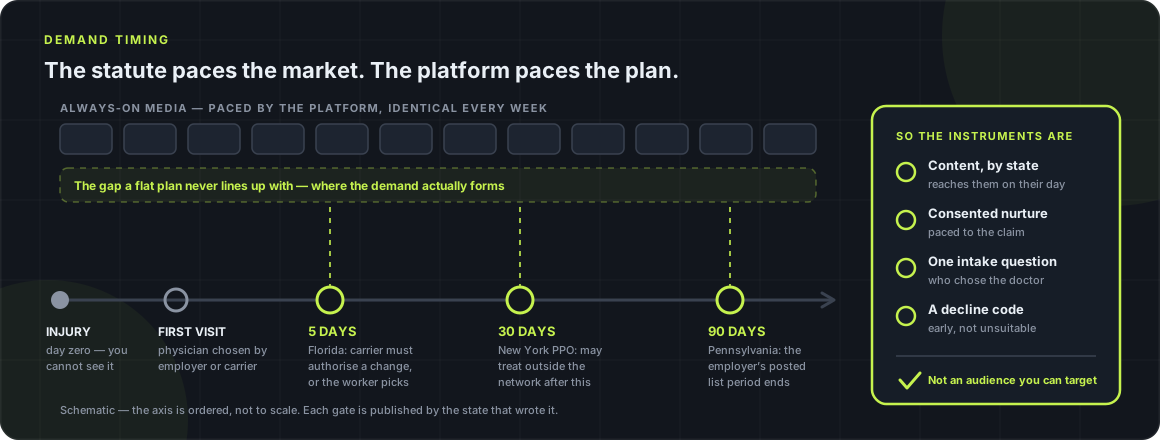
Content, by state, answering the care question. Organic search reaches the worker on the worker’s day, not on yours. That is precisely what makes it the right instrument for a calendar you cannot observe.
Nurture paced to the claim rather than to the CRM. A firm that captures consent and a claim date on an early enquiry has everything it needs to send one useful, non-promotional message when a documented window is closing. Not “are you ready to hire us”. Something closer to: here is what the thirty-day mark means, here is the form, here is the number if you want to talk. Consent and cadence rules apply exactly as they do everywhere else in this category.
An intake question that costs four seconds. Ask who chose the doctor. The answer is a better predictor of the shape of the case than most of what is already on the intake form, and it is not a clinical question — which matters both for the platform constraint above and for what you can safely record.
A decline code for it. We argued in the piece on declined enquiries that the single word “unqualified” destroys the information in three completely different situations. “Still inside the directed-care window, nothing to do yet” is a textbook not yet: a real person with a real claim who is early rather than unsuitable. Coded that way and read monthly by source, it tells you which channels are reaching workers before the market does.
The figure below puts the whole argument in one frame: the statutory clock underneath, the firm’s flat media above it, and the gap where the demand actually forms.
The build: one afternoon per state
Four steps, none of which requires a budget approval.
One. Read the rule for every state you advertise in. Go to the state agency’s own site — the board, the division, the department of labour. Not a competitor’s summary and not ours. Write down who picks the first treating physician, what the worker may do, and the date or condition that changes it. This takes about twenty minutes a state.
Two. Put those dates beside your cost per signed case by state. If you cannot produce cost per signed case by state, that is the more urgent finding and it is the subject of its own article. If you can, look at whether the directed-care states behave differently from the worker-choice ones. You are not looking for a correlation you could publish. You are looking for an explanation you had not considered for a gap you were about to attribute to media.
Three. Publish one page per state, on the care question. The rule, the citation, the date, the procedure, the disclaimer, and a visible last-checked date. Have counsel read it. Put the last-checked date in your own calendar, because statutes and network rules move and a stale page on a statutory question is worse than no page at all.
Four. Add the intake question and the decline code. Who chose the doctor, recorded as a coded field rather than free text; and a “still inside the directed-care window” decline code that routes to the nurture list rather than to the bin. Read the decline codes by source once a month.
Key takeaways
-
In most states, the employer picks the treating doctor. Choice of physician is set by statute, not by the worker, and the statute is public.
-
Each rule starts a clock. The date the employer’s control over care lapses is published: days in Florida, weeks in a New York PPO, months in Pennsylvania.
-
Directed care manufactures the moment. When a worker is unhappy with a doctor they did not choose, that control window is a predictable, recurring demand signal.
-
It is the closest thing comp has to a demand calendar. You can put the statutory dates in your media calendar and reach workers exactly when control lapses.
-
There is a page most firms lack, and a line not to cross. Explain the rule honestly; never tell a worker to defy a valid medical directive.
Frequently asked questions
Is this just an argument for writing more “can I choose my own doctor” blog posts?
It is an argument for writing one per state you advertise in, properly, and for treating it as a conversion asset rather than an SEO chore. The difference between the good version and the usual version is the date. A generic page that says the rules vary by state and you should consult an attorney answers nothing. A page that says Pennsylvania restricts the choice for 90 days from the first visit, cites the Department of Labor and Industry, and shows when it was last checked answers the actual question a person has at day nine of a claim. The second one also ages honestly, because a reader can see when you last looked.
Can we target injured workers who are near the end of a statutory window?
No, and you should not try. You do not know anybody’s injury date until they tell you, the platforms will not supply it, and building a custom audience or conversion event whose name encodes an injury or a claim stage runs into prohibited-information rules on both major platforms. What you can do is publish content that is there when the worker looks, and — for people who have already contacted you and consented — send one genuinely useful message when a documented window is closing. That is nurture, not targeting, and it is subject to the same consent and cadence limits as everything else you send.
Does this mean our cost per signed case is out of our control?
Partly, and knowing which part is the useful bit. Control of care is one of several state-level variables — alongside fee statutes and the presence of free state advocacy offices — that set how many claimants ever enter the market at all. None of them responds to creative. What does respond is close rate, which is the lever with the best arithmetic in the model: at our book’s ~$75 cost per lead, moving from 9.6% to 10.6% takes cost per signed case from about $781 to about $708 with no extra media. The point of naming the structural variable is to stop firms spending against it as though it were an execution problem.
Is it fair to characterise the panel physician as “the other side’s doctor”?
In an argument to a fellow marketer, it is a fair shorthand for who selected the provider and who is paying. In published marketing aimed at injured workers, we would not use it. It implies bad faith we cannot evidence about individual physicians, most of whom are doing ordinary competent work, and bar rules on false or misleading statements do not soften because the claim is rhetorical. The honest version is also the more persuasive one: you did not choose this doctor, here is the rule that explains why, here is the date it changes. That is verifiable, it is useful, and it does not require anyone to be a villain.
How is this different from the article about denied claims?
Timing and population. A denial is a discrete, late, unambiguous event that affects a minority of claimants, and it is the highest-intent moment in the category. The control-of-care moment is earlier, quieter and much more common — it reaches workers whose claims are accepted and will never be denied, and it arrives within days or weeks rather than months. Firms that market only to the denial are competing for the small, obvious, expensive pool. The care question reaches a much larger group at a point where nobody else is talking to them.
Which states should we start with?
The ones you already spend money in, in descending order of spend. This is not a project to be run nationally. If you advertise in three states, this is an afternoon; if you advertise in fifteen, do the top three this week and treat the rest as a backlog. The temptation to generate all fifty at once with an AI assistant should be resisted, because the deadline is the only load-bearing element on the page and a confidently wrong deadline on a legal question is the single worst thing a law firm’s website can publish.
What should intake do with this?
Ask one question — who chose the doctor — and record the answer as a coded field, not free text. It takes about four seconds, it predicts the shape of the case better than most of what is already on the form, and it is a procedural question rather than a clinical one, which matters for what you are allowed to store and transmit. Then add a decline code for enquiries that are early rather than unsuitable, so that a worker still inside a directed-care window goes to the nurture list rather than to the bin. Read those codes by lead source once a month.
Sources & further reading
-
01
Choice-of-physician statutes
The rules that set who controls care, and the date that control lapses, vary sharply by state.
-
02
How much care is directed
CWCI research on the share of injured-worker medical care delivered inside directed networks.
-
03
What injured workers report
WCRI’s multi-state survey of injured workers on care and satisfaction.
-
04
Further reading
How the care calendar meets your media plan.
Statutes, caps and rules vary by state and change over time — confirm the current rule in your state with counsel. General marketing information, not legal advice.