A managing partner asked me last year to help him decide whether to take his monthly ad budget from one number to a larger one. We spent most of a call on the usual inputs: what the extra spend would do to cost per lead, whether intake could absorb the volume, which of his markets had room. All of it was the right conversation, and none of it was the conversation that mattered.
Three months later he pulled the increase back. Not because the leads were bad — they were fine. Not because intake drowned — it coped. He pulled it back because he had committed an additional sum every month to acquire cases whose fees would not be approved by anybody for the better part of a year, and the firm’s operating account had started to notice.
That is not a marketing failure. It is a marketing decision that was taken on the wrong financial statement.
Your growth metrics are in dollars; your constraint is in days
Every acquisition number a comp firm manages is a price. The thing that caps growth is a duration, and almost nobody measures it.
Look at what a comp firm actually tracks. Cost per lead. Cost per signed case. Close rate. Average case value. Marketing as a percentage of revenue. Every one of them is a ratio of dollars to dollars or dollars to cases. They are good numbers — cost per signed case in particular is the only one with revenue attached, and a firm that does not know it is flying blind.
But a complete set of correct price metrics will still not tell you whether you can afford to double your spend, because affordability in this business is a function of time. A signed case is not revenue. It is a receivable with no due date and no right of collection until a judge says so.
Compare it with almost any other professional service. A dentist bills at the chair. An accountant invoices monthly. A personal injury firm at least has a settlement it can push, a demand letter it controls the timing of, and in many cases a defendant with an incentive to resolve. A workers’ comp claimant firm has none of those levers in the same measure, because the fee is not a private contract between the firm and the client. It is a determination made by a state tribunal, on a schedule that tribunal publishes.
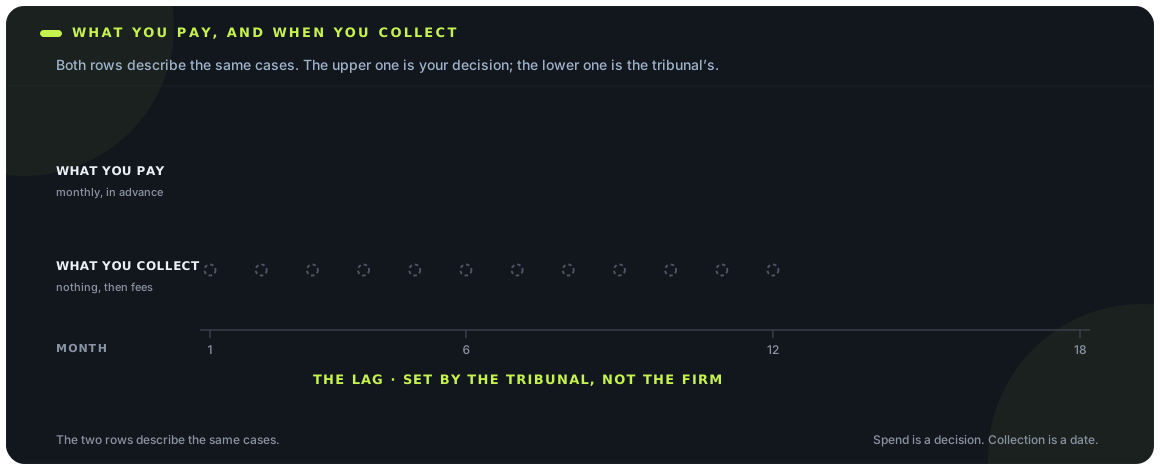
The practical consequence is that the growth question and the cash question have different answers, and firms routinely get a yes on the first one and act as though they have been given a yes on the second.
The statute forbids revenue at signing
This is not a market convention a clever firm can engineer around. In comp it is written into the act.
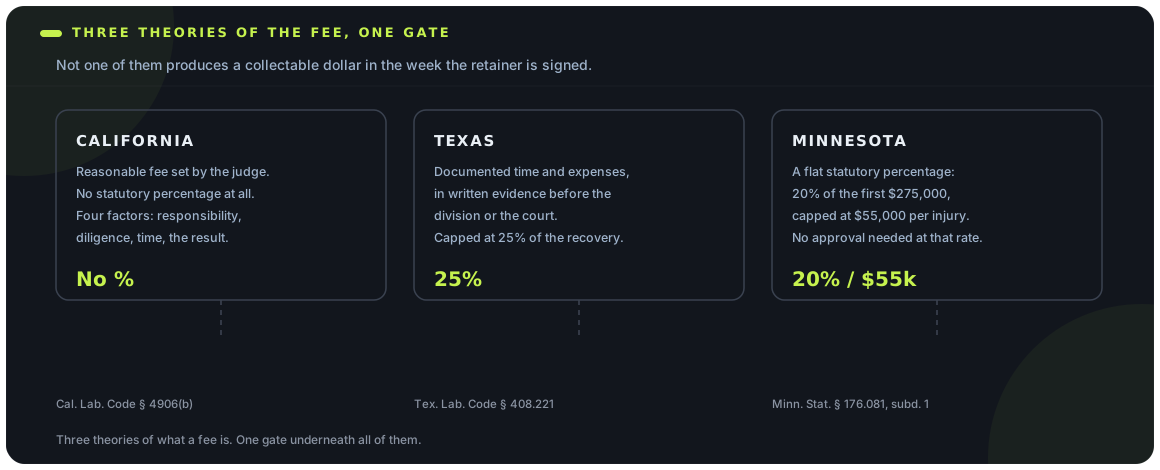
Start with the rule that makes everything else follow. In California, Labor Code § 4906(b) provides that an attorney or agent “shall not demand or accept any fee from an employee or dependent of an employee… until the amount of the fee has been approved or set by the appeals board.” Subsection (a) limits the charge to a reasonable amount and makes any agreement unenforceable above it. Subsection (c) requires any fee agreement to be submitted to the board for approval within ten days of being made.
Read that as an operator rather than as a lawyer. The signed retainer is not an instrument the firm can collect against. It is permission to go and ask a tribunal, later, for a number the tribunal will set. There is no deposit, no evergreen, no hourly draw, no partial billing at a milestone. Revenue at signing is not small in workers’ comp. It is zero, as a matter of law.
Texas reaches the same place by a different route. Under Labor Code § 408.221, a claimant’s attorney’s fee “must be approved by the commissioner or court,” is calculated “based on the attorney’s time and expenses according to written evidence presented to the division or court,” is “paid from the claimant’s recovery,” and “may not exceed 25 percent of the claimant’s recovery.” Minnesota fixes the number instead of the method: Minn. Stat. § 176.081, subd. 1 sets the contingent fee at 20% of the first $275,000 of compensation awarded, with all fees for the same injury capped at $55,000 — raised in 2024 from 20% of the first $130,000 and a $26,000 ceiling. Minnesota is also the honest exception to the approval point: at that statutory rate the fee expressly “does not require approval by the commissioner, compensation judge, or any other party,” and the attorney files a statement of fees with the Court of Administrative Hearings rather than applying for permission.
| State | How the fee is fixed | Ceiling | When the firm may take it |
|---|---|---|---|
| California | No statutory percentage. A reasonable fee set by the judge, weighing responsibility, diligence, time spent and the result obtained (8 CCR § 10844) | “A reasonable amount” — determined case by case | Only after the Appeals Board has approved or set it (Lab. Code § 4906(b)) |
| Texas | Documented time and expenses, in written evidence put before the division or court | 25% of the claimant’s recovery | Only on approval by the commissioner or court; paid from the recovery (Lab. Code § 408.221) |
| Minnesota | Flat contingent percentage of compensation awarded | 20% of the first $275,000; $55,000 across all fees for one injury | Withholdable from periodic compensation as it is paid, up to the same limit (§ 176.081, subd. 1(c)) |
Three completely different theories of what a fee is — a judicial reasonableness finding, a documented-hours calculation and a statutory percentage. California and Texas gate the fee behind an approval; Minnesota does not, at the capped rate. What all three share is the thing that actually matters here: the fee is a slice of the injured worker’s compensation, so it cannot exist until there is compensation to take it from. Not one of them produces a dollar the week the client signs.
The docket, not the firm, sets the date
Minnesota writes its litigation calendar into the act. California’s rating bureau measures what the tail actually looks like. Neither number is in anybody’s marketing model.
If the fee arrives at resolution, the obvious next question is when resolution happens. Two states answer it in public, from opposite directions.
Minnesota answers it prospectively, in statute. A 2011 amendment, described in the Department of Labor and Industry’s 2026 Workers’ Compensation System Report, requires the Court of Administrative Hearings to schedule a settlement conference within 180 days of the filing of a claim petition, and — if no settlement is reached — to schedule a hearing no more than 90 days after that conference. That is 270 days of statutory calendar from the petition, before anybody has appealed anything. If somebody does appeal, the state’s Workers’ Compensation Court of Appeals reports a median of 185 days from filing to decision for 2025 decisions, made up of 111 days to the argument date and 85 from argument to the decision being filed.
And note where that clock starts. It starts at the claim petition — which is filed after the injury, after the worker decided to look for a lawyer, after your advertisement did its work, after intake qualified the call and after the retainer was signed. Every one of those steps happens upstream of day zero on the statutory calendar.
California answers the same question retrospectively, with measurement. The Workers’ Compensation Insurance Rating Bureau — the state’s rating bureau, not an advocacy organisation — published a claim duration study in 2022 comparing California against a set of other states. At 18 months of maturity, 43% of California indemnity claims were closed, against 68% in the median comparison state. It takes about seven years to close 90% of California indemnity claims, against roughly three years for the median state — a finding independently reported at the time by the trade press. Temporary-disability-only claims in California averaged 36 months, roughly half again as long as the comparison-state median.
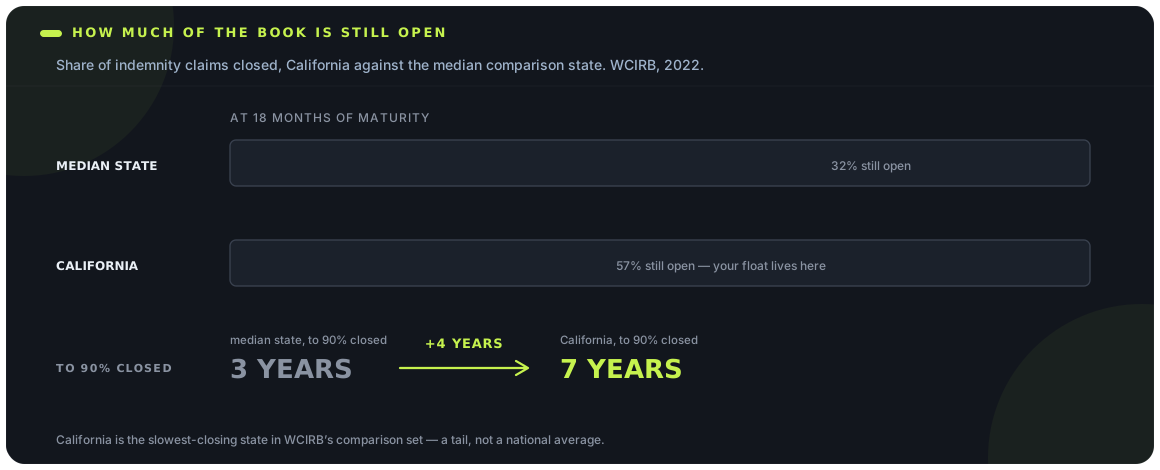
Those two states are not making the same point in two ways. Minnesota is telling you the floor: even a well-run, uncontested path has 270 days of calendar in it. California is telling you about the tail: a meaningful share of the caseload is still open years later, and the average sits inside a distribution with a very long right-hand side.
The arithmetic of the trough
Two inputs set the depth. The size of the fee is not one of them.
Here is the part most firms have never written down. Take a budget increase sized to produce ten additional signed cases a month. Use our own blended acquisition figure — across roughly $16.5M of managed workers’ comp Meta spend, about 219,000 injured-worker leads at around $75 each and about 21,000 signed cases, the blended cost has been approximately $775 per signed case. Ten more cases a month is therefore about $7,750 a month of additional spend.
Now run the cash. In month one the firm spends $7,750 and collects nothing. Same in month two. Same every month until the first of those cases produces an approved fee. If that happens on a twelve-month lag, the firm has spent $93,000 before the first incremental dollar arrives. On an eighteen-month lag, $139,500. On twenty-four, $186,000.
The depth of the trough is monthly spend increment multiplied by lag in months. The fee is not in that formula.
That is worth sitting with, because it contradicts the instinct every firm has when it hears this problem. The instinct is to fix it with case value: market for bigger cases, improve the mix, chase the permanent-disability end of the book. That is often a good idea for other reasons — it is most of what the case-value piece is about — but it does not make the trough shallower by a single dollar. A richer case mix usually resolves more slowly, not less, which makes the trough deeper.
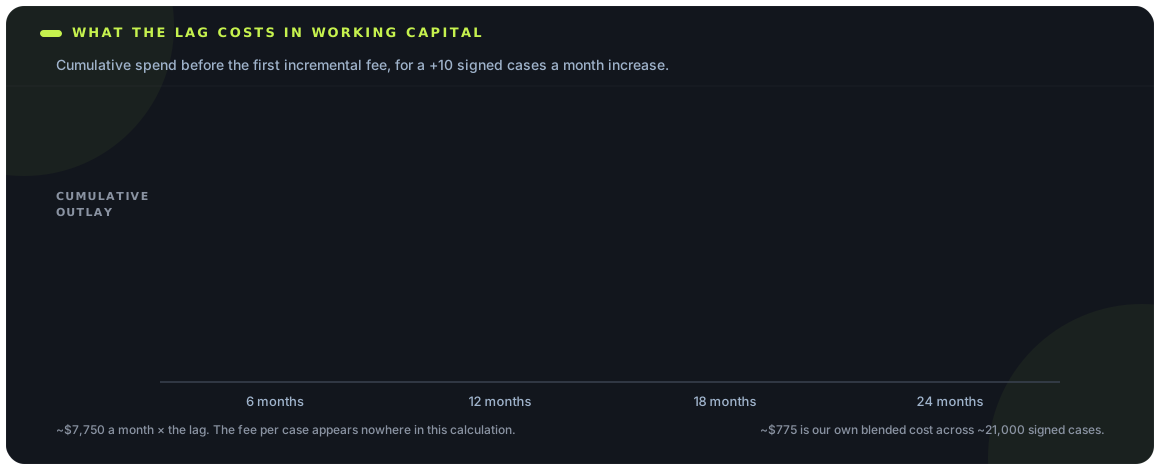
What the fee does govern is the refill. Once fees begin arriving at the steady-state rate, the monthly surplus is ten times the difference between the fee per case and the $775 it cost to acquire it. The months required to climb back to zero are the trough divided by that surplus.
| Lag to first fee | Trough depth | Months to climb back, fee per case $2,500 | Months to climb back, fee per case $5,000 |
|---|---|---|---|
| 6 months | $46,500 | 2.7 | 1.1 |
| 12 months | $93,000 | 5.4 | 2.2 |
| 18 months | $139,500 | 8.1 | 3.3 |
| 24 months | $186,000 | 10.8 | 4.4 |
Read the two right-hand columns as what they are: arithmetic, not a benchmark. We do not publish a fee-per-case figure and neither should anybody else, because it is a function of state, benefit type and case mix. Put your own number in. The shape of the answer does not change — a larger fee shortens the climb and leaves the depth exactly where it was.
The fee does not always arrive as a lump
Minnesota lets the fee be withheld from each periodic payment. That changes the shape of the recovery, not the fact of the gap.
The trough model above assumes the fee lands as a single event. In some states, for some benefit types, it does not — and the difference matters enough to be worth a paragraph.
Minn. Stat. § 176.081, subd. 1(c) permits an attorney to withhold up to 20% of the first $275,000 of periodic compensation from the periodic payments themselves, provided the cheque states the purpose, the attorney’s name, the amount withheld and the gross figure. Where a client is receiving weekly wage-loss benefits, the firm is therefore being paid in slices across the benefit period rather than waiting for an award. The cash curve for that case is shallow and early. Where the case runs instead to a stipulated settlement, the fee arrives at approval, and the curve is deep and late.
So a firm’s float is not one number — it is a weighted average across its benefit mix, and the mix is partly a product of what the marketing attracted. A book skewed toward disputed permanent-impairment cases has a longer, deeper float than a book skewed toward accepted wage-loss cases with a represented claimant collecting weekly. That is a real and under-appreciated link between the top of the funnel and the bank account: the campaign selects the benefit mix, and the benefit mix sets the float.
Three caveats, because this is state law and it moves. The withholding mechanism is Minnesota’s; other states handle periodic-benefit fees differently and some do not permit it in the same form. Minnesota’s own numbers changed in 2024, when the ceiling went from 20% of the first $130,000 and a $26,000 cap to 20% of the first $275,000 and a $55,000 cap. And none of this is legal advice about any particular fee in any particular case.
What this does to the budget conversation
Four questions that belong in the room before an increase is approved, and are almost never asked.
The reframe is simple and the practice is not: before approving a spend increase, the firm should know what it is lending and for how long. In our experience the conversation goes better when it is reduced to four questions.
One: how many months of the increment can the firm fund without distress? Not comfortably — the real number, from the operating account and whatever line of credit exists. Multiply the monthly increment by the honest answer and you have the maximum lag the firm can absorb. If that product is smaller than the firm’s actual observed lag, the increase is not affordable at that size, and the right move is a smaller increase held for longer rather than a larger one abandoned in month seven.
Two: what does the firm’s own signed-to-fee curve look like? Not the median — the full curve, or at minimum the share of signed cases with no fee by month twelve and by month eighteen. Almost every firm has this data in its case management system and has never run the query.
Three: is the lag a state fact or a firm fact? Some of it is statutory and immovable. Some of it is the firm’s own file handling — how quickly a petition gets filed, how fast records are requested, whether the file sits. The second part is the cheapest growth lever in the building, because shortening the lag by three months on a $7,750 increment frees $23,250 of working capital permanently, with no new spend at all.
Four: which channels resolve fastest? Two channels with identical cost per signed case can have materially different floats if one of them brings in a different benefit mix. A firm that is cash-constrained but wants to grow should weight toward the faster-resolving mix during the climb and rebalance afterwards. That is a legitimate channel-selection criterion and I have almost never heard it raised.
Measuring your own float in four numbers
An afternoon of queries, and no new spend.
None of this requires a model. It requires four numbers, three of which are already in systems the firm pays for.
The increment. Monthly spend increase, divided by your cost per signed case, gives the additional cases. The spend figure is the one that matters for the trough; the case count is for sizing capacity. If you do not have a reliable cost per signed case, that is the prerequisite, and it is a different article.
The lag. From the case management system: for every case signed in a cohort two or more years old, the number of days from retainer to the first fee receipt on that matter. Report the median and the share still at zero at twelve and eighteen months. If the data is not clean, the twelve-month zero share alone is enough to act on.
The split. Fee receipts separated into periodic withholdings versus award-and-settlement receipts, as above.
The funding ceiling. What the firm can advance without distress, stated as a dollar figure rather than a feeling.
Those four give you the only sentence that actually answers the budget question: at this increment, with this lag, the firm will be down to this figure in month N, and that is or is not inside what it can fund. Everything else in a marketing proposal is downstream of that sentence. Our budget calculator handles the spend side, and the CEO’s guide has more on the capital-allocation framing; neither will do the lag query for you, because only your case management system knows it.
Where this stops
The limits of the argument, stated plainly.
This is a claim about timing, not about whether comp marketing works. A firm with adequate working capital and a known lag should scale, and the arithmetic above is mostly an argument for scaling with the number in hand rather than against scaling.
The data has real limits. Minnesota’s 180-and-90 figures are the statutory scheduling requirement as described in the Department of Labor and Industry’s own report; they describe what the court must schedule, not what every case experiences, and continuances exist. The 185-day appellate median is one state, one year. The WCIRB duration figures are California indemnity claims measured in a 2022 study against a comparison set, and California is the slowest-closing state in that comparison — which makes it a useful illustration of a tail and a poor proxy for a national average. Claim closure is also not the same event as fee approval: a fee can be approved on a case that stays open, and a case can close without a contested fee at all.
The $775 is our own blended cost across roughly 21,000 signed cases and about $16.5M of managed Meta spend. It is a real figure and it is ours; it is not an industry benchmark and your number will differ by market, channel and case mix. Every fee figure in the tables above is arithmetic on an input the reader supplies, not a published average, and we have deliberately not invented one.
Finally, the operational conclusions here — stage the increase, shorten the lag, weight toward faster-resolving mix — are judgements, not findings. They are what we would do and what we have seen work. They are not measured outcomes and should not be read as a promise about any firm’s results.
Key takeaways
-
There is no revenue at signing, as a matter of law. Cal. Lab. Code § 4906(b) forbids demanding or accepting a fee from the employee until the Appeals Board has approved or set it; Texas pays the fee from the claimant’s recovery on approval. The fee is a slice of compensation, so it cannot exist before the compensation does.
-
A budget increase is a financing decision, not an expense decision. The firm advances money now against an approval it receives later, at a term a tribunal sets, with no interest and no security.
-
The clock is published. Minnesota’s act gives the Court of Administrative Hearings 180 days to schedule a settlement conference on a claim petition and 90 more to reach a hearing; its appellate comp court ran a 185-day median from filing to decision in 2025.
-
The tail is long where it is long. WCIRB, 2022: 43% of California indemnity claims closed at 18 months against 68% in the median comparison state, and about seven years to close 90% against roughly three.
-
Trough depth = monthly increment × lag. At our blended ~$775 per signed case, ten extra cases a month is ~$7,750 of monthly spend: $93,000 funded before the first fee on a twelve-month lag, $139,500 on eighteen.
-
The size of the fee does not affect the depth. It governs only how fast the trough refills. A richer case mix usually resolves more slowly, which makes the hole deeper, not shallower.
-
The campaign selects the benefit mix, and the mix sets the float. Minnesota permits fee withholding from periodic compensation under § 176.081, subd. 1(c), so a wage-loss book is paid in slices while a settlement book is paid at approval.
-
The worst outcome is cutting inside the trough. The spend stops, the cases already bought still resolve on their own schedule, and restarting later funds a fresh trough from zero. Stage the increase instead.
-
Four numbers answer the question. The monthly increment, your own signed-to-fee lag, the split between periodic and terminal fee receipts, and what the firm can advance without distress.
WorkersComp Marketing is a marketing agency, not a law firm, and nothing here is legal advice or financial advice about any particular firm. Attorney-fee rules and litigation timetables are state law and are amended frequently: the Minnesota fee ceiling cited was raised in 2024, the Minnesota scheduling requirement dates from a 2011 amendment as described in the Department of Labor and Industry’s 2026 report, and the California duration figures come from a 2022 WCIRB study. Claim closure is not the same event as fee approval. Check the current rule and your own case data before acting on any figure here.
Frequently asked questions
Can a workers’ comp firm take a retainer up front?
Not against the comp claim itself, in the ordinary case. California is explicit: Labor Code § 4906(b) provides that an attorney or agent “shall not demand or accept any fee from an employee or dependent of an employee… until the amount of the fee has been approved or set by the appeals board,” and § 4906(a) makes any agreement unenforceable above a reasonable amount. Texas requires approval by the commissioner or court under § 408.221 and pays the fee from the claimant’s recovery. Minnesota fixes the amount by statute. The arrangements differ, but none of them produces collectable revenue in the week the retainer is signed. We are a marketing agency, not a law firm — check your own jurisdiction’s rule with counsel.
What exactly do you mean by “the float”?
The stock of cases a firm has acquired and is carrying that have not yet produced a fee. It is the comp equivalent of work in progress, with the difference that the firm cannot invoice against it, cannot accelerate it by much, and cannot borrow against it easily. Its cost is the acquisition spend already sunk into it; its duration is set largely by the tribunal.
How deep is the trough for a given budget increase?
Monthly spend increment multiplied by the lag in months to the first fee from that cohort. At our blended figure of about $775 per signed case, a ten-case-a-month increase is roughly $7,750 a month of additional spend: $46,500 at a six-month lag, $93,000 at twelve, $139,500 at eighteen and $186,000 at twenty-four. The average fee per case does not enter the calculation. It determines how quickly the trough refills once fees start arriving, and nothing about how deep it gets.
Doesn’t marketing for higher-value cases fix this?
No, and it usually makes it worse. Case value affects the recovery slope, not the depth, and the higher-value end of a comp book is the contested permanent-impairment end, which resolves more slowly. Improving the case mix is frequently the right strategic move — it is simply not a cash-flow remedy, and firms that adopt it for cash-flow reasons are often surprised in the other direction.
What is the single number a firm should pull first?
The share of cases signed two or more years ago that had produced no fee by month twelve, and by month eighteen. That one query, run against your case management system, tells you more about whether a budget increase is affordable than every marketing metric combined. Most firms have the data and have never run it.
Does the lag vary that much between states?
The published evidence says yes, at least at the closure stage. WCIRB’s 2022 claim duration study found 43% of California indemnity claims closed at 18 months against 68% in the median comparison state, and about seven years to close 90% of California indemnity claims against roughly three years in the median state. Minnesota, by contrast, writes a scheduling floor into its act: a settlement conference within 180 days of a claim petition and a hearing within 90 days of that conference. For a multi-market firm that means the same campaign has different working-capital requirements in different states, which is a real input into choosing a second market.
Is any of the fee paid before the case resolves?
Sometimes, depending on the state and the benefit type. Minn. Stat. § 176.081, subd. 1(c) permits withholding up to 20% of the first $275,000 of periodic compensation from the periodic payments themselves, with the cheque required to state the purpose, the attorney’s name, the amount withheld and the gross figure. Where that applies, a wage-loss case pays the firm in slices across the benefit period rather than in one event at the end. It shortens and flattens the curve; it does not remove the gap, because the benefits themselves only begin once the claim is accepted and running.
Is this an argument against increasing the budget?
The opposite, in most cases. The tables show a trough that a healthy increase repays within a handful of months of the first cohort landing, after which it compounds. The argument is against increasing the budget without knowing the number — because the firms that get hurt are not the ones that scaled, they are the ones that discovered the trough in month seven and cut the spend at exactly the moment the first cohort was about to start paying.
How does this interact with intake capacity?
They are two separate ceilings and a firm can hit either one first. The capacity ceiling is about whether the firm can answer and convert the volume it buys; the float is about whether it can fund the gap before the fees arrive. A firm can have ample intake capacity and no working capital, or plenty of cash and an intake queue that drops a third of the calls. Diagnose both before approving an increase, because the remedies have nothing in common.
Sources & further reading
-
01
California — no fee may be demanded or accepted before the board approves it
Cal. Lab. Code § 4906. Subsection (a) limits fees and disbursements to a reasonable amount and makes any charge, claim or agreement “not enforceable, valid, or binding in excess of a reasonable amount,” with the Appeals Board determining what is reasonable. Subsection (b): an attorney or agent “shall not demand or accept any fee from an employee or dependent of an employee… until the amount of the fee has been approved or set by the appeals board.” Subsection (c) requires any fee agreement to be submitted to the board within ten days. The factors a judge weighs in setting a reasonable fee — responsibility, diligence, time spent and the result obtained — are at 8 CCR § 10844, which sets no percentage.
-
02
Texas — documented time and expenses, capped at 25% of the recovery, paid on approval
Tex. Lab. Code § 408.221. Subsection (a): a fee, including a contingency fee, “must be approved by the commissioner or court.” Subsection (b): the fee is “based on the attorney’s time and expenses according to written evidence presented to the division or court” and “shall be paid from the claimant’s recovery.” Subsection (i): “an attorney’s fee may not exceed 25 percent of the claimant’s recovery.” Subsection (d) lists the factors weighed; subsection (e) permits commutation and requires periodic payment in a narrow death-benefit situation.
-
03
Minnesota — the statutory fee ceiling and the periodic-withholding mechanism
Minn. Stat. § 176.081, subd. 1. Paragraph (a) sets the maximum permissible fee at 20% of the first $275,000 of compensation awarded to the employee and provides that such a fee does not require approval by the commissioner, a compensation judge or any other party; paragraph (b) caps all fees for the same injury at $55,000; paragraph (c) permits withholding up to 20% of the first $275,000 of periodic compensation from the periodic payments, with the cheque required to state the purpose, the attorney’s name, the amount withheld and the gross compensation. The ceiling was raised by a 2024 law change from 20% of the first $130,000 and a $26,000 cap, as recorded in the Department of Labor and Industry’s system report appendix.
-
04
Minnesota — the published litigation calendar and appellate timing
Minnesota Department of Labor and Industry, Workers’ Compensation System Report — 2026 (August 2026). Appendix B records the 2011 amendment requiring the Court of Administrative Hearings to schedule a settlement conference within 180 days of a claim petition filing and within 45 days of a petition to discontinue, and — if no settlement is reached — to schedule a hearing “no more than 90 days after the scheduled settlement conference.” Part 5 reports 7,238 dispute filings in 2025 across the four major types, with claim petitions 57–66% of disputes since 2020; a median of 71 days from a medical request to the first scheduled DLI conference in 2025 (up from 37 in 2013) and 32 days for rehabilitation requests; and, at the Workers’ Compensation Court of Appeals, a median of 111 days from filing to argument, 85 from argument to decision and 185 days filing to decision for 2025 decisions. Part 3 reports that 18.3% of paid indemnity claims carried a settlement benefit in 2024, averaging about $55,290 per claim with a settlement.
-
05
California — how long claims actually stay open
Workers’ Compensation Insurance Rating Bureau of California, claim duration study (2022). At 18 months of maturity 43% of California indemnity claims were closed, against 68% in the median comparison state; it takes about seven years to close 90% of California indemnity claims, against roughly three years for the median state; temporary-disability-only claims in California averaged about 36 months, roughly 50% longer than the comparison-state median. California is the slowest-closing state in that comparison set, so the figures illustrate a tail rather than a national average.
-
06
Our own acquisition figures, and the method behind them
The ~$775 blended cost per signed case used throughout is our own, across approximately $16.5M of managed workers’ compensation Meta ad spend, about 219,000 injured-worker leads at roughly $75 average cost per lead and about 21,000 signed cases. It is a real figure from our own book, not an industry benchmark, and it will differ by market, channel and case mix. Every fee-per-case figure in the tables is arithmetic on an input the reader supplies; we have not published a fee benchmark because we do not have a defensible one.