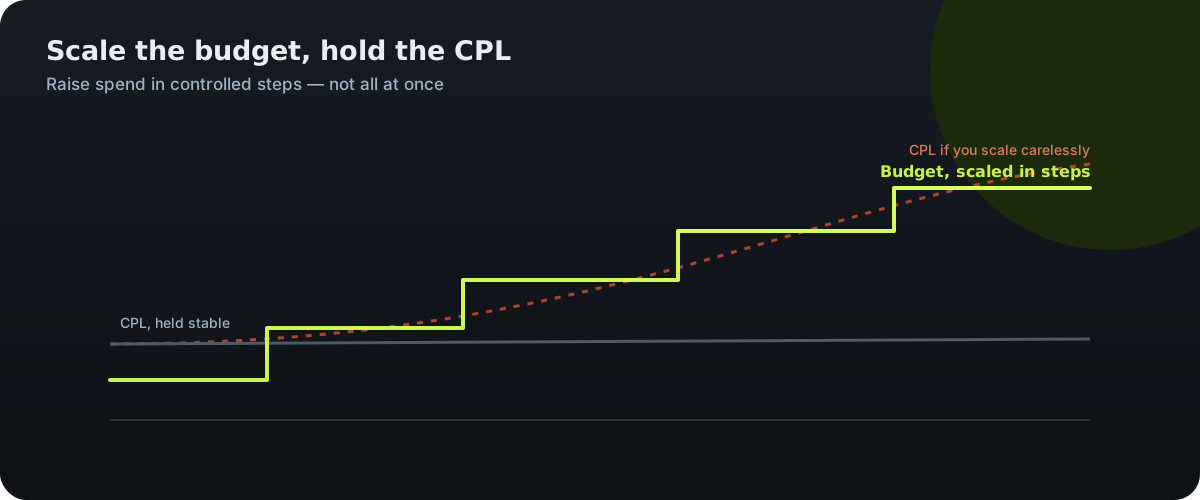
Every growing firm hits the same wall. The campaign is working, the cases are signing, so the natural move is to pour in more money. Then cost per lead jumps 40%, quality dips, and the whole thing feels broken overnight.
It isn’t broken. It’s physics. More spend forces the platform to reach further into colder audiences, and the creative that carried you at $10,000 a month starts to fatigue at $30,000.
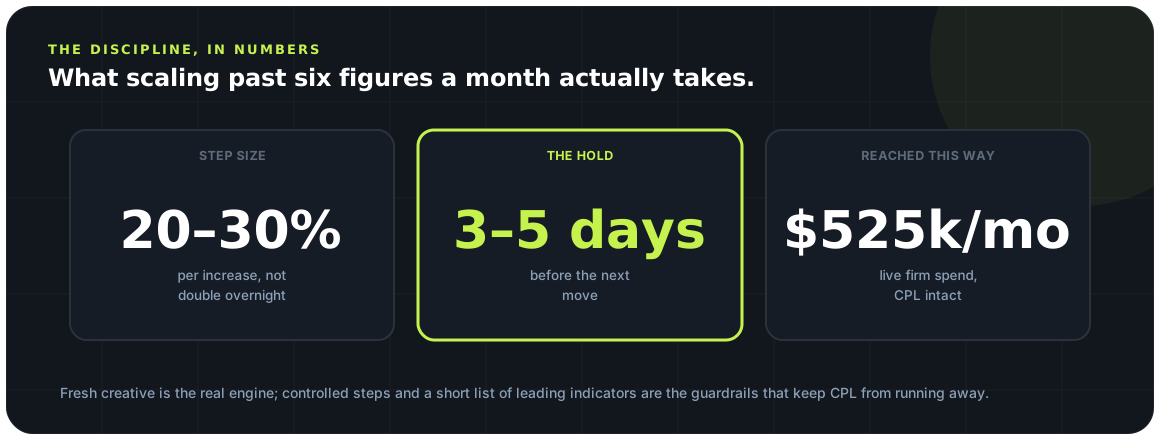
This is the discipline we use to scale workers’ comp campaigns past six figures a month without letting CPL run away. It’s the same approach behind spend that reached $525,000/month inside live firms — and it starts with understanding exactly why CPL breaks.
Why CPL rises when you scale
Three forces push cost per lead up the moment you add budget — and they compound.
Cost per lead is not a fixed price you pay for a lead. It’s the outcome of an auction, an audience, and a piece of creative all working together. Change the amount of money in the system and you change all three at once.
Legal is the worst possible category to get this wrong in. According to WordStream’s 2026 benchmarks, Attorneys & Legal Services is the most expensive paid-search category — an average cost per click of $9.87 and an average cost per lead of $131.63. When your starting CPL is already that high, a careless scale can turn an efficient campaign into a losing one fast.
Three forces do the damage.
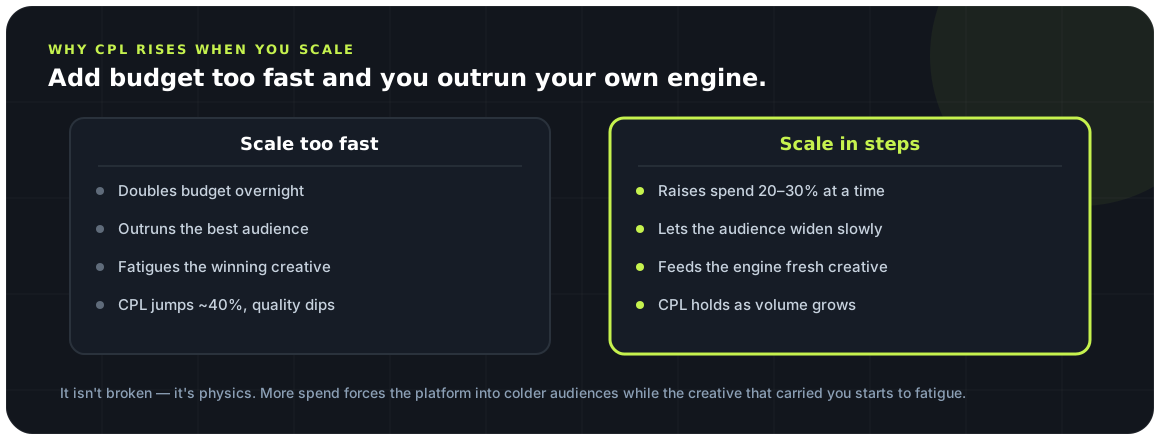
Audience saturation. Your first dollars reach the warmest, most likely-to-convert people. Push more budget through and the platform has to serve colder audiences to spend it — and colder audiences convert worse.
Saturation is real — and it is also the explanation firms reach for when the true cause is off the ad account entirely. If your cost per signed case rises while CPL holds, the capacity ceiling sets out the four numbers that tell saturation and an overwhelmed intake desk apart.
Creative fatigue. The same ad shown more often, to more people, more times each, stops working. Frequency climbs, click-through rate slides, and the platform charges you more for the same attention.
Bidding pressure. More budget usually means chasing more inventory in the same auction, which nudges your effective bid up. You pay more per result even before quality shifts.
Sources: WordStream 2026 industry benchmarks; MIT Lead Response Management study (Dr. James Oldroyd).
The 4 rules of scaling without breaking CPL
Our framework — the Stable-Scale Rules — for adding spend without adding chaos.
We call this framework the Stable-Scale Rules. Each one exists to counter one of the forces above, and together they let you grow spend while keeping cost per lead inside a range you can live with.
Rule 1 — Move in small steps, then hold. Increase a campaign’s budget by roughly 20–30% at a time, then leave it alone for several days. That pause lets the algorithm re-stabilize before you ask it to do more.
Rule 2 — Feed the machine fresh creative before you feed it money. New audiences need new angles. If you scale spend without new creative in the pipeline, fatigue will cap your growth no matter how patient your budget pacing is.
Rule 3 — Never scale a campaign that isn’t stable. If CPL and quality are still bouncing, more budget just amplifies the volatility. Scale winners that have held steady for several days, not last week’s lucky spike.
Rule 4 — Scale intake in lockstep with spend. More leads mean nothing if response time slips. MIT’s research found responding in five minutes versus thirty makes a lead up to 21× more likely to qualify — so intake capacity is part of the scaling plan, not an afterthought.
Scaling isn’t a bigger number in the budget field. It’s a sequence — fresh creative, a small step up, a pause to stabilize, then repeat.
Spencer Moeller, WorkersComp Marketing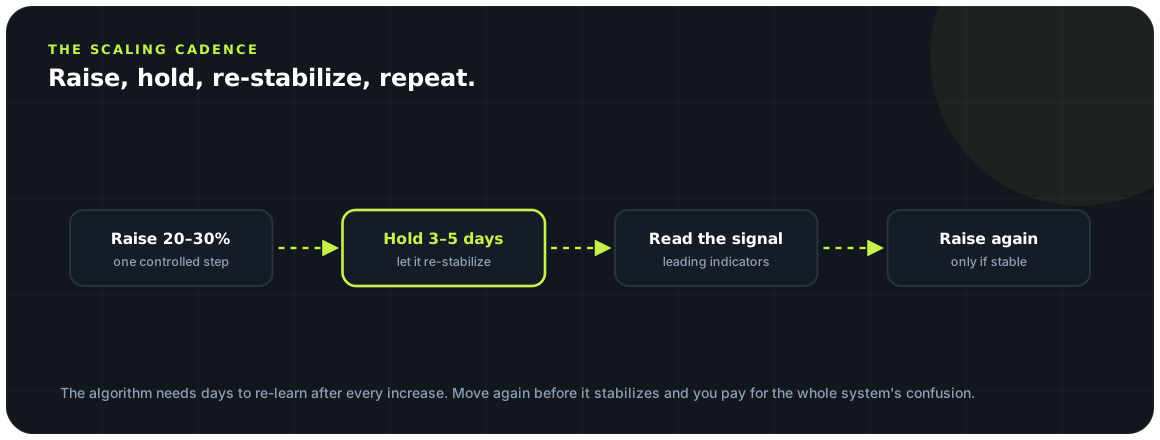
Creative testing is the real scaling engine
Budget is the throttle. Creative is the fuel — and you run out of fuel first.
Most firms think scaling is a budget problem. It’s a creative problem wearing a budget costume. The ceiling on how much you can profitably spend is set almost entirely by how much fresh, working creative you have in rotation.
Here’s why. Every ad has a finite audience before fatigue sets in. When you scale, you burn through that audience faster, so the ad that lasted a month at low spend might fatigue in ten days at high spend.
The only durable fix is a pipeline. New angles, new hooks, new formats — tested constantly — so that as one ad tires, another is already proven and ready to absorb the budget.
This is exactly the discipline behind Meta ad creative that scales. On Meta for Business, volume follows fresh creative — not the other way around. Firms that treat creative as a monthly batch to test, not a one-time asset, are the ones whose spend keeps climbing without CPL climbing with it.
Campaign structure & budget pacing
How to add spend safely — in increments, with a wait, on a signal.
Once the creative pipeline is in place, scaling becomes a pacing exercise. The mechanics are simple, but the discipline of waiting is where most firms fail.
The core move is the same every time: raise the budget a modest amount, then wait long enough for the platform to re-stabilize before touching it again. Rushing the wait is what breaks CPL.
The table below is a set of guidelines, not guarantees. Your market, offer, and creative depth will shift the exact numbers — but the shape of disciplined scaling holds across firms.
| Stage | Suggested budget change | Wait before next move | Signal to proceed |
|---|---|---|---|
| Early / proving | +20% per step | 4–5 days | CPL & lead quality steady across the hold |
| Confident scale | +25–30% per step | 3–4 days | Frequency in check, CTR holding, CPL flat |
| Aggressive push | +30% per step | 3+ days | Fresh creative live, intake keeping pace |
| Any stage — pause | Hold, don’t cut | Until stable | CPL spiking or quality dropping? Wait it out |
Illustrative guidelines drawn from live WC campaign management, not a promised outcome. Increments and wait times should flex to your data.
Structurally, keep your winners consolidated enough to gather data quickly. Splitting a proven campaign into many tiny ad sets to “scale” usually fragments the signal and starves each one of the volume it needs to optimize.
What to watch as you scale
A short list of leading indicators beats a long list of vanity metrics.
When you scale, daily CPL gets noisy. If you react to every wobble you’ll never let the algorithm settle. The trick is to watch a handful of leading indicators that tell you a CPL problem is coming before it fully lands.
| Metric | Watch for | Action |
|---|---|---|
| Frequency | Climbing week over week | Fatigue incoming — push fresh creative live |
| Click-through rate | Steady decline as spend rises | Rotate in new hooks; pause tired ads |
| Cost per lead (3–5 day avg) | Sharp jump, not a gentle drift | Hold budget until it re-stabilizes |
| Lead quality / sign rate | Softening as you reach colder traffic | Tighten qualification in ad and form |
| Speed-to-lead | Response time slipping past 5 min | Add intake capacity before adding budget |
Notice that two of the five indicators aren’t about the ads at all — they’re about quality and intake. That’s deliberate. You can hold CPL perfectly and still lose money if the leads soften or intake can’t keep up. For the full view of what to monitor, see the metrics to track.
Key takeaways
-
CPL rises when you scale, by default. More budget reaches a less-qualified audience, so cost per lead climbs unless you manage it.
-
Scaling without breaking CPL has four rules. Widen deliberately, protect learning, pace budget, and keep the offer tight.
-
Creative testing is the real scaling engine. Fresh, winning creative is what lets you spend more without paying more per case.
-
Structure and pacing protect the account. Sudden jumps reset learning; staged increases hold CPL.
-
Watch the right signals as you scale. Frequency, CPL drift, and intake capacity tell you when to push and when to hold.
Frequently asked questions
How fast can I scale a law firm’s ad budget?
Slower than you want to. A practical rhythm is raising a campaign’s budget about 20–30% at a time, then holding for several days so the algorithm can re-stabilize before the next move. These are guidelines, not guarantees — but rushing the wait is the single most reliable way to spike cost per lead.
Why does my cost per lead go up when I increase budget?
Three forces hit at once: audience saturation (the platform reaches colder people to spend the money), creative fatigue (the same ads get shown more often and stop working), and bidding pressure (chasing more inventory nudges your effective bid up). A small, gradual CPL lift can still be profitable; a sharp jump means you moved too fast.
How much should I increase ad spend at once?
As a guideline, roughly 20–30% per step, then hold for several days before moving again. Bigger jumps — like doubling a budget overnight — tend to reset the learning phase and spike CPL. The point is to give the algorithm room to re-stabilize between moves, not to grow as fast as the budget field allows.
How often should we test new ad creative?
Continuously, on a regular cadence, so there’s always a proven ad ready to absorb budget as another fatigues. Volume follows fresh creative — the depth of your creative bench sets the real ceiling on how much you can profitably spend. Treat creative as an ongoing pipeline, not a one-time batch.
When should I stop scaling?
Pause when CPL spikes sharply, lead quality softens, frequency climbs while CTR falls, or intake can’t respond in under five minutes at the new volume. Stopping usually means holding the budget steady until things re-stabilize — not cutting spend. Once the leading indicators settle again, you can resume the next small step.
Sources & further reading
-
01
Cost benchmarks & platform limits
Industry CPL benchmarks and Meta’s own documentation on budget pacing and the learning phase.
- 02
External sources were accurate at publication and change over time; confirm current figures at the source. General marketing information, not legal advice.